
Probability The collection of all possible outcomes of
Probability
The collection of all possible outcomes of an event is called the sample space. Flipping a Coin: S = {Heads, Tails} Rolling a Single Die: S = {1, 2, 3, 4, 5, 6}
How many elements are in the sample space for randomly drawing a card out of a standard deck? 52 Elements S = {2 Hearts, 2 Spades, 2 Clubs, 2 Diamonds, 3 Hearts…}
Notation: P(A) means the probability that event A will occur.
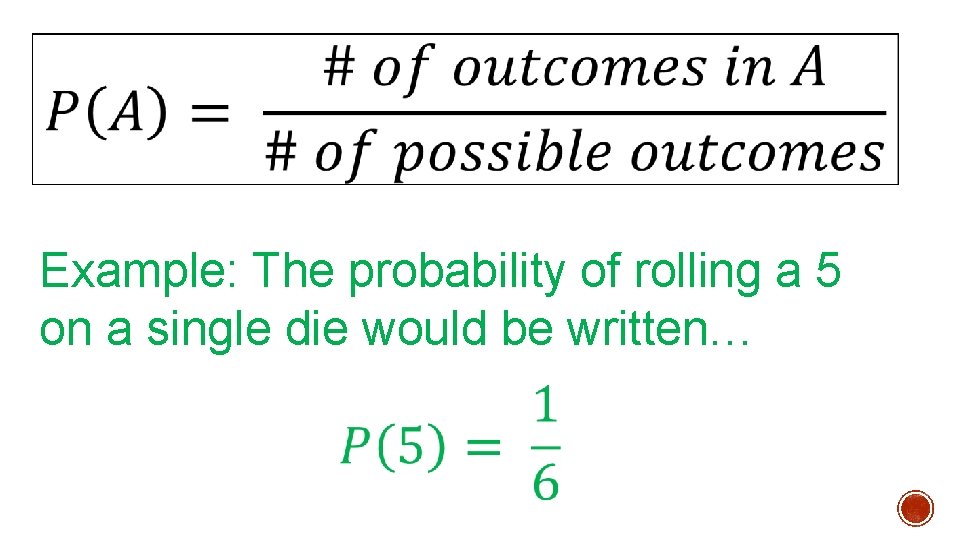
Example: The probability of rolling a 5 on a single die would be written…
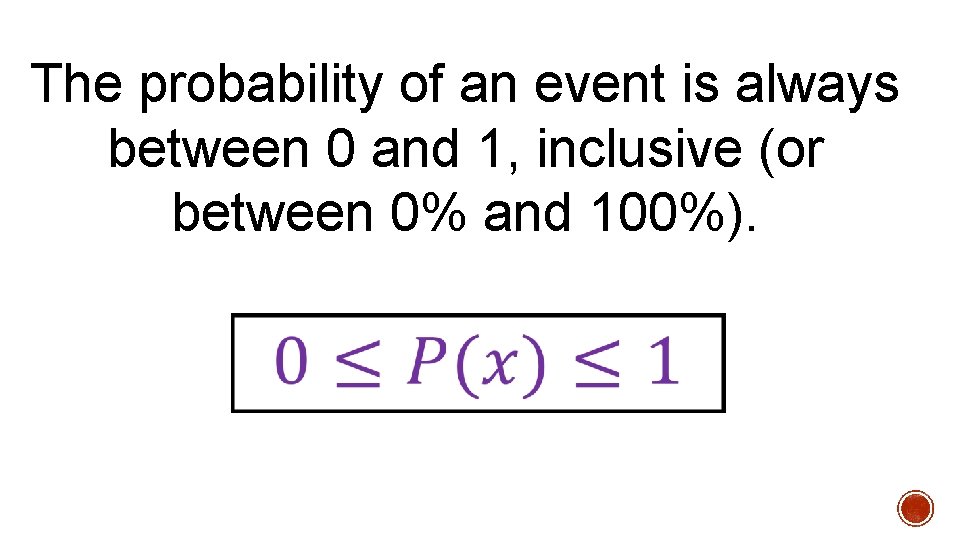
The probability of an event is always between 0 and 1, inclusive (or between 0% and 100%).
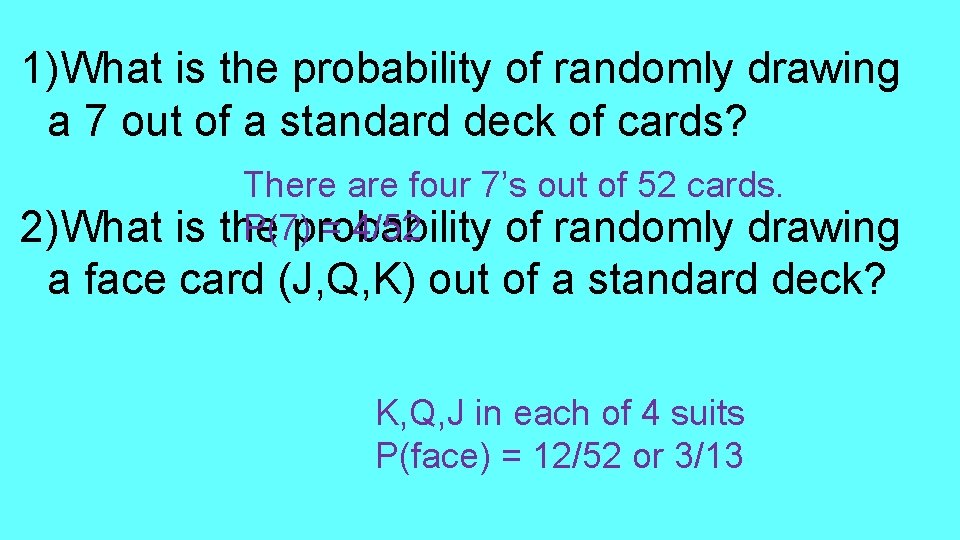
1)What is the probability of randomly drawing a 7 out of a standard deck of cards? There are four 7’s out of 52 cards. P(7) = 4/52 the probability of randomly drawing 2)What is a face card (J, Q, K) out of a standard deck? K, Q, J in each of 4 suits P(face) = 12/52 or 3/13
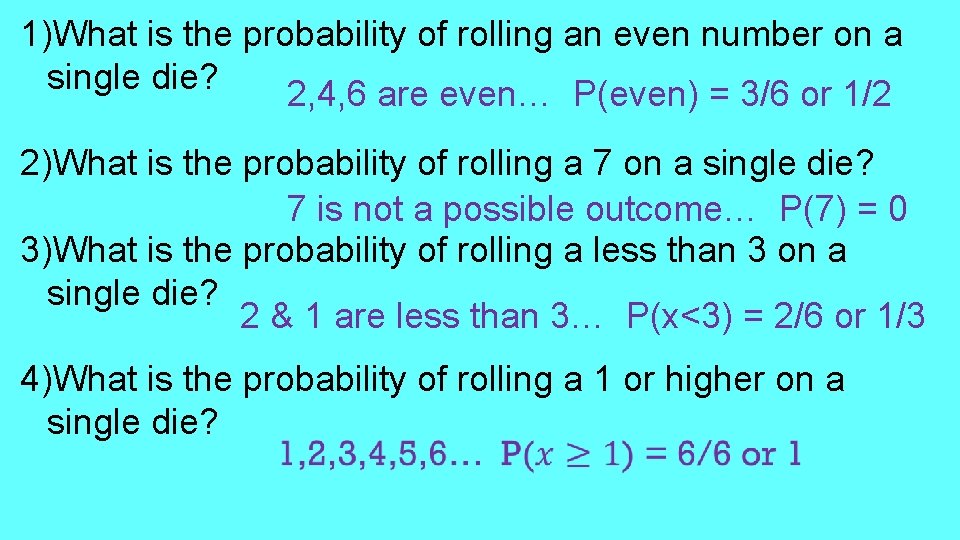
1)What is the probability of rolling an even number on a single die? 2, 4, 6 are even… P(even) = 3/6 or 1/2 2)What is the probability of rolling a 7 on a single die? 7 is not a possible outcome… P(7) = 0 3)What is the probability of rolling a less than 3 on a single die? 2 & 1 are less than 3… P(x<3) = 2/6 or 1/3 4)What is the probability of rolling a 1 or higher on a single die?
As the number of independent trials increases, the long-run relative frequency of repeated events gets closer and closer to a single value. (It approaches theoretical probability. )
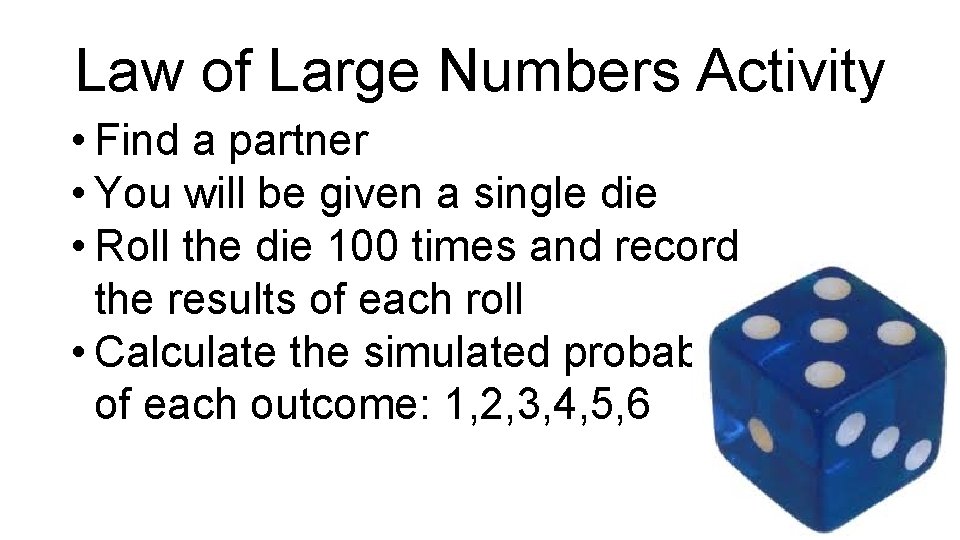
Law of Large Numbers Activity • Find a partner • You will be given a single die • Roll the die 100 times and record the results of each roll • Calculate the simulated probability of each outcome: 1, 2, 3, 4, 5, 6
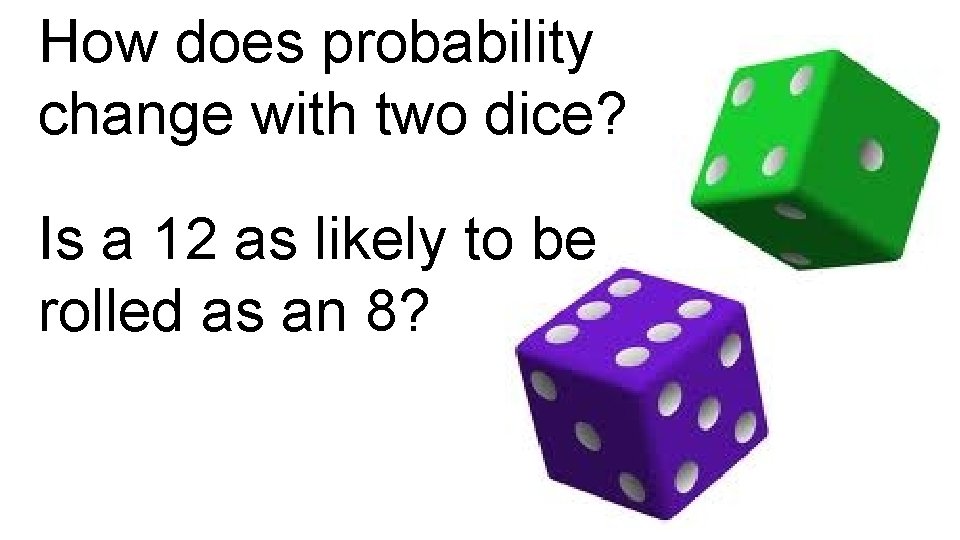
How does probability change with two dice? Is a 12 as likely to be rolled as an 8?
Today’s Assignment: q. Read Chapter 14 q. HW: page 338 #1, 2, 11, 12
- Slides: 12