
Probability Statistic and Data Analysis Project Sport among
Probability, Statistic and Data Analysis Project: Sport among Students Part 2 (Data Testing) Member: Daniel Nizri Syuraikh Ezzuddin Muhammed Afiq Afwan Muhammad Shahmi Lecturer: Dr. Chan Weng Howe Date of submission: 22 May 2018
Introduction • The purpose of this report is to investigate the students of University Technology Malaysia (UTM) regarding their sport and recreational activities around the campus. The report will also include the time or money spent toward any particular sports or activities. A recent studies conduct by Statistic Brain Research Institute shows that around 36, 250, 000 people around the age of 5 and 18 play organized sport each year in America alone. So we want to know whether this statistic also reflect on the UTM student that range around 19 to 26 years old. • From this finding we are hoping to come out a conclusion toward the activities among the student. Hopefully from the result we could increase or improve on any categories so that it could lead to a better youth society. • From this potential testing, we would like to make out a complete conclusion regarding our test topic on whether the hypothesis, variable and even correlation between each others.

Type of Data Testing and Review 1. Hypothesis Testing Variables and elements: • Hypothesis statement • Test Statistic on mean and standard deviation • Level of confidence • Conclusion/Decision Rule
2. Chi-square Test & Contingency Analysis Variables and elements: • Goodness-of-fit • Expected and observed variables 3. Correlation Analysis Variables and elements: • Scatter plot • Population correlation coefficient • Sample correlation coefficient
4. Data Testing and Review Students involvement in sports activities Test 1: Test statistic for proportion (right tail test) • Number of population=55 • Student that plays sport=38 • Students that do not play sports=17 • Probality that students play sport=0. 69 • Significance level: 0. 05 • Null Hypothesis: p=0. 5 • Alternate Hypothesis: p>0. 5 • z-value= 2. 818 • Conclusion: Null hypothesis is rejected as there is sufficient evidence that show that there are more than 50% of students that plays sport.
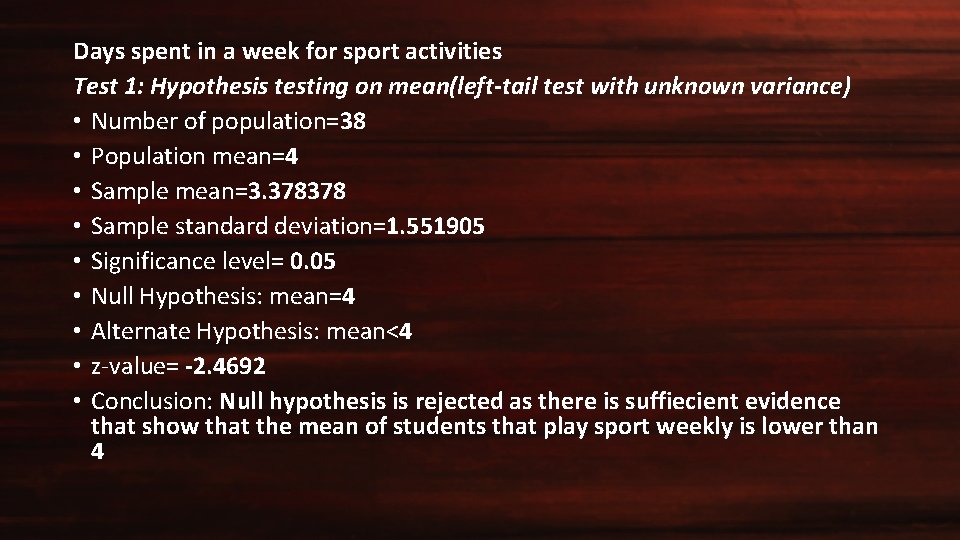
Days spent in a week for sport activities Test 1: Hypothesis testing on mean(left-tail test with unknown variance) • Number of population=38 • Population mean=4 • Sample mean=3. 378378 • Sample standard deviation=1. 551905 • Significance level= 0. 05 • Null Hypothesis: mean=4 • Alternate Hypothesis: mean<4 • z-value= -2. 4692 • Conclusion: Null hypothesis is rejected as there is suffiecient evidence that show that the mean of students that play sport weekly is lower than 4
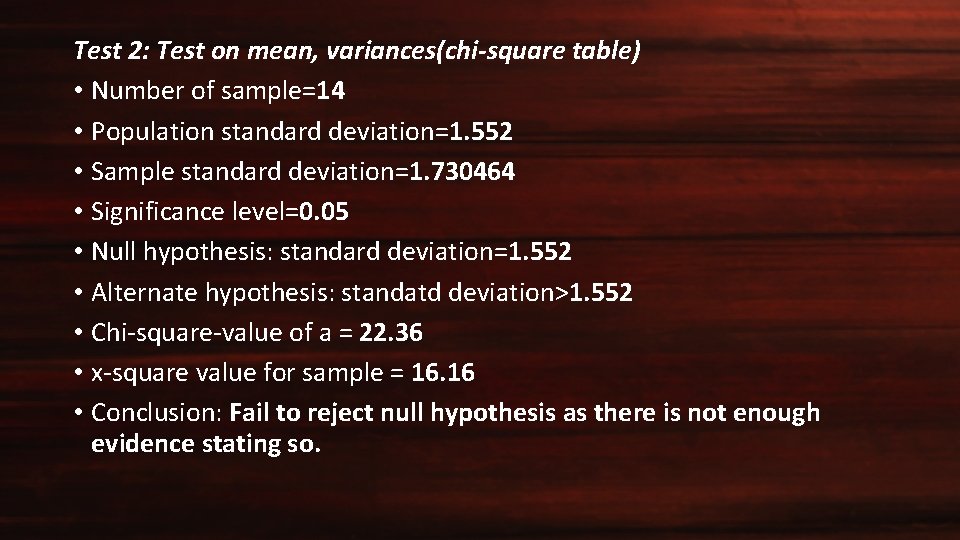
Test 2: Test on mean, variances(chi-square table) • Number of sample=14 • Population standard deviation=1. 552 • Sample standard deviation=1. 730464 • Significance level=0. 05 • Null hypothesis: standard deviation=1. 552 • Alternate hypothesis: standatd deviation>1. 552 • Chi-square-value of a = 22. 36 • x-square value for sample = 16. 16 • Conclusion: Fail to reject null hypothesis as there is not enough evidence stating so.
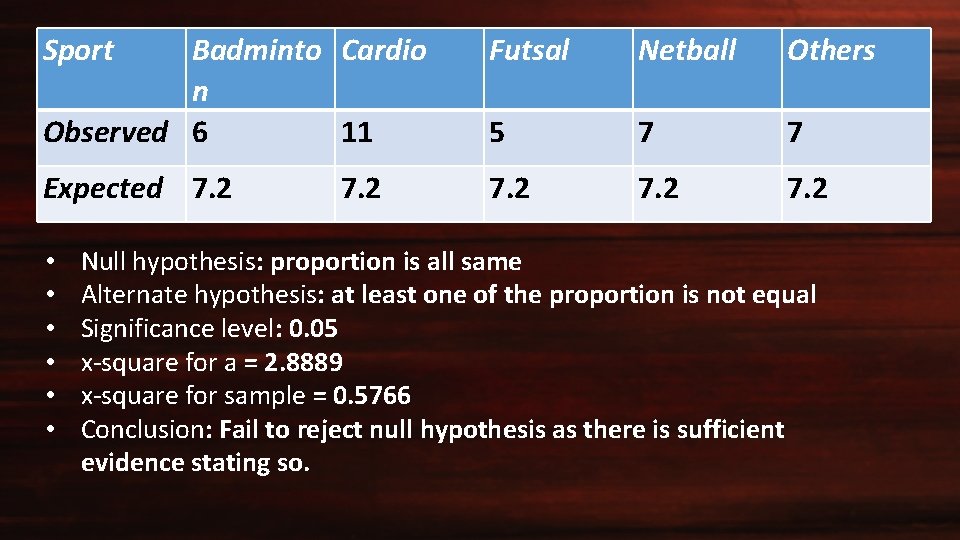
Sport Badminto Cardio n Observed 6 11 Futsal Netball Others 5 7 7 Expected 7. 2 • • • 7. 2 Null hypothesis: proportion is all same Alternate hypothesis: at least one of the proportion is not equal Significance level: 0. 05 x-square for a = 2. 8889 x-square for sample = 0. 5766 Conclusion: Fail to reject null hypothesis as there is sufficient evidence stating so.
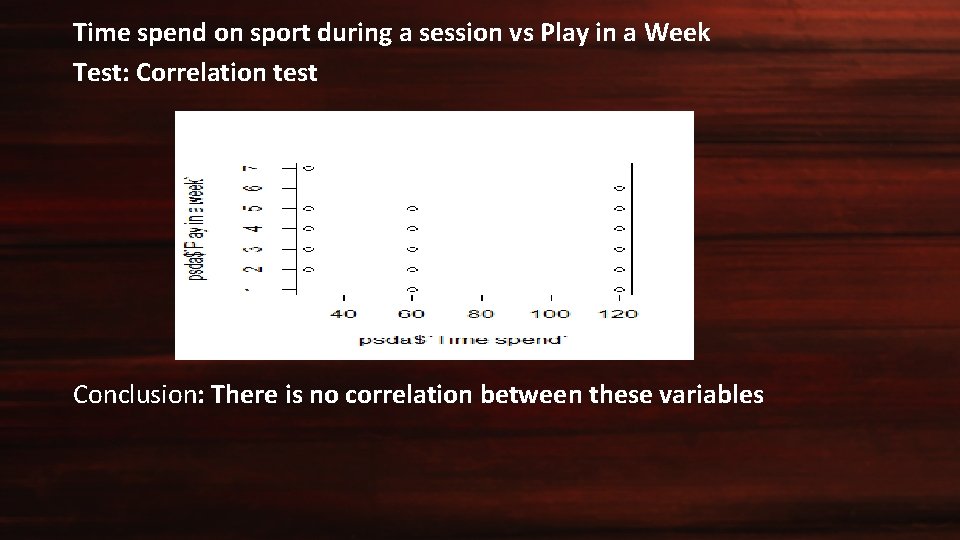
Time spend on sport during a session vs Play in a Week Test: Correlation test Conclusion: There is no correlation between these variables
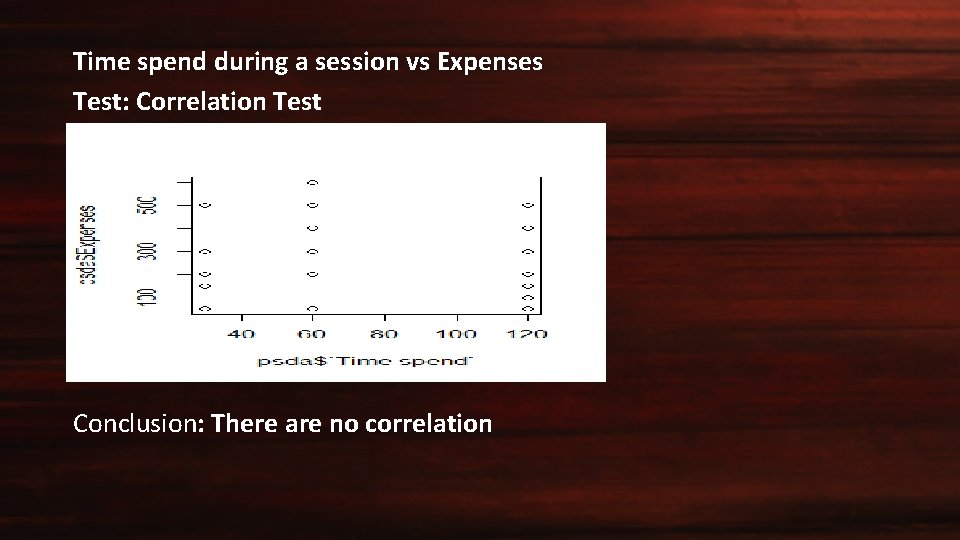
Time spend during a session vs Expenses Test: Correlation Test Conclusion: There are no correlation
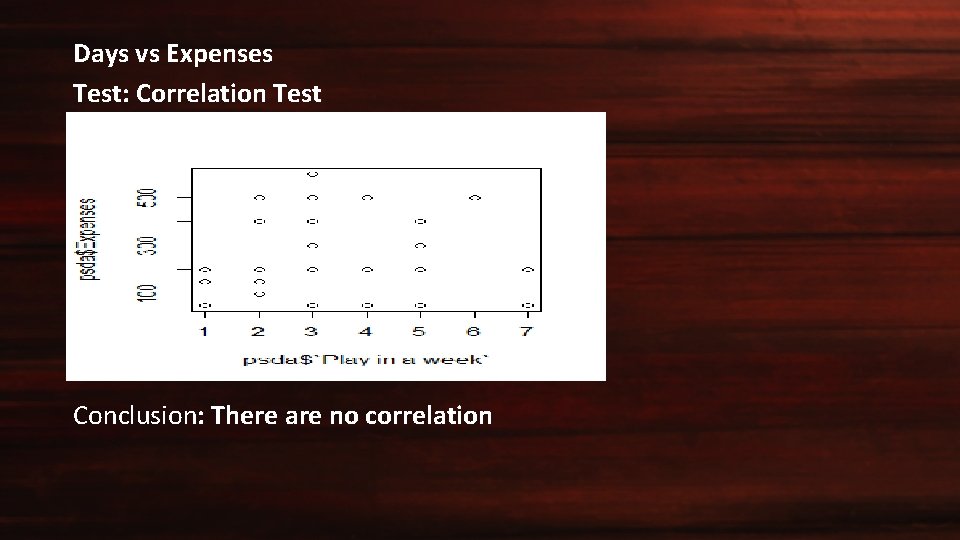
Days vs Expenses Test: Correlation Test Conclusion: There are no correlation
Conclusion • As we can conclude from this finding, in hypothesis testing, there is suffiecient evidence that show that the mean of students that play sport weekly is lower than 4. Also, there is no correlation between days and expenses, time spend during session and expenses and time spend in a session and days played. • From the testing, a most of the calculation is being done using Rprogramming to implemented the use of it on a real life situation.
- Slides: 12