
Probability Rules Chapter 15 Objectives 1 General Addition
Probability Rules Chapter 15
Objectives: 1. General Addition Rule 2. Conditional probability 3. General Multiplication Rule 4. Independence 5. Tree diagram
The General Addition Rule • When two events A and B are disjoint (mutually exclusive), we can use the addition rule for disjoint events from Chapter 14: P(A B) = P(A) + P(B) • However, when our events are not disjoint, this earlier addition rule will double count the probability of both A and B occurring. Thus, we need the General Addition Rule.
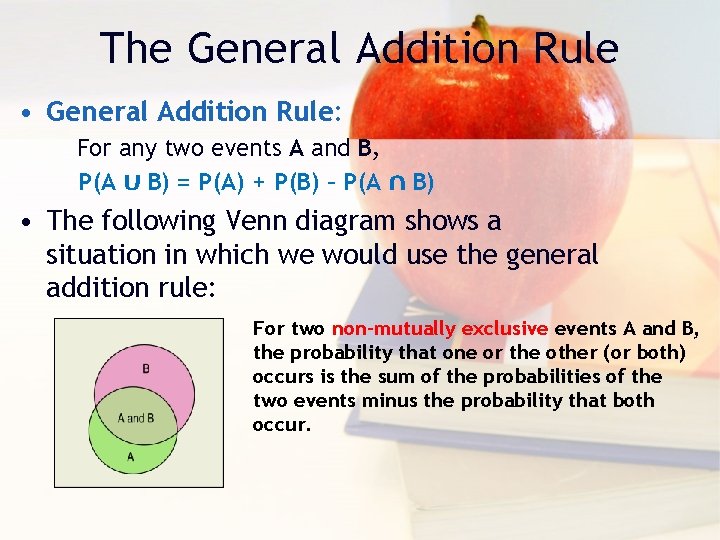
The General Addition Rule • General Addition Rule: For any two events A and B, P(A ∪ B) = P(A) + P(B) – P(A ∩ B) • The following Venn diagram shows a situation in which we would use the general addition rule: For two non-mutually exclusive events A and B, the probability that one or the other (or both) occurs is the sum of the probabilities of the two events minus the probability that both occur.

Addition Rule-Example A single card is drawn from a deck of cards. Find the probability that the card is a king or a queen. Kings Queens
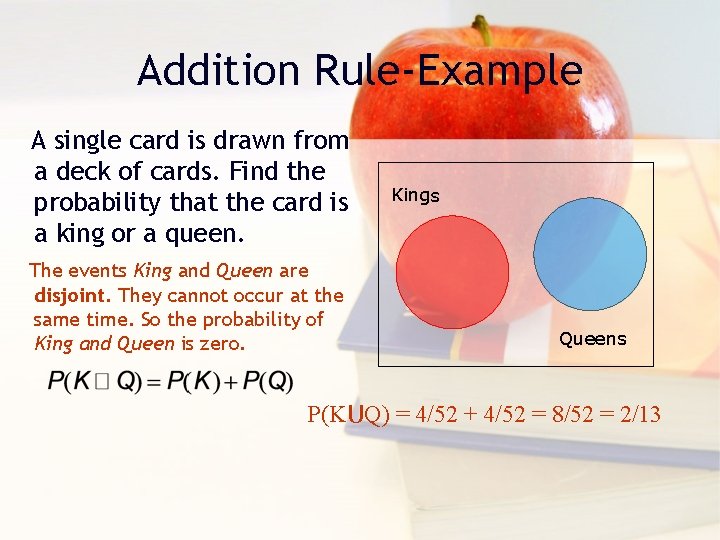
Addition Rule-Example A single card is drawn from a deck of cards. Find the probability that the card is a king or a queen. The events King and Queen are disjoint. They cannot occur at the same time. So the probability of King and Queen is zero. Kings Queens P(K⋃Q) = 4/52 + 4/52 = 8/52 = 2/13
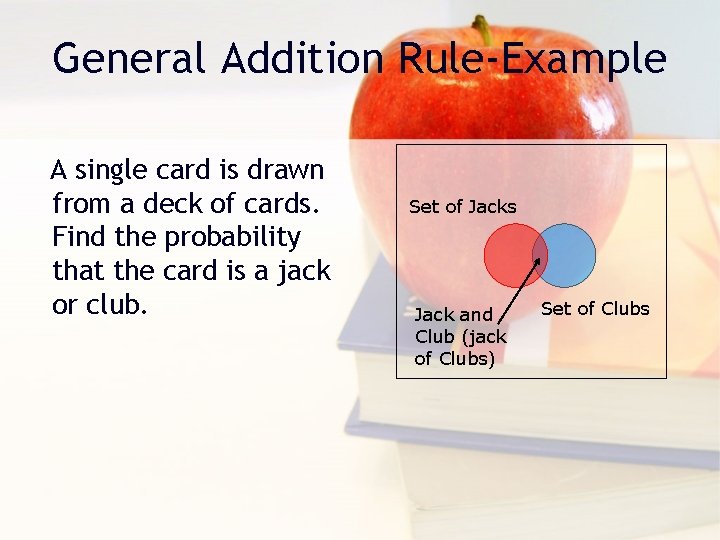
General Addition Rule-Example A single card is drawn from a deck of cards. Find the probability that the card is a jack or club. Set of Jacks Jack and Club (jack of Clubs) Set of Clubs
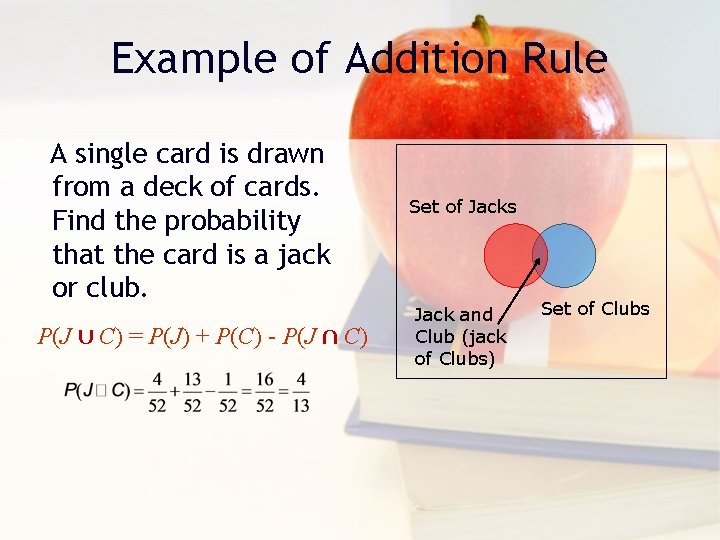
Example of Addition Rule A single card is drawn from a deck of cards. Find the probability that the card is a jack or club. P(J ∪ C) = P(J) + P(C) - P(J ∩ C) Set of Jacks Jack and Club (jack of Clubs) Set of Clubs
Addition Rule – Example When tossing a die once, find the probability of rolling a 5 or an even number. 1. Compound or event – addition rule. 2. Disjoint events, a 5 and an even number (2, 4, 6) cannot occur at the same time. 3. Therefore use: P(A ∪ B) = P(A) + P(B).
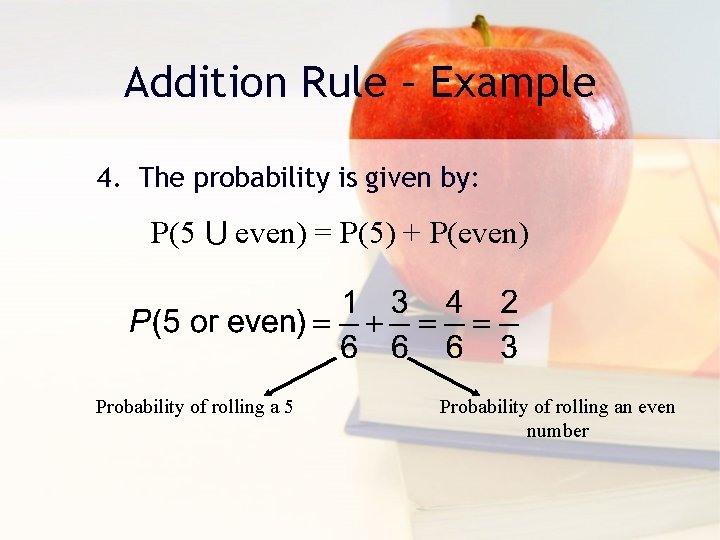
Addition Rule – Example 4. The probability is given by: P(5 ⋃ even) = P(5) + P(even) Probability of rolling a 5 Probability of rolling an even number
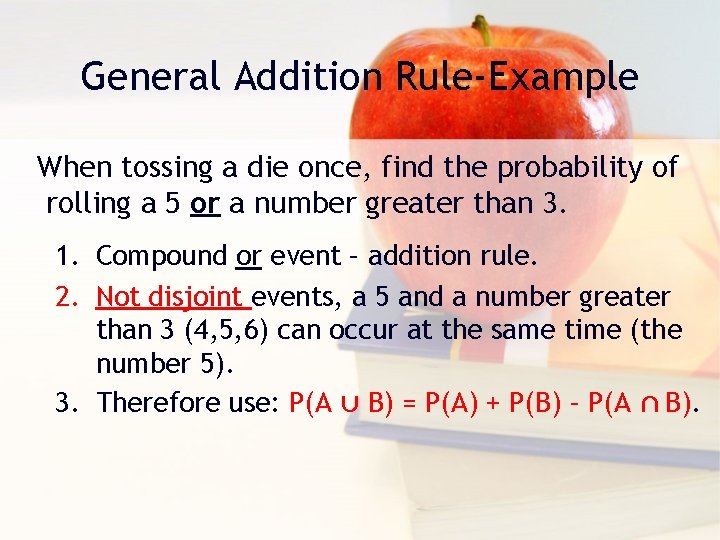
General Addition Rule-Example When tossing a die once, find the probability of rolling a 5 or a number greater than 3. 1. Compound or event – addition rule. 2. Not disjoint events, a 5 and a number greater than 3 (4, 5, 6) can occur at the same time (the number 5). 3. Therefore use: P(A ∪ B) = P(A) + P(B) – P(A ∩ B).

General Addition Rule-Example 4. There are three numbers greater than 3 on a die and one of them is the 5. We cannot count the 5 twice. 5. The probability is given by: P(5 ⋃ >3) = P(5) + P(>3) – P(5 ⋂ >3) Probability of rolling a 5 Probability of rolling a number > 3 Probability of rolling the same 5
Probability of an event from a conditional distribution – Conditional Probability Conditional probability is the probability of an event occurring, given that another event has already occurred, or, a probability that takes into account a given condition. • Conditional probability restricts the sample space. • The conditional probability of event B occurring, given that event A has occurred, is denoted by P(B|A) and is read as “probability of B, given A. ” • We use conditional probability when two events occurring in sequence are not independent. In other words, the fact that the first event (event A) has occurred affects the probability that the second event (event B) will occur.
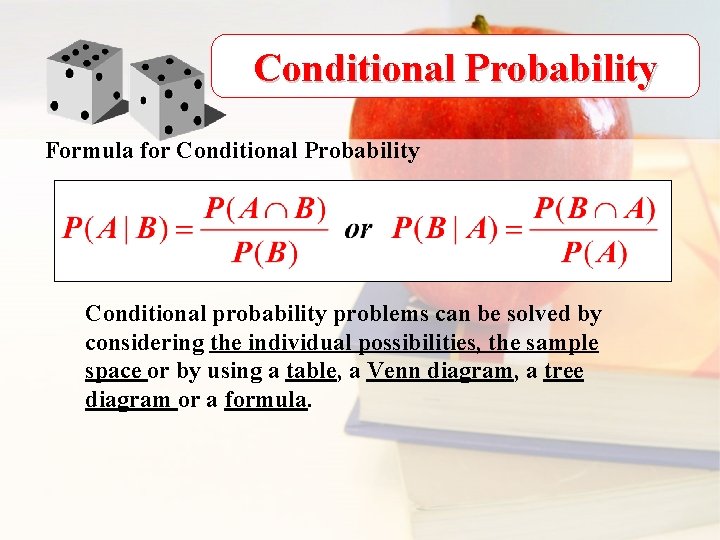
Conditional Probability Formula for Conditional Probability Conditional probability problems can be solved by considering the individual possibilities, the sample space or by using a table, a Venn diagram, a tree diagram or a formula.
The General Multiplication Rule • When two events A and B are independent, we can use the multiplication rule for independent events from Chapter 14: P(A B) = P(A) x P(B) • When our events are not independent, this earlier multiplication rule does not work. We need to use the General Multiplication Rule.
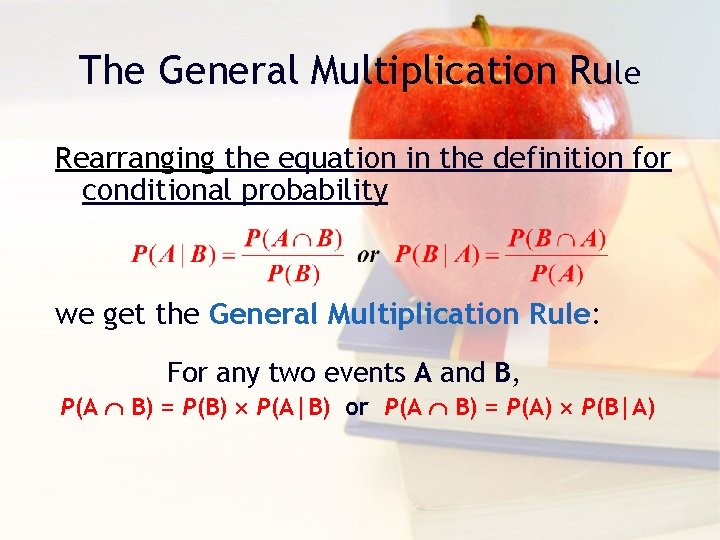
The General Multiplication Rule Rearranging the equation in the definition for conditional probability we get the General Multiplication Rule: For any two events A and B, P(A B) = P(B) P(A|B) or P(A B) = P(A) P(B|A)
Independence - Definition • Independence of two events means that the outcome of one event does not influence the probability of the other. • With our new notation for conditional probabilities, we can now formalize this definition: Events A and B are independent whenever P(B|A) = P(B), or, P(A|B) = P(A).
Independence • Examples: – If you roll two dice and obtain a sum of seven, the result of that roll has no effect on the next roll, so the two rolls are independent. – But if you draw an ace from a deck of cards P(A 1) = 4/52 and without replacing it draw a second card, the probability that it is an ace is P(A 2|A 1) = 3/51. These events are not independent.
Independence ***!!!*** § If two events are “physically independent” then they will also be statistically independent. § Never assume that two events are independent unless you are absolutely certain that they are independent.
Is Independent = Disjoint ? • Mutually Exclusive means that the events A and B have nothing in common, and so there is no intersection, i. e. , P(A ∩ B) = 0. • Independent means that the outcome of event A will not influence the outcome of event B.
Independent ≠ Disjoint (Mutually Exclusive) Disjoint events cannot be independent! Well, why not? – Since we know that disjoint events have no outcomes in common, knowing that one occurred means the other didn’t. – Thus, the probability of the second occurring changed based on our knowledge that the first occurred. – It follows, then, that the two events are not independent. – OR, think algebraically!!! (The Addition Rule)
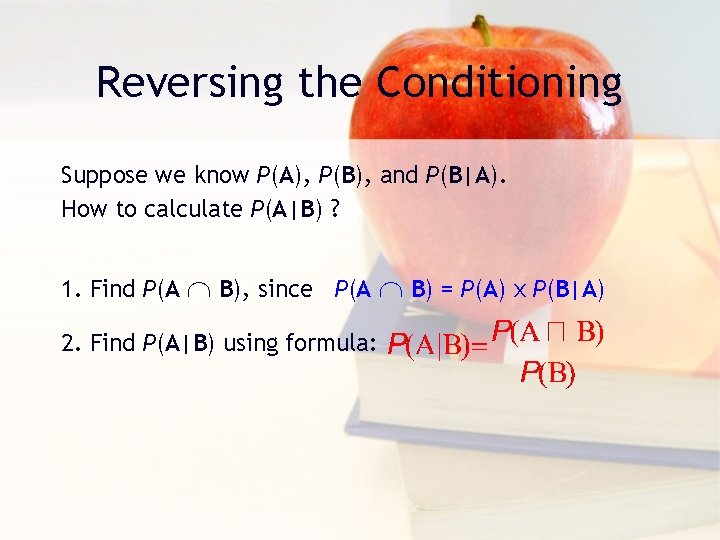
Reversing the Conditioning Suppose we know P(A), P(B), and P(B|A). How to calculate P(A|B) ? 1. Find P(A B), since P(A 2. Find P(A|B) using formula: B) = P(A) x P(B|A)
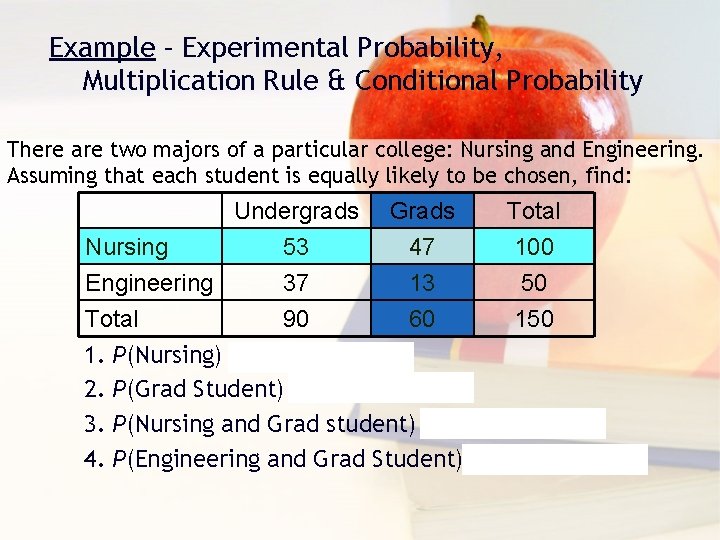
Example – Experimental Probability, Multiplication Rule & Conditional Probability There are two majors of a particular college: Nursing and Engineering. Assuming that each student is equally likely to be chosen, find: Undergrads Grads Total Nursing 53 47 100 Engineering 37 13 50 Total 90 60 150 1. P(Nursing) = 100/150 = 2/3 2. P(Grad Student) = 60/150 = 2/5 3. P(Nursing and Grad student) = 47/150 4. P(Engineering and Grad Student) = 13/150
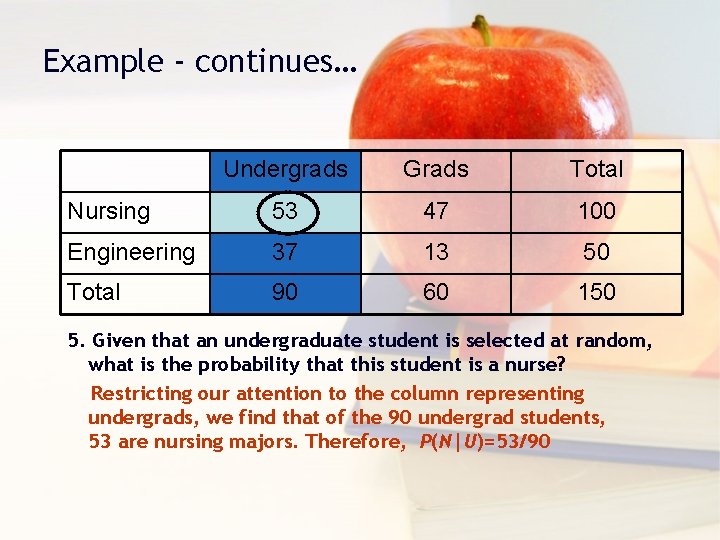
Example - continues… Undergrads Grads Total Nursing 53 47 100 Engineering 37 13 50 Total 90 60 150 5. Given that an undergraduate student is selected at random, what is the probability that this student is a nurse? Restricting our attention to the column representing undergrads, we find that of the 90 undergrad students, 53 are nursing majors. Therefore, P(N|U)=53/90
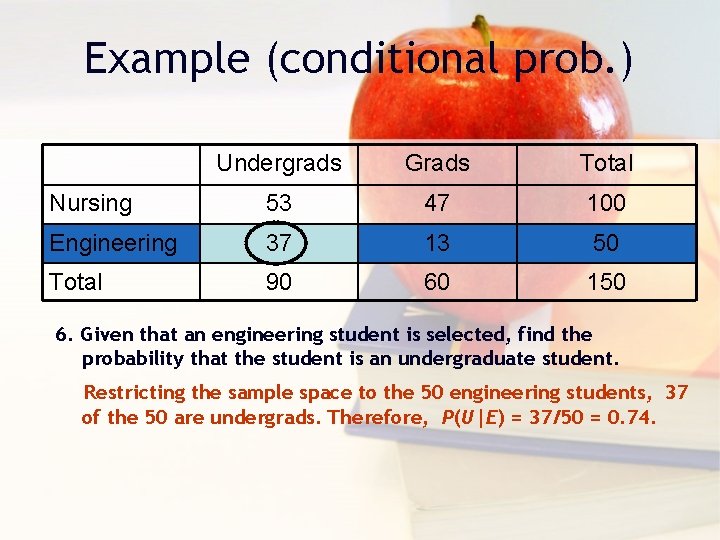
Example (conditional prob. ) Undergrads Grads Total Nursing 53 47 100 Engineering 37 13 50 Total 90 60 150 6. Given that an engineering student is selected, find the probability that the student is an undergraduate student. Restricting the sample space to the 50 engineering students, 37 of the 50 are undergrads. Therefore, P(U|E) = 37/50 = 0. 74.
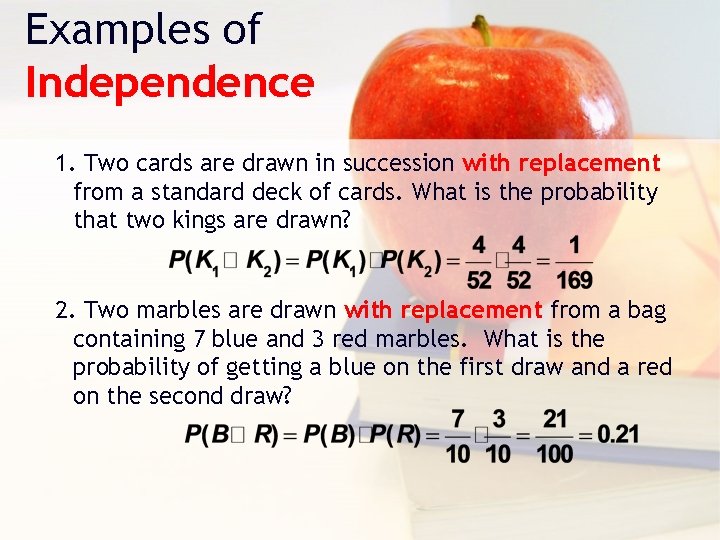
Examples of Independence 1. Two cards are drawn in succession with replacement from a standard deck of cards. What is the probability that two kings are drawn? 2. Two marbles are drawn with replacement from a bag containing 7 blue and 3 red marbles. What is the probability of getting a blue on the first draw and a red on the second draw?
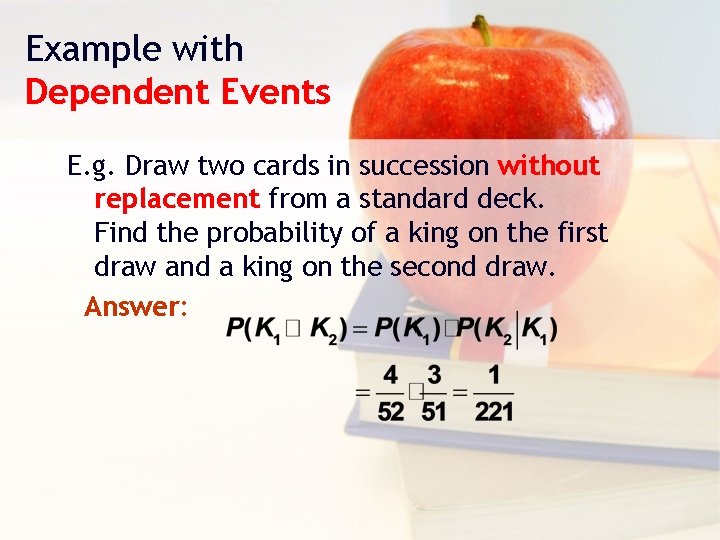
Example with Dependent Events E. g. Draw two cards in succession without replacement from a standard deck. Find the probability of a king on the first draw and a king on the second draw. Answer:
SUMMARY: To determine Independence vs. Dependence Use the definition of independence and the multiplication rule: • A and B are independent if and only if P(A B) = P(A)∙P(B). OR, • If A and B are independent events, then P(A|B) = P(A) and P(B|A) = P(B). • If P(A|B) = P(A) or P(B|A) = P(B), then A and B are independent.
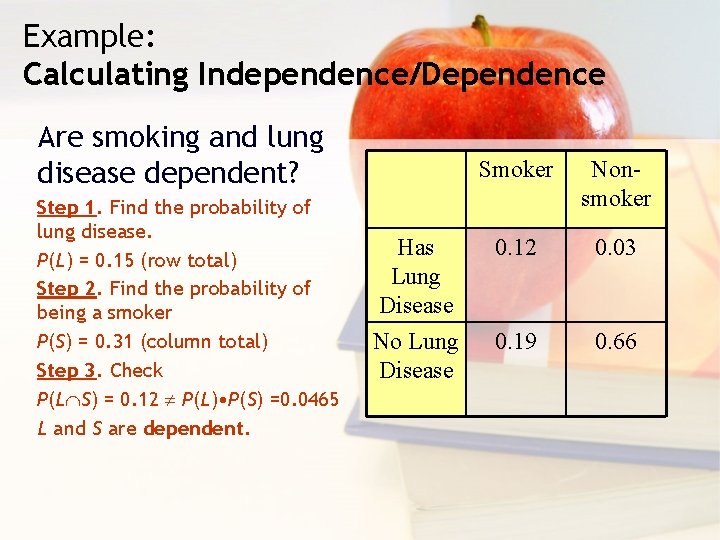
Example: Calculating Independence/Dependence Are smoking and lung disease dependent? Step 1. Find the probability of lung disease. P(L) = 0. 15 (row total) Step 2. Find the probability of being a smoker P(S) = 0. 31 (column total) Step 3. Check P(L S) = 0. 12 P(L) • P(S) =0. 0465 L and S are dependent. Smoker Nonsmoker Has Lung Disease 0. 12 0. 03 No Lung Disease 0. 19 0. 66
Problem Solving Strategies in Probability
Visualizing Sample Space & Probabilities • 1. List – Sample Space • 2. Venn Diagram • 3. Lattice Diagram • 4. Tree Diagram • 5. Geometric Probability
1. The List Sample Space
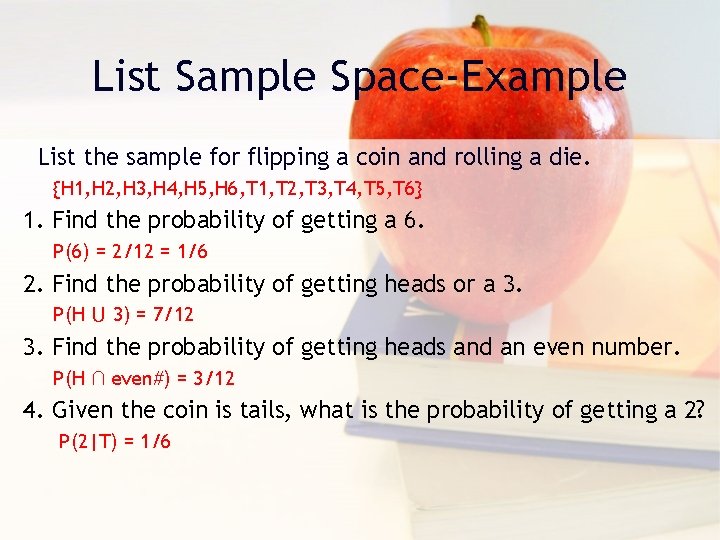
List Sample Space-Example List the sample for flipping a coin and rolling a die. {H 1, H 2, H 3, H 4, H 5, H 6, T 1, T 2, T 3, T 4, T 5, T 6} 1. Find the probability of getting a 6. P(6) = 2/12 = 1/6 2. Find the probability of getting heads or a 3. P(H ⋃ 3) = 7/12 3. Find the probability of getting heads and an even number. P(H ∩ even#) = 3/12 4. Given the coin is tails, what is the probability of getting a 2? P(2|T) = 1/6
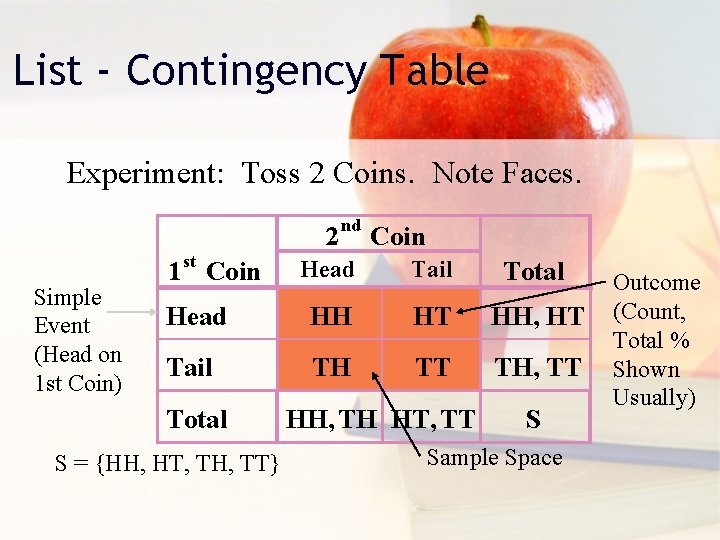
List - Contingency Table Experiment: Toss 2 Coins. Note Faces. 2 st Simple Event (Head on 1 st Coin) nd Coin Head Tail Total Head HH HT HH, HT Tail TH TT TH, TT 1 Coin Total S = {HH, HT, TH, TT} HH, TH HT, TT S Sample Space Outcome (Count, Total % Shown Usually)
2. Venn Diagram
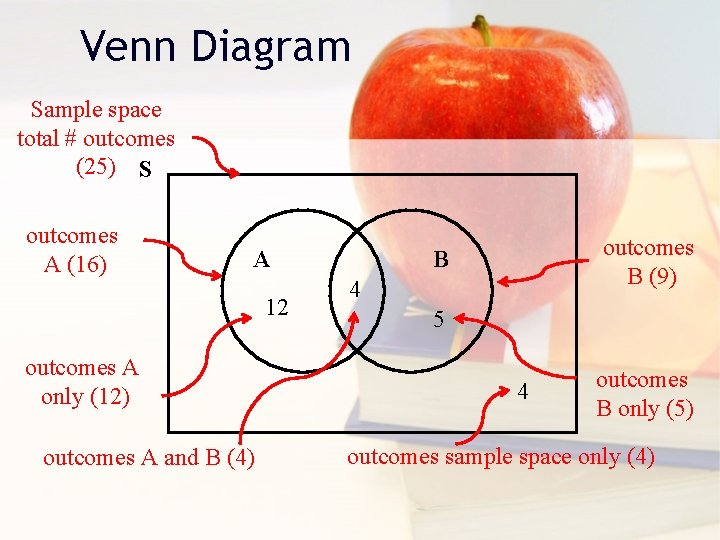
Venn Diagram Sample space total # outcomes (25) S outcomes A (16) A 12 outcomes A only (12) outcomes A and B (4) outcomes B (9) B 4 5 4 outcomes B only (5) outcomes sample space only (4)
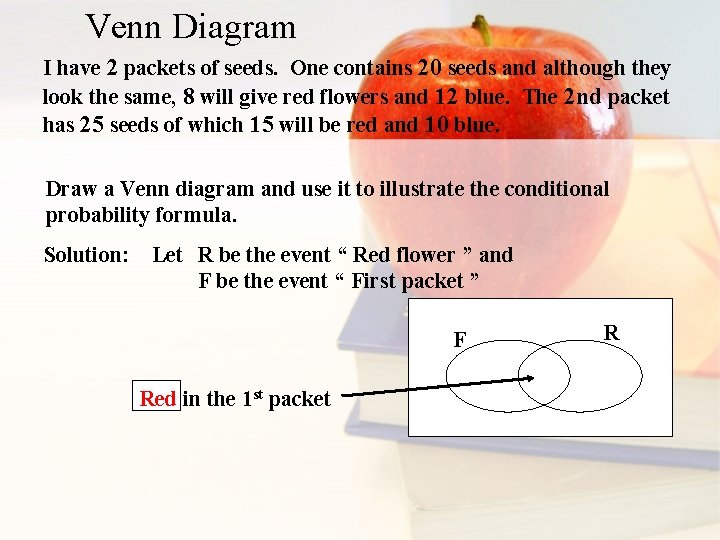
Venn Diagram I have 2 packets of seeds. One contains 20 seeds and although they look the same, 8 will give red flowers and 12 blue. The 2 nd packet has 25 seeds of which 15 will be red and 10 blue. Draw a Venn diagram and use it to illustrate the conditional probability formula. Solution: Let R be the event “ Red flower ” and F be the event “ First packet ” F Red in the 1 st packet R
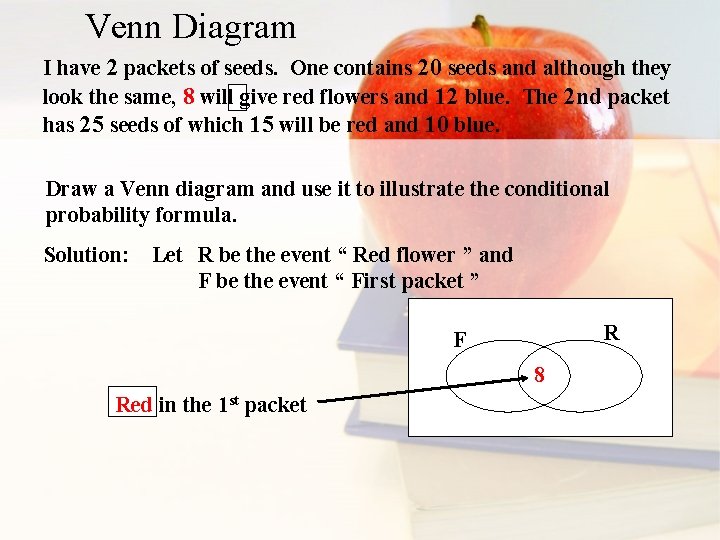
Venn Diagram I have 2 packets of seeds. One contains 20 seeds and although they look the same, 8 will give red flowers and 12 blue. The 2 nd packet has 25 seeds of which 15 will be red and 10 blue. Draw a Venn diagram and use it to illustrate the conditional probability formula. Solution: Let R be the event “ Red flower ” and F be the event “ First packet ” R F 8 Red in the 1 st packet
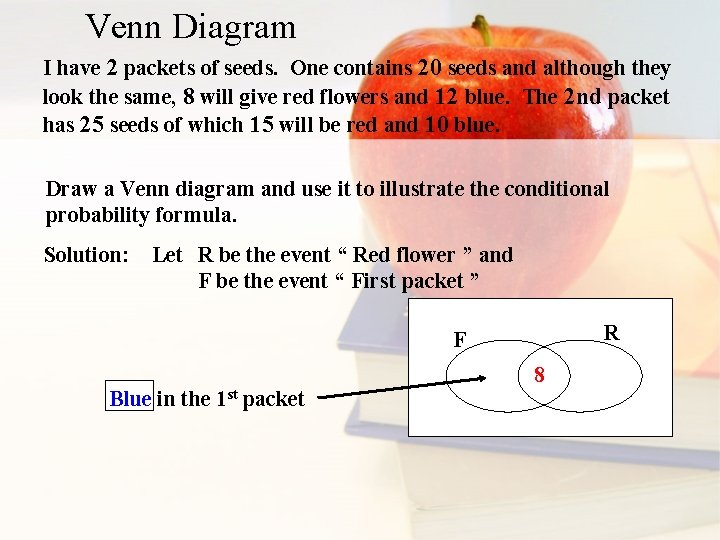
Venn Diagram I have 2 packets of seeds. One contains 20 seeds and although they look the same, 8 will give red flowers and 12 blue. The 2 nd packet has 25 seeds of which 15 will be red and 10 blue. Draw a Venn diagram and use it to illustrate the conditional probability formula. Solution: Let R be the event “ Red flower ” and F be the event “ First packet ” R F Blue in the 1 st packet 8
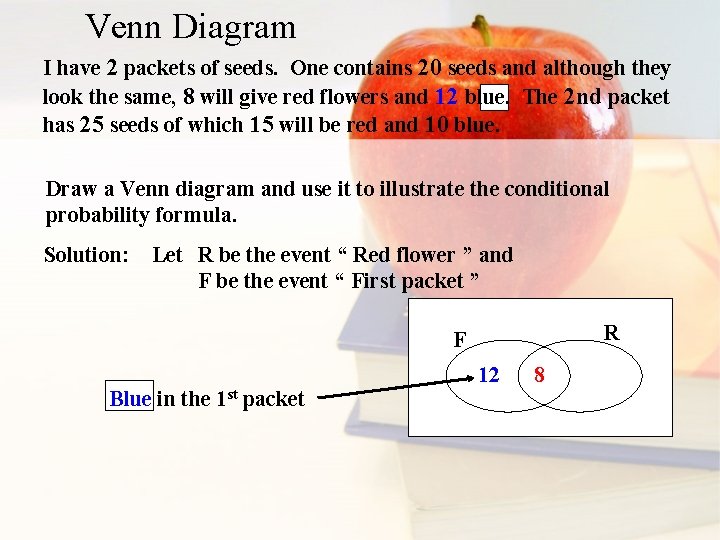
Venn Diagram I have 2 packets of seeds. One contains 20 seeds and although they look the same, 8 will give red flowers and 12 blue. The 2 nd packet has 25 seeds of which 15 will be red and 10 blue. Draw a Venn diagram and use it to illustrate the conditional probability formula. Solution: Let R be the event “ Red flower ” and F be the event “ First packet ” R F Blue in the 1 st packet 12 8
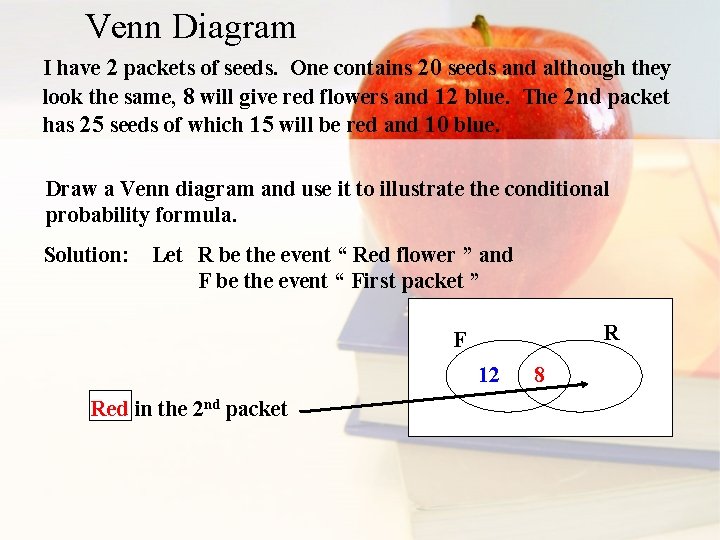
Venn Diagram I have 2 packets of seeds. One contains 20 seeds and although they look the same, 8 will give red flowers and 12 blue. The 2 nd packet has 25 seeds of which 15 will be red and 10 blue. Draw a Venn diagram and use it to illustrate the conditional probability formula. Solution: Let R be the event “ Red flower ” and F be the event “ First packet ” R F 12 Red in the 2 nd packet 8
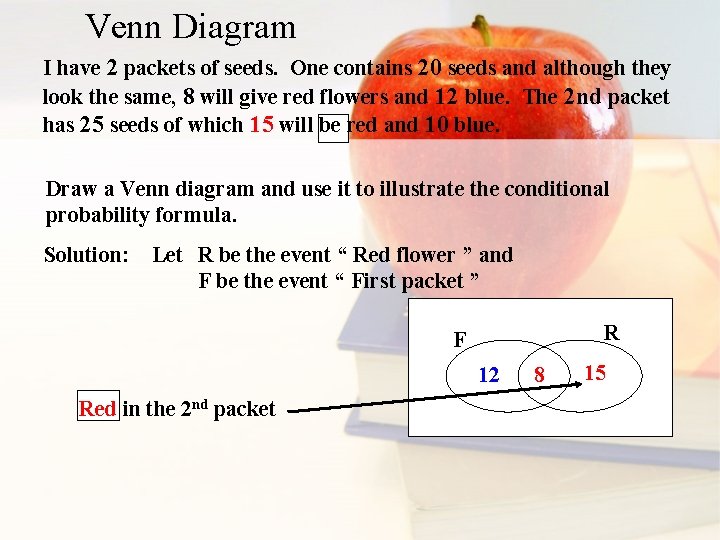
Venn Diagram I have 2 packets of seeds. One contains 20 seeds and although they look the same, 8 will give red flowers and 12 blue. The 2 nd packet has 25 seeds of which 15 will be red and 10 blue. Draw a Venn diagram and use it to illustrate the conditional probability formula. Solution: Let R be the event “ Red flower ” and F be the event “ First packet ” R F 12 Red in the 2 nd packet 8 15
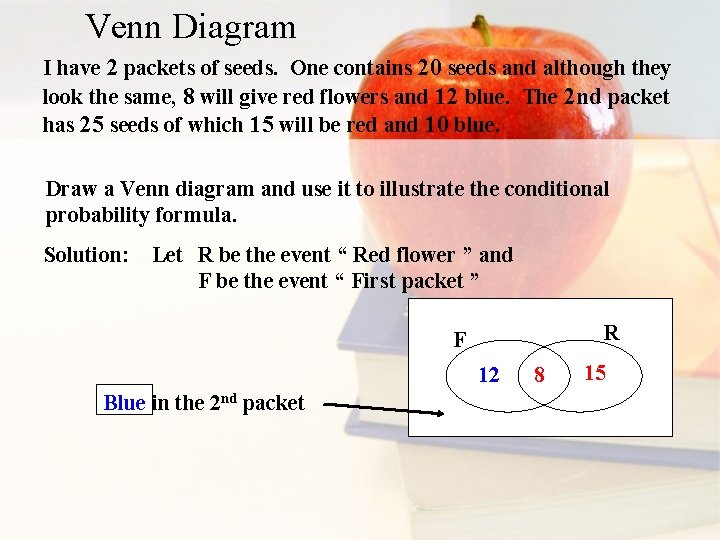
Venn Diagram I have 2 packets of seeds. One contains 20 seeds and although they look the same, 8 will give red flowers and 12 blue. The 2 nd packet has 25 seeds of which 15 will be red and 10 blue. Draw a Venn diagram and use it to illustrate the conditional probability formula. Solution: Let R be the event “ Red flower ” and F be the event “ First packet ” R F 12 Blue in the 2 nd packet 8 15
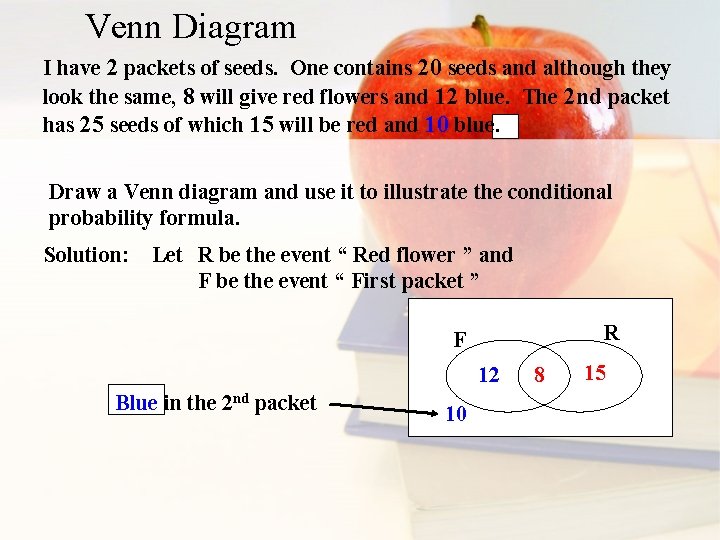
Venn Diagram I have 2 packets of seeds. One contains 20 seeds and although they look the same, 8 will give red flowers and 12 blue. The 2 nd packet has 25 seeds of which 15 will be red and 10 blue. Draw a Venn diagram and use it to illustrate the conditional probability formula. Solution: Let R be the event “ Red flower ” and F be the event “ First packet ” R F 12 Blue in the 2 nd packet 10 8 15
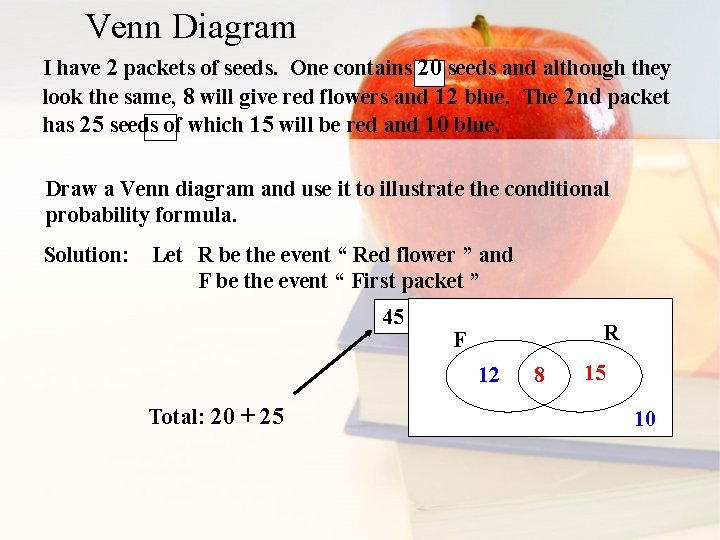
Venn Diagram I have 2 packets of seeds. One contains 20 seeds and although they look the same, 8 will give red flowers and 12 blue. The 2 nd packet has 25 seeds of which 15 will be red and 10 blue. Draw a Venn diagram and use it to illustrate the conditional probability formula. Solution: Let R be the event “ Red flower ” and F be the event “ First packet ” 45 R F 12 Total: 20 + 25 8 15 10
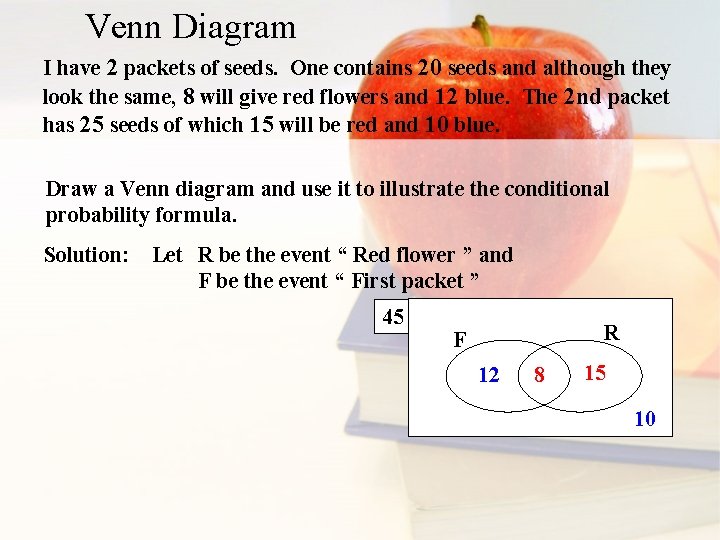
Venn Diagram I have 2 packets of seeds. One contains 20 seeds and although they look the same, 8 will give red flowers and 12 blue. The 2 nd packet has 25 seeds of which 15 will be red and 10 blue. Draw a Venn diagram and use it to illustrate the conditional probability formula. Solution: Let R be the event “ Red flower ” and F be the event “ First packet ” 45 R F 12 8 15 10
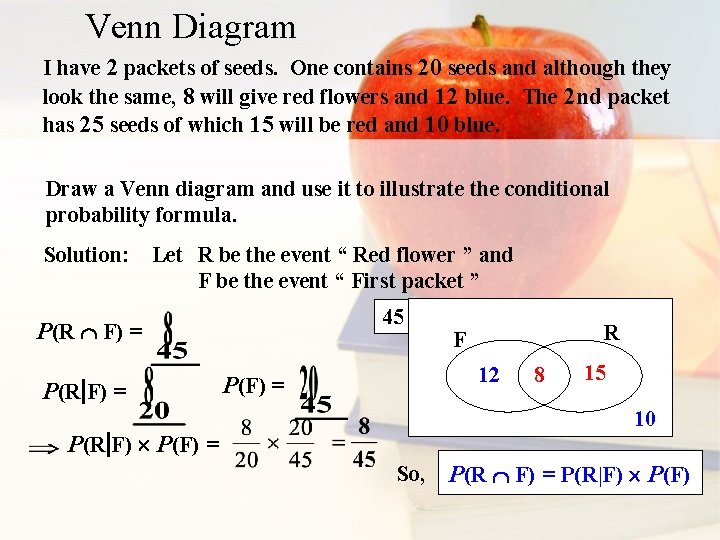
Venn Diagram I have 2 packets of seeds. One contains 20 seeds and although they look the same, 8 will give red flowers and 12 blue. The 2 nd packet has 25 seeds of which 15 will be red and 10 blue. Draw a Venn diagram and use it to illustrate the conditional probability formula. Solution: Let R be the event “ Red flower ” and F be the event “ First packet ” 45 P(R F) = P(R F) = R F 12 P(F) = 8 15 10 P(R F) P(F) = So, P(R F) = P(R|F) P(F)
Example A and B are two events such that P(A)=. 3, P(B)=. 5 and P(A or B)=. 55. Find the probabilities of the following events: 1. 2. 3. 4. 5. P(A and B) P(B') P(A' ∩ B) P(A|B) P(B'|A)
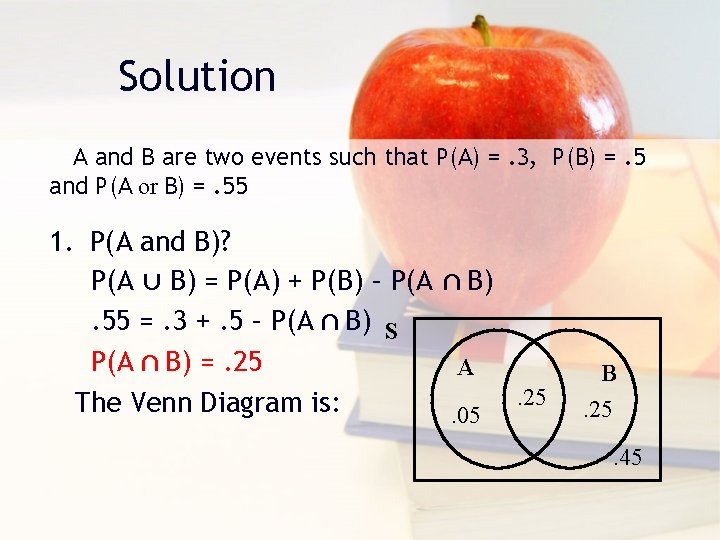
Solution A and B are two events such that P(A) =. 3, P(B) =. 5 and P(A or B) =. 55 1. P(A and B)? P(A ∪ B) = P(A) + P(B) – P(A ∩ B). 55 =. 3 +. 5 – P(A ∩ B) S P(A ∩ B) =. 25 A. 25 The Venn Diagram is: . 05 B. 25. 45
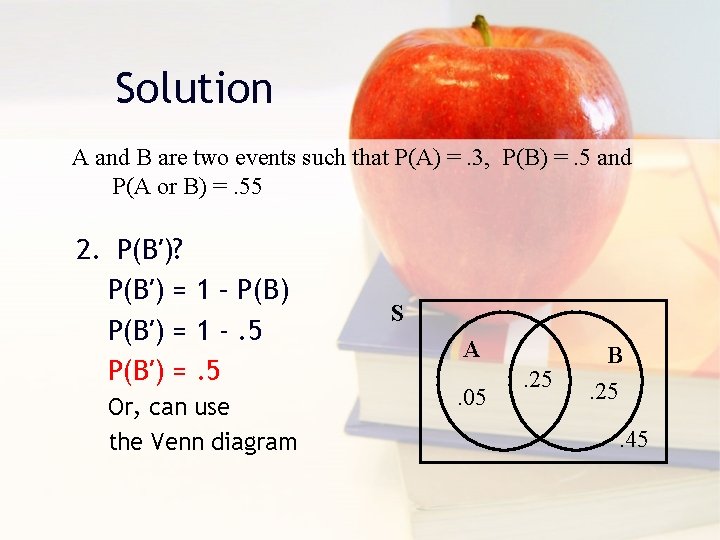
Solution A and B are two events such that P(A) =. 3, P(B) =. 5 and P(A or B) =. 55 2. P(B′)? P(B′) = 1 – P(B) P(B′) = 1 -. 5 P(B′) =. 5 Or, can use the Venn diagram S A. 05 . 25 B. 25. 45
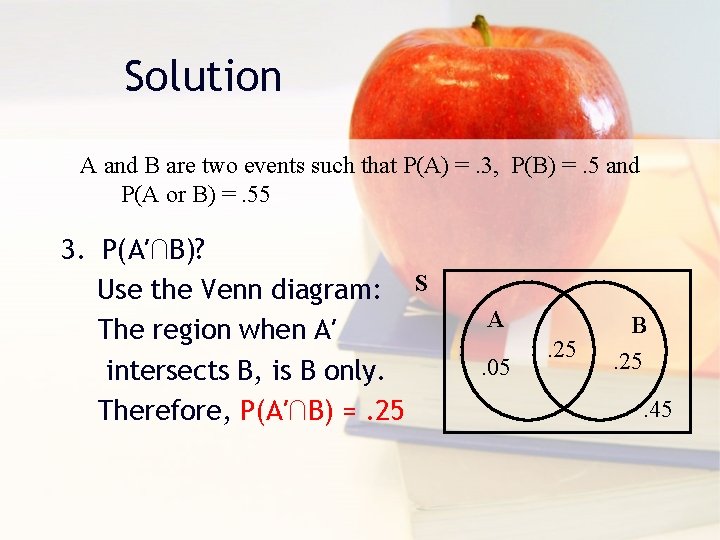
Solution A and B are two events such that P(A) =. 3, P(B) =. 5 and P(A or B) =. 55 3. P(A′∩B)? Use the Venn diagram: S The region when A′ intersects B, is B only. Therefore, P(A′∩B) =. 25 A. 05 . 25 B. 25. 45
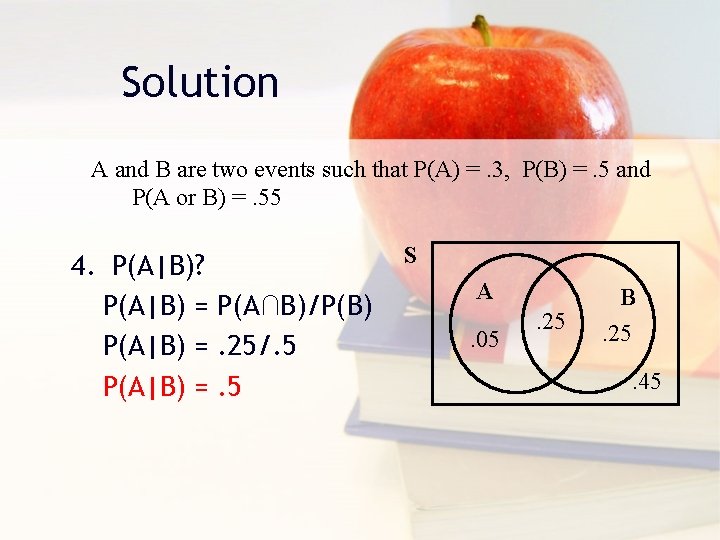
Solution A and B are two events such that P(A) =. 3, P(B) =. 5 and P(A or B) =. 55 4. P(A|B)? P(A|B) = P(A∩B)/P(B) P(A|B) =. 25/. 5 P(A|B) =. 5 S A. 05 . 25 B. 25. 45
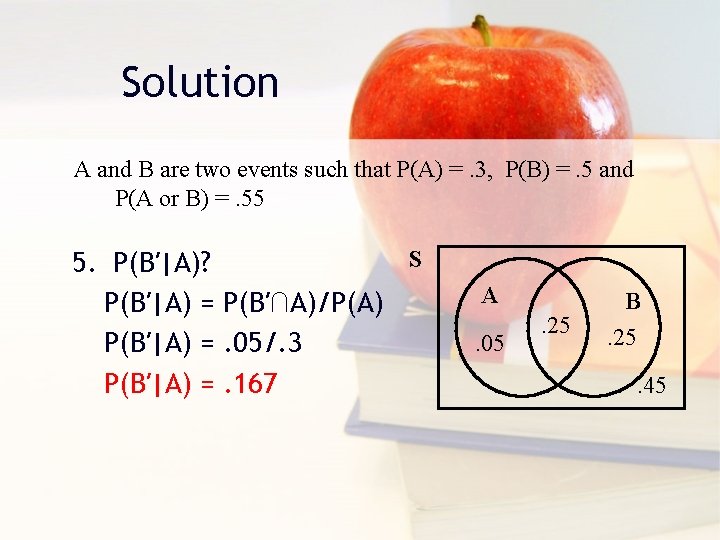
Solution A and B are two events such that P(A) =. 3, P(B) =. 5 and P(A or B) =. 55 S 5. P(B′|A)? P(B′|A) = P(B′∩A)/P(A) P(B′|A) =. 05/. 3 P(B′|A) =. 167 A. 05 . 25 B. 25. 45
3. Lattice Diagram
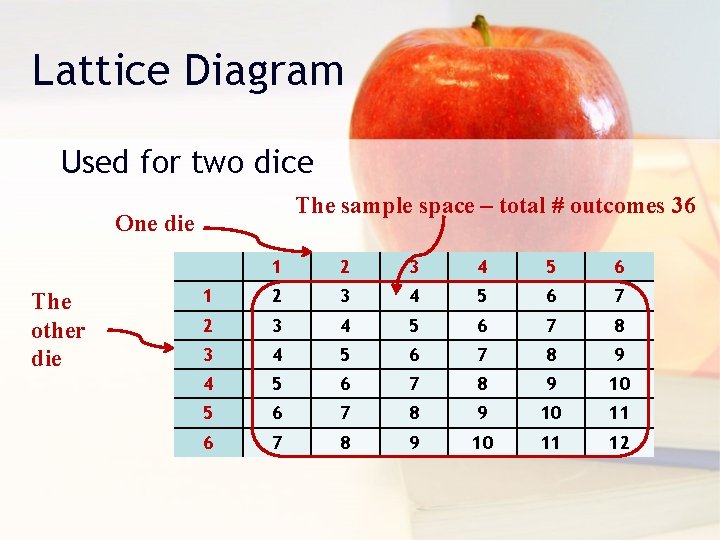
Lattice Diagram Used for two dice The sample space – total # outcomes 36 One die The other die 1 2 3 4 5 6 7 8 9 4 5 6 7 8 9 10 11 12
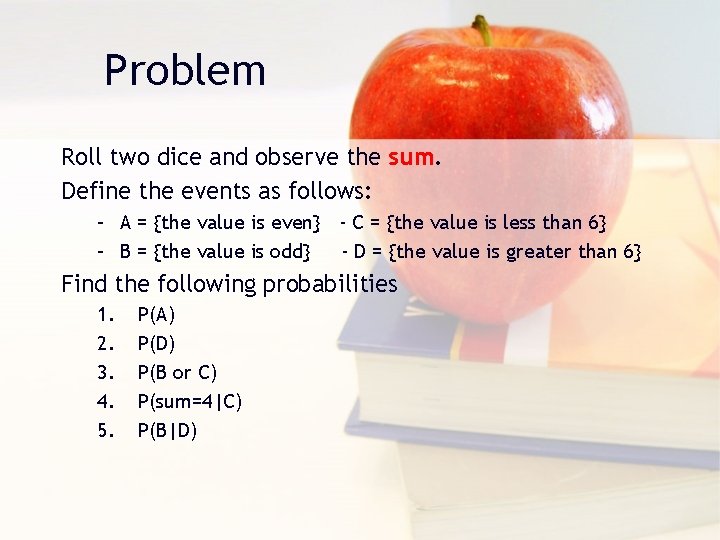
Problem Roll two dice and observe the sum. Define the events as follows: – A = {the value is even} - C = {the value is less than 6} – B = {the value is odd} - D = {the value is greater than 6} Find the following probabilities 1. 2. 3. 4. 5. P(A) P(D) P(B or C) P(sum=4|C) P(B|D)
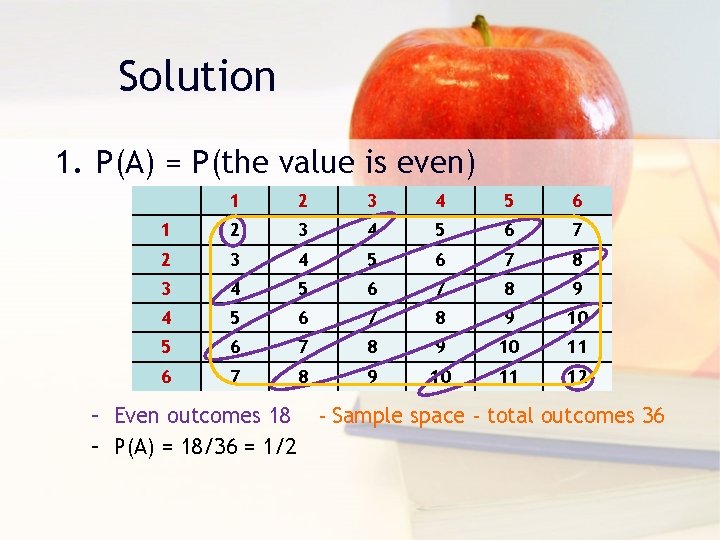
Solution 1. P(A) = P(the value is even) 1 2 3 4 5 6 7 8 9 4 5 6 7 8 9 10 11 12 – Even outcomes 18 - Sample space - total outcomes 36 – P(A) = 18/36 = 1/2
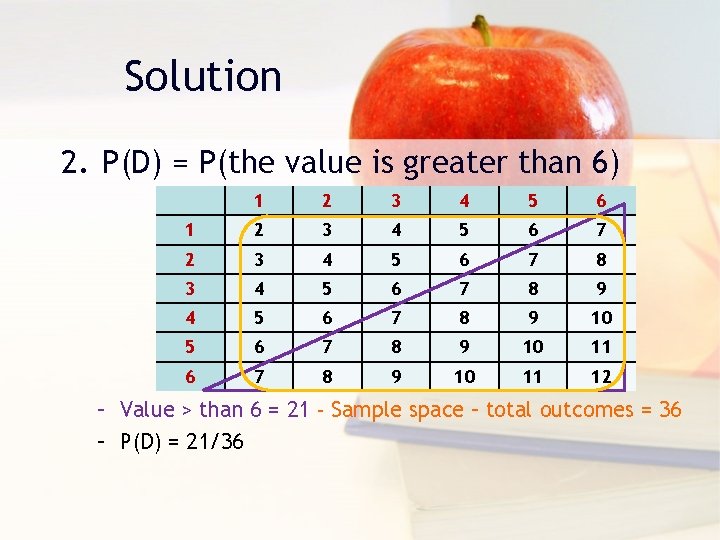
Solution 2. P(D) = P(the value is greater than 6) 1 2 3 4 5 6 7 8 9 4 5 6 7 8 9 10 11 12 – Value > than 6 = 21 - Sample space – total outcomes = 36 – P(D) = 21/36
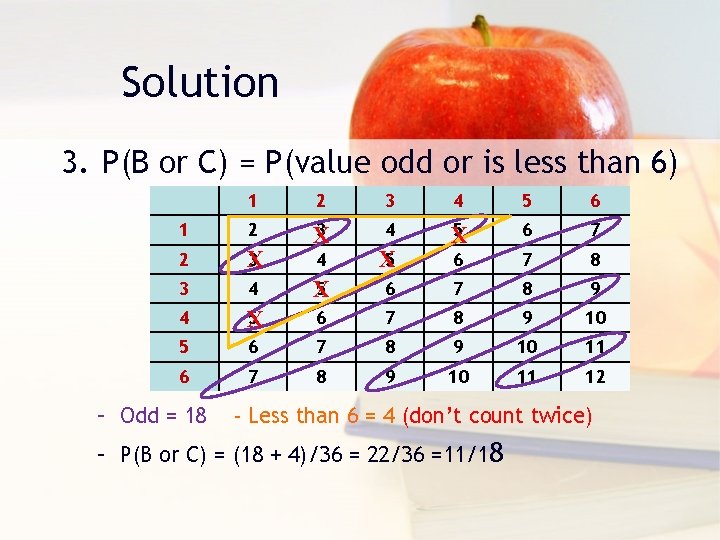
Solution 3. P(B or C) = P(value odd or is less than 6) 1 2 3 4 5 6 1 2 4 5 X 6 7 2 3 X 6 7 8 3 4 X 5 4 5 X 6 7 8 9 10 5 6 7 8 9 10 11 12 – Odd = 18 - Less than 6 = 4 (don’t count twice) – P(B or C) = (18 + 4)/36 = 22/36 =11/18
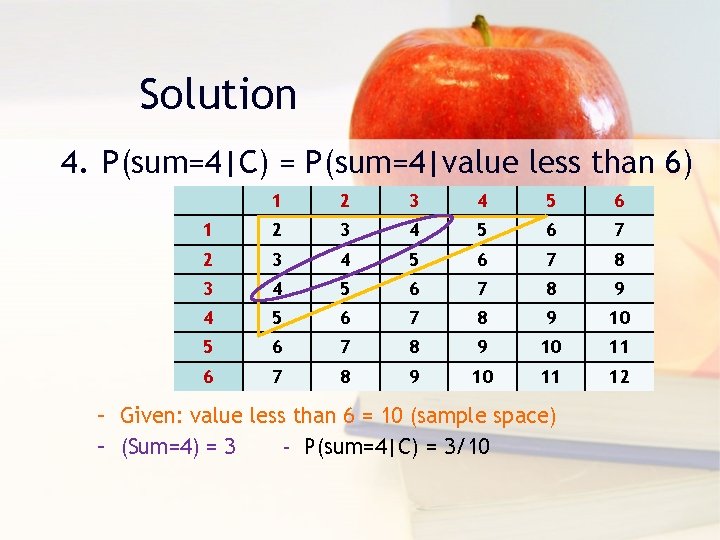
Solution 4. P(sum=4|C) = P(sum=4|value less than 6) 1 2 3 4 5 6 7 8 9 4 5 6 7 8 9 10 11 12 – Given: value less than 6 = 10 (sample space) – (Sum=4) = 3 - P(sum=4|C) = 3/10
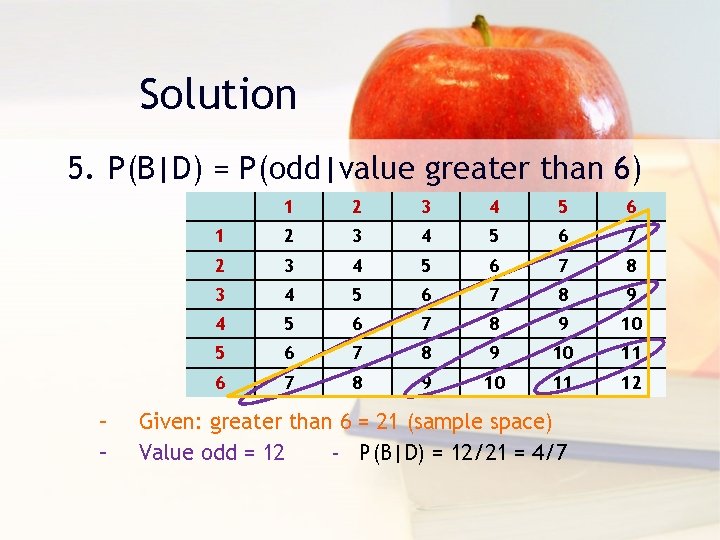
Solution 5. P(B|D) = P(odd|value greater than 6) – – 1 2 3 4 5 6 7 8 9 4 5 6 7 8 9 10 11 12 Given: greater than 6 = 21 (sample space) Value odd = 12 - P(B|D) = 12/21 = 4/7
4. Tree diagram
Tree Diagrams • A tree diagram helps us think through conditional probabilities by showing sequences of events as paths that look like branches of a tree. • Helps to calculate probabilities of complex events.
Probability Tree Diagrams - Steps 1. Draw the appropriate tree diagram. 2. Assign probabilities to each branch. (Each section sums to 1) 3. Multiply the probabilities along individual branches to find the probability of the outcome at the end of each branch. 4. Add the probabilities of the relevant outcomes, depending on the event.
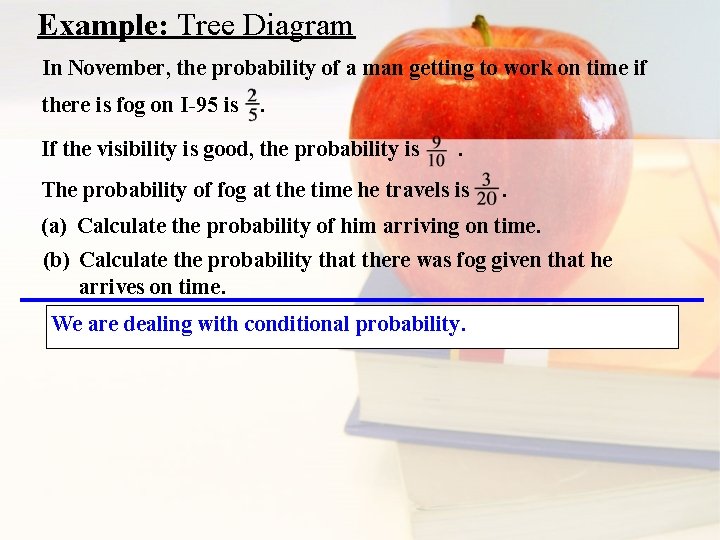
Example: Tree Diagram In November, the probability of a man getting to work on time if there is fog on I-95 is . If the visibility is good, the probability is . The probability of fog at the time he travels is . (a) Calculate the probability of him arriving on time. (b) Calculate the probability that there was fog given that he arrives on time. We are dealing with conditional probability.
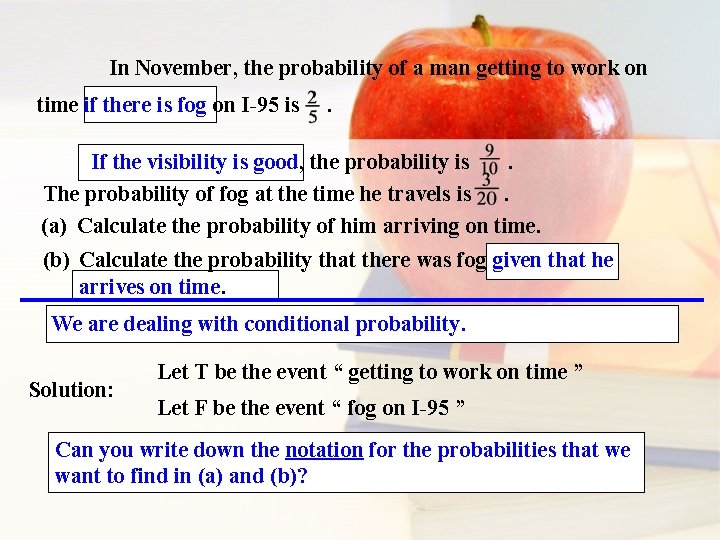
In November, the probability of a man getting to work on time if there is fog on I-95 is . If the visibility is good, the probability is. The probability of fog at the time he travels is. (a) Calculate the probability of him arriving on time. (b) Calculate the probability that there was fog given that he arrives on time. We are dealing with conditional probability. Solution: Let T be the event “ getting to work on time ” Let F be the event “ fog on I-95 ” Can you write down the notation for the probabilities that we want to find in (a) and (b)?
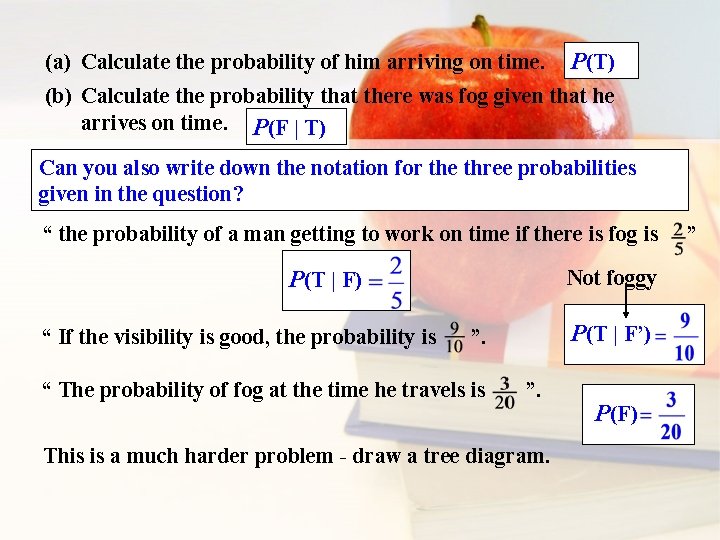
(a) Calculate the probability of him arriving on time. P(T) (b) Calculate the probability that there was fog given that he arrives on time. P(F | T) Can you also write down the notation for the three probabilities given in the question? “ the probability of a man getting to work on time if there is fog is P(T | F) “ If the visibility is good, the probability is Not foggy P(T | F’) ”. “ The probability of fog at the time he travels is ”. This is a much harder problem - draw a tree diagram. P(F) ”
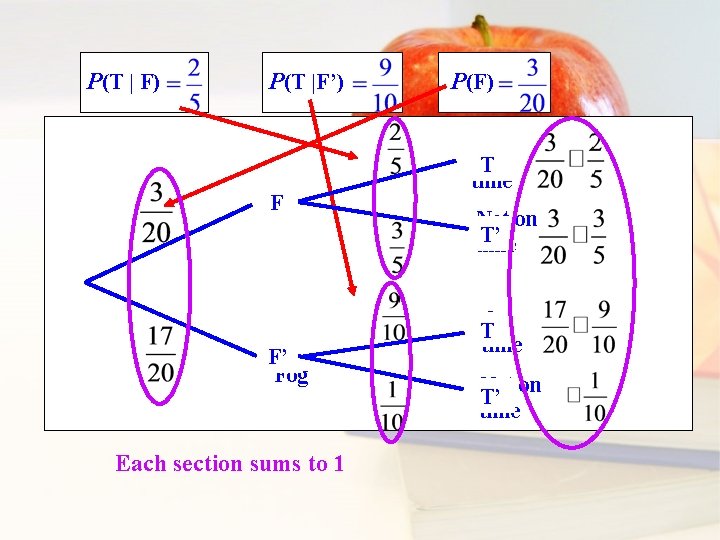
P(T | F) P(T |F’) F Fog No F’ Fog Each section sums to 1 P(F) On T time Not on T’ time
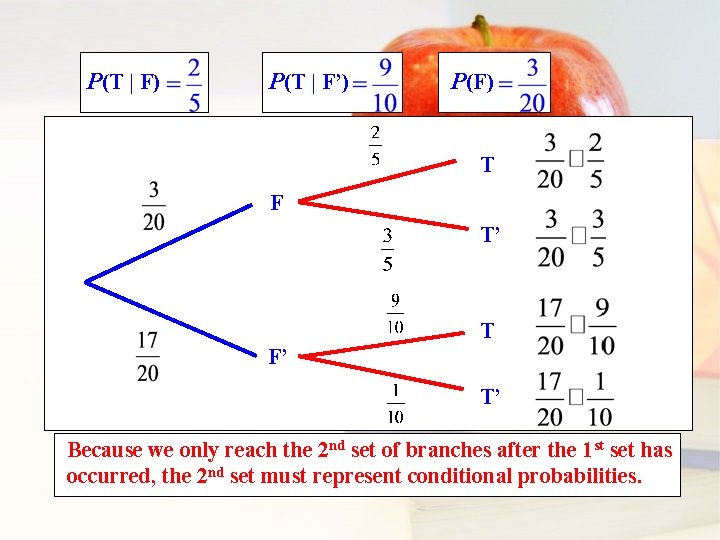
P(T | F) P(T | F’) P(F) T F T’ T F’ T’ Because we only reach the 2 nd set of branches after the 1 st set has occurred, the 2 nd set must represent conditional probabilities.
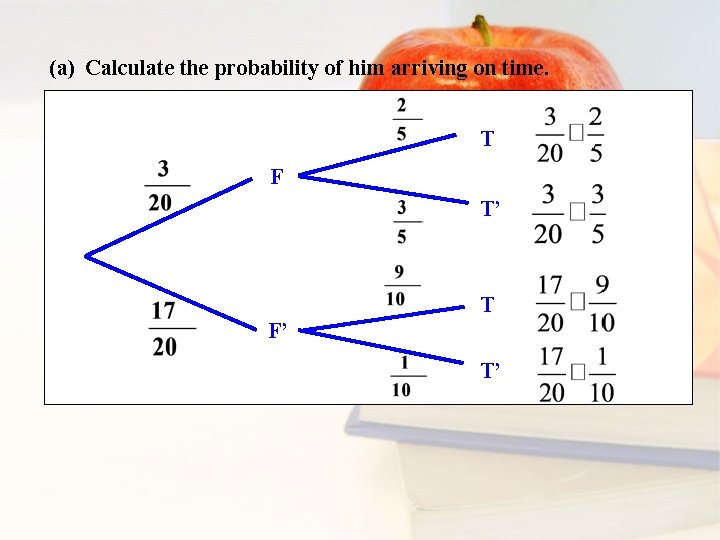
(a) Calculate the probability of him arriving on time. T F T’ T F’ T’
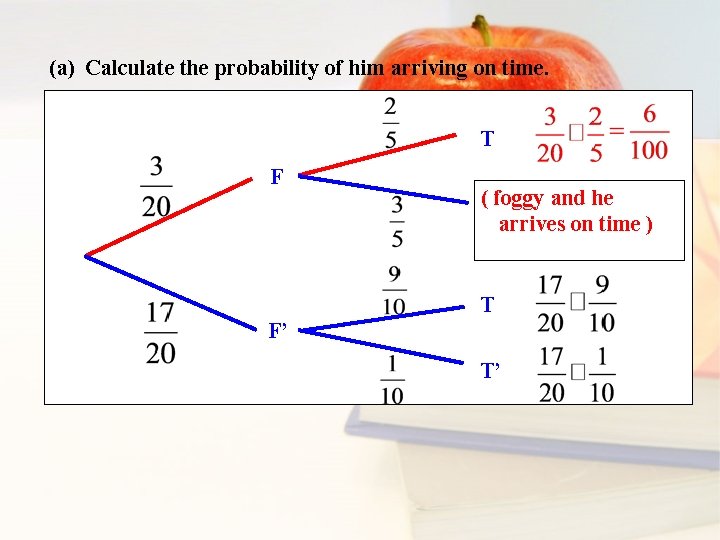
(a) Calculate the probability of him arriving on time. T F ( foggy and he T’ arrives on time ) T F’ T’
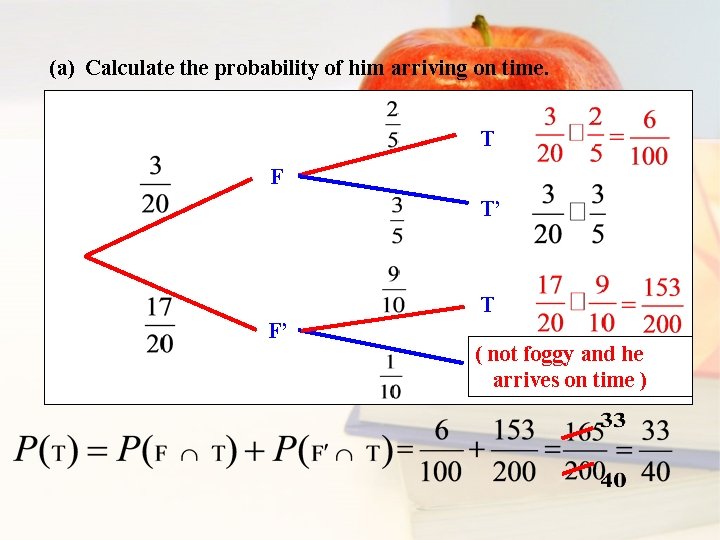
(a) Calculate the probability of him arriving on time. T F T’ T F’ ( not foggy and he T’arrives on time )
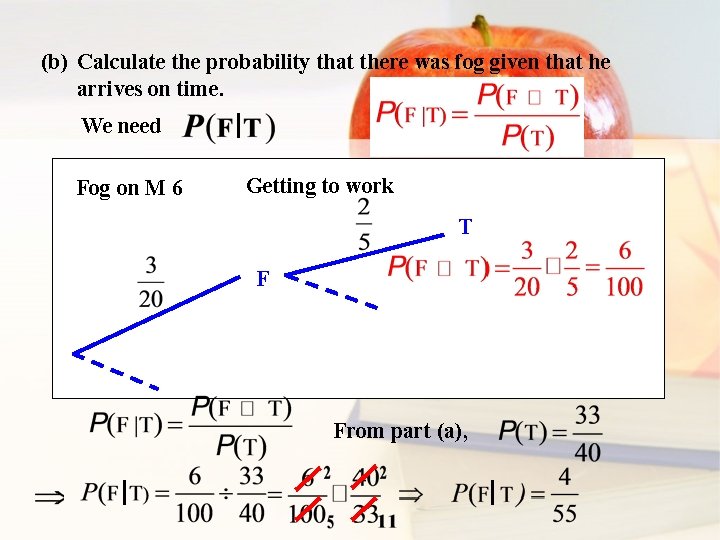
(b) Calculate the probability that there was fog given that he arrives on time. We need Fog on M 6 Getting to work T F From part (a),
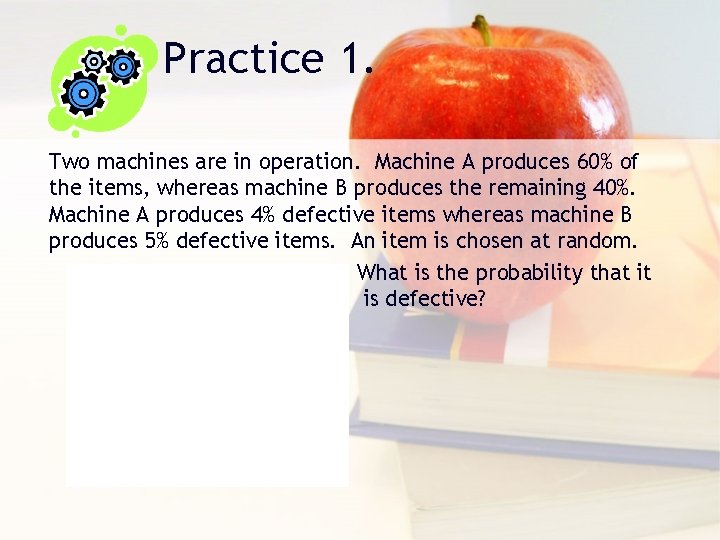
Practice 1. Two machines are in operation. Machine A produces 60% of the items, whereas machine B produces the remaining 40%. Machine A produces 4% defective items whereas machine B produces 5% defective items. An item is chosen at random. What is the probability that it 0. 04 def is defective? A 60% 40% 0. 96 good 0. 05 def B 0. 95 good
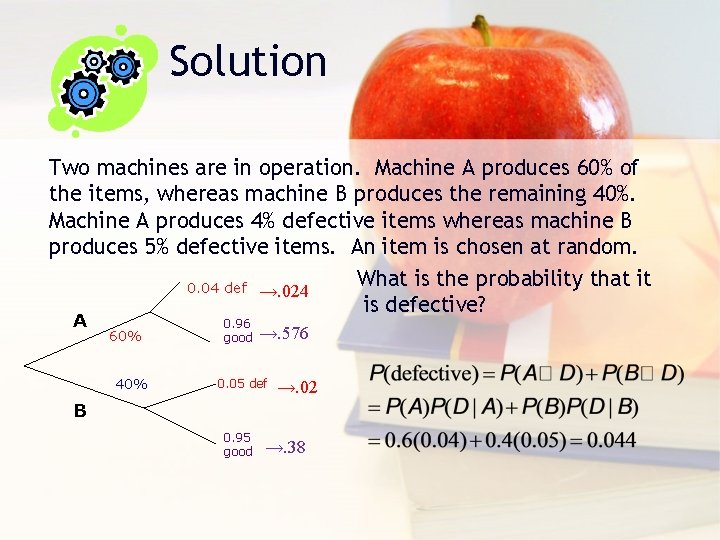
Solution Two machines are in operation. Machine A produces 60% of the items, whereas machine B produces the remaining 40%. Machine A produces 4% defective items whereas machine B produces 5% defective items. An item is chosen at random. What is the probability that it 0. 04 def →. 024 is defective? A 60% 40% 0. 96 good →. 576 0. 05 def →. 02 B 0. 95 good →. 38

Practice 2. The disease X has a 1% prevalence in the population. There is a test for X, and – If you are sick, the test is positive in 90% of cases. – If you are not sick, the test is positive in 10% of cases. You have a positive test. What is the probability that you are sick?
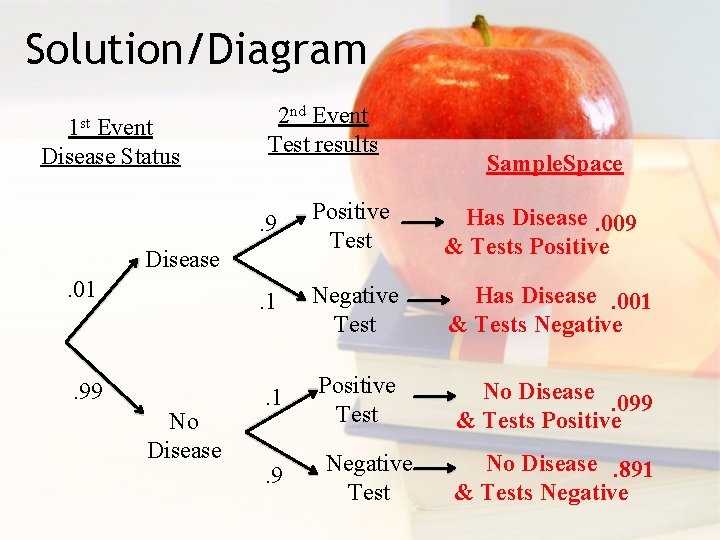
Solution/Diagram 1 st Event Disease Status 2 nd Event Test results Sample. Space . 9 Positive Test Has Disease. 009 & Tests Positive . 01 . 1 Negative Test Has Disease. 001 & Tests Negative . 99 . 1 Positive Test No Disease. 099 & Tests Positive Disease No Disease . 9 Negative Test No Disease. 891 & Tests Negative
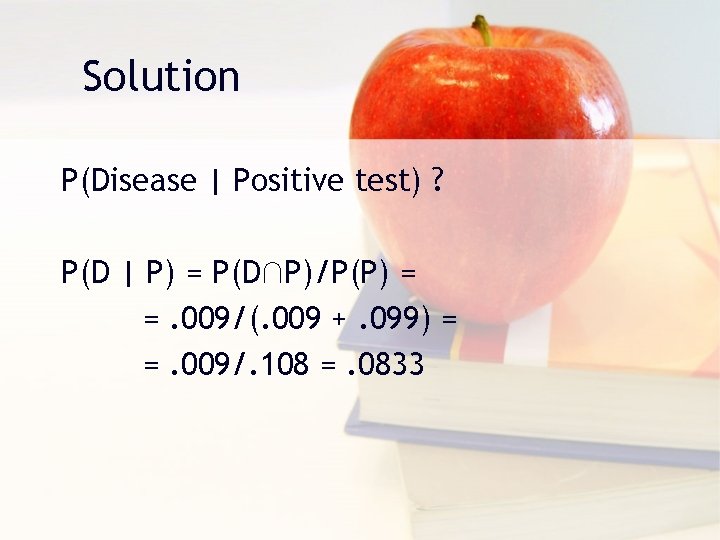
Solution P(Disease | Positive test) ? P(D | P) = P(D∩P)/P(P) = =. 009/(. 009 +. 099) = =. 009/. 108 =. 0833
- Slides: 78