
Probability Review ECS 152 A Acknowledgement slides from
Probability Review ECS 152 A Acknowledgement: slides from S. Kalyanaraman & B. Sikdar

Overview • Network Layer Performance Modeling & Analysis – Part I: Essentials of Probability – Part II: Inside a Router – Part III: Network Analysis 2
Network Layer Performance Modeling & Analysis: Part I Essential of Probability • Motivation • Basic Definitions • Modeling Experiments with Uncertainty • Random Variables: Geometric, Poisson, Exponential 3
Network Layer Performance Modeling & Analysis: Part I Essential of Probability • Read any of the probability references, e. g. Ross, Molloy, Papoulis, Stark and Wood • Check out online source: http: //www. cs. duke. edu/~fishhai/ misc/queue. pdf 4
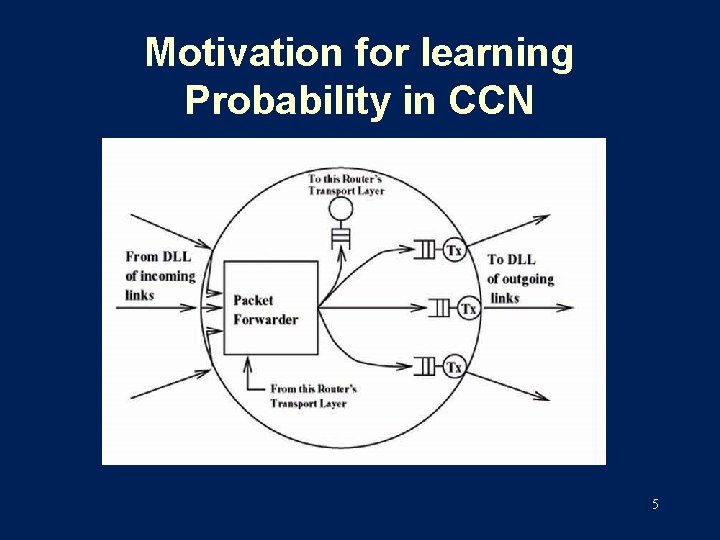
Motivation for learning Probability in CCN 5
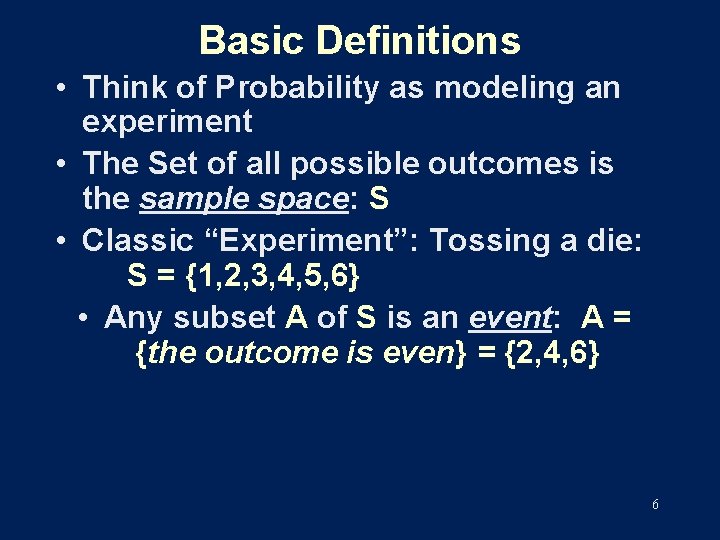
Basic Definitions • Think of Probability as modeling an experiment • The Set of all possible outcomes is the sample space: S • Classic “Experiment”: Tossing a die: S = {1, 2, 3, 4, 5, 6} • Any subset A of S is an event: A = {the outcome is even} = {2, 4, 6} 6
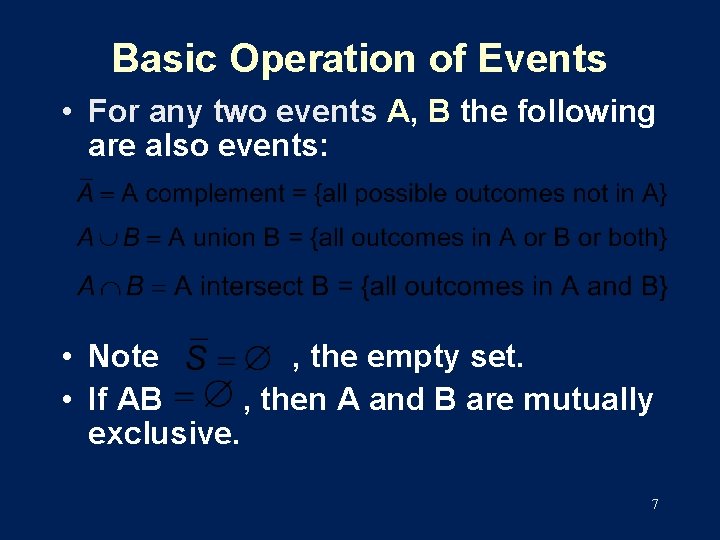
Basic Operation of Events • For any two events A, B the following are also events: • Note , the empty set. • If AB , then A and B are mutually exclusive. 7
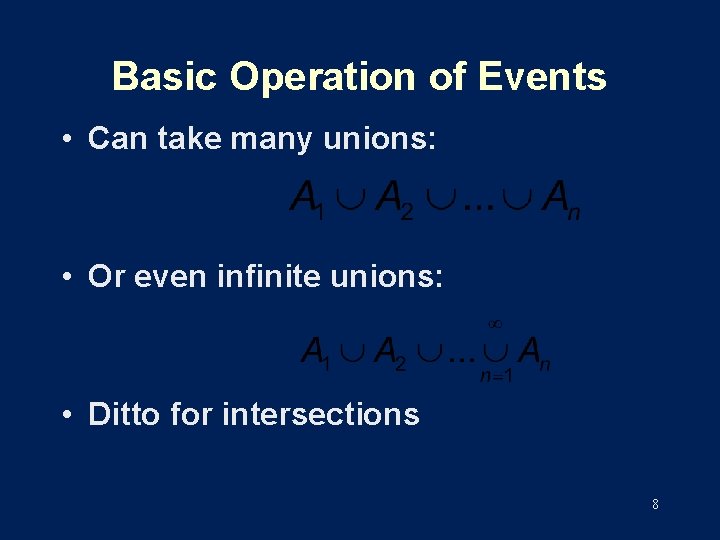
Basic Operation of Events • Can take many unions: • Or even infinite unions: • Ditto for intersections 8
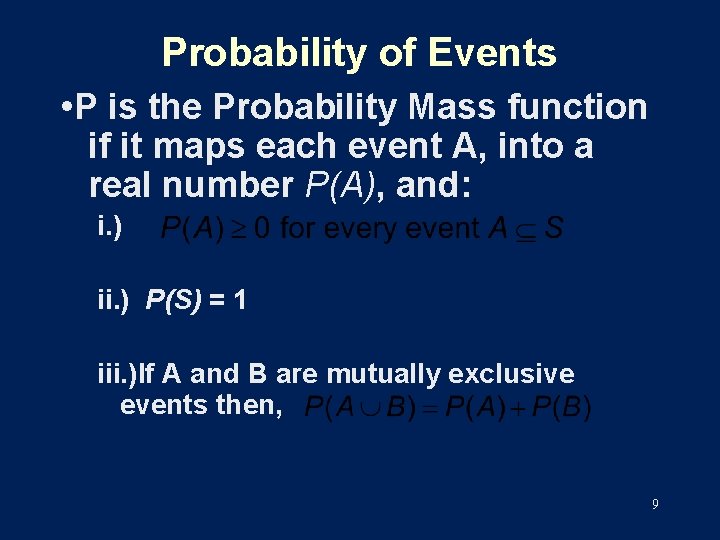
Probability of Events • P is the Probability Mass function if it maps each event A, into a real number P(A), and: i. ) ii. ) P(S) = 1 iii. )If A and B are mutually exclusive events then, 9
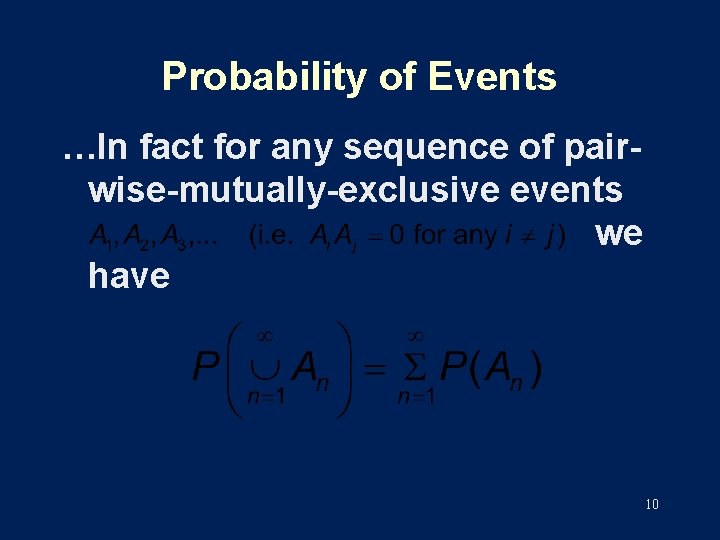
Probability of Events …In fact for any sequence of pairwise-mutually-exclusive events we have 10
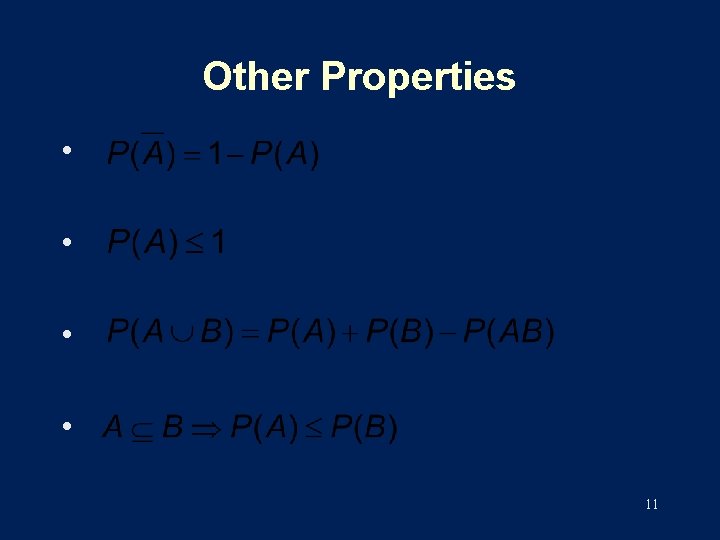
Other Properties • • 11
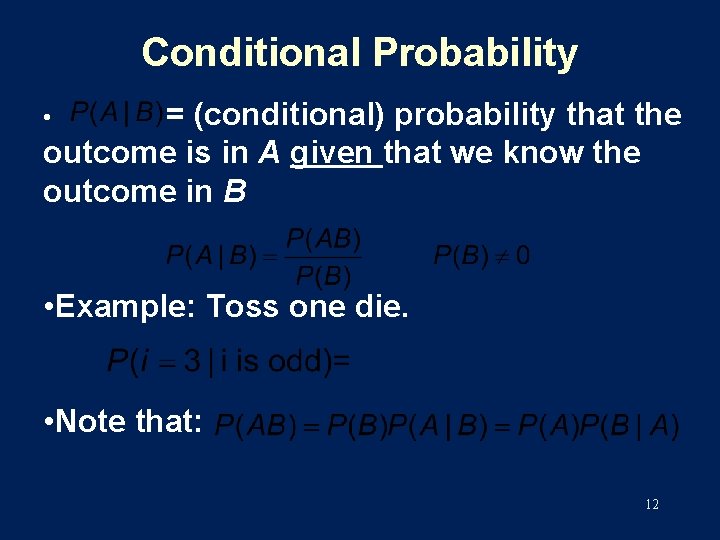
Conditional Probability = (conditional) probability that the outcome is in A given that we know the outcome in B • • Example: Toss one die. • Note that: 12
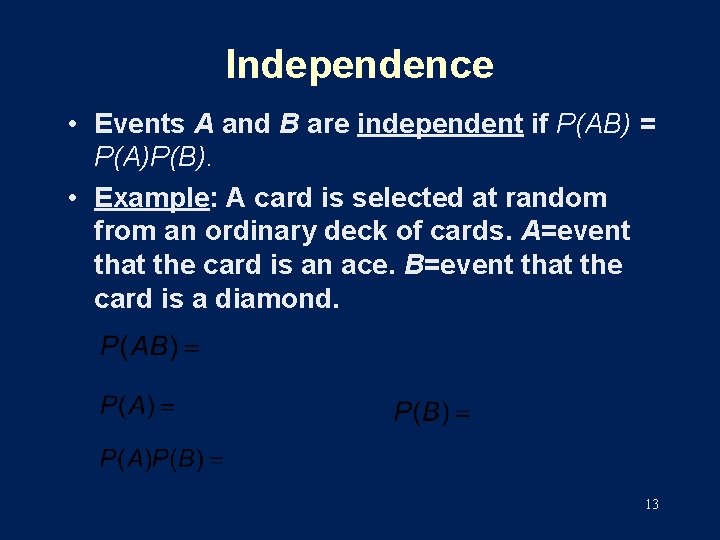
Independence • Events A and B are independent if P(AB) = P(A)P(B). • Example: A card is selected at random from an ordinary deck of cards. A=event that the card is an ace. B=event that the card is a diamond. 13
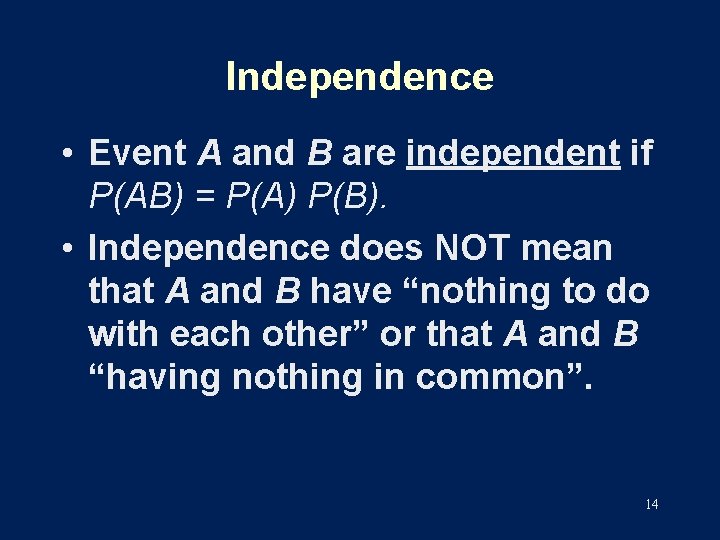
Independence • Event A and B are independent if P(AB) = P(A) P(B). • Independence does NOT mean that A and B have “nothing to do with each other” or that A and B “having nothing in common”. 14
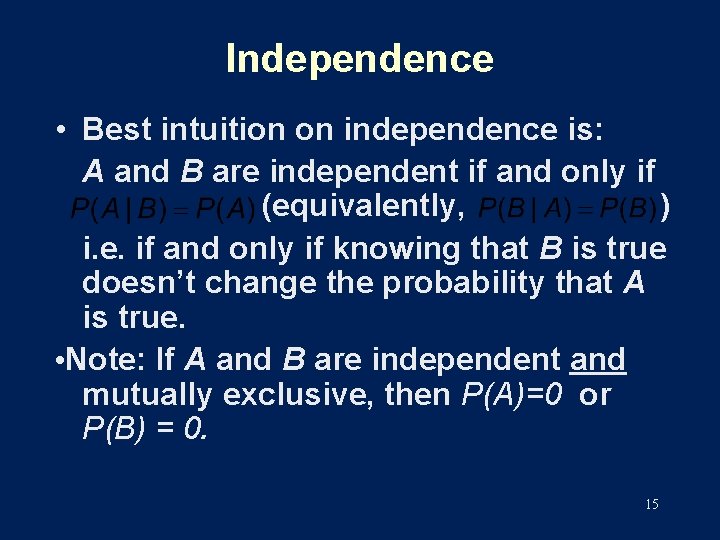
Independence • Best intuition on independence is: A and B are independent if and only if (equivalently, ) i. e. if and only if knowing that B is true doesn’t change the probability that A is true. • Note: If A and B are independent and mutually exclusive, then P(A)=0 or P(B) = 0. 15
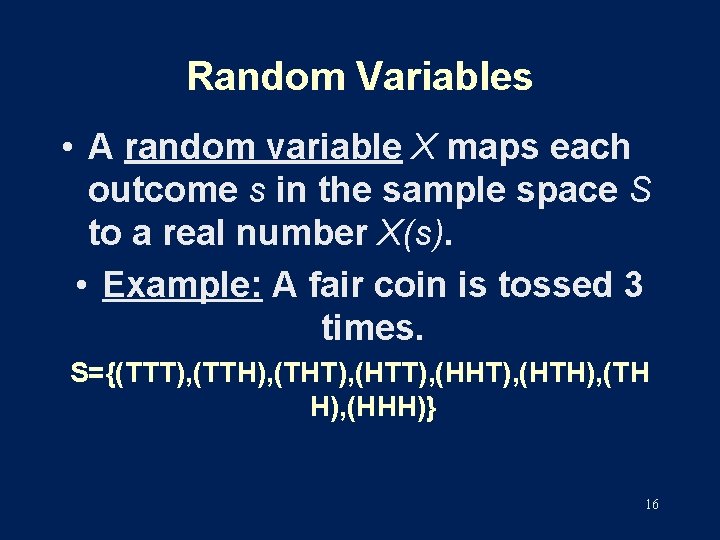
Random Variables • A random variable X maps each outcome s in the sample space S to a real number X(s). • Example: A fair coin is tossed 3 times. S={(TTT), (TTH), (THT), (HTT), (HHT), (HTH), (TH H), (HHH)} 16
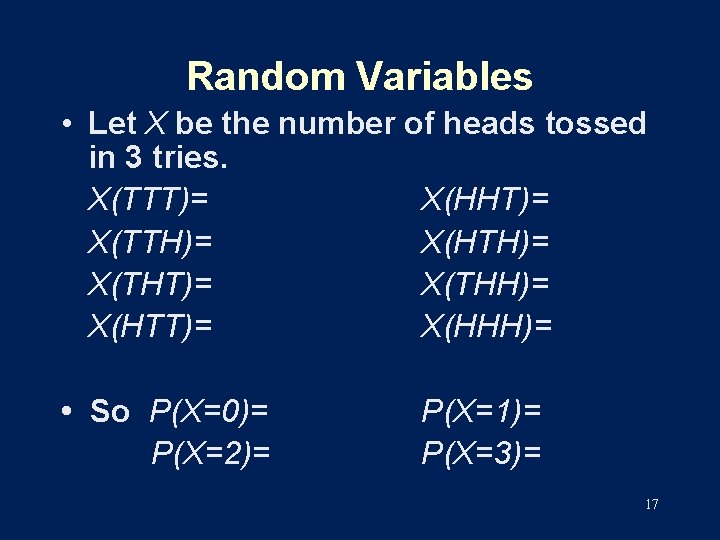
Random Variables • Let X be the number of heads tossed in 3 tries. X(TTT)= X(HHT)= X(TTH)= X(HTH)= X(THT)= X(THH)= X(HTT)= X(HHH)= • So P(X=0)= P(X=2)= P(X=1)= P(X=3)= 17
Random Variable as a Measurement • Think of much more complicated experiments – A chemical reaction. – A laser emitting photons. – A packet arriving at a router. 18
Random Variable as a Measurement • We cannot give an exact description of a sample space in these cases, but we can still describe specific measurements on them – The temperature change produced. – The number of photons emitted in one millisecond. – The time of arrival of the packet. 19
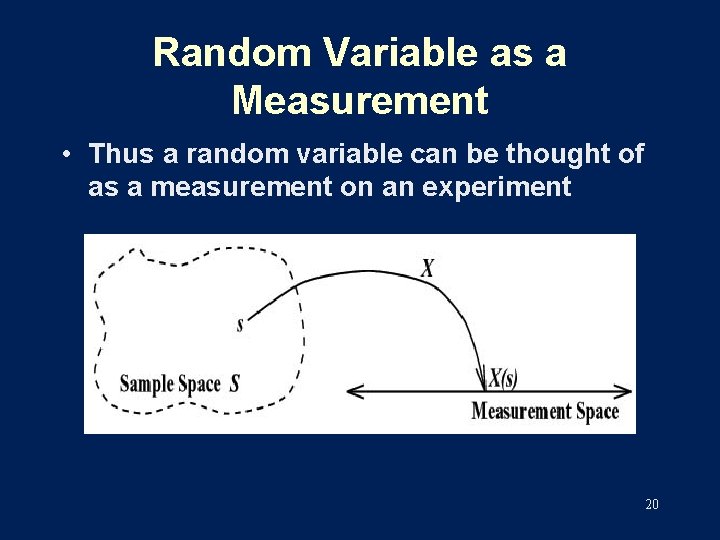
Random Variable as a Measurement • Thus a random variable can be thought of as a measurement on an experiment 20
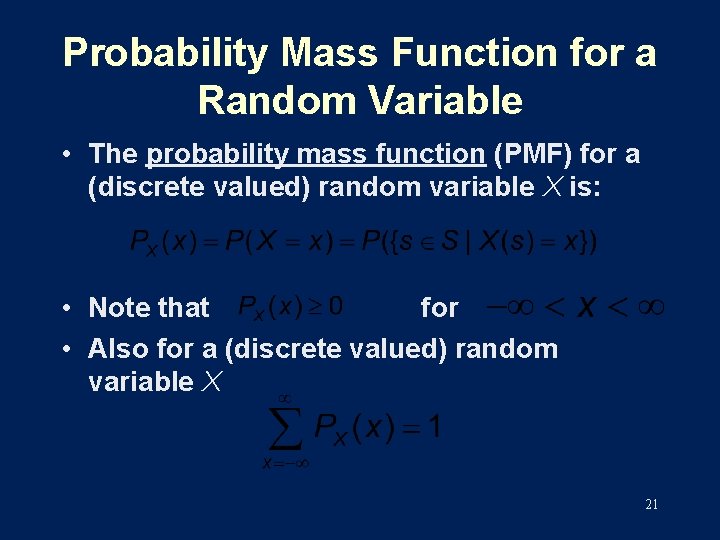
Probability Mass Function for a Random Variable • The probability mass function (PMF) for a (discrete valued) random variable X is: • Note that for • Also for a (discrete valued) random variable X 21
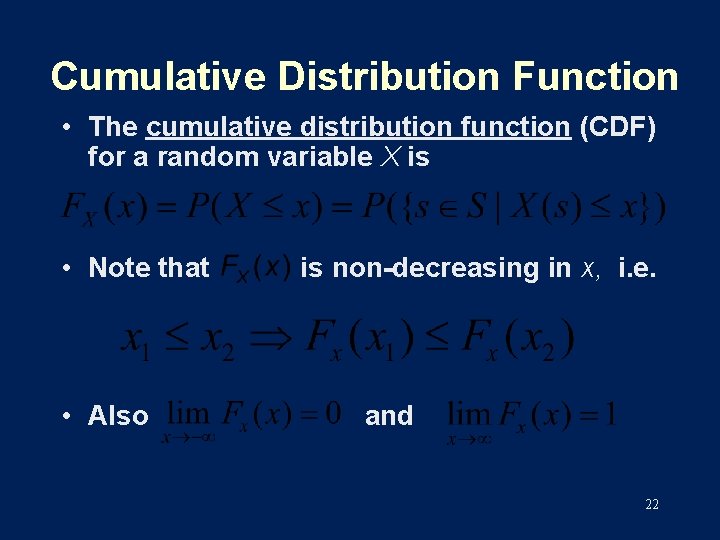
Cumulative Distribution Function • The cumulative distribution function (CDF) for a random variable X is • Note that • Also is non-decreasing in x, i. e. and 22
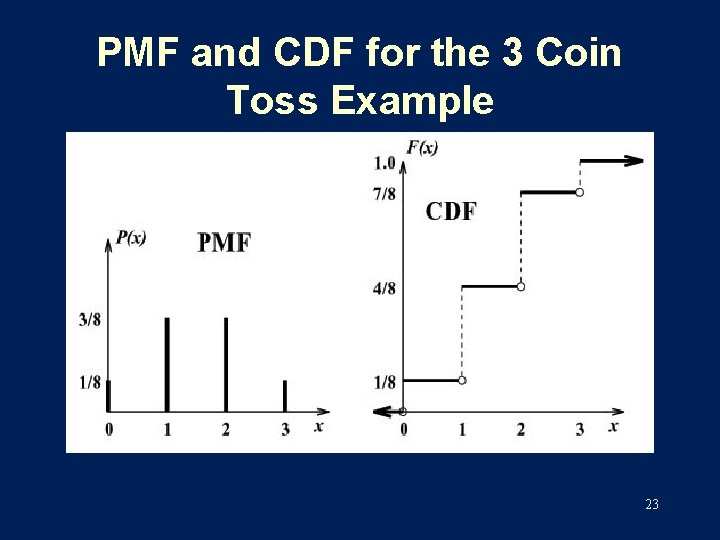
PMF and CDF for the 3 Coin Toss Example 23
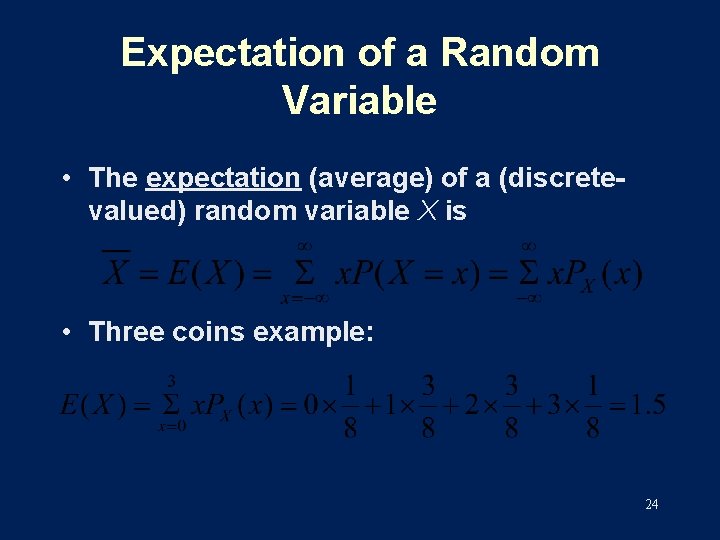
Expectation of a Random Variable • The expectation (average) of a (discretevalued) random variable X is • Three coins example: 24
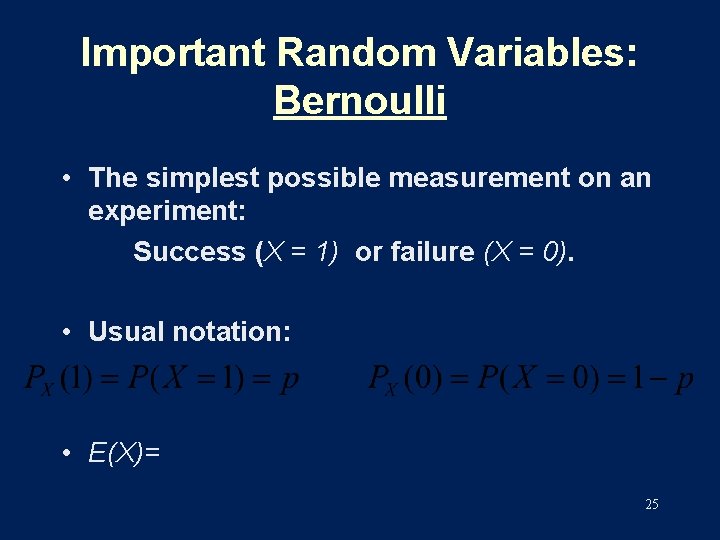
Important Random Variables: Bernoulli • The simplest possible measurement on an experiment: Success (X = 1) or failure (X = 0). • Usual notation: • E(X)= 25
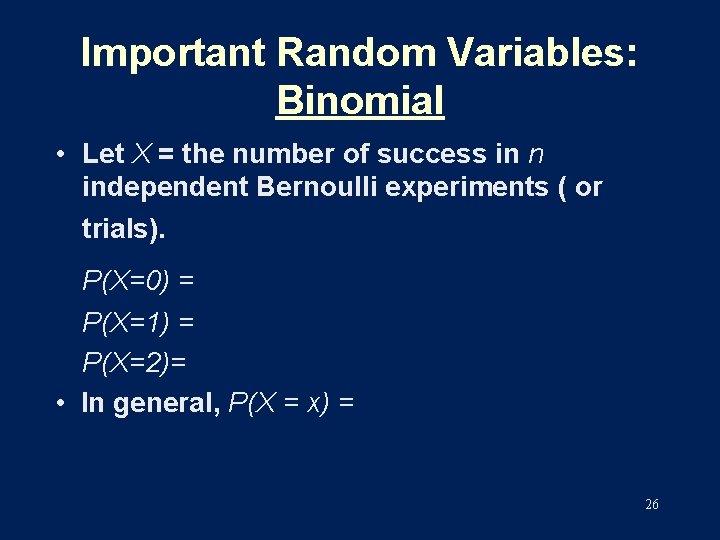
Important Random Variables: Binomial • Let X = the number of success in n independent Bernoulli experiments ( or trials). P(X=0) = P(X=1) = P(X=2)= • In general, P(X = x) = 26
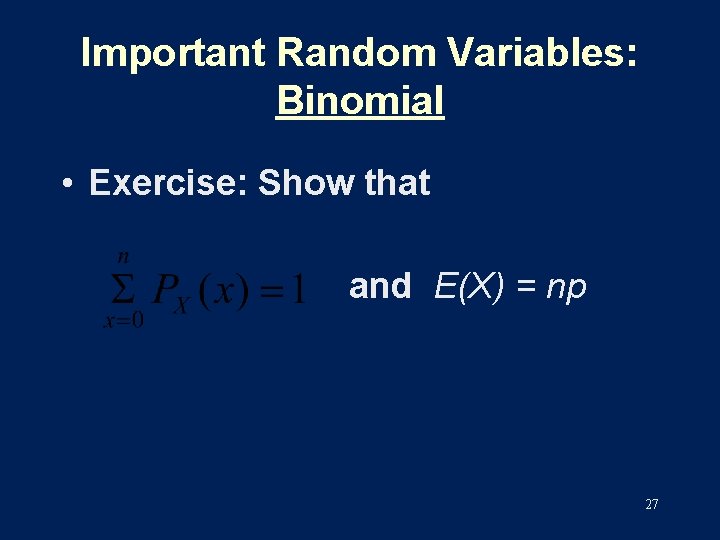
Important Random Variables: Binomial • Exercise: Show that and E(X) = np 27
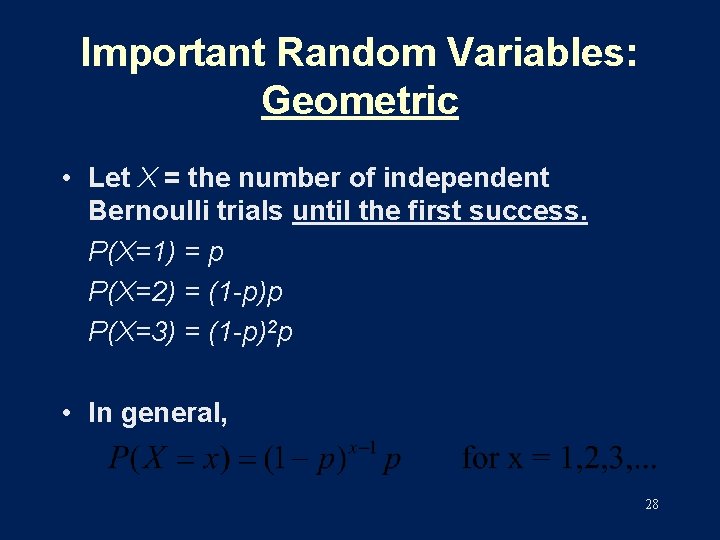
Important Random Variables: Geometric • Let X = the number of independent Bernoulli trials until the first success. P(X=1) = p P(X=2) = (1 -p)p P(X=3) = (1 -p)2 p • In general, 28
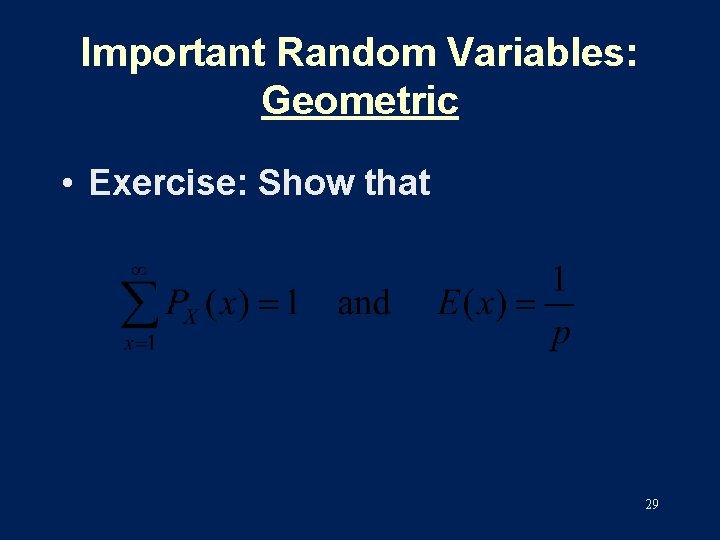
Important Random Variables: Geometric • Exercise: Show that 29
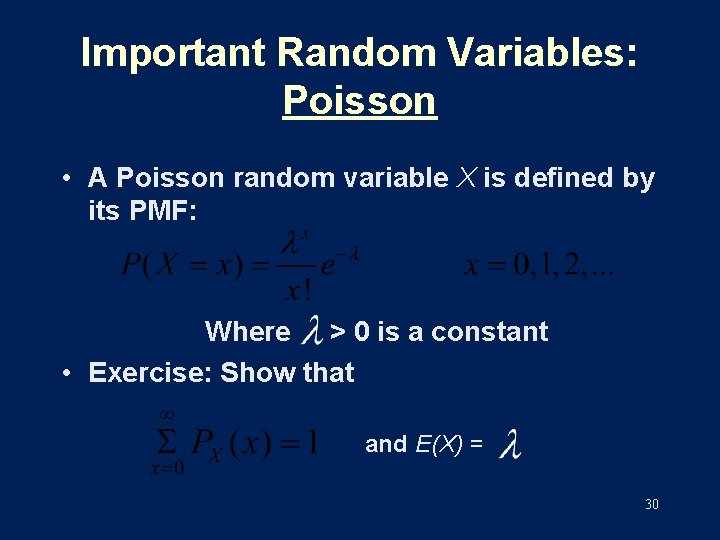
Important Random Variables: Poisson • A Poisson random variable X is defined by its PMF: Where > 0 is a constant • Exercise: Show that and E(X) = 30
Important Random Variables: Poisson • Poisson random variables are good for counting things like the number of customers that arrive to a bank in one hour, or the number of packets that arrive to a router in one second. 31
Continuous-valued Random Variables • So far we have focused on discrete(valued) random variables, e. g. X(s) must be an integer • Examples of discrete random variables: number of arrivals in one second, number of attempts until sucess 32
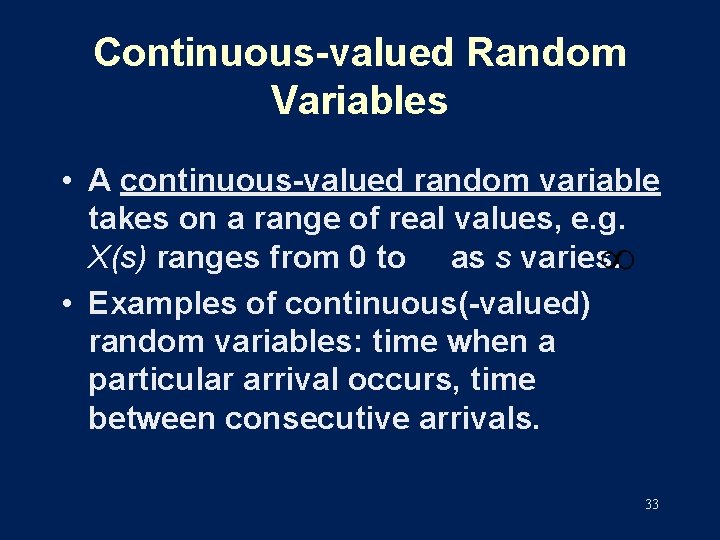
Continuous-valued Random Variables • A continuous-valued random variable takes on a range of real values, e. g. X(s) ranges from 0 to as s varies. • Examples of continuous(-valued) random variables: time when a particular arrival occurs, time between consecutive arrivals. 33
Continuous-valued Random Variables • A discrete random variable has a “staircase” CDF. • A continuous random variable has (some) continuous slope to its CDF. 34
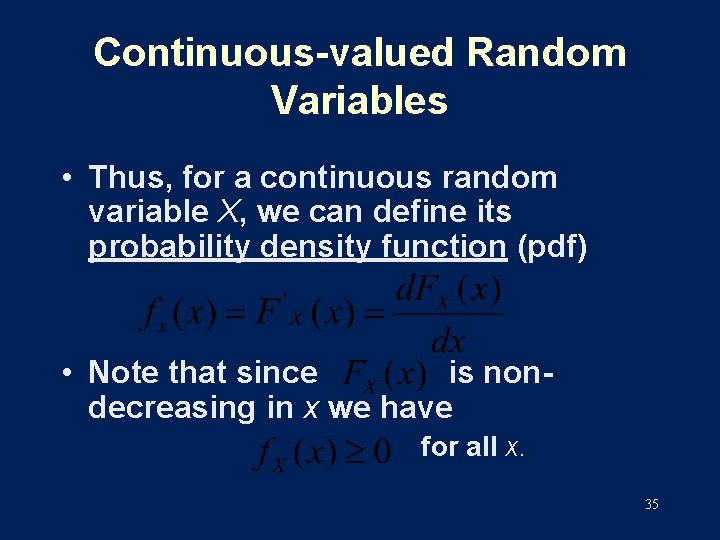
Continuous-valued Random Variables • Thus, for a continuous random variable X, we can define its probability density function (pdf) • Note that since is nondecreasing in x we have for all x. 35
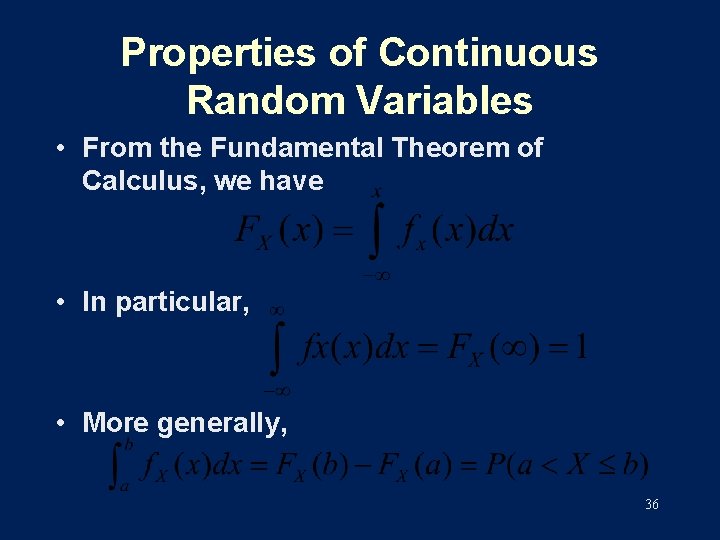
Properties of Continuous Random Variables • From the Fundamental Theorem of Calculus, we have • In particular, • More generally, 36
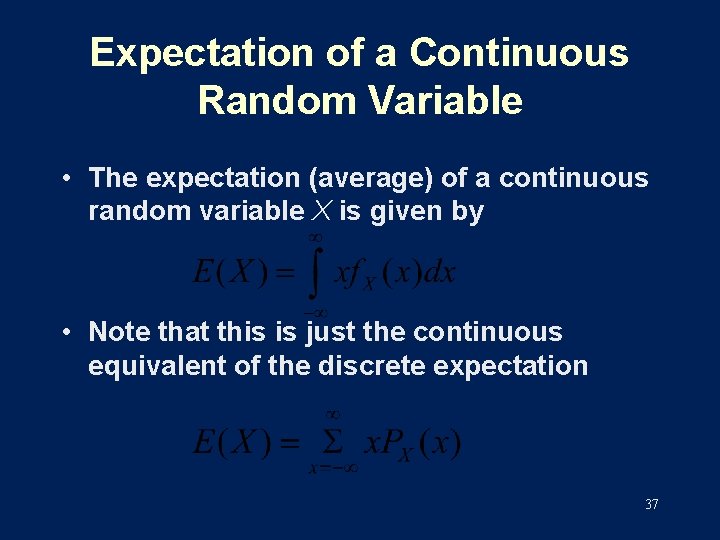
Expectation of a Continuous Random Variable • The expectation (average) of a continuous random variable X is given by • Note that this is just the continuous equivalent of the discrete expectation 37
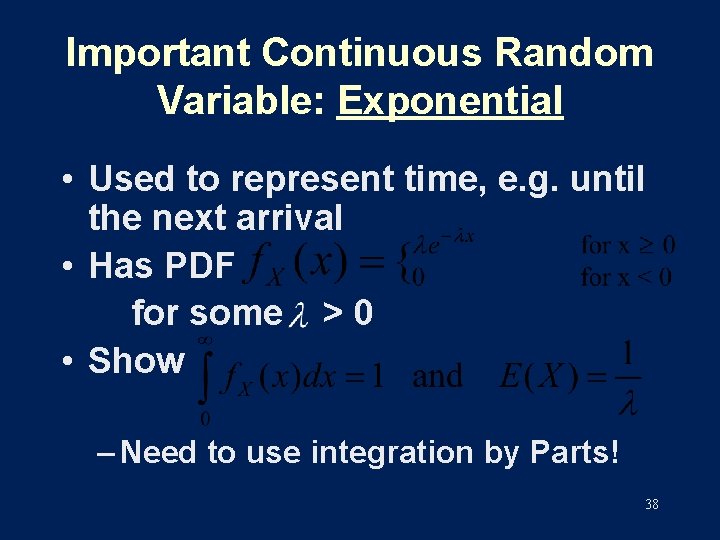
Important Continuous Random Variable: Exponential • Used to represent time, e. g. until the next arrival • Has PDF for some > 0 • Show – Need to use integration by Parts! 38
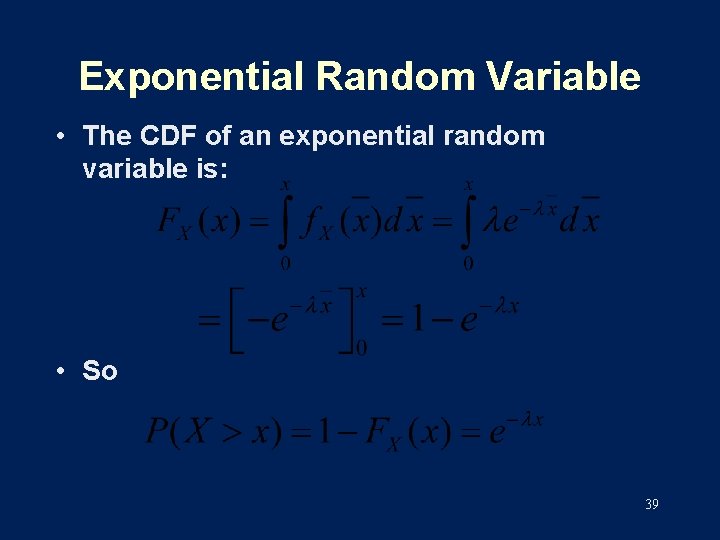
Exponential Random Variable • The CDF of an exponential random variable is: • So 39
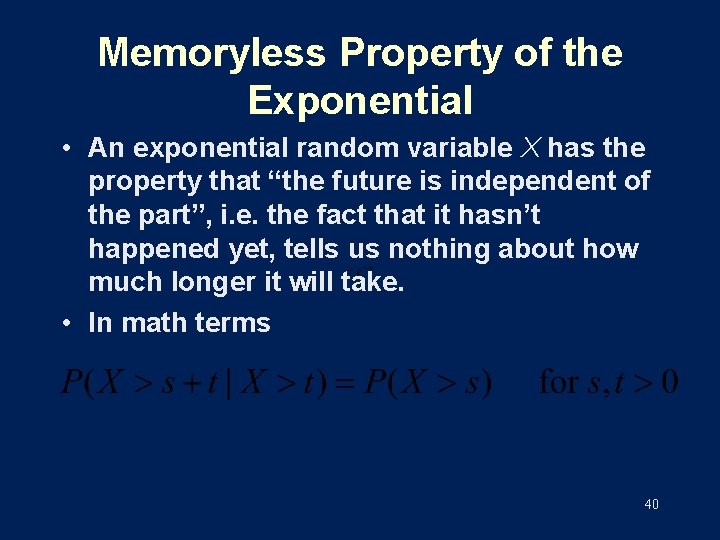
Memoryless Property of the Exponential • An exponential random variable X has the property that “the future is independent of the part”, i. e. the fact that it hasn’t happened yet, tells us nothing about how much longer it will take. • In math terms 40
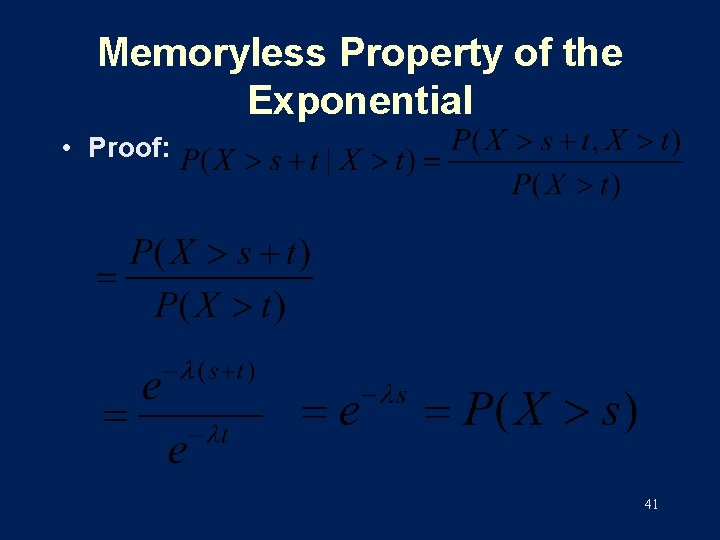
Memoryless Property of the Exponential • Proof: 41
- Slides: 41