
Probability Probability n The ratio of favorable outcomes
Probability
Probability n The ratio of favorable outcomes to possible outcomes, or in other words the likelihood (or chance) that something will happen n Can be represented as a fraction (ratio), percent, or decimal n 2 Types: – Theoretical – Experimental
Probability Theoretical Experimental
Theoretical Probability n Determined through mathematical means n Example: What is the probability of obtaining tails when flipping a coin?
n Visit http: //www. unitedstreaming. com and view a video segment from the video Discovering Math: Probability (Grades 6 -8) called Example 2: Multiple Events--Number Cubes Citation (MLA) Discovering Math: Probability (Grades 6 -8). Discovery Channel School. 2006. unitedstreaming. 3 June 2008 <http: //streaming. discoveryeducation. com/>
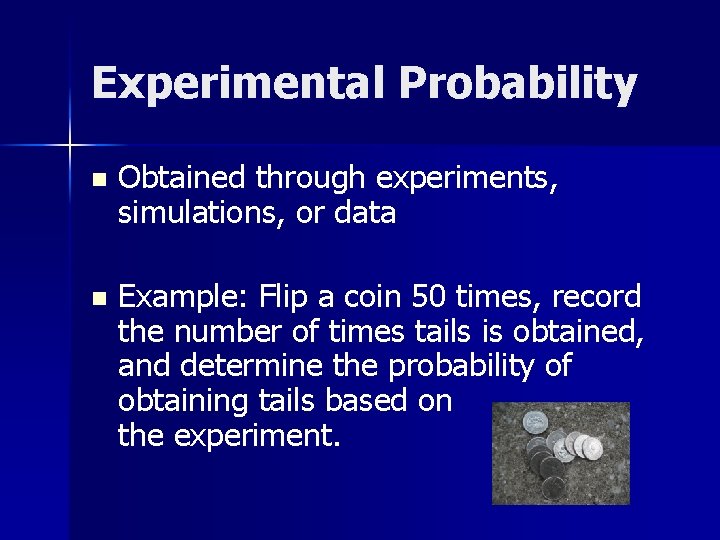
Experimental Probability n Obtained through experiments, simulations, or data n Example: Flip a coin 50 times, record the number of times tails is obtained, and determine the probability of obtaining tails based on the experiment.
n Visit http: //www. unitedstreaming. com and view a video segment from the video Discovering Math: Probability (Grades 6 -8) called Example 1: Historical Probability—Basketball Free Throws Citation (MLA) Discovering Math: Probability (Grades 6 -8). Discovery Channel School. 2006. unitedstreaming. 3 June 2008 <http: //streaming. discoveryeducation. com/>
Differences n What would make theoretical probabilities and experimental probabilities differ? n What needs to be done to bring an experimental probability closer to a theoretical probability?
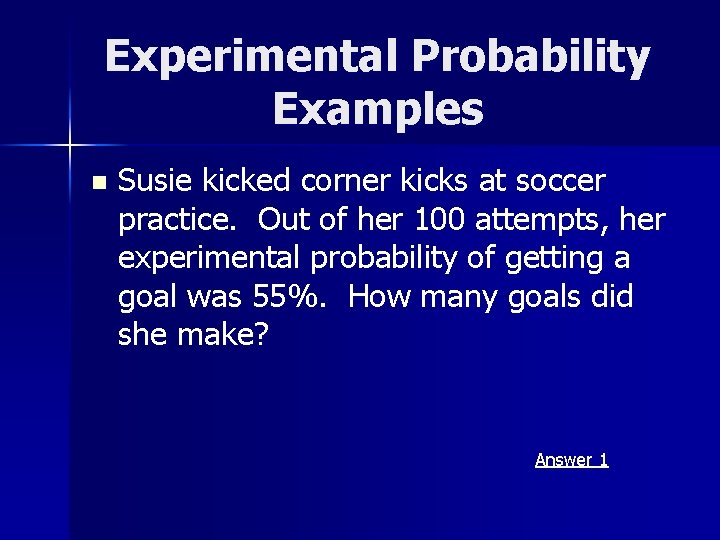
Experimental Probability Examples n Susie kicked corner kicks at soccer practice. Out of her 100 attempts, her experimental probability of getting a goal was 55%. How many goals did she make? Answer 1
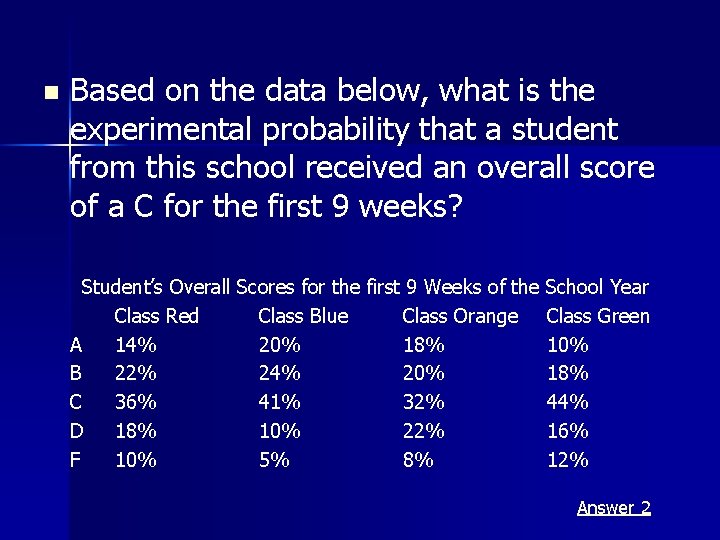
n Based on the data below, what is the experimental probability that a student from this school received an overall score of a C for the first 9 weeks? Student’s Overall Scores for the first 9 Weeks of the School Year Class Red Class Blue Class Orange Class Green A 14% 20% 18% 10% B 22% 24% 20% 18% C 36% 41% 32% 44% D 18% 10% 22% 16% F 10% 5% 8% 12% Answer 2
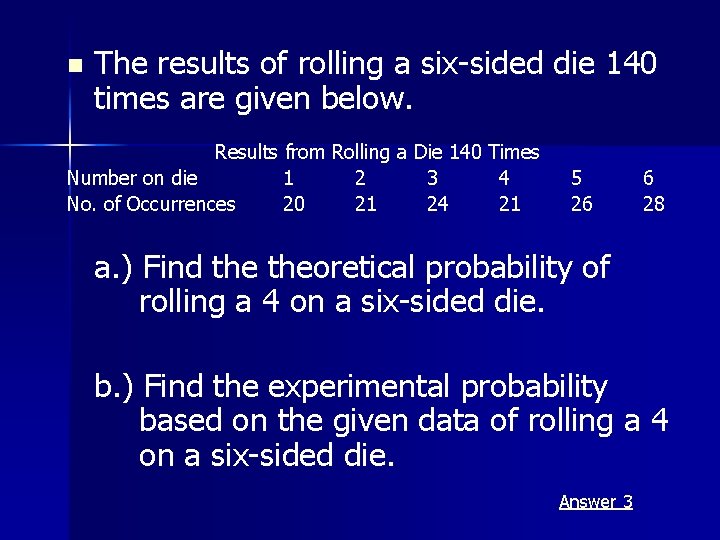
n The results of rolling a six-sided die 140 times are given below. Results from Rolling a Die 140 Times Number on die 1 2 3 4 No. of Occurrences 20 21 24 21 5 26 6 28 a. ) Find theoretical probability of rolling a 4 on a six-sided die. b. ) Find the experimental probability based on the given data of rolling a 4 on a six-sided die. Answer 3
n Let’s conduct our own simulations and find the respective probabilities. Simulation Time!

The End
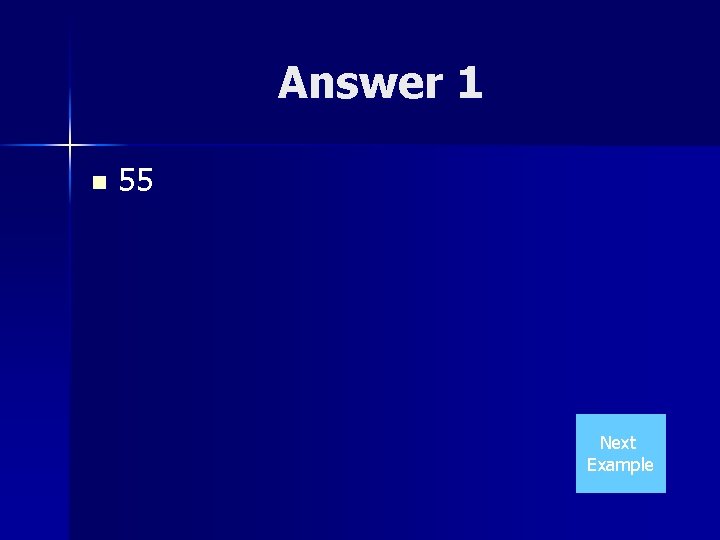
Answer 1 n 55 Next Example
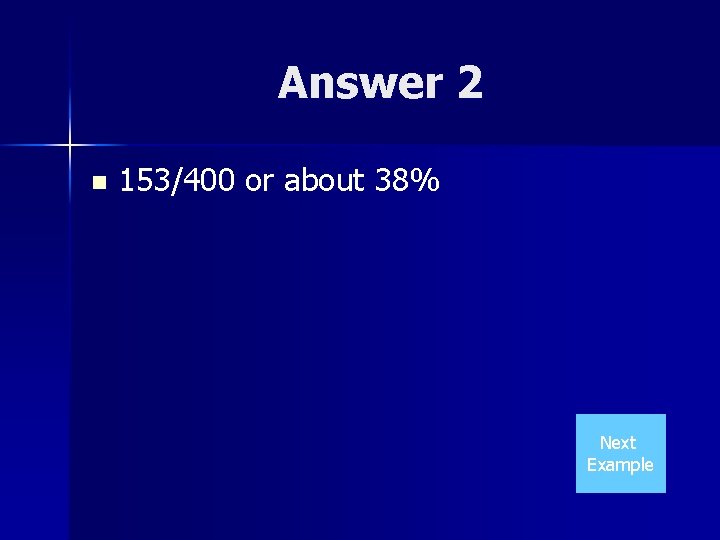
Answer 2 n 153/400 or about 38% Next Example
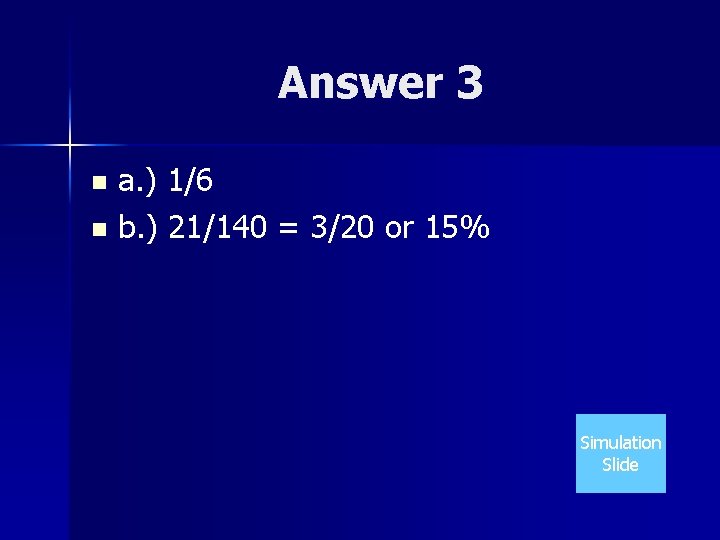
Answer 3 a. ) 1/6 n b. ) 21/140 = 3/20 or 15% n Simulation Slide
- Slides: 16