
Probability Probability An experiment is any process that
Probability
Probability An experiment is any process that allows researchers to obtain observations and which leads to a single outcome which cannot be predicted with certainty
Probability An experiment is any process that allows researchers to obtain observations and which leads to a single outcome which cannot be predicted with certainty Example: A coin is tossed…possible outcomes are H, T. Example: Two coins are tossed…possible outcomes are HH, HT, TH, TT.
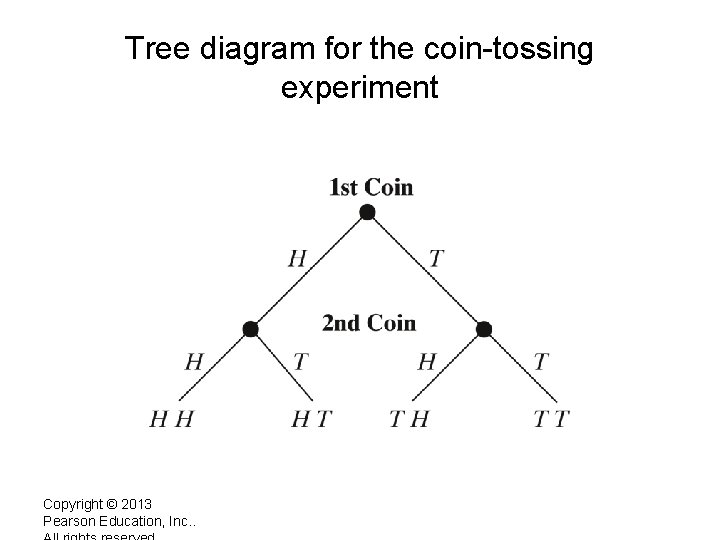
Tree diagram for the coin-tossing experiment Copyright © 2013 Pearson Education, Inc. .

Probability An outcome is also called a sample point. The collection of all possible sample points is called the sample space. .
Probability An outcome is also called a sample point. The collection of all possible sample points is called the sample space. Example: Roll a die and observe the result. The sample space consists of the set S = {1, 2, 3, 4, 5, 6}

Example When we roll two dice the sample space is all 36 possible pairs of rolls 1, 1 2, 1 3, 1 4, 1 5, 1 6, 1 1, 2 2, 2 3, 2 4, 2 5, 2 6, 2 1, 3 2, 3 3, 3 4, 3 5, 3 6, 3 1, 4 2, 4 3, 4 4, 4 5, 4 6, 4 1, 5 2, 5 3, 5 4, 5 5, 5 6, 5 1, 6 2, 6 3, 6 4, 6 5, 6 6, 6
The probability of a single outcome If an experiment is repeated many times, and if a particular outcome is known or observed to occur, for example, 1/6 th of the time, we say that the probability of that outcome is 1/6. Sometimes one can compute probabilities exactly. E. g. , if a bowl contains 5 red chips and 3 Blue chips and if a chip is selected at random, then the probability a blue chip is selected is 3/8. In general, it may be difficult to determine the probability of an outcome. (for example, what is the probability of rain tomorrow).
In general, the probabilty that a particular outcome occurs is defined to be the fraction of times which that outcome occurs in the long run.
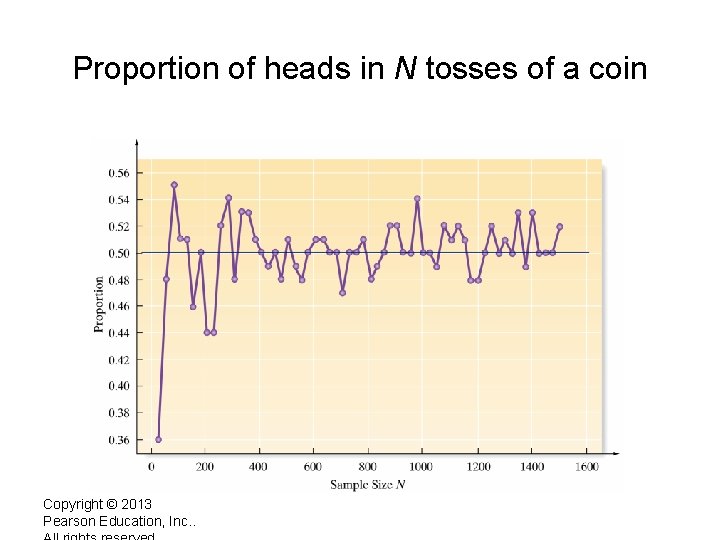
Proportion of heads in N tosses of a coin Copyright © 2013 Pearson Education, Inc. .

Equi-probability sample spaces A sample space S in which all sample points are equally likely to occur is called an equi-probability space. Definition: For an equi-probability space, the probability of a particular outcome is 1/n, where n is the number of sample points in S.
Example A coin is tossed and a die is rolled. What is the probability that the outcome is H 6?
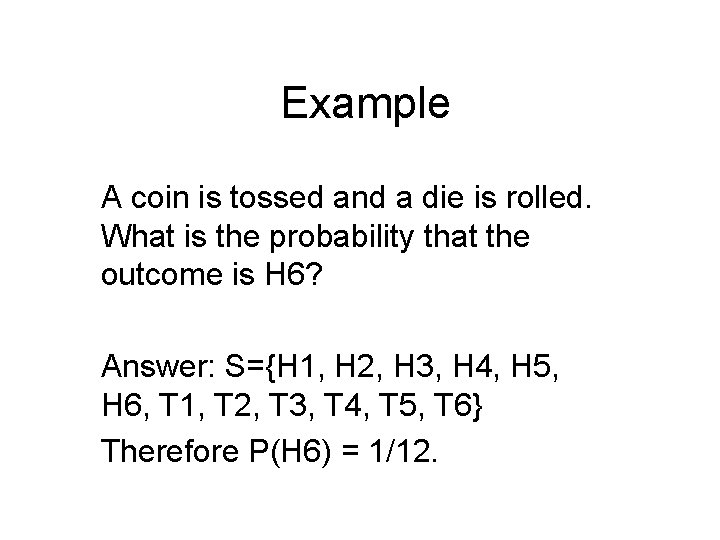
Example A coin is tossed and a die is rolled. What is the probability that the outcome is H 6? Answer: S={H 1, H 2, H 3, H 4, H 5, H 6, T 1, T 2, T 3, T 4, T 5, T 6} Therefore P(H 6) = 1/12.
Events It turns out that we are usually interested NOT in a single outcome, but rather a collection of outcomes forming a subset of the sample space. Definition: An event is a specific collection of sample points.
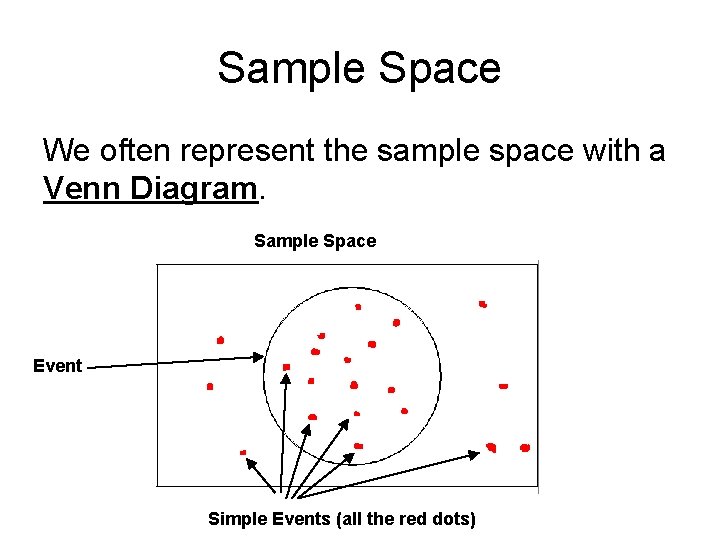
Sample Space We often represent the sample space with a Venn Diagram. Sample Space Event Simple Events (all the red dots)
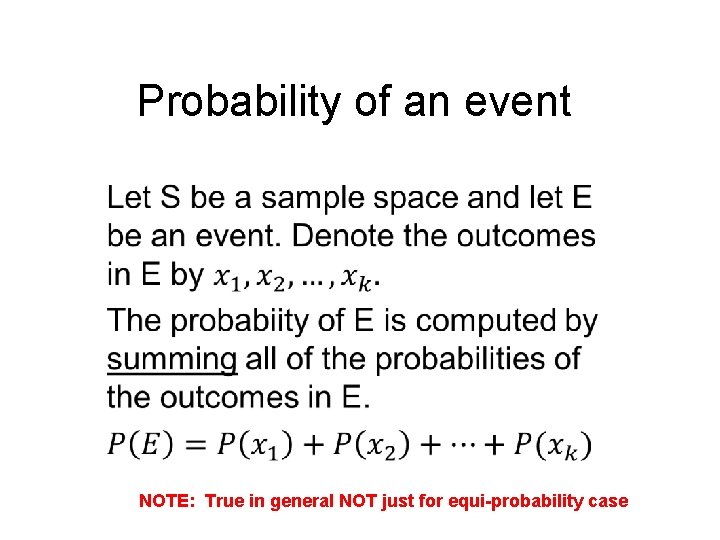
Probability of an event NOTE: True in general NOT just for equi-probability case
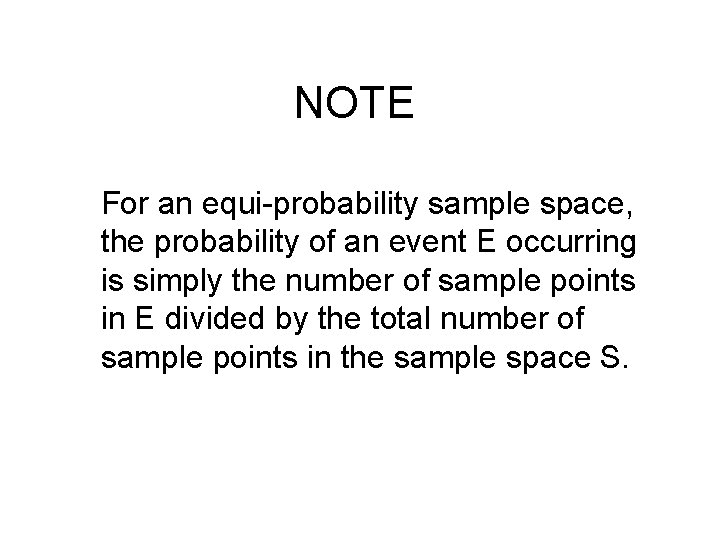
NOTE For an equi-probability sample space, the probability of an event E occurring is simply the number of sample points in E divided by the total number of sample points in the sample space S.
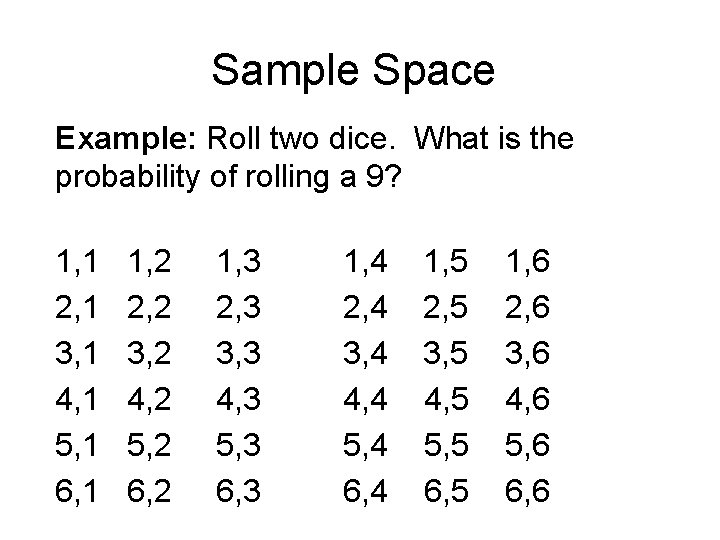
Sample Space Example: Roll two dice. What is the probability of rolling a 9? 1, 1 2, 1 3, 1 4, 1 5, 1 6, 1 1, 2 2, 2 3, 2 4, 2 5, 2 6, 2 1, 3 2, 3 3, 3 4, 3 5, 3 6, 3 1, 4 2, 4 3, 4 4, 4 5, 4 6, 4 1, 5 2, 5 3, 5 4, 5 5, 5 6, 5 1, 6 2, 6 3, 6 4, 6 5, 6 6, 6
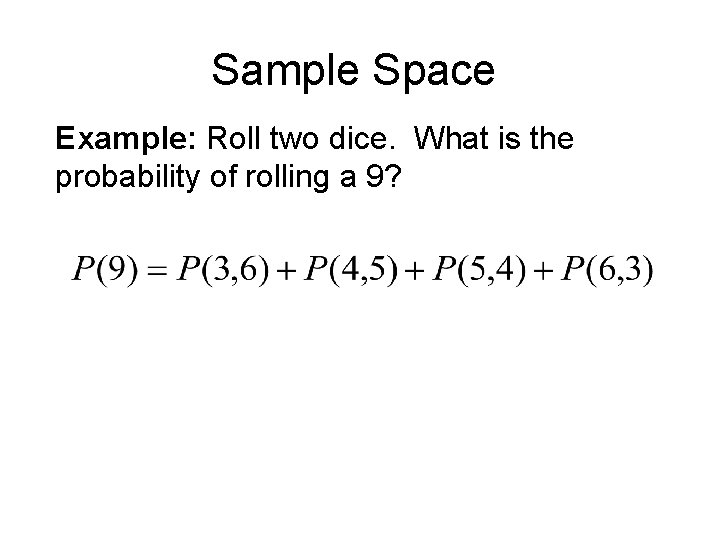
Sample Space Example: Roll two dice. What is the probability of rolling a 9?
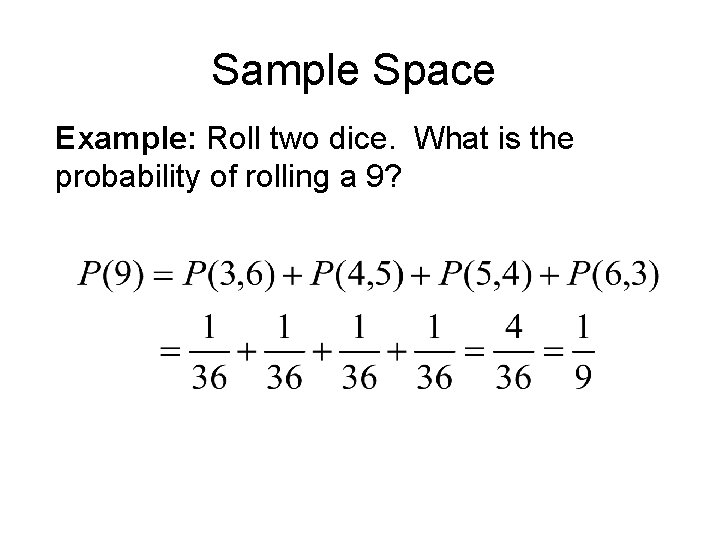
Sample Space Example: Roll two dice. What is the probability of rolling a 9?
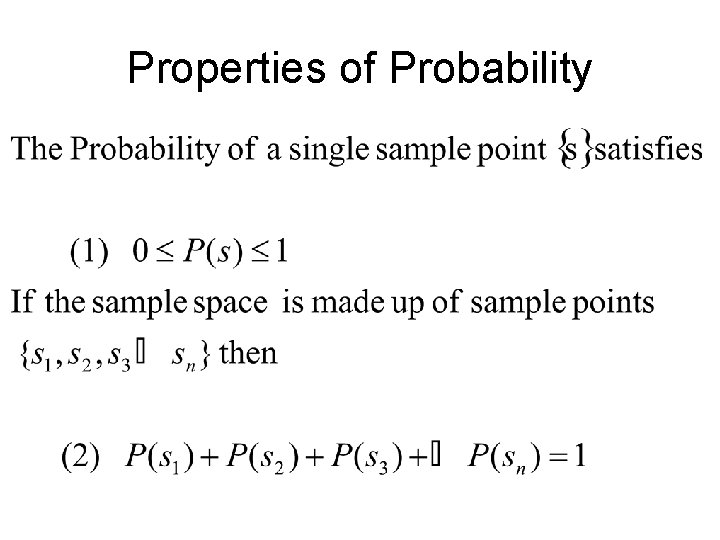
Properties of Probability
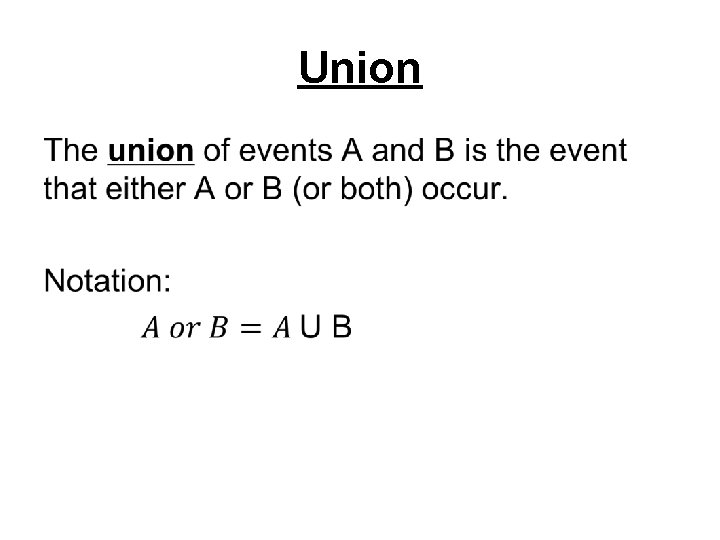
Union •
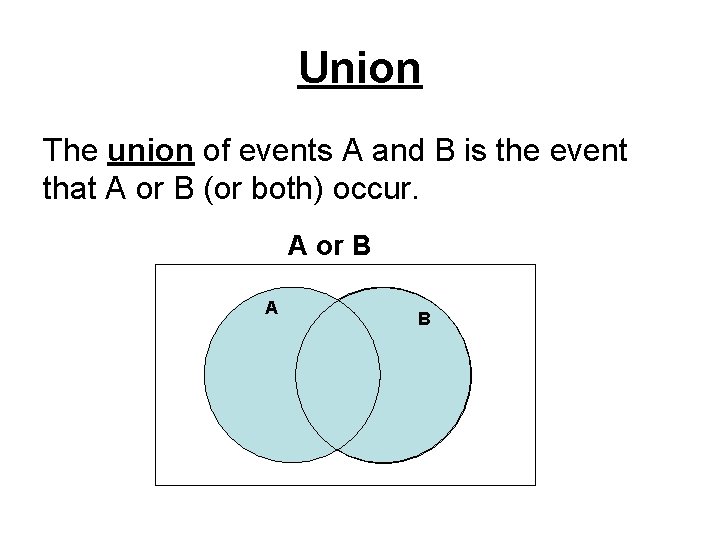
Union The union of events A and B is the event that A or B (or both) occur. A or B A B
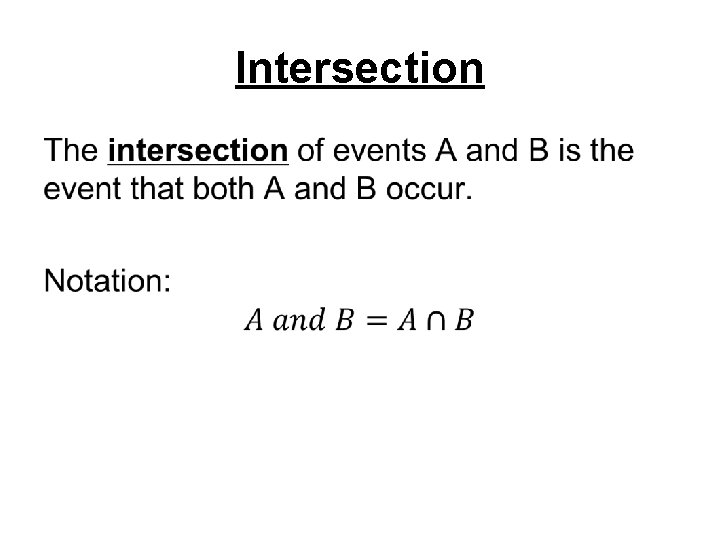
Intersection •
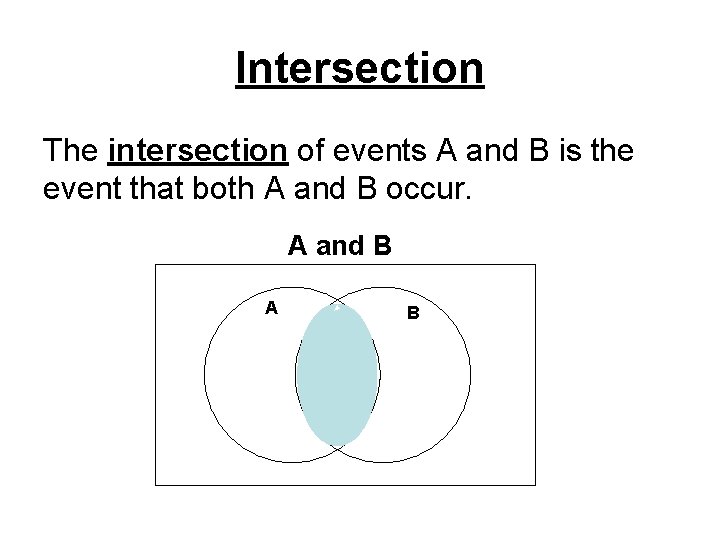
Intersection The intersection of events A and B is the event that both A and B occur. A and B A B
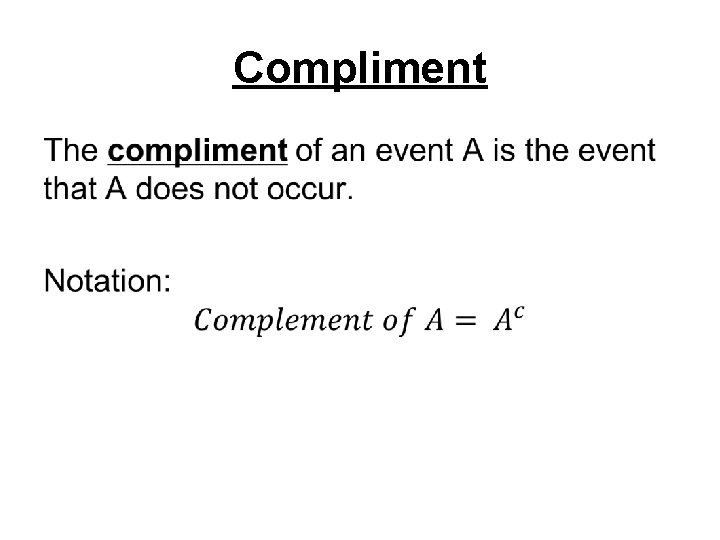
Compliment •
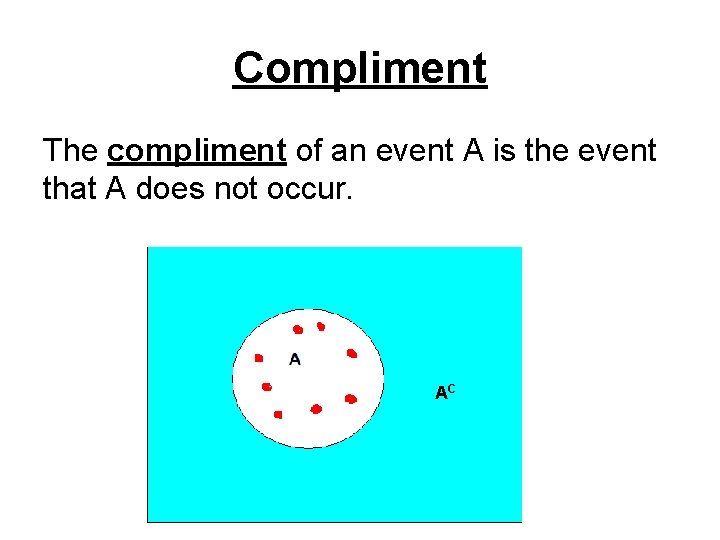
Compliment The compliment of an event A is the event that A does not occur. AC
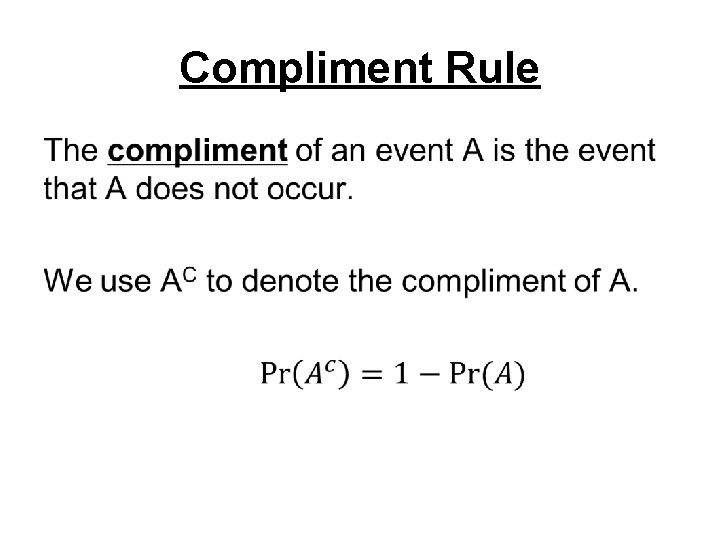
Compliment Rule •
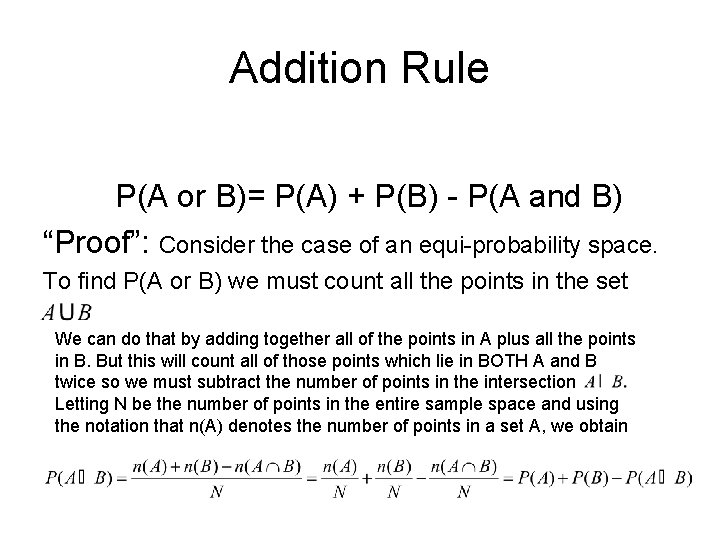
Addition Rule P(A or B)= P(A) + P(B) - P(A and B) “Proof”: Consider the case of an equi-probability space. To find P(A or B) we must count all the points in the set We can do that by adding together all of the points in A plus all the points in B. But this will count all of those points which lie in BOTH A and B twice so we must subtract the number of points in the intersection Letting N be the number of points in the entire sample space and using the notation that n(A) denotes the number of points in a set A, we obtain
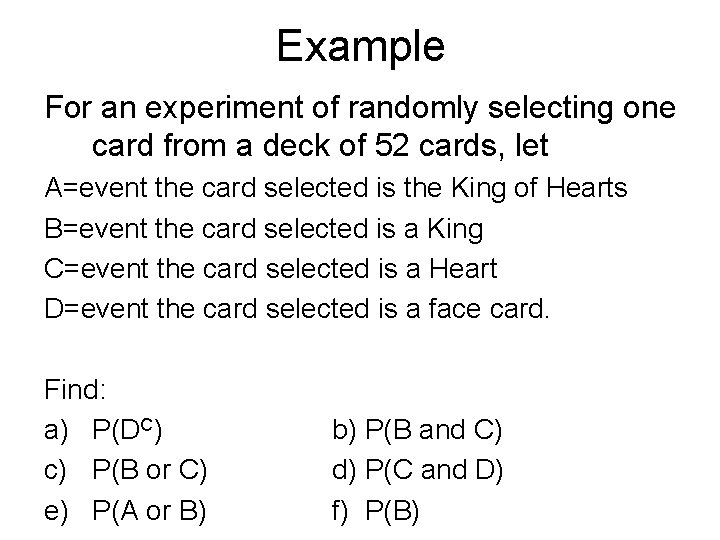
Example For an experiment of randomly selecting one card from a deck of 52 cards, let A=event the card selected is the King of Hearts B=event the card selected is a King C=event the card selected is a Heart D=event the card selected is a face card. Find: a) P(DC) c) P(B or C) e) P(A or B) b) P(B and C) d) P(C and D) f) P(B)
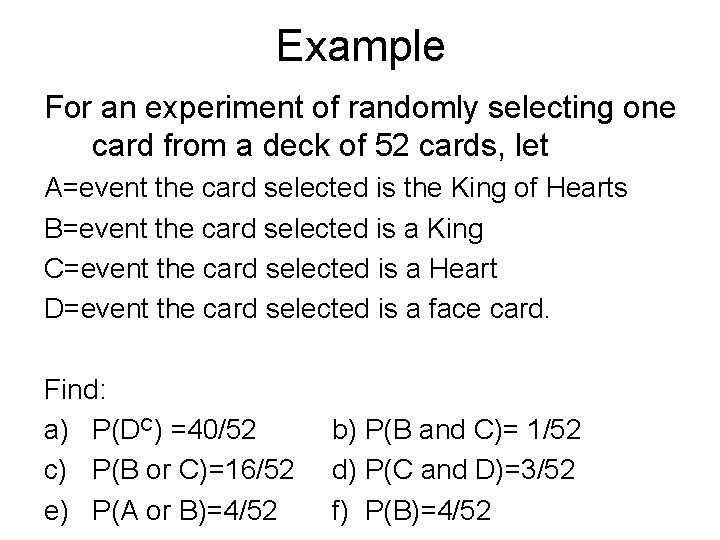
Example For an experiment of randomly selecting one card from a deck of 52 cards, let A=event the card selected is the King of Hearts B=event the card selected is a King C=event the card selected is a Heart D=event the card selected is a face card. Find: a) P(DC) =40/52 c) P(B or C)=16/52 e) P(A or B)=4/52 b) P(B and C)= 1/52 d) P(C and D)=3/52 f) P(B)=4/52

Mutually Exclusive Events Two events are mutually exclusive if P (A and B) = 0. In terms of sets, this means that the sets A and B to do not overlap. For mutually exclusive sets, we have a simplified addition rule:
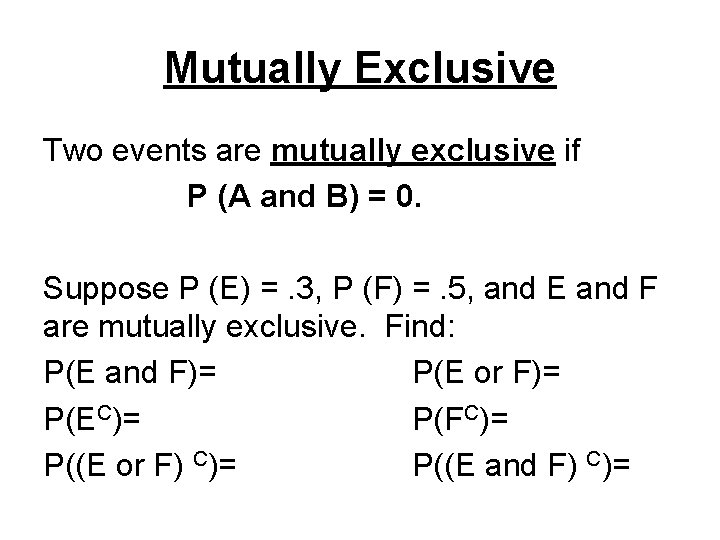
Mutually Exclusive Two events are mutually exclusive if P (A and B) = 0. Suppose P (E) =. 3, P (F) =. 5, and E and F are mutually exclusive. Find: P(E and F)= P(E or F)= P(EC)= P(FC)= P((E or F) C)= P((E and F) C)=
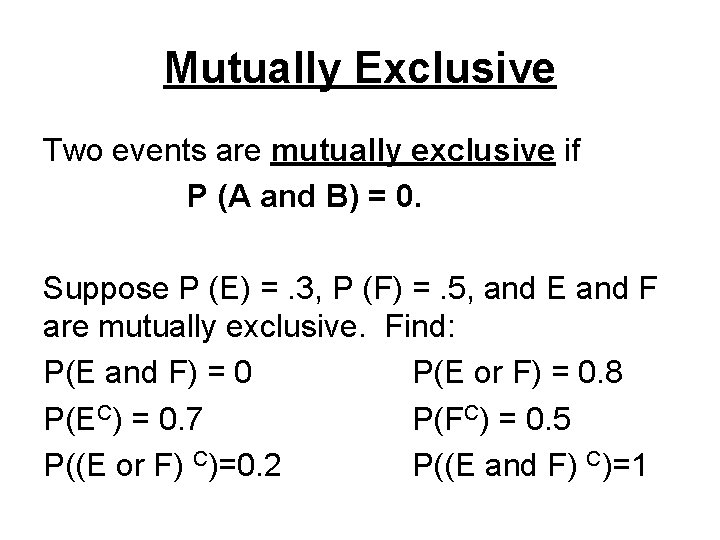
Mutually Exclusive Two events are mutually exclusive if P (A and B) = 0. Suppose P (E) =. 3, P (F) =. 5, and E and F are mutually exclusive. Find: P(E and F) = 0 P(E or F) = 0. 8 P(EC) = 0. 7 P(FC) = 0. 5 P((E or F) C)=0. 2 P((E and F) C)=1
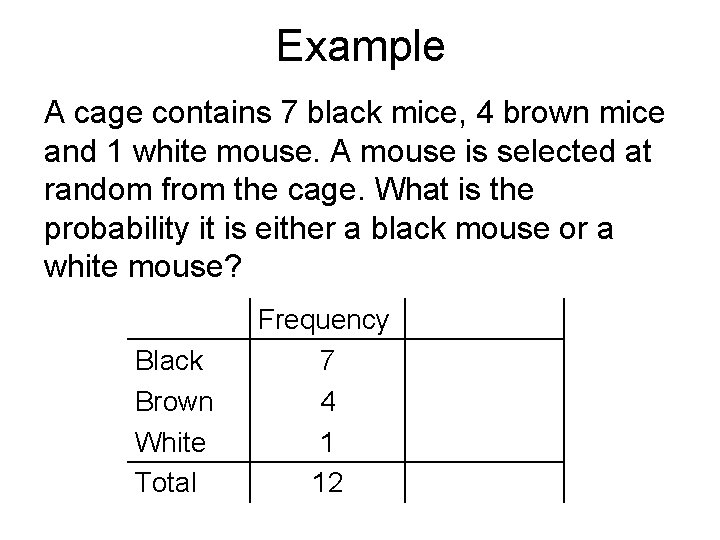
Example A cage contains 7 black mice, 4 brown mice and 1 white mouse. A mouse is selected at random from the cage. What is the probability it is either a black mouse or a white mouse? Black Brown White Total Frequency 7 4 1 12
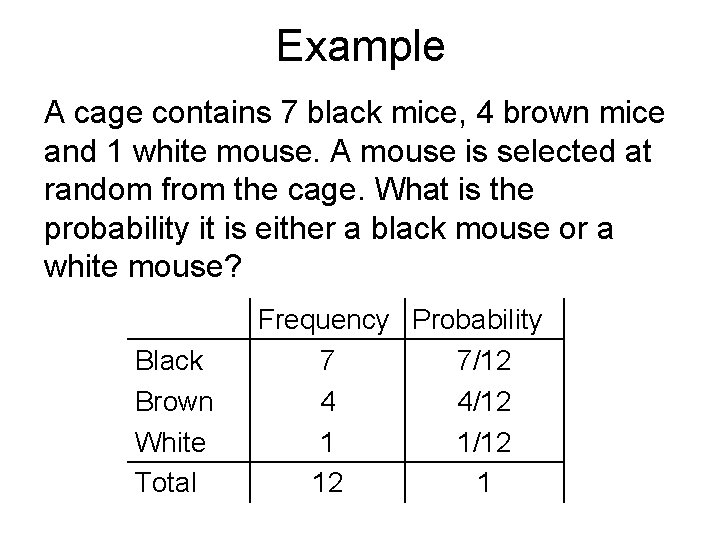
Example A cage contains 7 black mice, 4 brown mice and 1 white mouse. A mouse is selected at random from the cage. What is the probability it is either a black mouse or a white mouse? Black Brown White Total Frequency Probability 7 7/12 4 4/12 1 1/12 12 1
Example A cage contains 7 black mice, 4 brown mice and 1 white mouse. A mouse is selected at random from the cage. What is the probability it is either a black mouse or a white mouse? P (Black or White) =
Example A cage contains 7 black mice, 4 brown mice and 1 white mouse. A mouse is selected at random from the cage. What is the probability it is either a black mouse or a white mouse? P (Black or White) = P(Black) +P(White)
Example A cage contains 7 black mice, 4 brown mice and 1 white mouse. A mouse is selected at random from the cage. What is the probability it is either a black mouse or a white mouse? P (Black or White) = P(Black) +P(White) = 7/12 + 1/12 = 8/12
Example In buying a new computer (tower, monitor, keyboard and mouse) studies show that 4% have problems with their mouse and 2% have problems with their monitor and 0. 2% have problems with both before the expirations of their manufactured warranty. a) Find the probability that a computer set purchased has one of the two problems b) Neither c) Just a monitor problem
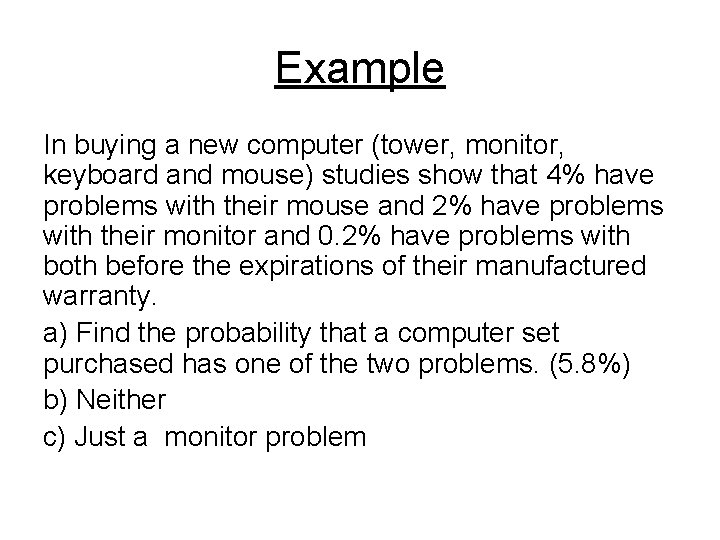
Example In buying a new computer (tower, monitor, keyboard and mouse) studies show that 4% have problems with their mouse and 2% have problems with their monitor and 0. 2% have problems with both before the expirations of their manufactured warranty. a) Find the probability that a computer set purchased has one of the two problems. (5. 8%) b) Neither c) Just a monitor problem
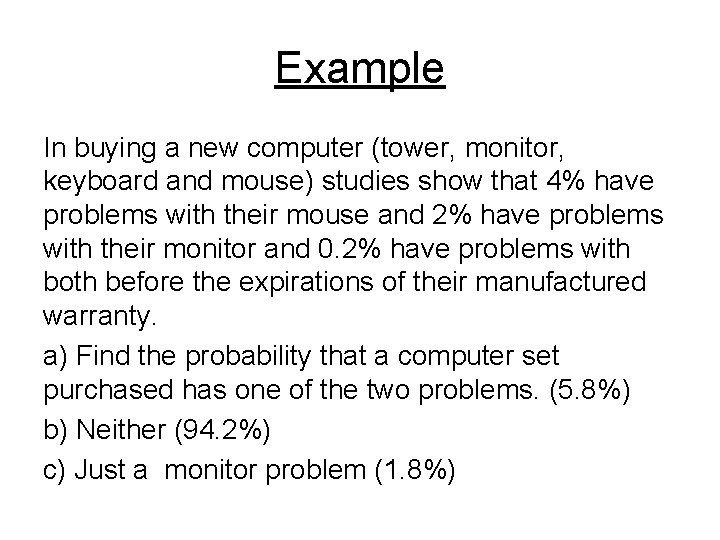
Example In buying a new computer (tower, monitor, keyboard and mouse) studies show that 4% have problems with their mouse and 2% have problems with their monitor and 0. 2% have problems with both before the expirations of their manufactured warranty. a) Find the probability that a computer set purchased has one of the two problems. (5. 8%) b) Neither (94. 2%) c) Just a monitor problem (1. 8%)
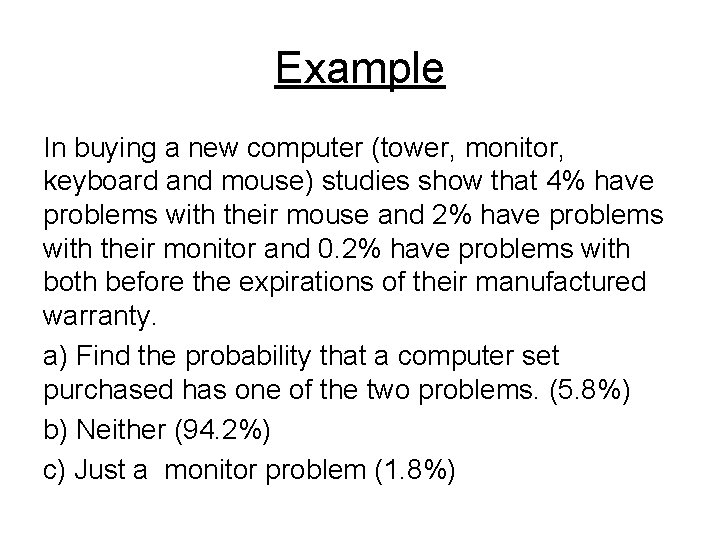
Example In buying a new computer (tower, monitor, keyboard and mouse) studies show that 4% have problems with their mouse and 2% have problems with their monitor and 0. 2% have problems with both before the expirations of their manufactured warranty. a) Find the probability that a computer set purchased has one of the two problems. (5. 8%) b) Neither (94. 2%) c) Just a monitor problem (1. 8%)
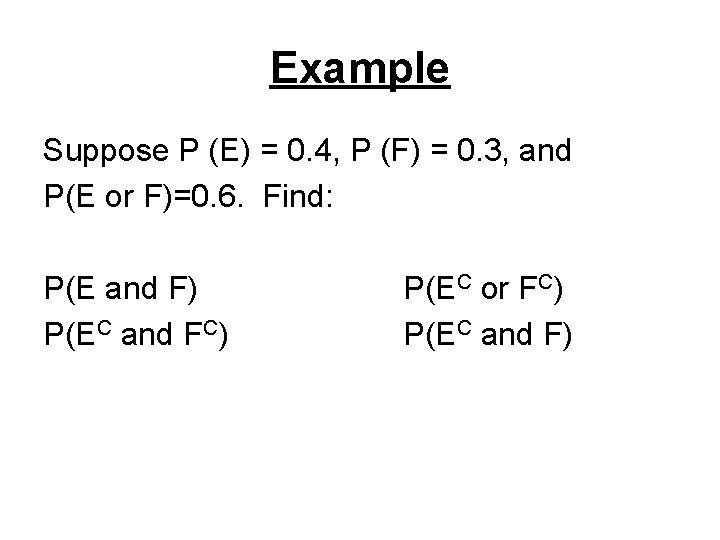
Example Suppose P (E) = 0. 4, P (F) = 0. 3, and P(E or F)=0. 6. Find: P(E and F) P(EC and FC) P(EC or FC) P(EC and F)
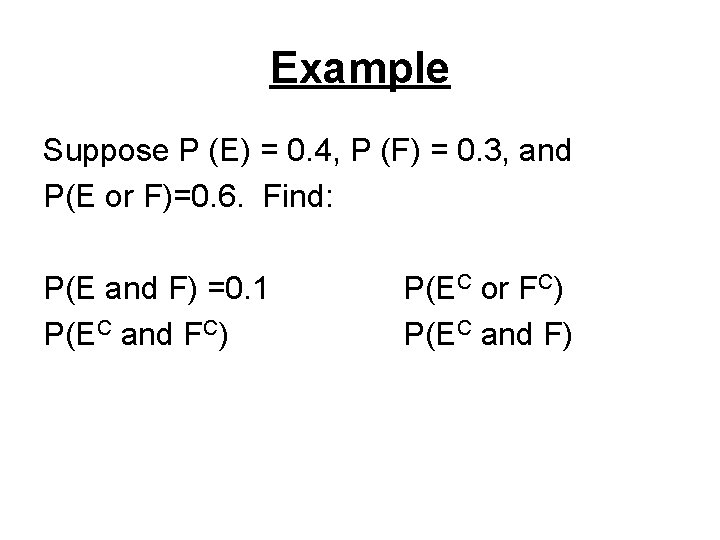
Example Suppose P (E) = 0. 4, P (F) = 0. 3, and P(E or F)=0. 6. Find: P(E and F) =0. 1 P(EC and FC) P(EC or FC) P(EC and F)

Example Suppose P (E) = 0. 4, P (F) = 0. 3, and P(E or F)=0. 6. Find: P(E and F) =0. 1 P(EC and FC) P(EC or FC)=0. 9 P(EC and F)
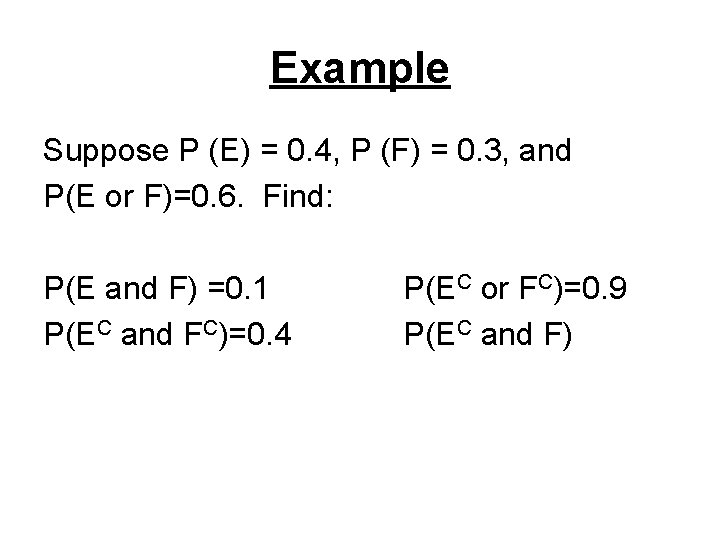
Example Suppose P (E) = 0. 4, P (F) = 0. 3, and P(E or F)=0. 6. Find: P(E and F) =0. 1 P(EC and FC)=0. 4 P(EC or FC)=0. 9 P(EC and F)
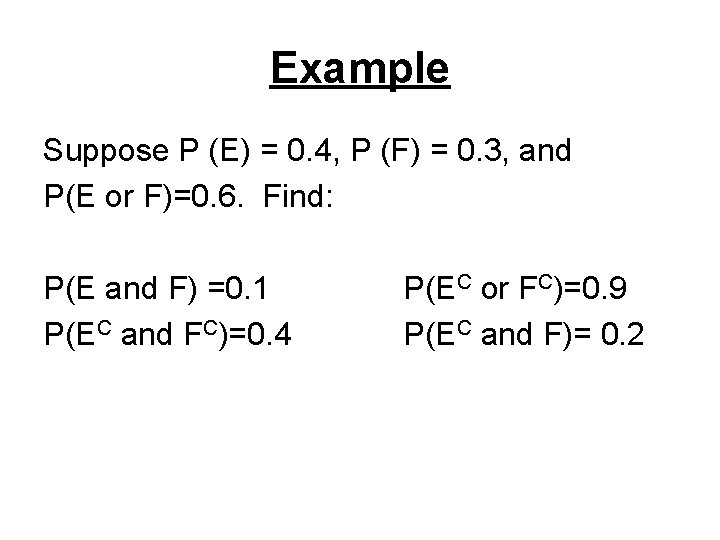
Example Suppose P (E) = 0. 4, P (F) = 0. 3, and P(E or F)=0. 6. Find: P(E and F) =0. 1 P(EC and FC)=0. 4 P(EC or FC)=0. 9 P(EC and F)= 0. 2
Review Probabilities – Definitions of experiment, event, simple event, sample space, probabilities, intersection, union compliment – Finding Probabilities – Drawing Venn Diagrams – If A and B are two events then P(A or B) = P(A) + P(B) - P(A and B), P(not A) = 1 - P(A). – Two events A and B are mutually exclusive if P(A and B) = 0.
- Slides: 49