
Probability Lecture 22 Section 7 1 7 4
Probability Lecture 22 Section 7. 1 – 7. 4. 1 Wed, Oct 20, 2004
Random Outcomes n To have a random outcome, we must have a procedure in which at least one step is left to chance. Select a student and see what is grade was on Test #1. n Wherein lies the randomness? n n Sample space or outcome space – the set of all possible outcomes of the procedure.

Random Outcomes The various possible outcomes may be equally likely, but they do not have to be. n Toss a coin. n n n Heads or tails. Look out the window. Hurricane or no hurricane. n It depends on whether you live in Florida. n
Example: Toss 2 Coins Toss two coins and observe how each coin lands. n Draw a tree diagram: n
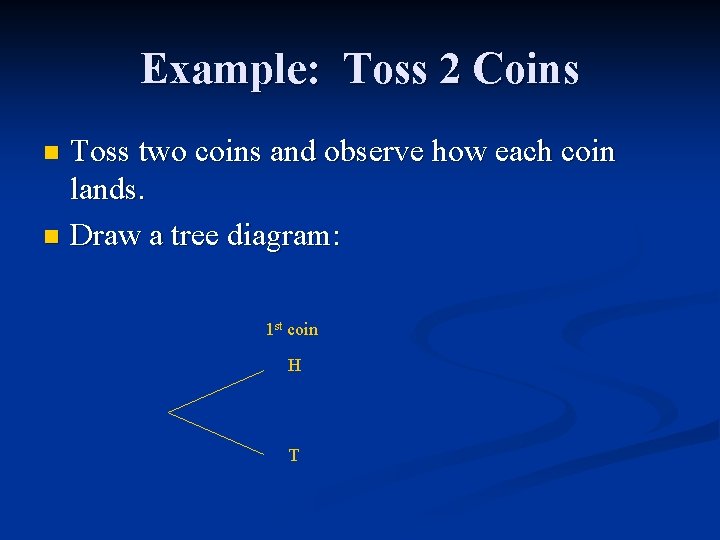
Example: Toss 2 Coins Toss two coins and observe how each coin lands. n Draw a tree diagram: n 1 st coin H T
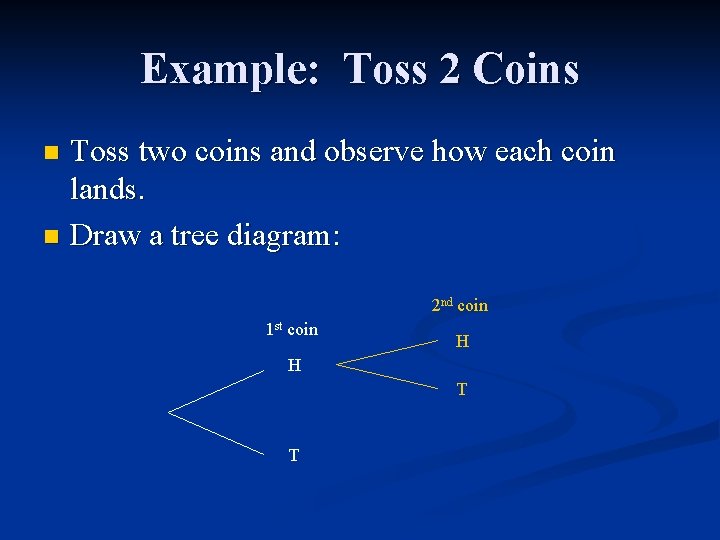
Example: Toss 2 Coins Toss two coins and observe how each coin lands. n Draw a tree diagram: n 2 nd coin 1 st coin H H T T
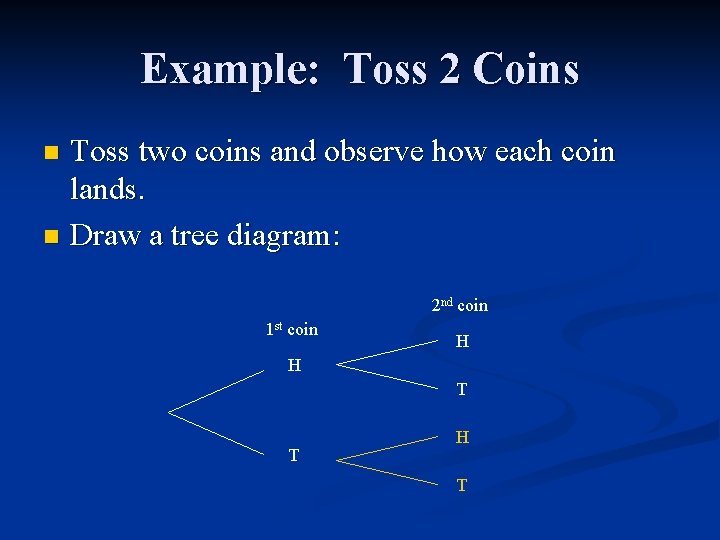
Example: Toss 2 Coins Toss two coins and observe how each coin lands. n Draw a tree diagram: n 2 nd coin 1 st coin H H T T H T
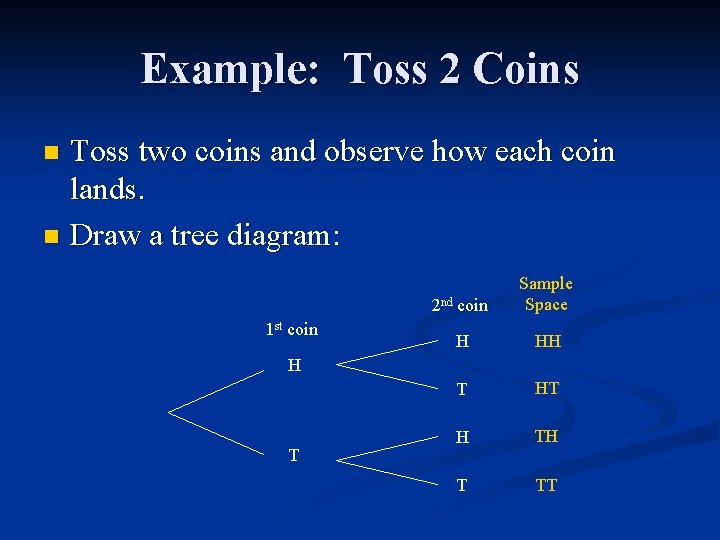
Example: Toss 2 Coins Toss two coins and observe how each coin lands. n Draw a tree diagram: n 1 st coin 2 nd coin Sample Space H HH T HT H TH T TT H T
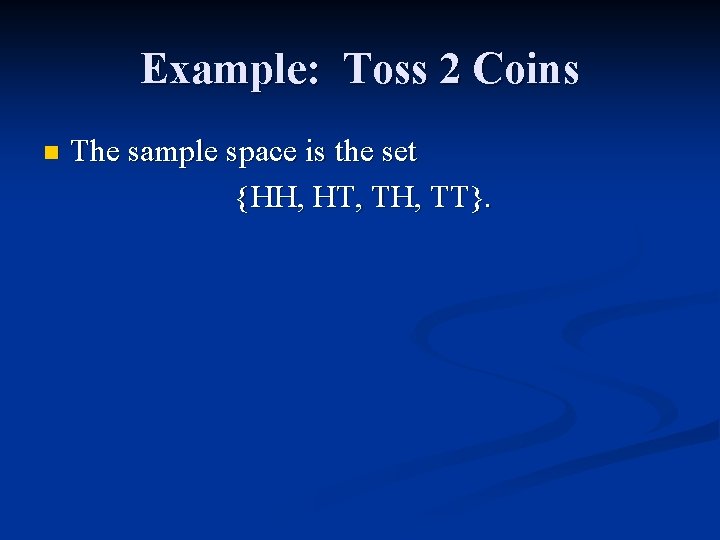
Example: Toss 2 Coins n The sample space is the set {HH, HT, TH, TT}.
Events Event – a collection of possible outcomes. n Therefore, it is a subset of the sample space. n We say that the event occurs if the actual outcome is among those included in the event. n Otherwise, the event does not occur. n
Events A Venn diagram is a convenient way to draw an event. n Draw a rectangle that represents the sample space. n Represent events as ovals within the rectangle. n The ovals should overlap if the events have outcomes in common. n
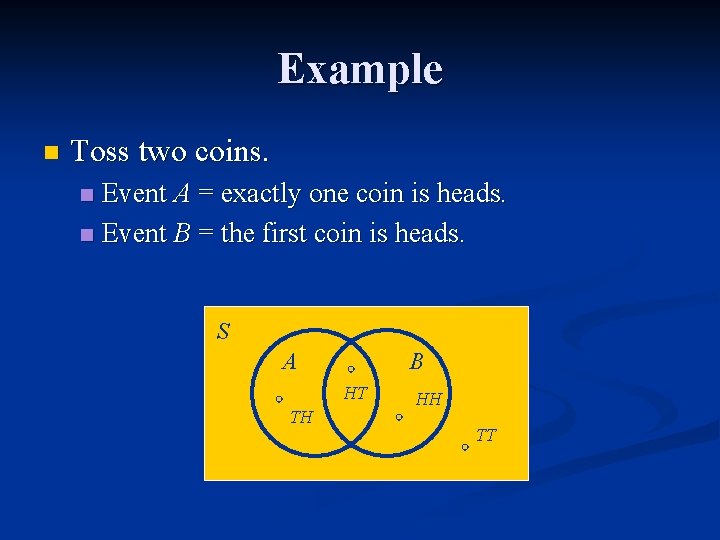
Example n Toss two coins. Event A = exactly one coin is heads. n Event B = the first coin is heads. n S A B HT TH HH TT
Let’s Do It! Let’s do it! 7. 7, p. 390 – Expressing Events. n Let’s do it! 7. 8, p. 391 – Favor or Oppose. n
- Slides: 13