
Probability l Definitions l Addition Rule l Multiplication
Probability l. Definitions l. Addition Rule l. Multiplication Rule l. Tables
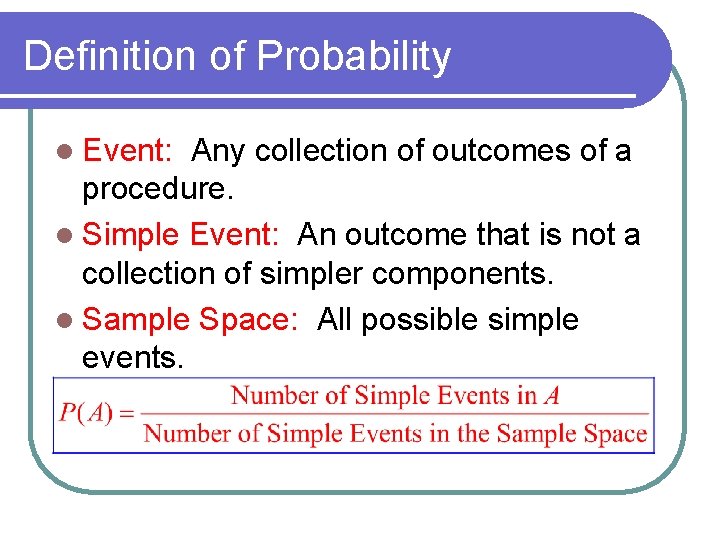
Definition of Probability l Event: Any collection of outcomes of a procedure. l Simple Event: An outcome that is not a collection of simpler components. l Sample Space: All possible simple events.
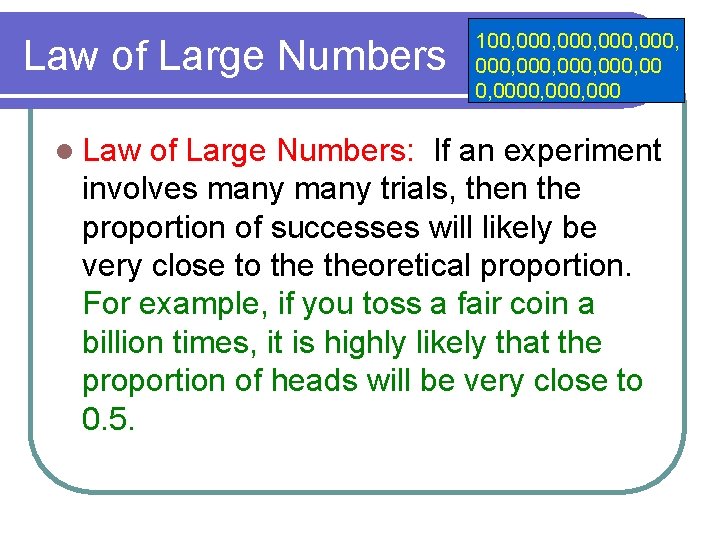
Law of Large Numbers l Law 100, 000, 000, 00 0, 000, 000 of Large Numbers: If an experiment involves many trials, then the proportion of successes will likely be very close to theoretical proportion. For example, if you toss a fair coin a billion times, it is highly likely that the proportion of heads will be very close to 0. 5.
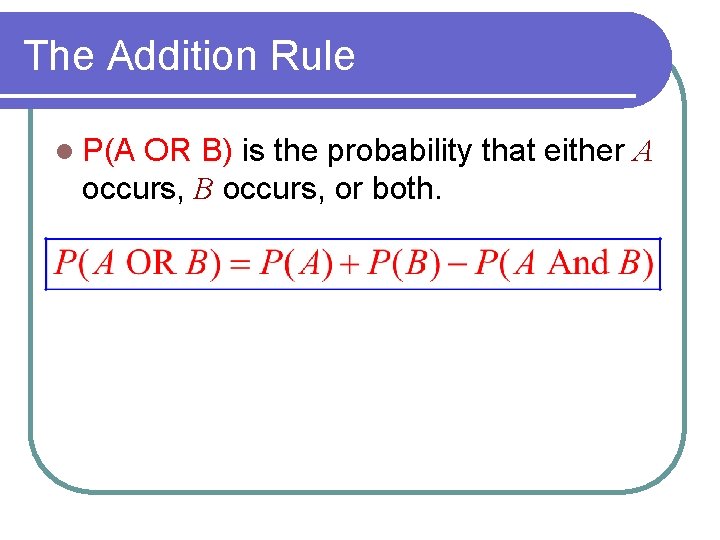
The Addition Rule l P(A OR B) is the probability that either A occurs, B occurs, or both.
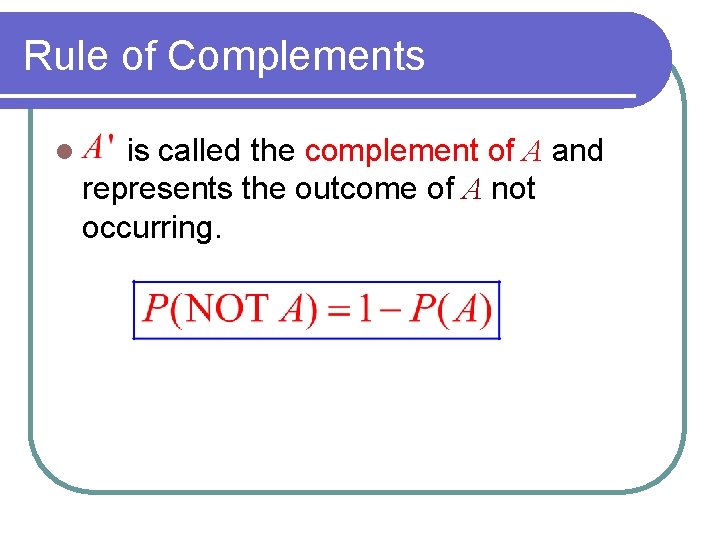
Rule of Complements l is called the complement of A and represents the outcome of A not occurring.
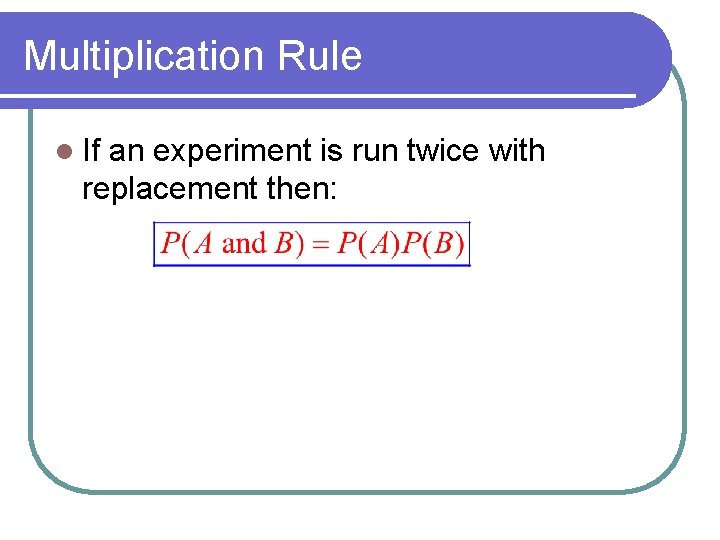
Multiplication Rule l If an experiment is run twice with replacement then:
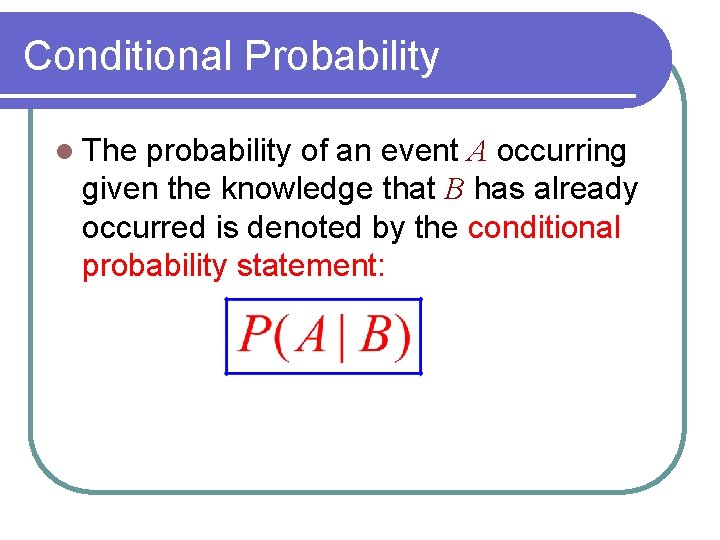
Conditional Probability l The probability of an event A occurring given the knowledge that B has already occurred is denoted by the conditional probability statement:
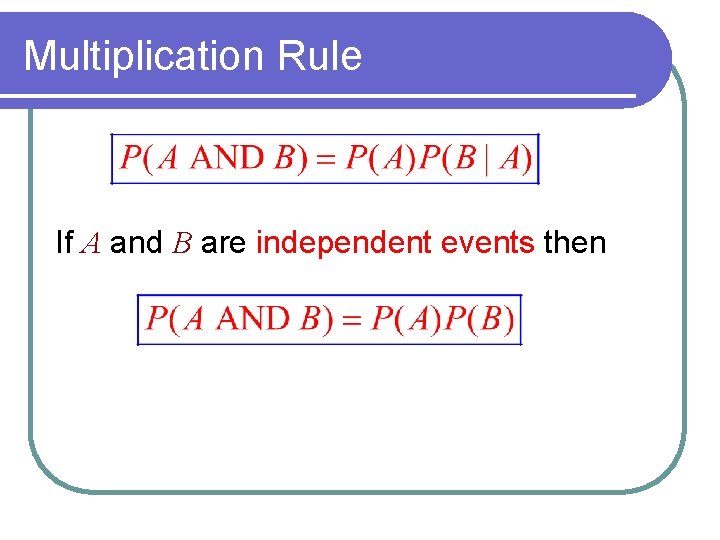
Multiplication Rule If A and B are independent events then
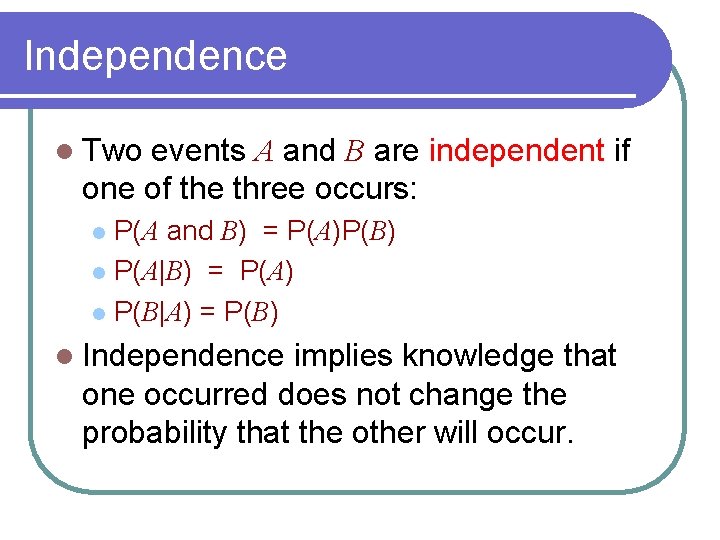
Independence l Two events A and B are independent if one of the three occurs: P(A and B) = P(A)P(B) l P(A|B) = P(A) l P(B|A) = P(B) l l Independence implies knowledge that one occurred does not change the probability that the other will occur.
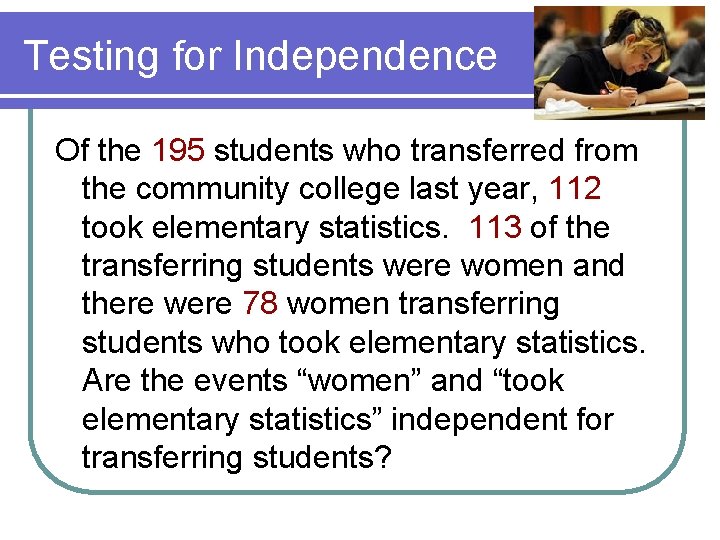
Testing for Independence Of the 195 students who transferred from the community college last year, 112 took elementary statistics. 113 of the transferring students were women and there were 78 women transferring students who took elementary statistics. Are the events “women” and “took elementary statistics” independent for transferring students?
Independence Guideline l If the sample size is no more than 5% of the population size, treat the solutions as independent events (even though they are slightly dependent).
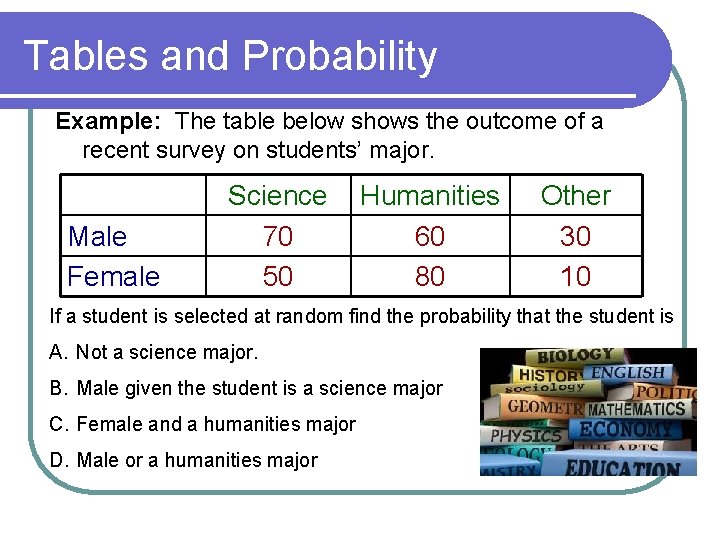
Tables and Probability Example: The table below shows the outcome of a recent survey on students’ major. Male Female Science 70 50 Humanities 60 80 Other 30 10 If a student is selected at random find the probability that the student is A. Not a science major. B. Male given the student is a science major C. Female and a humanities major D. Male or a humanities major
Fundamental Counting Rule For a sequence of 2 events in which the first can occur in m ways and the second in n ways, the events together can occur in a total of m x n ways. l Example: If you pick a card from a 52 card deck then roll a 6 sided die, there are 52 x 6 = 312 possible outcomes.
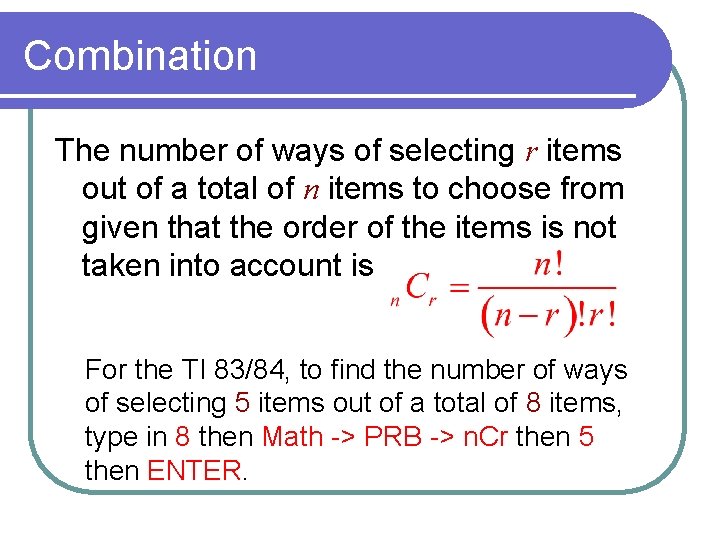
Combination The number of ways of selecting r items out of a total of n items to choose from given that the order of the items is not taken into account is For the TI 83/84, to find the number of ways of selecting 5 items out of a total of 8 items, type in 8 then Math -> PRB -> n. Cr then 5 then ENTER.
The California Lottery l To play the California Lottery, pick 5 numbers from 1 to 56 and one number from 1 to 46. You win $21, 000 if your numbers are selected. l What is the probability of winning the lottery with one ticket?
- Slides: 15