
Probability Key Terms Probability the likelihood that an

Probability

Key Terms � Probability- the likelihood that an event will have a particular result; the ratio of the number of desired outcomes to the total possible outcomes. � Event- an experiment where there is an outcome � Outcome- a result of an experiment � Independent Event- an event to which the result is in no way affected by other events � Dependent Event- an event where the outcome depends or is affected by the outcome of another event.
Probability is always a number between 0 and 1 ◦ The probability of an impossibility is 0 ◦ The probability of a certainty is 1
The sum of the probabilities of all outcomes of an event is always 1 � The just probability that an event will not occur is 1 – the probability that the event will occur.
Probability can be written as a fraction or as a decimal � To convert from fraction to a decimal divide the numerator by the denominator (round if necessary) 2/3 = 2 ÷ 3 =. 67
Events � Also called “experiments” � Examples: ◦ Flip a coin ◦ Draw a random card ◦ Choose a random marble, sock, book

Outcomes � (also called “results”) � Examples: ◦ ◦ ◦ Heads Ace of Hearts Green marble Red sock “Cat in the Hat”

Sample Space � List of the possible outcomes (no duplicates) � Examples: ◦ For a coin toss: {heads, tails} ◦ To choose from a bag of marbles with 2 red marbles, 4 blue marbles, and one yellow marble, {red, blue, yellow}
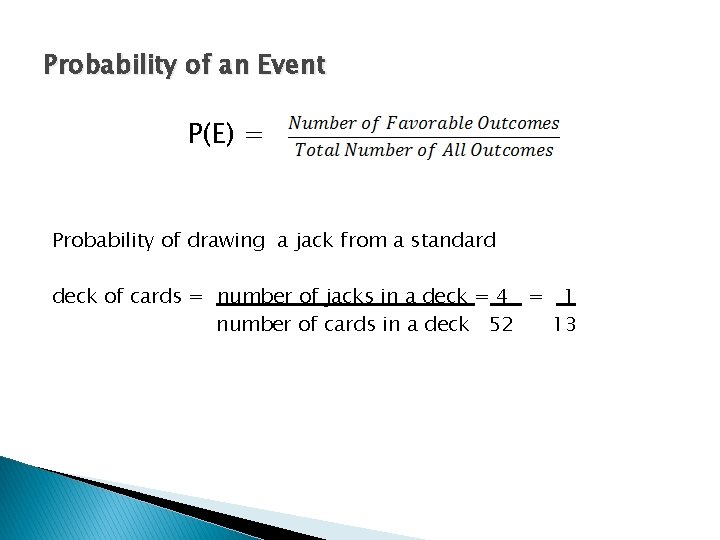
Probability of an Event P(E) = Probability of drawing a jack from a standard deck of cards = number of jacks in a deck = 4 = 1 number of cards in a deck 52 13
Probability of drawing a red 10 from a deck of cards number of red 10’s in a deck = 2 = 1 number of cards in a deck 52 26
Probability of drawing a red card from a deck of cards number of red cards in a deck = 26 = 1 number of cards in a deck 52 2
Probability of drawing an Ace of Hearts from a standard deck of cards = number of Aces of Hearts in a deck = 1 number of cards in a deck 52
Key Facts To find the probability of multiple independent events, multiply the probabilities of each event together.
Key Facts To find the probability of multiple dependent events, multiply the probabilities of each event together considering the dependence.
Conditional Probbility Multiplication Rule 2: When two events, A and B, are dependent, the probability of both occurring is:
Conditional Probability The conditional probability of an event B in relationship to an event A is the probability that event B occurs given that event A has already occurred. The notation for conditional probability is P(B|A), read as the probability of B given A.
Example 1 A jar contains black and white marbles. Two marbles are chosen without replacement. The probability of selecting a black marble and then a white marble is 0. 34, and the probability of selecting a black marble on the first draw is 0. 47. What is the probability of selecting a white marble on the second draw, given that the first marble drawn was black?
Example 2 The probability that it is Friday and that a student is absent is 0. 03. Since there are 5 school days in a week, the probability that it is Friday is 0. 2. What is the probability that a student is absent given that today is Friday?
Example 3 At Kennedy Middle School, the probability that a student takes Technology and Spanish is 0. 087. The probability that a student takes Technology is 0. 68. What is the probability that a student takes Spanish given that the student is taking Technology?

Probability versus Odds � Value between 0 and 1 � Wins/Total Outcomes � Usually expressed as a fraction or decimal � Any positive number or 0 � Wins/Losses (Odds For) or � Losses/Wins (Odds Against) � Usually expressed as a ratio
- Slides: 21