
Probability How likely is an event to occur
Probability How likely is an event to occur? What are the chances of that happening? ? !!
Lesson objectives: n To understand the terms ‘equal chance’ and ‘outcome’ when thinking about probability. n To complete a maths investigation involving tossing a coin and rolling a dice! - to test the ‘equal chance’ theory!
Mathematical Vocabulary n We can describe the probability or chance of an event happening by saying: n It is IMPOSSIBLE. n It is UNLIKELY. n It is CERTAIN.
Some events have an equal chance of happening or not happening. Can you think of any?
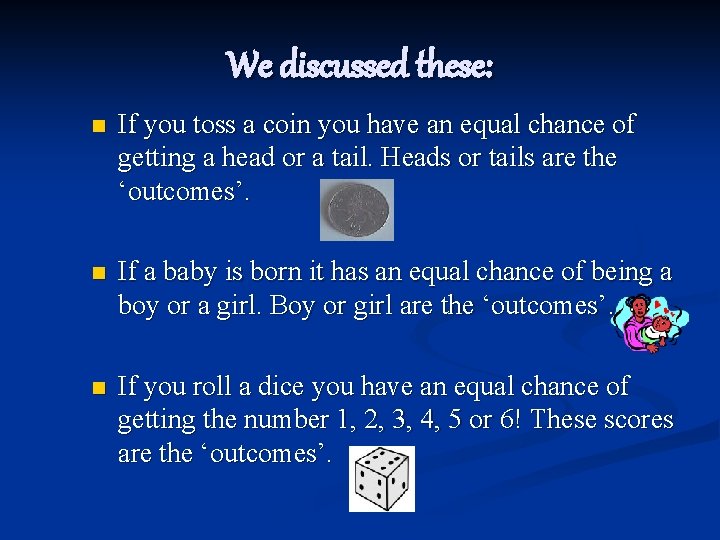
We discussed these: n If you toss a coin you have an equal chance of getting a head or a tail. Heads or tails are the ‘outcomes’. n If a baby is born it has an equal chance of being a boy or a girl. Boy or girl are the ‘outcomes’. n If you roll a dice you have an equal chance of getting the number 1, 2, 3, 4, 5 or 6! These scores are the ‘outcomes’.
Today’s task: We are going to carry out a maths investigation. n We are going to investigate whether we have an equal number of heads and tails when we toss a coin 30 times. n We will also investigate whether we get an equal number of 1 s, 2 s, 3 s, 4, 5 s and 6 s when we roll a dice 30 times. n We will record our findings. n
What do you think we will find out? Perhaps we will have 15 heads and 15 tails when we toss our coin 30 times? ? n Perhaps we will have each number on the dice 5 times. (five scores of 1, five scores of 2 etc. ) n n It’s up to you to find out!!!!
Did we achieve out learning objectives today? n n We understand what is meant by the terms ‘equal chance’ and ‘outcomes’. We have carried out an investigation into ‘equal chance’. n We have recorded our findings.
Things to think about! n If we rolled 2 coins what possible outcomes could we get? n If we rolled more than 1 dice what possible outcomes could we get? n What would our chances of getting 2 heads or a 6 be like then? !!!
- Slides: 9