
Probability Biostatistics Dr Muhammad Arif Ph D m

Probability & Biostatistics Dr. Muhammad Arif, Ph. D m. arif@faculty. muet. edu. pk 由Nordri. Design提供 www. nordridesign. com

Course Outline • Introduction to Biostatistics • Descriptive Biostatistics • Probability • Discrete Probability Distributions • Continuous Probability Distributions • Estimation • Hypothesis Testing
Lecture Outline • • • • Introduction to probability Sample Space & Events Mutually Exclusive Events Union & Intersection Joint Probability Complementary Events Conditional Probability Multiplication Law of Probability Independent Events Dependent Events Addition Law of Probability Marginal Probability Sensitivity & Specificity Bayes’ Law Bayesian Inference
Introduction • The theory of probability provides the foundation for statistical inference. • The concept of probability is not foreign to health workers and is frequently encountered in everyday communication. For example; i. A physician say that a patient has a 50– 50 chance of surviving a certain operation. ii. A physician may say that she is 95 percent certain that a patient has a particular disease. iii. A public health nurse may say that nine times out of ten a certain client will break an appointment. • As these examples suggest, most people express probabilities in terms of percentages.
Introduction • In dealing with probabilities mathematically, it is more convenient to express probabilities as fractions. • Thus, we measure the probability of the occurrence of some event by a number between zero and one. • The more likely the event, the closer the number is to one; and the more unlikely the event, the closer the number is to zero. • An event that cannot occur has a probability of zero, and an event that is certain to occur has a probability of one.
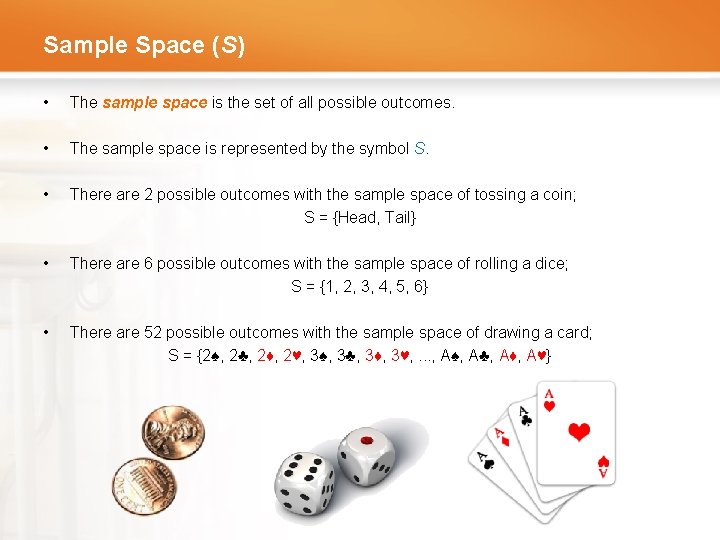
Sample Space (S) • The sample space is the set of all possible outcomes. • The sample space is represented by the symbol S. • There are 2 possible outcomes with the sample space of tossing a coin; S = {Head, Tail} • There are 6 possible outcomes with the sample space of rolling a dice; S = {1, 2, 3, 4, 5, 6} • There are 52 possible outcomes with the sample space of drawing a card; S = {2♠, 2♣, 2♦, 2♥, 3♠, 3♣, 3♦, 3♥, . . . , A♠, A♣, A♦, A♥}
Event • An event is a subset of a sample space S. • In referring to probabilities of events, an event is any set of outcomes of interest. • The symbol { } is used as shorthand for the phrase “the event. ” • The probability of an event E, denoted by P(E) or Pr(E), always satisfies 0 ≤ Pr(E) ≤ 1.
Probability The probability of an event is the relative frequency of this set of outcomes over an indefinitely large (or infinite) number of trials.
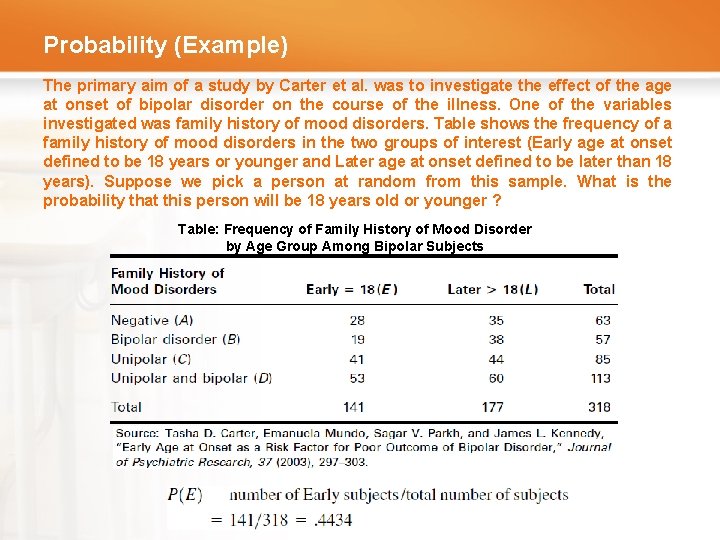
Probability (Example) The primary aim of a study by Carter et al. was to investigate the effect of the age at onset of bipolar disorder on the course of the illness. One of the variables investigated was family history of mood disorders. Table shows the frequency of a family history of mood disorders in the two groups of interest (Early age at onset defined to be 18 years or younger and Later age at onset defined to be later than 18 years). Suppose we pick a person at random from this sample. What is the probability that this person will be 18 years old or younger ? Table: Frequency of Family History of Mood Disorder by Age Group Among Bipolar Subjects
Mutually Exclusive Two events A and B are mutually exclusive, or disjoint, if A ∩ B = Φ, that is, if A and B have no elements in common. or Two events A and B are mutually exclusive if they cannot both happen at the same time. If outcomes A and B are two events that cannot both happen at the same time, then; Pr(A or B) = Pr(A) + Pr(B)
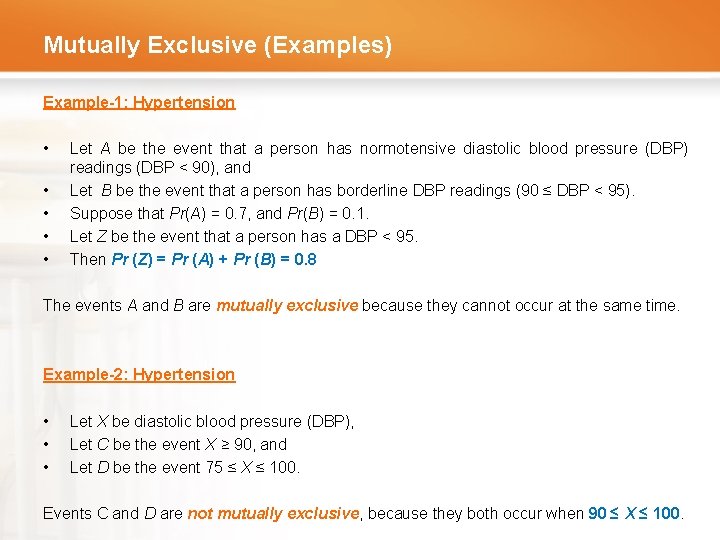
Mutually Exclusive (Examples) Example-1: Hypertension • • • Let A be the event that a person has normotensive diastolic blood pressure (DBP) readings (DBP < 90), and Let B be the event that a person has borderline DBP readings (90 ≤ DBP < 95). Suppose that Pr(A) = 0. 7, and Pr(B) = 0. 1. Let Z be the event that a person has a DBP < 95. Then Pr (Z) = Pr (A) + Pr (B) = 0. 8 The events A and B are mutually exclusive because they cannot occur at the same time. Example-2: Hypertension • • • Let X be diastolic blood pressure (DBP), Let C be the event X ≥ 90, and Let D be the event 75 ≤ X ≤ 100. Events C and D are not mutually exclusive, because they both occur when 90 ≤ X ≤ 100.
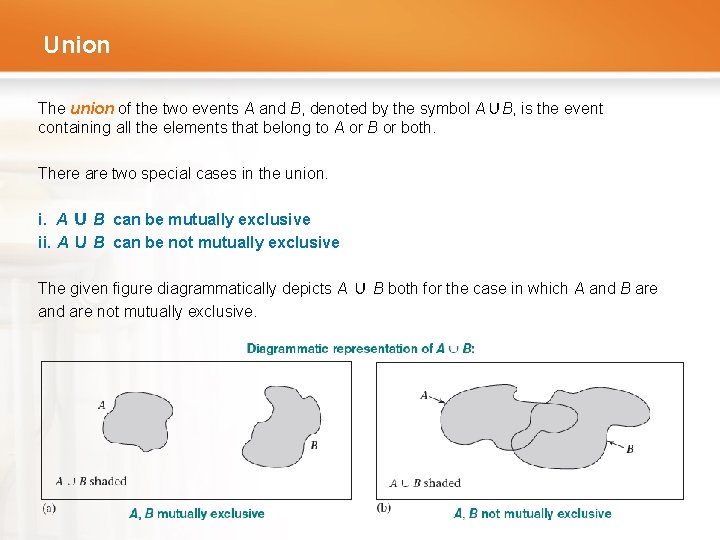
Union The union of the two events A and B, denoted by the symbol A∪B, is the event containing all the elements that belong to A or B or both. There are two special cases in the union. i. A ∪ B can be mutually exclusive ii. A ∪ B can be not mutually exclusive The given figure diagrammatically depicts A ∪ B both for the case in which A and B are and are not mutually exclusive.
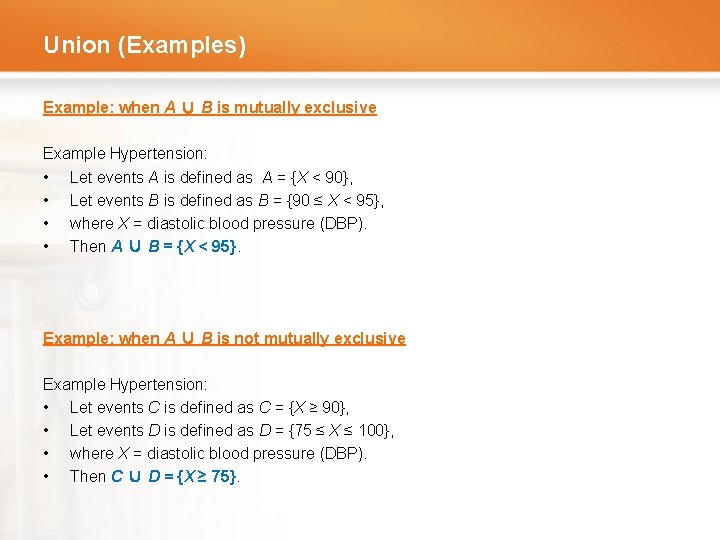
Union (Examples) Example: when A ∪ B is mutually exclusive Example Hypertension: • Let events A is defined as A = {X < 90}, • Let events B is defined as B = {90 ≤ X < 95}, • where X = diastolic blood pressure (DBP). • Then A ∪ B = {X < 95}. Example: when A ∪ B is not mutually exclusive Example Hypertension: • Let events C is defined as C = {X ≥ 90}, • Let events D is defined as D = {75 ≤ X ≤ 100}, • where X = diastolic blood pressure (DBP). • Then C ∪ D = {X ≥ 75}.
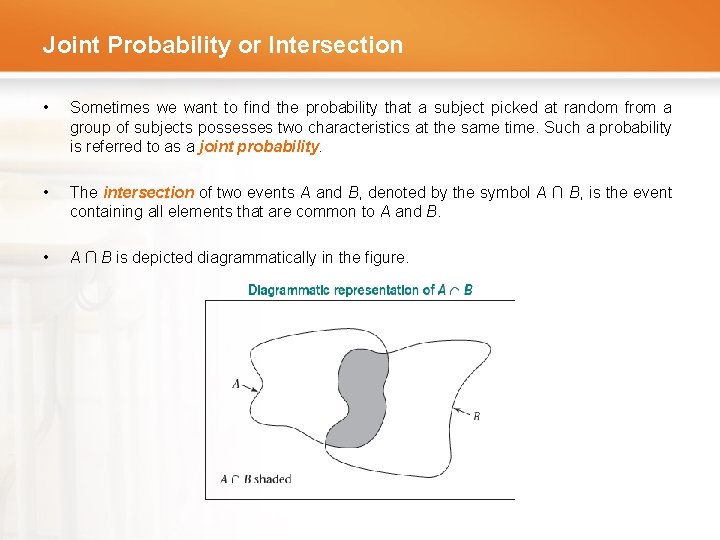
Joint Probability or Intersection • Sometimes we want to find the probability that a subject picked at random from a group of subjects possesses two characteristics at the same time. Such a probability is referred to as a joint probability. • The intersection of two events A and B, denoted by the symbol A ∩ B, is the event containing all elements that are common to A and B. • A ∩ B is depicted diagrammatically in the figure.
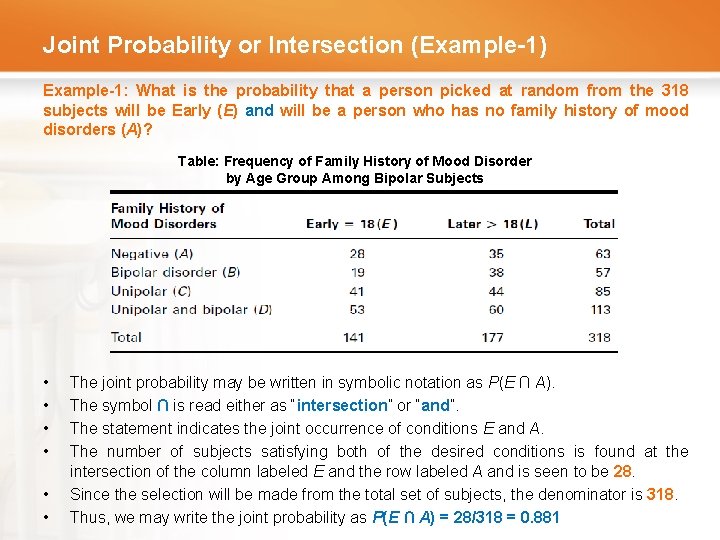
Joint Probability or Intersection (Example-1) Example-1: What is the probability that a person picked at random from the 318 subjects will be Early (E) and will be a person who has no family history of mood disorders (A)? Table: Frequency of Family History of Mood Disorder by Age Group Among Bipolar Subjects • • • The joint probability may be written in symbolic notation as P(E ∩ A). The symbol ∩ is read either as “intersection” or “and”. The statement indicates the joint occurrence of conditions E and A. The number of subjects satisfying both of the desired conditions is found at the intersection of the column labeled E and the row labeled A and is seen to be 28. Since the selection will be made from the total set of subjects, the denominator is 318. Thus, we may write the joint probability as P(E ∩ A) = 28/318 = 0. 881
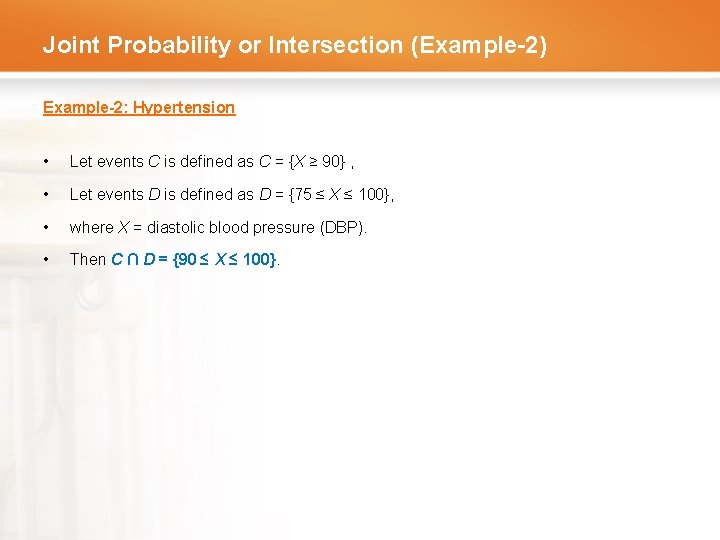
Joint Probability or Intersection (Example-2) Example-2: Hypertension • Let events C is defined as C = {X ≥ 90} , • Let events D is defined as D = {75 ≤ X ≤ 100}, • where X = diastolic blood pressure (DBP). • Then C ∩ D = {90 ≤ X ≤ 100}.
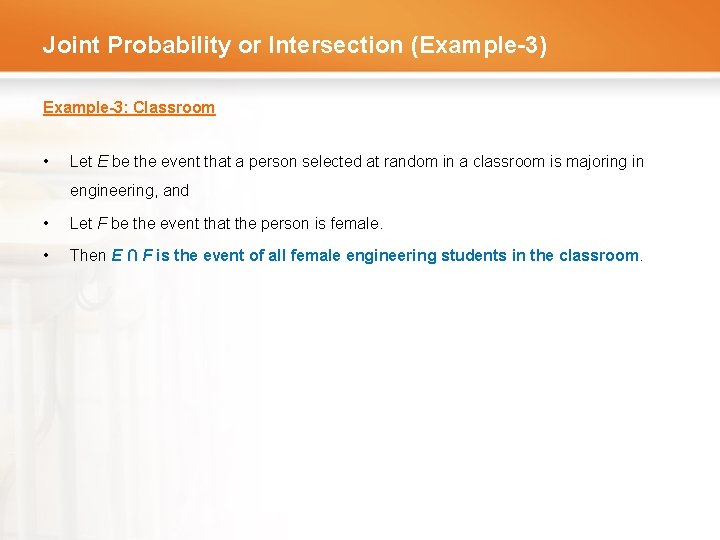
Joint Probability or Intersection (Example-3) Example-3: Classroom • Let E be the event that a person selected at random in a classroom is majoring in engineering, and • Let F be the event that the person is female. • Then E ∩ F is the event of all female engineering students in the classroom.
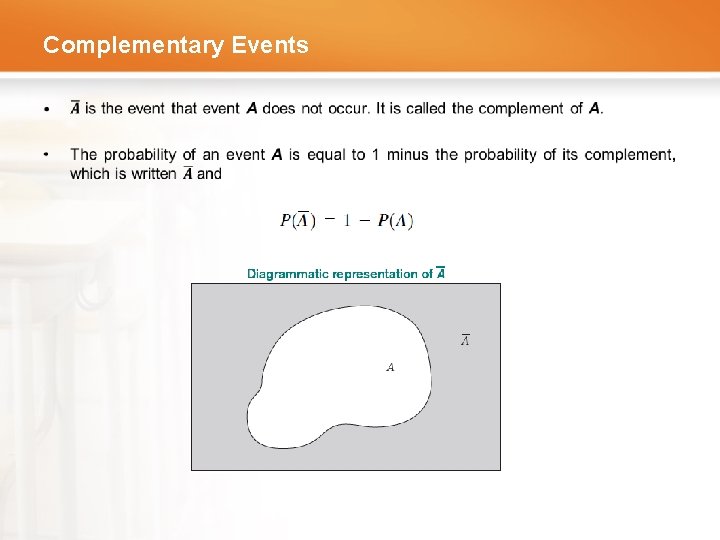
Complementary Events •
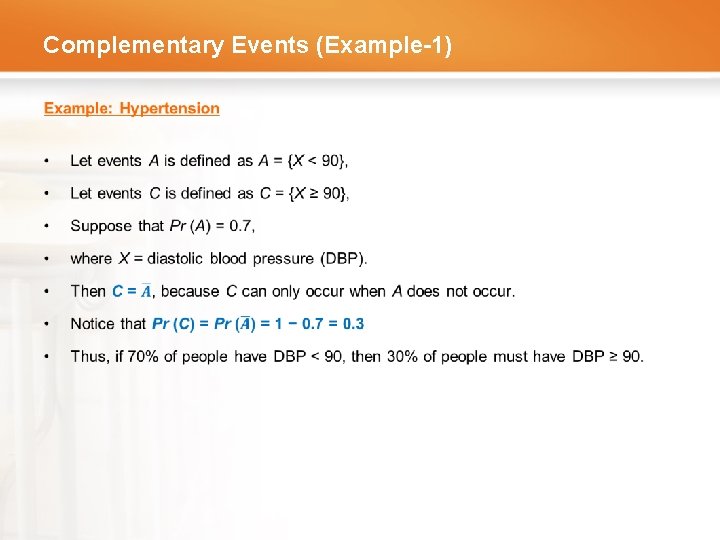
Complementary Events (Example-1) •
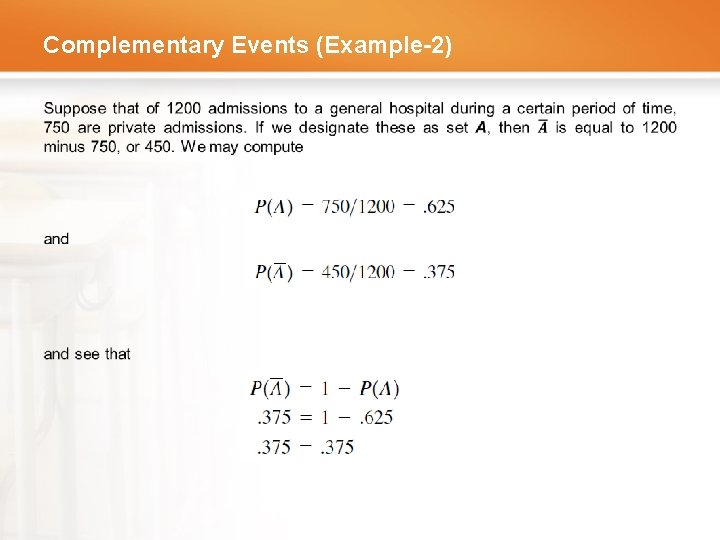
Complementary Events (Example-2) •
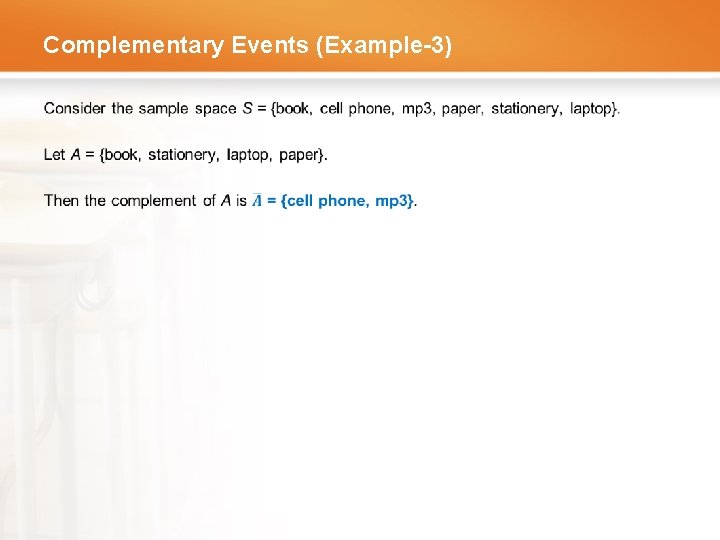
Complementary Events (Example-3) •
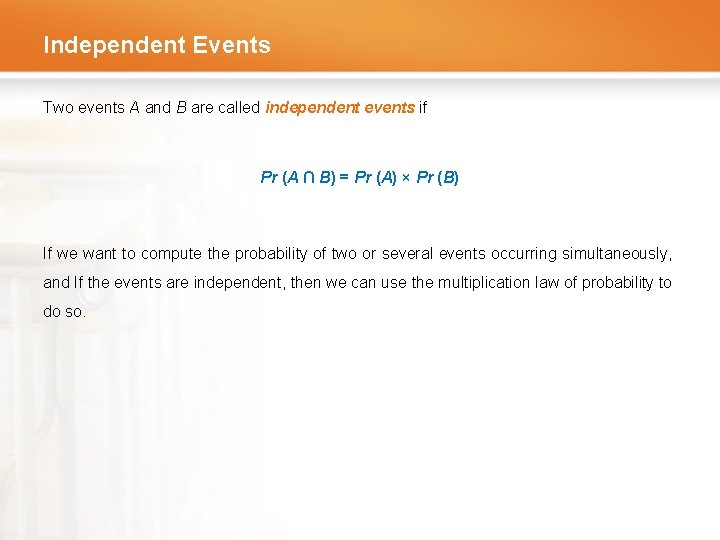
Independent Events Two events A and B are called independent events if Pr (A ∩ B) = Pr (A) × Pr (B) If we want to compute the probability of two or several events occurring simultaneously, and If the events are independent, then we can use the multiplication law of probability to do so.
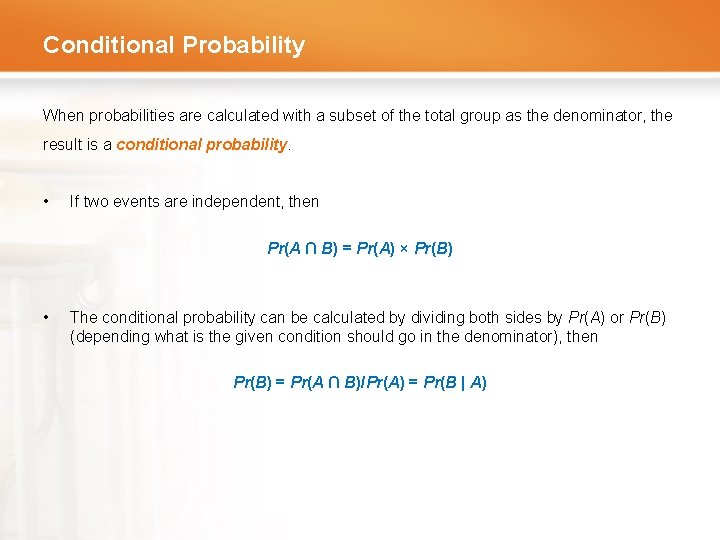
Conditional Probability When probabilities are calculated with a subset of the total group as the denominator, the result is a conditional probability. • If two events are independent, then Pr(A ∩ B) = Pr(A) × Pr(B) • The conditional probability can be calculated by dividing both sides by Pr(A) or Pr(B) (depending what is the given condition should go in the denominator), then Pr(B) = Pr(A ∩ B)/Pr(A) = Pr(B | A)
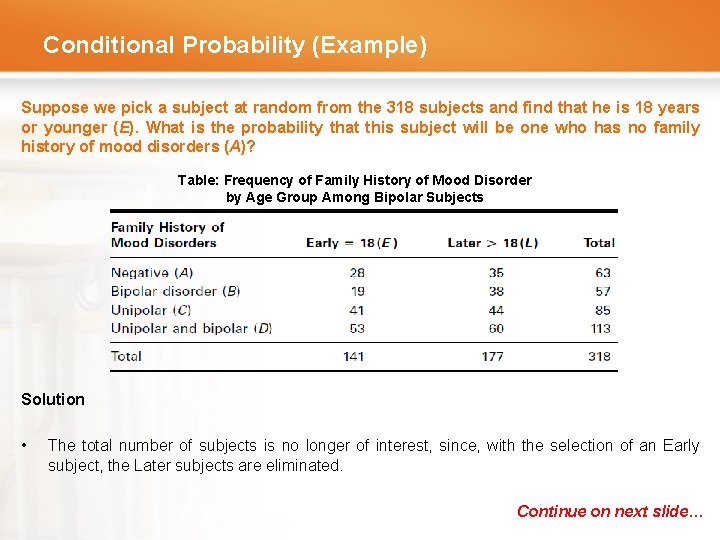
Conditional Probability (Example) Suppose we pick a subject at random from the 318 subjects and find that he is 18 years or younger (E). What is the probability that this subject will be one who has no family history of mood disorders (A)? Table: Frequency of Family History of Mood Disorder by Age Group Among Bipolar Subjects Solution • The total number of subjects is no longer of interest, since, with the selection of an Early subject, the Later subjects are eliminated. Continue on next slide…
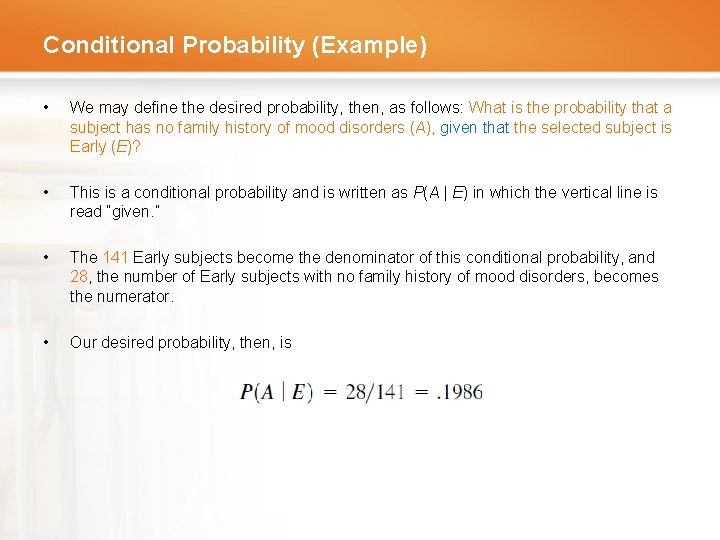
Conditional Probability (Example) • We may define the desired probability, then, as follows: What is the probability that a subject has no family history of mood disorders (A), given that the selected subject is Early (E)? • This is a conditional probability and is written as P(A | E) in which the vertical line is read “given. ” • The 141 Early subjects become the denominator of this conditional probability, and 28, the number of Early subjects with no family history of mood disorders, becomes the numerator. • Our desired probability, then, is
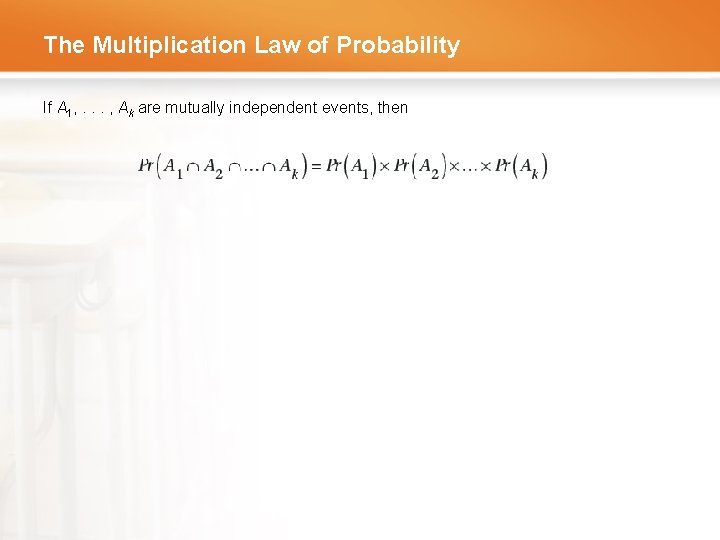
The Multiplication Law of Probability If A 1, . . . , Ak are mutually independent events, then
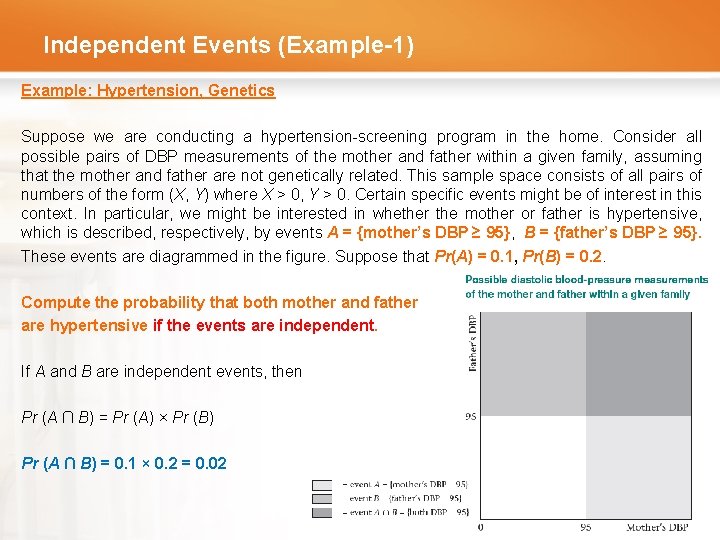
Independent Events (Example-1) Example: Hypertension, Genetics Suppose we are conducting a hypertension-screening program in the home. Consider all possible pairs of DBP measurements of the mother and father within a given family, assuming that the mother and father are not genetically related. This sample space consists of all pairs of numbers of the form (X, Y) where X > 0, Y > 0. Certain specific events might be of interest in this context. In particular, we might be interested in whether the mother or father is hypertensive, which is described, respectively, by events A = {mother’s DBP ≥ 95}, B = {father’s DBP ≥ 95}. These events are diagrammed in the figure. Suppose that Pr(A) = 0. 1, Pr(B) = 0. 2. Compute the probability that both mother and father are hypertensive if the events are independent. If A and B are independent events, then Pr (A ∩ B) = Pr (A) × Pr (B) Pr (A ∩ B) = 0. 1 × 0. 2 = 0. 02
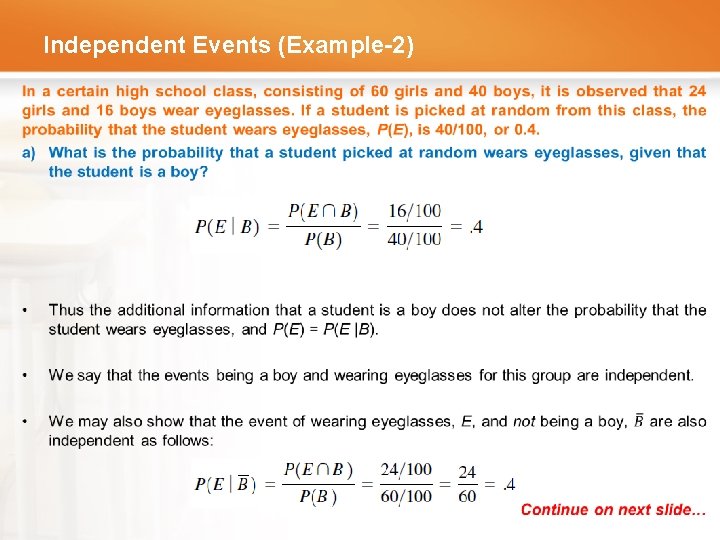
Independent Events (Example-2) •
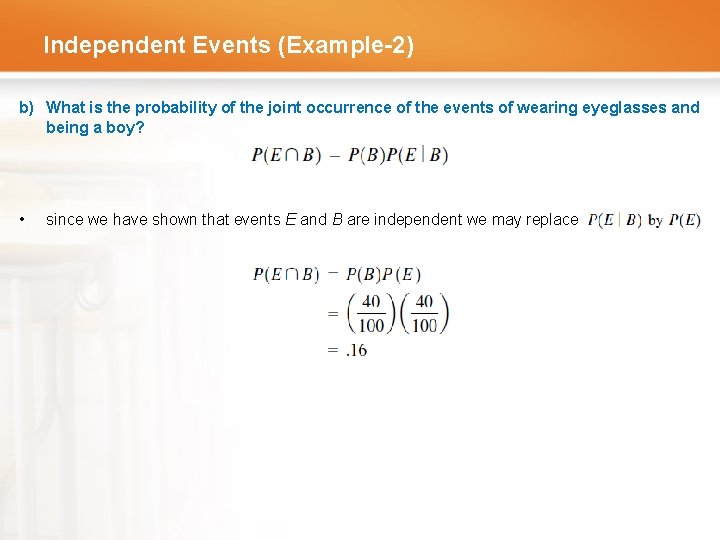
Independent Events (Example-2) b) What is the probability of the joint occurrence of the events of wearing eyeglasses and being a boy? • since we have shown that events E and B are independent we may replace
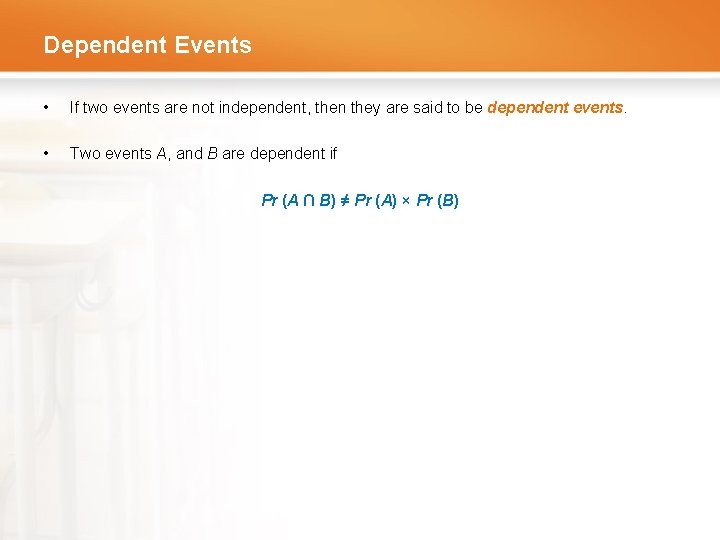
Dependent Events • If two events are not independent, then they are said to be dependent events. • Two events A, and B are dependent if Pr (A ∩ B) ≠ Pr (A) × Pr (B)
Dependent Events (Example) Example: Hypertension, Genetics Consider all possible diastolic blood pressure (DBP) measurements from a mother and her first-born child. • Let A = {mother’s DBP ≥ 95}, • Let B = {first-born child’s DBP ≥ 80}, • Suppose Pr(A ∩ B) = 0. 05, Pr(A) = 0. 1, Pr(B) = 0. 2 • Then Pr(A ∩ B) = 0. 05 > Pr(A) × Pr(B) = 0. 02 • The events A, B would be dependent. • This outcome would be expected because the mother and first-born child both share the same environment and are genetically related. • In other words, the firstborn child is more likely to have elevated blood pressure in households where the mother is hypertensive than in households where the mother is not hypertensive.
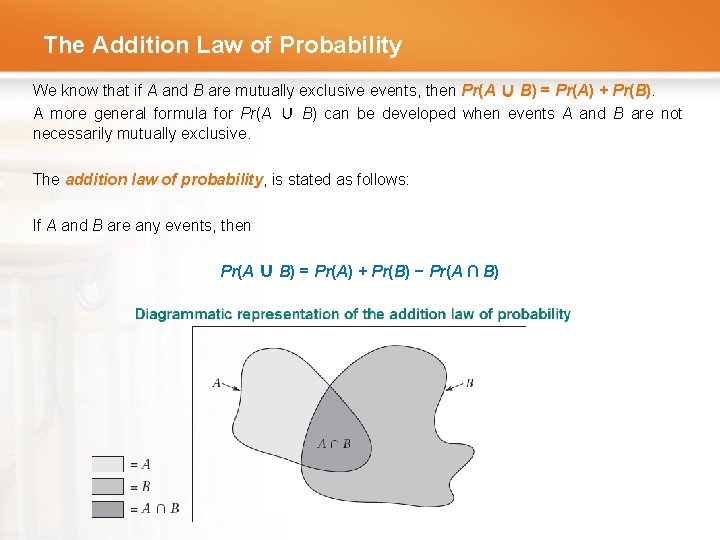
The Addition Law of Probability We know that if A and B are mutually exclusive events, then Pr(A ∪ B) = Pr(A) + Pr(B). A more general formula for Pr(A ∪ B) can be developed when events A and B are not necessarily mutually exclusive. The addition law of probability, is stated as follows: If A and B are any events, then Pr(A ∪ B) = Pr(A) + Pr(B) − Pr(A ∩ B)
The Addition Law of Probability The addition law of probability of two events A and B is Pr(A ∪ B) = Pr(A) + Pr(B) − Pr(A ∩ B) There are Two special cases of the addition law of probability. First Case: If events A and B are mutually exclusive Then, Pr(A ∩ B) = 0 and the addition law reduces to Pr(A ∪ B) = Pr(A) + Pr(B) Second Case: If events A and B are independent Then, by definition Pr(A ∩ B) = Pr(A) × Pr(B) and Pr(A ∪ B) can be rewritten as Pr(A ∪ B) = Pr(A) + Pr(B) − Pr(A) × Pr(B) • This leads to the following important special case of the addition law. If two events A and B are independent, then Pr (A∪ B) = Pr (A) + Pr (B) × [1 − Pr (A)]
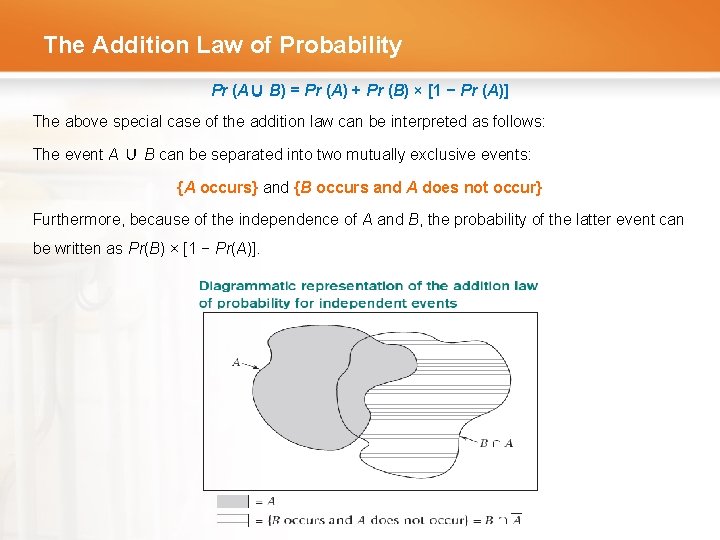
The Addition Law of Probability Pr (A∪ B) = Pr (A) + Pr (B) × [1 − Pr (A)] The above special case of the addition law can be interpreted as follows: The event A ∪ B can be separated into two mutually exclusive events: {A occurs} and {B occurs and A does not occur} Furthermore, because of the independence of A and B, the probability of the latter event can be written as Pr(B) × [1 − Pr(A)].
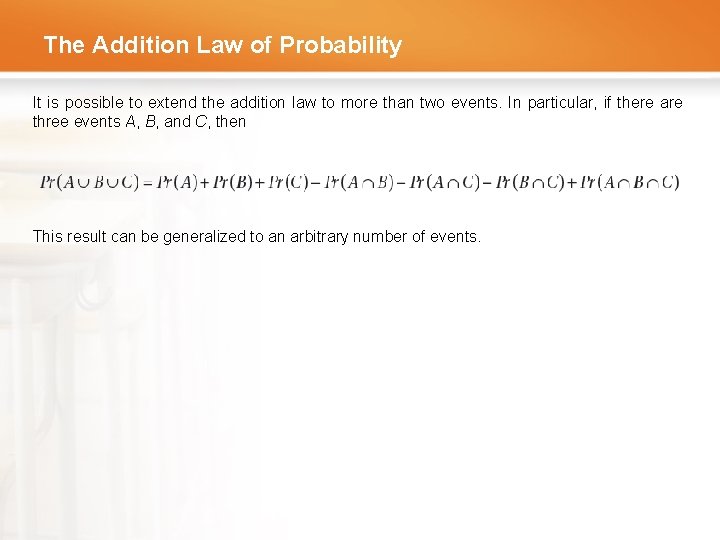
The Addition Law of Probability It is possible to extend the addition law to more than two events. In particular, if there are three events A, B, and C, then This result can be generalized to an arbitrary number of events.
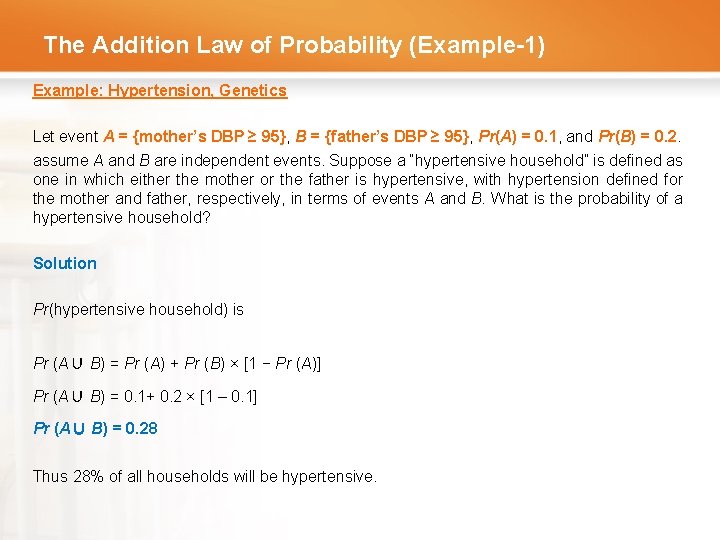
The Addition Law of Probability (Example-1) Example: Hypertension, Genetics Let event A = {mother’s DBP ≥ 95}, B = {father’s DBP ≥ 95}, Pr(A) = 0. 1, and Pr(B) = 0. 2. assume A and B are independent events. Suppose a “hypertensive household” is defined as one in which either the mother or the father is hypertensive, with hypertension defined for the mother and father, respectively, in terms of events A and B. What is the probability of a hypertensive household? Solution Pr(hypertensive household) is Pr (A∪ B) = Pr (A) + Pr (B) × [1 − Pr (A)] Pr (A∪ B) = 0. 1+ 0. 2 × [1 – 0. 1] Pr (A∪ B) = 0. 28 Thus 28% of all households will be hypertensive.
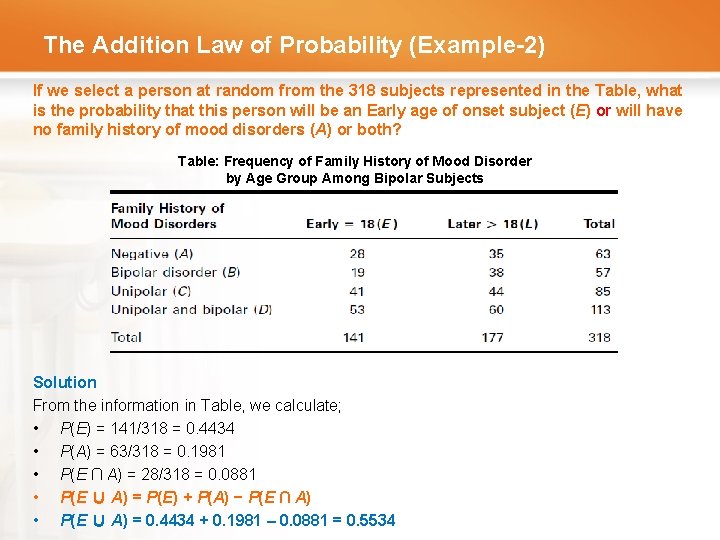
The Addition Law of Probability (Example-2) If we select a person at random from the 318 subjects represented in the Table, what is the probability that this person will be an Early age of onset subject (E) or will have no family history of mood disorders (A) or both? Table: Frequency of Family History of Mood Disorder by Age Group Among Bipolar Subjects Solution From the information in Table, we calculate; • P(E) = 141/318 = 0. 4434 • P(A) = 63/318 = 0. 1981 • P(E ∩ A) = 28/318 = 0. 0881 • P(E ∪ A) = P(E) + P(A) − P(E ∩ A) • P(E ∪ A) = 0. 4434 + 0. 1981 – 0. 0881 = 0. 5534
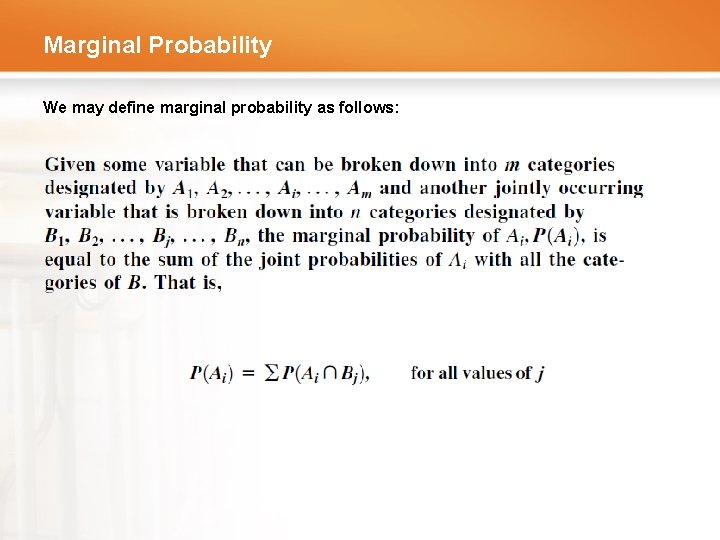
Marginal Probability We may define marginal probability as follows:
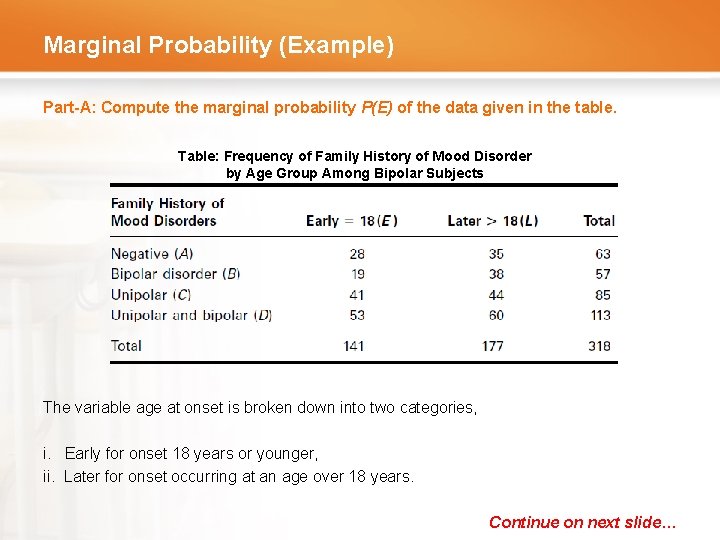
Marginal Probability (Example) Part-A: Compute the marginal probability P(E) of the data given in the table. Table: Frequency of Family History of Mood Disorder by Age Group Among Bipolar Subjects The variable age at onset is broken down into two categories, i. Early for onset 18 years or younger, ii. Later for onset occurring at an age over 18 years. Continue on next slide…
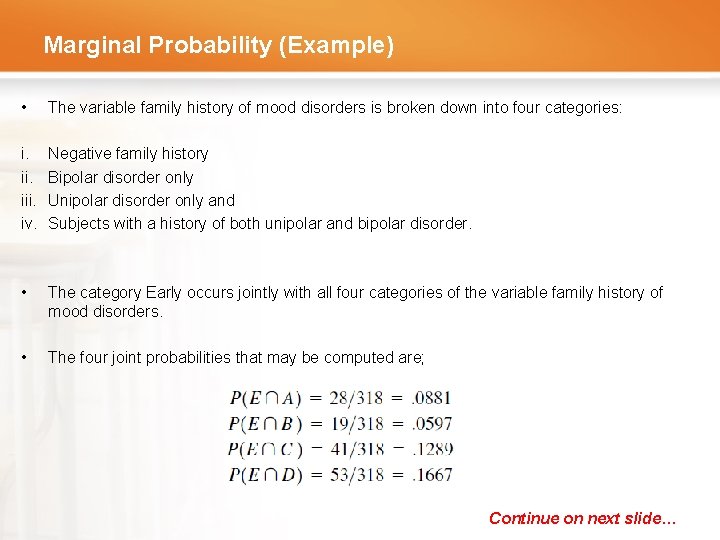
Marginal Probability (Example) • The variable family history of mood disorders is broken down into four categories: i. iii. iv. Negative family history Bipolar disorder only Unipolar disorder only and Subjects with a history of both unipolar and bipolar disorder. • The category Early occurs jointly with all four categories of the variable family history of mood disorders. • The four joint probabilities that may be computed are; Continue on next slide…
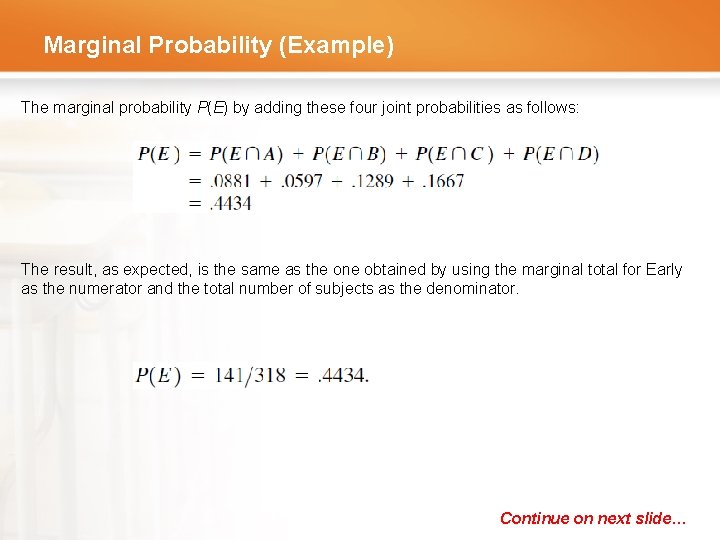
Marginal Probability (Example) The marginal probability P(E) by adding these four joint probabilities as follows: The result, as expected, is the same as the one obtained by using the marginal total for Early as the numerator and the total number of subjects as the denominator. Continue on next slide…
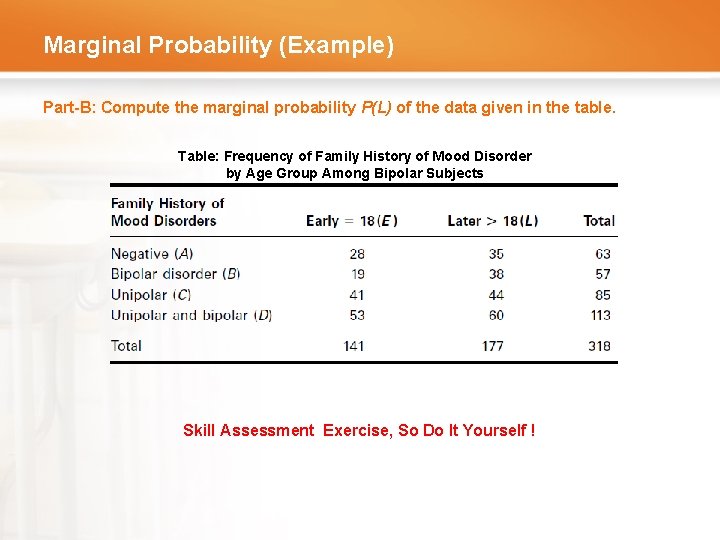
Marginal Probability (Example) Part-B: Compute the marginal probability P(L) of the data given in the table. Table: Frequency of Family History of Mood Disorder by Age Group Among Bipolar Subjects Skill Assessment Exercise, So Do It Yourself !
False Positive A false positive is defined as a positive test result when the disease or condition being tested for is not actually present.
False Negative A false negative is defined as a negative test result when the disease or condition being tested for is actually present.
Sensitivity The sensitivity of a symptom (or screening test) is the probability that the symptom is present given that the person has a disease.
Specificity The specificity of a symptom (or screening test) is the probability that the symptom is not present given that the person does not have a disease.
Predictive Value Positive (PV+) The predictive value positive (PV+) of a screening test (or symptom) is the probability that a person has a disease given that the screening test is positive (or has the symptom). Pr(disease|test+)
Predictive Value Negative (PV−) The predictive value negative (PV−) of a screening test (or symptom) is the probability that a person does not have a disease given that the screening test is negative (or does not have the symptom). Pr(no disease | test−)
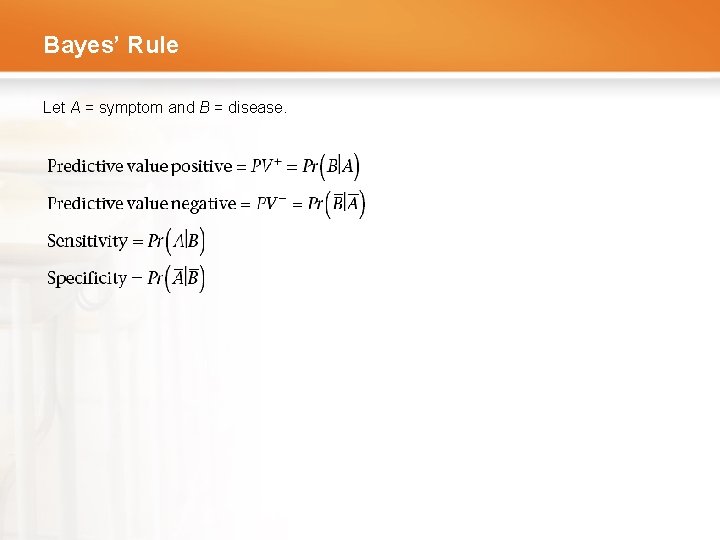
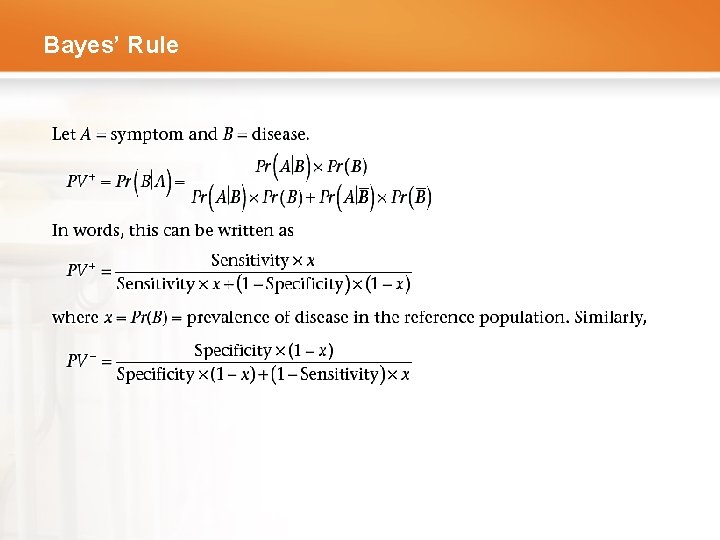
Bayes’ Rule Let A = symptom and B = disease.
Bayes’ Rule The Bayes’ rule allows to obtain the estimates of predictive value positive and predictive value negative of a test (or symptom) from knowledge of a test’s (or symptom’s) sensitivity and specificity and the probability of the relevant disease in the general population.
Bayes’ Rule
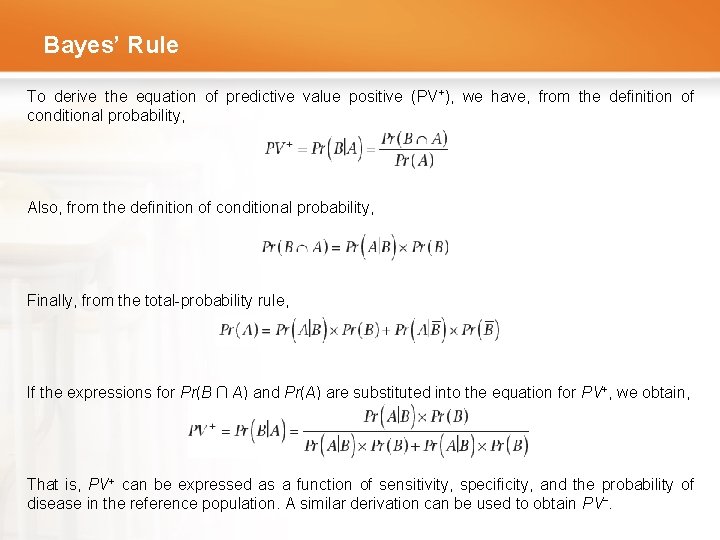
Bayes’ Rule To derive the equation of predictive value positive (PV+), we have, from the definition of conditional probability, Also, from the definition of conditional probability, Finally, from the total-probability rule, If the expressions for Pr(B ∩ A) and Pr(A) are substituted into the equation for PV+, we obtain, That is, PV+ can be expressed as a function of sensitivity, specificity, and the probability of disease in the reference population. A similar derivation can be used to obtain PV−.
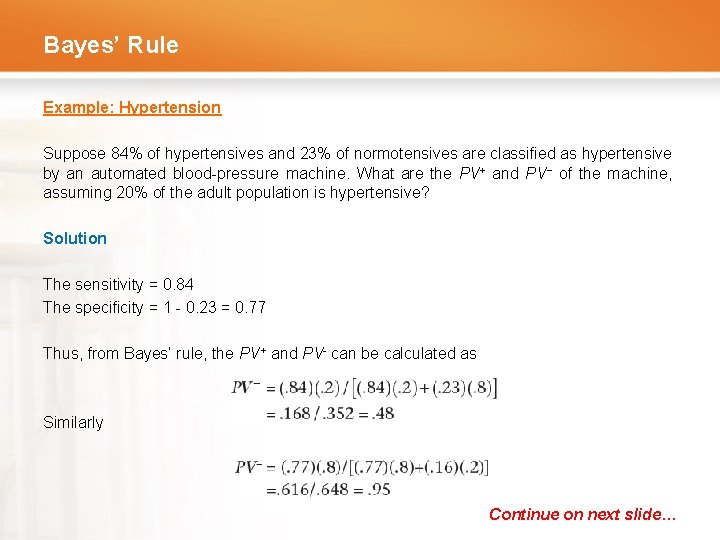
Bayes’ Rule Example: Hypertension Suppose 84% of hypertensives and 23% of normotensives are classified as hypertensive by an automated blood-pressure machine. What are the PV+ and PV− of the machine, assuming 20% of the adult population is hypertensive? Solution The sensitivity = 0. 84 The specificity = 1 - 0. 23 = 0. 77 Thus, from Bayes’ rule, the PV+ and PV- can be calculated as Similarly Continue on next slide…
Bayes’ Rule • Thus a negative result from the machine is reasonably predictive because we are 95% sure a person with a negative result from the machine is normotensive. • However, a positive result is not very predictive because we are only 48% sure a person with a positive result from the machine is hypertensive.
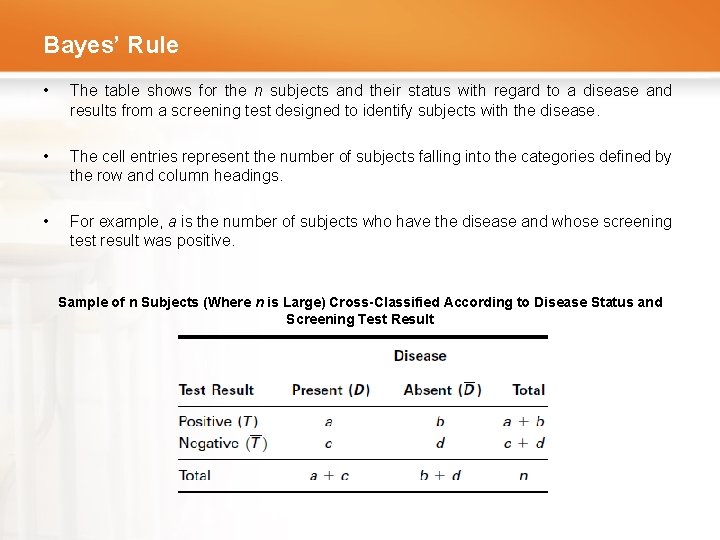
Bayes’ Rule • The table shows for the n subjects and their status with regard to a disease and results from a screening test designed to identify subjects with the disease. • The cell entries represent the number of subjects falling into the categories defined by the row and column headings. • For example, a is the number of subjects who have the disease and whose screening test result was positive. Sample of n Subjects (Where n is Large) Cross-Classified According to Disease Status and Screening Test Result
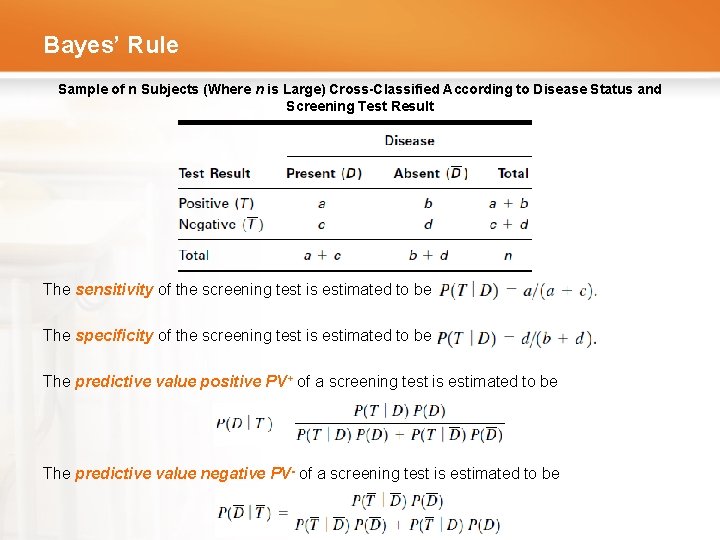
Bayes’ Rule Sample of n Subjects (Where n is Large) Cross-Classified According to Disease Status and Screening Test Result The sensitivity of the screening test is estimated to be The specificity of the screening test is estimated to be The predictive value positive PV+ of a screening test is estimated to be The predictive value negative PV- of a screening test is estimated to be
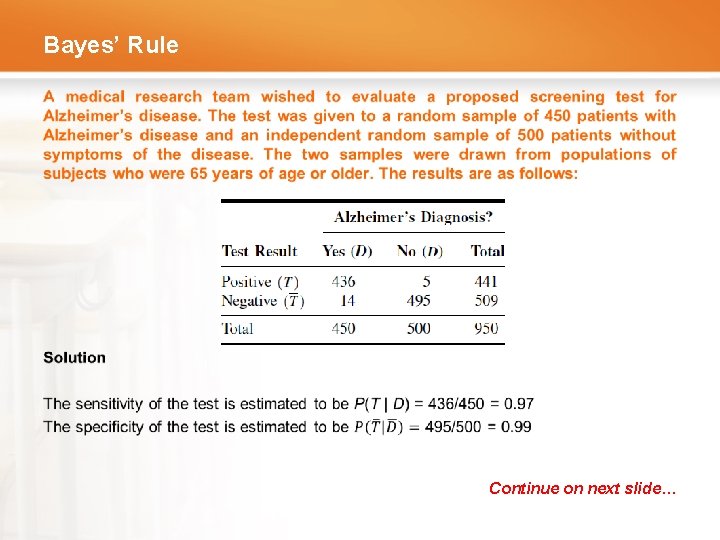
Bayes’ Rule Continue on next slide…
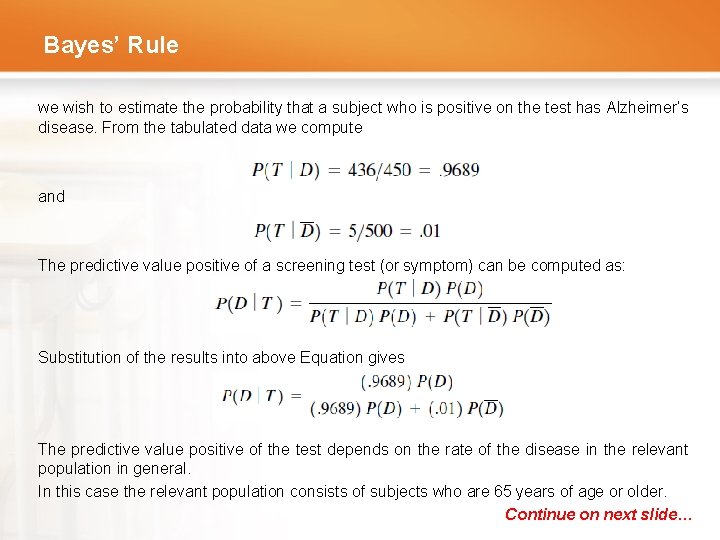
Bayes’ Rule we wish to estimate the probability that a subject who is positive on the test has Alzheimer’s disease. From the tabulated data we compute and The predictive value positive of a screening test (or symptom) can be computed as: Substitution of the results into above Equation gives The predictive value positive of the test depends on the rate of the disease in the relevant population in general. In this case the relevant population consists of subjects who are 65 years of age or older. Continue on next slide…
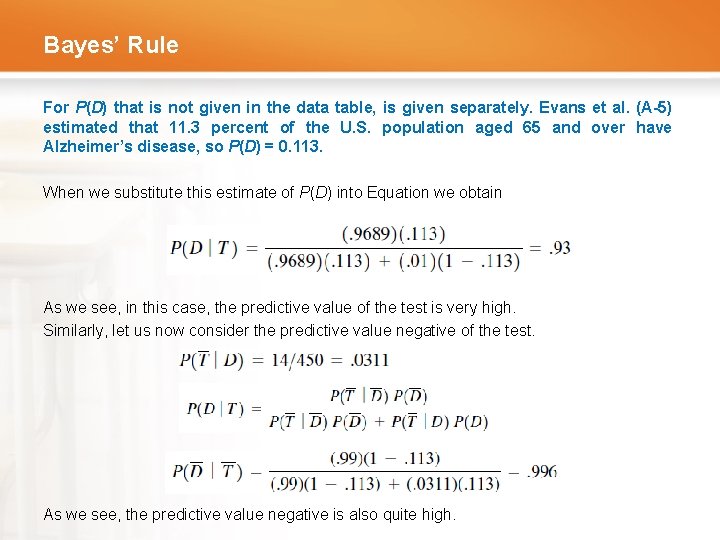
Bayes’ Rule For P(D) that is not given in the data table, is given separately. Evans et al. (A-5) estimated that 11. 3 percent of the U. S. population aged 65 and over have Alzheimer’s disease, so P(D) = 0. 113. When we substitute this estimate of P(D) into Equation we obtain As we see, in this case, the predictive value of the test is very high. Similarly, let us now consider the predictive value negative of the test. As we see, the predictive value negative is also quite high.
Bayesian Inference • Bayesian inference is an alternative definition of probability and inference, espoused by a vocal minority of statisticians. • The Bayesian school of inference rejects the idea of the frequency definition of probability (conventional definition), considering that it is a theoretical concept that can never be realized in practice. • Instead, Bayesians conceive of two types of probability: a prior probability and a posterior probability.
Bayesian Inference 1. prior probability The prior probability of an event is the best guess by the observer of an event’s likelihood in the absence of data. This prior probability may be a single number, or it may be a range of likely values for the probability, perhaps with weights attached to each possible value.
Bayesian Inference (Example) Example: Hypertension Suppose 84% of hypertensives and 23% of normotensives are classified as hypertensive by an automated blood-pressure machine. What are the PV+ and PV− of the machine, assuming 20% of the adult population is hypertensive? What is the prior probability of hypertension? Solution The prior probability of hypertension in the absence of additional data is 0. 20 because 20% of the adult population is hypertensive.
Bayesian Inference 2. posterior probability The posterior probability of an event is the likelihood that an event will occur after collecting some empirical data. It is obtained by integrating information from the prior probability with additional data related to the event in question.
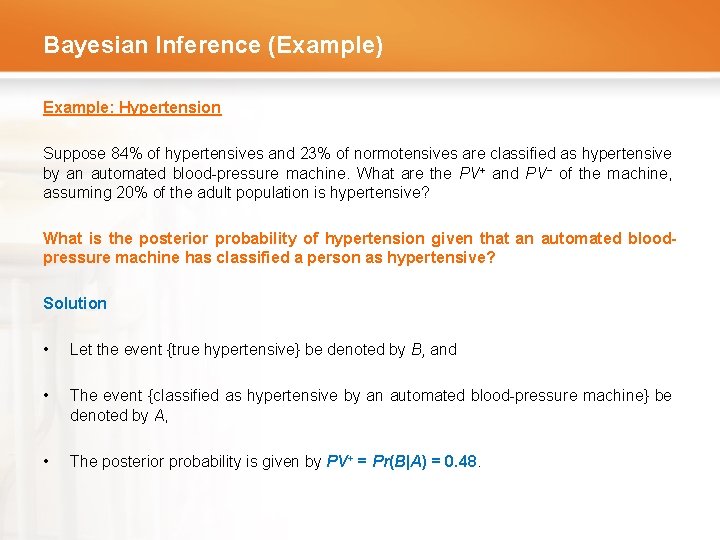
Bayesian Inference (Example) Example: Hypertension Suppose 84% of hypertensives and 23% of normotensives are classified as hypertensive by an automated blood-pressure machine. What are the PV+ and PV− of the machine, assuming 20% of the adult population is hypertensive? What is the posterior probability of hypertension given that an automated bloodpressure machine has classified a person as hypertensive? Solution • Let the event {true hypertensive} be denoted by B, and • The event {classified as hypertensive by an automated blood-pressure machine} be denoted by A, • The posterior probability is given by PV+ = Pr(B|A) = 0. 48.
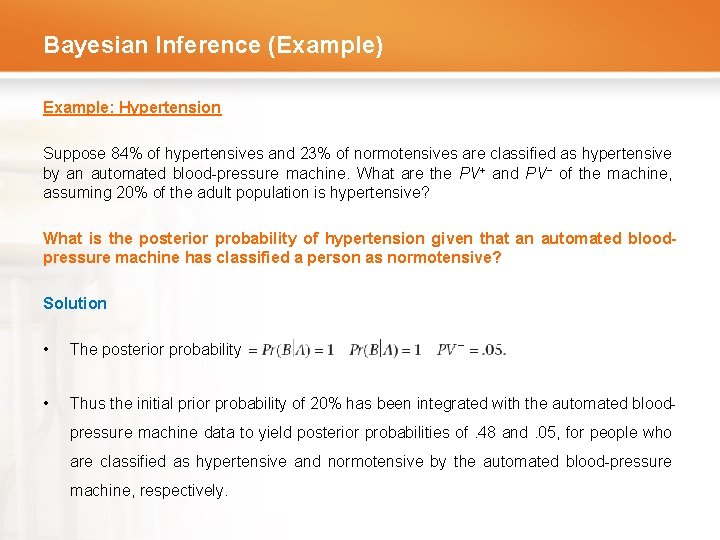
Bayesian Inference (Example) Example: Hypertension Suppose 84% of hypertensives and 23% of normotensives are classified as hypertensive by an automated blood-pressure machine. What are the PV+ and PV− of the machine, assuming 20% of the adult population is hypertensive? What is the posterior probability of hypertension given that an automated bloodpressure machine has classified a person as normotensive? Solution • The posterior probability • Thus the initial prior probability of 20% has been integrated with the automated bloodpressure machine data to yield posterior probabilities of. 48 and. 05, for people who are classified as hypertensive and normotensive by the automated blood-pressure machine, respectively.

Thank You !!!
- Slides: 66