
Probability and Statistics What is probability What is
Probability and Statistics ØWhat is probability? ØWhat is statistics? 1
Probability and Statistics Ø Probability n n Formally defined using a set of axioms Seeks to determine the likelihood that a given event or observation or measurement will or has happened w What is the probability of throwing a 7 using two dice? Ø Statistics n n Used to analyze the frequency of past events Uses a given sample of data to assess a probabilistic model’s validity or determine values of its parameters w After observing several throws of two dice, can I determine whether or not they are loaded n Also depends on what we mean by probability 2
Probability and Statistics ØWe perform an experiment to collect a number of top quarks n n n How do we extract the best value for its mass? What is the uncertainty of our best value? Is our experiment internally consistent? Is this value consistent with a given theory, which itself may contain uncertainties? Is this value consistent with other measurements of the top quark mass? 3
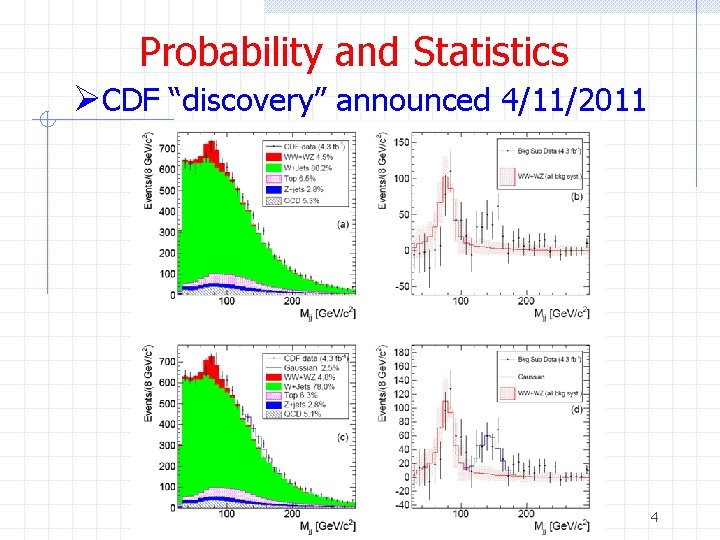
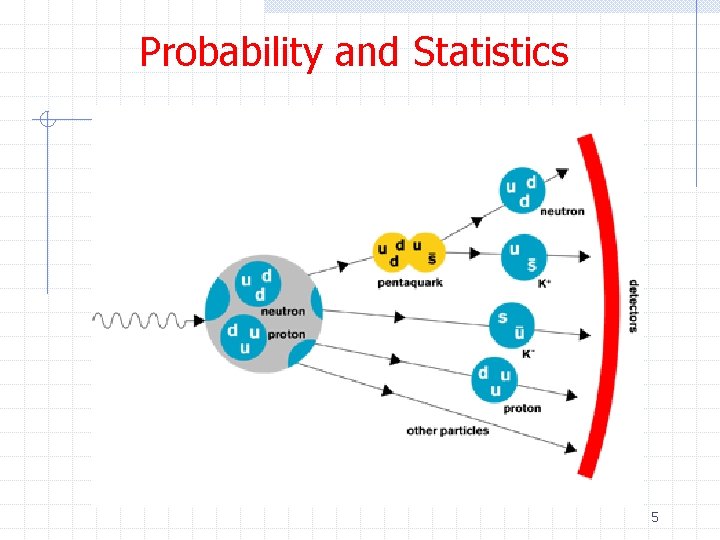
Probability and Statistics ØCDF “discovery” announced 4/11/2011 4
Probability and Statistics 5
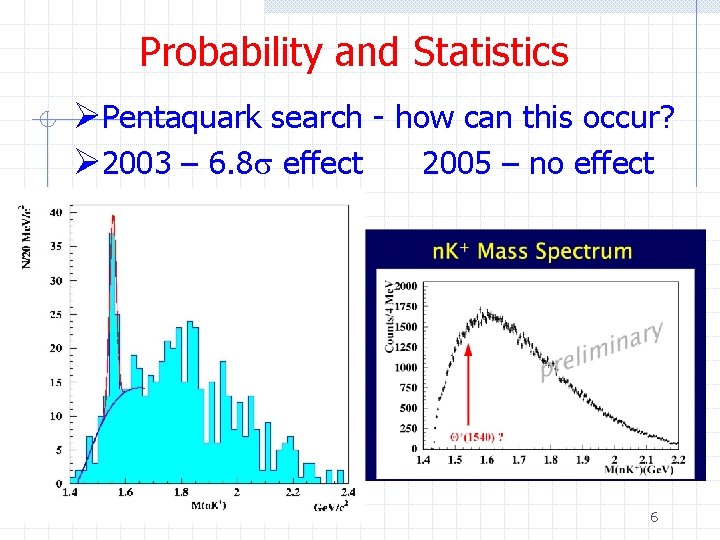
Probability and Statistics ØPentaquark search - how can this occur? Ø 2003 – 6. 8 s effect 2005 – no effect 6

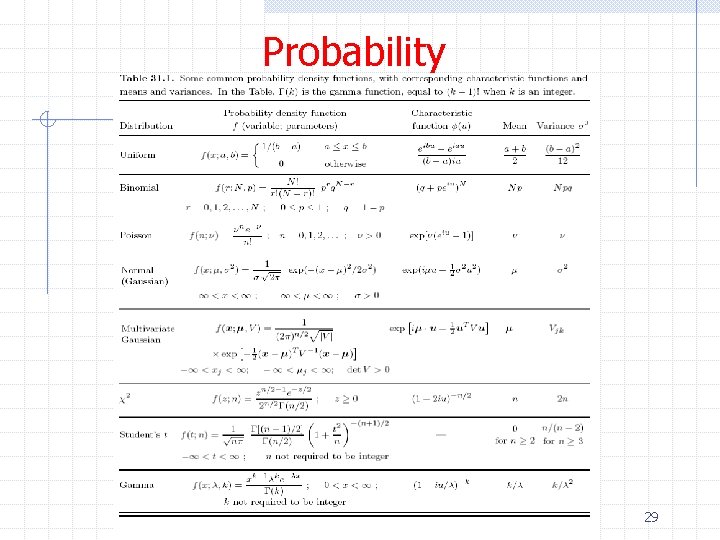
Probability Ø Let the sample space S be the space of all possible outcomes of an experiment Ø Let x be a possible outcome n n n Then P(x found in [x, x+dx]) = f(x)dx f(x) is called the probability density function (pdf) It may be called f(x; q) since the pdf could depend on one or more parameters q w Often we will want to determine q from a set of measurements n Of course x must be somewhere so 7
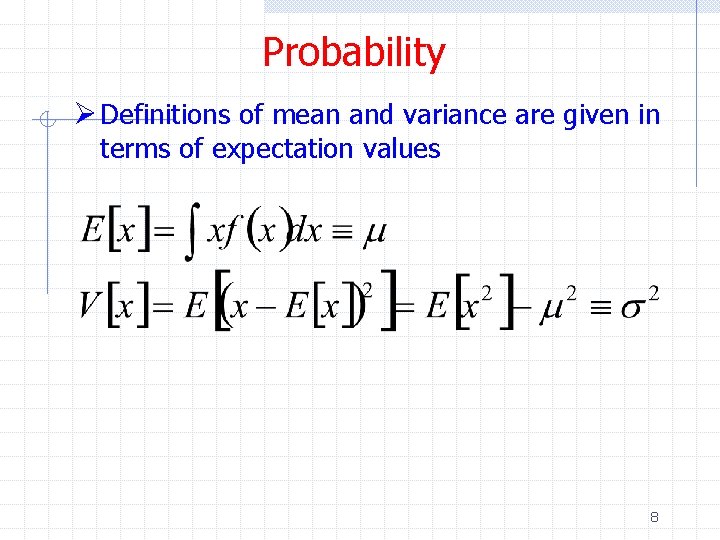
Probability Ø Definitions of mean and variance are given in terms of expectation values 8
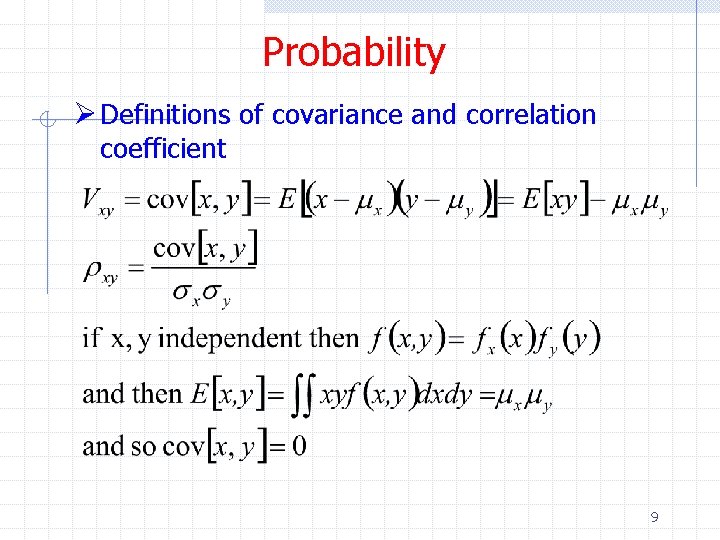
Probability Ø Definitions of covariance and correlation coefficient 9
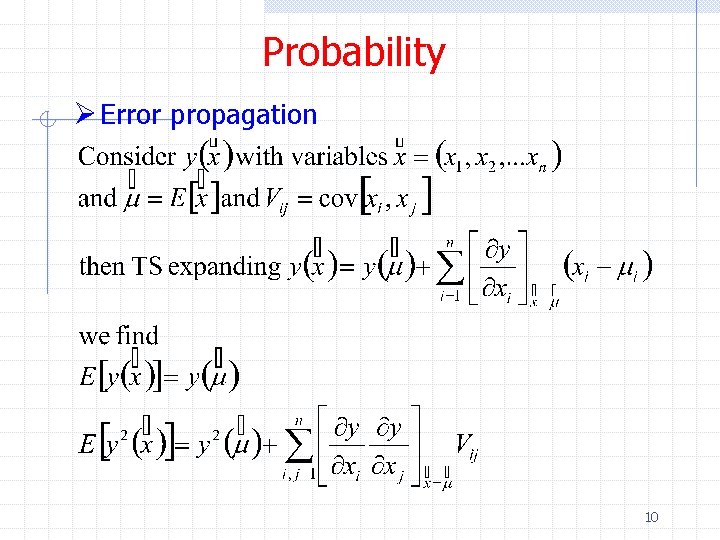
Probability Ø Error propagation 10
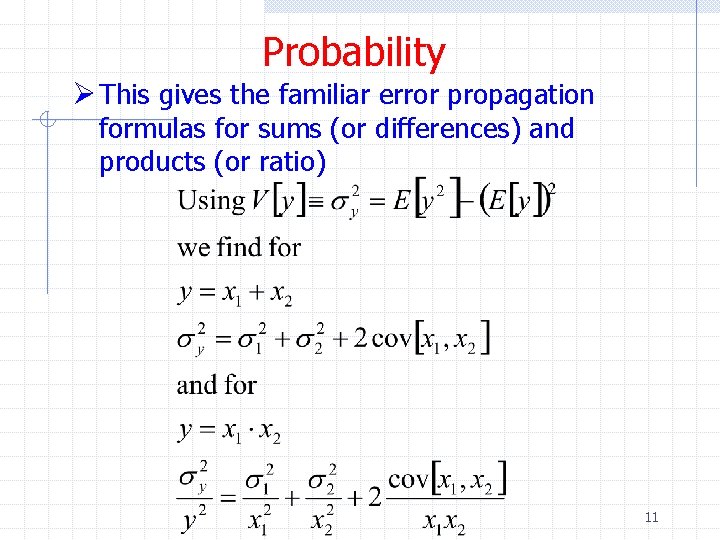
Probability Ø This gives the familiar error propagation formulas for sums (or differences) and products (or ratio) 11
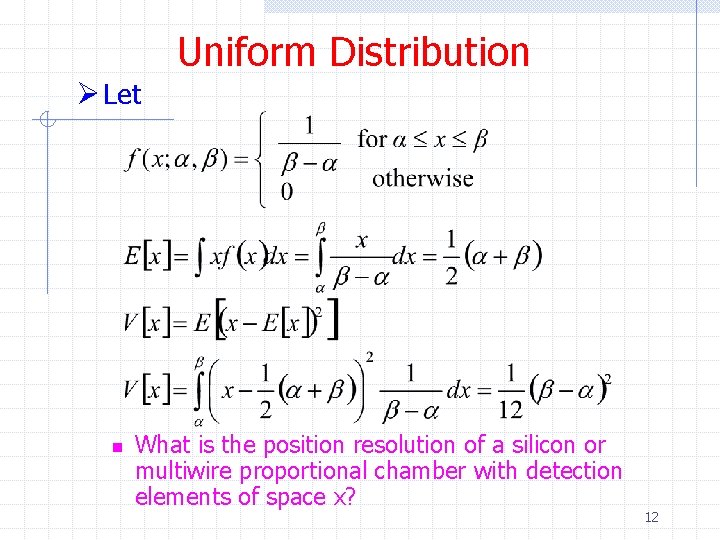
Uniform Distribution Ø Let n What is the position resolution of a silicon or multiwire proportional chamber with detection elements of space x? 12
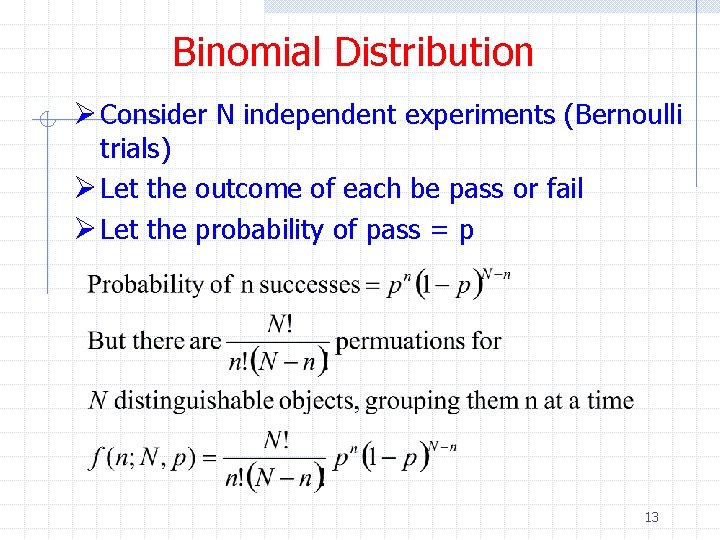
Binomial Distribution Ø Consider N independent experiments (Bernoulli trials) Ø Let the outcome of each be pass or fail Ø Let the probability of pass = p 13

Permutations Ø Quick review 14
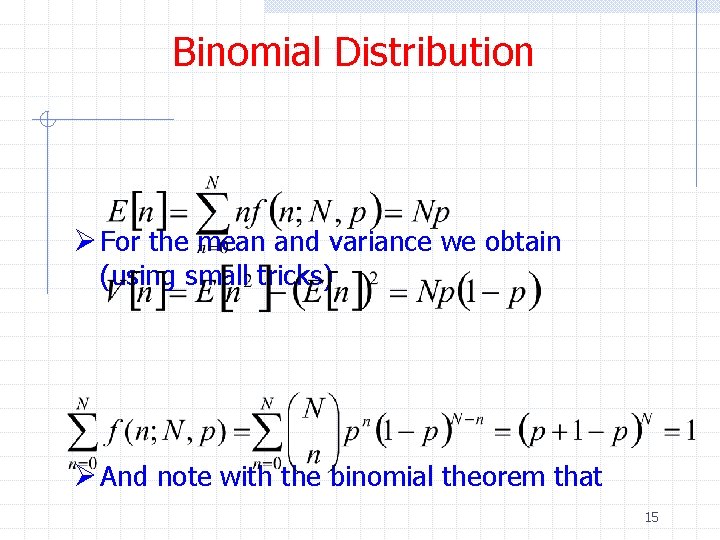
Binomial Distribution Ø For the mean and variance we obtain (using small tricks) Ø And note with the binomial theorem that 15
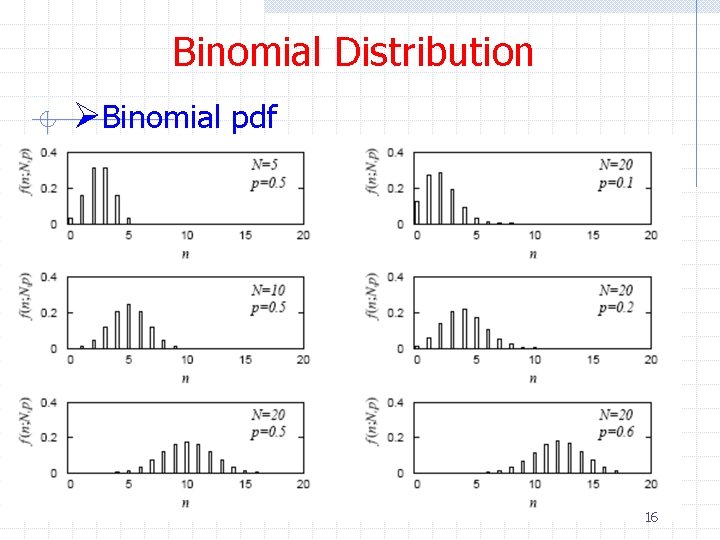
Binomial Distribution ØBinomial pdf 16
Binomial Distribution ØExamples n n n Coin flip (p=1/2) Dice throw (p=1/6) Branching ratio of nuclear and particle decays (p=Br) Detector or trigger efficiencies (pass or not pass) Blood group B or not blood group B 17
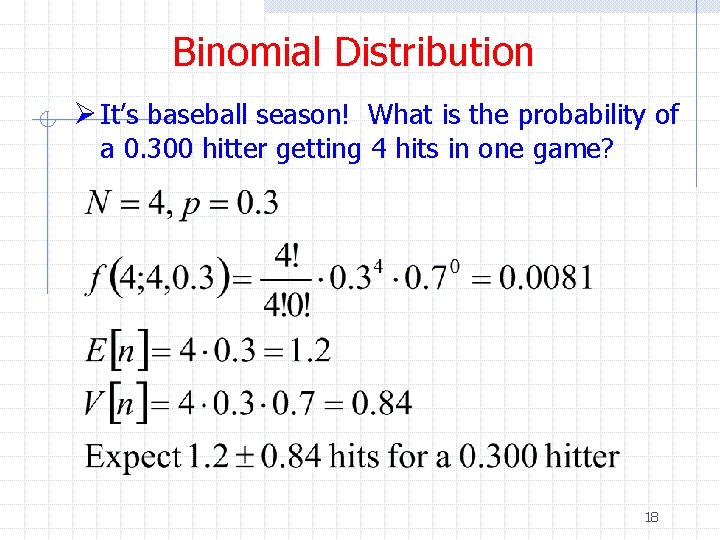
Binomial Distribution Ø It’s baseball season! What is the probability of a 0. 300 hitter getting 4 hits in one game? 18
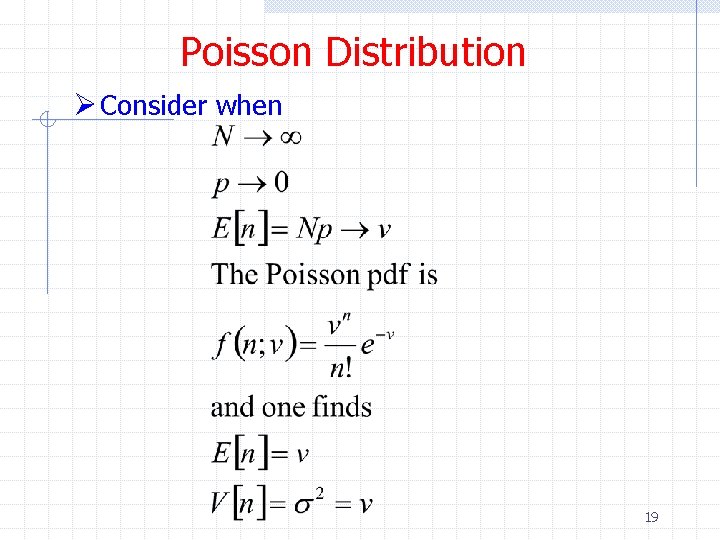
Poisson Distribution Ø Consider when 19
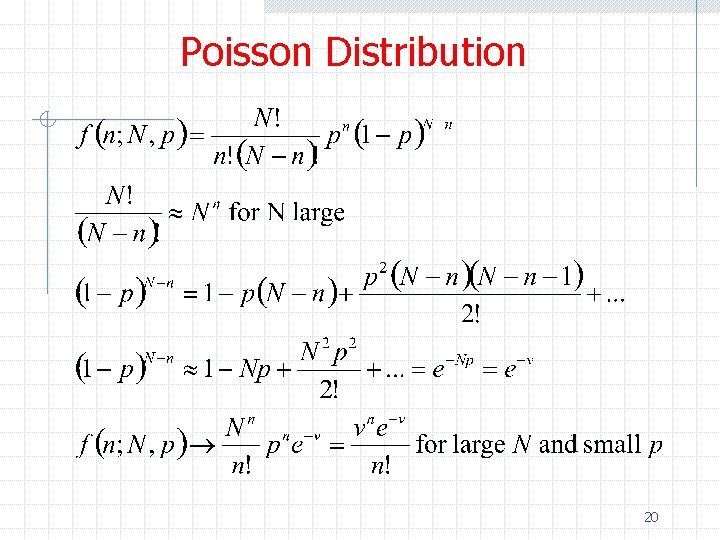
Poisson Distribution 20
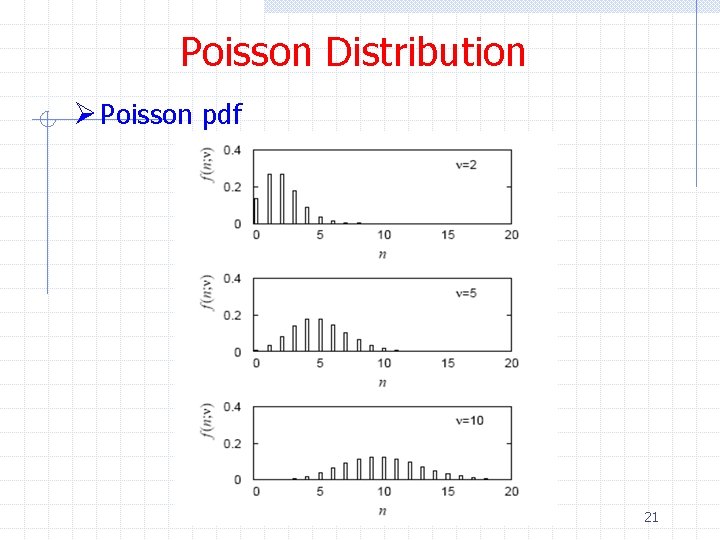
Poisson Distribution Ø Poisson pdf 21
Poisson Distribution Ø Examples n Particles detected from radioactive decays w Sum of two Poisson processes is a Poisson process n n n Particles detected from scattering of a beam on target with cross section s Cosmic rays observed in a time interval t Number of entries in a histogram bin when data is accumulated over a fixed time interval Number of Prussian soldiers kicked to death by horses Infant mortality QC/failure rate predictions 22
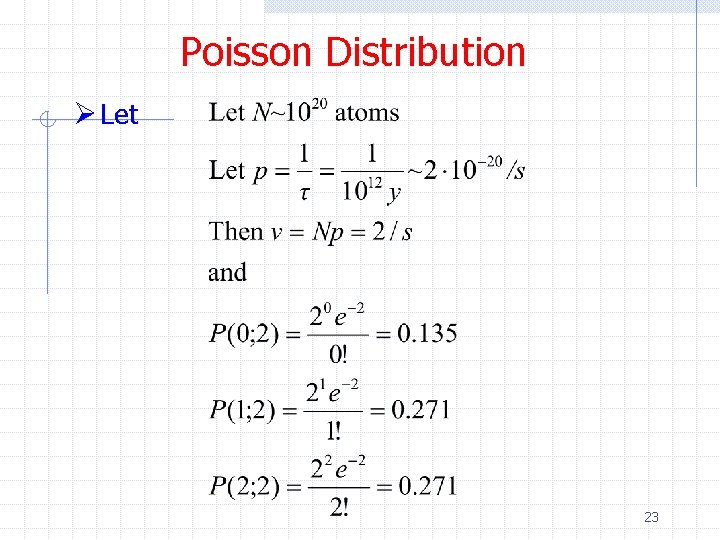
Poisson Distribution Ø Let 23
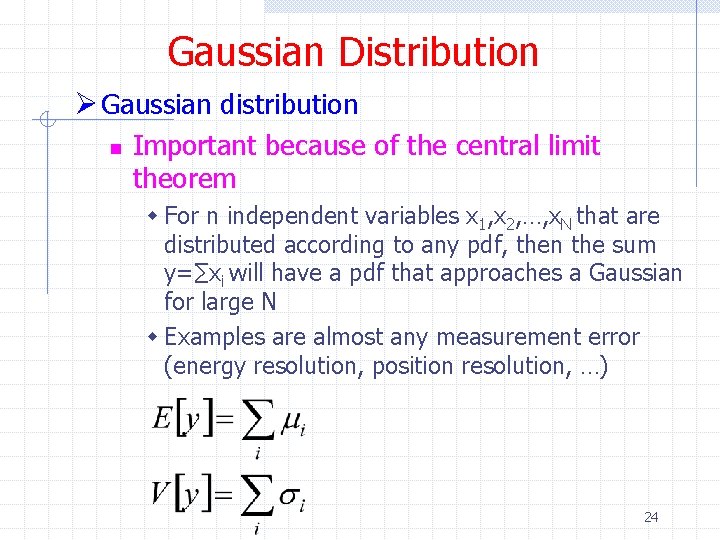
Gaussian Distribution Ø Gaussian distribution n Important because of the central limit theorem w For n independent variables x 1, x 2, …, x. N that are distributed according to any pdf, then the sum y=∑xi will have a pdf that approaches a Gaussian for large N w Examples are almost any measurement error (energy resolution, position resolution, …) 24
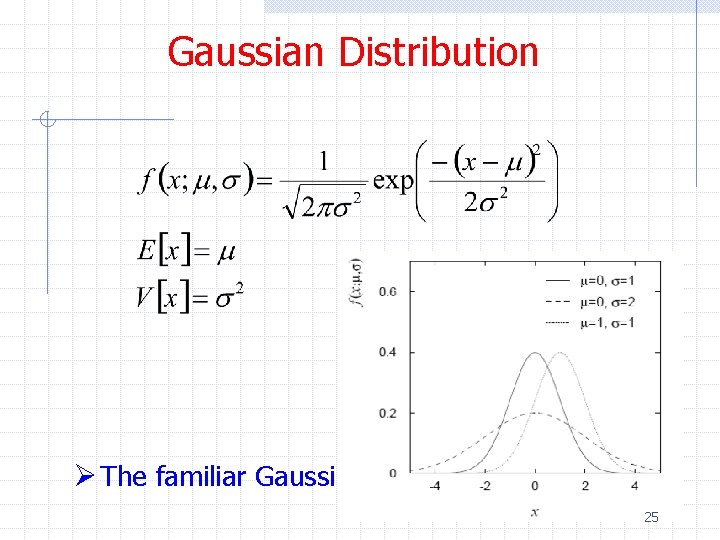
Gaussian Distribution Ø The familiar Gaussian pdf is 25
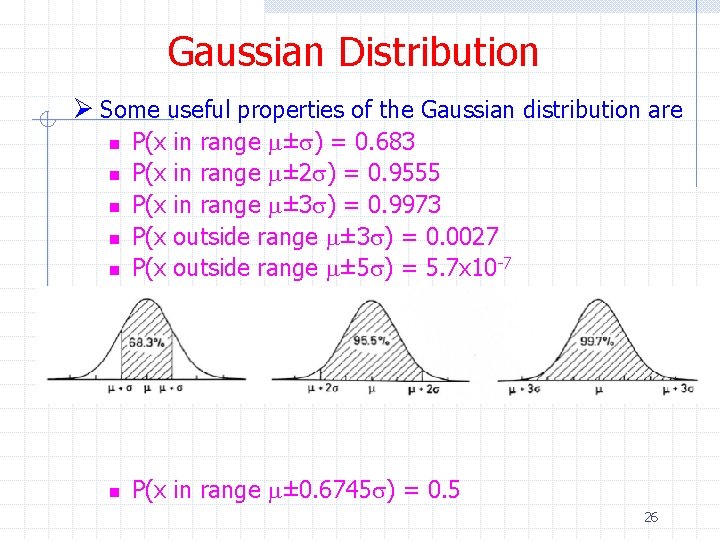
Gaussian Distribution Ø Some useful properties of the Gaussian distribution are in range m±s) = 0. 683 in range m± 2 s) = 0. 9555 in range m± 3 s) = 0. 9973 outside range m± 3 s) = 0. 0027 outside range m± 5 s) = 5. 7 x 10 -7 n P(x P(x P(x n P(x in range m± 0. 6745 s) = 0. 5 n n 26
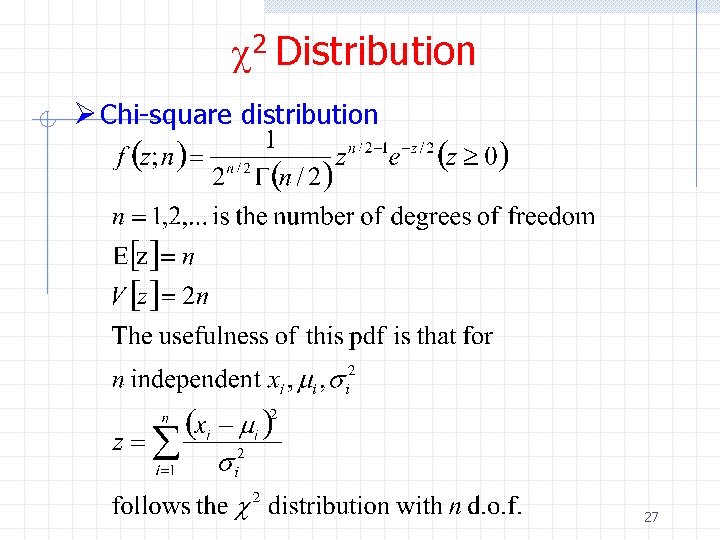
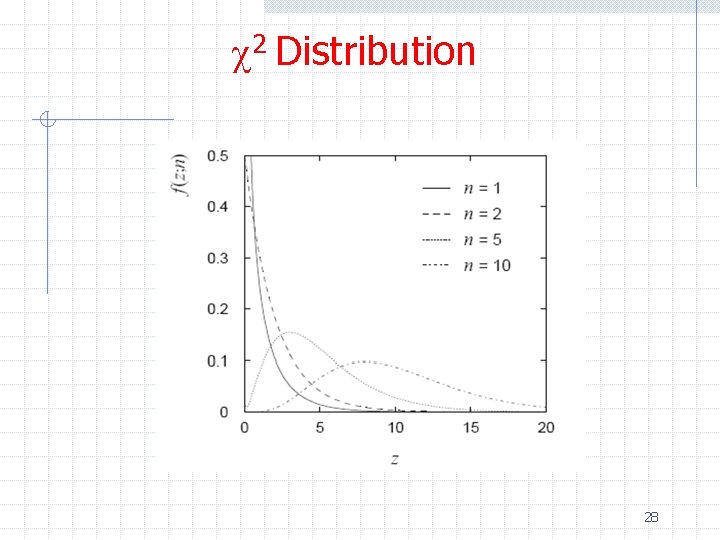
c 2 Distribution Ø Chi-square distribution 27
c 2 Distribution 28
Probability 29
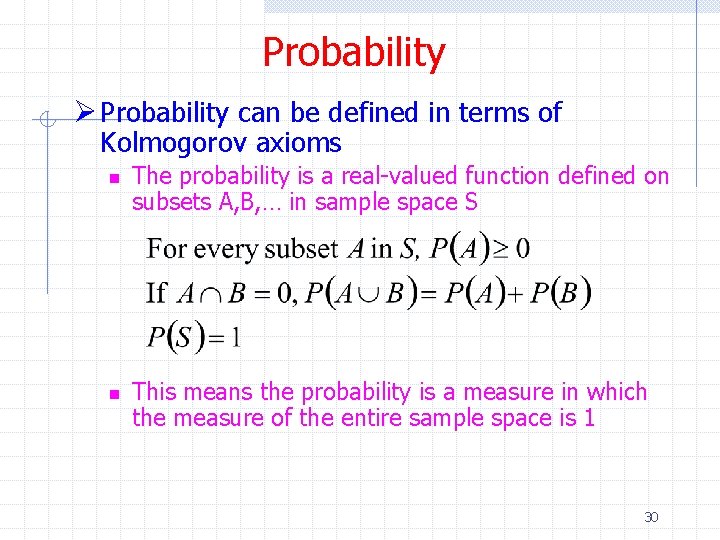
Probability Ø Probability can be defined in terms of Kolmogorov axioms n n The probability is a real-valued function defined on subsets A, B, … in sample space S This means the probability is a measure in which the measure of the entire sample space is 1 30
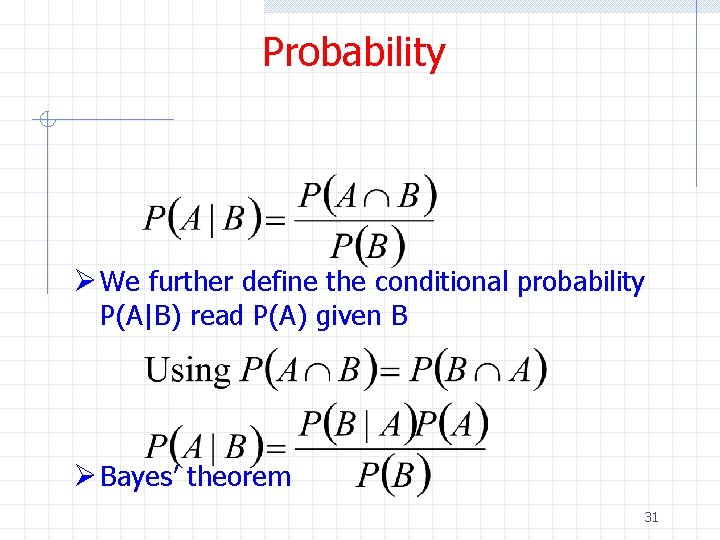
Probability Ø We further define the conditional probability P(A|B) read P(A) given B Ø Bayes’ theorem 31
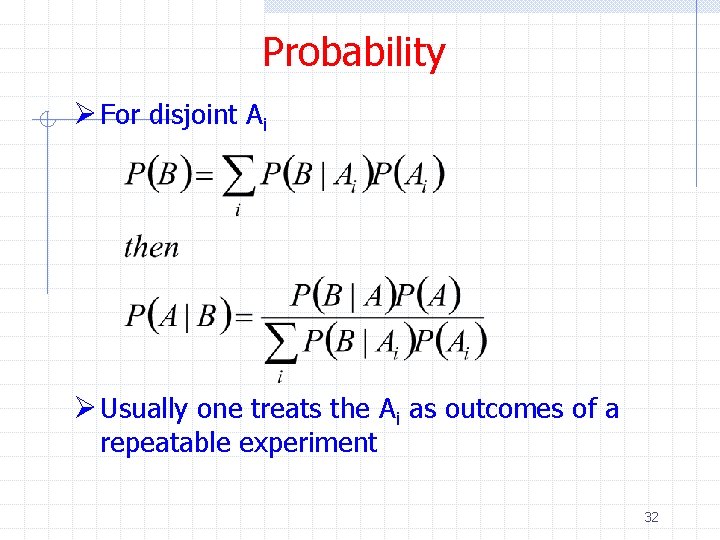
Probability Ø For disjoint Ai Ø Usually one treats the Ai as outcomes of a repeatable experiment 32
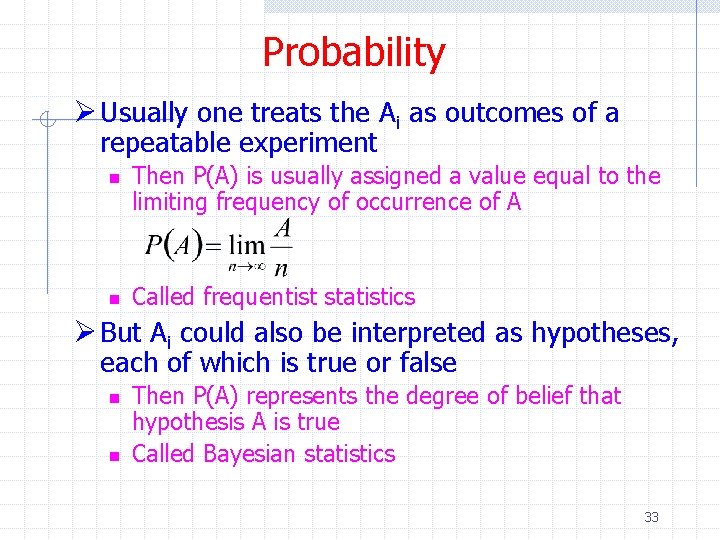
Probability Ø Usually one treats the Ai as outcomes of a repeatable experiment n n Then P(A) is usually assigned a value equal to the limiting frequency of occurrence of A Called frequentist statistics Ø But Ai could also be interpreted as hypotheses, each of which is true or false n n Then P(A) represents the degree of belief that hypothesis A is true Called Bayesian statistics 33
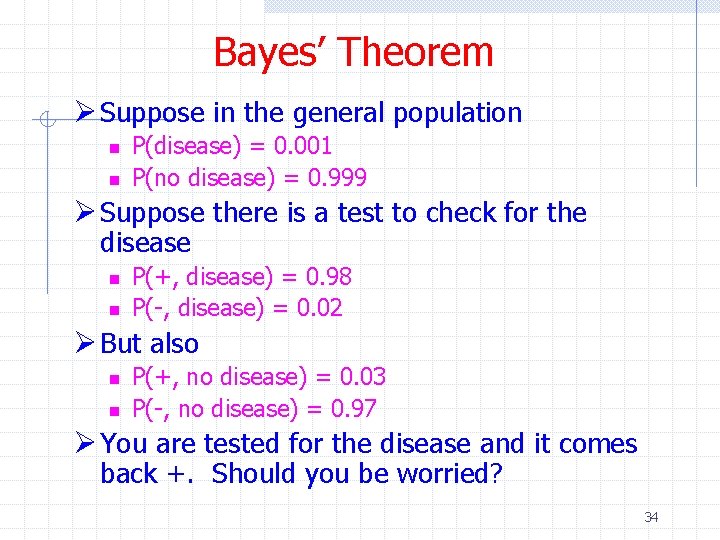
Bayes’ Theorem Ø Suppose in the general population n n P(disease) = 0. 001 P(no disease) = 0. 999 Ø Suppose there is a test to check for the disease n n P(+, disease) = 0. 98 P(-, disease) = 0. 02 Ø But also n n P(+, no disease) = 0. 03 P(-, no disease) = 0. 97 Ø You are tested for the disease and it comes back +. Should you be worried? 34
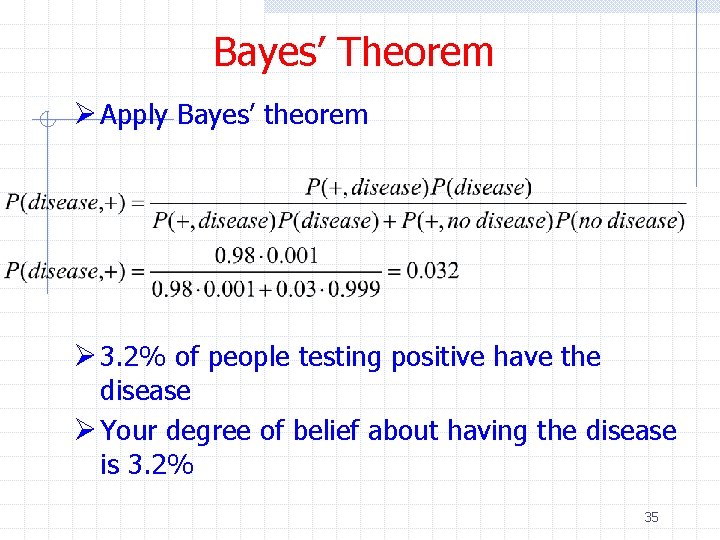
Bayes’ Theorem Ø Apply Bayes’ theorem Ø 3. 2% of people testing positive have the disease Ø Your degree of belief about having the disease is 3. 2% 35
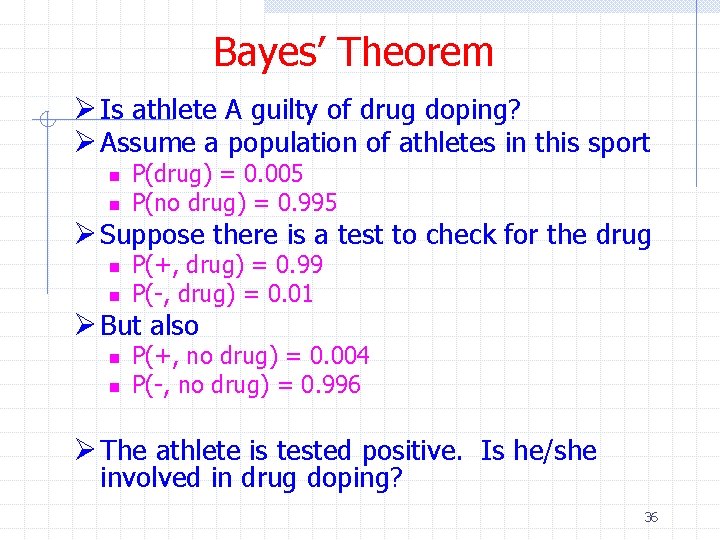
Bayes’ Theorem Ø Is athlete A guilty of drug doping? Ø Assume a population of athletes in this sport n n P(drug) = 0. 005 P(no drug) = 0. 995 Ø Suppose there is a test to check for the drug n n P(+, drug) = 0. 99 P(-, drug) = 0. 01 Ø But also n n P(+, no drug) = 0. 004 P(-, no drug) = 0. 996 Ø The athlete is tested positive. Is he/she involved in drug doping? 36
Bayes’ Theorem Ø Apply Bayes’ theorem Ø ? ? ? 37
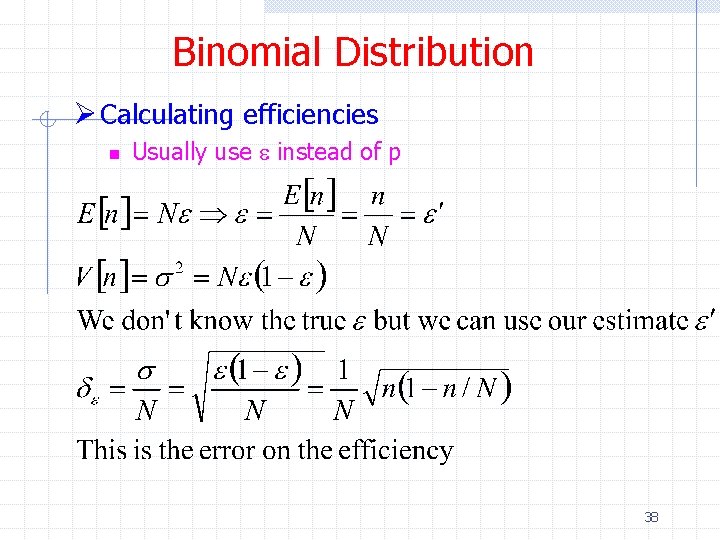
Binomial Distribution Ø Calculating efficiencies n Usually use e instead of p 38
Binomial Distribution Ø But there is a problem n n If n=0, d(e’) = 0 If n=N, d(e’) = 0 Ø Actually we went wrong in assuming the best estimate for e is n/N n We should really have used the most probable value of e given n and N Ø A proper treatment uses Bayes’ theorem but lucky for us (in HEP) the solution is implemented in ROOT n n n h_num->Sumw 2() h_den->Sumw 2() h_eff->Divide(h_num, h_den, 1. 0, ”B”) 39
- Slides: 39