
Probability and Statistics Review Thursday Mar 12 Sample
Probability and Statistics Review Thursday Mar 12

Sample space and Events • W : Sample Space, result of an experiment • If you toss a coin twice W = {HH, HT, TH, TT} • Event: a subset of W • First toss is head = {HH, HT} • S: event space, a set of events: • Closed under finite union and complements • Entails other binary operation: union, diff, etc. • Contains the empty event and W
Probability Measure • Defined over (W, S) s. t. • P( ) >= 0 for all in S • P(W) = 1 • If , b are disjoint, then • P( U b) = p( ) + p(b) • We can deduce other axioms from the above ones • Ex: P( U b) for non-disjoint event

Visualization • We can go on and define conditional probability, using the above visualization
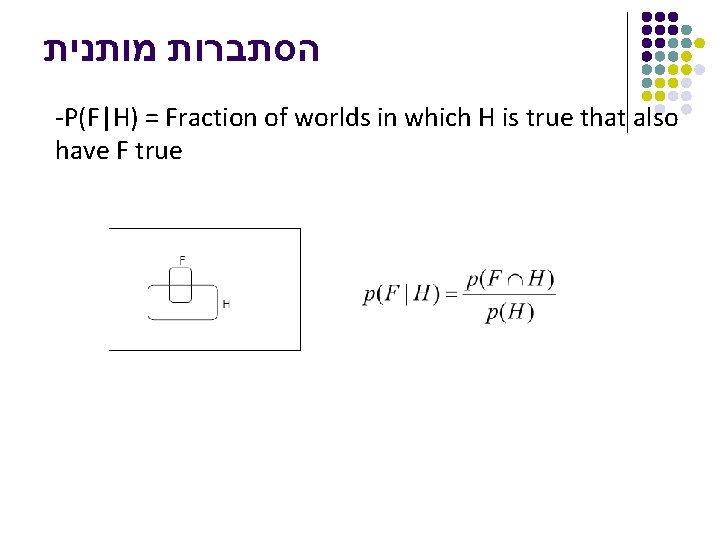
הסתברות מותנית -P(F|H) = Fraction of worlds in which H is true that also have F true
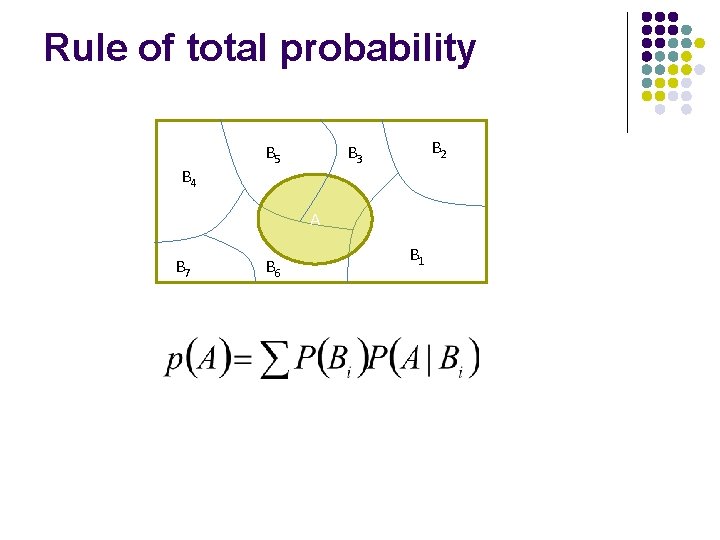
Rule of total probability B 4 B 5 B 2 B 3 A B 7 B 6 B 1

Bayes Rule • We know that P(smart) =. 7 • If we also know that the students grade is A+, then how this affects our belief about his intelligence? • Where this comes from?
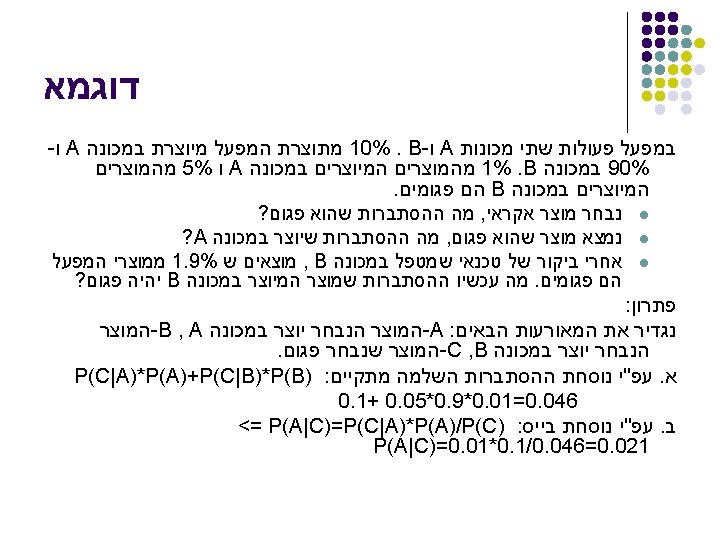
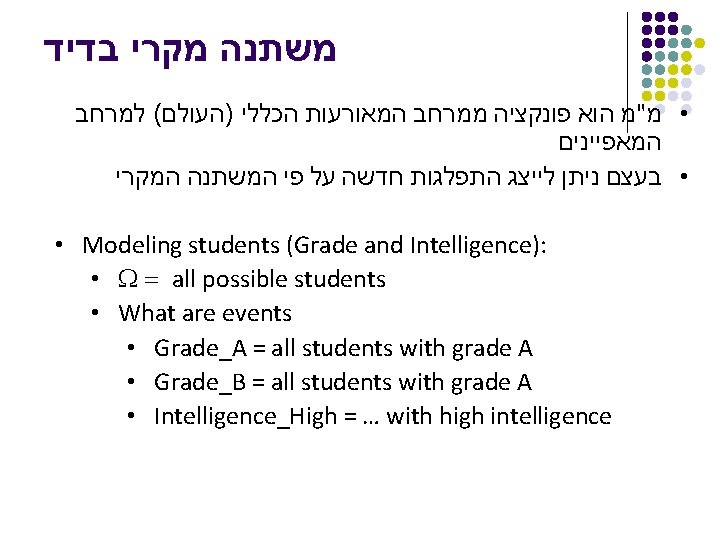
משתנה מקרי בדיד למרחב ( )העולם • מ"מ הוא פונקציה ממרחב המאורעות הכללי המאפיינים • בעצם ניתן לייצג התפלגות חדשה על פי המשתנה המקרי • Modeling students (Grade and Intelligence): • W = all possible students • What are events • Grade_A = all students with grade A • Grade_B = all students with grade A • Intelligence_High = … with high intelligence
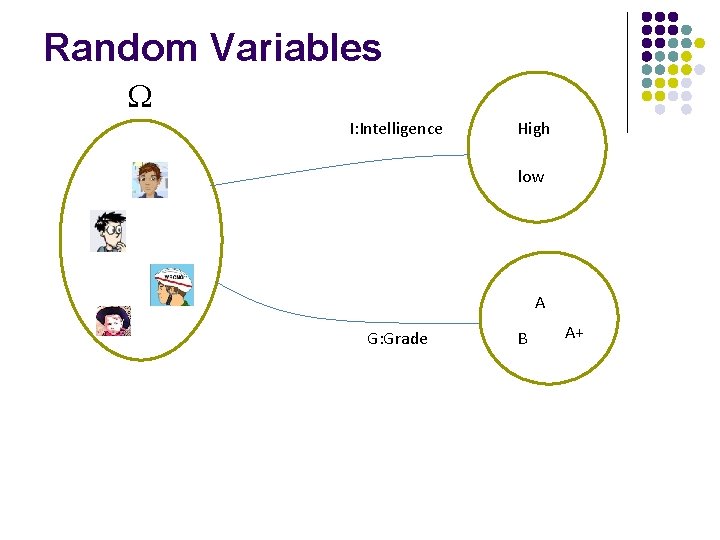
Random Variables W I: Intelligence High low A G: Grade B A+
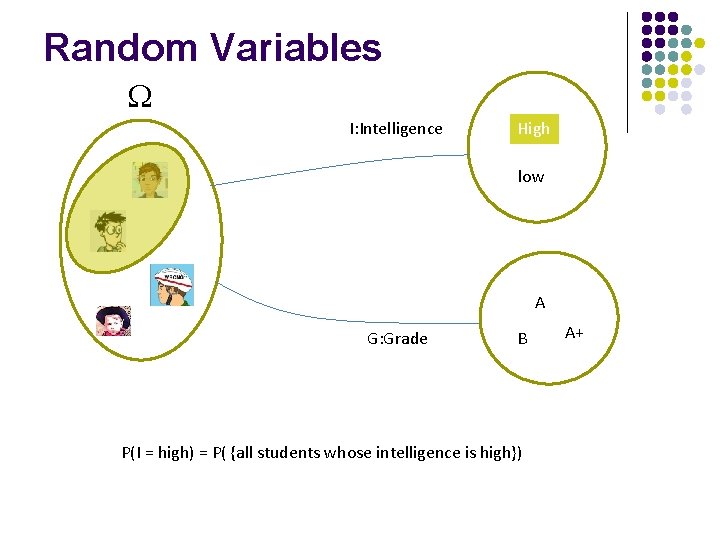
Random Variables W I: Intelligence High low A G: Grade B P(I = high) = P( {all students whose intelligence is high}) A+
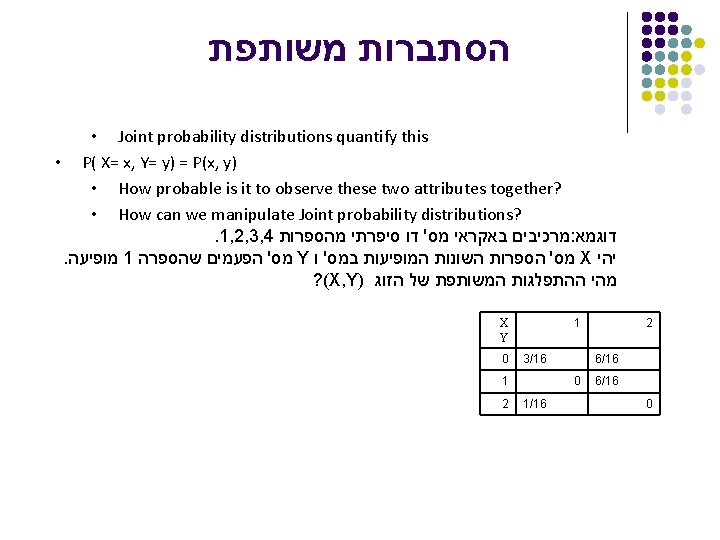
הסתברות משותפת • Joint probability distributions quantify this • P( X= x, Y= y) = P(x, y) • How probable is it to observe these two attributes together? • How can we manipulate Joint probability distributions? . 1, 2, 3, 4 מהספרות סיפרתי דו ' מס באקראי מרכיבים : דוגמא . מופיעה 1 שהספרה הפעמים ' מס Y ו ' במס המופיעות השונות הספרות ' מס X יהי ? (X, Y) הזוג של המשותפת ההתפלגות מהי 1 X Y 0 3/16 1 2 6/16 0 1/16 2 6/16 0
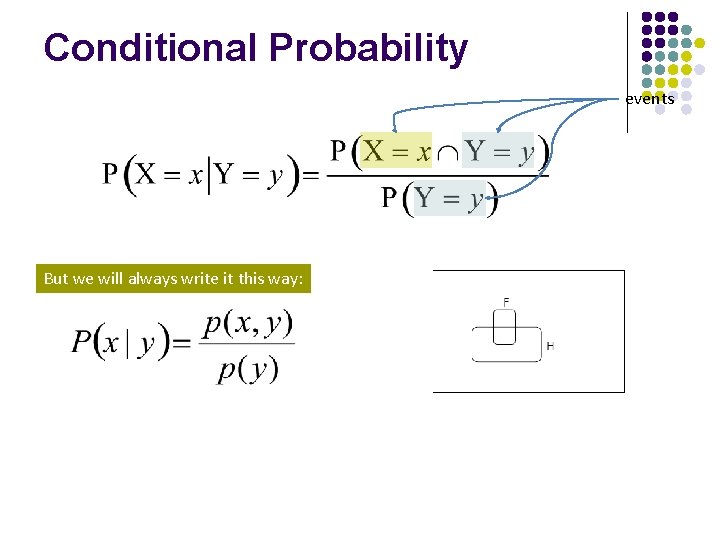
Conditional Probability events But we will always write it this way:

הסתברות השולית • We know P(X, Y), what is P(X=x)? • We can use the low of total probability, why? B 4 B 5 B 2 B 3 A B 7 B 6 B 1
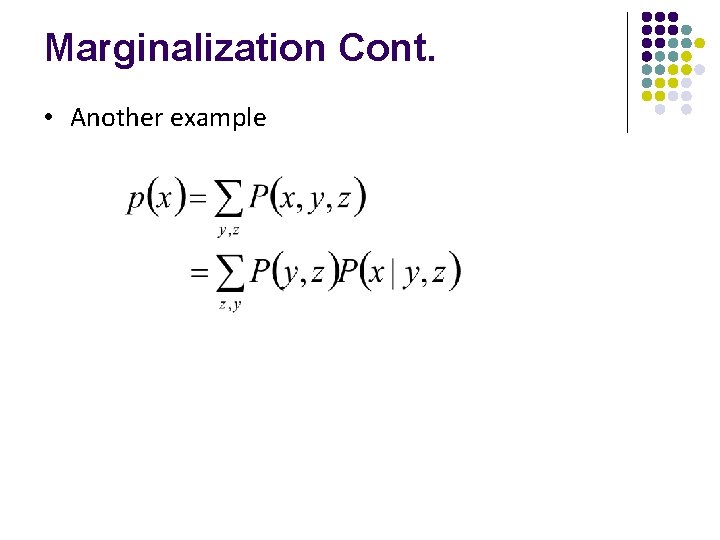
Marginalization Cont. • Another example
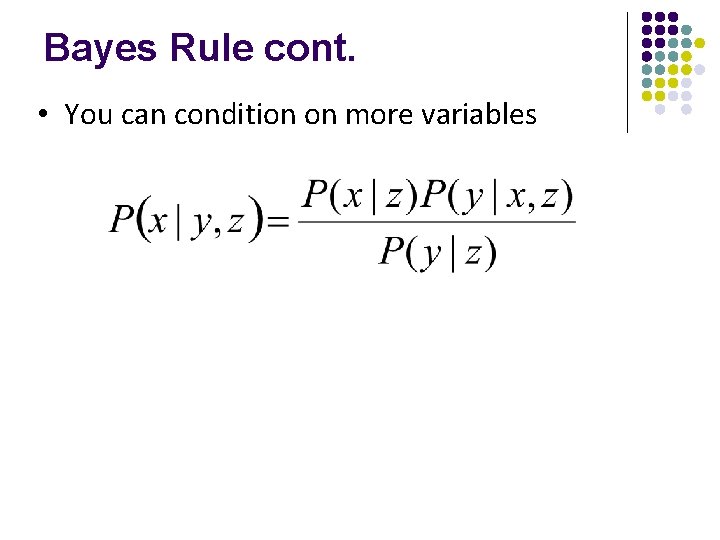
Bayes Rule cont. • You can condition on more variables
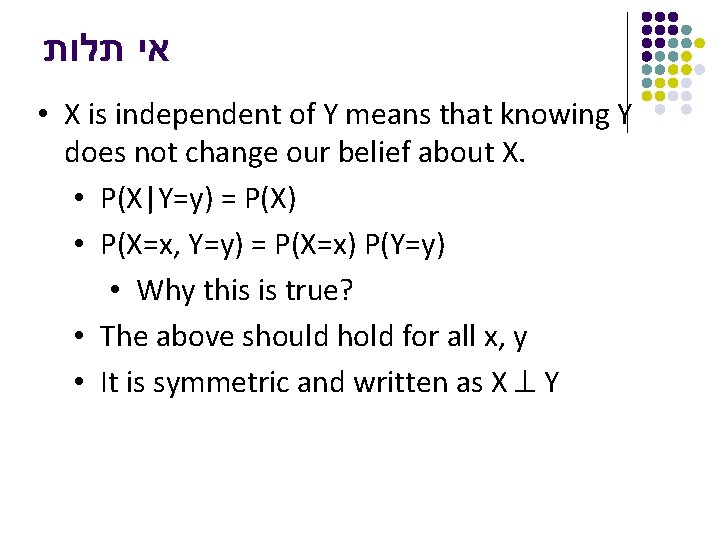
אי תלות • X is independent of Y means that knowing Y does not change our belief about X. • P(X|Y=y) = P(X) • P(X=x, Y=y) = P(X=x) P(Y=y) • Why this is true? • The above should hold for all x, y • It is symmetric and written as X Y
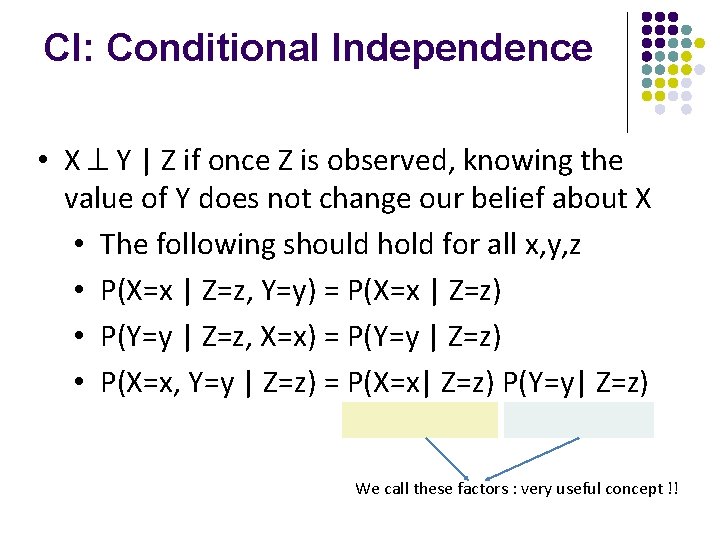
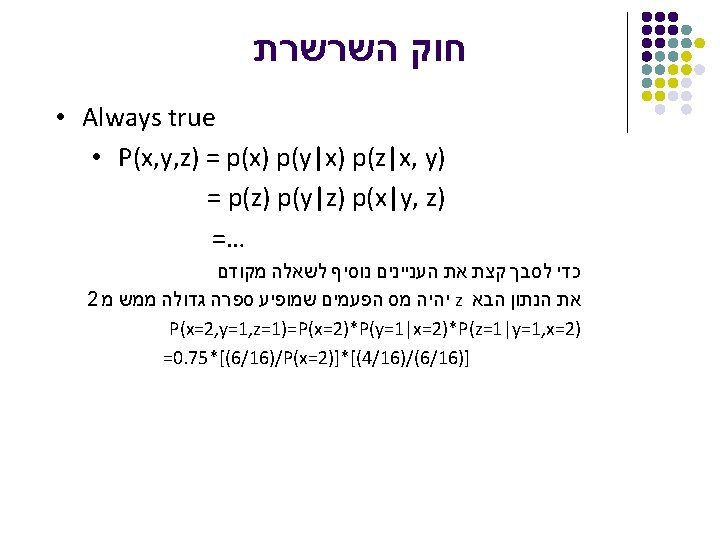
CI: Conditional Independence • X Y | Z if once Z is observed, knowing the value of Y does not change our belief about X • The following should hold for all x, y, z • P(X=x | Z=z, Y=y) = P(X=x | Z=z) • P(Y=y | Z=z, X=x) = P(Y=y | Z=z) • P(X=x, Y=y | Z=z) = P(X=x| Z=z) P(Y=y| Z=z) We call these factors : very useful concept !!
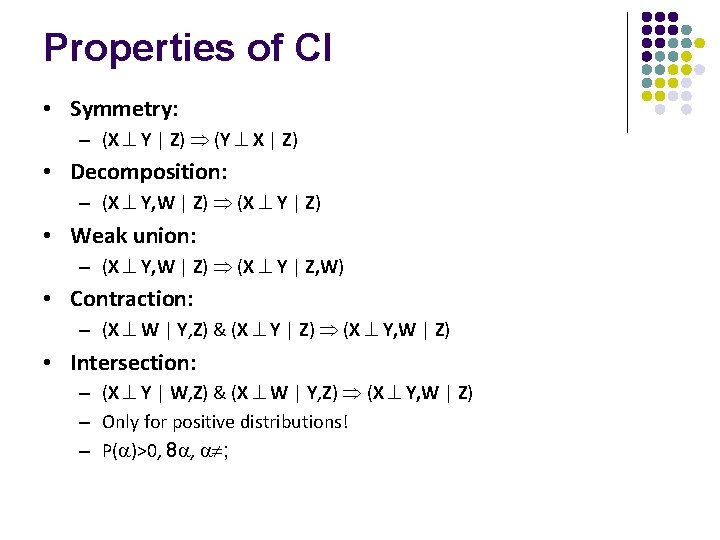
Properties of CI • Symmetry: – (X Y | Z) (Y X | Z) • Decomposition: – (X Y, W | Z) (X Y | Z) • Weak union: – (X Y, W | Z) (X Y | Z, W) • Contraction: – (X W | Y, Z) & (X Y | Z) (X Y, W | Z) • Intersection: – (X Y | W, Z) & (X W | Y, Z) (X Y, W | Z) – Only for positive distributions! – P( )>0, 8 , ;
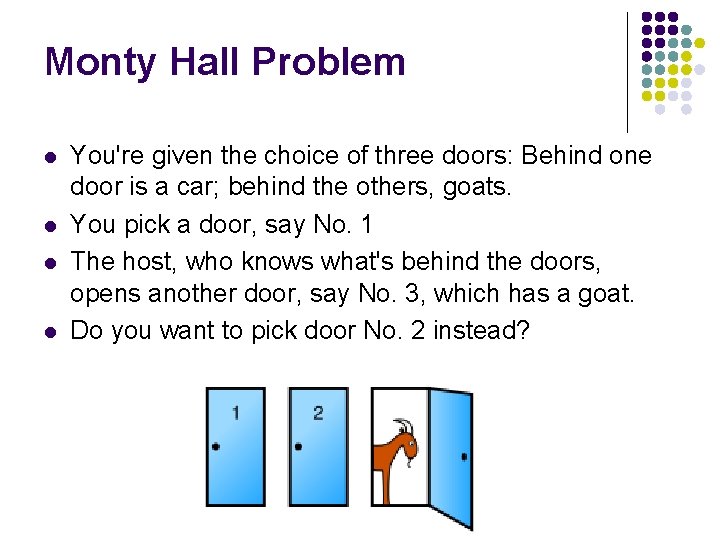
Monty Hall Problem l l You're given the choice of three doors: Behind one door is a car; behind the others, goats. You pick a door, say No. 1 The host, who knows what's behind the doors, opens another door, say No. 3, which has a goat. Do you want to pick door No. 2 instead?
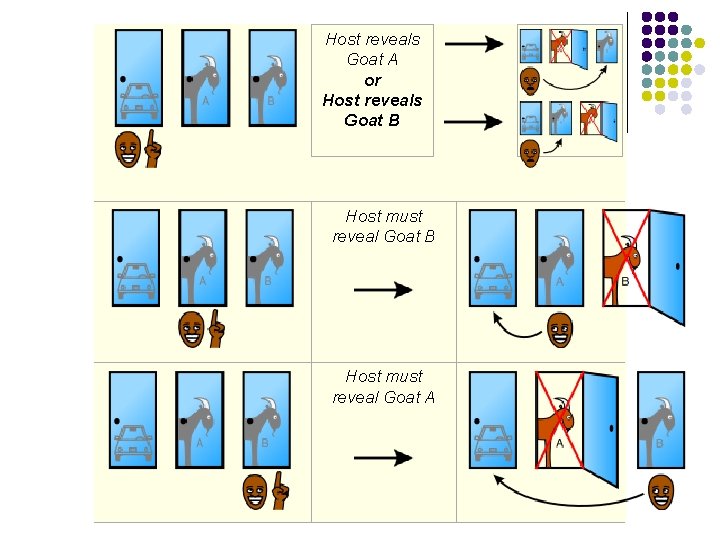
Host reveals Goat A or Host reveals Goat B Host must reveal Goat B Host must reveal Goat A
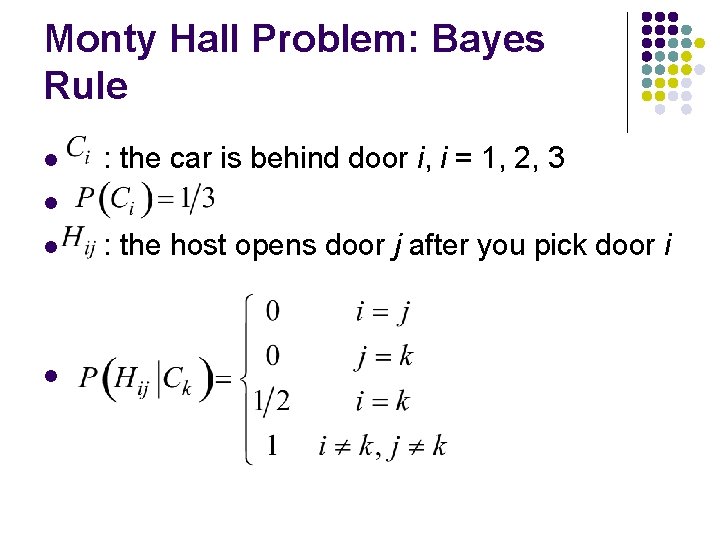
Monty Hall Problem: Bayes Rule l l : the car is behind door i, i = 1, 2, 3 : the host opens door j after you pick door i
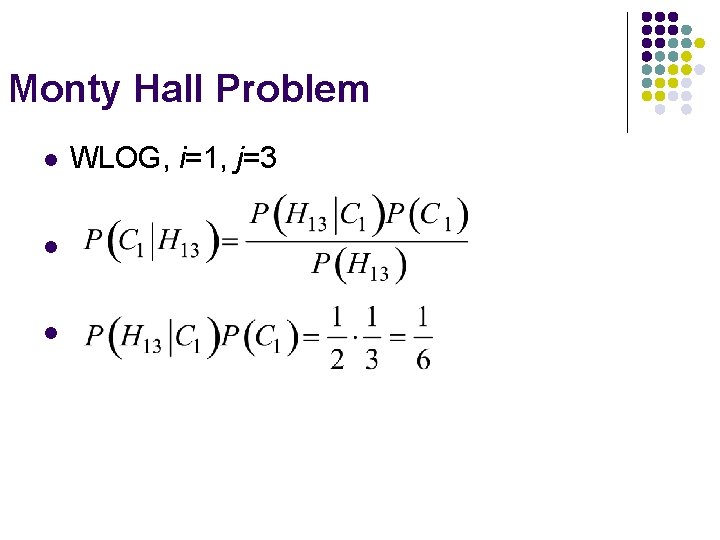
Monty Hall Problem l WLOG, i=1, j=3 l l
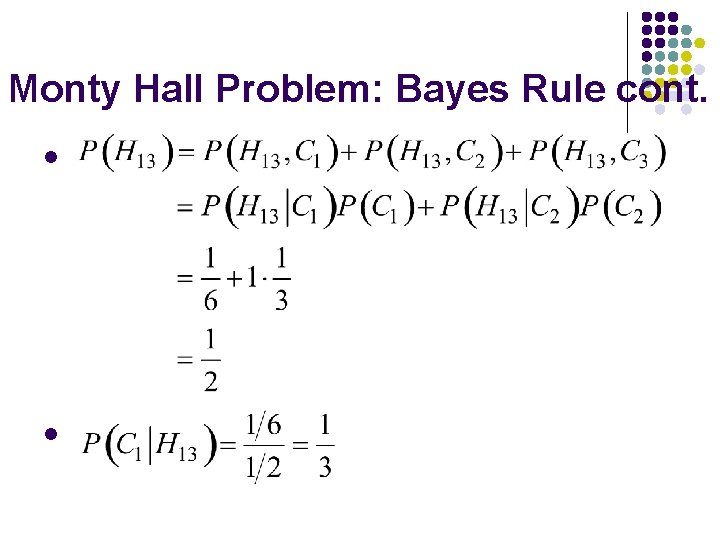
Monty Hall Problem: Bayes Rule cont. l l
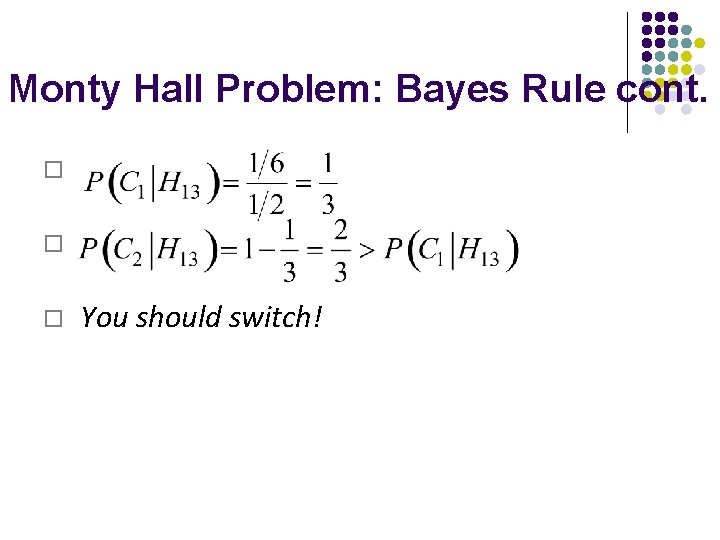
Monty Hall Problem: Bayes Rule cont. o o o You should switch!
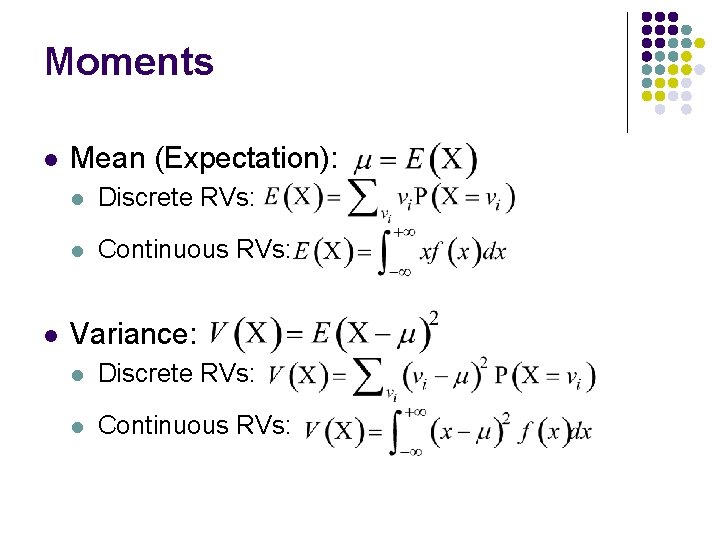
Moments l l Mean (Expectation): l Discrete RVs: l Continuous RVs: Variance: l Discrete RVs: l Continuous RVs:

Properties of Moments l Mean l l If X and Y are independent, Variance l l If X and Y are independent,
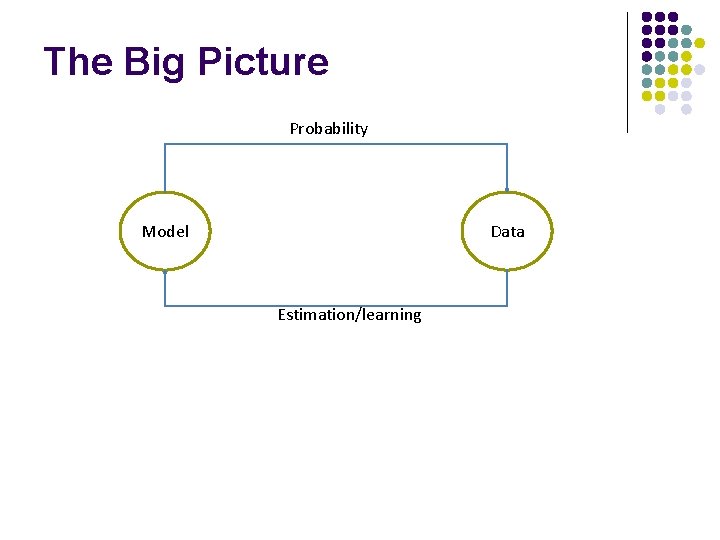
The Big Picture Probability Model Data Estimation/learning
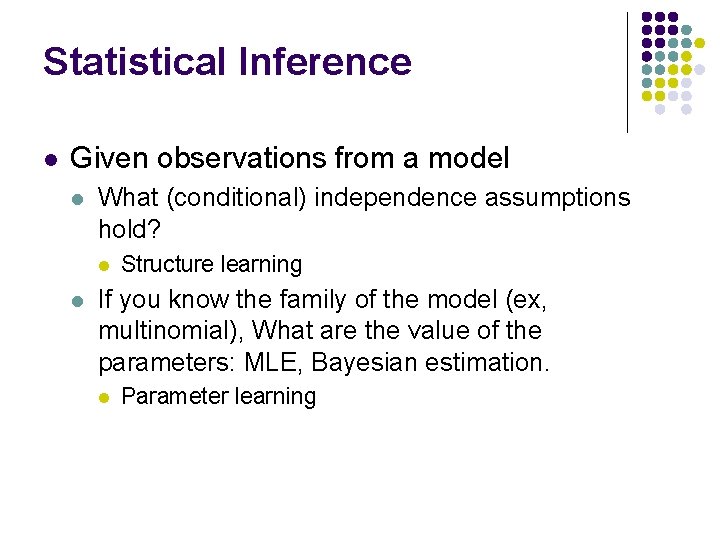
Statistical Inference l Given observations from a model l What (conditional) independence assumptions hold? l l Structure learning If you know the family of the model (ex, multinomial), What are the value of the parameters: MLE, Bayesian estimation. l Parameter learning
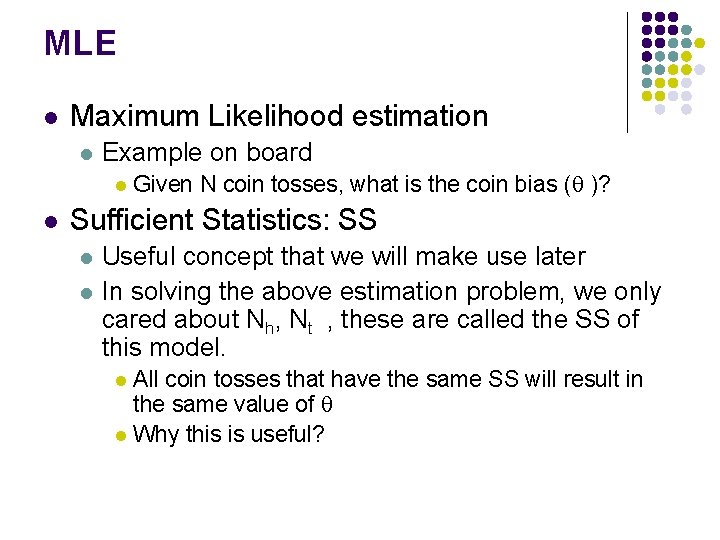
MLE l Maximum Likelihood estimation l Example on board l l Given N coin tosses, what is the coin bias (q )? Sufficient Statistics: SS l l Useful concept that we will make use later In solving the above estimation problem, we only cared about Nh, Nt , these are called the SS of this model. All coin tosses that have the same SS will result in the same value of q l Why this is useful? l
Statistical Inference l Given observation from a model l What (conditional) independence assumptions holds? l l Structure learning If you know the family of the model (ex, multinomial), What are the value of the parameters: MLE, Bayesian estimation. l Parameter learning We need some concepts from information theory
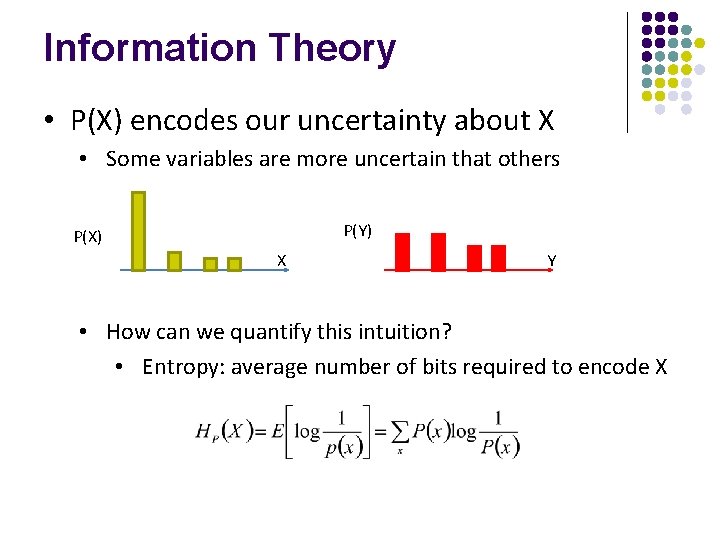
Information Theory • P(X) encodes our uncertainty about X • Some variables are more uncertain that others P(Y) P(X) X Y • How can we quantify this intuition? • Entropy: average number of bits required to encode X
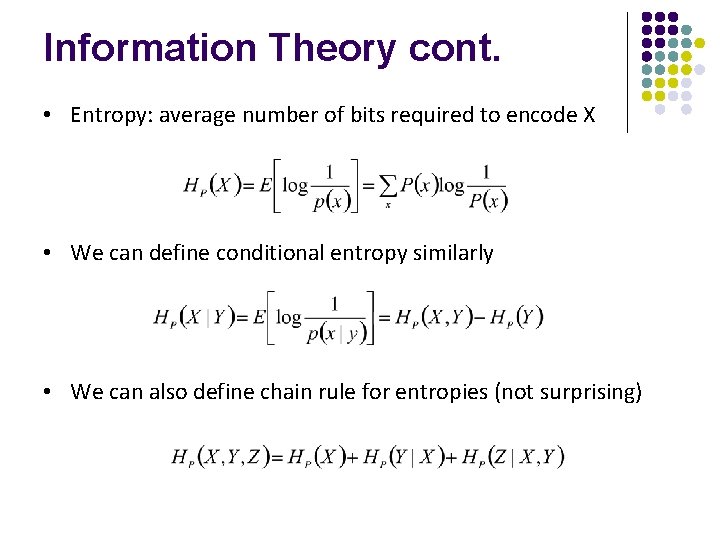
Information Theory cont. • Entropy: average number of bits required to encode X • We can define conditional entropy similarly • We can also define chain rule for entropies (not surprising)
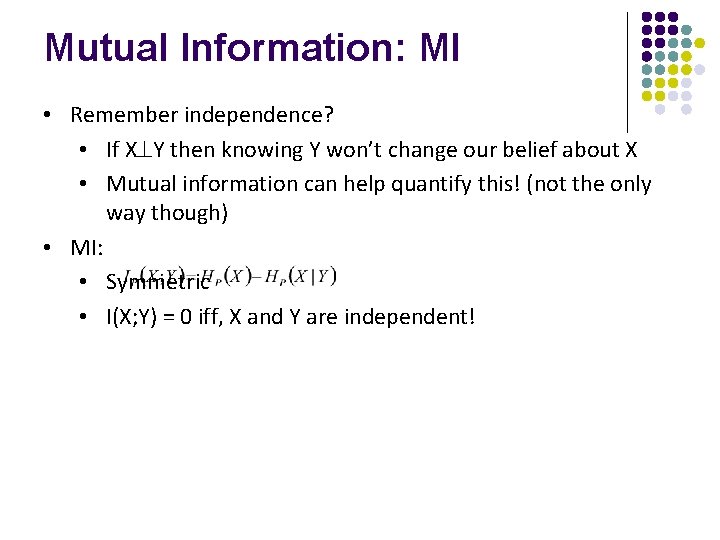
Mutual Information: MI • Remember independence? • If X Y then knowing Y won’t change our belief about X • Mutual information can help quantify this! (not the only way though) • MI: • Symmetric • I(X; Y) = 0 iff, X and Y are independent!
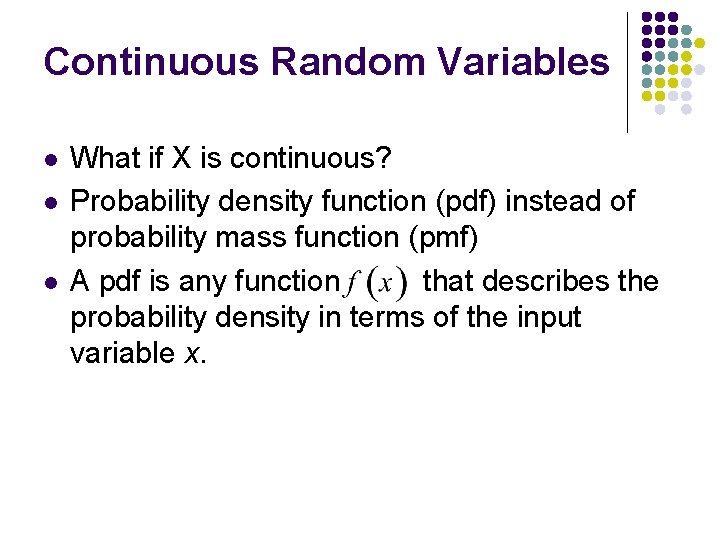
Continuous Random Variables l l l What if X is continuous? Probability density function (pdf) instead of probability mass function (pmf) A pdf is any function that describes the probability density in terms of the input variable x.
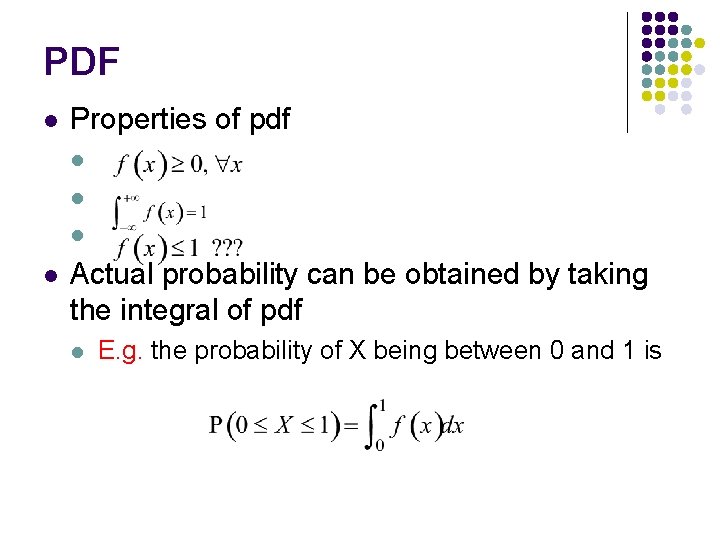
PDF l Properties of pdf l l Actual probability can be obtained by taking the integral of pdf l E. g. the probability of X being between 0 and 1 is
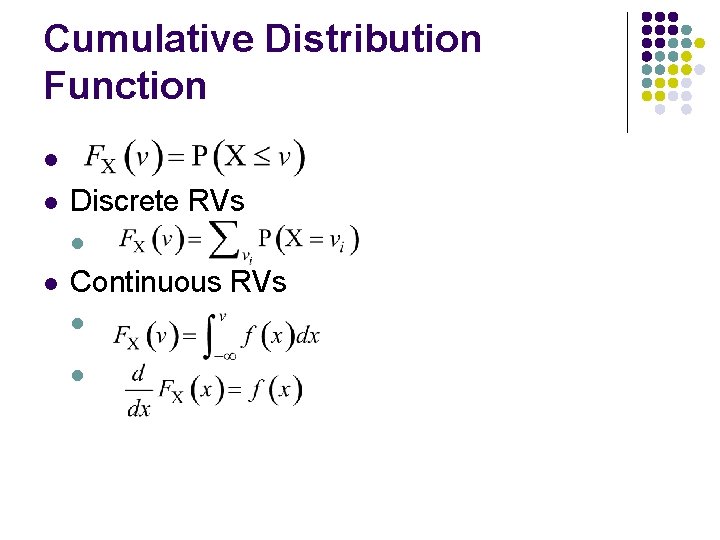
Cumulative Distribution Function l l Discrete RVs l l Continuous RVs l l
Acknowledgment l Andrew Moore Tutorial: http: //www. autonlab. org/tutorials/prob. html l Monty hall problem: http: //en. wikipedia. org/wiki/Monty_Hall_problem l http: //www. cs. cmu. edu/~guestrin/Class/10701 -F 07/recitation_schedule. html
- Slides: 41