
PROBABILITY AND STATISTICS PROJECT INTRODUCTION Probability theory is

: PROBABILITY AND STATISTICS : -: PROJECT: -
-: INTRODUCTION: - • Probability theory is a very important subject which can be studied at various mathematical levels. Probability is the foundation of Statistical theory and its application. • The term “Probability” in Statistics refers to the chances obtained of an event among a large number of possibilities. A collection of well defined is called a set. The objects comprising the set are called elements. • Probability is the combination of sets and subsets. The phrase probable is often used in our daily conversation which means likely.
-: MEANING OF PROBABILITY: Probability means possibility. It is a branch of mathematics that deals with the occurrence of a random event. The value is expressed from zero to one. To find the probability of a single event to occur, first, we should know the total number of possible outcomes.
-: EVENT AND PROBABILITY: - • An event is an outcome or defined collection of outcomes of a random experiment. • Or else an event is a set of outcomes of an experiment to which a probability is assigned. • If there is a chance that an event will happen, then its probability is between zero and 1. • Examples of Events: tossing a coin and it landing on heads. tossing a coin and it landing on tails.
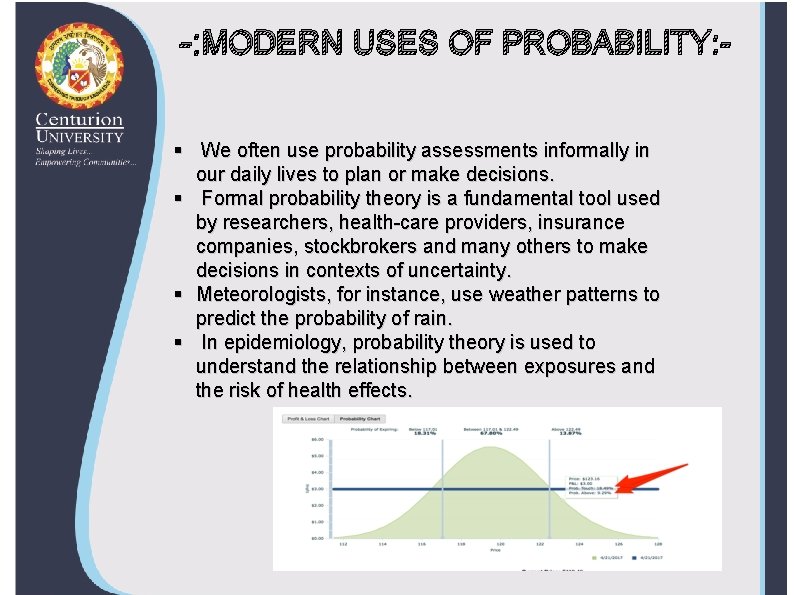
-: MODERN USES OF PROBABILITY: § We often use probability assessments informally in our daily lives to plan or make decisions. § Formal probability theory is a fundamental tool used by researchers, health-care providers, insurance companies, stockbrokers and many others to make decisions in contexts of uncertainty. § Meteorologists, for instance, use weather patterns to predict the probability of rain. § In epidemiology, probability theory is used to understand the relationship between exposures and the risk of health effects.
-: APPLICATIONS: Sports Strategies. . • Athletes and coaches use probability to determine the best sports strategies for games and competitions. Planning Around the Weather. . • Nearly every day you use probability to plan around the weather. • Meteorologists can't predict exactly what the weather will be, so they use tools and instruments to determine the likelihood that it will rain, snow or hail. Insurance Options. . • Probability plays an important role in analyzing insurance policies to determine which plans are best for your family and what deductible amounts you need. • When choosing a car insurance policy, you use probability to determine how likely it is that you'll need to file a claim.
-: EXAMPLES: • If football kicker makes nine out of 15 field goal attempts from over 40 yards during the season, he has a 60 percent chance of scoring on his next field goal attempt from that distance. The equation is: 9 / 15 = 0. 60 or 60 percent • If there's a 60 -percent chance of rain, then the weather conditions are such that 60 out of 100 days with similar conditions, it has rained. You may decide to wear closed-toed shoes rather than sandals or take an umbrella to work. • If 12 out of every 100 drivers -- or 12 percent of drivers -- in your community have hit a deer over the past year, you'll likely want to consider comprehensive -- not just liability -- insurance on your car. You might also consider a lower deductible if average car repairs after a deer-related incident run $2, 800 and you don't have out-of-pocket funds to cover those expenses.
: CONCLUSION: • Probability helps people understand which choices are safe and which choices are risky. • Of course, this task is much easier when we have fluent knowledge of probability. • By learning about probability, we can learn about the likelihood of future events, and prepare accordingly.

- Slides: 9