
PROBABILITY AND STATISTICS APPLICATION OF RANDOM VARIABLES IN

PROBABILITY AND STATISTICS

APPLICATION OF RANDOM VARIABLES IN ENGINEERING FIELD
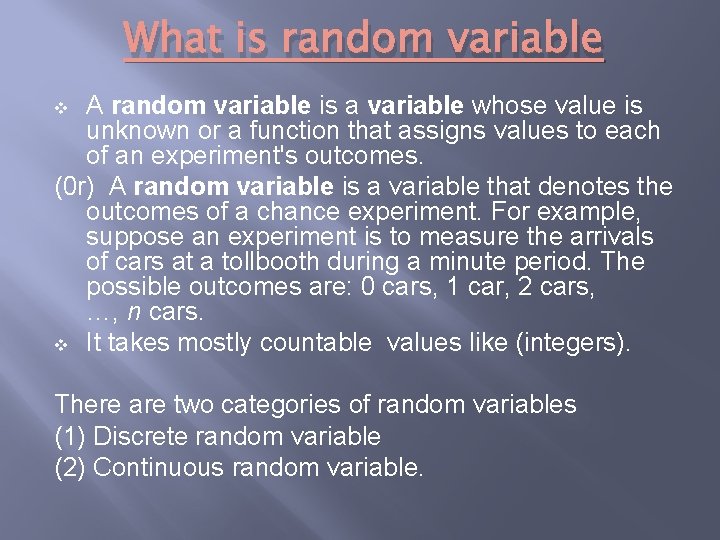
What is random variable A random variable is a variable whose value is unknown or a function that assigns values to each of an experiment's outcomes. (0 r) A random variable is a variable that denotes the outcomes of a chance experiment. For example, suppose an experiment is to measure the arrivals of cars at a tollbooth during a minute period. The possible outcomes are: 0 cars, 1 car, 2 cars, …, n cars. v It takes mostly countable values like (integers). v There are two categories of random variables (1) Discrete random variable (2) Continuous random variable.
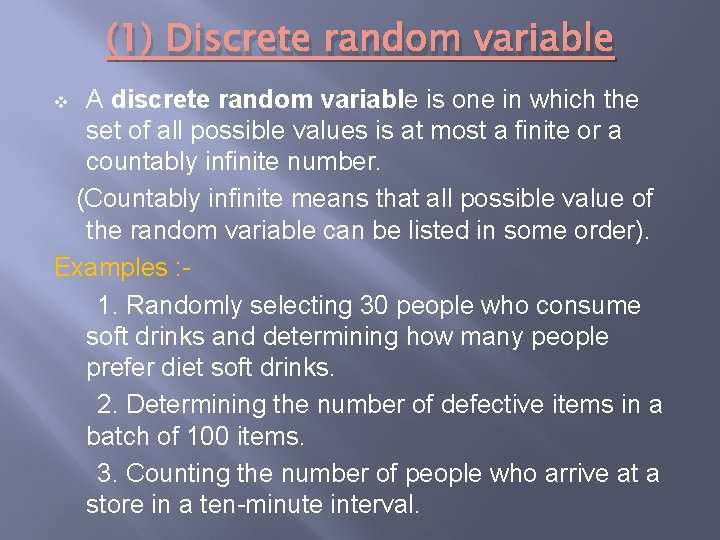
(1) Discrete random variable A discrete random variable is one in which the set of all possible values is at most a finite or a countably infinite number. (Countably infinite means that all possible value of the random variable can be listed in some order). Examples : 1. Randomly selecting 30 people who consume soft drinks and determining how many people prefer diet soft drinks. 2. Determining the number of defective items in a batch of 100 items. 3. Counting the number of people who arrive at a store in a ten-minute interval. v
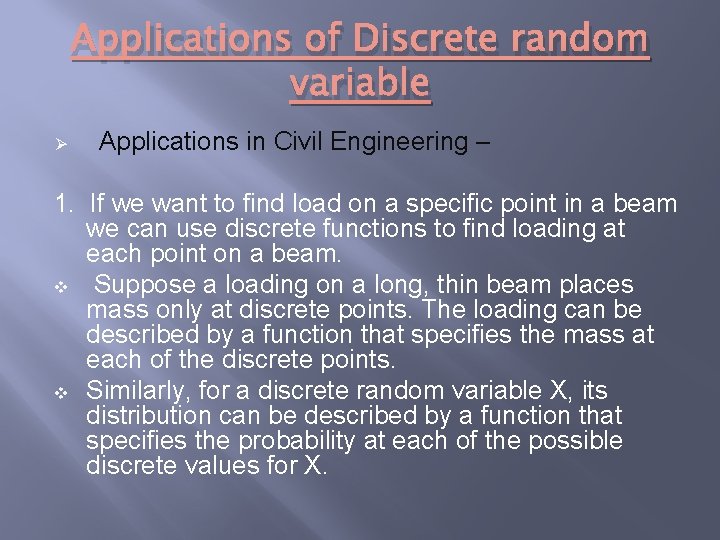
Applications of Discrete random variable Ø Applications in Civil Engineering – 1. If we want to find load on a specific point in a beam we can use discrete functions to find loading at each point on a beam. v Suppose a loading on a long, thin beam places mass only at discrete points. The loading can be described by a function that specifies the mass at each of the discrete points. v Similarly, for a discrete random variable X, its distribution can be described by a function that specifies the probability at each of the possible discrete values for X.

2. Statisticians use sampling plans to either accept or reject batches or lots of construction material. v Suppose one of these sampling plans involves sampling independently 10 items from a lot of 100 items in which 12 are defective.
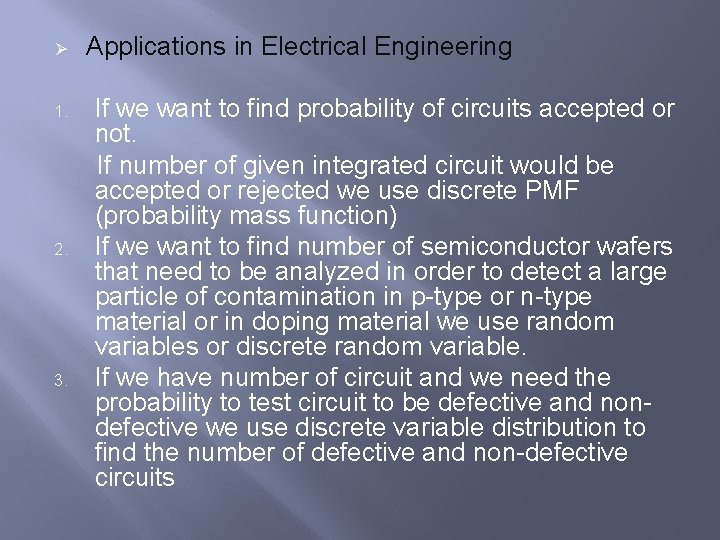
Ø 1. 2. 3. Applications in Electrical Engineering If we want to find probability of circuits accepted or not. If number of given integrated circuit would be accepted or rejected we use discrete PMF (probability mass function) If we want to find number of semiconductor wafers that need to be analyzed in order to detect a large particle of contamination in p-type or n-type material or in doping material we use random variables or discrete random variable. If we have number of circuit and we need the probability to test circuit to be defective and nondefective we use discrete variable distribution to find the number of defective and non-defective circuits

Ø Applications in Business In any business firm there is a communication system with certain number of lines to communication data and voice communication. § If we need to know the probability of how many lines are working at one time we use discrete variables.
Ø Other Applications v Number of airplanes taking off and landing during a given time in an airport There are 2 indigo flights landing from vizag airport to kolkata Airport at west bengal and 2 indigo flights departing from Kolkata Airport at west bengal every day , So 2 is a discrete number and can be denoted as X discrete random variable. v v
(2) Continuous random variable A continuous random variable takes on any value in a given interval. So, continuous random variables have no gaps. Continuous random variables are usually generated from experiments in which things are “measured” not “counted”. § It can take any real number. v Examples : 1. Sampling the volume of liquid nitrogen in a storage tank. 2. Measuring the time between customer arrivals at a store. 3. Measuring the lengths of cars produced in factory.
Applications of continues random variable Ø Application in Chemical Engineering 1. When one conducts an investigation measuring the distances that certain make of automobile will travel over a prescribed test course on 5 liters of gasoline. v Assuming distance to be a variable measured to any degree of accuracy, and then clearly we have an infinite number of possible distances in the sample space that cannot be equated to the number of whole numbers.
2. If one were to record the length of time for a chemical reaction to take place, once again the possible time intervals making up our sample space are infinite in number and uncountable. We see now that all sample spaces need not be discrete. 3. Error in the reaction temperature may be defined by continues random variable with any probability density function. 4. We can estimate the time at which the chemical reaction completes as we can see in this example using continues random variable.
Ø Application in Civil engineering 1. Task completion time , Suppose a construction project to be completed in 20 to 24 months and its probability is 0. 05. There are infinite sample space between 20 to 24 month. 2. The magnitude of load applied on a structural system § At any given moment in a building we cannot count the load on its roof. § We can only assume the range of load on its roof while designing , So its continuous random variable
Ø Application in Electrical Engineering Engineers defines the range of the amount of current which can pass through a certain wire. we want to know the probability of passing of certain amount of current through that wire we use continues random variable. 1. We can find expected phase angle of AC circuit using continues random variable , and also we can find how the phase angle varies from original value which gives the quality of our circuit 2. We can also estimate the time require for the failure of electrical component by using continues random variable and its functions. Suppose the time till failure of an electronic component has an Exponential distribution and it is known that 10% of components have failed by 1000 hours. We use continues random variable for finding the probabilities 3.

- Slides: 15