
Probability and Probability Distribution Dr Manoj Kumar Bhambu
Probability and Probability Distribution Dr Manoj Kumar Bhambu GCCBA-42, Chandigarh M- +91 -988 -823 -7733 mkbhambu@hotmail. com
Objectives of Learning this Unit Probability and Probability Distribution: Definitions- Probability Rules –Application of Probability Rules-Conditional Probability. Bayes theorem Random Variable and Probability Distributions; Binomial. Distribution- Poisson Distribution and Normal Distribution.
Probability: Meaning Ø A probability is a quantitative measure of uncertainty – a number that conveys the strength of our belief in the occurrence of an uncertain event. Ø Probability is a measure of uncertainty of events in a random experiment.
Types of Experiment 1. Deterministic Experiment: Experiments that have fixed outcome or result no matter any number of times they are repeated 2. Random Experiment: if an experiment, when repeated under identical conditions, do not produce the same outcome every time but the outcome in a trial is one of the several possible outcomes then such an experiment is known as random or probabilistic experiment.
Basic Terms in Probability A Random Experiment is any situation whose outcome cannot be predicted with certainty. Examples of an experiment include rolling a die, flipping a coin, and choosing a card from a deck of playing cards. By an outcome or simple event we mean any result of the experiment. For example, the experiment of rolling a die yields six outcomes, namely, the outcomes 1, 2, 3, 4, 5, and 6.
Examples of ‘Outcomes’ If you toss a coin you have an equal chance of getting a head or a tail. Heads or tails are the ‘outcomes’. If a baby is born it has an equal chance of being a boy or a girl. Boy or girl are the ‘outcomes’. If you roll a dice you have an equal chance of getting the number 1, 2, 3, 4, 5 or 6! These scores are the ‘outcomes’.
Basic Terms in Probability (con. ) The sample space S of an experiment is the set of all possible outcomes for the experiment. For example, if you roll a die one time then the experiment is the roll of the die. A sample space for this experiment could be S = {1, 2, 3, 4, 5, 6} where each digit represents a face of the die. Discrete Sample Space: A sample space whose elements are finite or infinite but countable is called Discrete Sample Space Continuous Sample Space: A Sample Space whose elements are infinite and uncountable or assume all the values on a real line R or on an intervals of R is called a Continuous Sample Space.
Event: An event is a subset of the sample space. For example, the event of rolling an odd number with a die consists of three simple events {1, 3, 5}. Null Event: An event having no sample point is called a Null Event and is denoted by Φ. Simple Event: An event consisting of only one sample point of a sample space is called a simple event. Compound Events: When an event is decomposable into a number of simple events, then it is called a compound event. Exhaustive Events: It is the total number of all possible outcomes of an experiment.
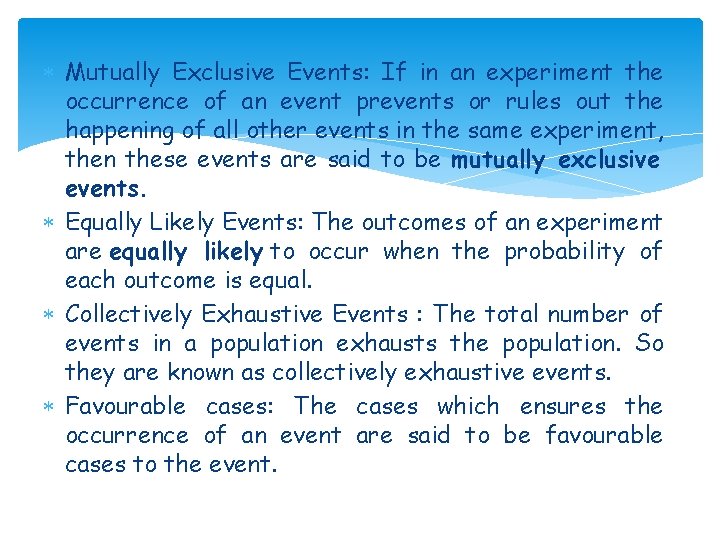
Mutually Exclusive Events: If in an experiment the occurrence of an event prevents or rules out the happening of all other events in the same experiment, then these events are said to be mutually exclusive events. Equally Likely Events: The outcomes of an experiment are equally likely to occur when the probability of each outcome is equal. Collectively Exhaustive Events : The total number of events in a population exhausts the population. So they are known as collectively exhaustive events. Favourable cases: The cases which ensures the occurrence of an event are said to be favourable cases to the event.
Independent and Dependent Events When an experiment is conducted in such a way that the occurrence of event neither effect the occurrence of another event nor is effected by the occurrence of another event, both the events are called independent events. Events which are not independent are called dependent events
Mathematical Vocabulary We can describe the probability or chance of an event happening by saying: It is IMPOSSIBLE. It is UNLIKELY. It is CERTAIN.
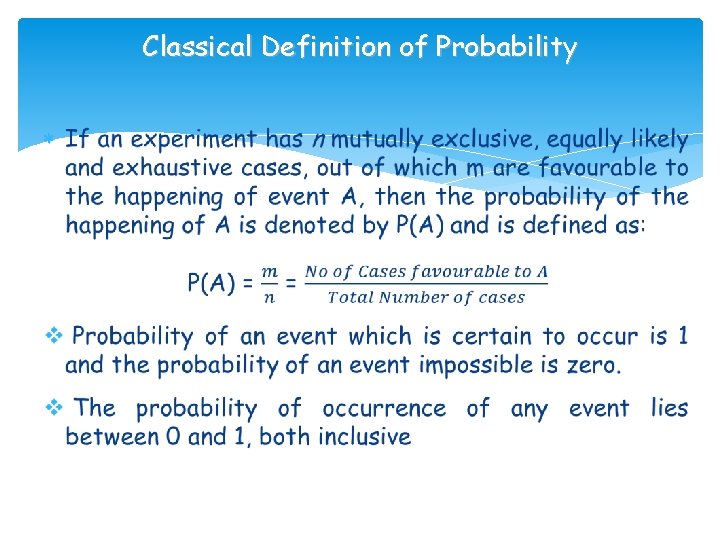
Classical Definition of Probability
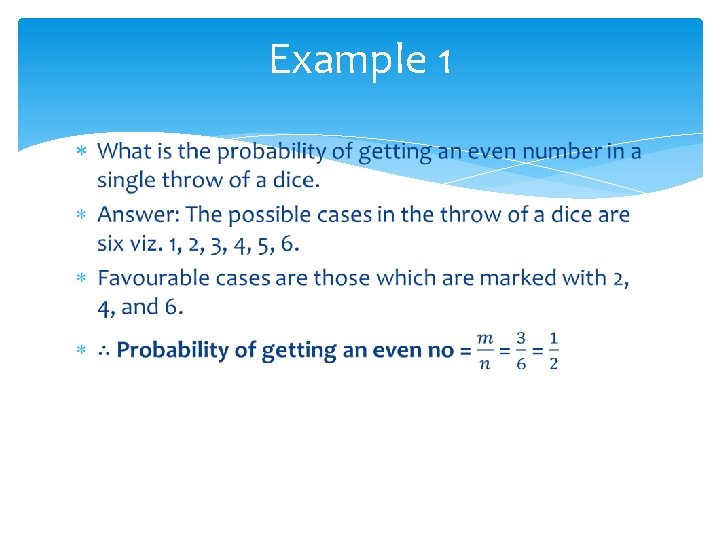
Example 1
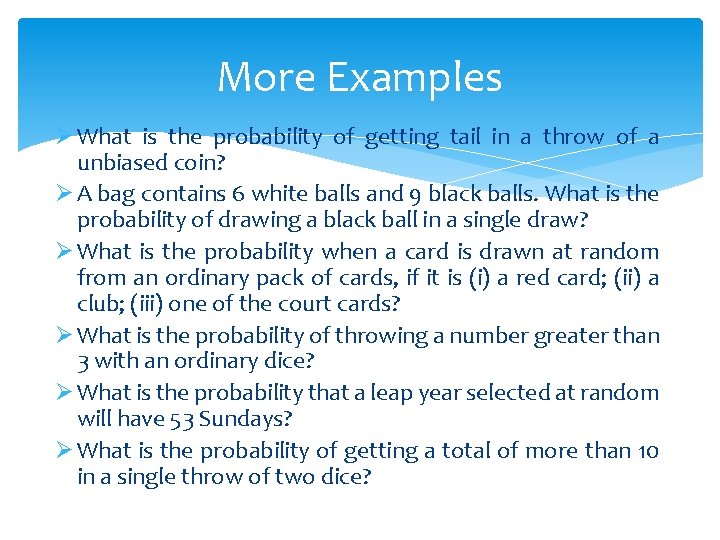
More Examples Ø What is the probability of getting tail in a throw of a unbiased coin? Ø A bag contains 6 white balls and 9 black balls. What is the probability of drawing a black ball in a single draw? Ø What is the probability when a card is drawn at random from an ordinary pack of cards, if it is (i) a red card; (ii) a club; (iii) one of the court cards? Ø What is the probability of throwing a number greater than 3 with an ordinary dice? Ø What is the probability that a leap year selected at random will have 53 Sundays? Ø What is the probability of getting a total of more than 10 in a single throw of two dice?
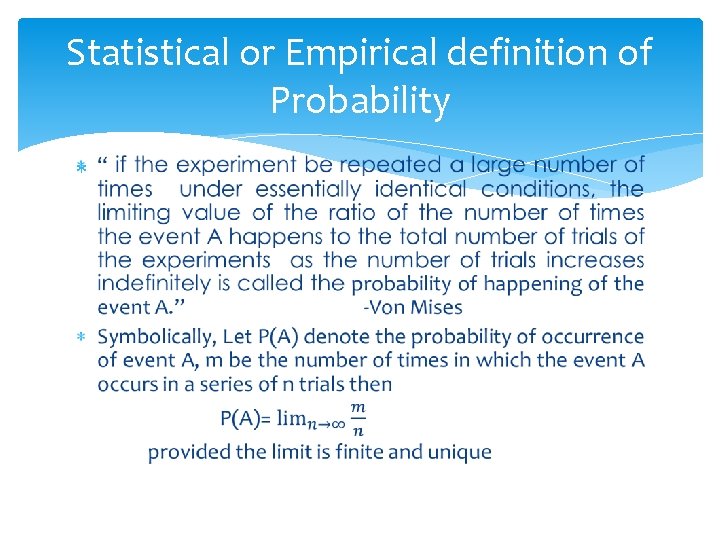
Statistical or Empirical definition of Probability
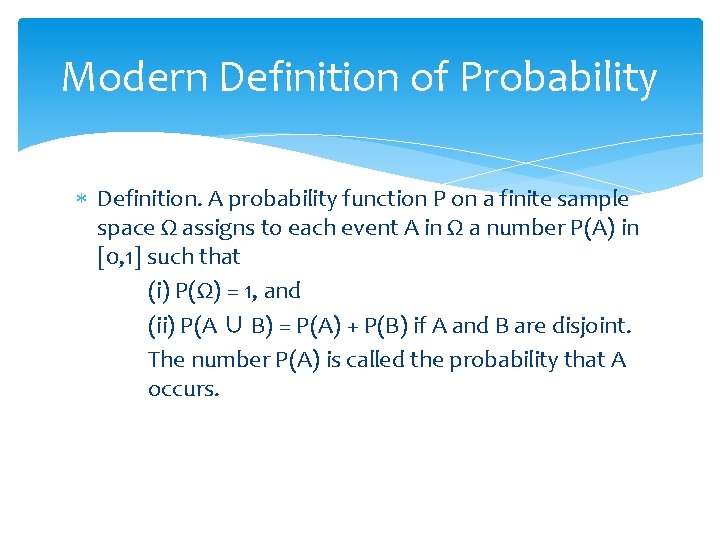
Modern Definition of Probability Definition. A probability function P on a finite sample space Ω assigns to each event A in Ω a number P(A) in [0, 1] such that (i) P(Ω) = 1, and (ii) P(A ∪ B) = P(A) + P(B) if A and B are disjoint. The number P(A) is called the probability that A occurs.
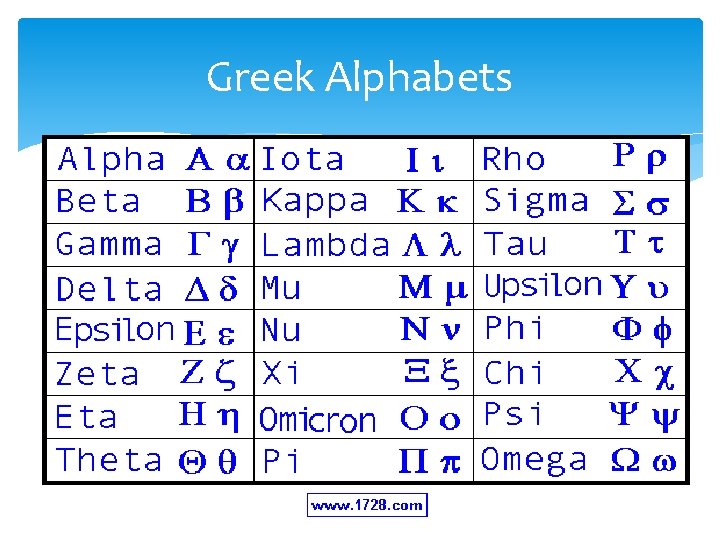
Greek Alphabets
Theorems on Probability There are two important theorems of probability, namely 1. Addition Theorem or Theorem on Total Probability 2. Multiplication Theorem or Theorem on Compound Probability

Addition Theorem
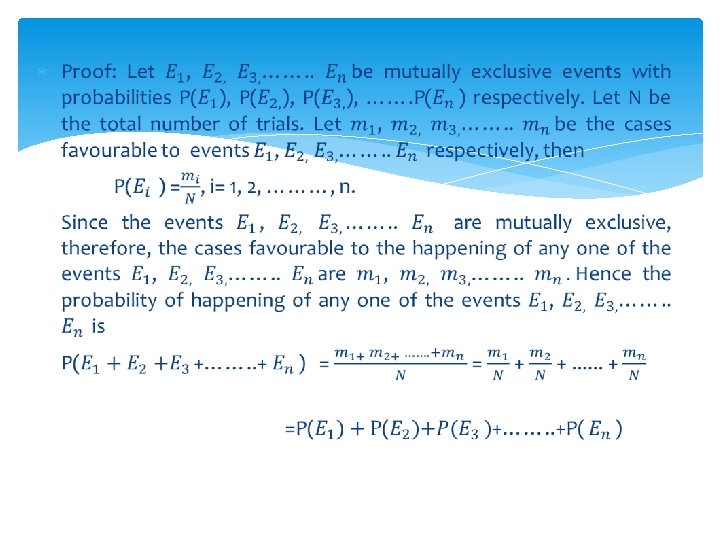
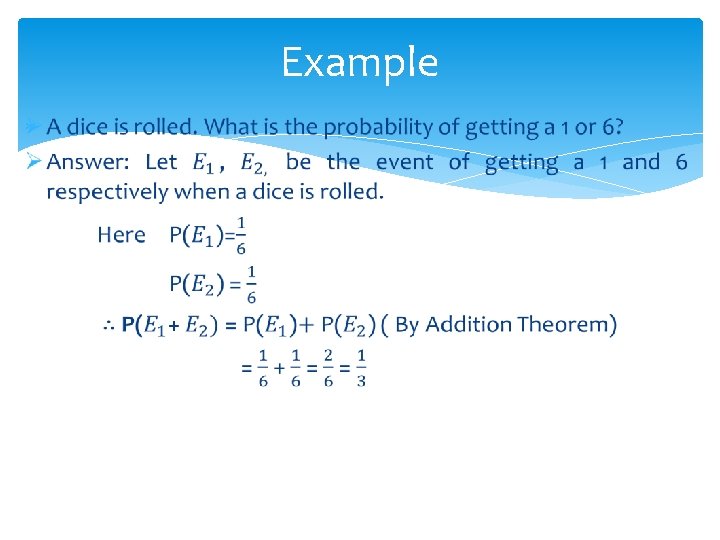
Example
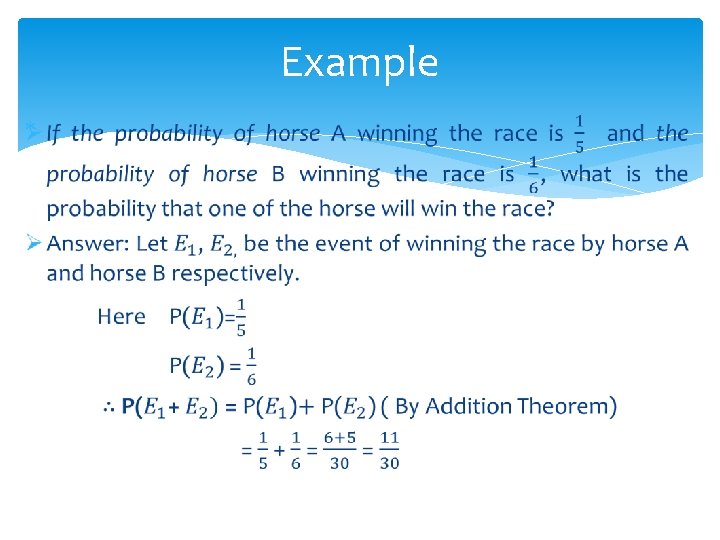
Example
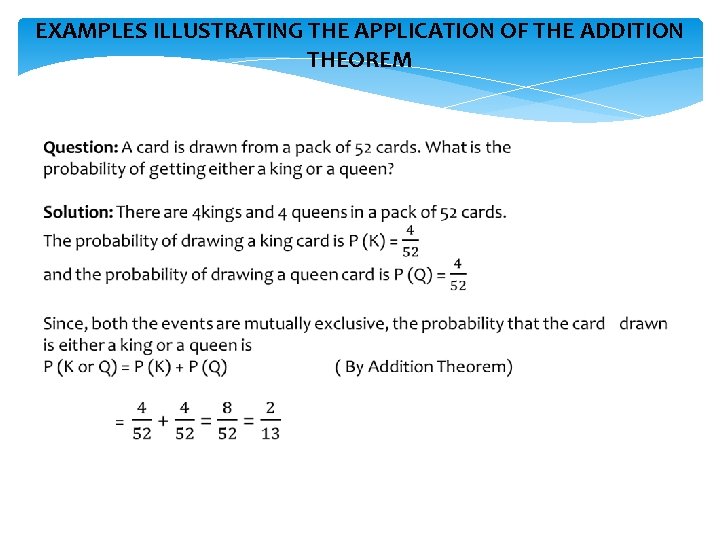
EXAMPLES ILLUSTRATING THE APPLICATION OF THE ADDITION THEOREM
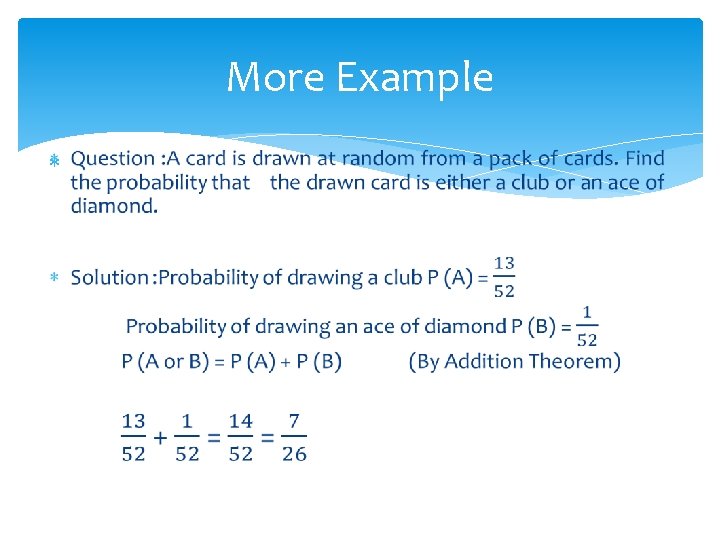
More Example
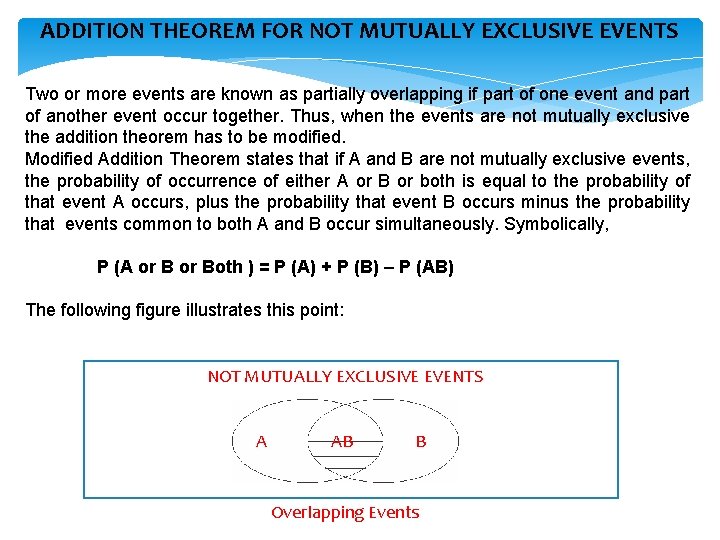
ADDITION THEOREM FOR NOT MUTUALLY EXCLUSIVE EVENTS Two or more events are known as partially overlapping if part of one event and part of another event occur together. Thus, when the events are not mutually exclusive the addition theorem has to be modified. Modified Addition Theorem states that if A and B are not mutually exclusive events, the probability of occurrence of either A or B or both is equal to the probability of that event A occurs, plus the probability that event B occurs minus the probability that events common to both A and B occur simultaneously. Symbolically, P (A or Both ) = P (A) + P (B) – P (AB) The following figure illustrates this point: NOT MUTUALLY EXCLUSIVE EVENTS A AB B Overlapping Events
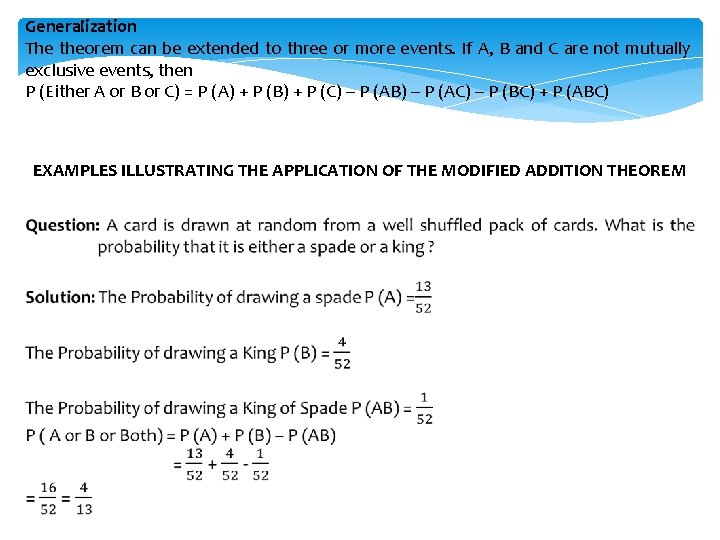
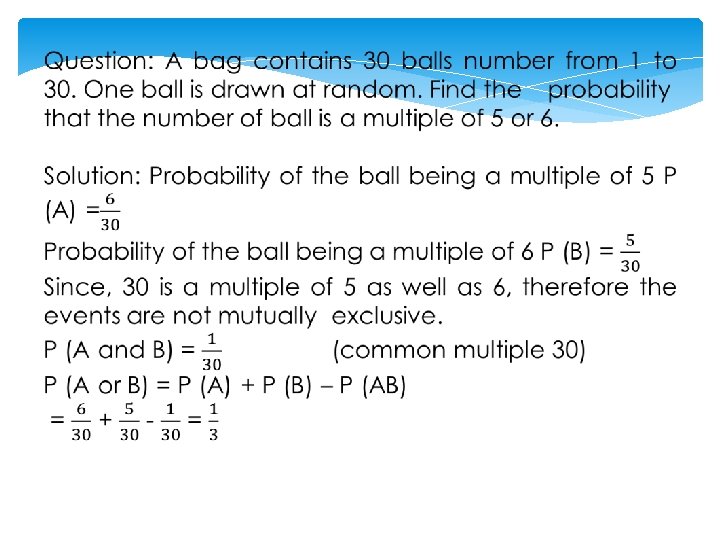
Generalization The theorem can be extended to three or more events. If A, B and C are not mutually exclusive events, then P (Either A or B or C) = P (A) + P (B) + P (C) – P (AB) – P (AC) – P (BC) + P (ABC) EXAMPLES ILLUSTRATING THE APPLICATION OF THE MODIFIED ADDITION THEOREM
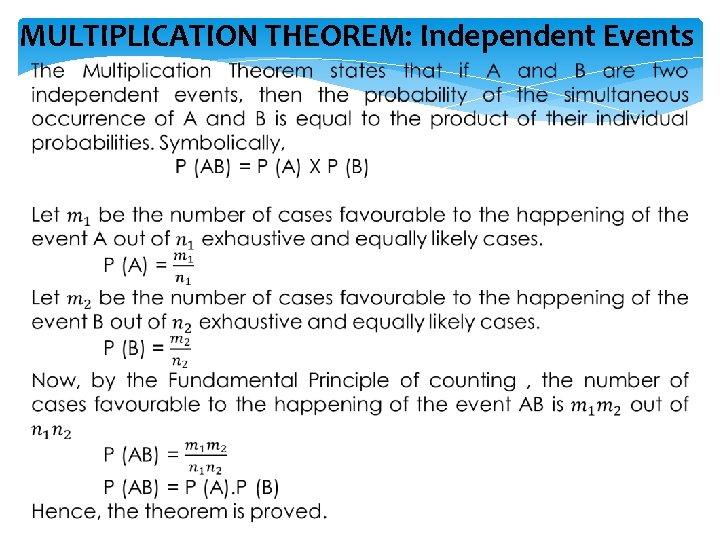
MULTIPLICATION THEOREM: Independent Events
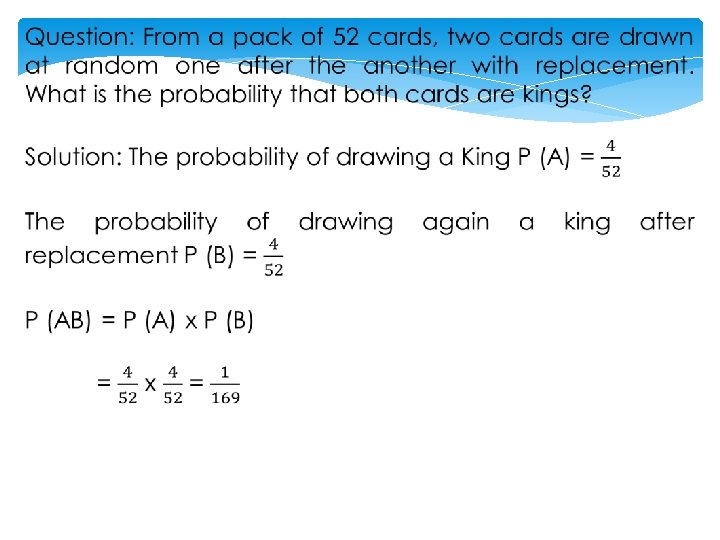
Generalisation The theorem can be extended to three or more independent events. If A, B and C are three independent events, then P (ABC) = P (A) x P (B) x P (C) EXAMPLES ILLUSTRATING THE APPLICATION OF THE MULTIPLE THEOREM
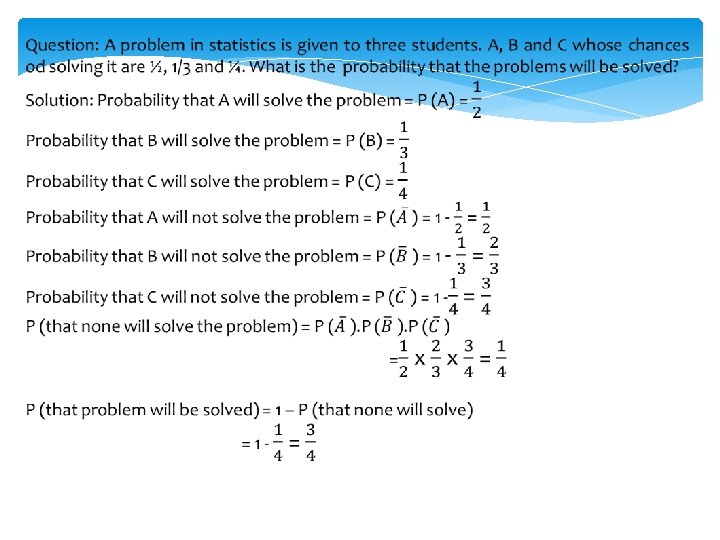
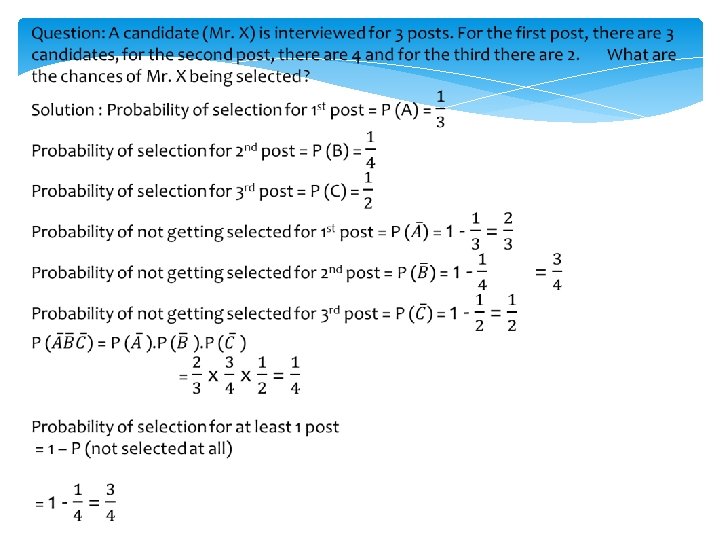
Probability of happening of atleast one event in case of n independent events P (happening of at least one of the events) = 1 – P (happening of none of the events)
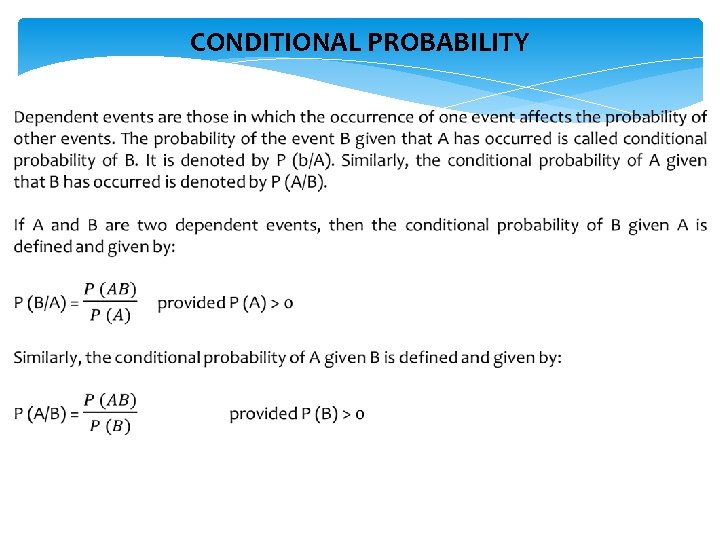
CONDITIONAL PROBABILITY
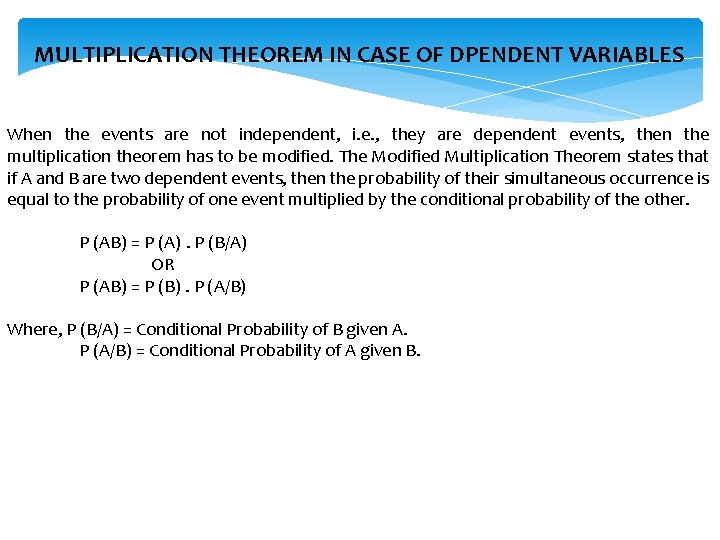
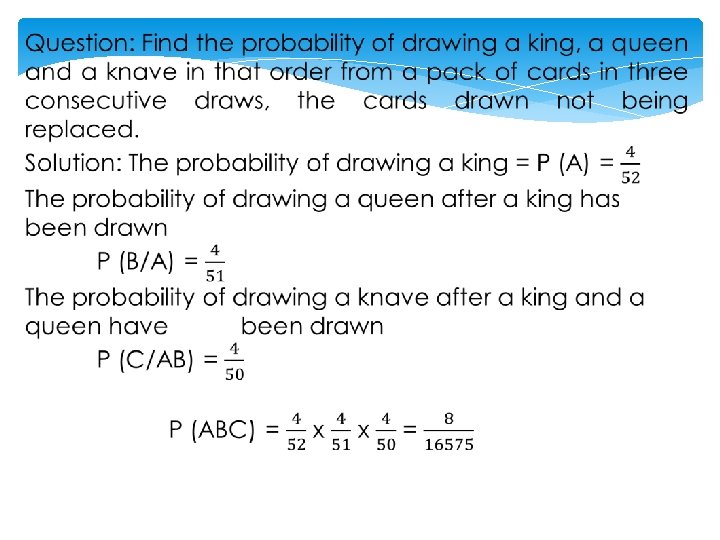
MULTIPLICATION THEOREM IN CASE OF DPENDENT VARIABLES When the events are not independent, i. e. , they are dependent events, then the multiplication theorem has to be modified. The Modified Multiplication Theorem states that if A and B are two dependent events, then the probability of their simultaneous occurrence is equal to the probability of one event multiplied by the conditional probability of the other. P (AB) = P (A). P (B/A) OR P (AB) = P (B). P (A/B) Where, P (B/A) = Conditional Probability of B given A. P (A/B) = Conditional Probability of A given B.
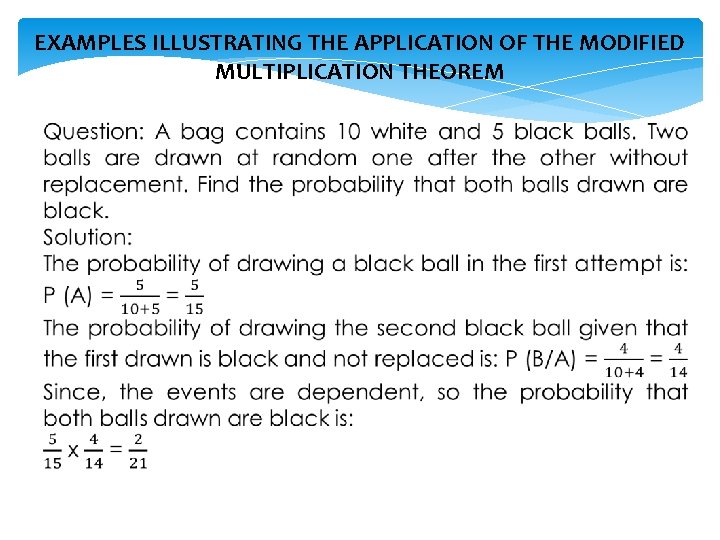
EXAMPLES ILLUSTRATING THE APPLICATION OF THE MODIFIED MULTIPLICATION THEOREM
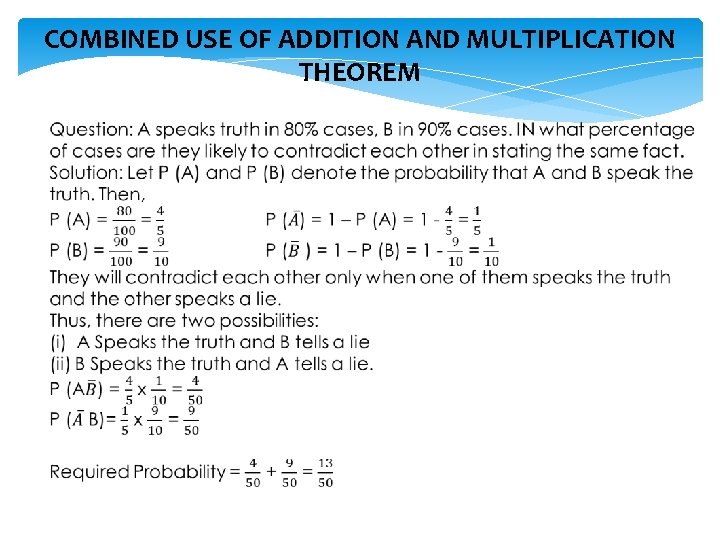
COMBINED USE OF ADDITION AND MULTIPLICATION THEOREM
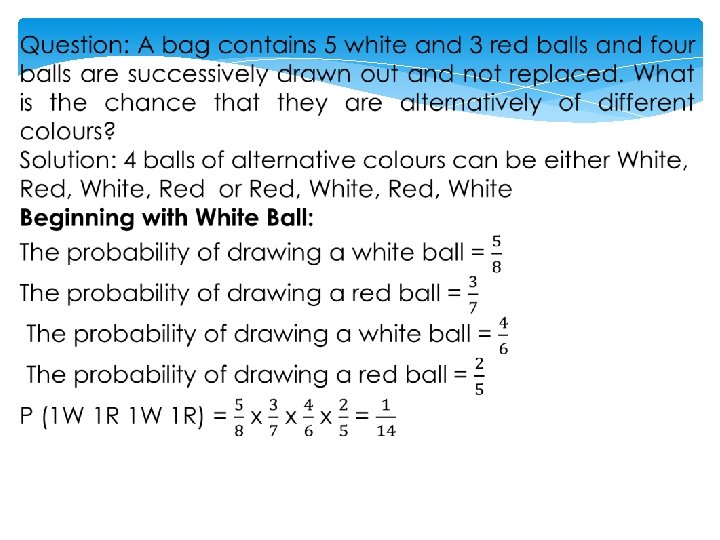
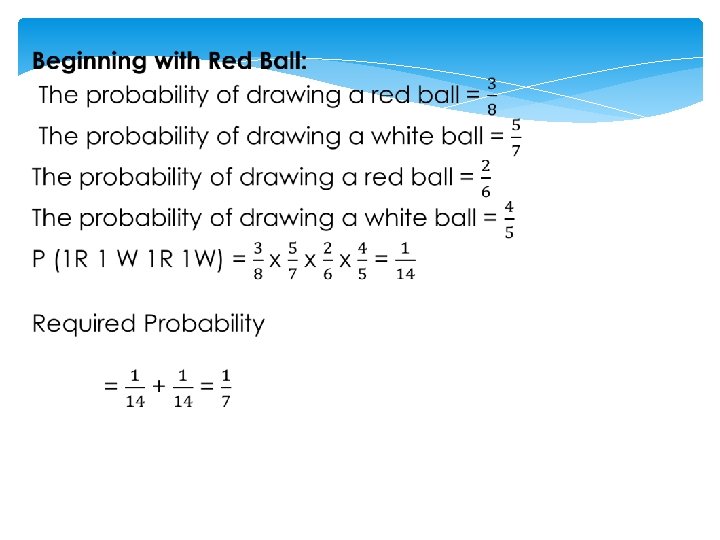
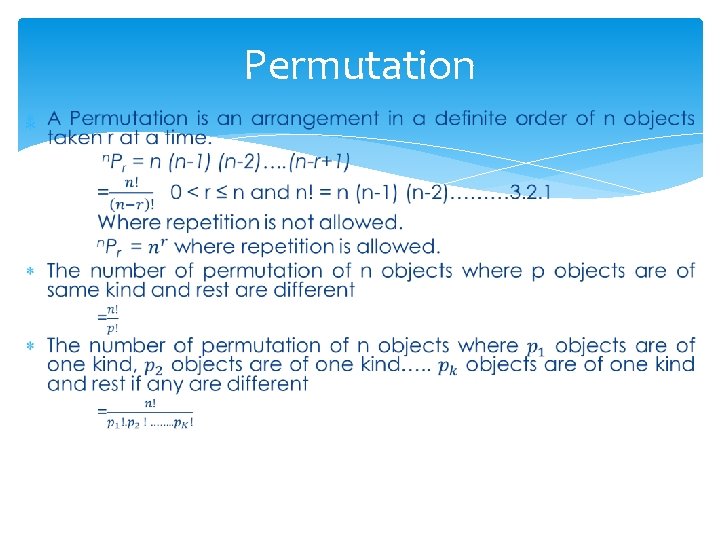
Permutation
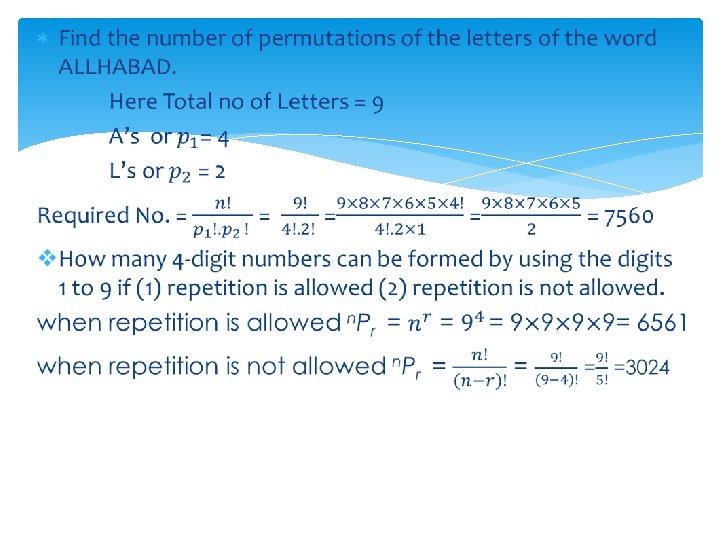
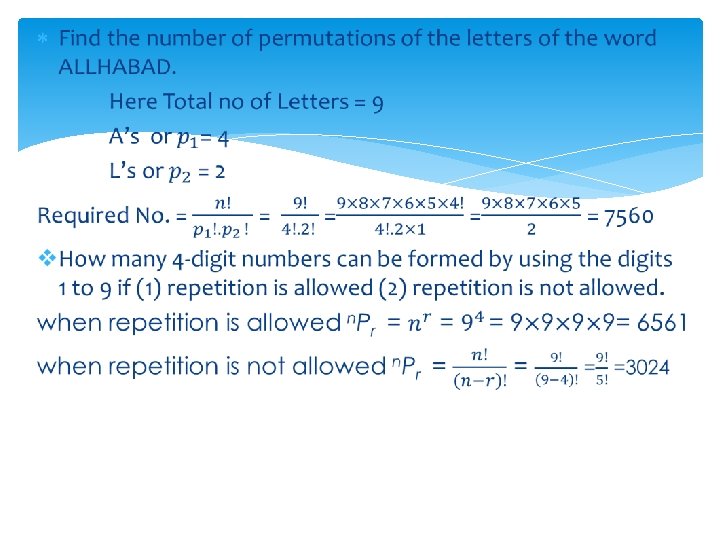
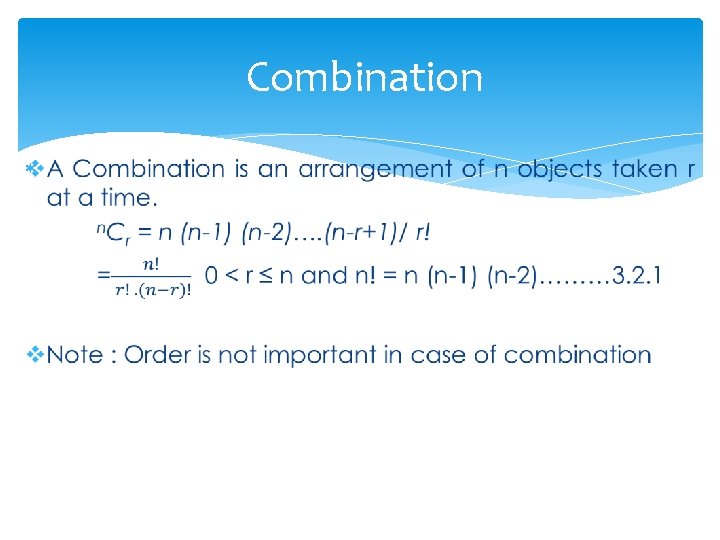
Combination
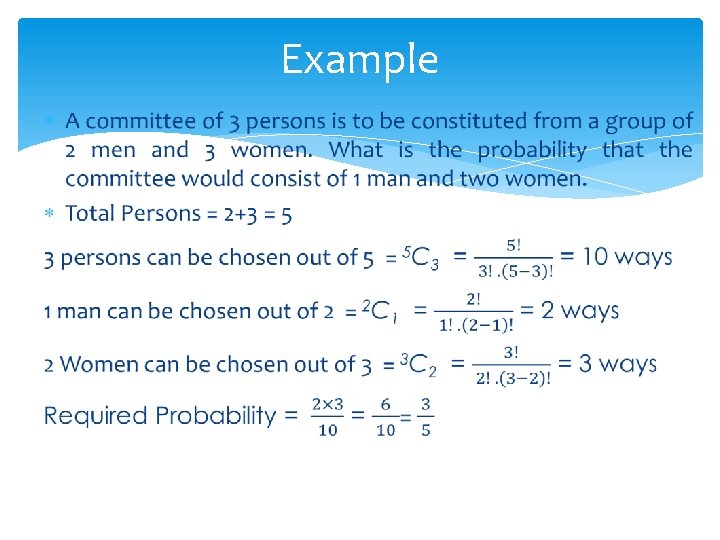
Example
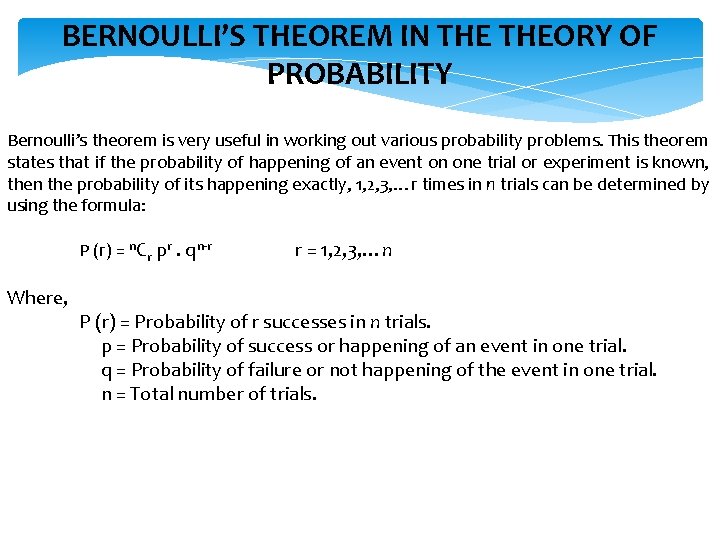
BERNOULLI’S THEOREM IN THEORY OF PROBABILITY Bernoulli’s theorem is very useful in working out various probability problems. This theorem states that if the probability of happening of an event on one trial or experiment is known, then the probability of its happening exactly, 1, 2, 3, …r times in n trials can be determined by using the formula: P (r) = n. Cr pr. qn-r Where, r = 1, 2, 3, …n P (r) = Probability of r successes in n trials. p = Probability of success or happening of an event in one trial. q = Probability of failure or not happening of the event in one trial. n = Total number of trials.
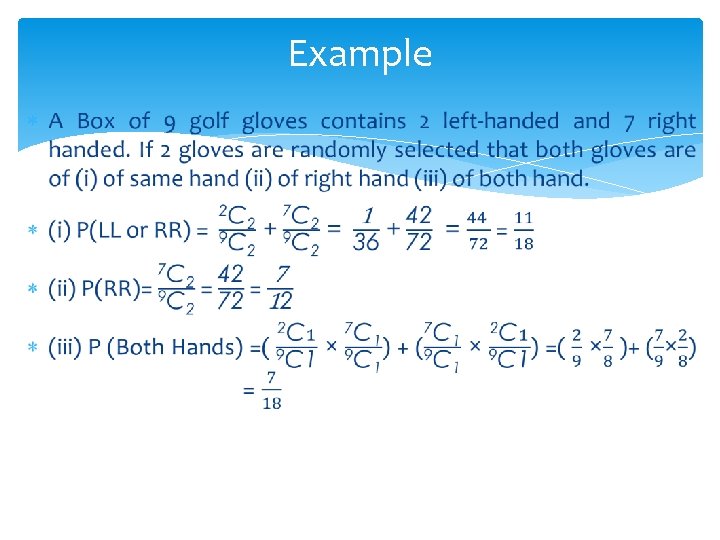
Example
EXAMPLES ILLUSTRATING THE APPLICATION OF BERNOULLI’S THEOREM
BAYE’S THEOREM Bayes' Theorem is named after the British Mathematician Thomas Bayes and it was published in the year 1763. With the help of Bayes' Theorem, prior probability are revised in the light of some sample information and posterior probabilities are obtained. This theorem is also called Theorem of Inverse Probability. STATEMENT OF BAYE’S THEOREM
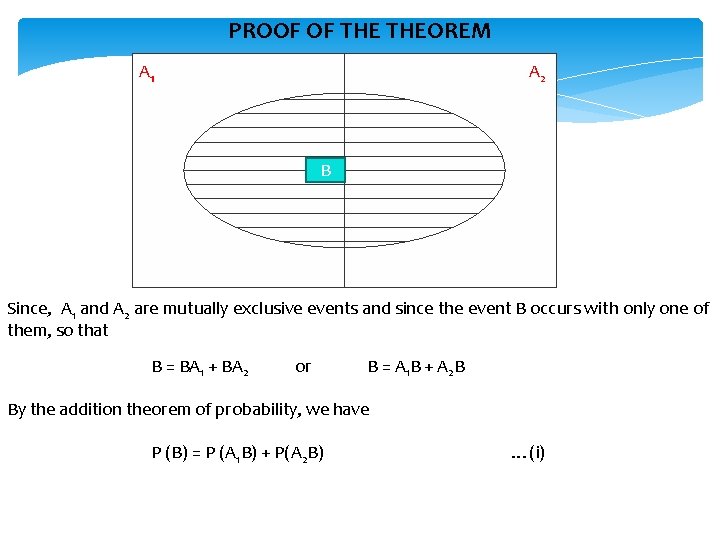
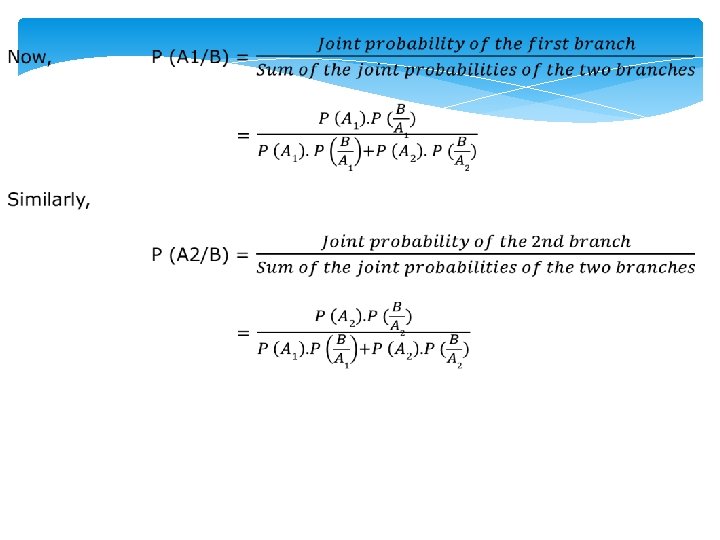
PROOF OF THEOREM A 1 A 2 B Since, A 1 and A 2 are mutually exclusive events and since the event B occurs with only one of them, so that B = BA 1 + BA 2 or B = A 1 B + A 2 B By the addition theorem of probability, we have P (B) = P (A 1 B) + P(A 2 B) …(i)
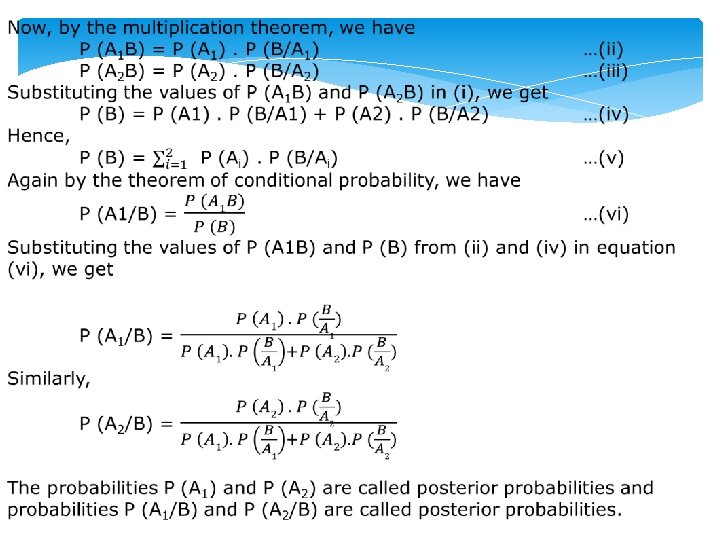
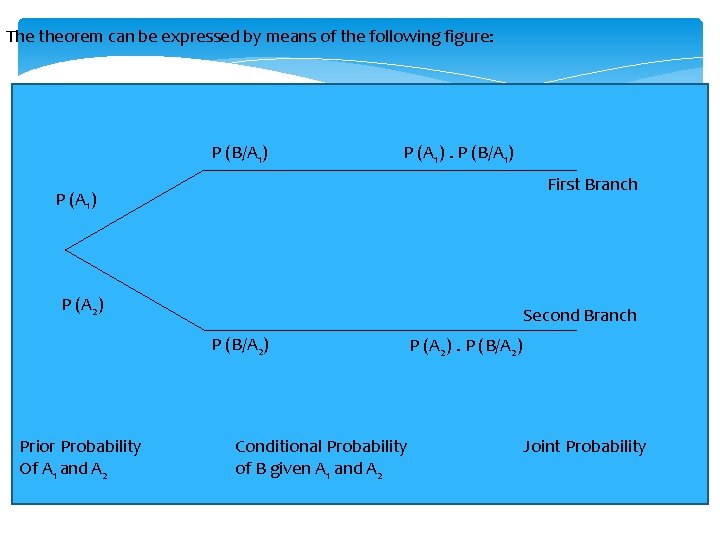
The theorem can be expressed by means of the following figure: P (B/A 1) P (A 1). P (B/A 1) First Branch P (A 1) P (A 2) Second Branch P (B/A 2) Prior Probability Of A 1 and A 2 Conditional Probability of B given A 1 and A 2 P (A 2). P (B/A 2) Joint Probability
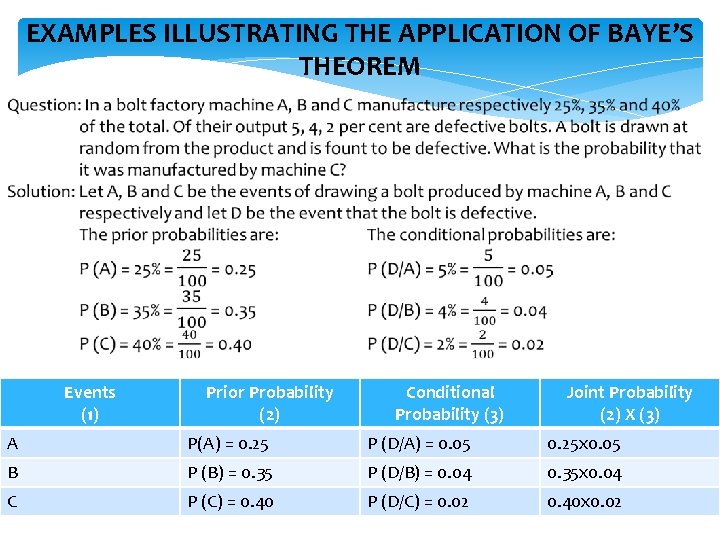
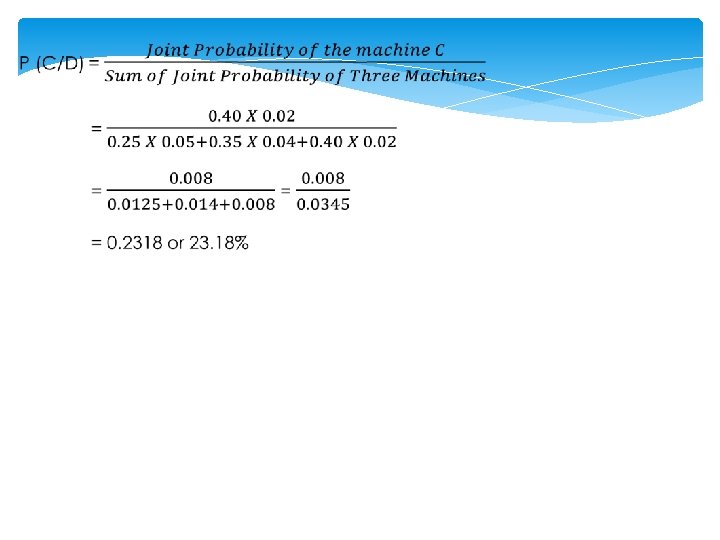
EXAMPLES ILLUSTRATING THE APPLICATION OF BAYE’S THEOREM Events (1) Prior Probability (2) Conditional Probability (3) Joint Probability (2) X (3) A P(A) = 0. 25 P (D/A) = 0. 05 0. 25 x 0. 05 B P (B) = 0. 35 P (D/B) = 0. 04 0. 35 x 0. 04 C P (C) = 0. 40 P (D/C) = 0. 02 0. 40 x 0. 02
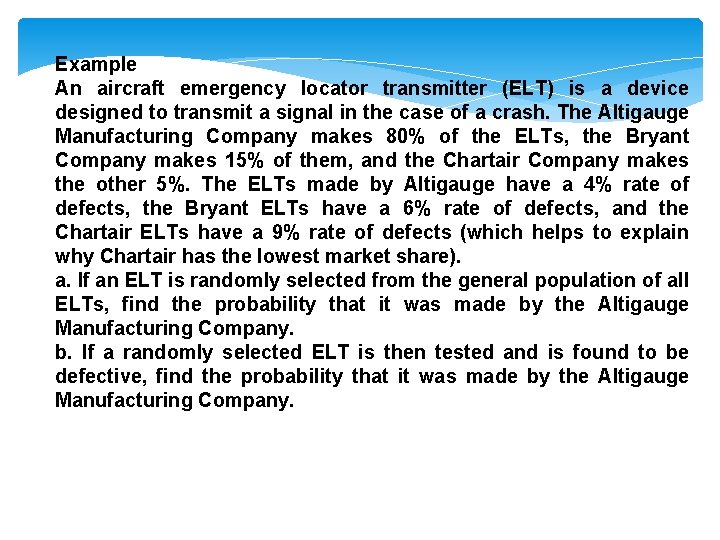
Example An aircraft emergency locator transmitter (ELT) is a device designed to transmit a signal in the case of a crash. The Altigauge Manufacturing Company makes 80% of the ELTs, the Bryant Company makes 15% of them, and the Chartair Company makes the other 5%. The ELTs made by Altigauge have a 4% rate of defects, the Bryant ELTs have a 6% rate of defects, and the Chartair ELTs have a 9% rate of defects (which helps to explain why Chartair has the lowest market share). a. If an ELT is randomly selected from the general population of all ELTs, find the probability that it was made by the Altigauge Manufacturing Company. b. If a randomly selected ELT is then tested and is found to be defective, find the probability that it was made by the Altigauge Manufacturing Company.
A factory has two machines A and B. Past records show that machine A produces 30% of the total output and machine B 70%. Machine A produces 5% defective articles and machine B produces 1% defective items. An item is drawn at random and found to be defective. What is the probability that it was produced by machine A.
More Examples A man is known to speak truth 3 out of 4 times. He throws a dice and reports that it is a six. Find the probability that it is actually six. A restaurant serves two special dishes, A and the rest B to its customers consisting of 60 % men and 40% women. 80% of men order dish A and the rest dish B. 70% of women order dish B and the rest A. In what ratio of A to B should the restaurant prepare the two dishes. There are two identical boxes containing respectively 4 white and 3 red balls; and 3 white and 7 red balls respectively. A ball is drawn and it is white what is the probability that is drawn from first box.
- Slides: 59