
Probabilities of success GAELLE SAINTHILARY SERVIER PSIEFSPI SIG

Probabilities of success GAELLE SAINT-HILARY (SERVIER) PSI/EFSPI SIG QDM – WEBINAR 2, 10 DECEMBER 2019
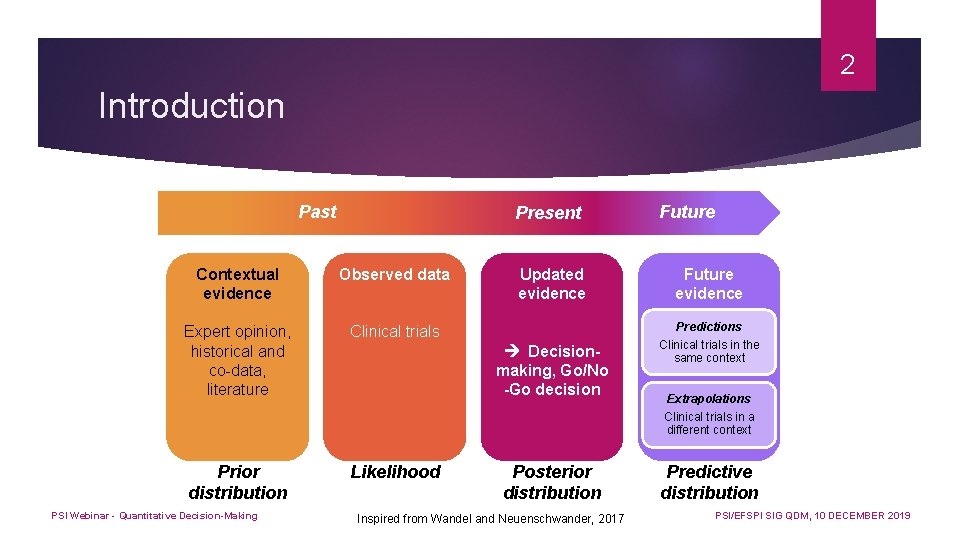
2 Introduction Past Present Contextual evidence Observed data Expert opinion, historical and co-data, literature Clinical trials Updated evidence Future evidence Predictions Decisionmaking, Go/No -Go decision Clinical trials in the same context Extrapolations Clinical trials in a different context Prior distribution PSI Webinar - Quantitative Decision-Making Likelihood Posterior distribution Inspired from Wandel and Neuenschwander, 2017 Predictive distribution PSI/EFSPI SIG QDM, 10 DECEMBER 2019
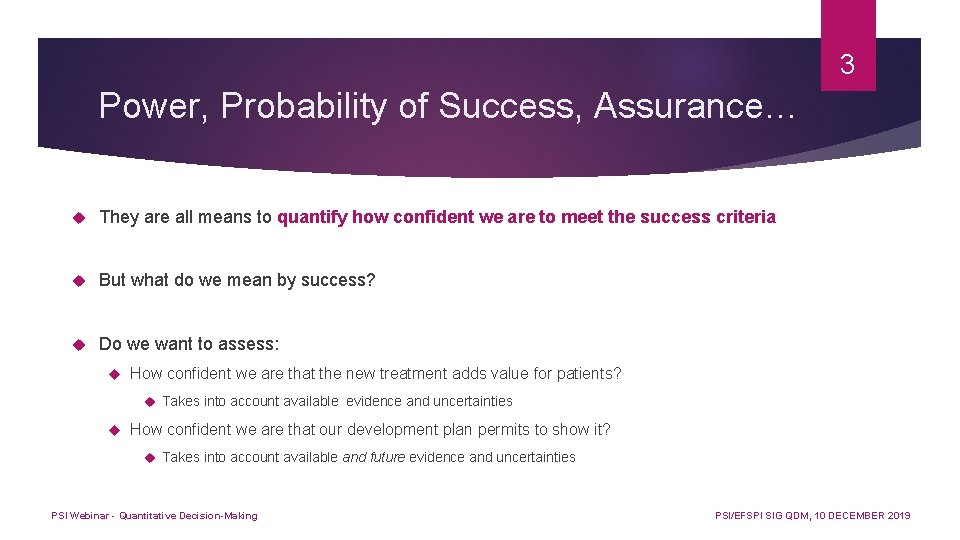
3 Power, Probability of Success, Assurance… They are all means to quantify how confident we are to meet the success criteria But what do we mean by success? Do we want to assess: How confident we are that the new treatment adds value for patients? Takes into account available evidence and uncertainties How confident we are that our development plan permits to show it? Takes into account available and future evidence and uncertainties PSI Webinar - Quantitative Decision-Making PSI/EFSPI SIG QDM, 10 DECEMBER 2019
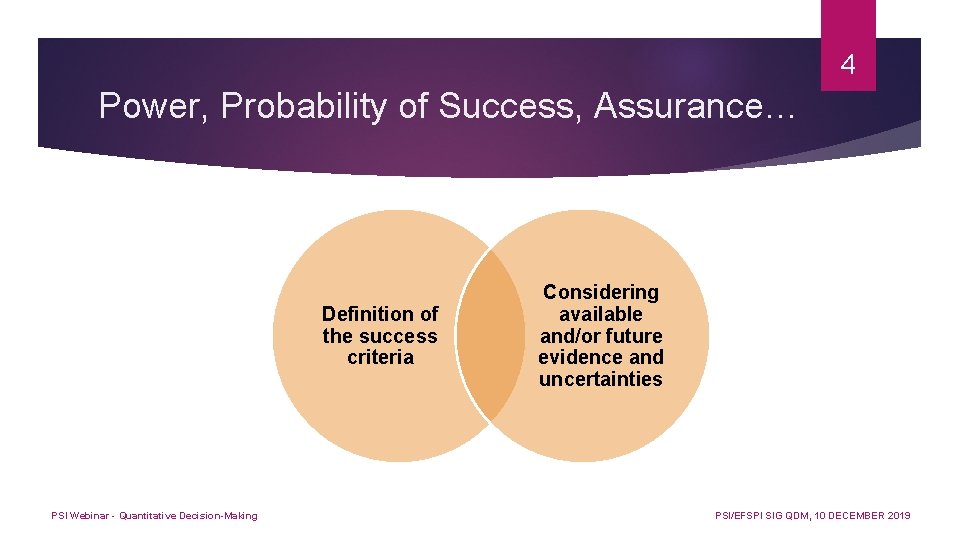
4 Power, Probability of Success, Assurance… Definition of the success criteria PSI Webinar - Quantitative Decision-Making Considering available and/or future evidence and uncertainties PSI/EFSPI SIG QDM, 10 DECEMBER 2019
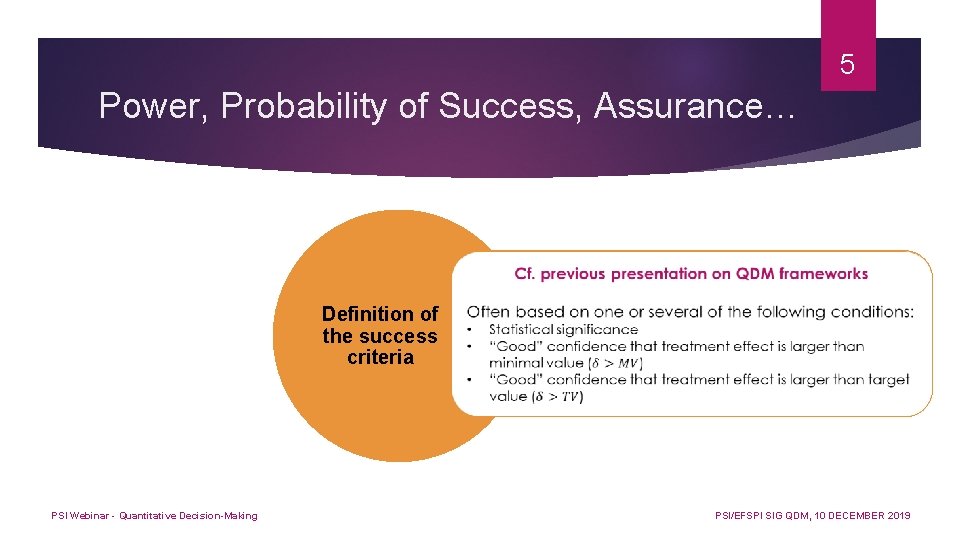
5 Power, Probability of Success, Assurance… Definition of the success criteria PSI Webinar - Quantitative Decision-Making Considering present and/or future evidence and uncertainties PSI/EFSPI SIG QDM, 10 DECEMBER 2019
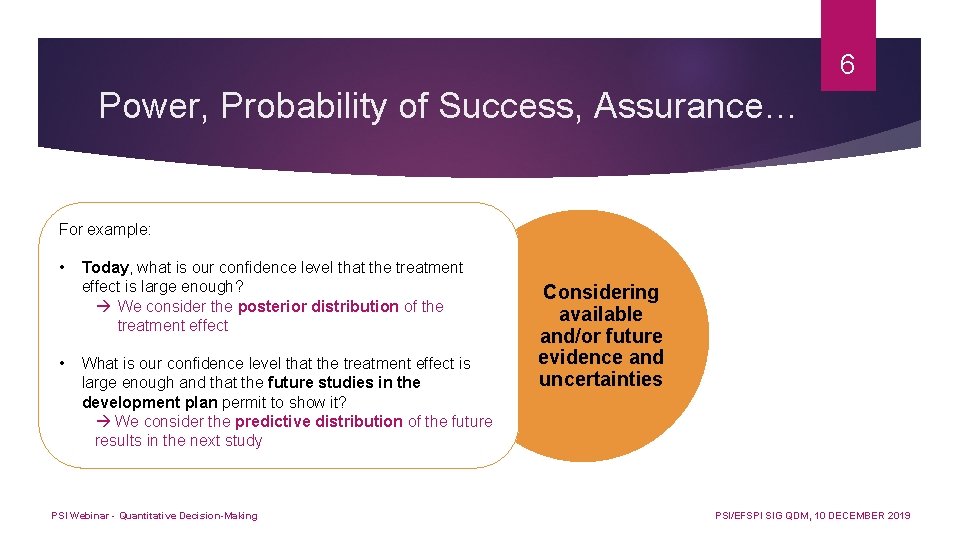
6 Power, Probability of Success, Assurance… For example: • • Today, what is our confidence level that the treatment effect is large enough? We consider the posterior distribution of the treatment effect Definition of the success criteria What is our confidence level that the treatment effect is large enough and that the future studies in the development plan permit to show it? We consider the predictive distribution of the future results in the next study PSI Webinar - Quantitative Decision-Making Considering available and/or future evidence and uncertainties PSI/EFSPI SIG QDM, 10 DECEMBER 2019
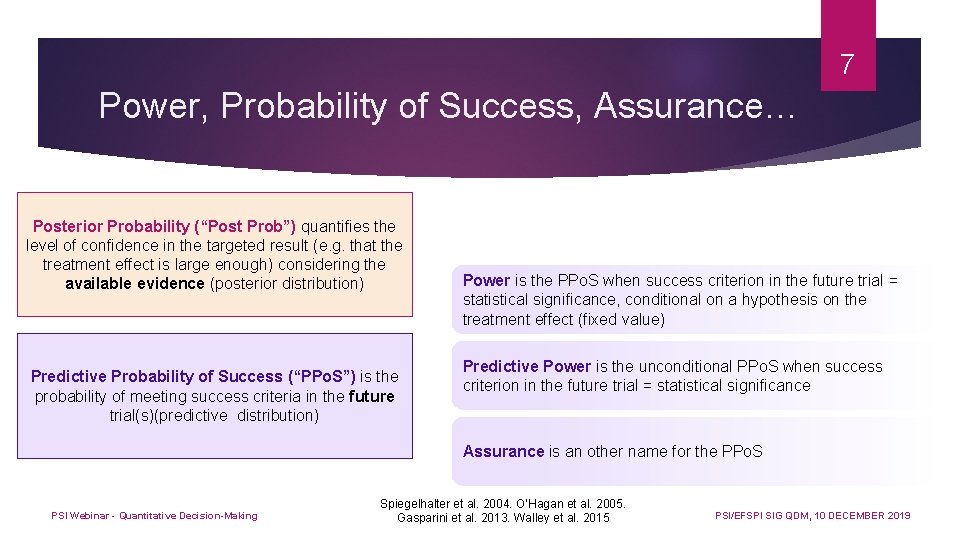
7 Power, Probability of Success, Assurance… Posterior Probability (“Post Prob”) quantifies the level of confidence in the targeted result (e. g. that the treatment effect is large enough) considering the available evidence (posterior distribution) Predictive Probability of Success (“PPo. S”) is the probability of meeting success criteria in the future trial(s)(predictive distribution) Power is the PPo. S when success criterion in the future trial = statistical significance, conditional on a hypothesis on the treatment effect (fixed value) Predictive Power is the unconditional PPo. S when success criterion in the future trial = statistical significance Assurance is an other name for the PPo. S PSI Webinar - Quantitative Decision-Making Spiegelhalter et al. 2004. O’Hagan et al. 2005. Gasparini et al. 2013. Walley et al. 2015 PSI/EFSPI SIG QDM, 10 DECEMBER 2019
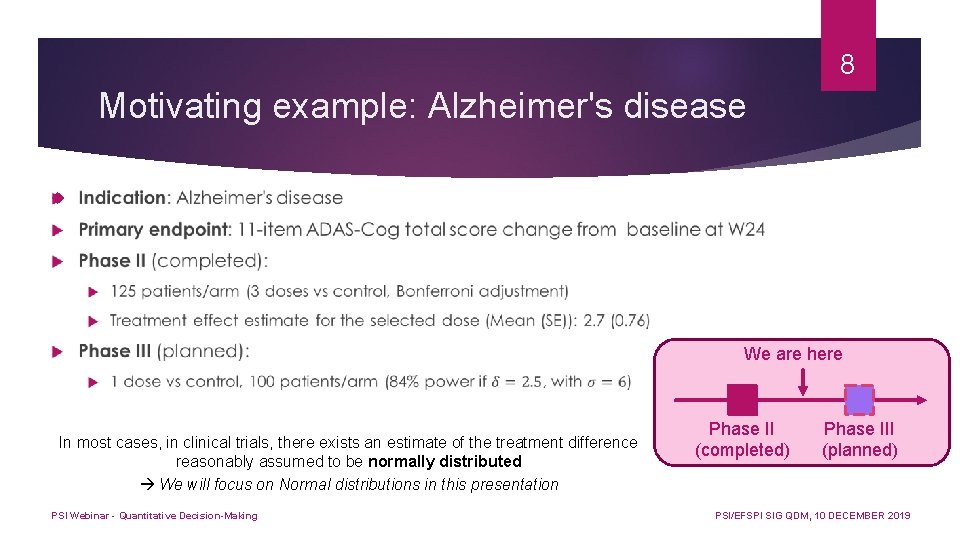
8 Motivating example: Alzheimer's disease We are here In most cases, in clinical trials, there exists an estimate of the treatment difference reasonably assumed to be normally distributed We will focus on Normal distributions in this presentation PSI Webinar - Quantitative Decision-Making Phase II (completed) Phase III (planned) PSI/EFSPI SIG QDM, 10 DECEMBER 2019
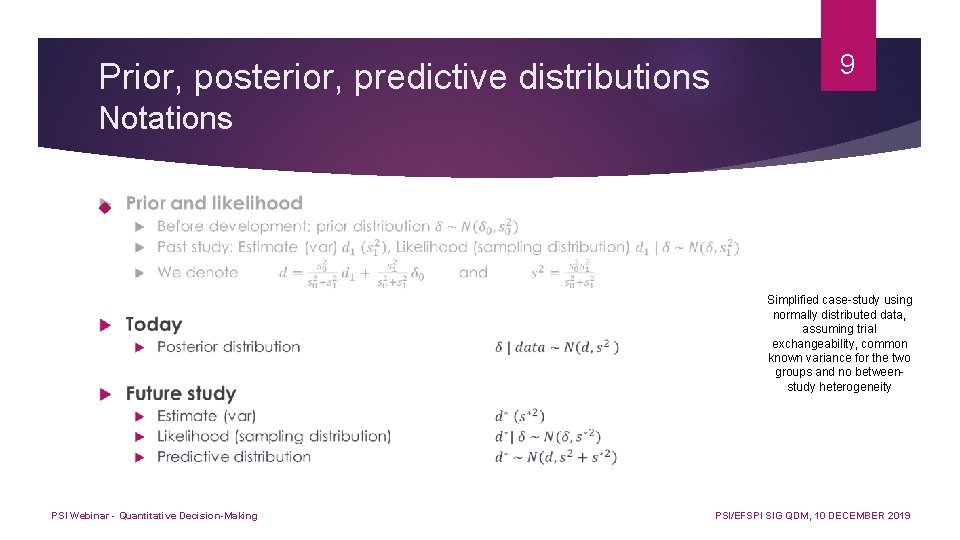
Prior, posterior, predictive distributions 9 Notations Simplified case-study using normally distributed data, assuming trial exchangeability, common known variance for the two groups and no betweenstudy heterogeneity PSI Webinar - Quantitative Decision-Making PSI/EFSPI SIG QDM, 10 DECEMBER 2019
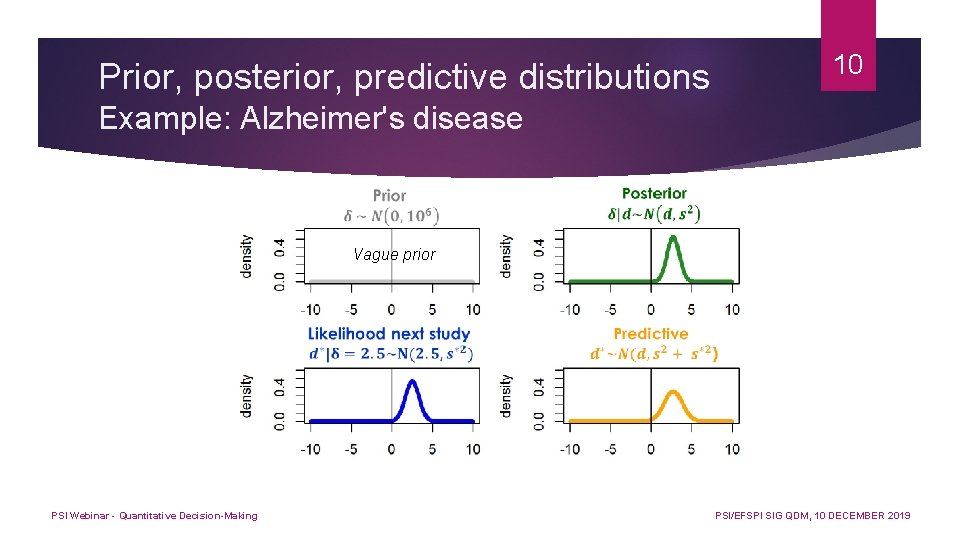
Prior, posterior, predictive distributions 10 Example: Alzheimer's disease Vague prior PSI Webinar - Quantitative Decision-Making PSI/EFSPI SIG QDM, 10 DECEMBER 2019
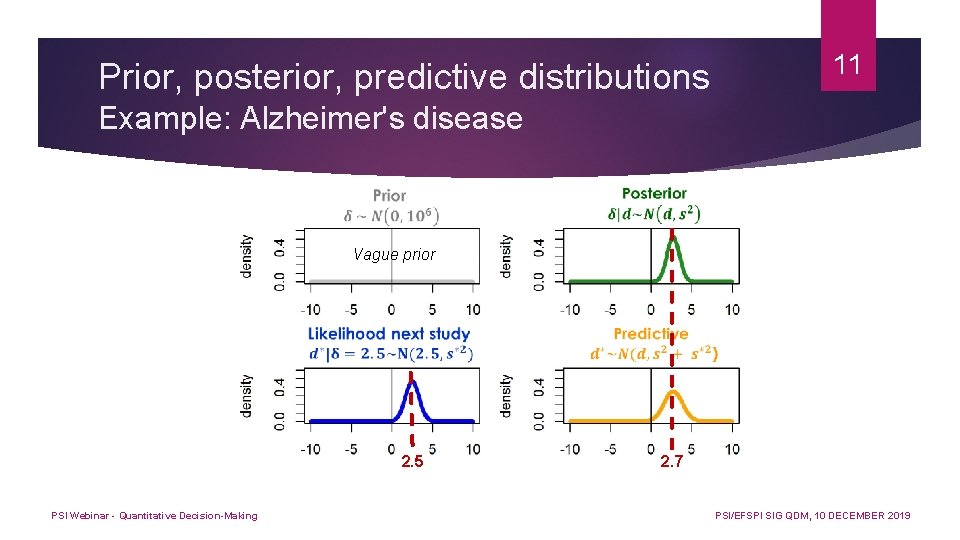
Prior, posterior, predictive distributions 11 Example: Alzheimer's disease Vague prior 2. 5 PSI Webinar - Quantitative Decision-Making 2. 7 PSI/EFSPI SIG QDM, 10 DECEMBER 2019
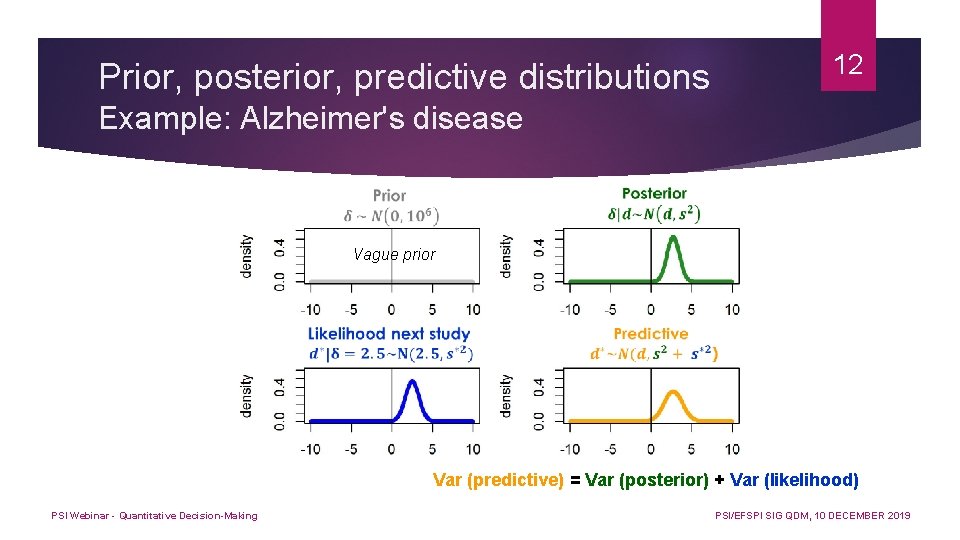
Prior, posterior, predictive distributions 12 Example: Alzheimer's disease Vague prior Var (predictive) = Var (posterior) + Var (likelihood) PSI Webinar - Quantitative Decision-Making PSI/EFSPI SIG QDM, 10 DECEMBER 2019
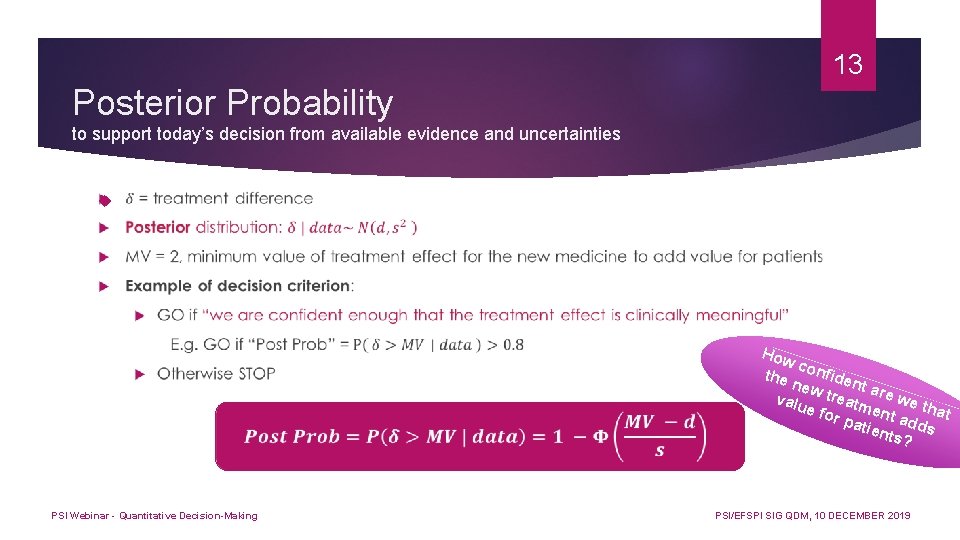
13 Posterior Probability to support today’s decision from available evidence and uncertainties PSI Webinar - Quantitative Decision-Making How c the onfide nt a new valu treatm re we t h e fo r pa ent add at tien ts? s PSI/EFSPI SIG QDM, 10 DECEMBER 2019
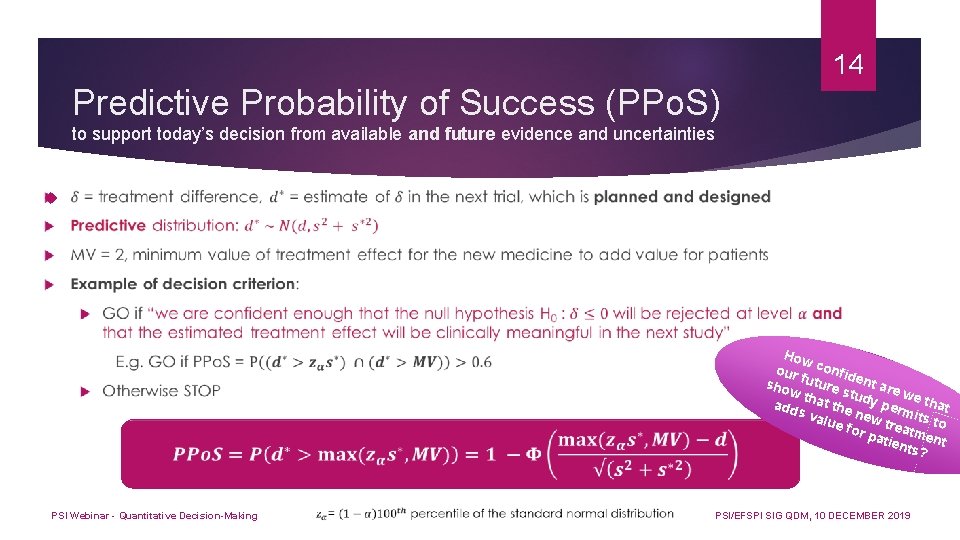
14 Predictive Probability of Success (PPo. S) to support today’s decision from available and future evidence and uncertainties How our confid sho future ent are stud w th w a y pe e that t add t h s va e new rmits lue for treatm to pati ents ent ? PSI Webinar - Quantitative Decision-Making PSI/EFSPI SIG QDM, 10 DECEMBER 2019
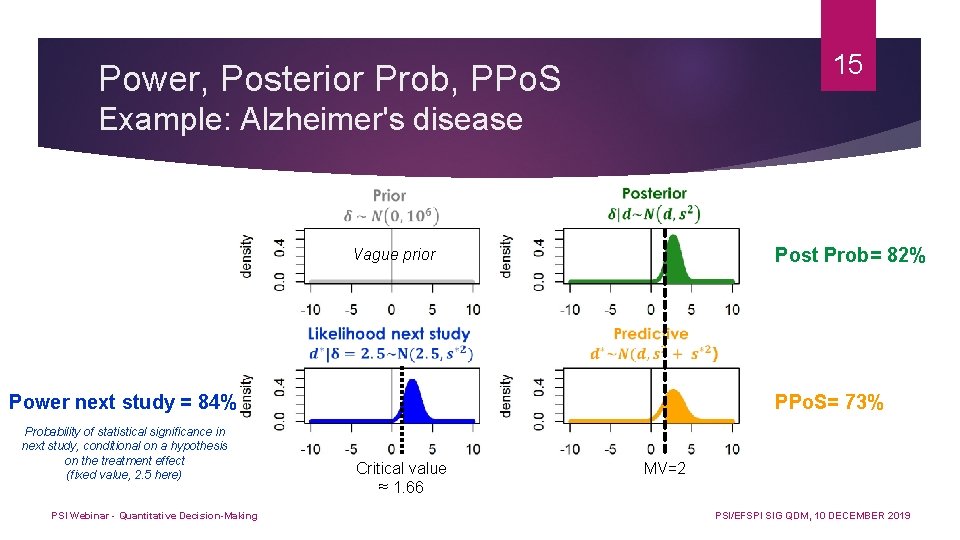
15 Power, Posterior Prob, PPo. S Example: Alzheimer's disease Post Prob= 82% Vague prior Power next study = 84% Probability of statistical significance in next study, conditional on a hypothesis on the treatment effect (fixed value, 2. 5 here) PSI Webinar - Quantitative Decision-Making PPo. S= 73% Critical value ≈ 1. 66 MV=2 PSI/EFSPI SIG QDM, 10 DECEMBER 2019
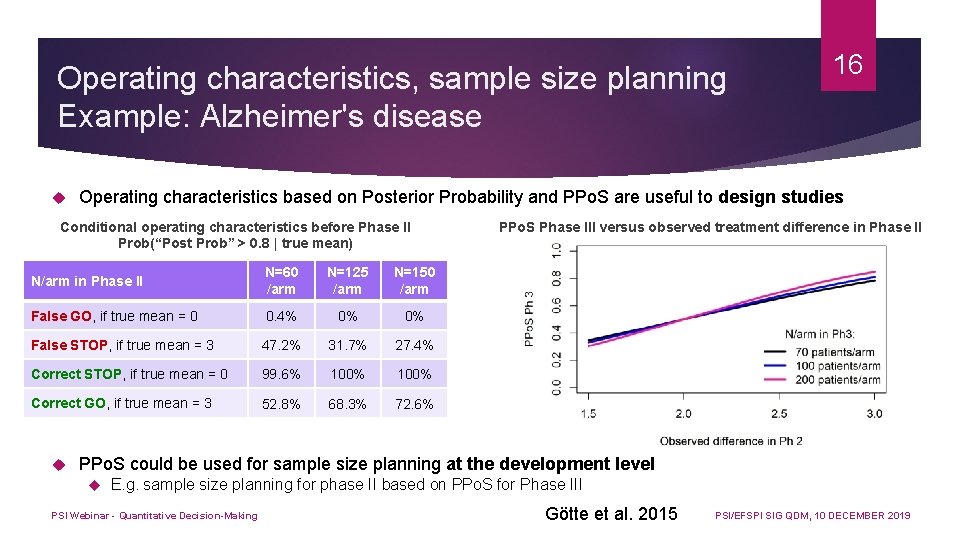
Operating characteristics, sample size planning Example: Alzheimer's disease Operating characteristics based on Posterior Probability and PPo. S are useful to design studies Conditional operating characteristics before Phase II Prob(“Post Prob” > 0. 8 | true mean) N/arm in Phase II N=60 /arm N=125 /arm N=150 /arm False GO, if true mean = 0 0. 4% 0% 0% False STOP, if true mean = 3 47. 2% 31. 7% 27. 4% Correct STOP, if true mean = 0 99. 6% 100% Correct GO, if true mean = 3 52. 8% 68. 3% 72. 6% 16 PPo. S Phase III versus observed treatment difference in Phase II PPo. S could be used for sample size planning at the development level E. g. sample size planning for phase II based on PPo. S for Phase III PSI Webinar - Quantitative Decision-Making Götte et al. 2015 PSI/EFSPI SIG QDM, 10 DECEMBER 2019
17 What level of Posterior Probability/PPo. S is needed to support a Go decision? The Post Prob and PPo. S depend on the success criteria, the design of the studies (in particular, the sample size) and the amount of uncertainty about the treatment effect The target level for a Go decision should be chosen based on What is achievable (assessed using operating characteristics, conditional on fixed values or using informative priors) What is desirable in the context: what level of risk is acceptable to make a decision? E. g. • Well understood disease, highly competitive environment Low level of acceptable risk • High unmet need, high risk of development failure Higher level of acceptable risk Note on classical Power vs Predictive Power in confirmatory trials is usually 80% or 90% • Based on an assumption about the treatment effect • Could always be increased by increasing the sample size PSI Webinar - Quantitative Decision-Making Predictive Power takes into account uncertainties about the treatment effect • There is a limit of how high it can be, which depends on the amount of available uncertainty Crisp et al. 2018 PSI/EFSPI SIG QDM, 10 DECEMBER 2019
18 Extensions, other settings Several prior studies: estimate based on (network-) meta-analysis Several future studies: probability to reach the criteria in each study Interim analysis: probability to reach the criteria at the end of the study given the results at the interim (independent increments) Multiple endpoints / Multiple doses v v Type 1 error adjustment for multiple comparisons if needed Joint distributions Bias: selection of doses or populations overestimation of treatment effect overestimation of probabilities of success bias correction needed Decision-making based on surrogate endpoints v Patient-level or trial-level surrogacy (Saint-Hilary et al. 2019) PSI Webinar - Quantitative Decision-Making PSI/EFSPI SIG QDM, 10 DECEMBER 2019
19 Discussion Posterior Probability and PPo. S help decision-making At the study level (planning, interim analyses, …) At the development level when assessing Ø Development strategies Ø Strategic milestones Ø Due-diligences Ø Global project value assessment Choosing between Posterior Probability or PPo. S to define the Go/No-Go criteria depends on the question of interest (related to the treatment effect only, or also to the success of future trials) and the context (future studies already planned and designed? ) PSI Webinar - Quantitative Decision-Making PSI/EFSPI SIG QDM, 10 DECEMBER 2019
20 Lessons learned from the webinars Quantitative Decision-Making in Drug Development QDM provides value to trial level, program level and portfolio level decision-making There is an awareness of QDM methods among statisticians and, to a lesser extent, also among nonstatisticians and decision-makers v However, statisticians are not seen as leaders in decision-making processes Many quantitative methods exist but some of them still remain unknown or unused v QDM is currently used mainly in clinical development Pre-specification of QDM frameworks with quantitative criteria is a driver for better decision-making Statistical methods e. g. probabilities of success permit to quantify uncertainty QDM facilitates better cross-functional communication and planning PSI Webinar - Quantitative Decision-Making PSI/EFSPI SIG QDM, 3 & 10 DECEMBER 2019
21 References Wandel, S, and Neuenschwander, B (2017). Bayesian Clinical Trials Workshop, Ulm University, Germany, October 4 -5. Spiegelhalter, DJ, Abramsn, KR, and Myles, JP (2004). Bayesian approaches to clinical trials and health-care evaluation. John Wiley & Sons Ltd, Chichester, UK. O Hagan, A, Stevens, JW, and Campbell, MJ (2005). Assurance in clinical trial design. Pharmaceutical Statistics 4, 187– 201. Walley RJ, Smith CL, Gale JD, Woodward P (2015). Advantages of a wholly Bayesian approach to assessing efficacy in early drug development: a case study. Pharm Stat. 14(3): 205 -15. doi: 10. 1002/pst. 1675. Gasparini, M, Di Scala, L, Bretz, F, and Racine-Poon, A (2013). Predictive probability of success in clinical drug development. Epidemiology Biostatistics and Public Health 10 -1, e 8760 -1 -14. Götte, H, Schüler, A, Kirchner, M, and Kieser, M (2015). Sample size planning for phase II trials based on success probabilities for phase III. Pharmaceutical Statistics; 14: 515– 524. doi: 10. 1002/pst. 1717. Crisp, A, Miller, S, Thompson, D, Best, N. (2018). Practical experiences of adopting assurance as a quantitative framework to support decision making in drug development. Pharmaceutical Statistics; 17: 317– 328. doi: 10. 1002/pst. 1856 Saint‐Hilary, G, Barboux, V, Pannaux, M, Gasparini, M, Robert, V, and Mastrantonio, G (2019). Predictive probability of success using surrogate endpoints. Statistics in Medicine; 38: 1753– 1774. doi: 10. 1002/sim. 8060 PSI Webinar - Quantitative Decision-Making PSI/EFSPI SIG QDM, 10 DECEMBER 2019
- Slides: 21