
Probabilistic Skyline Operator over sliding Windows Wan Qian

Probabilistic Skyline Operator over sliding Windows Wan Qian HKUST DB Group

Introduction

Skyline l Find a good hotel cheap and near the beach 700 m 600 kr 900 m 600 kr 60 m 1200 kr 20 m 400 kr 80 m 500 kr 20 m 1100 kr
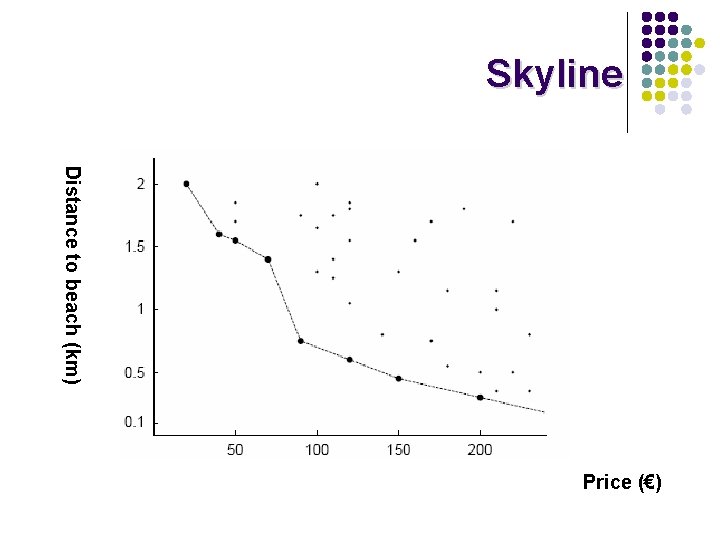
Skyline Distance to beach (km) Price (€)

On-line Shopping System Each products are evaluated in various aspects In addition, the seller is associated with a “trustability”. Customers may want to continuously monitor on-line advertisements by selecting the candidates for the best deal ---- skyline points. Note that the data is uncertain
Problem Statement l In this paper, we study the problem of efficiently retrieving skyline elements from the most recent N elements for a sequence of uncertain elements in a d-dimensional numeric space, with the skyline probabilities not smaller than a given threshold q (0 < q ≤ 1)
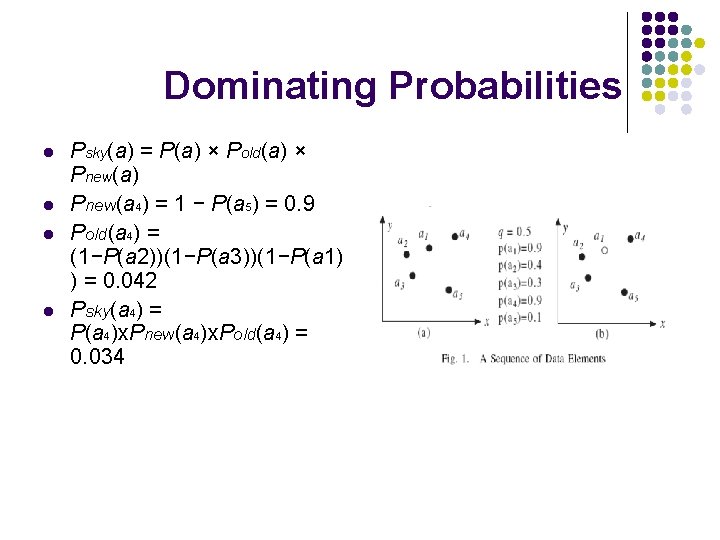
Dominating Probabilities l l Psky(a) = P(a) × Pold(a) × Pnew(a) Pnew(a 4) = 1 − P(a 5) = 0. 9 Pold(a 4) = (1−P(a 2))(1−P(a 3))(1−P(a 1) ) = 0. 042 Psky(a 4) = P(a 4)x. Pnew(a 4)x. Pold(a 4) = 0. 034

Algorithm
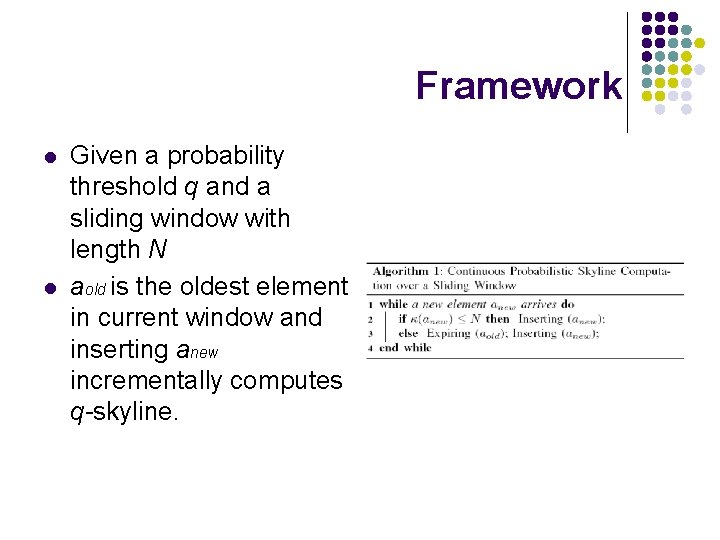
Framework l l Given a probability threshold q and a sliding window with length N aold is the oldest element in current window and inserting anew incrementally computes q-skyline.
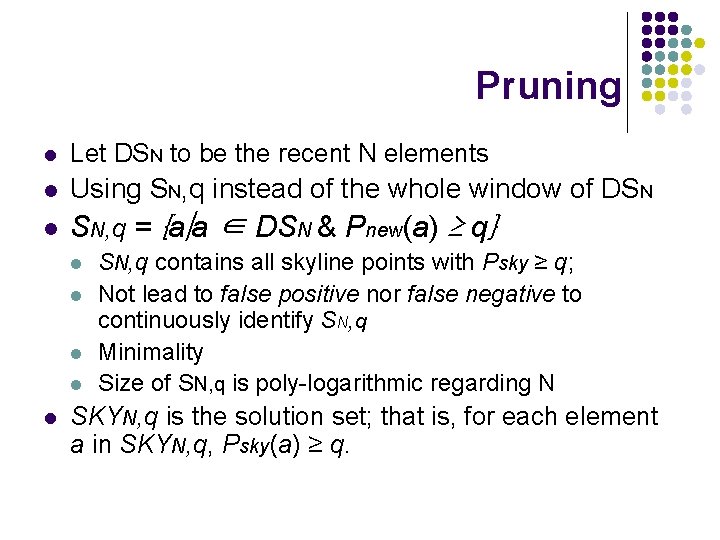
Pruning l Let DSN to be the recent N elements l Using SN, q instead of the whole window of DSN l SN, q = {a|a ∈ DSN & Pnew(a) ≥ q} l l l SN, q contains all skyline points with Psky ≥ q; Not lead to false positive nor false negative to continuously identify SN, q Minimality Size of SN, q is poly-logarithmic regarding N SKYN, q is the solution set; that is, for each element a in SKYN, q, Psky(a) ≥ q.
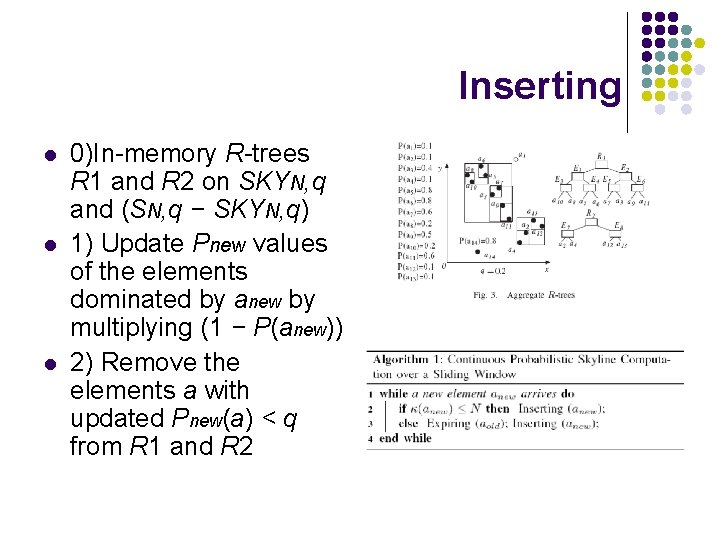
Inserting l l l 0)In-memory R-trees R 1 and R 2 on SKYN, q and (SN, q − SKYN, q) 1) Update Pnew values of the elements dominated by anew by multiplying (1 − P(anew)) 2) Remove the elements a with updated Pnew(a) < q from R 1 and R 2
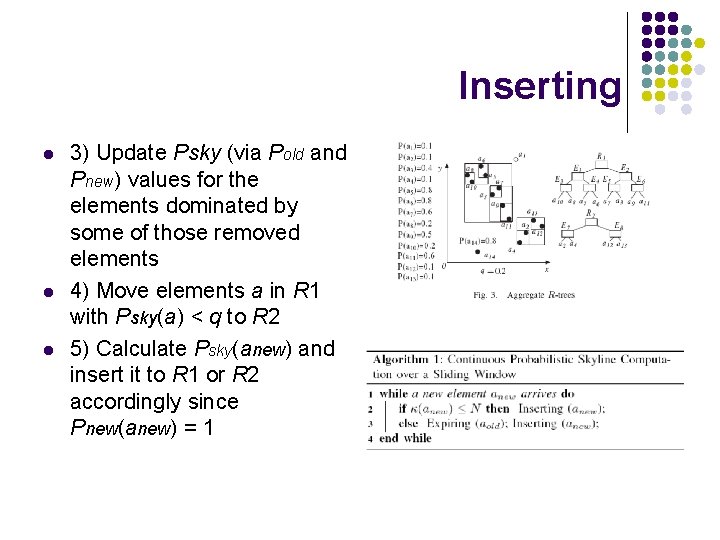
Inserting l l l 3) Update Psky (via Pold and Pnew) values for the elements dominated by some of those removed elements 4) Move elements a in R 1 with Psky(a) < q to R 2 5) Calculate Psky(anew) and insert it to R 1 or R 2 accordingly since Pnew(anew) = 1
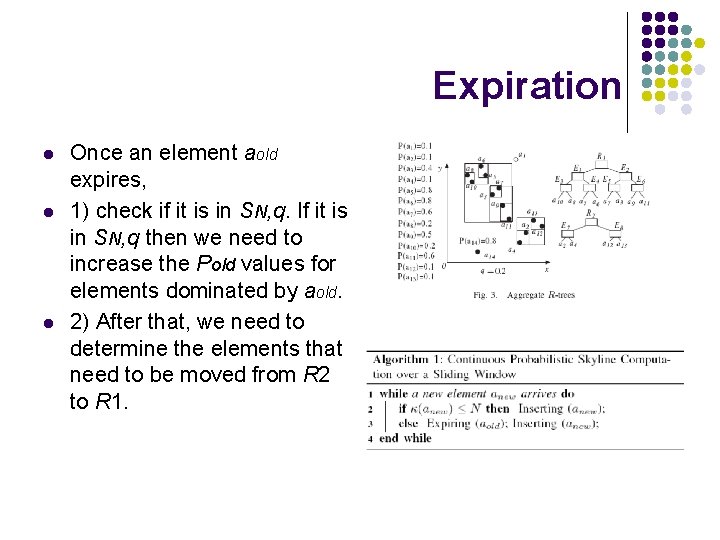
Expiration l l l Once an element aold expires, 1) check if it is in SN, q. If it is in SN, q then we need to increase the Pold values for elements dominated by aold. 2) After that, we need to determine the elements that need to be moved from R 2 to R 1.
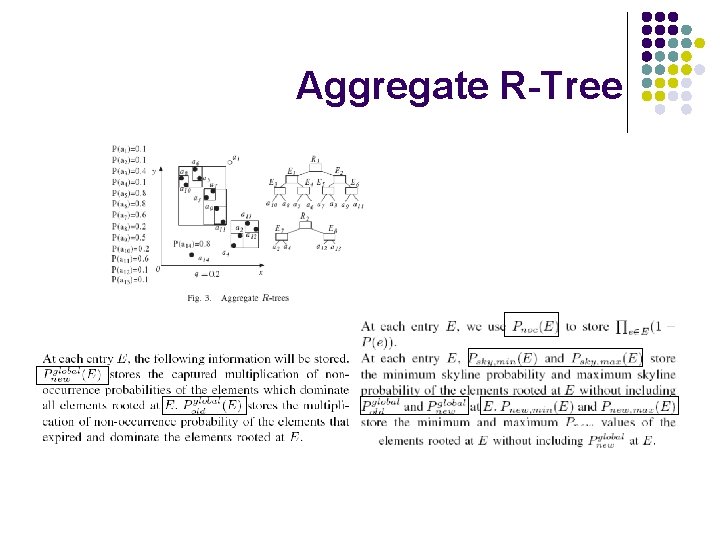
Aggregate R-Tree
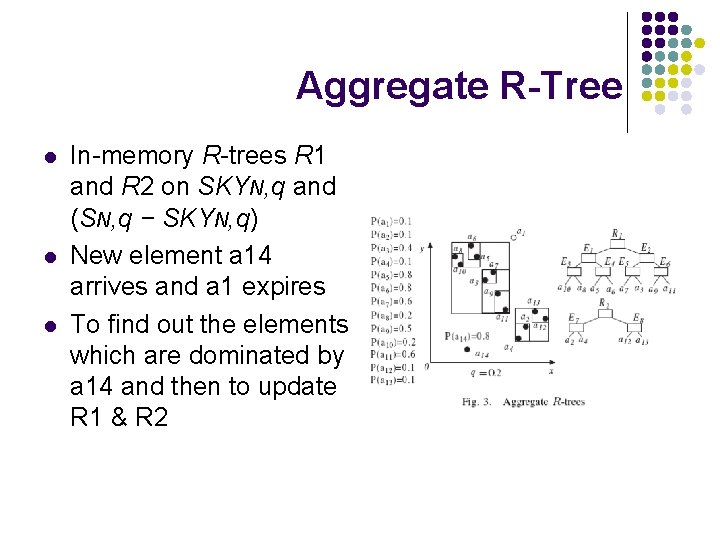
Aggregate R-Tree l l l In-memory R-trees R 1 and R 2 on SKYN, q and (SN, q − SKYN, q) New element a 14 arrives and a 1 expires To find out the elements which are dominated by a 14 and then to update R 1 & R 2
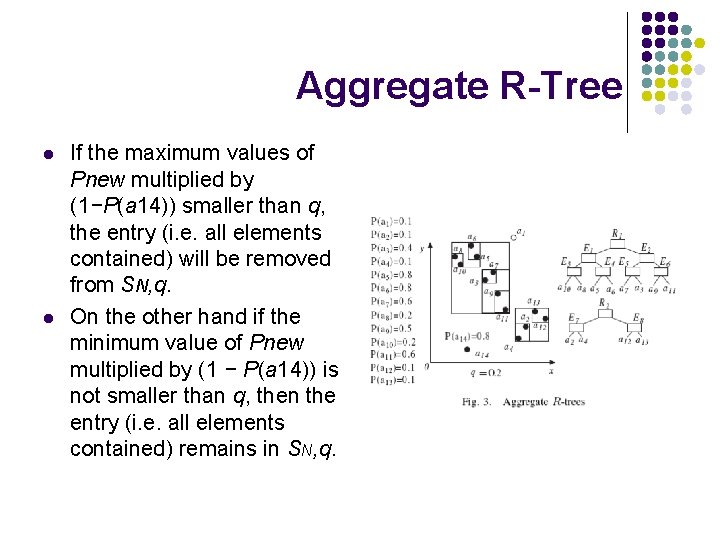
Aggregate R-Tree l l If the maximum values of Pnew multiplied by (1−P(a 14)) smaller than q, the entry (i. e. all elements contained) will be removed from SN, q. On the other hand if the minimum value of Pnew multiplied by (1 − P(a 14)) is not smaller than q, then the entry (i. e. all elements contained) remains in SN, q.
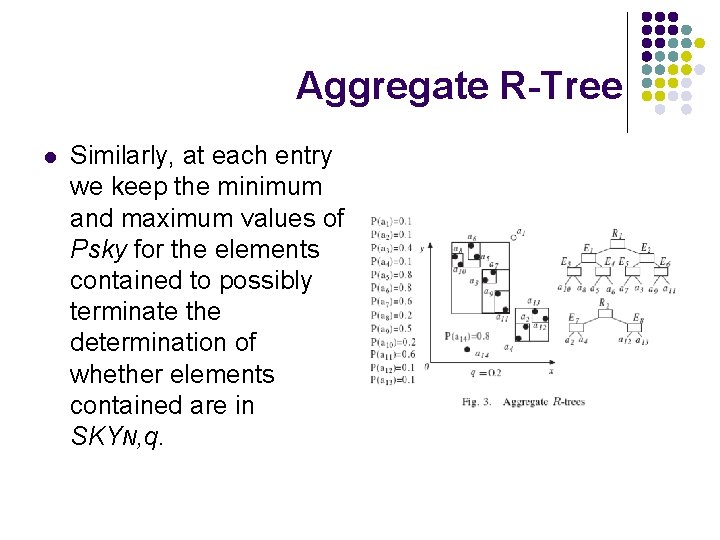
Aggregate R-Tree l Similarly, at each entry we keep the minimum and maximum values of Psky for the elements contained to possibly terminate the determination of whether elements contained are in SKYN, q.
Analysis l l Space Complexity. Clearly, in our algorithm we use aggregate-R trees to keep each element in SN, q and each element is kept only once. Thus, the space complexity is O(|SN, q|). Time Complexity. No sensible time complexity analysis
Extension l Multiple thresholds l l run multiple queries and intersect results together Ad-hoc Queries l l “find the skyline with skyline probability at least q”. Assume that currently we maintain k skylines as discussed above and q ≥ qk. First find an Ri such that qi ≤ q < qi− 1; clearly elements {Rj : j < i− 1} are contained in the solution. Run search to get all elements in Ri with skyline probabilities ≥ q
Experiment
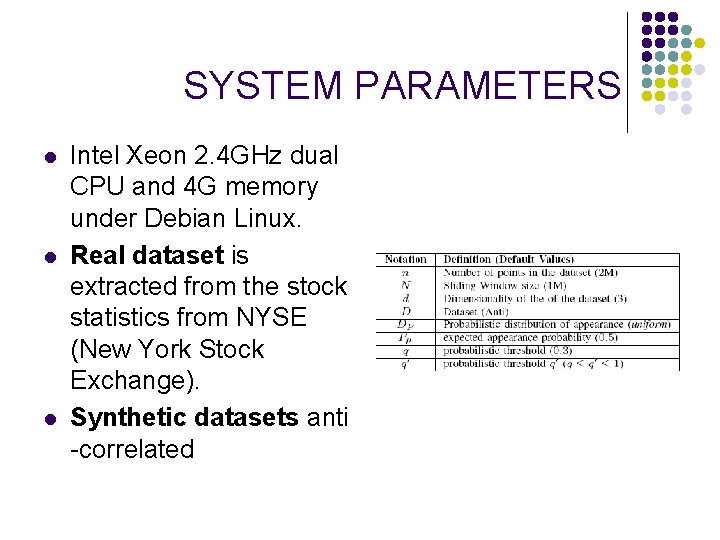
SYSTEM PARAMETERS l l l Intel Xeon 2. 4 GHz dual CPU and 4 G memory under Debian Linux. Real dataset is extracted from the stock statistics from NYSE (New York Stock Exchange). Synthetic datasets anti -correlated
Algorithms l l SSKY Techniques presented in Section IV to continuously compute q-skyline (i. e. , skyline with the probability not less than a given q) against a sliding window. Naïve approach on basic problem is about 20 times slower than SSKY, so it’s been ruled out
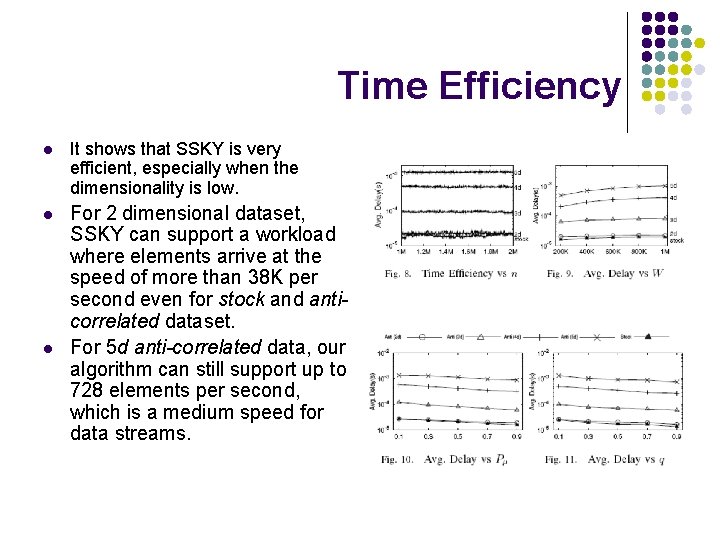
Time Efficiency l It shows that SSKY is very efficient, especially when the dimensionality is low. l For 2 dimensional dataset, SSKY can support a workload where elements arrive at the speed of more than 38 K per second even for stock and anticorrelated dataset. For 5 d anti-correlated data, our algorithm can still support up to 728 elements per second, which is a medium speed for data streams. l

Q&A Thanks
- Slides: 24