
Probabilistic Robotics Probability Theory Basics Error Propagation Slides
Probabilistic Robotics Probability Theory Basics Error Propagation Slides from Autonomous Robots (Siegwart and Nourbaksh), Chapter 5 Probabilistic Robotics (S. Thurn et al. ), Jana Kosecka
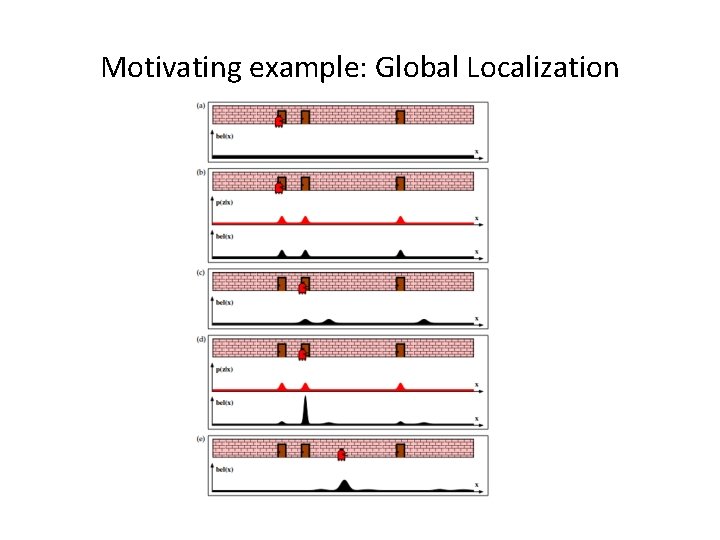
Motivating example: Global Localization

Probabilistic Robotics Key idea: Explicit representation of uncertainty using the calculus of probability theory – Perception – Action = state estimation = utility optimization 4
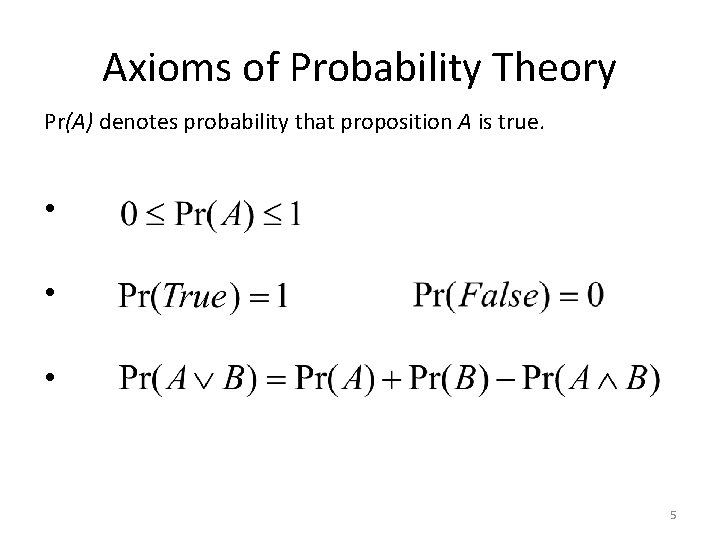
Axioms of Probability Theory Pr(A) denotes probability that proposition A is true. • • • 5
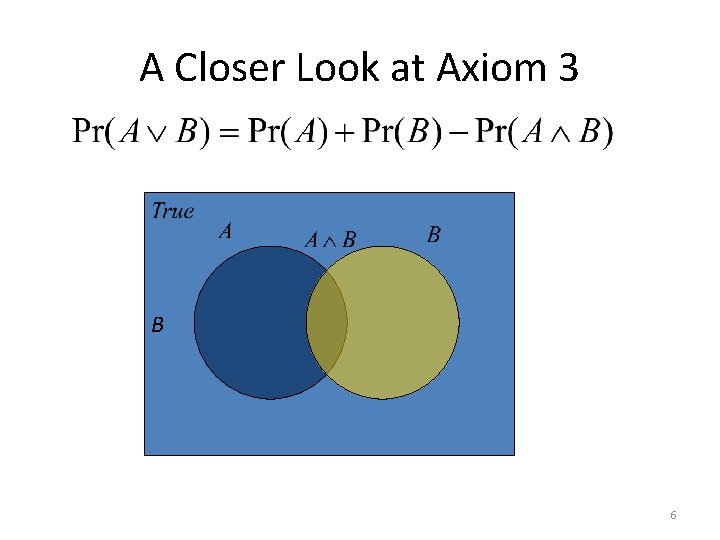
A Closer Look at Axiom 3 B 6
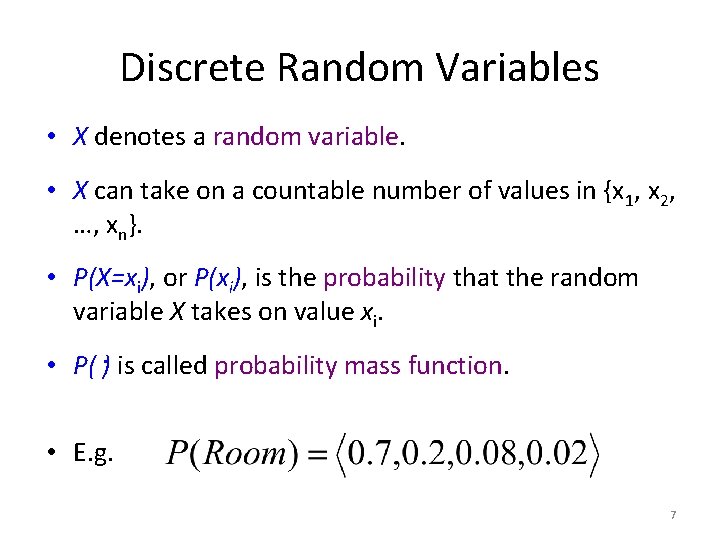
Discrete Random Variables • X denotes a random variable. • X can take on a countable number of values in {x 1, x 2, …, xn}. • P(X=xi), or P(xi), is the probability that the random variable X takes on value xi. • P( ). is called probability mass function. • E. g. 7
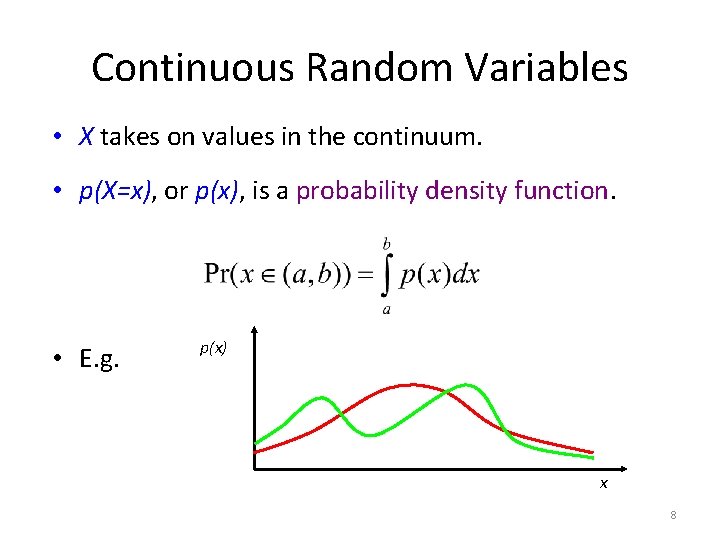
Continuous Random Variables • X takes on values in the continuum. • p(X=x), or p(x), is a probability density function. • E. g. p(x) x 8
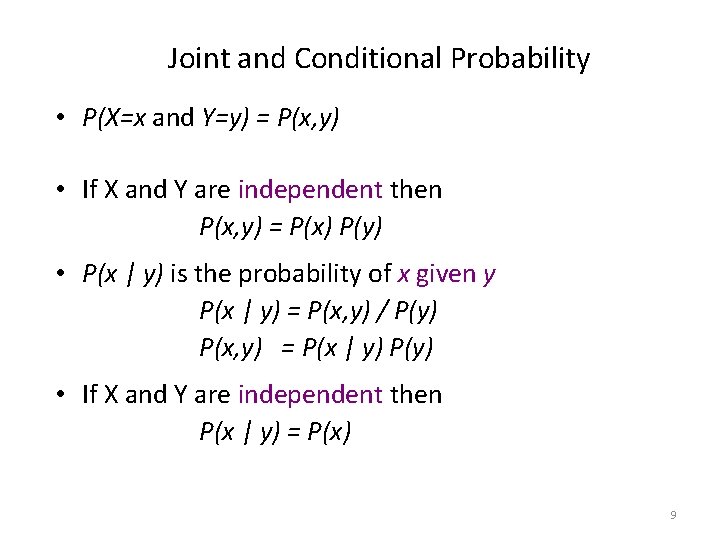
Joint and Conditional Probability • P(X=x and Y=y) = P(x, y) • If X and Y are independent then P(x, y) = P(x) P(y) • P(x | y) is the probability of x given y P(x | y) = P(x, y) / P(y) P(x, y) = P(x | y) P(y) • If X and Y are independent then P(x | y) = P(x) 9
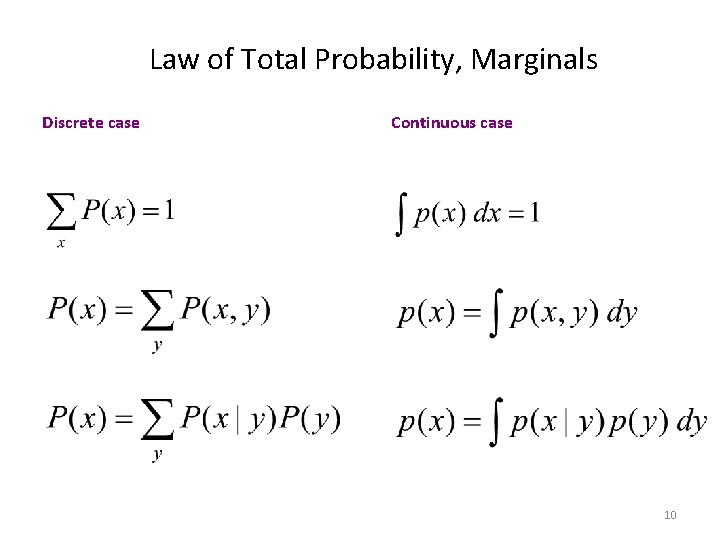
Law of Total Probability, Marginals Discrete case Continuous case 10
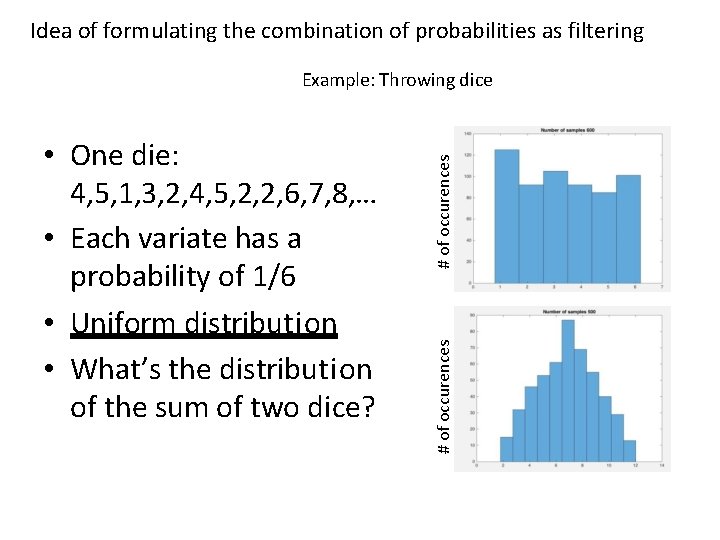
Idea of formulating the combination of probabilities as filtering # of occurences • One die: 4, 5, 1, 3, 2, 4, 5, 2, 2, 6, 7, 8, … • Each variate has a probability of 1/6 • Uniform distribution • What’s the distribution of the sum of two dice? # of occurences Example: Throwing dice

Example Sum of two probability distributions The distribution of the sum of two random variables is the convolution of their distributions.
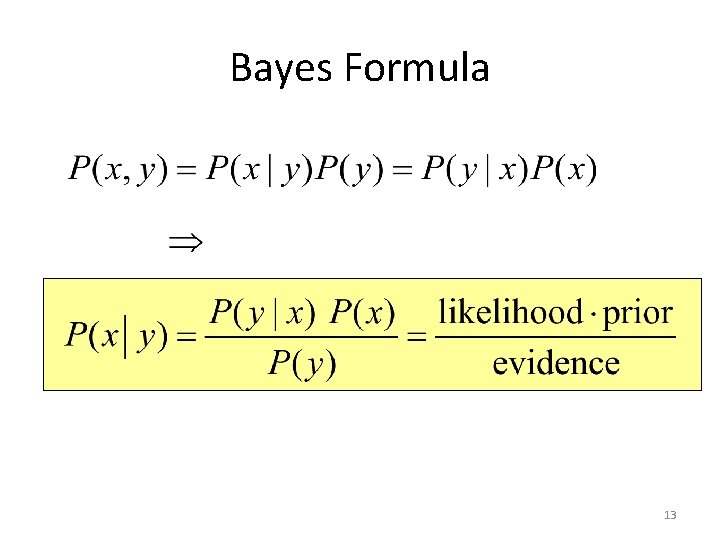
Bayes Formula 13
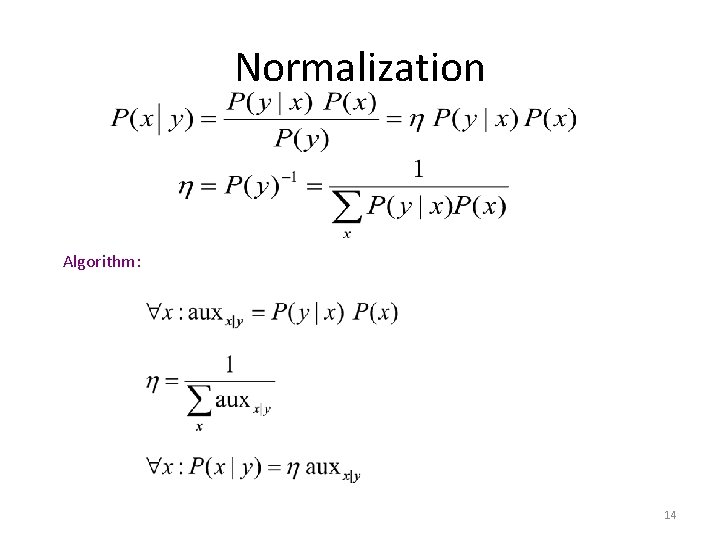
Normalization Algorithm: 14

• Law of total probability: 15
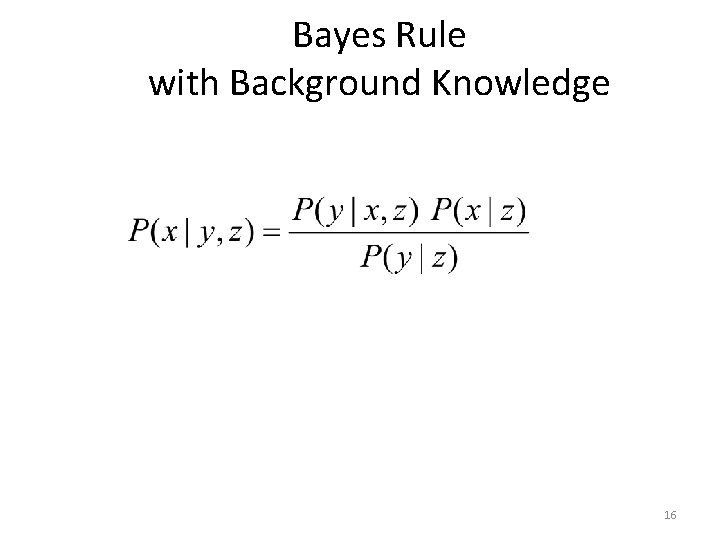
Bayes Rule with Background Knowledge 16
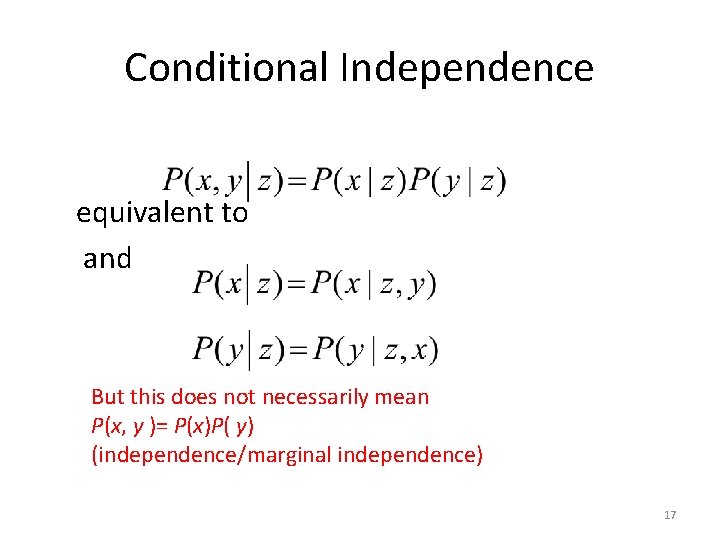
Conditional Independence equivalent to and But this does not necessarily mean P(x, y )= P(x)P( y) (independence/marginal independence) 17
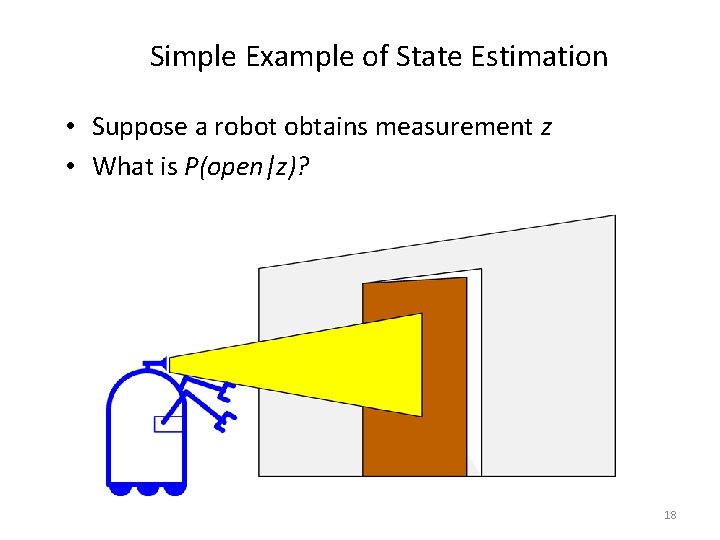
Simple Example of State Estimation • Suppose a robot obtains measurement z • What is P(open|z)? 18
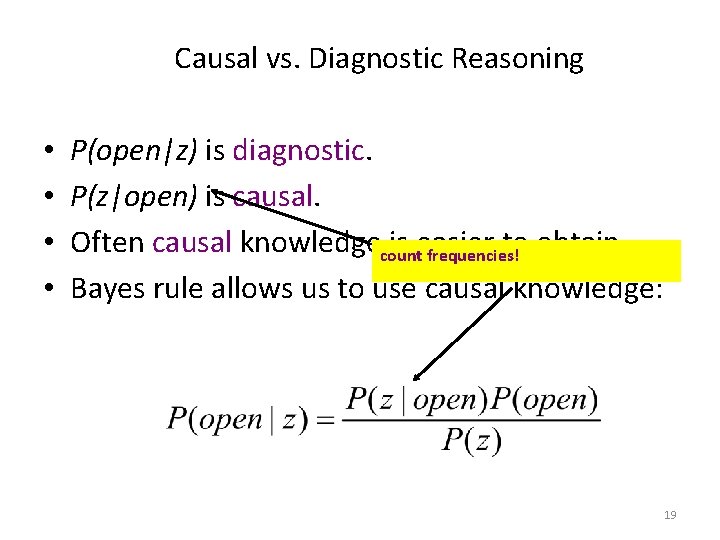
Causal vs. Diagnostic Reasoning • • P(open|z) is diagnostic. P(z|open) is causal. Often causal knowledgecount is easier to obtain. frequencies! Bayes rule allows us to use causal knowledge: 19
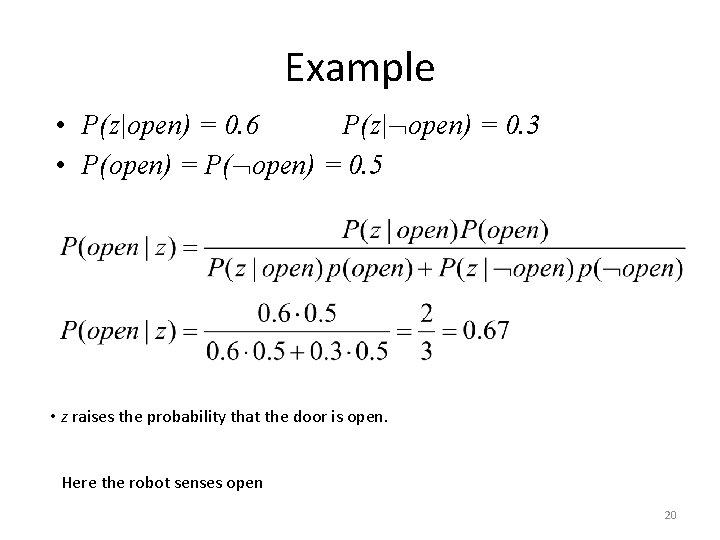
Example • P(z|open) = 0. 6 P(z| open) = 0. 3 • P(open) = P( open) = 0. 5 • z raises the probability that the door is open. Here the robot senses open 20
Combining Evidence • Suppose our robot obtains another observation z 2. • How can we integrate this new information? • More generally, how can we estimate P(x| z 1. . . zn )? 21
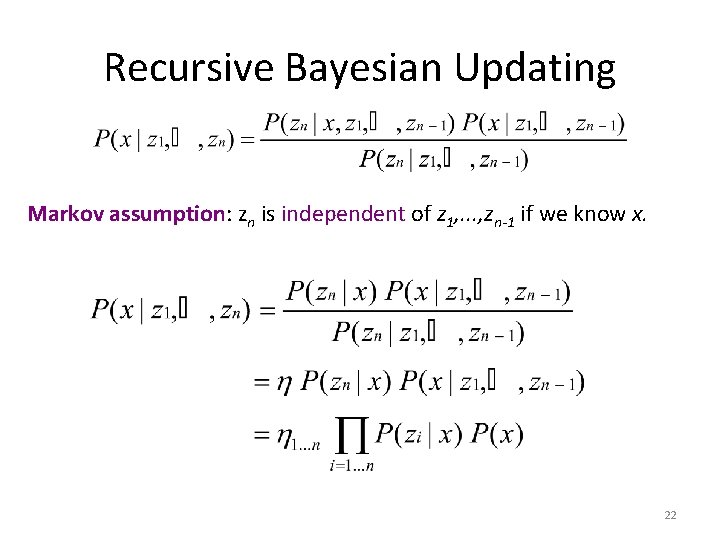
Recursive Bayesian Updating Markov assumption: zn is independent of z 1, . . . , zn-1 if we know x. 22
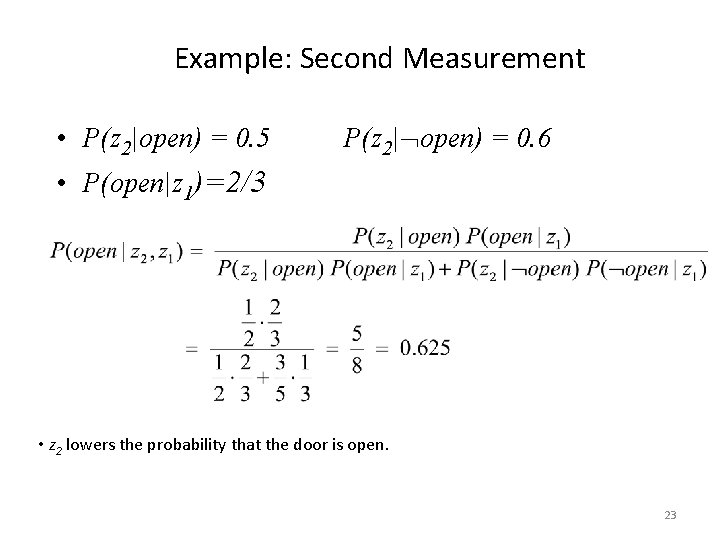
Example: Second Measurement • P(z 2|open) = 0. 5 P(z 2| open) = 0. 6 • P(open|z 1)=2/3 • z 2 lowers the probability that the door is open. 23
Actions • Often the world is dynamic since – actions carried out by the robot, – actions carried out by other agents, – or just the time passing by change the world. • How can we incorporate such actions? 24
Typical Actions • The robot turns its wheels to move • The robot uses its manipulator to grasp an object • Plants grow over time… • Actions are never carried out with absolute certainty. • In contrast to measurements, actions generally increase the uncertainty. 25
Modeling Actions • To incorporate the outcome of an action u into the current “belief”, we use the conditional pdf P(x|u, x’) • This term specifies the pdf that executing u changes the state from x’ to x. 26
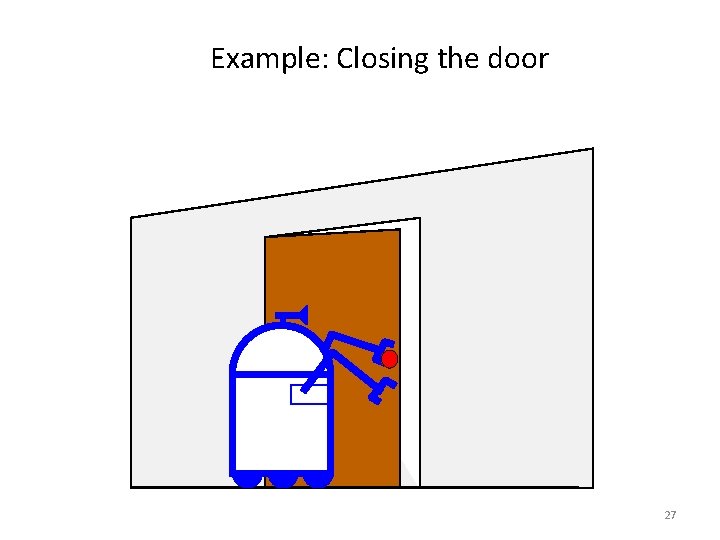
Example: Closing the door 27
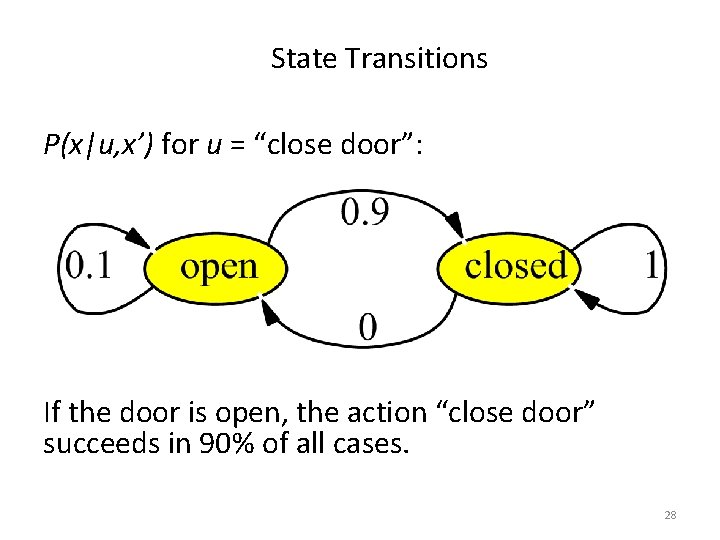
State Transitions P(x|u, x’) for u = “close door”: If the door is open, the action “close door” succeeds in 90% of all cases. 28
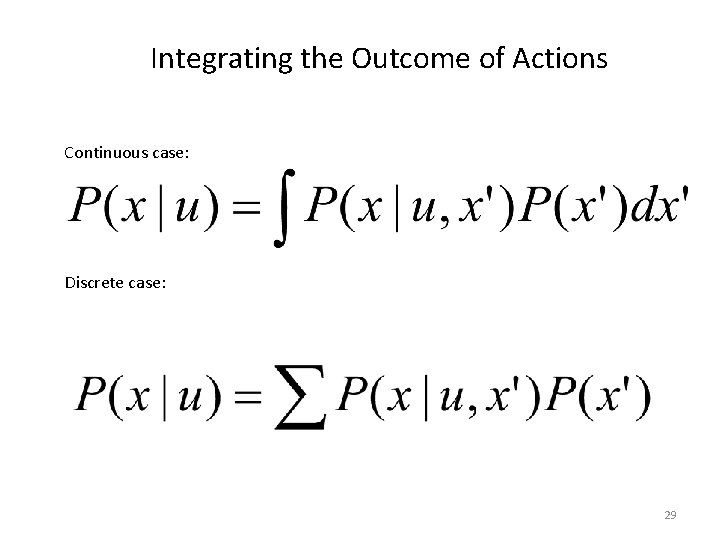
Integrating the Outcome of Actions Continuous case: Discrete case: 29
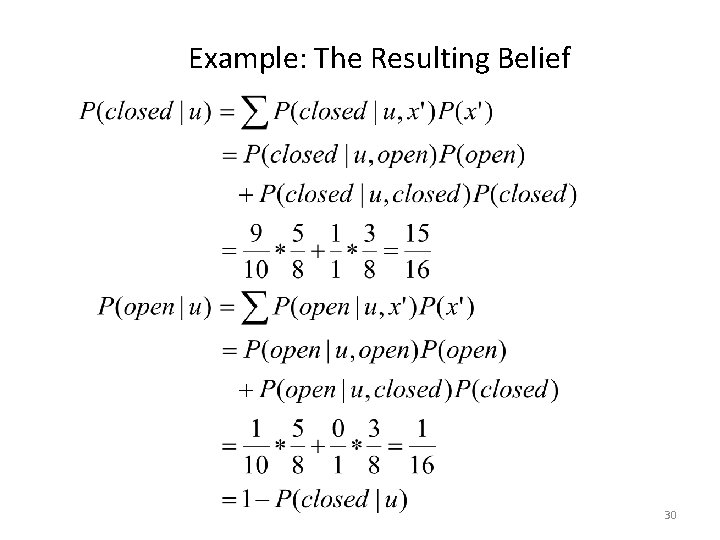
Example: The Resulting Belief 30
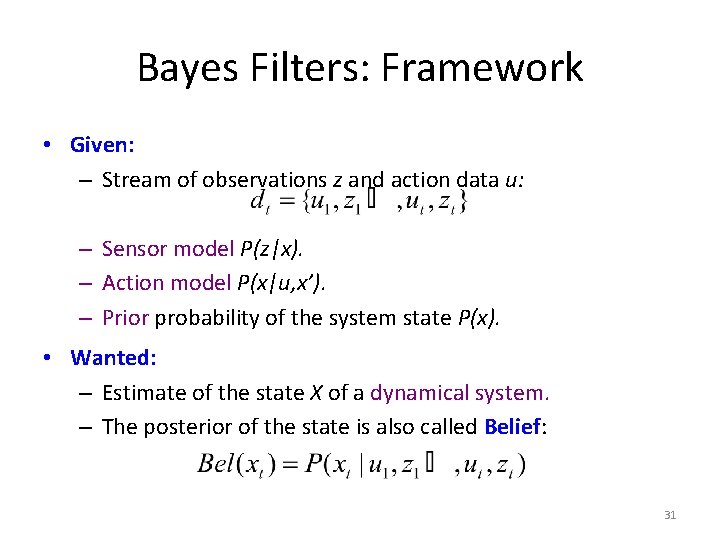
Bayes Filters: Framework • Given: – Stream of observations z and action data u: – Sensor model P(z|x). – Action model P(x|u, x’). – Prior probability of the system state P(x). • Wanted: – Estimate of the state X of a dynamical system. – The posterior of the state is also called Belief: 31
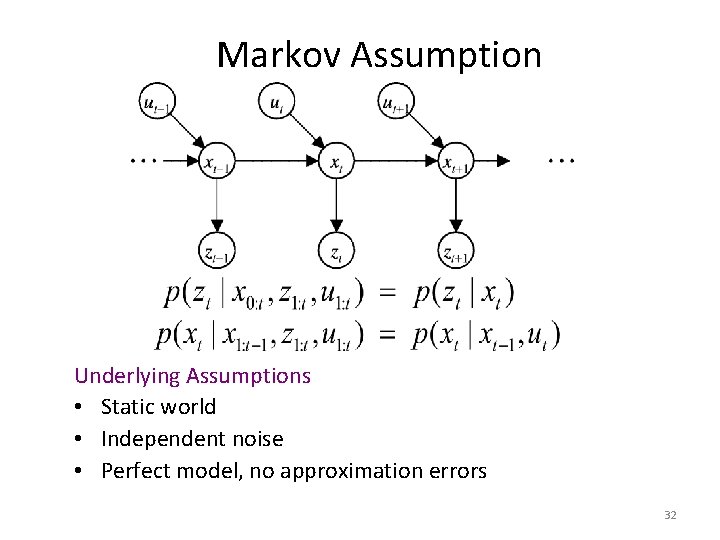
Markov Assumption Underlying Assumptions • Static world • Independent noise • Perfect model, no approximation errors 32
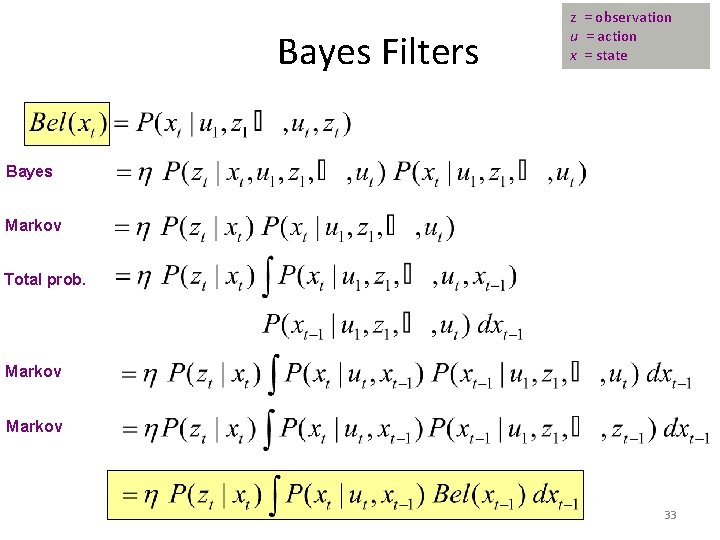
Bayes Filters z = observation u = action x = state Bayes Markov Total prob. Markov 33
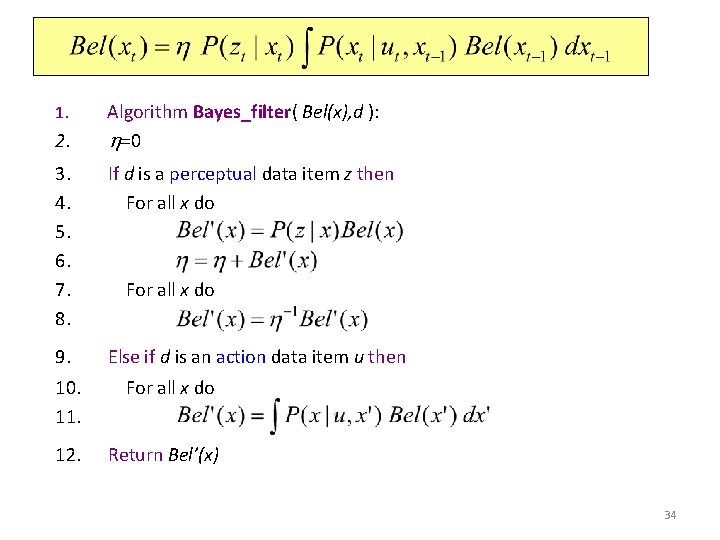
Bayes Filter Algorithm 1. 2. Algorithm Bayes_filter( Bel(x), d ): h=0 3. 4. 5. 6. 7. 8. If d is a perceptual data item z then For all x do 9. Else if d is an action data item u then For all x do 10. 11. For all x do 12. Return Bel’(x) 34
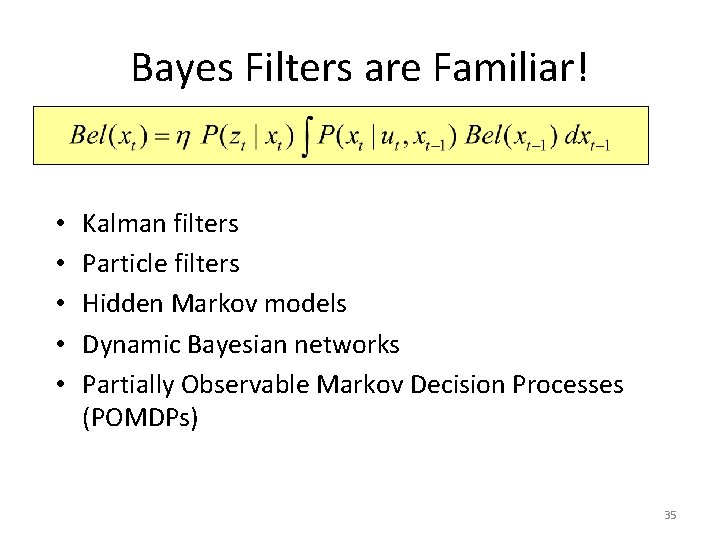
Bayes Filters are Familiar! • • • Kalman filters Particle filters Hidden Markov models Dynamic Bayesian networks Partially Observable Markov Decision Processes (POMDPs) 35
Summary • Bayes rule allows us to compute probabilities that are hard to assess otherwise. • Under the Markov assumption, recursive Bayesian updating can be used to efficiently combine evidence. • Bayes filters are a probabilistic tool for estimating the state of dynamic systems. 36
- Slides: 35