
Probabilistic Inference Modulo Theories Rodrigo de Salvo Braz
Probabilistic Inference Modulo Theories Rodrigo de Salvo Braz Artificial Intelligence Center - SRI International joint work with Ciaran O’Reilly Artificial Intelligence Center - SRI International Vibhav Gogate University of Texas at Dallas Rina Dechter University of California, Irvine Probabilistic Programming for Advanced Machine Learning Hybrid Reasoning Workshop – IJCAI 2015 - July 26, 2015
Outline • Two extremes: logic and probabilistic inference • Probabilistic inference in Graphical Models – – Factorized joint probability distribution Marginalization Variable elimination Mainstream probabilistic inference representation • Logic Inference – – Theories Inference: satisfiability DPLL(T) • Symbolic Generalized DPLL Modulo Theories (SGDPLL(T)) • Experiments • Conclusion
Two extremes: logic and probabilistic inference • Logic – Initial mainstream approach to AI: represent knowledge declaratively, have a system using it – Can use rich theories: data structures, numeric constraints, functions – Basic logic does not offer treatment for uncertain knowledge • Probabilistic Inference – Follows the idea of representing knowledge declaratively and having a system use it – Very good treatment of uncertainty – Poor representation, equivalent to discrete variables with equality, lacking interpreted functions (data structures, arithmetic) and even uninterpreted non-nullary functions (friends(X, Y)) – Way to use such constructs is to ground them into tables or formulas
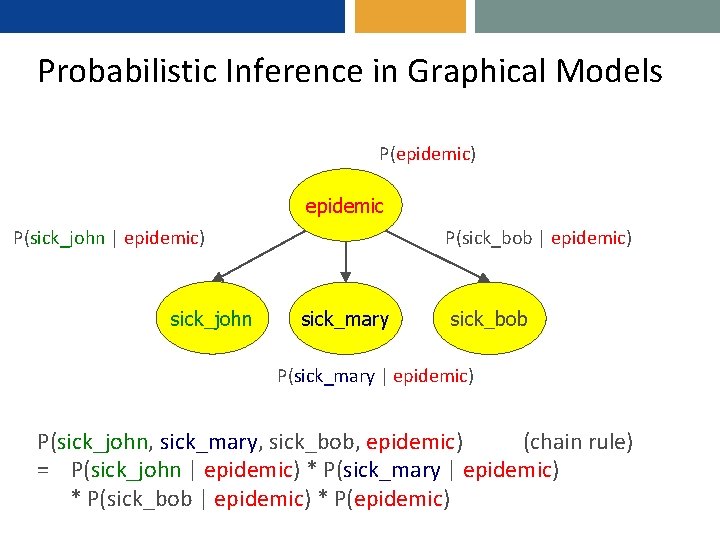
Probabilistic Inference in Graphical Models P(epidemic) epidemic P(sick_john | epidemic) sick_john P(sick_bob | epidemic) sick_mary sick_bob P(sick_mary | epidemic) P(sick_john, sick_mary, sick_bob, epidemic) (chain rule) = P(sick_john | epidemic) * P(sick_mary | epidemic) * P(sick_bob | epidemic) * P(epidemic)
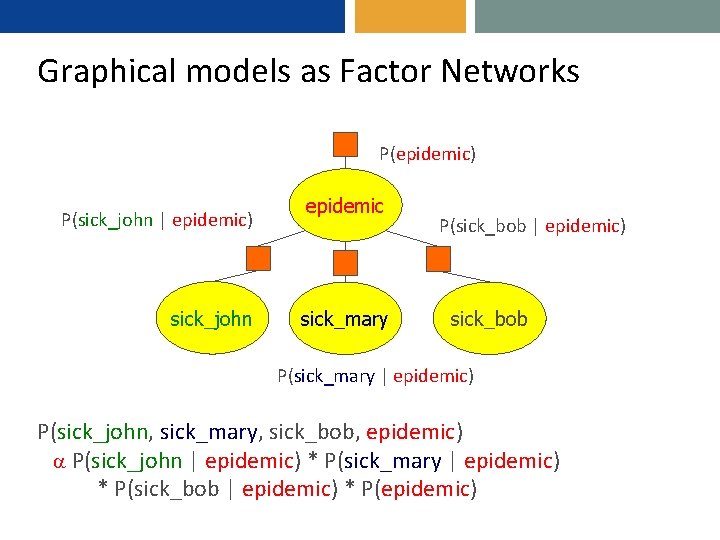
Graphical models as Factor Networks P(epidemic) P(sick_john | epidemic) sick_john epidemic sick_mary P(sick_bob | epidemic) sick_bob P(sick_mary | epidemic) P(sick_john, sick_mary, sick_bob, epidemic) P(sick_john | epidemic) * P(sick_mary | epidemic) * P(sick_bob | epidemic) * P(epidemic)
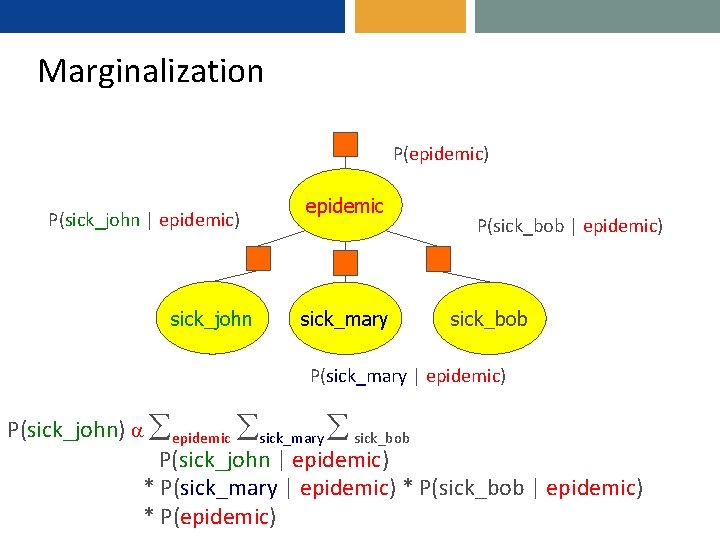
Marginalization P(epidemic) P(sick_john | epidemic) sick_john epidemic sick_mary P(sick_bob | epidemic) sick_bob P(sick_mary | epidemic) P(sick_john) epidemic sick_mary sick_bob P(sick_john | epidemic) * P(sick_mary | epidemic) * P(sick_bob | epidemic) * P(epidemic)
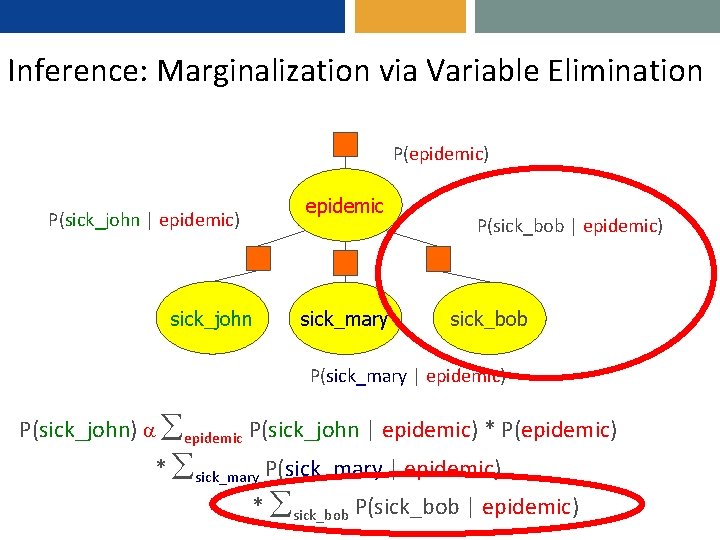
Inference: Marginalization via Variable Elimination P(epidemic) P(sick_john | epidemic) sick_john epidemic sick_mary P(sick_bob | epidemic) sick_bob P(sick_mary | epidemic) P(sick_john) epidemic P(sick_john | epidemic) * P(epidemic) * sick_mary P(sick_mary | epidemic) * sick_bob P(sick_bob | epidemic)
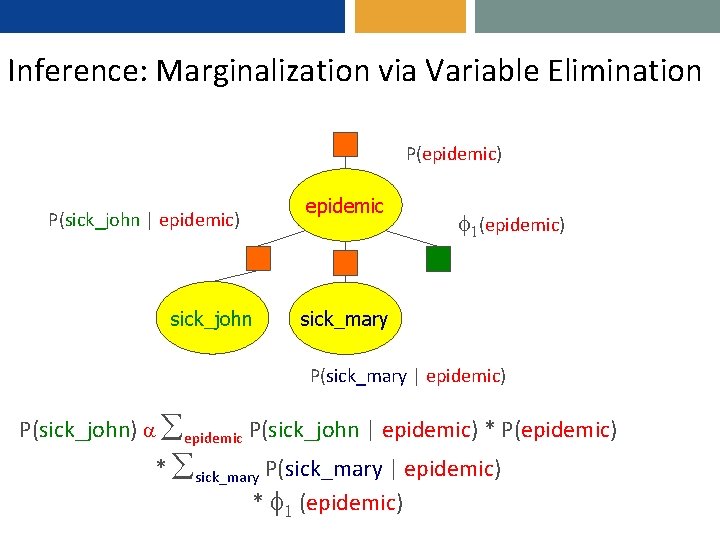
Inference: Marginalization via Variable Elimination P(epidemic) P(sick_john | epidemic) sick_john epidemic 1(epidemic) sick_mary P(sick_mary | epidemic) P(sick_john) epidemic P(sick_john | epidemic) * P(epidemic) * sick_mary P(sick_mary | epidemic) * 1 (epidemic)
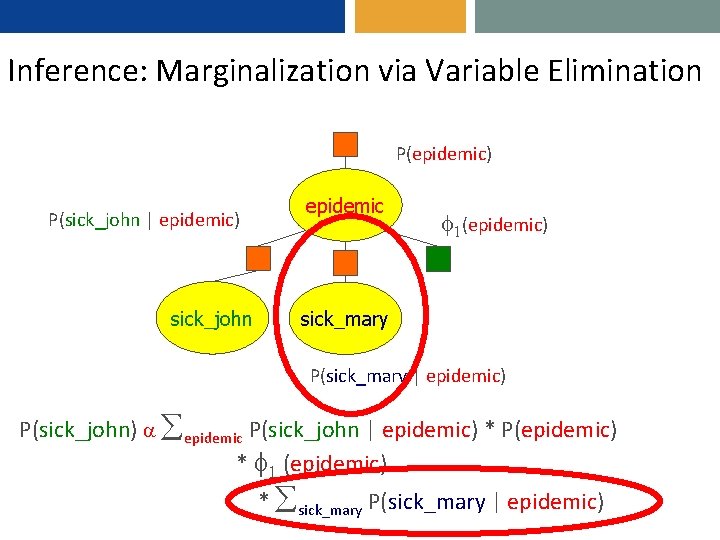
Inference: Marginalization via Variable Elimination P(epidemic) P(sick_john | epidemic) sick_john epidemic 1(epidemic) sick_mary P(sick_mary | epidemic) P(sick_john) epidemic P(sick_john | epidemic) * P(epidemic) * 1 (epidemic) * sick_mary P(sick_mary | epidemic)
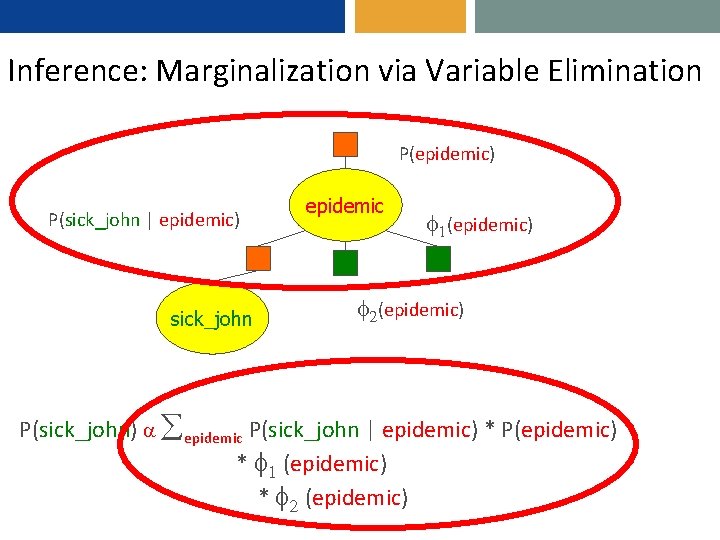
Inference: Marginalization via Variable Elimination P(epidemic) P(sick_john | epidemic) sick_john epidemic 1(epidemic) 2(epidemic) P(sick_john) epidemic P(sick_john | epidemic) * P(epidemic) * 1 (epidemic) * 2 (epidemic)
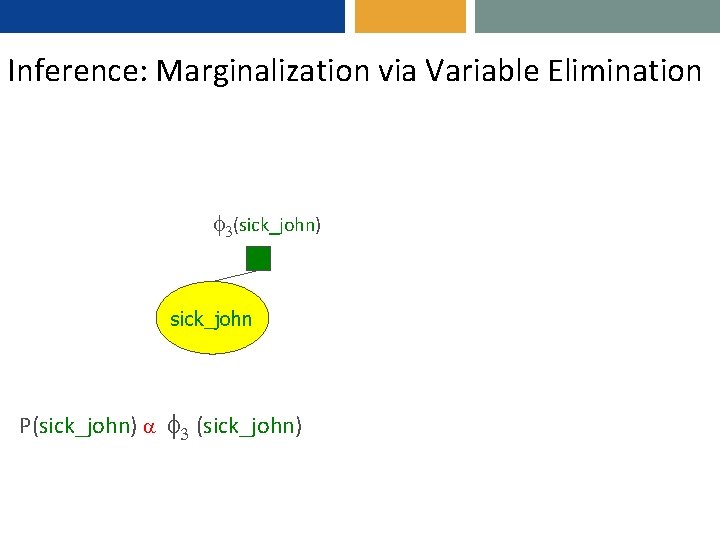
Inference: Marginalization via Variable Elimination 3(sick_john) sick_john P(sick_john) 3 (sick_john)
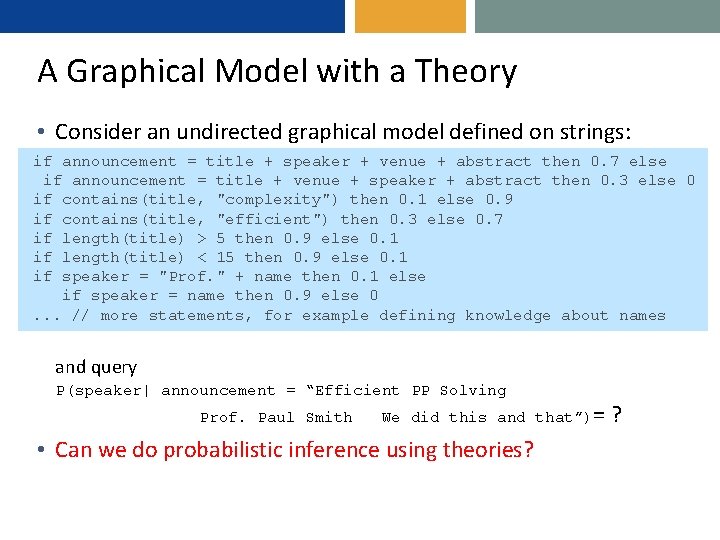
A Graphical Model with a Theory • Consider an undirected graphical model defined on strings: if announcement = title + speaker + venue + abstract then 0. 7 else if announcement = title + venue + speaker + abstract then 0. 3 else 0 if contains(title, "complexity") then 0. 1 else 0. 9 if contains(title, "efficient") then 0. 3 else 0. 7 if length(title) > 5 then 0. 9 else 0. 1 if length(title) < 15 then 0. 9 else 0. 1 if speaker = "Prof. " + name then 0. 1 else if speaker = name then 0. 9 else 0. . . // more statements, for example defining knowledge about names and query P(speaker| announcement = “Efficient PP Solving Prof. Paul Smith We did this and that”)= ? • Can we do probabilistic inference using theories?
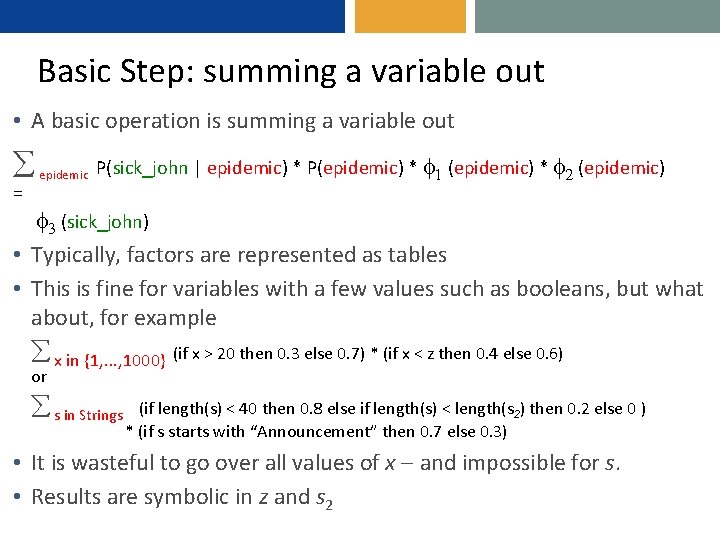
Basic Step: summing a variable out • A basic operation is summing a variable out epidemic P(sick_john | epidemic) * P(epidemic) * 1 (epidemic) * 2 (epidemic) = 3 (sick_john) • Typically, factors are represented as tables • This is fine for variables with a few values such as booleans, but what about, for example x in {1, . . . , 1000} (if x > 20 then 0. 3 else 0. 7) * (if x < z then 0. 4 else 0. 6) or s in Strings (if length(s) < 40 then 0. 8 else if length(s) < length(s 2) then 0. 2 else 0 ) * (if s starts with “Announcement” then 0. 7 else 0. 3) • It is wasteful to go over all values of x and impossible for s. • Results are symbolic in z and s 2
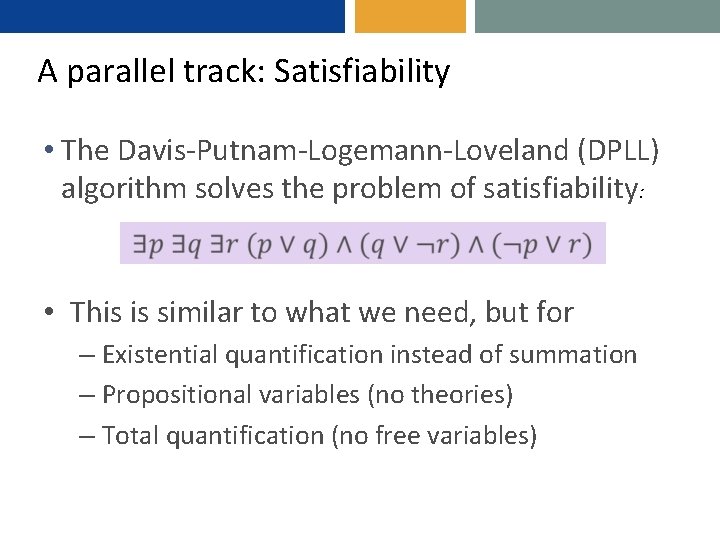
A parallel track: Satisfiability • The Davis-Putnam-Logemann-Loveland (DPLL) algorithm solves the problem of satisfiability: • This is similar to what we need, but for – Existential quantification instead of summation – Propositional variables (no theories) – Total quantification (no free variables)
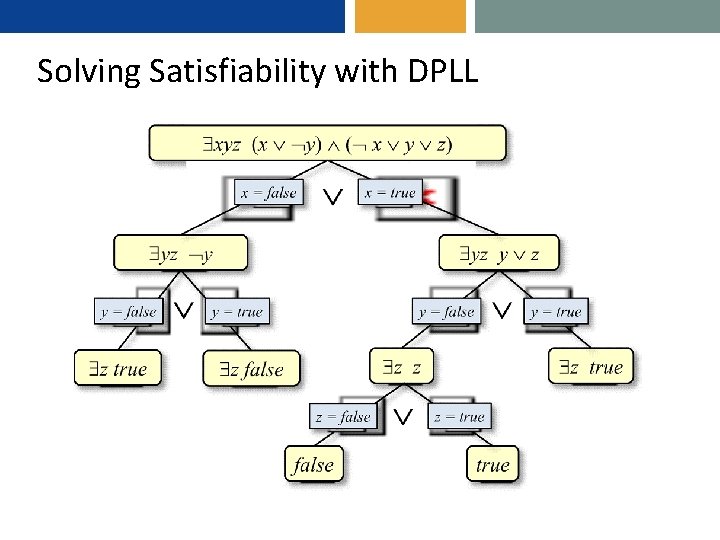
Solving Satisfiability with DPLL
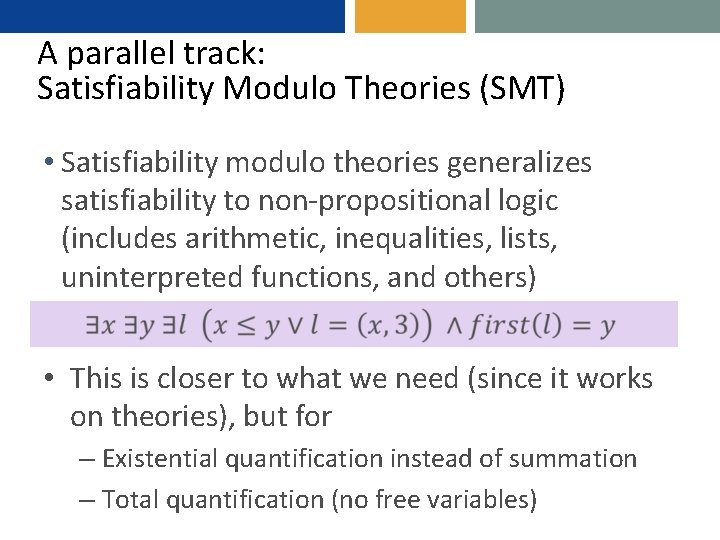
A parallel track: Satisfiability Modulo Theories (SMT) • Satisfiability modulo theories generalizes satisfiability to non-propositional logic (includes arithmetic, inequalities, lists, uninterpreted functions, and others) • This is closer to what we need (since it works on theories), but for – Existential quantification instead of summation – Total quantification (no free variables)
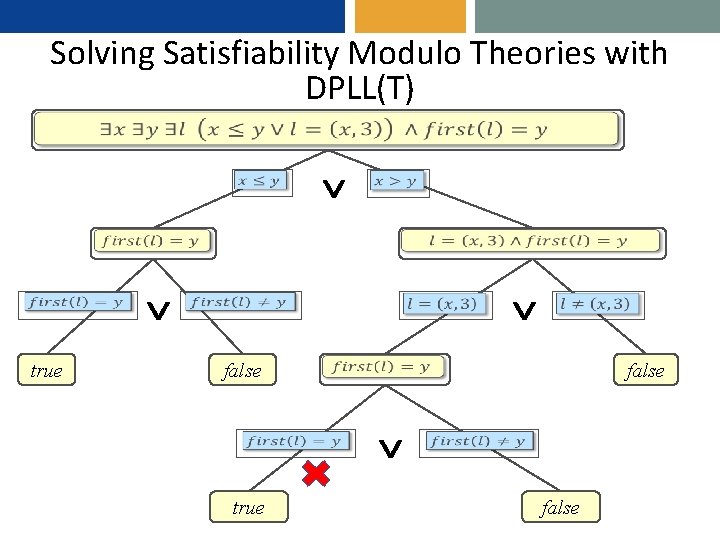
Solving Satisfiability Modulo Theories with DPLL(T) true false
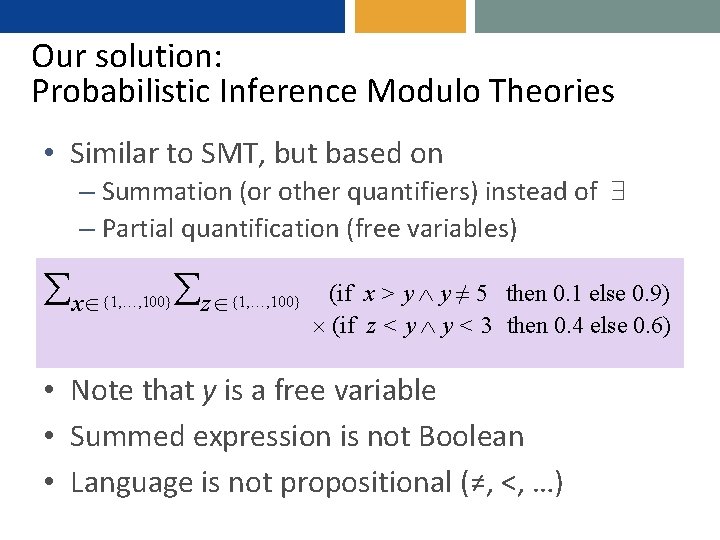
Our solution: Probabilistic Inference Modulo Theories • Similar to SMT, but based on – Summation (or other quantifiers) instead of – Partial quantification (free variables) x {1, …, 100} z {1, …, 100} (if x > y y ≠ 5 then 0. 1 else 0. 9) (if z < y y < 3 then 0. 4 else 0. 6) • Note that y is a free variable • Summed expression is not Boolean • Language is not propositional (≠, <, …)

Probabilistic Inference Modulo Theories (SGDPLL(T)) x {1, …, 100} z {1, …, 100} [ (if x > y y ≠ 5 then 0. 1 else 0. 9) (if z < y y < 3 then 0. 4 else 0. 6) ] + x>y x z : x>y if y ≠ 5 then x z : x z (if y ≠ 5 then 0. 1 else 0. 9) (if z < y y < 3 then 0. 4 else 0. 6) else : x≤ y … 0. 1 if z < y y < 3 then 0. 4 else 0. 6 x>y … Condition on literals until base case with no literals in main expression: x z 0. 04 : x>y : z<y = x: y < x ≤ 100 z: 1 ≤ z<y = x: y < x ≤ 100 (y – 1) 0. 04 = (100 – y) (y – 1) 0. 04 = – 0. 04 y 2 + 4. 04 y – 4 0. 04 x≤y 0. 9 (if z < y y < 3 then 0. 4 else 0. 6) … + …

Probabilistic Inference Modulo Theories (SGDPLL(T)) x {1, …, 100} z {1, …, 100} [ (if x > y y ≠ 5 then 0. 1 else 0. 9) (if z < y y < 3 then 0. 4 else 0. 6) ] x>y x z : x>y (if y ≠ 5 then 0. 1 else 0. 9) (if z < y y < 3 then 0. 4 else 0. 6) if y ≠ 5 then x z : else + x≤y x z : x≤ y 0. 9 (if z < y y < 3 then 0. 4 else 0. 6) … + … … 0. 1 if z < y y < 3 then 0. 4 else 0. 6 x>y … = x: y < x ≤ 100 z: 1 ≤ x z : x>y : z<y 0. 04 z<y = x: y < x ≤ 100 (y – 1) 0. 04 = (100 – y) (y – 1) 0. 04 = – 0. 04 y 2 + 4. 04 y – 4 0. 04 Condition on literals until base case with no literals in main expression
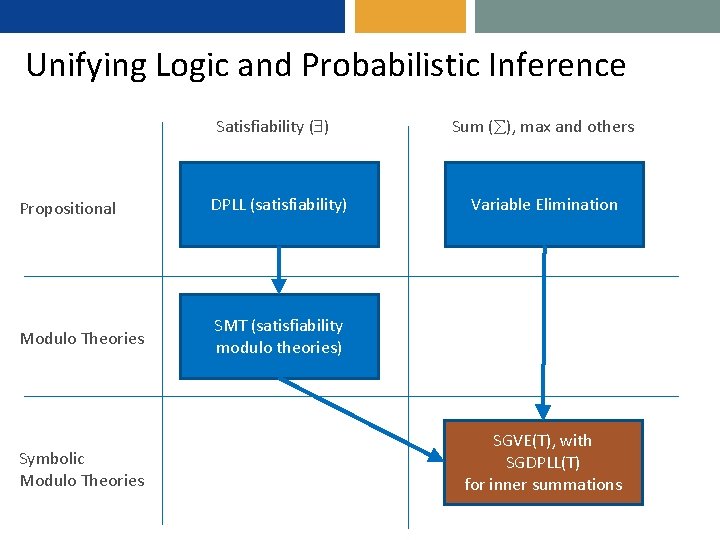
Unifying Logic and Probabilistic Inference Satisfiability ( ) Propositional DPLL (satisfiability) Modulo Theories SMT (satisfiability modulo theories) Symbolic Modulo Theories Sum ( ), max and others Variable Elimination SGVE(T), with SGDPLL(T) for inner summations
Evaluation • Generated random graphical models defined on equalities on bounded integers • Evaluated against VEC (Gogate & Dechter 2011), a state-of-the-art graphical model solver, after grounding into tables with increasing random variable domain sizes • For domain of size 16, our solver was already 20 times faster than VEC.
Final Remarks on SGDPLL(T) • • It is symbolic (S) It is generic (not only Boolean expressions) (G) Can use theories (T) Can re-use SMT techniques – Satisfiability solvers – Modern SAT solver techniques: – Unit propagation and Watched literals – Clause learning • Requires new solvers on theories for base cases (at least as powerful as model counting)

Thanks!
- Slides: 24