
Probabilistic Graphical Models For Text Mining A Topic
Probabilistic Graphical Models For Text Mining: A Topic Modeling Survey V. Jelisavčić*, B. Furlan **, J. Protić**, V. Milutinović** * Mathematical Institute of the Serbian Academy of Sciences and Arts/11000, Belgrade, Serbia ** Department of Computer Engineering, School of Electrical Engineering, University of Belgrade/11000, Belgrade, Serbia vladisavj@mi. sanu. ac. rs, {bojan. furlan, jeca, vm}@etf. rs vladisav@mi. sanu. ac. rs {bojan. furlan, jeca, vm}@etf. rs 1/42
Summary • Introduction to topic models • Theoretical introduction – Probabilistic graphical models: basics – Inference in graphical models – Finding topics with PGM • Classification of topic models – Classification method – Examples and applications • Conclusion and ideas for future research vladisav@mi. sanu. ac. rs {bojan. furlan, jeca, vm}@etf. rs 2/42
Introduction to topic models • How do we define “topic”? – Group of words that frequently co-occur together – Context – Semantics? • Why modeling topics? – Soft clustering of text – Similar documents -> similar topics – Machine learning from text: where to start? • What features to use? • Dimensionality of a million (or billion) words corpus • How to use additional features alongside pure text vladisav@mi. sanu. ac. rs {bojan. furlan, jeca, vm}@etf. rs 3/42
Introduction to topic models • How to deal with uncertainty in natural language: – Probabilistic approach • Comparison with language models: – Short distance vs long distance dependence – Local vs Global – Sequence vs Bag vladisav@mi. sanu. ac. rs {bojan. furlan, jeca, vm}@etf. rs 4/42
Introduction to topic models • Topic modeling in a nutshell: Text + (PG Model + Inference algorithm) -> Topics vladisav@mi. sanu. ac. rs {bojan. furlan, jeca, vm}@etf. rs 5/42
Probabilistic graphical models: basics • Modeling the problem: Start with the variable space • Uncertainty through probability • Basic elements: – Observed variables – Latent variables – Priors – Parameters vladisav@mi. sanu. ac. rs {bojan. furlan, jeca, vm}@etf. rs 6/42
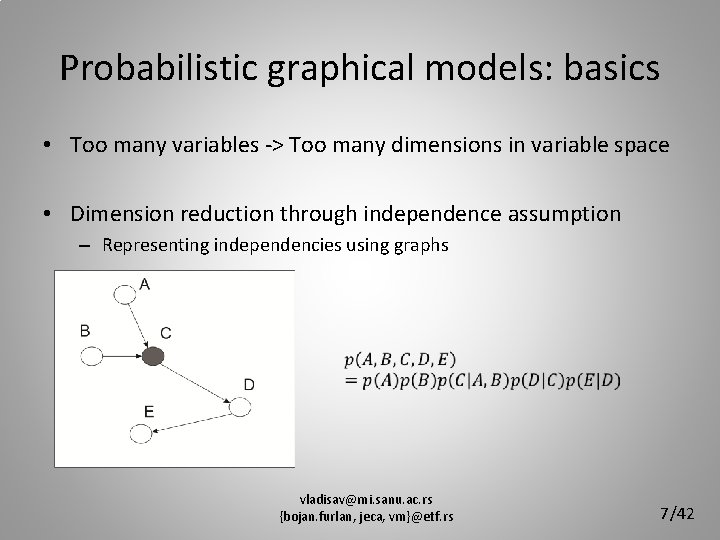
Probabilistic graphical models: basics • Too many variables -> Too many dimensions in variable space • Dimension reduction through independence assumption – Representing independencies using graphs vladisav@mi. sanu. ac. rs {bojan. furlan, jeca, vm}@etf. rs 7/42
Probabilistic graphical models: basics • Marginal & Conditional independence: knowing the difference • Goals: – Learn full probability distribution from observed data – Find marginal distribution over some subset of variables – Find most likely value of a specific variable vladisav@mi. sanu. ac. rs {bojan. furlan, jeca, vm}@etf. rs 8/42
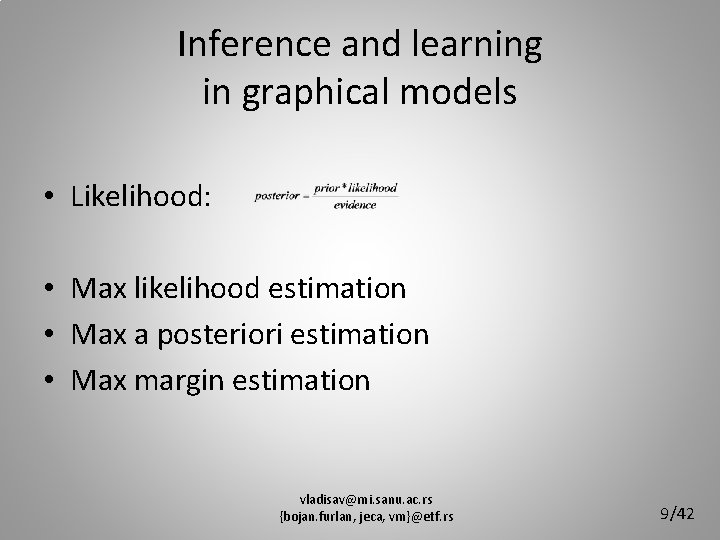
Inference and learning in graphical models • Likelihood: • Max likelihood estimation • Max a posteriori estimation • Max margin estimation vladisav@mi. sanu. ac. rs {bojan. furlan, jeca, vm}@etf. rs 9/42
Inference and learning in graphical models • Goal: Learn the value of the latent variables using the given data (observed variables): – What are the most probable values of latent variables? Values with highest likelihood given the evidence! – Going step further (full bayesian approach): What are the most probable distributions of lat. var. ? Use prior distributions! vladisav@mi. sanu. ac. rs {bojan. furlan, jeca, vm}@etf. rs 10/42
Inference and learning in graphical models • If there are no latent variables, learning is simple – Likelihood is concave function, finding max is trivial • If there are latent variable, things tend to get more complicated – Sometimes learning is intractable • To calculate the normalizing const for the likelihood, sum (or integration) over all possible values must be done – Approximation algorithms are required vladisav@mi. sanu. ac. rs {bojan. furlan, jeca, vm}@etf. rs 11/42
Inference and learning in graphical models • • Expectation Maximization Markov Chain Monte Carlo (Gibbs sampling) Variational Inference Kalman Filtering vladisav@mi. sanu. ac. rs {bojan. furlan, jeca, vm}@etf. rs 12/42
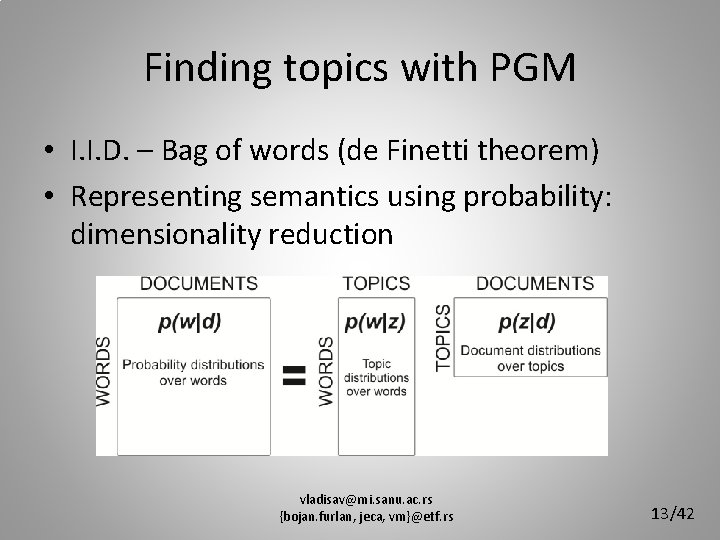
Finding topics with PGM • I. I. D. – Bag of words (de Finetti theorem) • Representing semantics using probability: dimensionality reduction vladisav@mi. sanu. ac. rs {bojan. furlan, jeca, vm}@etf. rs 13/42
Finding topics with PGM • Variables: documents, words, topics – Observed: words, documents – Latent: topics, topic assignment to words • Documents contain words • Topics are sets of words that frequently co-occur together (context) vladisav@mi. sanu. ac. rs {bojan. furlan, jeca, vm}@etf. rs 14/42
Finding topics with PGM • Soft clustering: – Documents contain multiple topics – Each topic can be found in multiple documents Þ Each document has its own distribution over topics – Topics contain multiple word types – Each word type can be found in multiple topics (with different probability) Þ Each topic has its own distribution over word types vladisav@mi. sanu. ac. rs {bojan. furlan, jeca, vm}@etf. rs 15/42
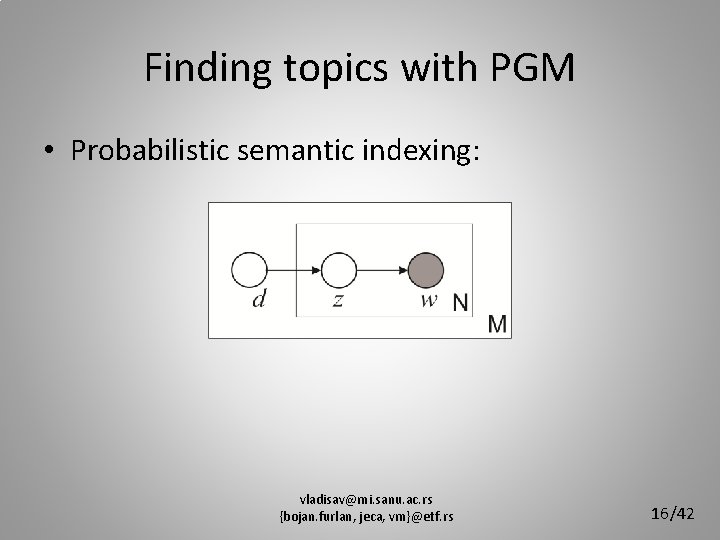
Finding topics with PGM • Probabilistic semantic indexing: vladisav@mi. sanu. ac. rs {bojan. furlan, jeca, vm}@etf. rs 16/42
Finding topics with PGM • Soft clustering: – Documents contain multiple topics – Each topic can be found in multiple documents Þ Each document has its own distribution over topics – Topics contain multiple word types – Each word type can be found in multiple topics (with different prob. ) Þ Each topic has its own distribution over word types • Number of parameters to learn should be independent of the total document number – Avoid overfitting – Solution: using priors! • Each word token in document comes from a specific topic Þ Each word token should have its own topic identifier assigned vladisav@mi. sanu. ac. rs {bojan. furlan, jeca, vm}@etf. rs 17/42
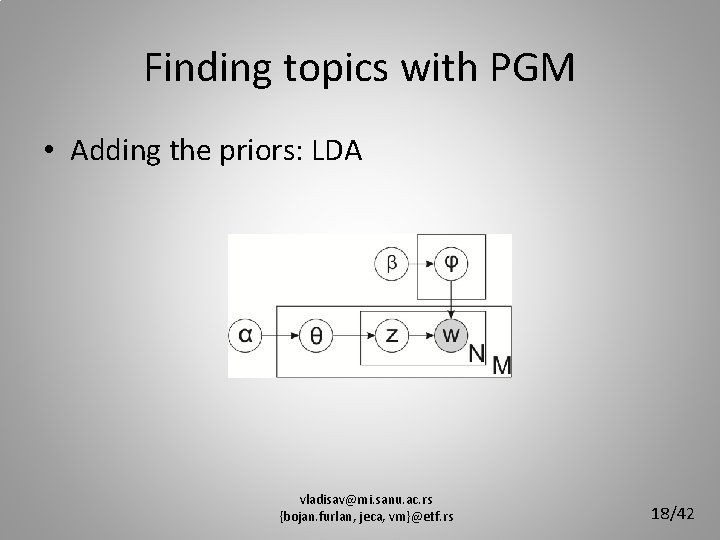
Finding topics with PGM • Adding the priors: LDA vladisav@mi. sanu. ac. rs {bojan. furlan, jeca, vm}@etf. rs 18/42
Finding topics with PGM • Advantages of using PGMs: – Extendable • Add more features to the model easily • Use different prior distributions • Incorporate other forms of knowledge alongside text – Modular • Lessons learned in one model can easily be adopted by the other – Widely applicable • Topics can be used to augment solutions to various existing problems vladisav@mi. sanu. ac. rs {bojan. furlan, jeca, vm}@etf. rs 19/42
Classification • Relaxing the exchangeability assumption: – Document relations • Time • Links – Topic relations • Correlations • Sequence – Word relations • Intra-document (Sequentiality) • Inter-document (Entity recognition) vladisav@mi. sanu. ac. rs {bojan. furlan, jeca, vm}@etf. rs 20/42
Classification • Modeling with additional data: – Document features • Sentiment • Authors – Topic features • Labels – Word features • Concepts vladisav@mi. sanu. ac. rs {bojan. furlan, jeca, vm}@etf. rs 21/42
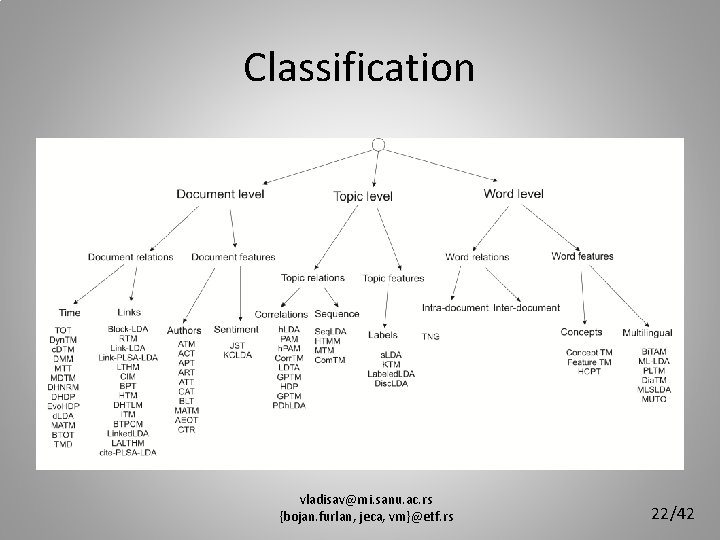
Classification vladisav@mi. sanu. ac. rs {bojan. furlan, jeca, vm}@etf. rs 22/42
Examples and applications: Document relations • In base model (LDA) documents are exchangeable (document exchangeability assumption) • By removing this assumption, we can build more complex model • More complex model -> New (more specific) applications • Two types of document relations: a) Sequential (time) b) Networked (links, citations, references…) vladisav@mi. sanu. ac. rs {bojan. furlan, jeca, vm}@etf. rs 23/42
Examples and applications • Modeling time: topic detection and tracking – Trend detection: What was popular? What will be popular? – Event detection: Something important has happened – Topic tracking: Evolution of a specific topic vladisav@mi. sanu. ac. rs {bojan. furlan, jeca, vm}@etf. rs 24/42
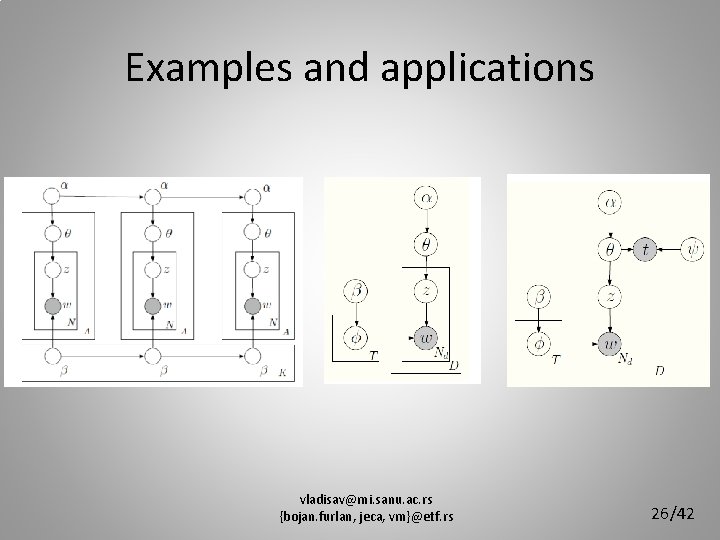
Examples and applications • Modeling time: two approaches – Markov dependency • Short-distance • Dynamic Topic Model – Time as additional feature • Long-distance • Topics-Over-Time vladisav@mi. sanu. ac. rs {bojan. furlan, jeca, vm}@etf. rs 25/42
Examples and applications vladisav@mi. sanu. ac. rs {bojan. furlan, jeca, vm}@etf. rs 26/42
Examples and applications • Modeling document networks: – Web (documents with hyperlinks) – Messages (documents with senders and recipients) – Scientific papers (documents and citations) vladisav@mi. sanu. ac. rs {bojan. furlan, jeca, vm}@etf. rs 27/42
Examples and applications: Topic relations • In base model (LDA) topics are “exchangeable” (topic exchangeability assumption) • By removing this assumption, we can build more complex model • More complex model -> New (more specific) applications • Two types of topic relations: a) Correlations (topic hierarchy, similarity, …) b) Sequence (linear structure of text) vladisav@mi. sanu. ac. rs {bojan. furlan, jeca, vm}@etf. rs 28/42
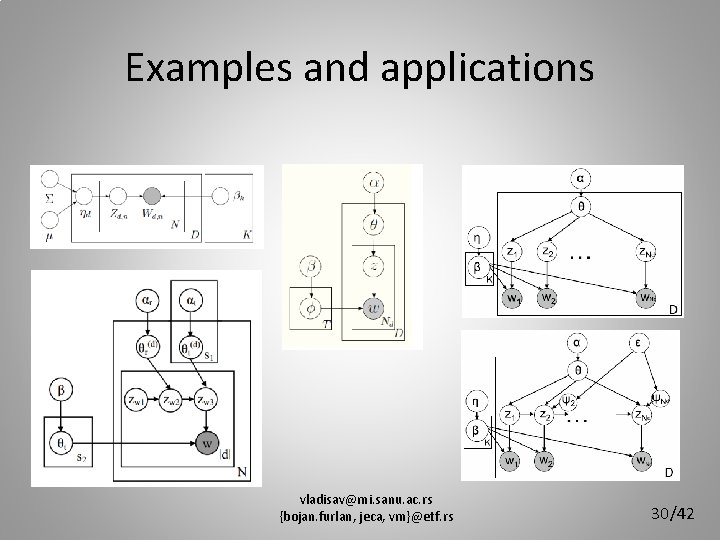
Examples and applications • Topic correlations: – Instead of finding “flat” topic structure: • Topic hierarchy: super-topics and sub-topics • Topic correlation matrix • Arbitrary DAG structure • Topic sequence: – Sequential nature of the human language: • Text is written from beginning to the end • Topics in latter chapters of the text tend to depend on previous • Markov property vladisav@mi. sanu. ac. rs {bojan. furlan, jeca, vm}@etf. rs 29/42
Examples and applications vladisav@mi. sanu. ac. rs {bojan. furlan, jeca, vm}@etf. rs 30/42
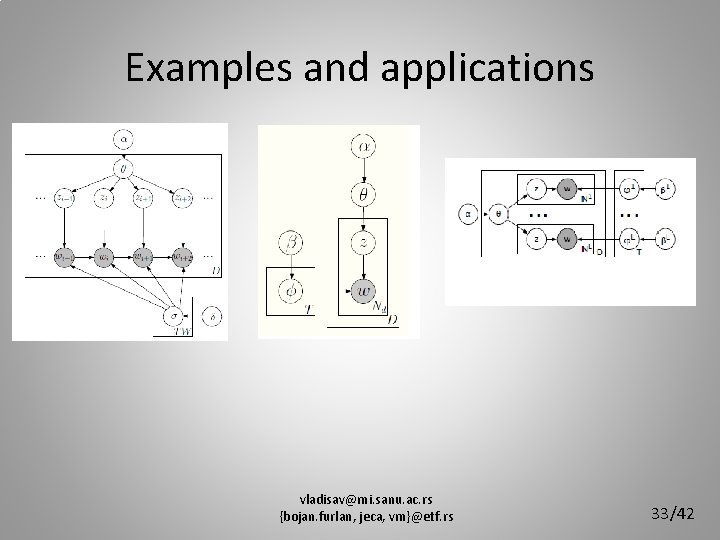
Examples and applications: Word relations • In base model (LDA) words are “exchangeable” (word exchangeability assumption) • By removing this assumption, we can build more complex model • More complex model -> New (more specific) applications • Two types of word relations: a) Intra-document (word sequence) b) Inter-document (entity recognition, multilinguality…) vladisav@mi. sanu. ac. rs {bojan. furlan, jeca, vm}@etf. rs 31/42
Examples and applications • Intra-document word relations: – Sequential nature of text: • Modeling phrases and n-grams • Markov property • Inter-document word relations: – Some words can be treated as special entities • Not sufficiently investigated – Multilingual models • Harnessing multiple languages • Bridging the language gap vladisav@mi. sanu. ac. rs {bojan. furlan, jeca, vm}@etf. rs 32/42
Examples and applications vladisav@mi. sanu. ac. rs {bojan. furlan, jeca, vm}@etf. rs 33/42
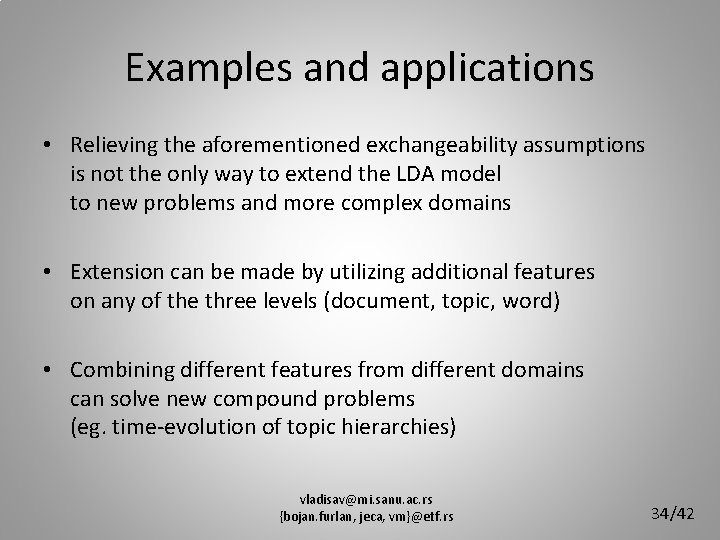
Examples and applications • Relieving the aforementioned exchangeability assumptions is not the only way to extend the LDA model to new problems and more complex domains • Extension can be made by utilizing additional features on any of the three levels (document, topic, word) • Combining different features from different domains can solve new compound problems (eg. time-evolution of topic hierarchies) vladisav@mi. sanu. ac. rs {bojan. furlan, jeca, vm}@etf. rs 34/42
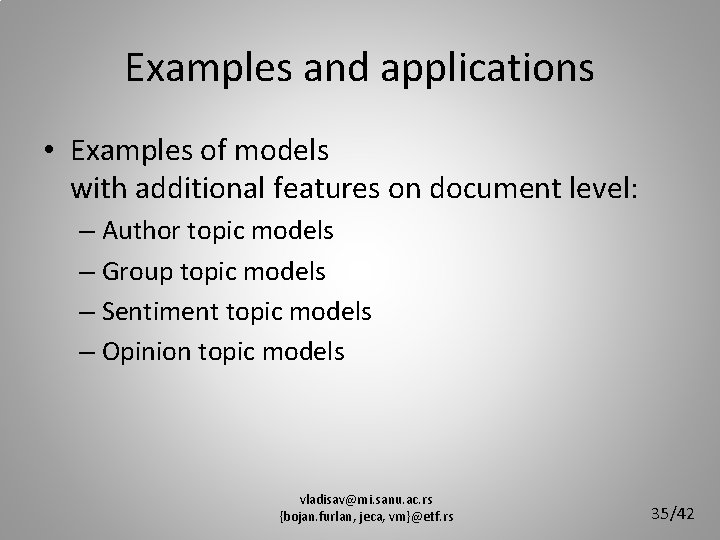
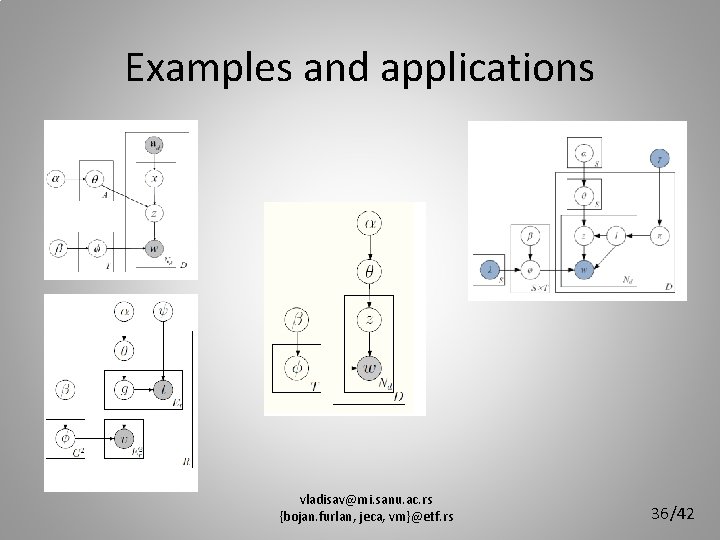
Examples and applications • Examples of models with additional features on document level: – Author topic models – Group topic models – Sentiment topic models – Opinion topic models vladisav@mi. sanu. ac. rs {bojan. furlan, jeca, vm}@etf. rs 35/42
Examples and applications vladisav@mi. sanu. ac. rs {bojan. furlan, jeca, vm}@etf. rs 36/42
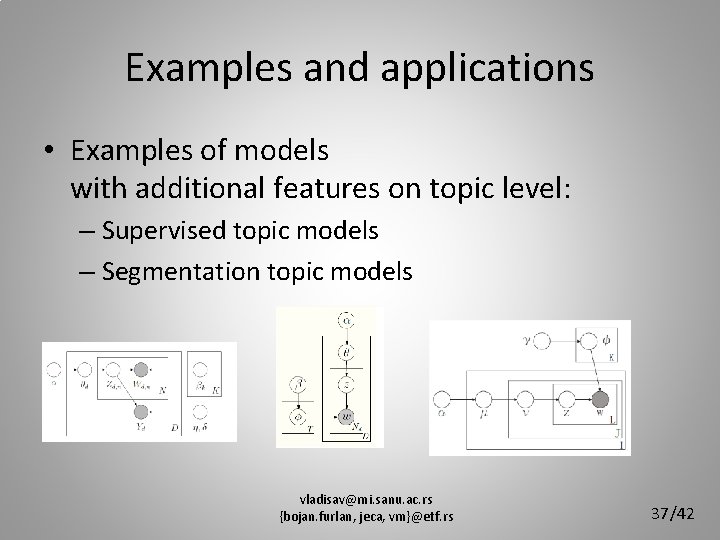
Examples and applications • Examples of models with additional features on topic level: – Supervised topic models – Segmentation topic models vladisav@mi. sanu. ac. rs {bojan. furlan, jeca, vm}@etf. rs 37/42
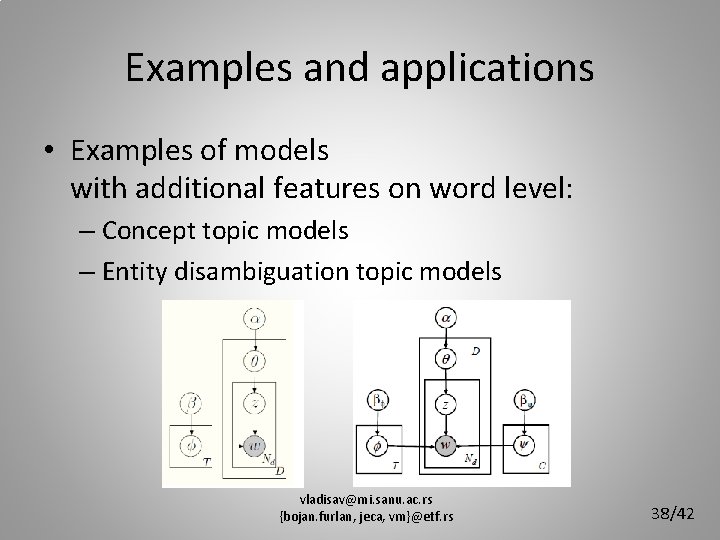
Examples and applications • Examples of models with additional features on word level: – Concept topic models – Entity disambiguation topic models vladisav@mi. sanu. ac. rs {bojan. furlan, jeca, vm}@etf. rs 38/42
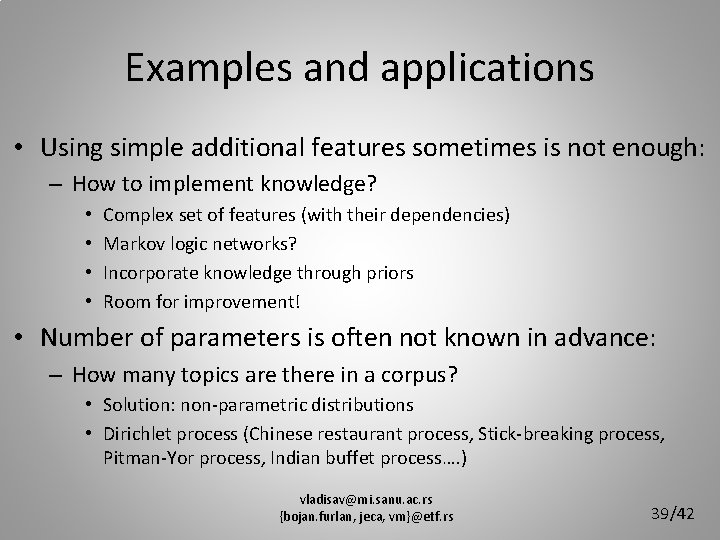
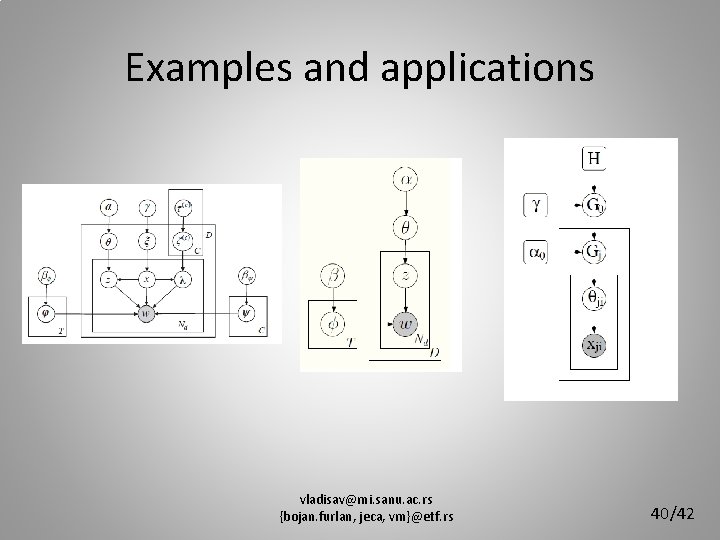
Examples and applications • Using simple additional features sometimes is not enough: – How to implement knowledge? • • Complex set of features (with their dependencies) Markov logic networks? Incorporate knowledge through priors Room for improvement! • Number of parameters is often not known in advance: – How many topics are there in a corpus? • Solution: non-parametric distributions • Dirichlet process (Chinese restaurant process, Stick-breaking process, Pitman-Yor process, Indian buffet process…. ) vladisav@mi. sanu. ac. rs {bojan. furlan, jeca, vm}@etf. rs 39/42
Examples and applications vladisav@mi. sanu. ac. rs {bojan. furlan, jeca, vm}@etf. rs 40/42
Conclusion and Ideas for Future Research • Extending the “word” side of topic models (e. g. , harnessing morphology): Stem LDA • Combining existing topic modeling paradigms on new problems • New topic representations (using ontology triplets instead of simple terms) vladisav@mi. sanu. ac. rs {bojan. furlan, jeca, vm}@etf. rs 41/42
THE END THANK YOU FOR YOUR TIME. Probabilistic Graphical Models For Text Mining: A Topic Modeling Survey vladisav@mi. sanu. ac. rs, {bojan. furlan, jeca, vm}@etf. rs vladisav@mi. sanu. ac. rs {bojan. furlan, jeca, vm}@etf. rs 42/42
- Slides: 42