
PROACTIVE TEACHING AND LEARNING IN THE AEROSPACE ENGINEERING
- Slides: 33
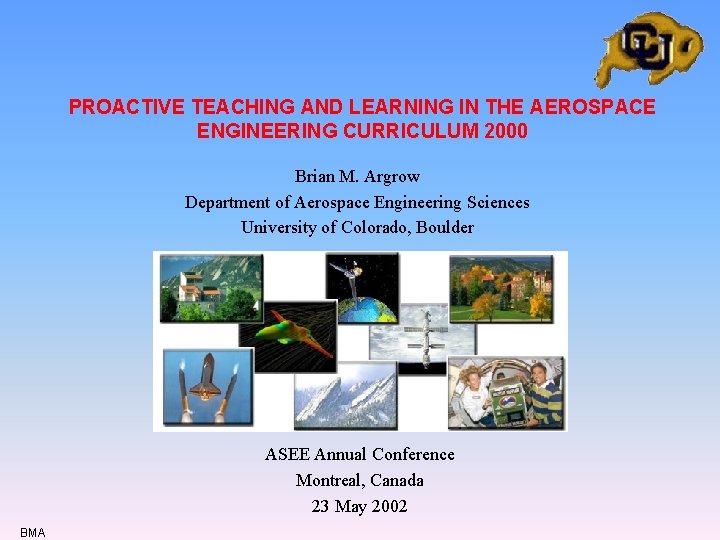
PROACTIVE TEACHING AND LEARNING IN THE AEROSPACE ENGINEERING CURRICULUM 2000 Brian M. Argrow Department of Aerospace Engineering Sciences University of Colorado, Boulder ASEE Annual Conference Montreal, Canada 23 May 2002 BMA
KNOWLEDGE & CURRICULUM BMA
Knowledge & Curriculum • A technical curriculum must address each component of knowledge: § Conceptual § Operational § Integral BMA 3
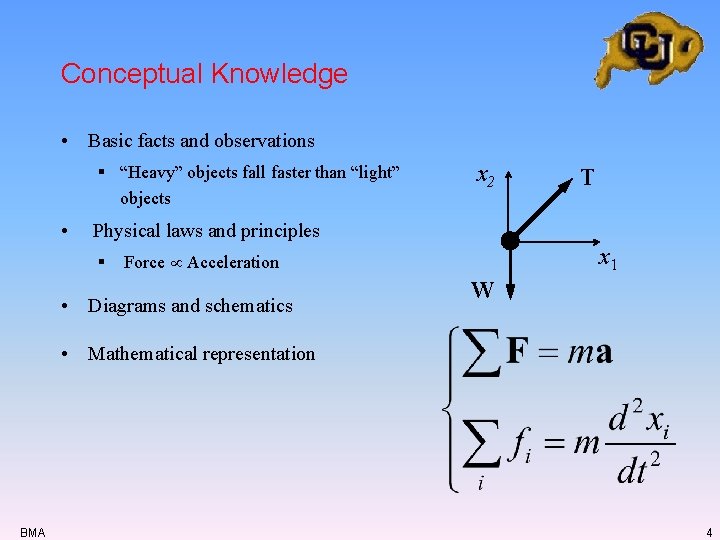
Conceptual Knowledge • Basic facts and observations § “Heavy” objects fall faster than “light” objects • x 2 T Physical laws and principles § x 1 Force Acceleration • Diagrams and schematics W • Mathematical representation BMA 4
Operational Knowledge • Formulation and Analysis Conceptual § Requirements? Constraints? Initial conditions? Symmetries? • Methods and Strategies § Analytical (closed-form or approximate? ) § Computational • Skills and Resources § Computing § Library BMA Group dynamics Internet 5
Integral Knowledge • Conceptual + Operational = Integral § Synthesis enables design § Practicum provides opportunity to build and test • Integral knowledge is essential for design § The foundation of new technology • Unique to the engineering profession § Given the why and how—what? BMA 6
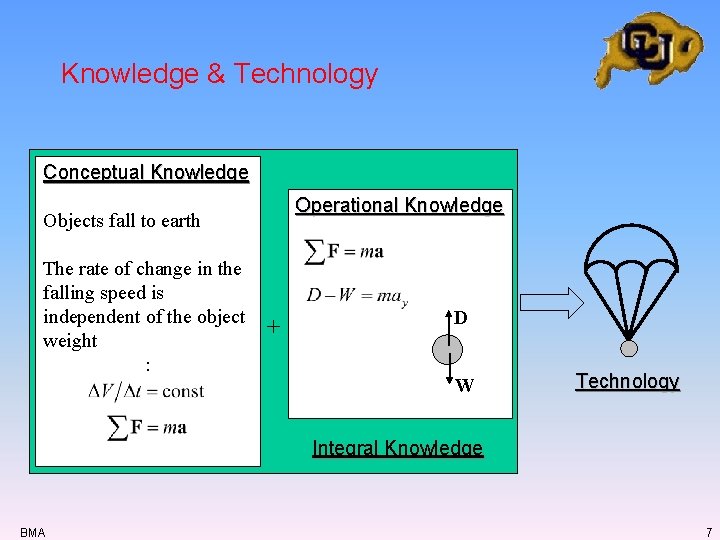
Knowledge & Technology Conceptual Knowledge Operational Knowledge Objects fall to earth The rate of change in the falling speed is independent of the object weight : + D W Technology Integral Knowledge BMA 7
A Proactive Philosophy Instruction and learning begin with teacher and student preparation. The classroom is not the place for teachers to display how much they know it is the place to learn what students do not know so those things become known. BMA 8
Teacher Motivation • Faculty are motivated… …to minimize load, maximize quality …by a tangible reward structure …by professional respect …by student respect …by self respect BMA 9
Student Motivation • Many students. . . …are not motivated to do what is good for them • reading in preparation for lectures • homework • early exam preparation …are motivated to avoid negative consequences, particularly if the consequences are immediate • low grades • negative peer pressure BMA 10
Teacher Preparation • Pick the appropriate text § Criticizing the text is a waste of time • Know the text and know your stuff § Prepare to ad-lib (oxymoron? ) • Definite, but flexible, plan § Syllabus contract § Learning goals instead of material coverage BMA 11
Student Preparation • You are responsible for your learning § Being Smart is not Enough* § Reading is fundamental—not intended for homework excerpts • Work outside the proverbial box § Don’t be constrained by “coverage” § Why are there references at the end of the chapter? *D. Dilaura BMA 12
Teachers in the Classroom • Learn last names • Ms. & Mr. for “friendly” formality • Emphasize good character, integrity, and ethical behavior • Discuss engineers’ social responsibilities • Require attendance • Respect students (those that deserve it) BMA 13
Students in the Classroom • Respect your teacher (we deserve it) • Bring necessities, e. g. , book, calculator, pencil, good attitude. . . • Respect your classmates • Respect property BMA 14
Sensors & Tools • Unit Quiz § Preparation is serious because it counts § Gives immediate feedback (get ‘em while they’re hot) § Outlines the “lecture” by promoting discussion § Helps teacher prepare to ad-lib § Keep it simple, but fundamental § Conventional lecture still appropriate BMA 15
Sensors & Tools • Group exercises § § § Integral knowledge through synthesis Group dynamics Exciting and contemporaneous Professional identity Reduces grading • Biweekly Exams § Test individual mastery § Discourage “cramming” BMA 16
Sensors & Tools • Homework § Minor portion of course grade • Question of the day § Reconnects the math-science-engineering disconnect • Class log and e-mail updates § § BMA Summary of the day’s activities Reflection and hindsight Complete account of course activities Complements class website 17
A Proactive Classroom • Preparation reduced, satisfaction increased • Classroom is energized • Students appreciate your effort and, more importantly, their effort • Students more responsible and responsive • Students display greater depth of knowledge BMA 18
THE AES CURRICULUM 2000 BMA
Need for Reform • Emphasis on basic science, mathematics, and engineering science in the early cold-war years 1945 -65 • Renewed hands-on, product design focus • A good engineer… must strike a balance between knowing and doing* *Seely, B. E. , “The Other Re-engineering of Engineering Education, 1900 -1965, ” Journal of Engineering Education, 88 (3), Jul. 1999, pp. 285 -294. BMA 20
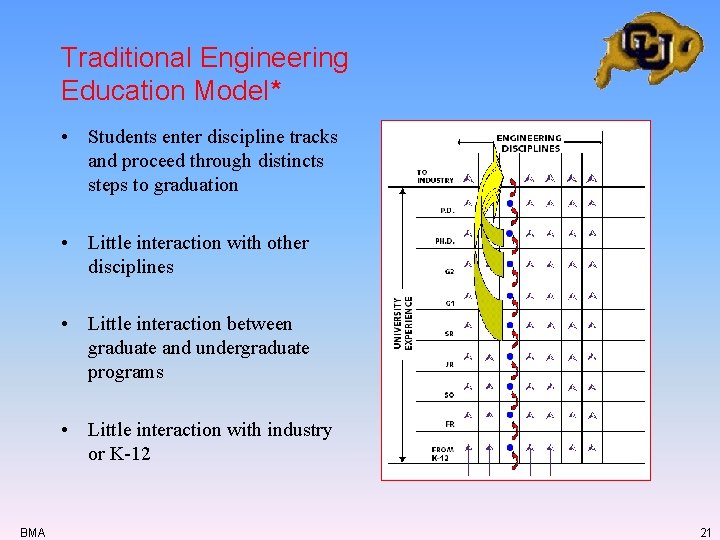
Traditional Engineering Education Model* • Students enter discipline tracks and proceed through distincts steps to graduation • Little interaction with other disciplines • Little interaction between graduate and undergraduate programs • Little interaction with industry or K-12 BMA 21
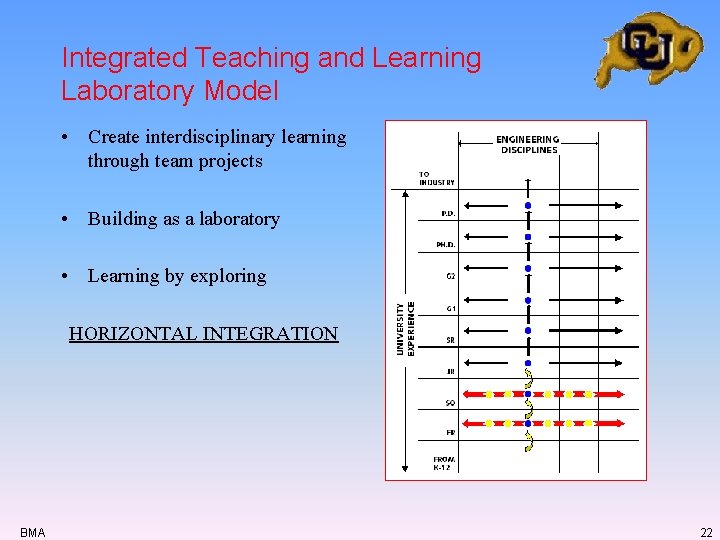
Integrated Teaching and Learning Laboratory Model • Create interdisciplinary learning through team projects • Building as a laboratory • Learning by exploring HORIZONTAL INTEGRATION BMA 22
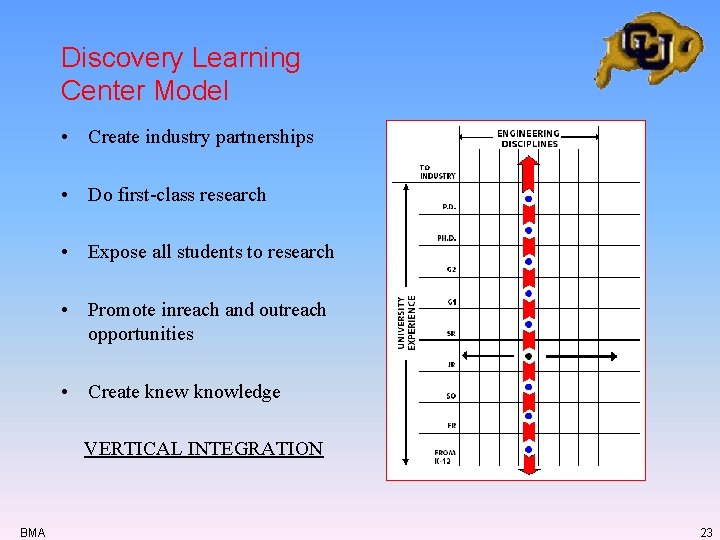
Discovery Learning Center Model • Create industry partnerships • Do first-class research • Expose all students to research • Promote inreach and outreach opportunities • Create knew knowledge VERTICAL INTEGRATION BMA 23
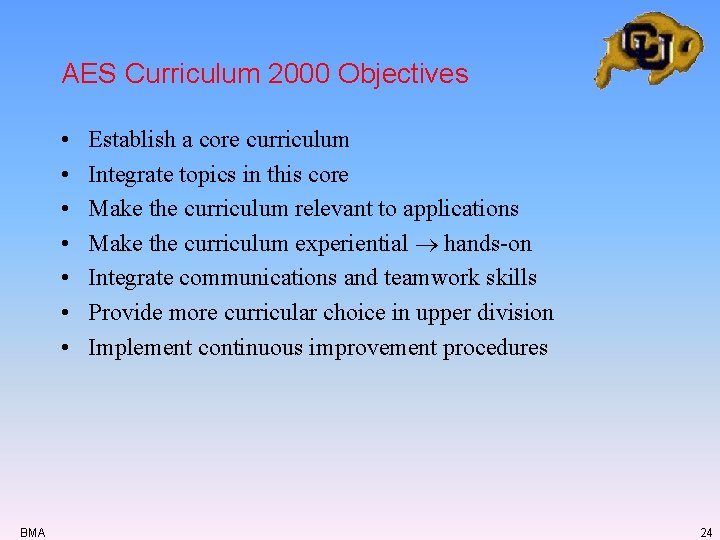
AES Curriculum 2000 Objectives • • BMA Establish a core curriculum Integrate topics in this core Make the curriculum relevant to applications Make the curriculum experiential hands-on Integrate communications and teamwork skills Provide more curricular choice in upper division Implement continuous improvement procedures 24
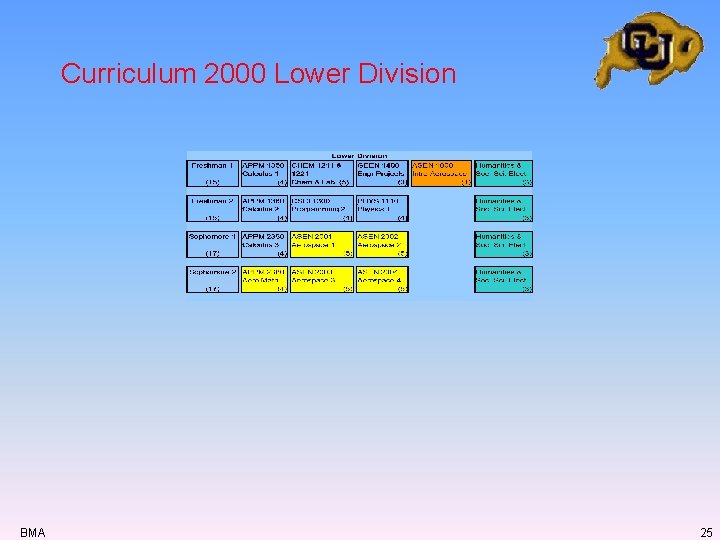
Curriculum 2000 Lower Division BMA 25
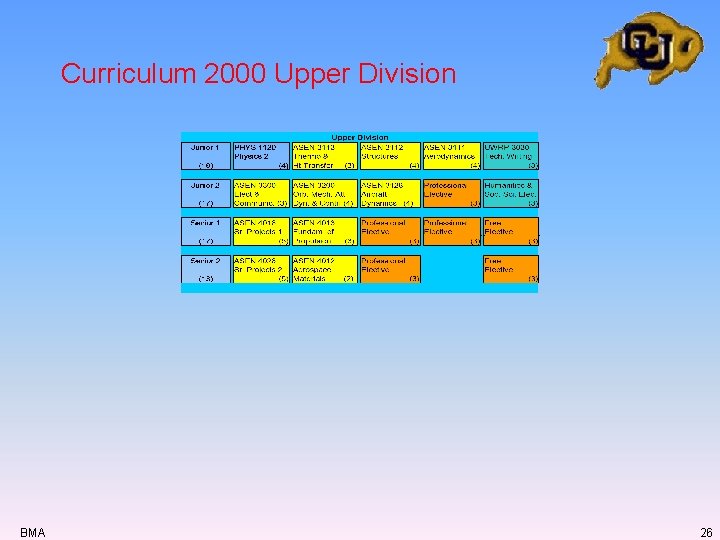
Curriculum 2000 Upper Division BMA 26
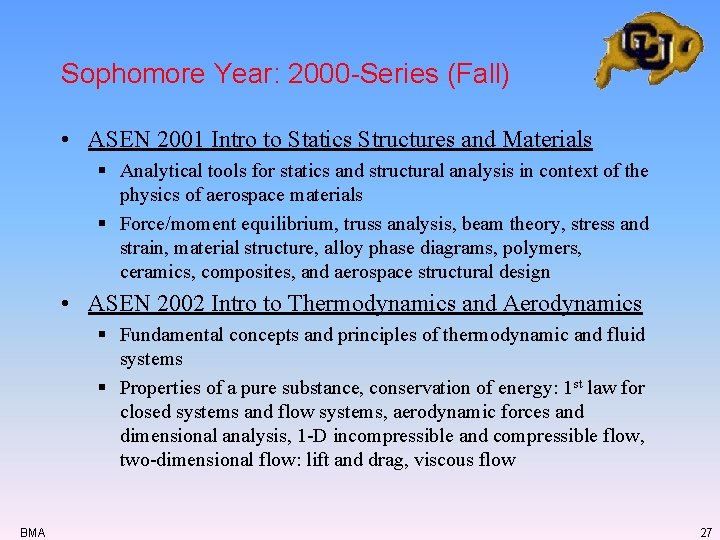
Sophomore Year: 2000 -Series (Fall) • ASEN 2001 Intro to Statics Structures and Materials § Analytical tools for statics and structural analysis in context of the physics of aerospace materials § Force/moment equilibrium, truss analysis, beam theory, stress and strain, material structure, alloy phase diagrams, polymers, ceramics, composites, and aerospace structural design • ASEN 2002 Intro to Thermodynamics and Aerodynamics § Fundamental concepts and principles of thermodynamic and fluid systems § Properties of a pure substance, conservation of energy: 1 st law for closed systems and flow systems, aerodynamic forces and dimensional analysis, 1 -D incompressible and compressible flow, two-dimensional flow: lift and drag, viscous flow BMA 27
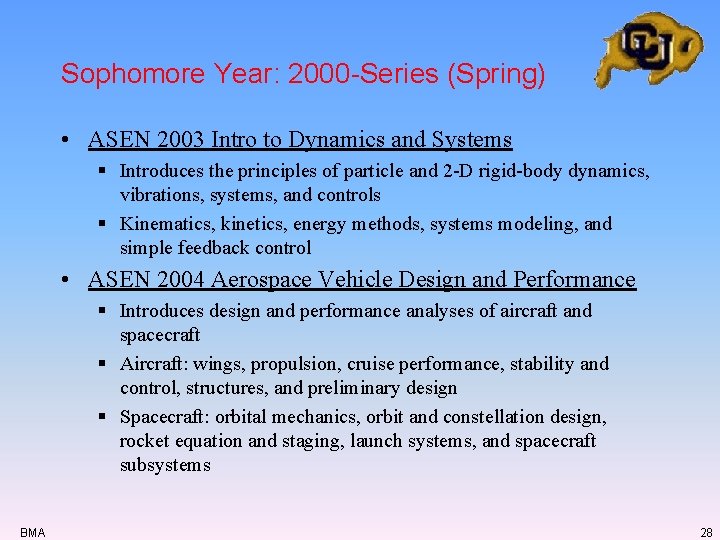
Sophomore Year: 2000 -Series (Spring) • ASEN 2003 Intro to Dynamics and Systems § Introduces the principles of particle and 2 -D rigid-body dynamics, vibrations, systems, and controls § Kinematics, kinetics, energy methods, systems modeling, and simple feedback control • ASEN 2004 Aerospace Vehicle Design and Performance § Introduces design and performance analyses of aircraft and spacecraft § Aircraft: wings, propulsion, cruise performance, stability and control, structures, and preliminary design § Spacecraft: orbital mechanics, orbit and constellation design, rocket equation and staging, launch systems, and spacecraft subsystems BMA 28
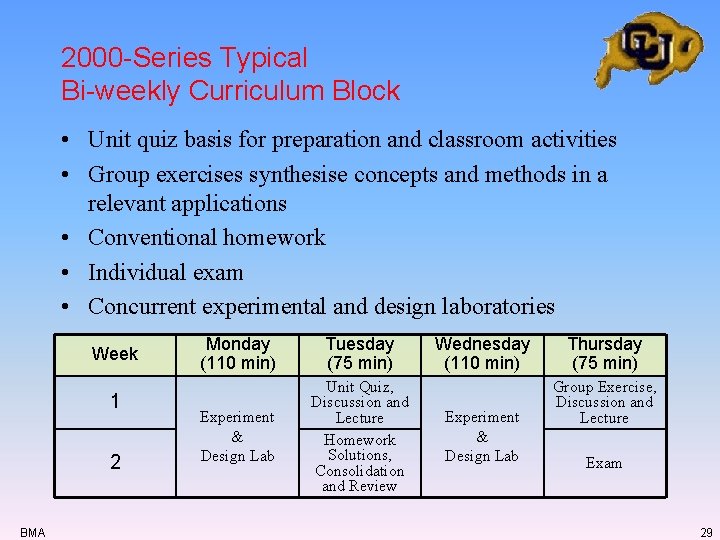
2000 -Series Typical Bi-weekly Curriculum Block • Unit quiz basis for preparation and classroom activities • Group exercises synthesise concepts and methods in a relevant applications • Conventional homework • Individual exam • Concurrent experimental and design laboratories Week 1 2 BMA Monday (110 min) Tuesday (75 min) Experiment & Design Lab Unit Quiz, Discussion and Lecture Homework Solutions, Consolidation and Review Wednesday (110 min) Experiment & Design Lab Thursday (75 min) Group Exercise, Discussion and Lecture Exam 29
Upper Division Courses • To maximize multidisciplinary opportunities, no professional electives required to be AES courses • All junior AES courses include a laboratory component • Capstone Senior Projects is a year-long synthesis and practicum course with design, build, and test requirement • Senior Projects sequence is focus of proposed vertical curriculum integration BMA 30
Challenges and Compromises • Team teaching § A rewarding new paradigm for AES • Assessment § Graduate surveys, student review team § Spreadsheet tool for mapping assignments according to desired outcomes and learning goals, and conventional grade assignment § Diligence • Resources and Facilities § § BMA Unilateral reform at a state university ITLL space limitations and laboratory expendibles Increased TA need—quantity and quality External funding 31
Conclusions and Future Initiatives • Opportunity to employ a proactive teaching and learning philosophy • Increased student-faculty contact hours • Curriculum lauded by academic peers, industry, advisory boards, and students • Improved national ranking • Vertical integration based on the Senior Projects courses • Discovery Learning Initiative BMA 32
Acknowledgements • AES Colleagues Penina Axelrad, Robert Culp, David Kalahar, Dale Lawrence, Lee Peterson • David Dilaura, John Dow, Michael Lightner (Univ. Colorado) • Ronald Blackwelder (Univ. Southern California), Adele Howe (Colorado State Univ. ) • Dedicated to the memory of Professor A. Richard Seebass BMA 33