
Proactive Strategies Communication Strategies for Supporting Elementary Children

- Slides: 58
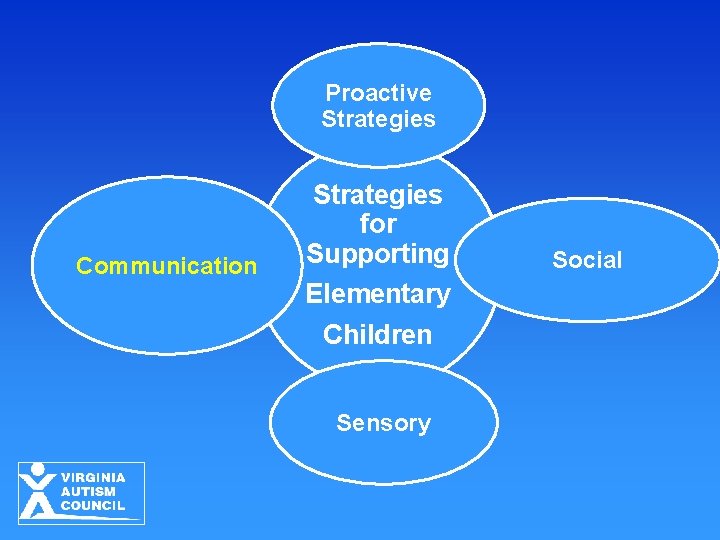
Proactive Strategies Communication Strategies for Supporting Elementary Children Sensory Social
Activity My Most Important Words • Make a list of the 10 most important words or phrases you would want included as part of your communication system, if you had to rely on one for any reason • Share with group
Topics for Today • The Foundation for Communication • Communication and Behavior • Communication Strategies and Activities • Communication Systems
Person Centered Approach. Make the least dangerous assumption: presume competence Anne Donnellan & Bill Stillman
“In my language” Amanda Baggs video clip: www. youtube. com/watch? v=Jnyl. M 1 h. I 2 jc
The Foundation for Communication
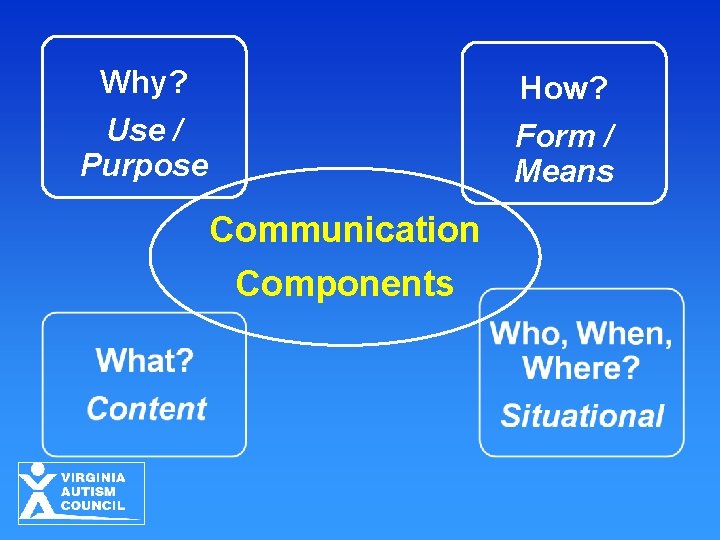
Why? How? Use / Purpose Form / Means Communication Components
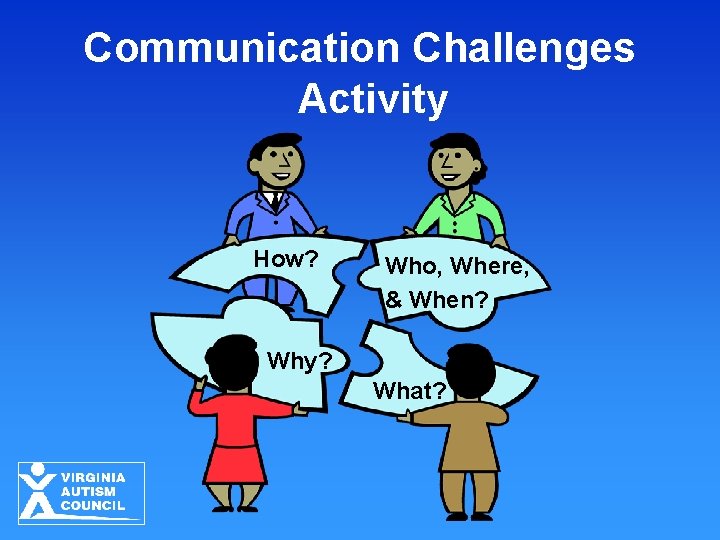
Communication Challenges Activity How? Who, Where, & When? Why? What?
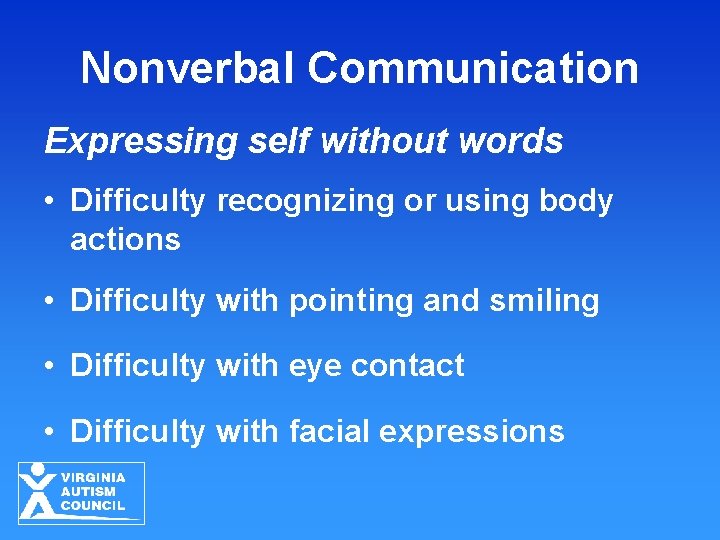
Nonverbal Communication Expressing self without words • Difficulty recognizing or using body actions • Difficulty with pointing and smiling • Difficulty with eye contact • Difficulty with facial expressions
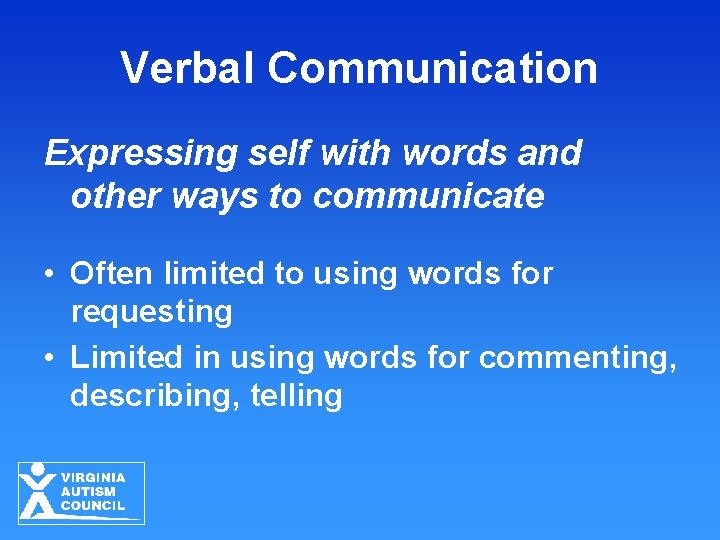
Verbal Communication Expressing self with words and other ways to communicate • Often limited to using words for requesting • Limited in using words for commenting, describing, telling
Receptive Communication Understanding and responding to communication • • Difficulty with vocabulary/parts of speech Difficulty following directions / multiple steps Difficulty with figurative / vague language Difficulty understanding the perspectives of others
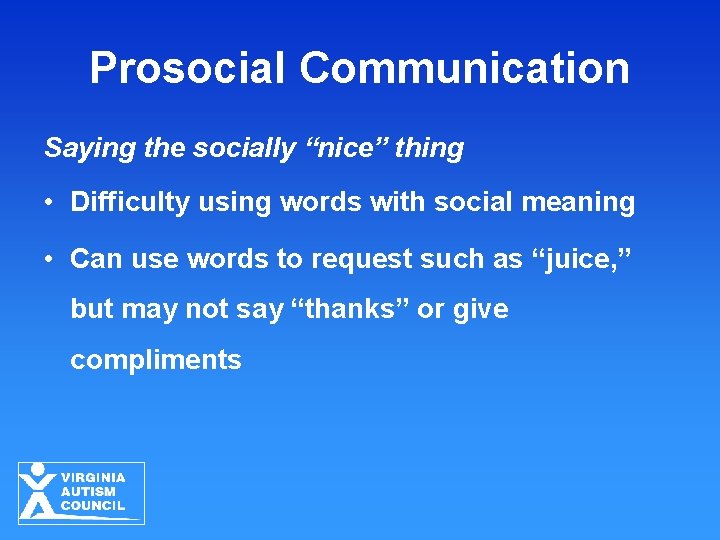
Prosocial Communication Saying the socially “nice” thing • Difficulty using words with social meaning • Can use words to request such as “juice, ” but may not say “thanks” or give compliments
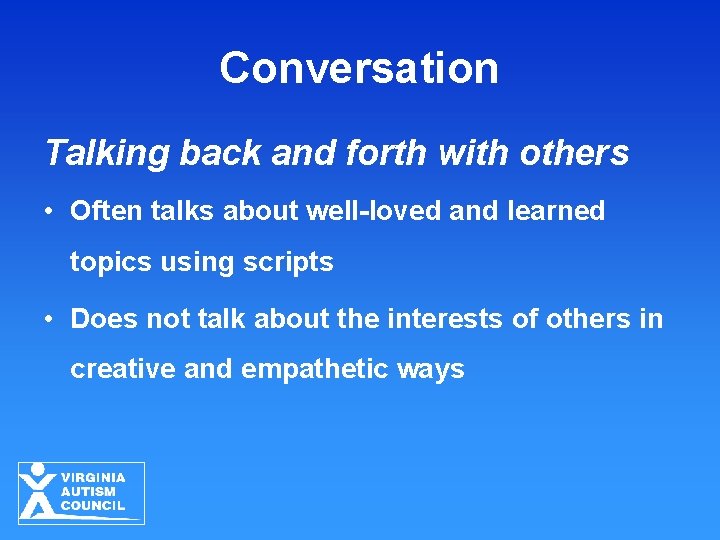
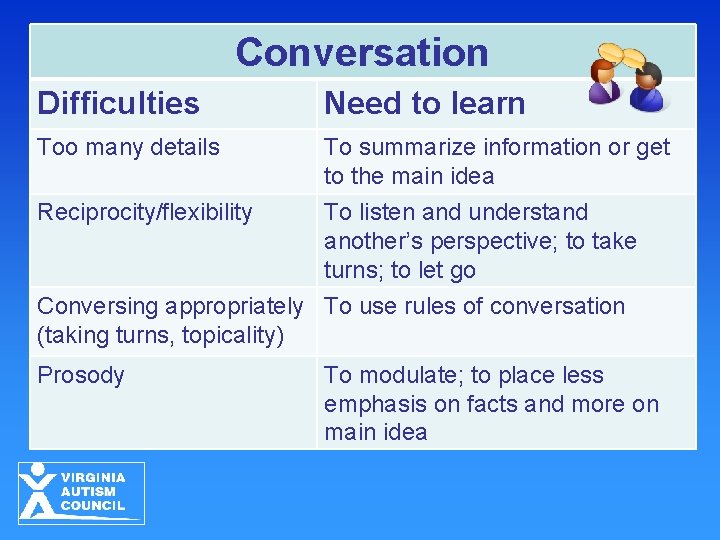
Conversation Talking back and forth with others • Often talks about well-loved and learned topics using scripts • Does not talk about the interests of others in creative and empathetic ways
Conversation Difficulties Need to learn Too many details To summarize information or get to the main idea Reciprocity/flexibility To listen and understand another’s perspective; to take turns; to let go Conversing appropriately To use rules of conversation (taking turns, topicality) Prosody To modulate; to place less emphasis on facts and more on main idea
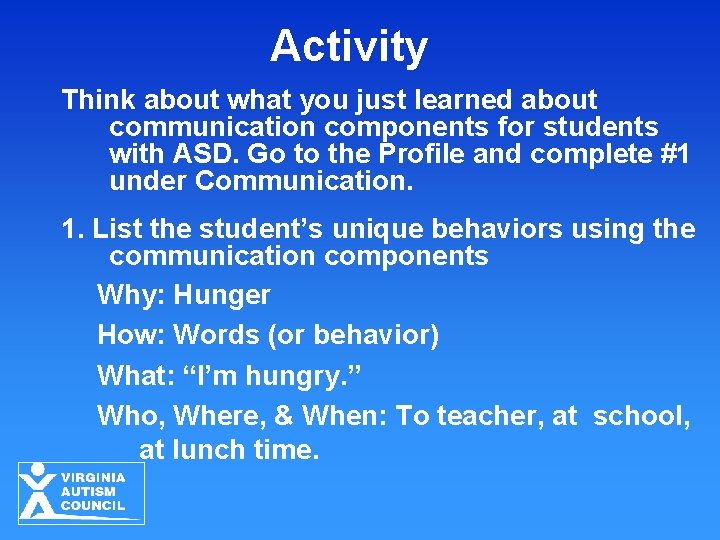
Activity Think about what you just learned about communication components for students with ASD. Go to the Profile and complete #1 under Communication. 1. List the student’s unique behaviors using the communication components Why: Hunger How: Words (or behavior) What: “I’m hungry. ” Who, Where, & When: To teacher, at school, at lunch time.
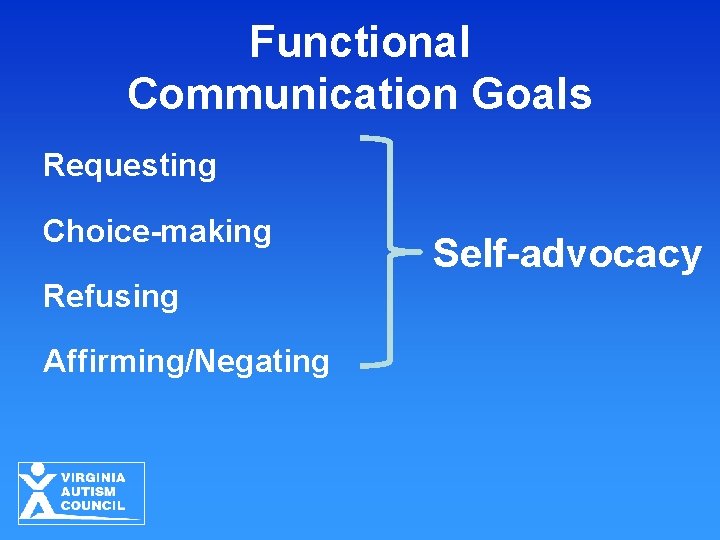
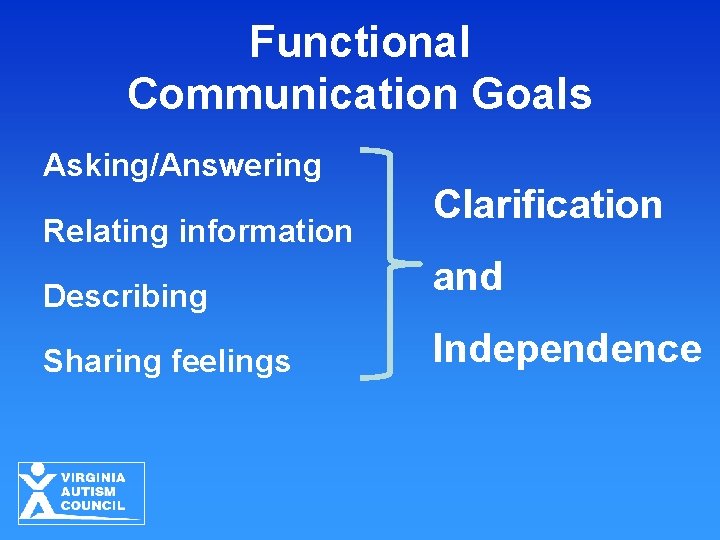
Functional Communication Goals Requesting Choice-making Refusing Affirming/Negating Self-advocacy
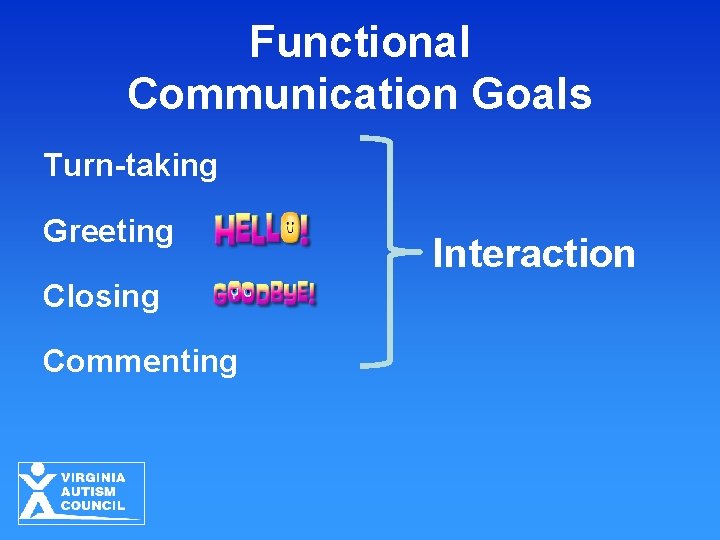
Functional Communication Goals Turn-taking Greeting Closing Commenting Interaction
Functional Communication Goals Asking/Answering Relating information Clarification Describing and Sharing feelings Independence
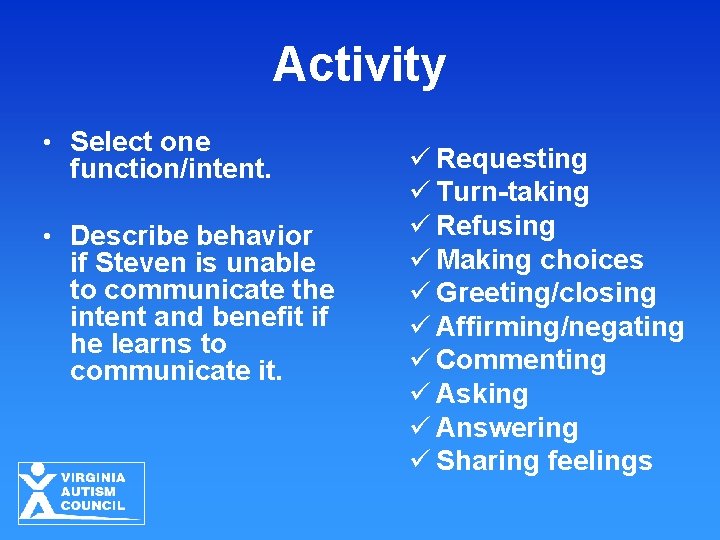
Activity • Select one function/intent. • Describe behavior if Steven is unable to communicate the intent and benefit if he learns to communicate it. ü Requesting ü Turn-taking ü Refusing ü Making choices ü Greeting/closing ü Affirming/negating ü Commenting ü Asking ü Answering ü Sharing feelings
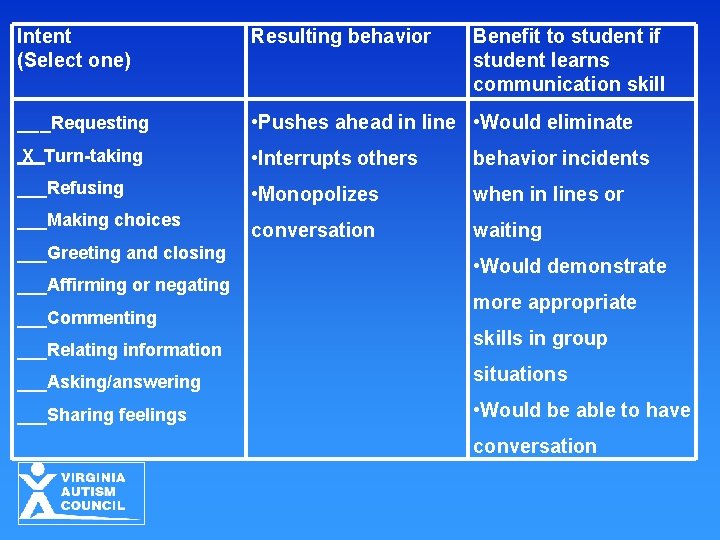
Intent (Select one) Resulting behavior ___Requesting • Pushes ahead in line • Would eliminate X Turn-taking • Interrupts others behavior incidents ___Refusing • Monopolizes when in lines or ___Making choices conversation waiting ___Greeting and closing ___Affirming or negating ___Commenting ___Relating information Benefit to student if student learns communication skill • Would demonstrate more appropriate skills in group ___Asking/answering situations ___Sharing feelings • Would be able to have conversation
Video Model Me Kids ® Talk on Topic
Communication and Behavior
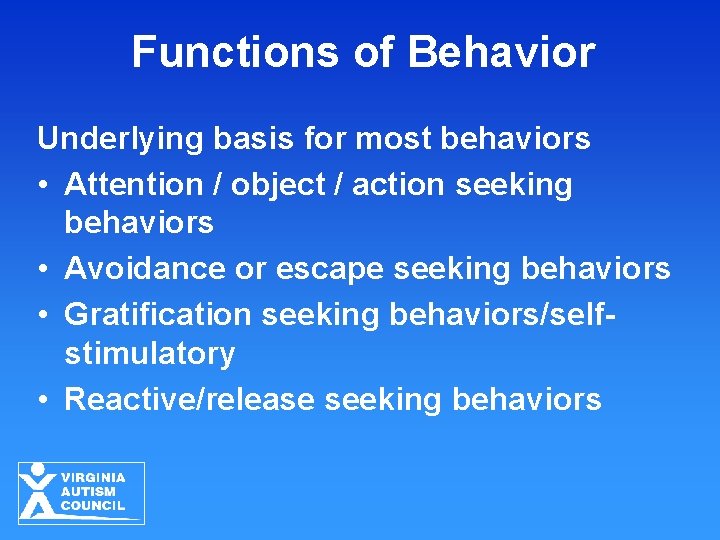
Functions of Behavior Underlying basis for most behaviors • Attention / object / action seeking behaviors • Avoidance or escape seeking behaviors • Gratification seeking behaviors/selfstimulatory • Reactive/release seeking behaviors
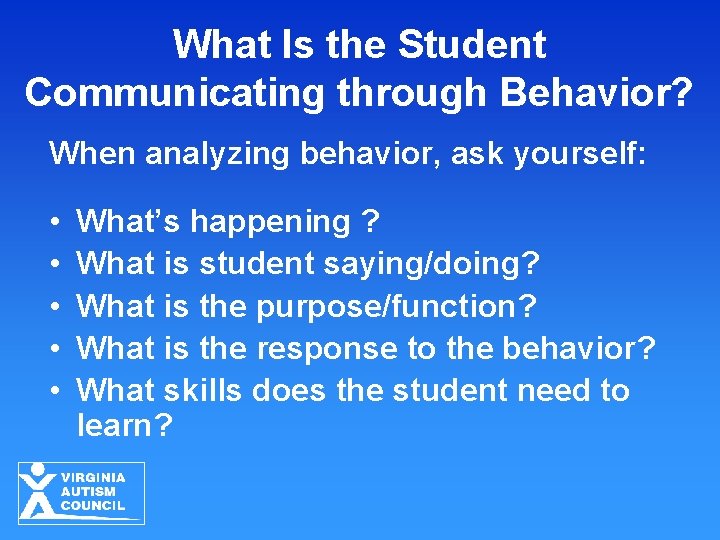
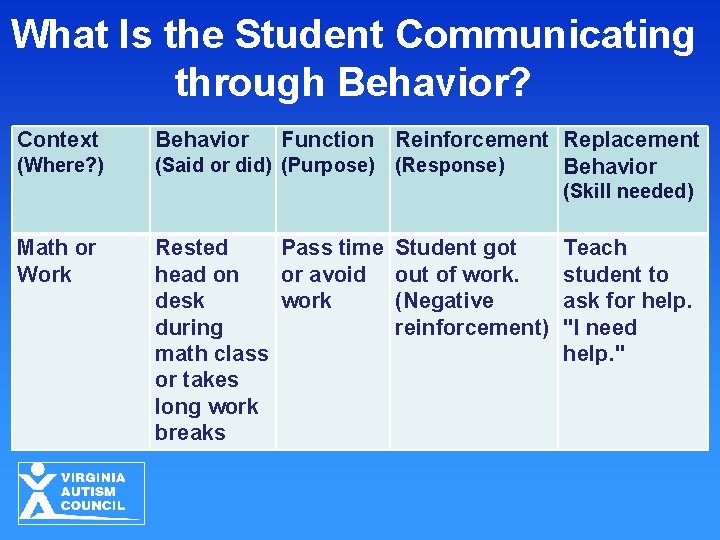
What Is the Student Communicating through Behavior? When analyzing behavior, ask yourself: • • • What’s happening ? What is student saying/doing? What is the purpose/function? What is the response to the behavior? What skills does the student need to learn?
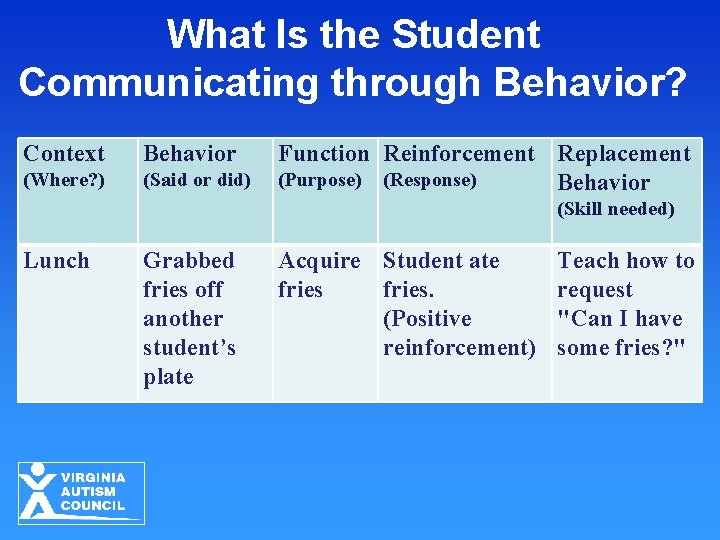
What Is the Student Communicating through Behavior? Context Behavior (Where? ) (Said or did) Function Reinforcement Replacement (Purpose) (Response) Behavior (Skill needed) Lunch Grabbed fries off another student’s plate Acquire Student ate fries. (Positive reinforcement) Teach how to request "Can I have some fries? "
What Is the Student Communicating through Behavior? Context (Where? ) Behavior Function Reinforcement Replacement (Said or did) (Purpose) (Response) Behavior (Skill needed) Math or Work Rested Pass time head on or avoid desk work during math class or takes long work breaks Student got out of work. (Negative reinforcement) Teach student to ask for help. "I need help. "
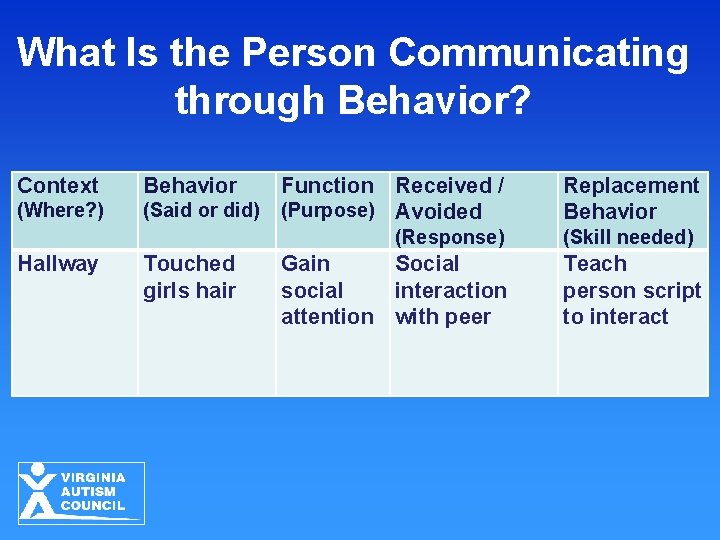
What Is the Person Communicating through Behavior? Context (Where? ) Behavior Function Received / (Said or did) (Purpose) Avoided (Response) Hallway Touched girls hair Gain Social social interaction attention with peer Replacement Behavior (Skill needed) Teach person script to interact
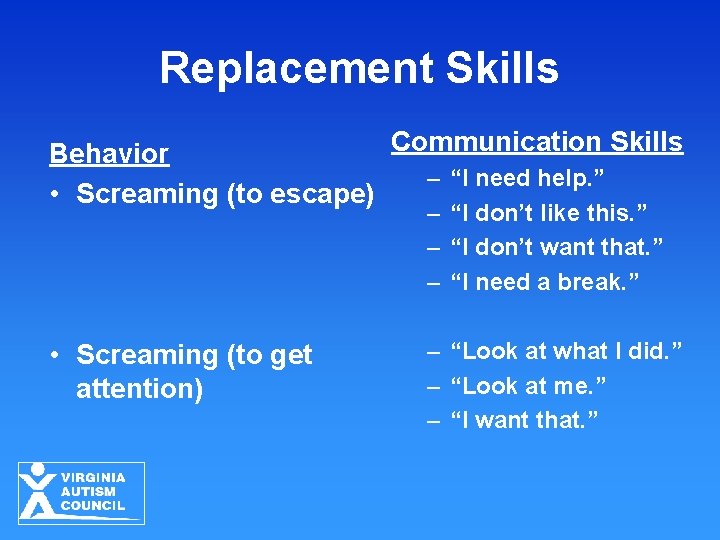
Replacement Skills Communication Skills Behavior – “I need help. ” • Screaming (to escape) – “I don’t like this. ” – “I don’t want that. ” – “I need a break. ” • Screaming (to get attention) – “Look at what I did. ” – “Look at me. ” – “I want that. ”
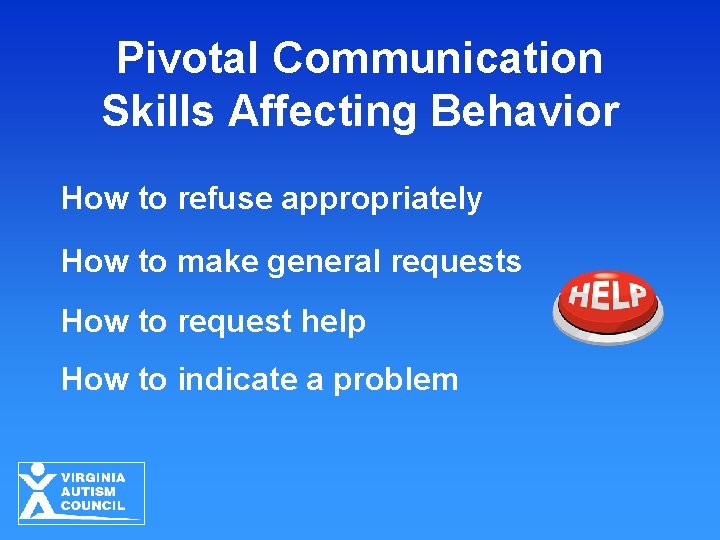
Pivotal Communication Skills Affecting Behavior How to refuse appropriately How to make general requests How to request help How to indicate a problem
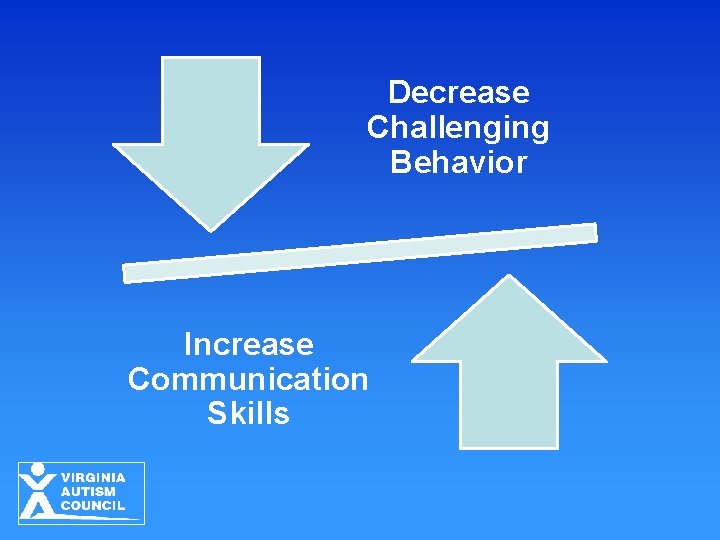
Decrease Challenging Behavior Increase Communication Skills
Activity Refer to the Student Profile to complete the communication functions chart under #2. 2. Complete this chart for a student you support.
Communication Systems
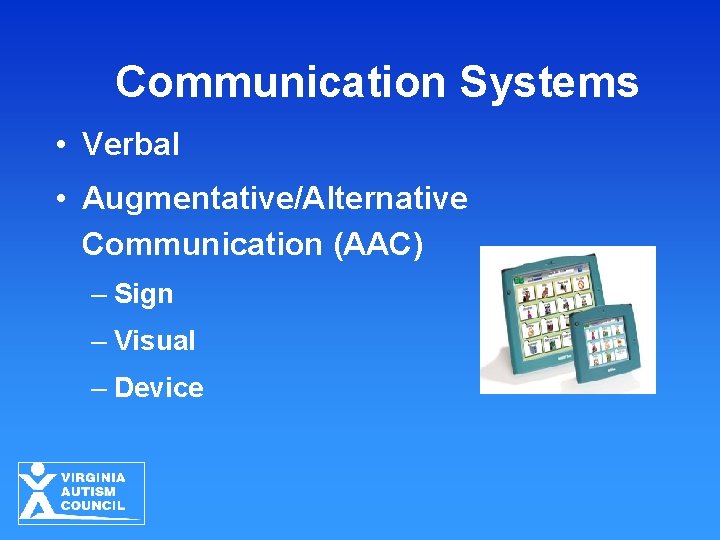
Communication Systems • Verbal • Augmentative/Alternative Communication (AAC) – Sign – Visual – Device
Considerations for Selecting Communication Systems • Chronological age of student • Developmental age of student • Communication level of student • Communication needs of student • Physical ability of student
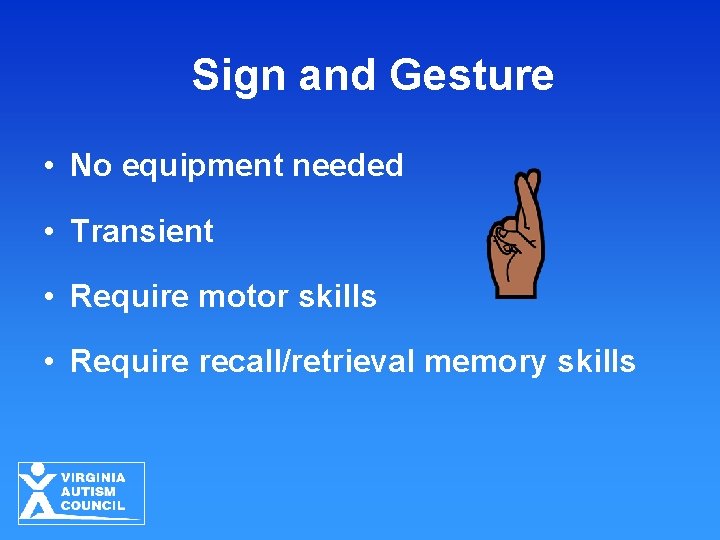
Sign and Gesture • No equipment needed • Transient • Require motor skills • Require recall/retrieval memory skills
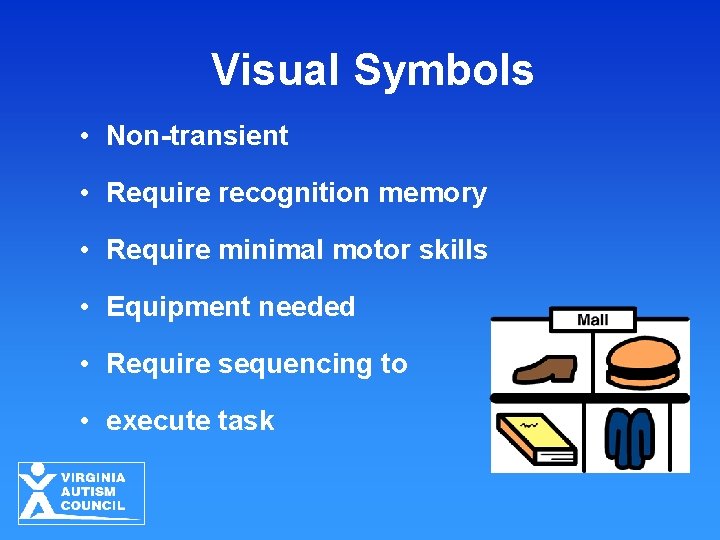
Visual Symbols • Non-transient • Require recognition memory • Require minimal motor skills • Equipment needed • Require sequencing to • execute task
Speech Output Device • Provides verbal model • Promotes verbal imitation • Clarifies pragmatic intent • Ensures listener attention • Requires equipment and programming • Needs to be carried or mounted
Video http: //www. youtube. com/watch? v=l. Mg. K 9 uio 8 r. Q&fe ature=related http: //www. youtube. com/watch? v=ulf 11 Kg 8 l. I&feature=related
Communication Strategies and Activities
Fostering Communication • Observe and identify effort to communicate • Respond to communication effort • Shape communication • Create opportunities for communication • Speak appropriately and respectfully to student
Determine the Communication Goals! • • • Verbal Nonverbal Receptive Prosocial Conversation
How Do We Teach Communication? • Identify communication supports (proactive) • Take advantage of naturally occurring opportunities • Create additional opportunities • Ensure motivation / reinforcement • Teach through routines • Alter the environment
How Do We Teach Communication? • Teach during naturally occurring opportunities • Create opportunities to teach communication
How Do We Teach Communication? • Teach in context to promote meaning and generalization
How Do We Teach Communication? • Teach through motivational activities to create desire and interest
How Do We Teach Communication? • Teach through routines to provide opportunity for repetition – Build communication into developed routines – Alter established routine to elicit communication
How Do We Teach Communication? • Teach through environmental modifications to provide frequent opportunities – Set up obstacles to desired objects or activities – Set up problem-solving situations – Place items out of reach but in sight
Teaching Strategies: Receptive and Expressive Communication • Identify and teach items of interest • Identify and teach items of relevance • Take advantage of naturally occurring opportunities • Use routines • Provide repetition • Use visual supports
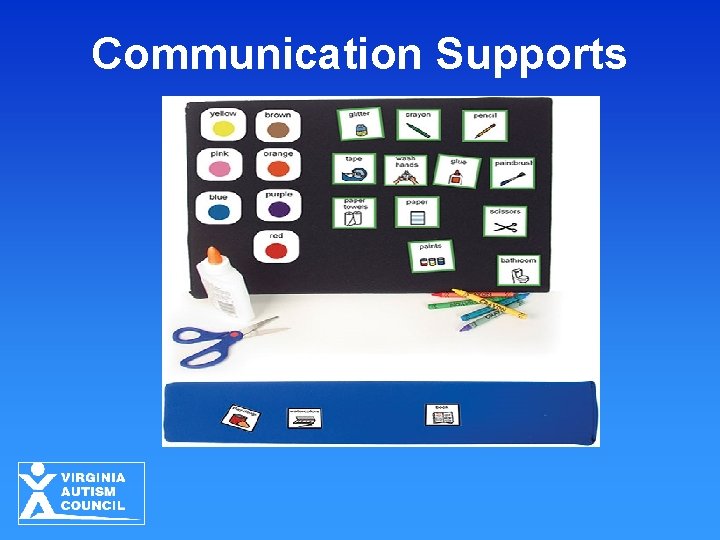
Communication Supports
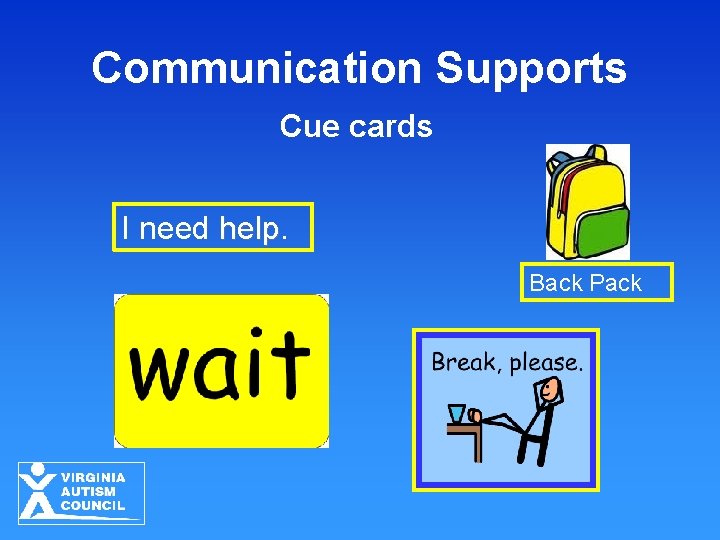
Communication Supports Cue cards I need help Back Pack
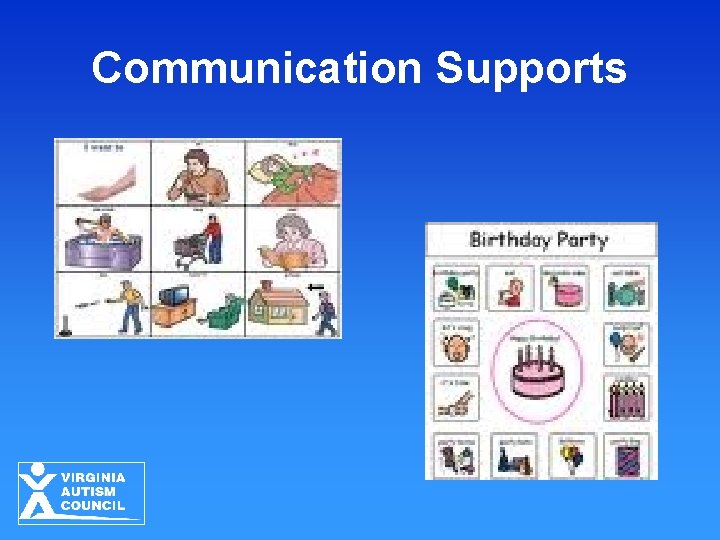
Communication Supports
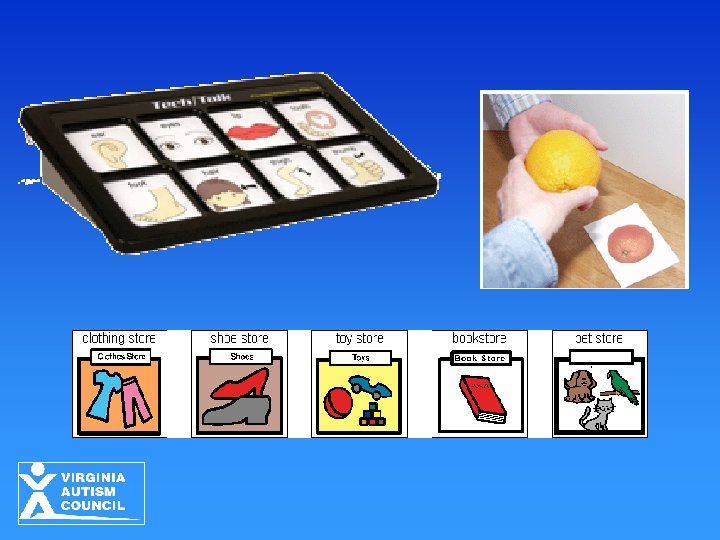
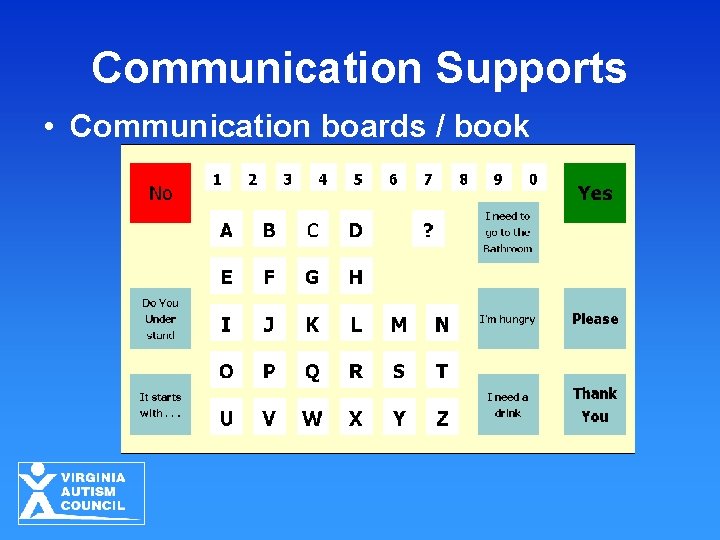
Communication Supports • Communication boards / book
Communication Supports
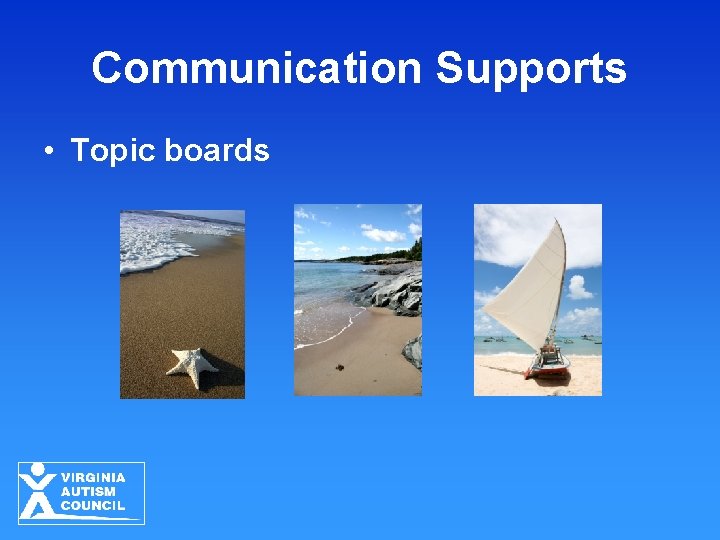
Communication Supports • Topic boards
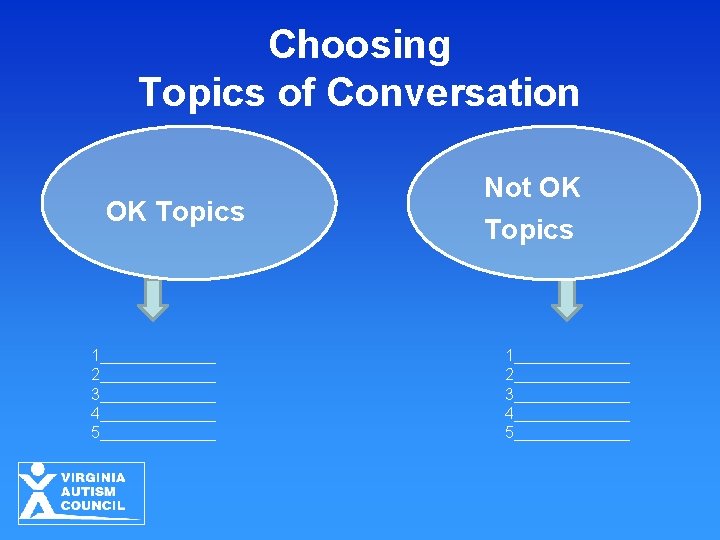
Choosing Topics of Conversation OK Topics 1_______ 2_______ 3_______ 4_______ 5_______ Not OK Topics 1_______ 2_______ 3_______ 4_______ 5_______
Activity: Steven • Take advantage of naturally occurring opportunities • Create additional opportunities • Ensure motivation / reinforcement • Teach through routines • Alter the environment • Use communication supports
Closing Points • Seek to understand the desires and needs of the person • Seek to understand the communication challenges the person faces and its impact on behavior • Provide communication supports the person desires to maximize inclusion in the community