
Pro Start Obj 2 0 pt 1 Keeping
Pro. Start Obj. 2. 0 pt 1 Keeping Food Safe © Copyright 2011 by the National Restaurant Association Educational Foundation (NRAEF) and published by Pearson Education, Inc. All rights reserved.
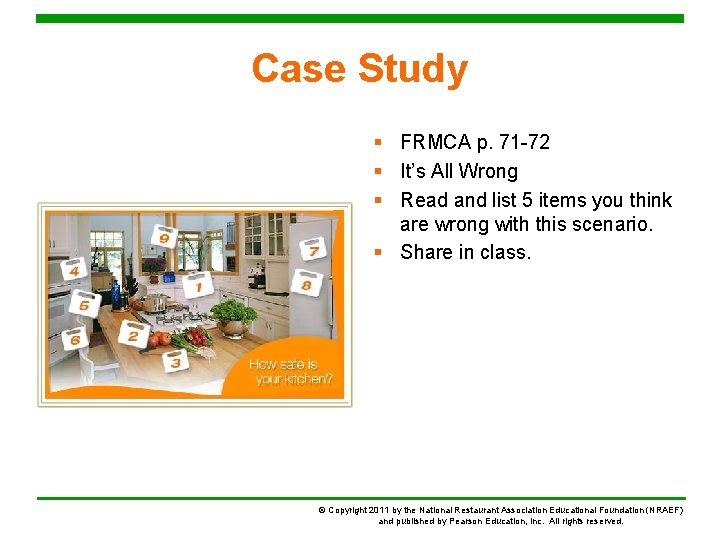
Case Study § FRMCA p. 71 -72 § It’s All Wrong § Read and list 5 items you think are wrong with this scenario. § Share in class. © Copyright 2011 by the National Restaurant Association Educational Foundation (NRAEF) and published by Pearson Education, Inc. All rights reserved.
What Is a Foodborne Illness? All restaurant and foodservice operations must keep food safe. Every person in the operation must work toward this goal. §A foodborne illness § a disease transmitted to people by food. §A foodborne-illness outbreak § when two or more people get the same illness after eating the same food. § The Centers for Disease Control and Prevention (CDC) estimates 76 million cases of foodborne illness in the United States each year. 2. 1 Chapter 2 | Keeping Food Safe 3
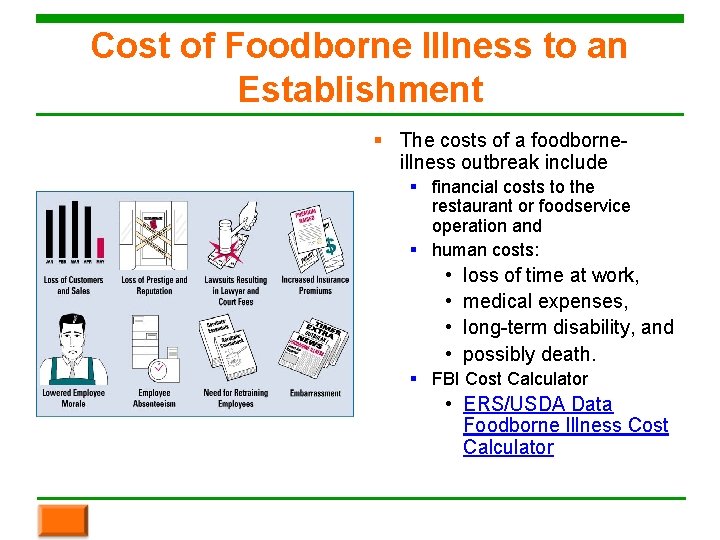
Cost of Foodborne Illness to an Establishment § The costs of a foodborneillness outbreak include § financial costs to the restaurant or foodservice operation and § human costs: • • loss of time at work, medical expenses, long-term disability, and possibly death. § FBI Cost Calculator • ERS/USDA Data Foodborne Illness Cost Calculator
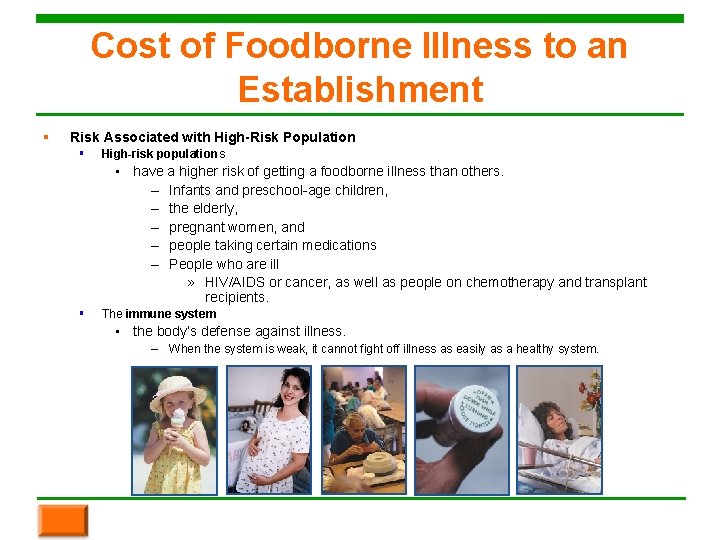
Cost of Foodborne Illness to an Establishment § Risk Associated with High-Risk Population § High-risk populations • have a higher risk of getting a foodborne illness than others. – Infants and preschool-age children, – the elderly, – pregnant women, and – people taking certain medications – People who are ill » HIV/AIDS or cancer, as well as people on chemotherapy and transplant recipients. § The immune system • the body’s defense against illness. – When the system is weak, it cannot fight off illness as easily as a healthy system.
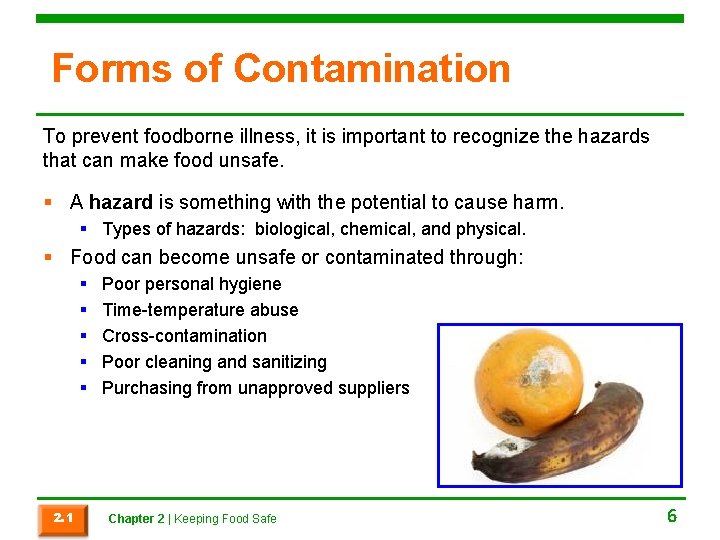
Forms of Contamination To prevent foodborne illness, it is important to recognize the hazards that can make food unsafe. § A hazard is something with the potential to cause harm. § Types of hazards: biological, chemical, and physical. § Food can become unsafe or contaminated through: § § § 2. 1 Poor personal hygiene Time-temperature abuse Cross-contamination Poor cleaning and sanitizing Purchasing from unapproved suppliers Chapter 2 | Keeping Food Safe 6
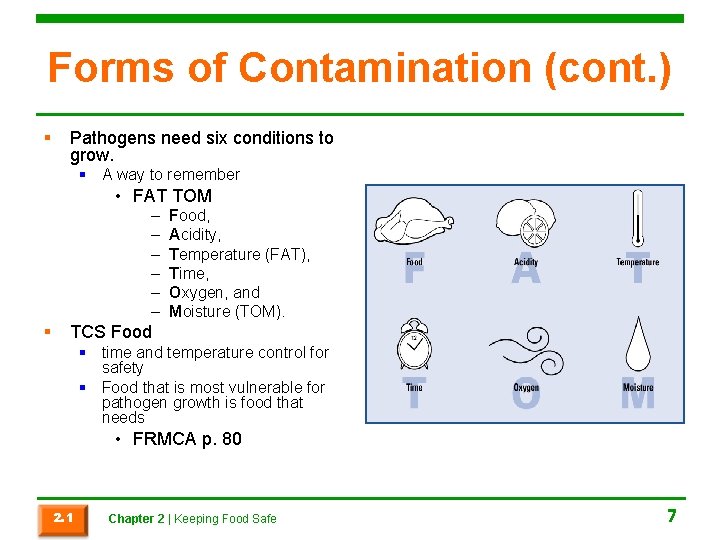
Forms of Contamination (cont. ) § Pathogens need six conditions to grow. § A way to remember • FAT TOM – – – § Food, Acidity, Temperature (FAT), Time, Oxygen, and Moisture (TOM). TCS Food § time and temperature control for safety § Food that is most vulnerable for pathogen growth is food that needs • FRMCA p. 80 2. 1 Chapter 2 | Keeping Food Safe 7
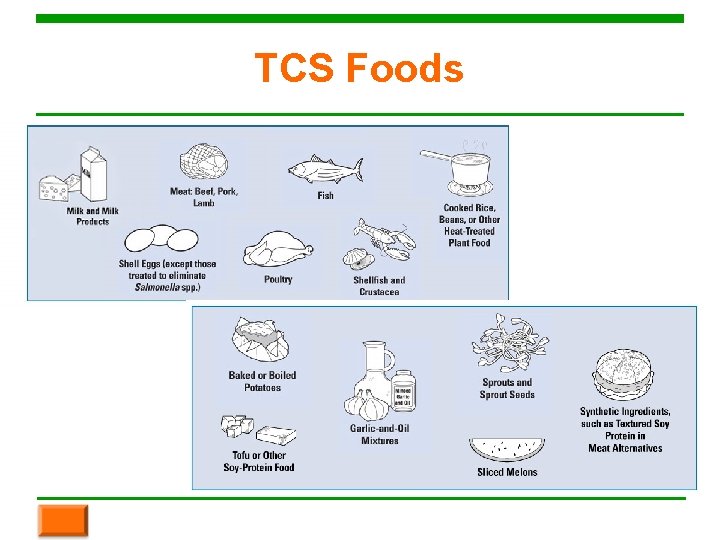
TCS Foods
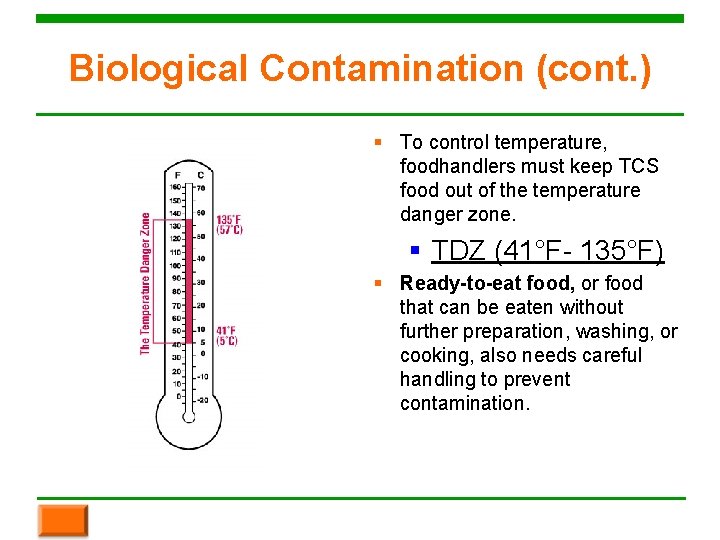
Biological Contamination (cont. ) § To control temperature, foodhandlers must keep TCS food out of the temperature danger zone. § TDZ (41°F- 135°F) § Ready-to-eat food, or food that can be eaten without further preparation, washing, or cooking, also needs careful handling to prevent contamination.
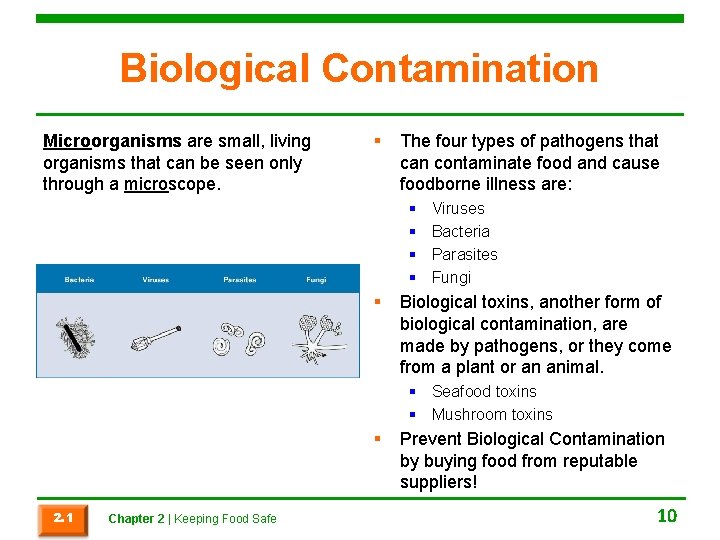
Biological Contamination Microorganisms are small, living organisms that can be seen only through a microscope. § The four types of pathogens that can contaminate food and cause foodborne illness are: § § § Viruses Bacteria Parasites Fungi Biological toxins, another form of biological contamination, are made by pathogens, or they come from a plant or an animal. § Seafood toxins § Mushroom toxins § 2. 1 Chapter 2 | Keeping Food Safe Prevent Biological Contamination by buying food from reputable suppliers! 10
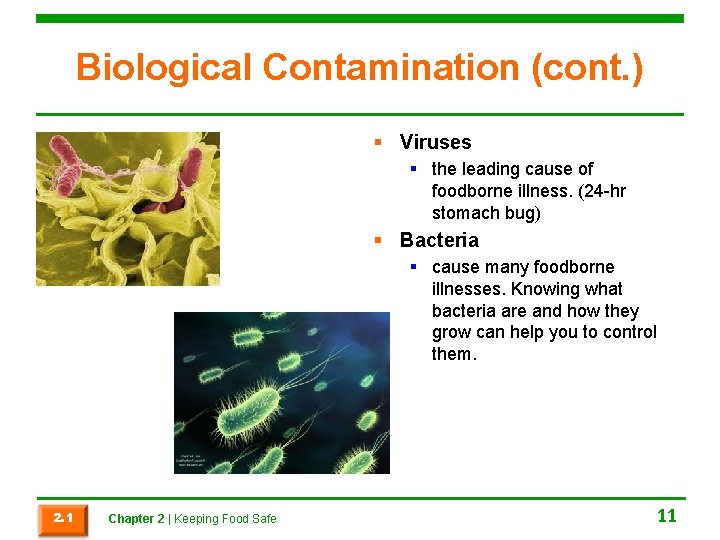
Biological Contamination (cont. ) § Viruses § the leading cause of foodborne illness. (24 -hr stomach bug) § Bacteria § cause many foodborne illnesses. Knowing what bacteria are and how they grow can help you to control them. 2. 1 Chapter 2 | Keeping Food Safe 11
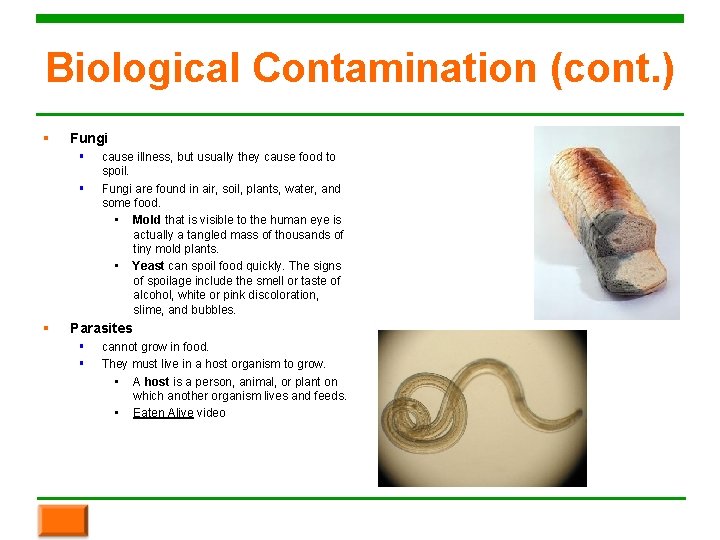
Biological Contamination (cont. ) § Fungi § § § cause illness, but usually they cause food to spoil. Fungi are found in air, soil, plants, water, and some food. • Mold that is visible to the human eye is actually a tangled mass of thousands of tiny mold plants. • Yeast can spoil food quickly. The signs of spoilage include the smell or taste of alcohol, white or pink discoloration, slime, and bubbles. Parasites § § cannot grow in food. They must live in a host organism to grow. • A host is a person, animal, or plant on which another organism lives and feeds. • Eaten Alive video
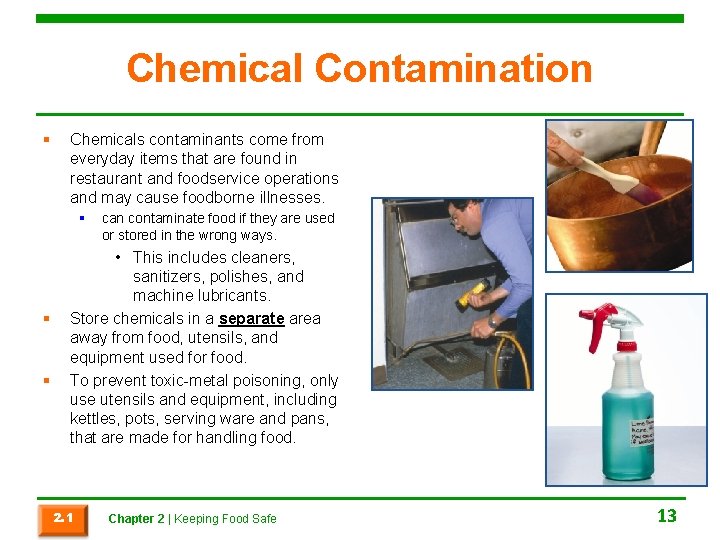
Chemical Contamination § Chemicals contaminants come from everyday items that are found in restaurant and foodservice operations and may cause foodborne illnesses. § § § can contaminate food if they are used or stored in the wrong ways. • This includes cleaners, sanitizers, polishes, and machine lubricants. Store chemicals in a separate area away from food, utensils, and equipment used for food. To prevent toxic-metal poisoning, only use utensils and equipment, including kettles, pots, serving ware and pans, that are made for handling food. 2. 1 Chapter 2 | Keeping Food Safe 13
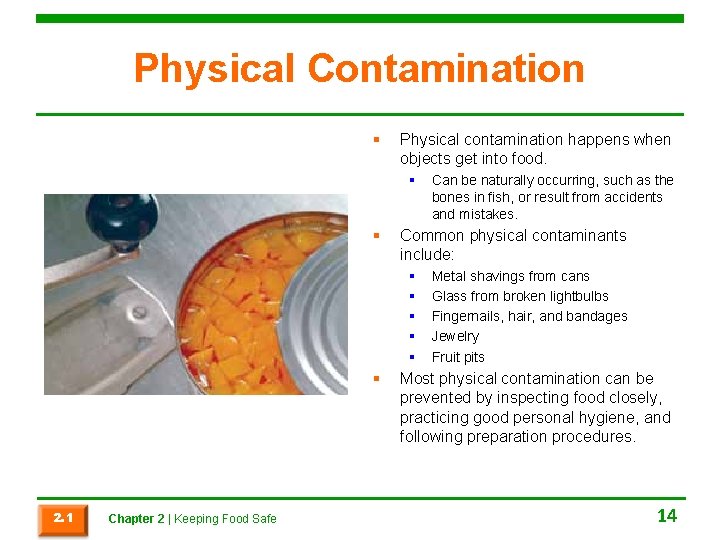
Physical Contamination § Physical contamination happens when objects get into food. § § Common physical contaminants include: § § § 2. 1 Chapter 2 | Keeping Food Safe Can be naturally occurring, such as the bones in fish, or result from accidents and mistakes. Metal shavings from cans Glass from broken lightbulbs Fingernails, hair, and bandages Jewelry Fruit pits Most physical contamination can be prevented by inspecting food closely, practicing good personal hygiene, and following preparation procedures. 14
Food Defense § A food defense system helps to prevent people from purposely contaminating food. § One important way to prevent tampering is to control access to the operation’s food storage and preparation areas. § Ex: Make sure access to an operation's food is controlled through use of uniforms and name tags. § All employees in an operation, from buser to executive chef, should report anything that seems suspicious. 2. 1 Chapter 2 | Keeping Food Safe 15
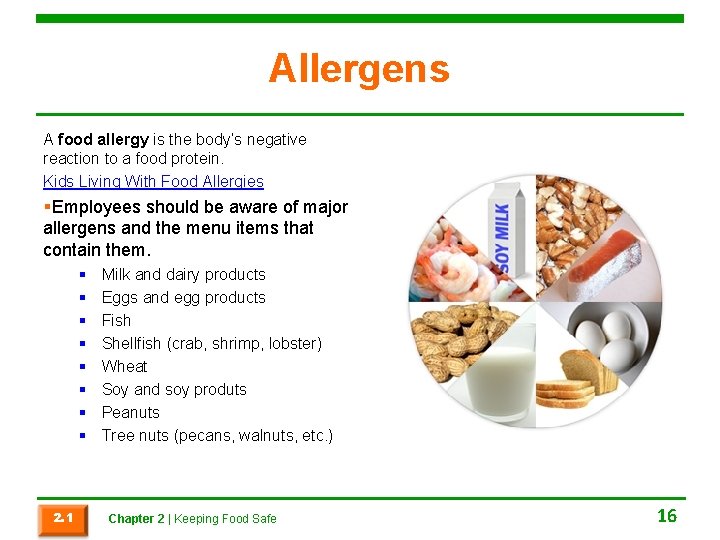
Allergens A food allergy is the body’s negative reaction to a food protein. Kids Living With Food Allergies §Employees should be aware of major allergens and the menu items that contain them. § § § § 2. 1 Milk and dairy products Eggs and egg products Fish Shellfish (crab, shrimp, lobster) Wheat Soy and soy produts Peanuts Tree nuts (pecans, walnuts, etc. ) Chapter 2 | Keeping Food Safe 16
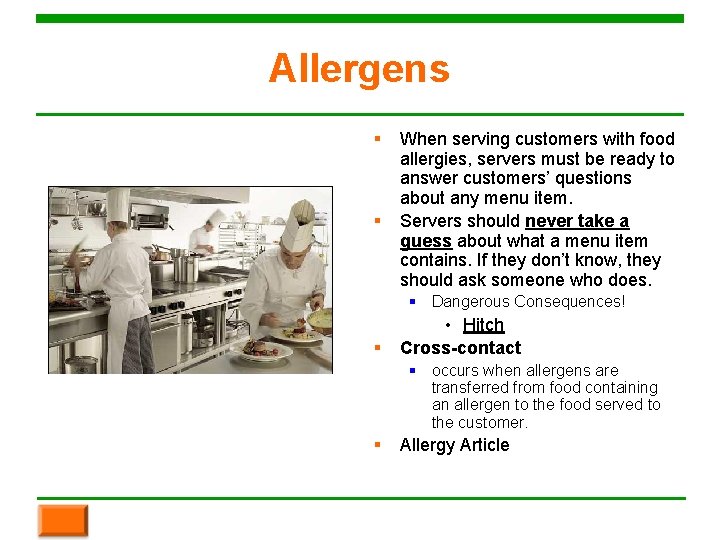
Allergens § § When serving customers with food allergies, servers must be ready to answer customers’ questions about any menu item. Servers should never take a guess about what a menu item contains. If they don’t know, they should ask someone who does. § Dangerous Consequences! § • Hitch Cross-contact § occurs when allergens are transferred from food containing an allergen to the food served to the customer. § Allergy Article
U. S. Regulation of Food Safety § § The restaurant and foodservice industry is monitored by many agencies. The FDA writes the FDA Food Code, and each state adopts the code as it sees fit. § State and local health departments then enforce these laws. • An inspection is a formal review or examination conducted to see if an operation is following food safety laws. – Inside Restaurant Inspections – Amazing Restaurant Inspections » Start at 2: 19 • Guest Speaker soon! § Successful restaurant and foodservice managers understand local food safety requirements and design policies that address them. 2. 1 Chapter 2 | Keeping Food Safe 18
STOP!
Pro. Start Obj. 2. 0 pt 2 Keeping Food Safe
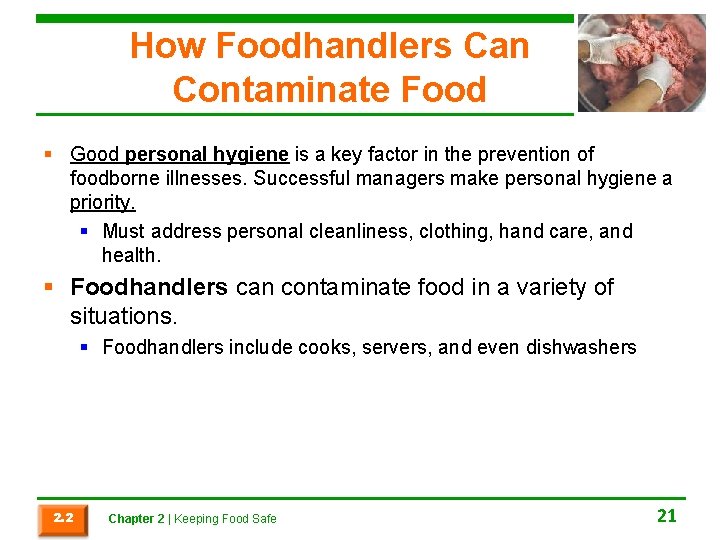
How Foodhandlers Can Contaminate Food § Good personal hygiene is a key factor in the prevention of foodborne illnesses. Successful managers make personal hygiene a priority. § Must address personal cleanliness, clothing, hand care, and health. § Foodhandlers can contaminate food in a variety of situations. § Foodhandlers include cooks, servers, and even dishwashers 2. 2 Chapter 2 | Keeping Food Safe 21
Personal Cleanliness and Work Attire § Good personal hygiene is a key factor in the prevention of foodborne illnesses. Successful managers make personal hygiene a priority. § Must address personal cleanliness, clothing, hand care, and health. § Foodhandlers can contaminate food in a variety of situations. § Foodhandlers include cooks, servers, and even dishwashers 2. 2 Chapter 2 | Keeping Food Safe 22
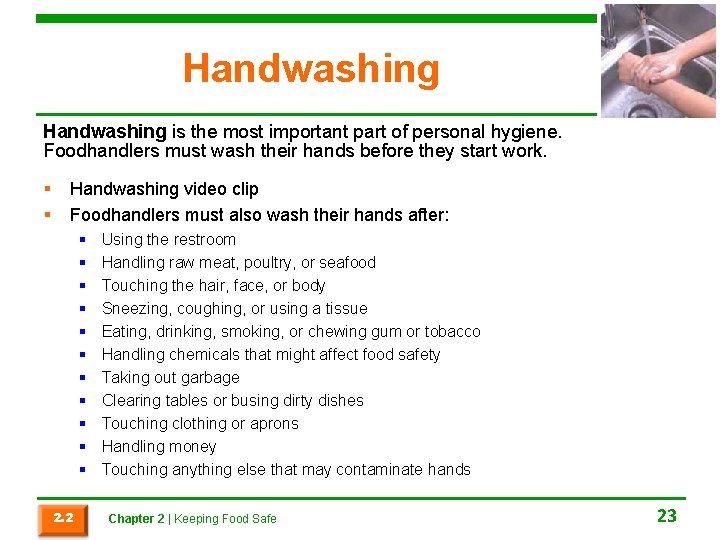
Handwashing is the most important part of personal hygiene. Foodhandlers must wash their hands before they start work. § § Handwashing video clip Foodhandlers must also wash their hands after: § § § 2. 2 Using the restroom Handling raw meat, poultry, or seafood Touching the hair, face, or body Sneezing, coughing, or using a tissue Eating, drinking, smoking, or chewing gum or tobacco Handling chemicals that might affect food safety Taking out garbage Clearing tables or busing dirty dishes Touching clothing or aprons Handling money Touching anything else that may contaminate hands Chapter 2 | Keeping Food Safe 23
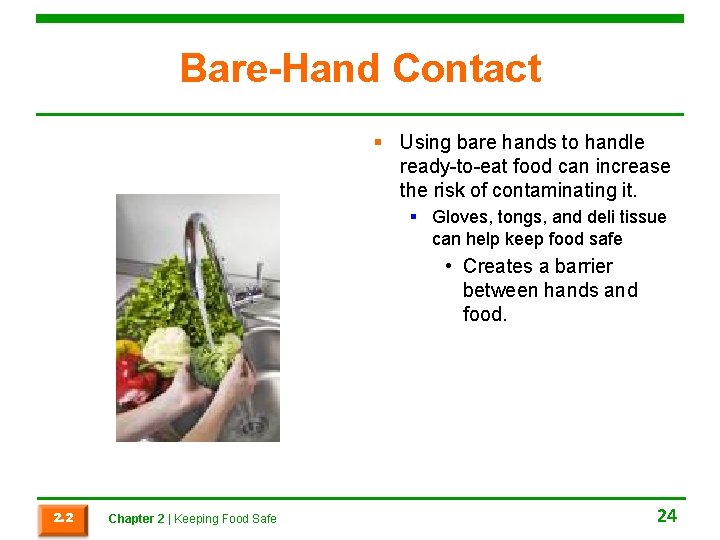
Bare-Hand Contact § Using bare hands to handle ready-to-eat food can increase the risk of contaminating it. § Gloves, tongs, and deli tissue can help keep food safe • Creates a barrier between hands and food. 2. 2 Chapter 2 | Keeping Food Safe 24
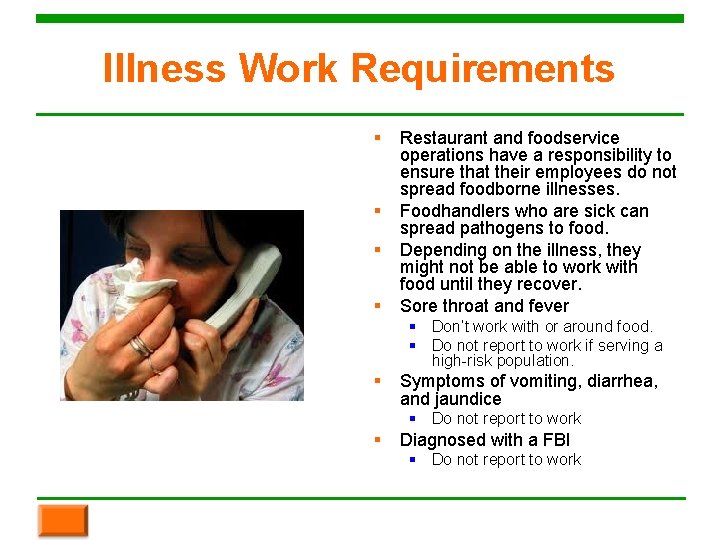
Illness Work Requirements § § Restaurant and foodservice operations have a responsibility to ensure that their employees do not spread foodborne illnesses. Foodhandlers who are sick can spread pathogens to food. Depending on the illness, they might not be able to work with food until they recover. Sore throat and fever § Don’t work with or around food. § Do not report to work if serving a high-risk population. § Symptoms of vomiting, diarrhea, and jaundice § Do not report to work § Diagnosed with a FBI § Do not report to work
STOP!
Pro. Start Obj. 2. 0 pt 3 Keeping Food Safe
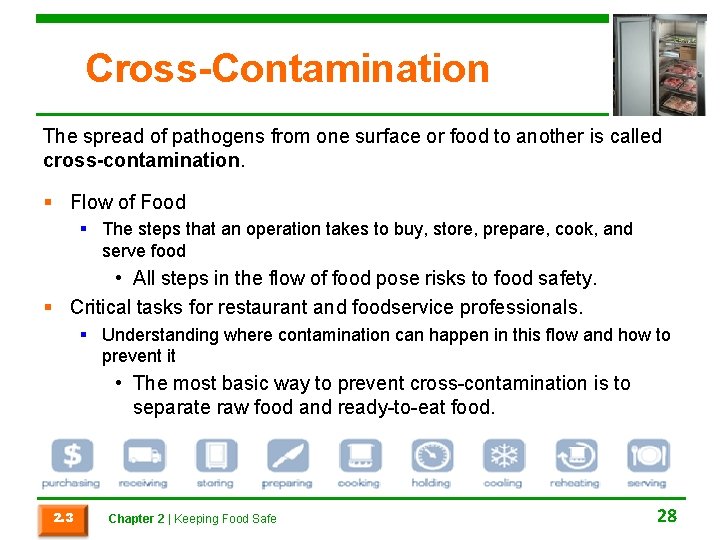
Cross-Contamination The spread of pathogens from one surface or food to another is called cross-contamination. § Flow of Food § The steps that an operation takes to buy, store, prepare, cook, and serve food • All steps in the flow of food pose risks to food safety. § Critical tasks for restaurant and foodservice professionals. § Understanding where contamination can happen in this flow and how to prevent it • The most basic way to prevent cross-contamination is to separate raw food and ready-to-eat food. 2. 3 Chapter 2 | Keeping Food Safe 28
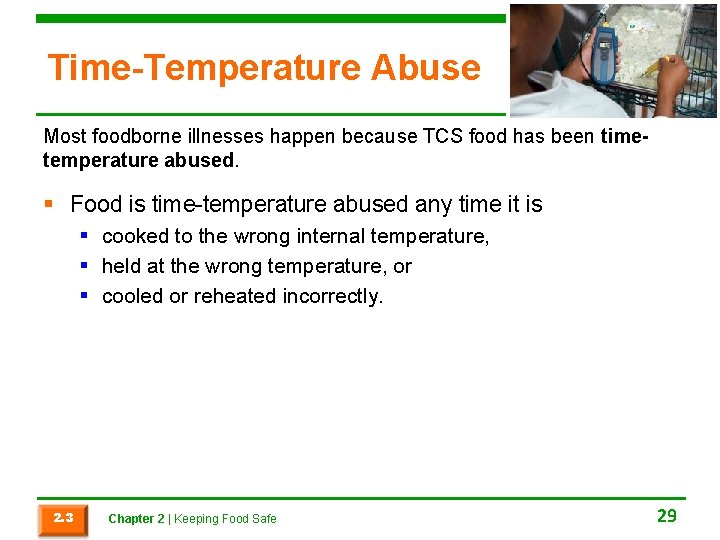
Time-Temperature Abuse Most foodborne illnesses happen because TCS food has been timetemperature abused. § Food is time-temperature abused any time it is § cooked to the wrong internal temperature, § held at the wrong temperature, or § cooled or reheated incorrectly. 2. 3 Chapter 2 | Keeping Food Safe 29
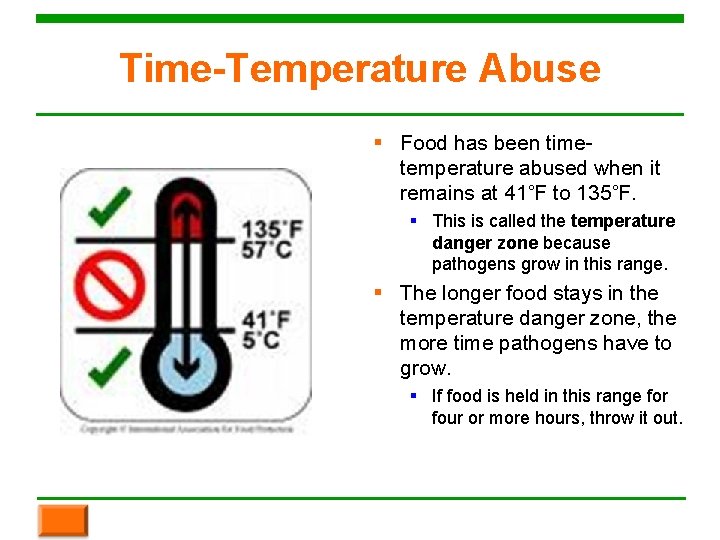
Time-Temperature Abuse § Food has been timetemperature abused when it remains at 41˚F to 135˚F. § This is called the temperature danger zone because pathogens grow in this range. § The longer food stays in the temperature danger zone, the more time pathogens have to grow. § If food is held in this range for four or more hours, throw it out.
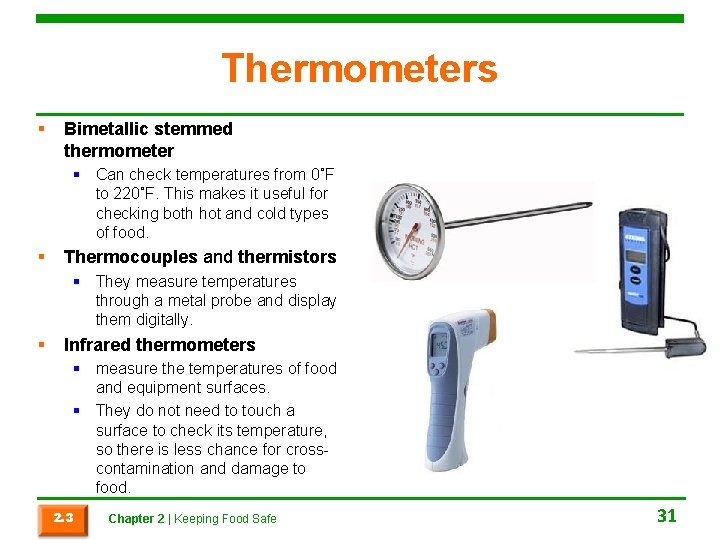
Thermometers § Bimetallic stemmed thermometer § Can check temperatures from 0˚F to 220˚F. This makes it useful for checking both hot and cold types of food. § Thermocouples and thermistors § They measure temperatures through a metal probe and display them digitally. § Infrared thermometers § measure the temperatures of food and equipment surfaces. § They do not need to touch a surface to check its temperature, so there is less chance for crosscontamination and damage to food. 2. 3 Chapter 2 | Keeping Food Safe 31
Purchasing All the food used in a restaurant or foodservice operation should come from approved, reputable suppliers. §Has been inspected by appropriate agencies and meets all applicable local, state, and federal laws. §Restaurant and foodservice purchasers must make sure that their suppliers use good food safety practices along the supply chain. § An operation’s supply chain can include • • • growers, shippers, packers, manufacturers, distributors (trucking fleets and warehouses), and/or • local markets. 2. 3 Chapter 2 | Keeping Food Safe 32
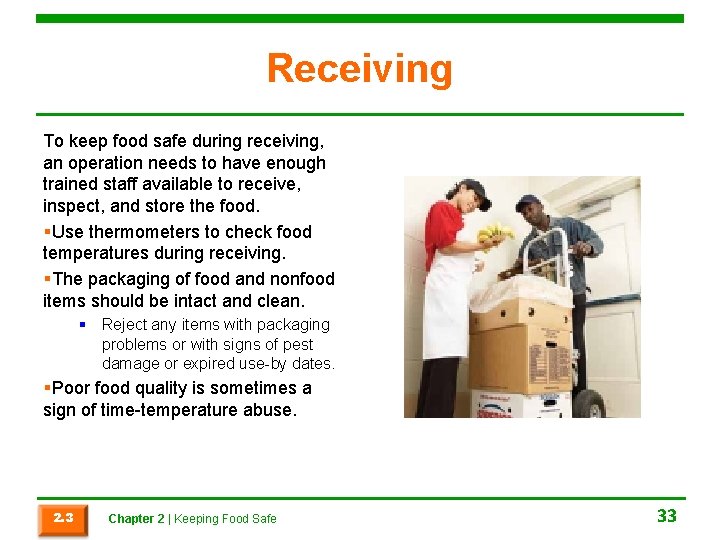
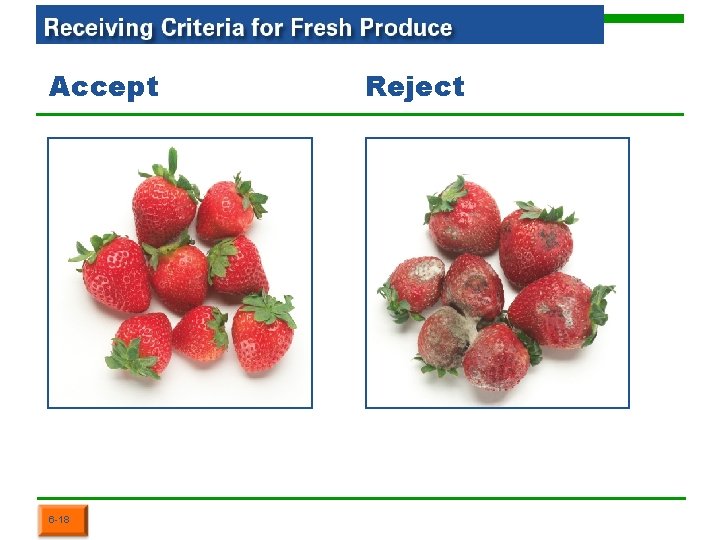
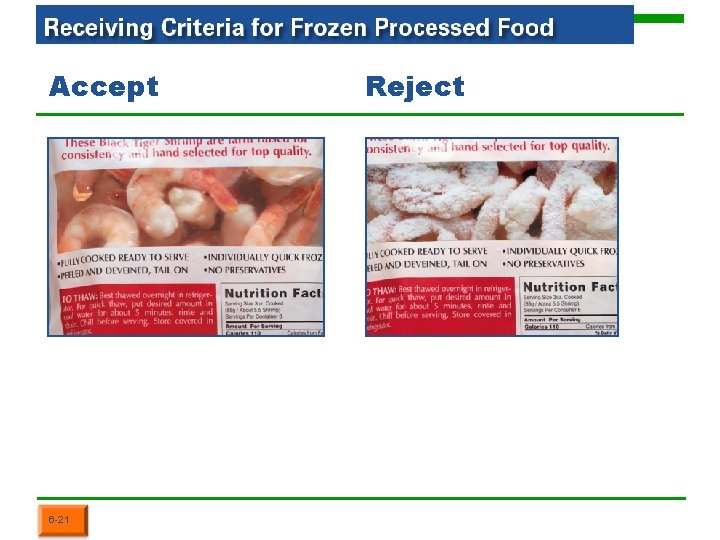
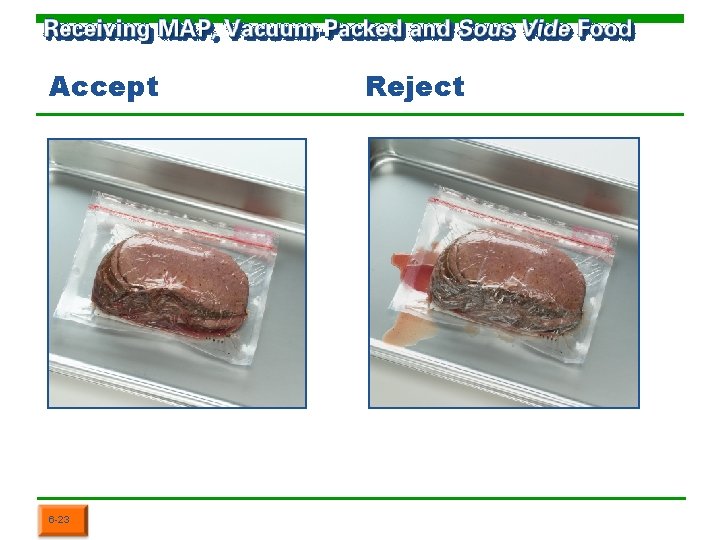
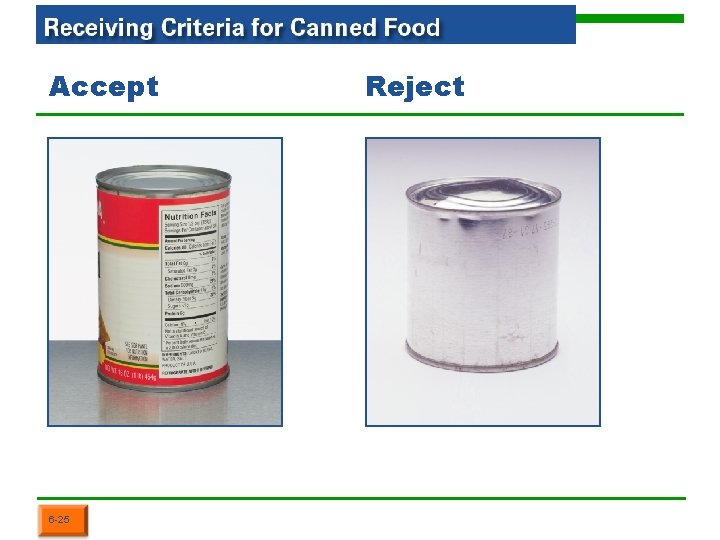
Receiving To keep food safe during receiving, an operation needs to have enough trained staff available to receive, inspect, and store the food. §Use thermometers to check food temperatures during receiving. §The packaging of food and nonfood items should be intact and clean. § Reject any items with packaging problems or with signs of pest damage or expired use-by dates. §Poor food quality is sometimes a sign of time-temperature abuse. 2. 3 Chapter 2 | Keeping Food Safe 33
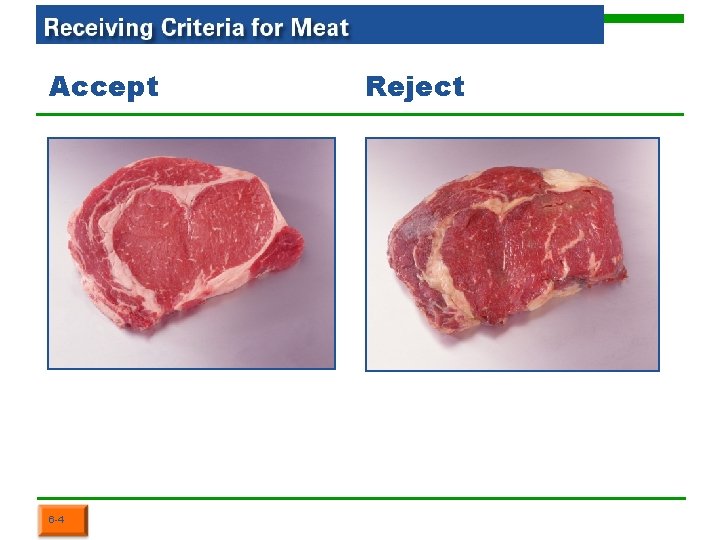
Accept 6 -4 Reject
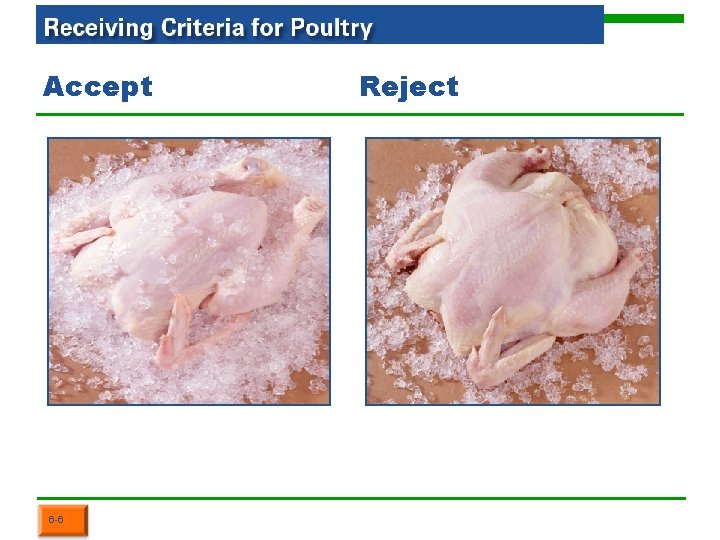
Accept 6 -6 Reject
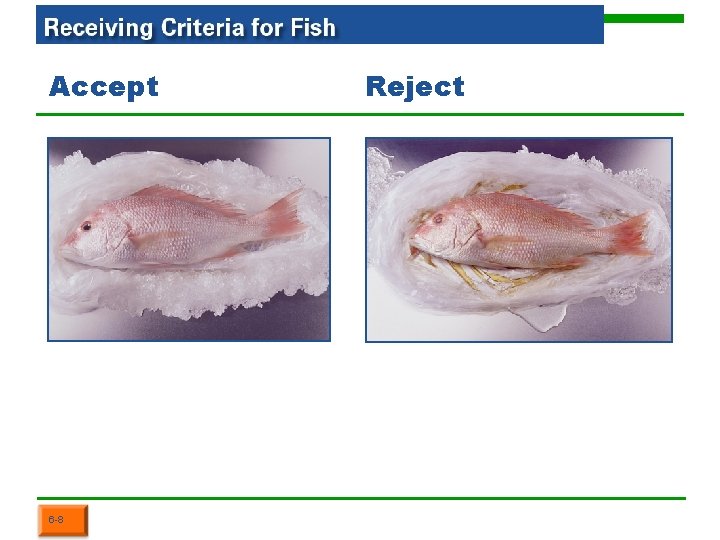
Accept 6 -8 Reject
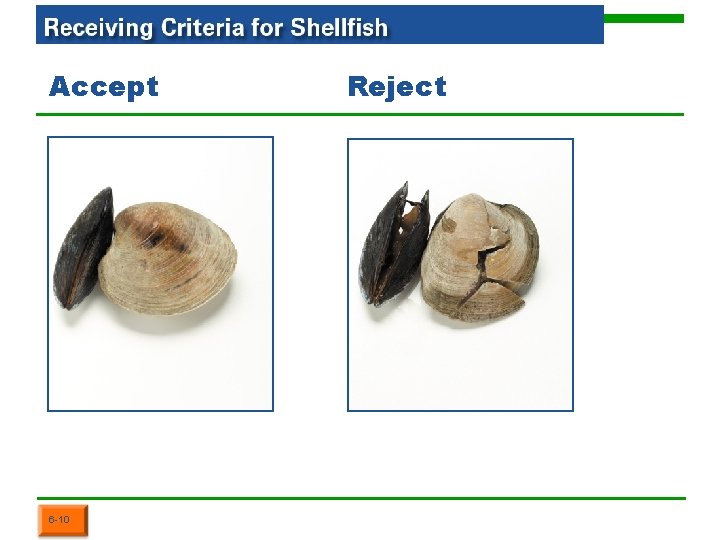
Accept 6 -10 Reject
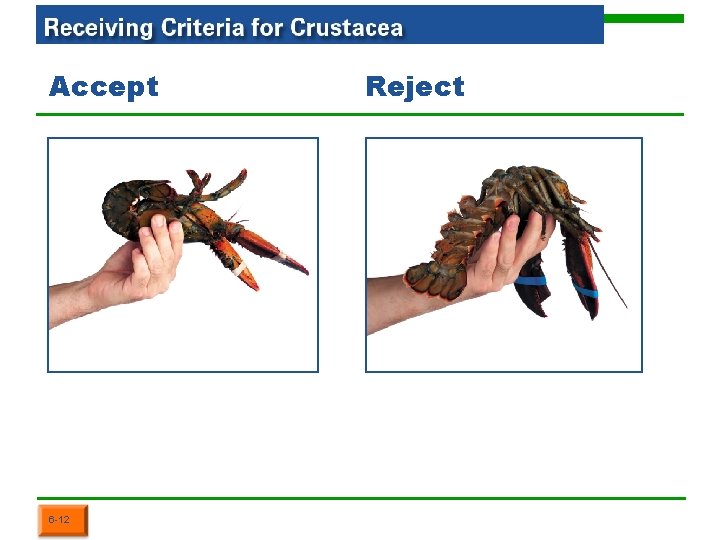
Accept 6 -12 Reject
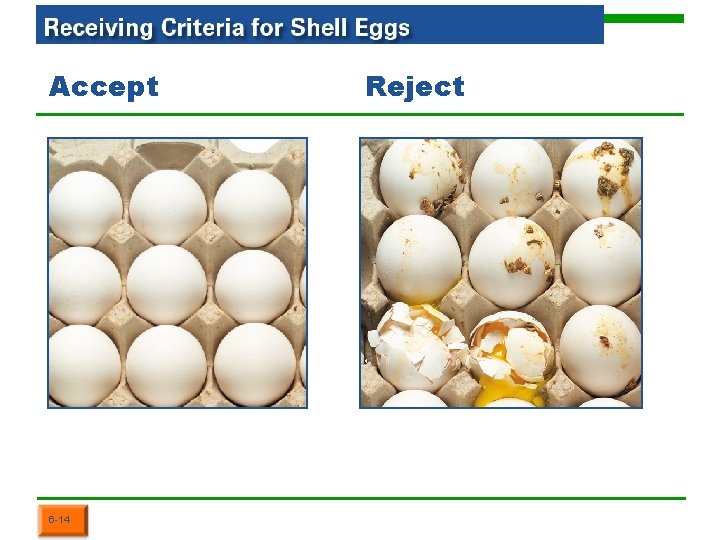
Accept 6 -14 Reject
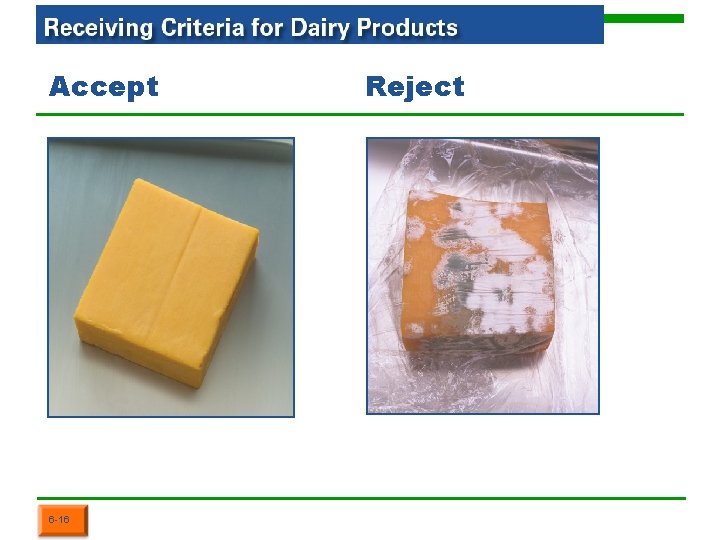
Accept 6 -16 Reject
Accept 6 -18 Reject
Accept 6 -21 Reject
Accept 6 -23 Reject
Accept 6 -25 Reject
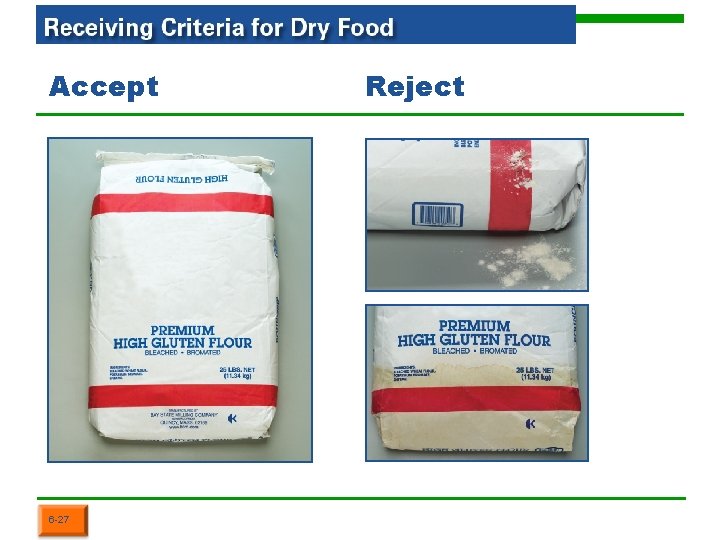
Accept 6 -27 Reject
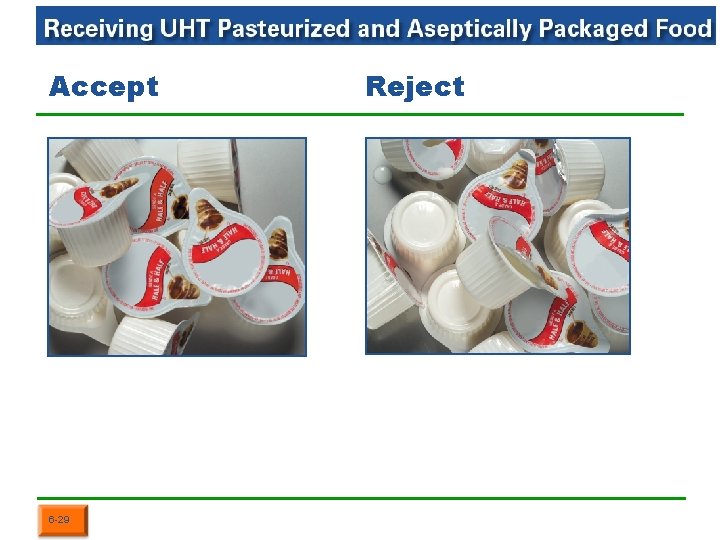
Accept 6 -29 Reject
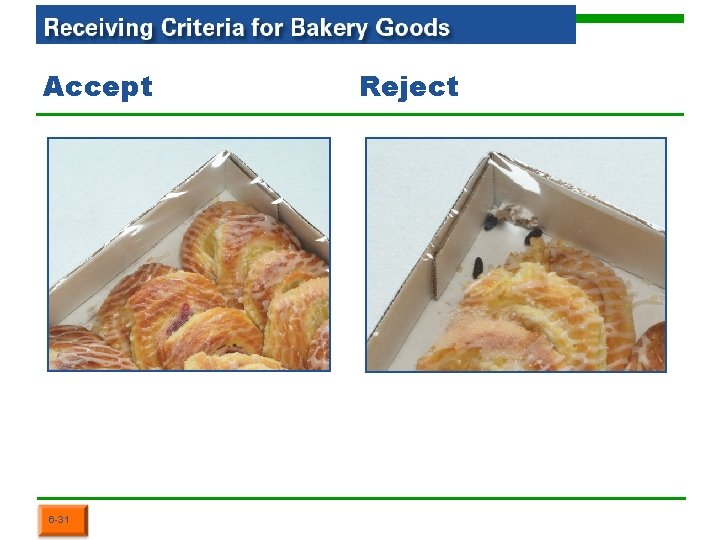
Accept 6 -31 Reject
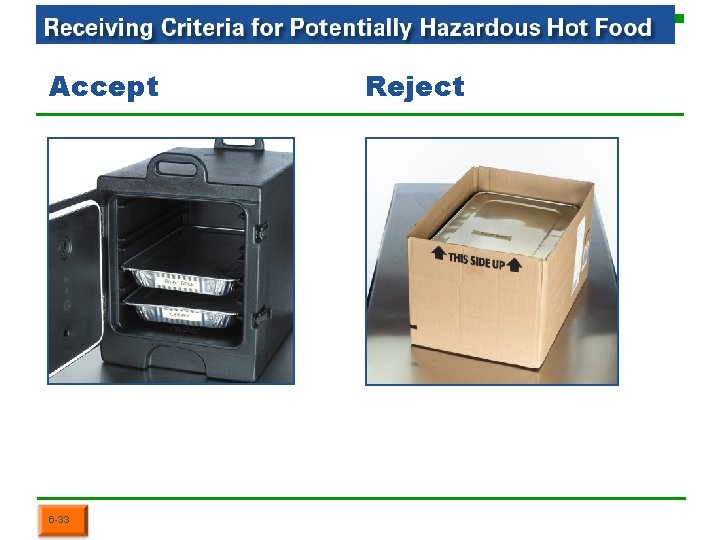
Accept 6 -33 Reject
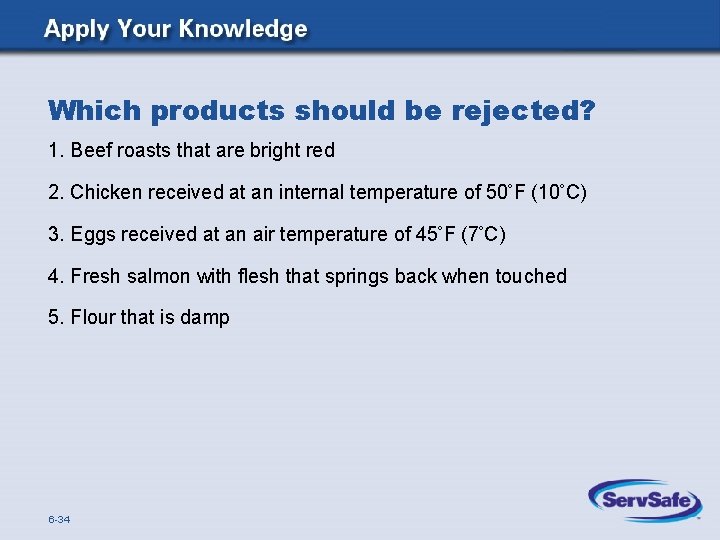
Which products should be rejected? 1. Beef roasts that are bright red 2. Chicken received at an internal temperature of 50 F (10 C) 3. Eggs received at an air temperature of 45 F (7 C) 4. Fresh salmon with flesh that springs back when touched 5. Flour that is damp 6 -34
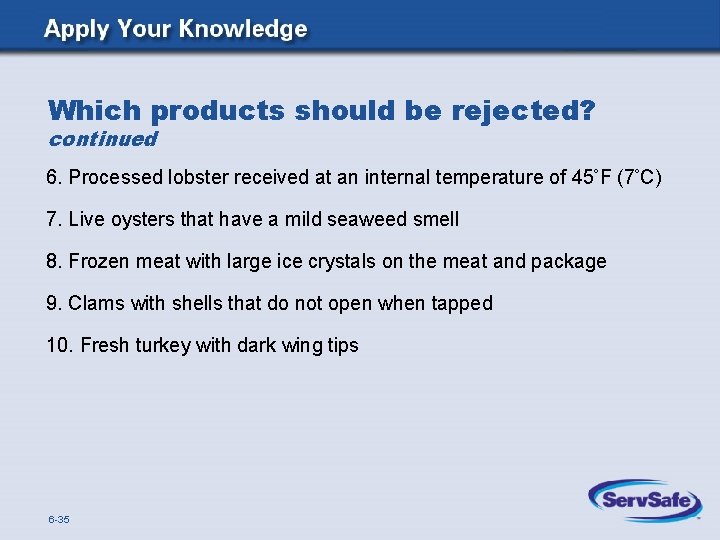
Which products should be rejected? continued 6. Processed lobster received at an internal temperature of 45 F (7 C) 7. Live oysters that have a mild seaweed smell 8. Frozen meat with large ice crystals on the meat and package 9. Clams with shells that do not open when tapped 10. Fresh turkey with dark wing tips 6 -35
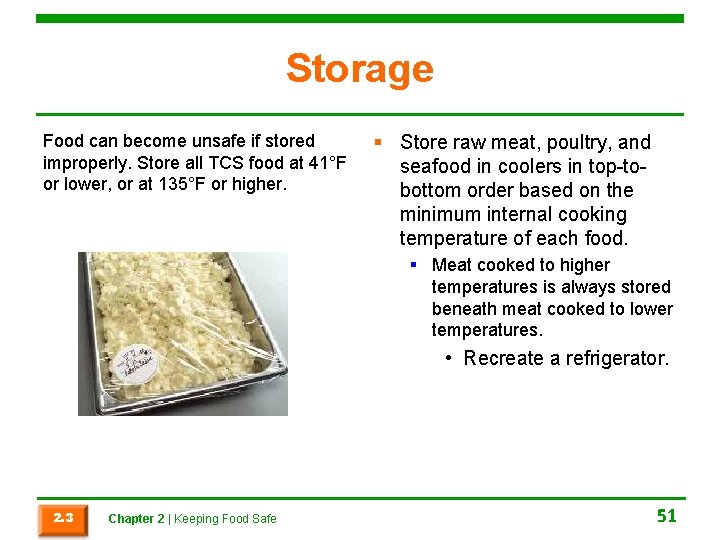
Storage Food can become unsafe if stored improperly. Store all TCS food at 41°F or lower, or at 135°F or higher. § Store raw meat, poultry, and seafood in coolers in top-tobottom order based on the minimum internal cooking temperature of each food. § Meat cooked to higher temperatures is always stored beneath meat cooked to lower temperatures. • Recreate a refrigerator. 2. 3 Chapter 2 | Keeping Food Safe 51
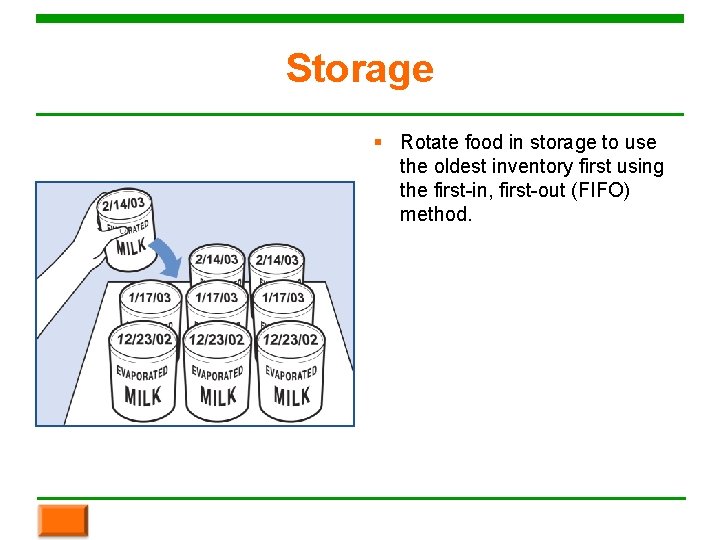
Storage § Rotate food in storage to use the oldest inventory first using the first-in, first-out (FIFO) method.
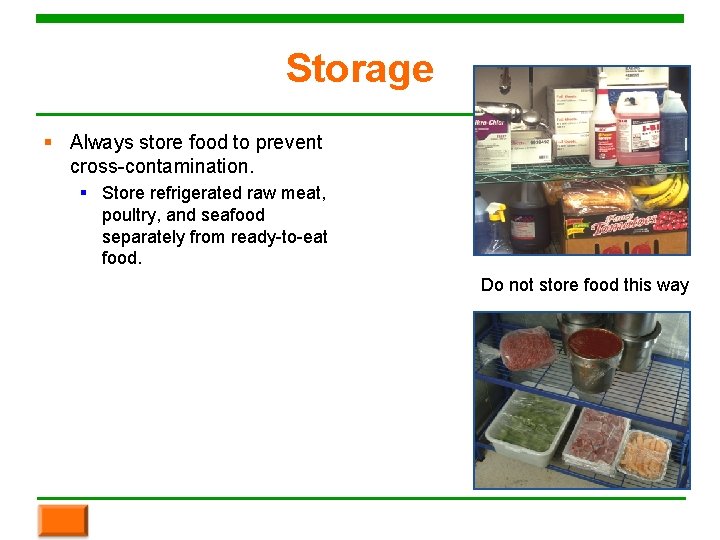
Storage § Always store food to prevent cross-contamination. § Store refrigerated raw meat, poultry, and seafood separately from ready-to-eat food. Do not store food this way
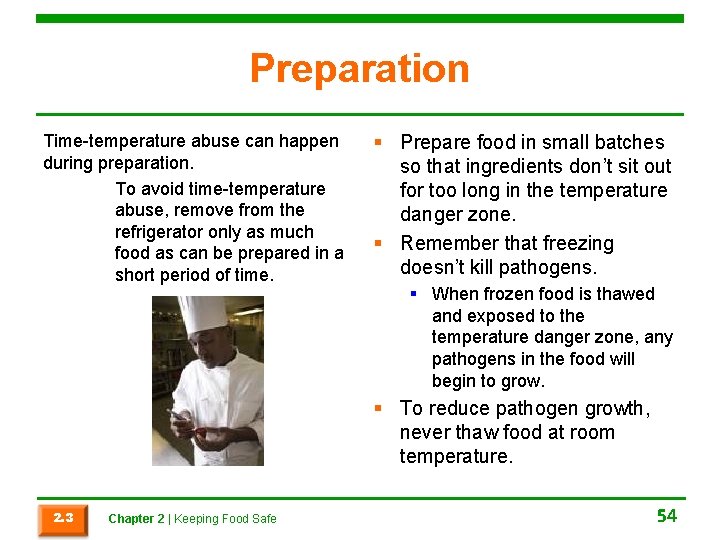
Preparation Time-temperature abuse can happen during preparation. To avoid time-temperature abuse, remove from the refrigerator only as much food as can be prepared in a short period of time. § Prepare food in small batches so that ingredients don’t sit out for too long in the temperature danger zone. § Remember that freezing doesn’t kill pathogens. § When frozen food is thawed and exposed to the temperature danger zone, any pathogens in the food will begin to grow. § To reduce pathogen growth, never thaw food at room temperature. 2. 3 Chapter 2 | Keeping Food Safe 54
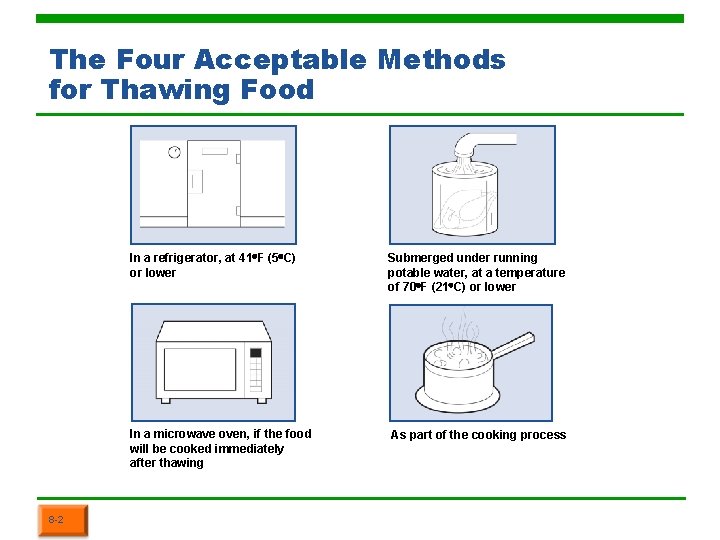
The Four Acceptable Methods for Thawing Food 8 -2 In a refrigerator, at 41 F (5 C) or lower Submerged under running potable water, at a temperature of 70 F (21 C) or lower In a microwave oven, if the food will be cooked immediately after thawing As part of the cooking process
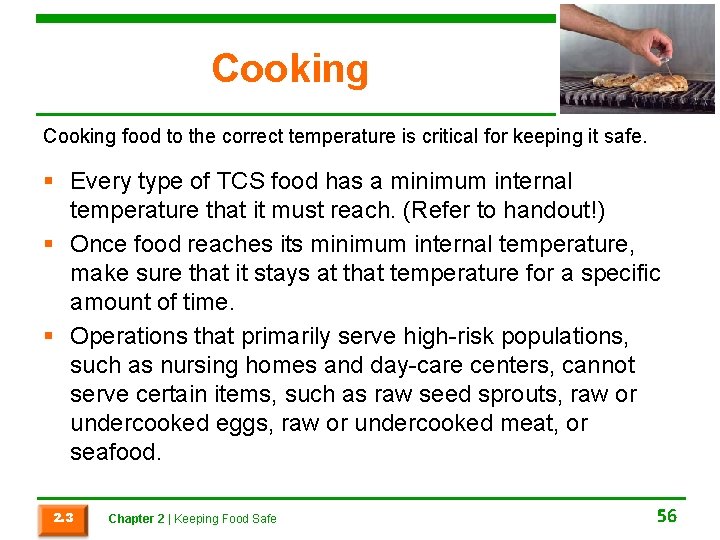
Cooking food to the correct temperature is critical for keeping it safe. § Every type of TCS food has a minimum internal temperature that it must reach. (Refer to handout!) § Once food reaches its minimum internal temperature, make sure that it stays at that temperature for a specific amount of time. § Operations that primarily serve high-risk populations, such as nursing homes and day-care centers, cannot serve certain items, such as raw seed sprouts, raw or undercooked eggs, raw or undercooked meat, or seafood. 2. 3 Chapter 2 | Keeping Food Safe 56
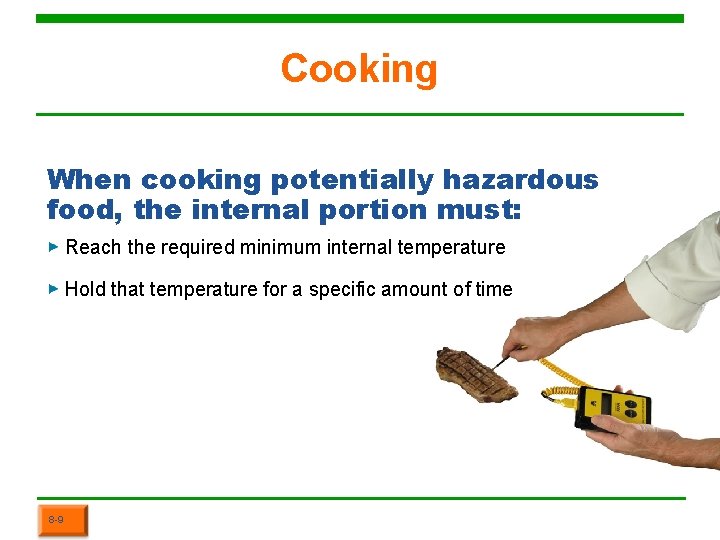
Cooking When cooking potentially hazardous food, the internal portion must: Reach the required minimum internal temperature Hold that temperature for a specific amount of time 8 -9
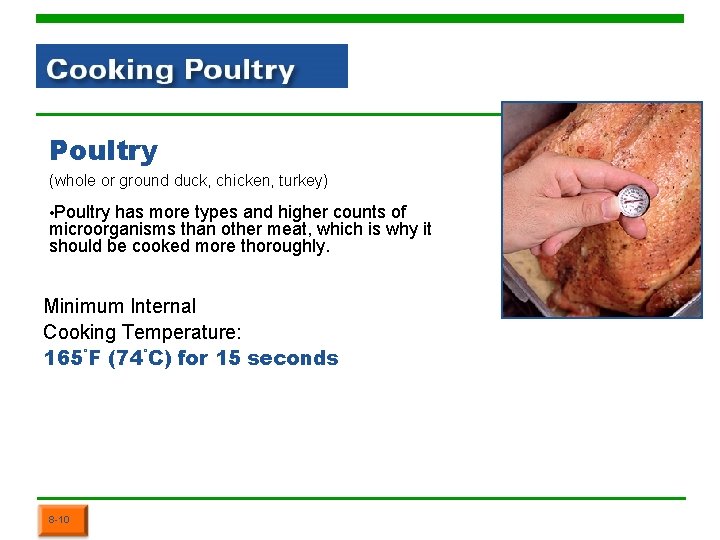
Poultry (whole or ground duck, chicken, turkey) • Poultry has more types and higher counts of microorganisms than other meat, which is why it should be cooked more thoroughly. Minimum Internal Cooking Temperature: 165°F (74°C) for 15 seconds 8 -10
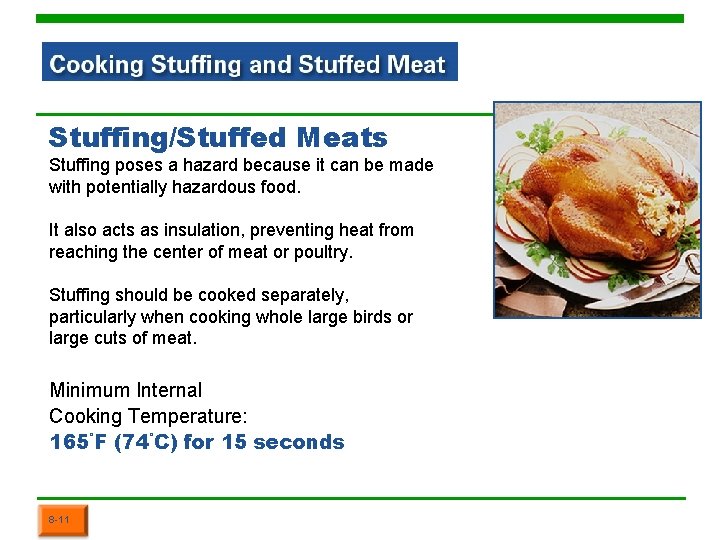
Stuffing/Stuffed Meats Stuffing poses a hazard because it can be made with potentially hazardous food. It also acts as insulation, preventing heat from reaching the center of meat or poultry. Stuffing should be cooked separately, particularly when cooking whole large birds or large cuts of meat. Minimum Internal Cooking Temperature: 165°F (74°C) for 15 seconds 8 -11
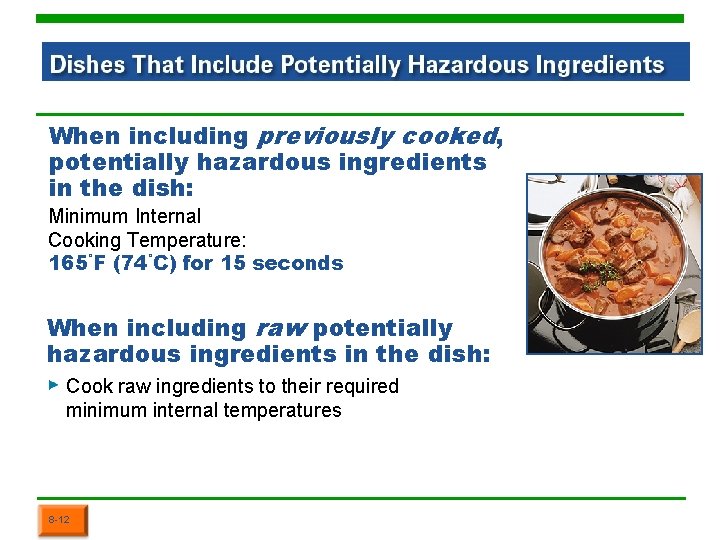
When including previously cooked, potentially hazardous ingredients in the dish: Minimum Internal Cooking Temperature: 165°F (74°C) for 15 seconds When including raw potentially hazardous ingredients in the dish: Cook raw ingredients to their required minimum internal temperatures 8 -12
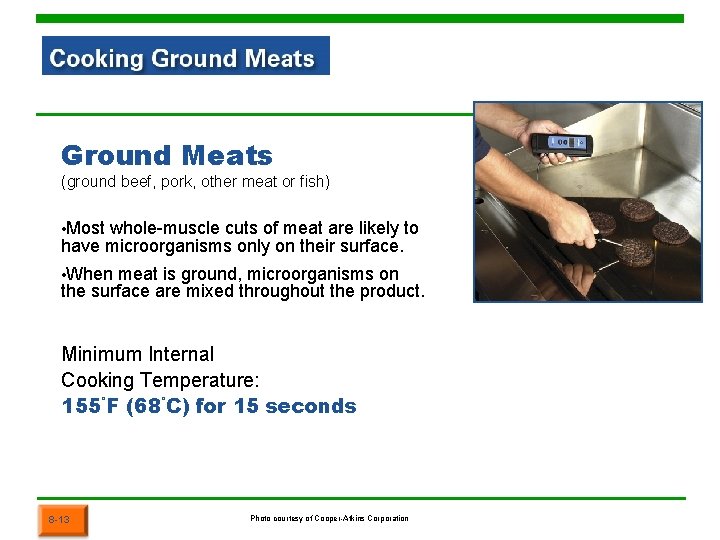
Ground Meats (ground beef, pork, other meat or fish) • Most whole-muscle cuts of meat are likely to have microorganisms only on their surface. • When meat is ground, microorganisms on the surface are mixed throughout the product. Minimum Internal Cooking Temperature: 155°F (68°C) for 15 seconds 8 -13 Photo courtesy of Cooper-Atkins Corporation
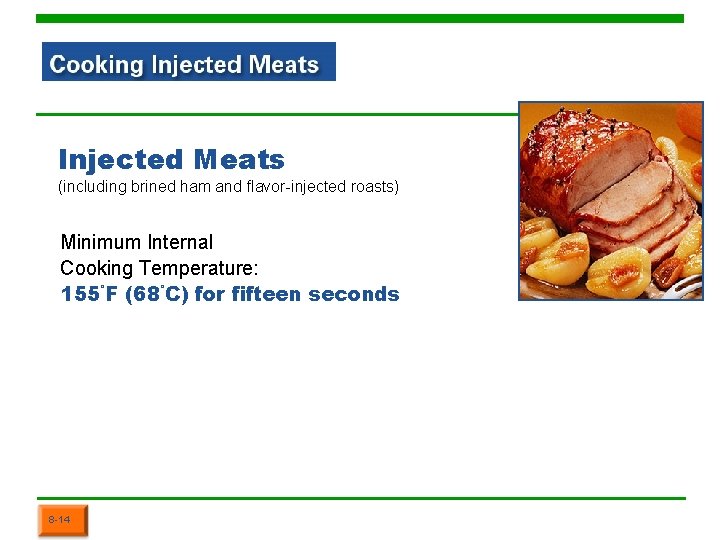
Injected Meats (including brined ham and flavor-injected roasts) Minimum Internal Cooking Temperature: 155°F (68°C) for fifteen seconds 8 -14
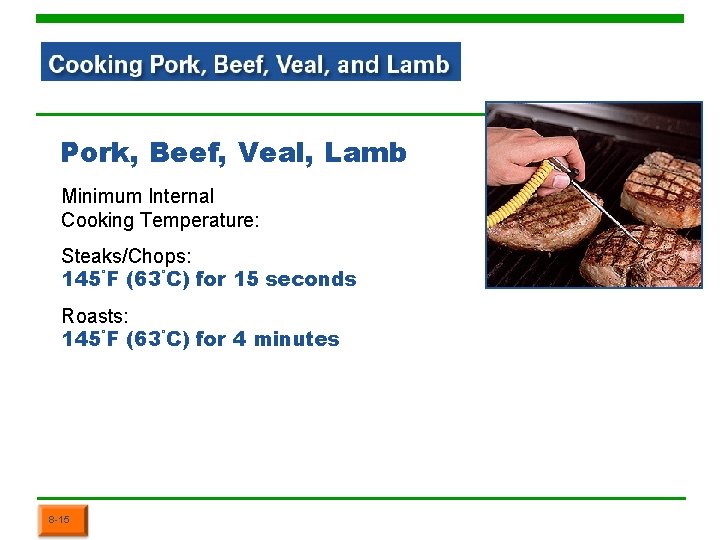
Pork, Beef, Veal, Lamb Minimum Internal Cooking Temperature: Steaks/Chops: 145°F (63°C) for 15 seconds Roasts: 145°F (63°C) for 4 minutes 8 -15
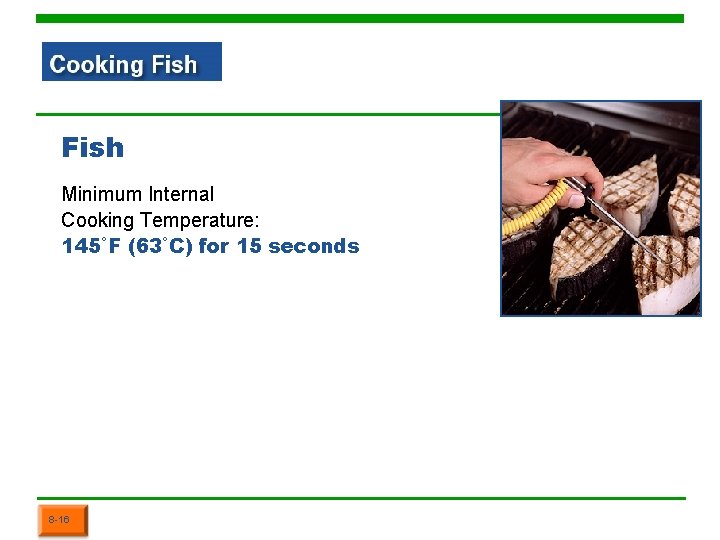
Fish Minimum Internal Cooking Temperature: 145˚F (63˚C) for 15 seconds 8 -16
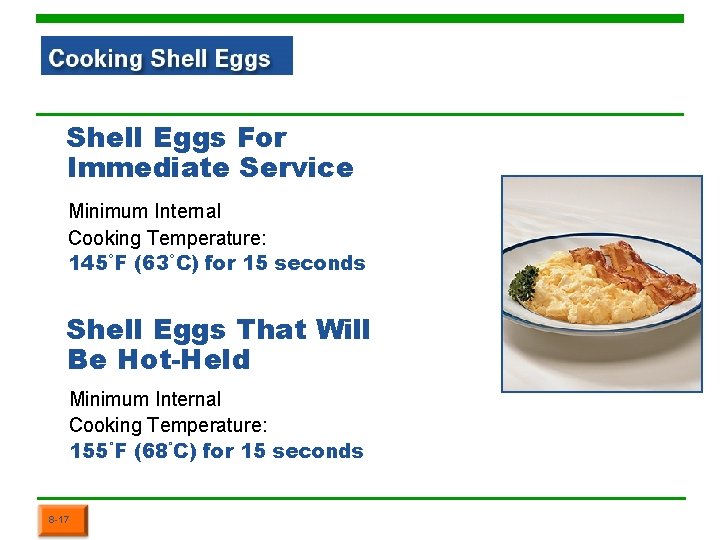
Shell Eggs For Immediate Service Minimum Internal Cooking Temperature: 145˚F (63˚C) for 15 seconds Shell Eggs That Will Be Hot-Held Minimum Internal Cooking Temperature: 155°F (68°C) for 15 seconds 8 -17
Fruit or Vegetables That Will Be Hot-Held for Service Minimum Internal Cooking Temperature: 135°F (57°C) 8 -18
Commercially Processed, Ready-to-Eat Food That Will Be Hot-held for Service (Includes cheese sticks, deep-fried vegetables, chicken wings, etc. ) Minimum Internal Cooking Temperature: 135°F (57°C) for 15 seconds 8 -19
Potentially Hazardous Food Cooked In A Microwave (eggs, poultry, fish, and meat) Minimum Internal Cooking Temperature: 165˚F (74˚C) 8 -20
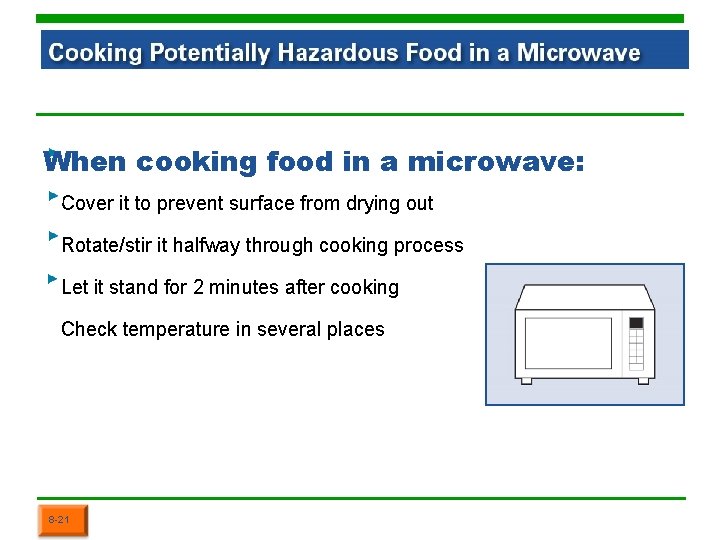
When cooking food in a microwave: Cover it to prevent surface from drying out Rotate/stir it halfway through cooking process Let it stand for 2 minutes after cooking Check temperature in several places 8 -21
What is the minimum internal cooking temperature for each of these items? 1. Ahi tuna steak 2. Green beans that will be hot-held 3. Ground pork 4. Lamb chops 5. Shell eggs for immediate service 6. Duck 7. Precooked frozen hot wings 8. Steak 9. Chicken enchiladas prepared with previously cooked chicken 10. Pork loin injected with marinade 8 -22
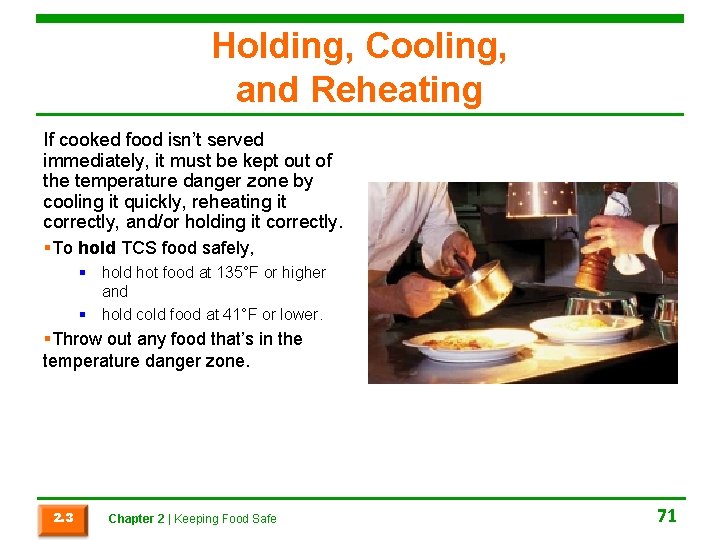
Holding, Cooling, and Reheating If cooked food isn’t served immediately, it must be kept out of the temperature danger zone by cooling it quickly, reheating it correctly, and/or holding it correctly. §To hold TCS food safely, § hold hot food at 135°F or higher and § hold cold food at 41°F or lower. §Throw out any food that’s in the temperature danger zone. 2. 3 Chapter 2 | Keeping Food Safe 71
When reheating food for hot-holding, heat it to an internal temperature of: 165°F (74°C) for 15 seconds within 2 hours If not, the food must be discarded! 8 -29
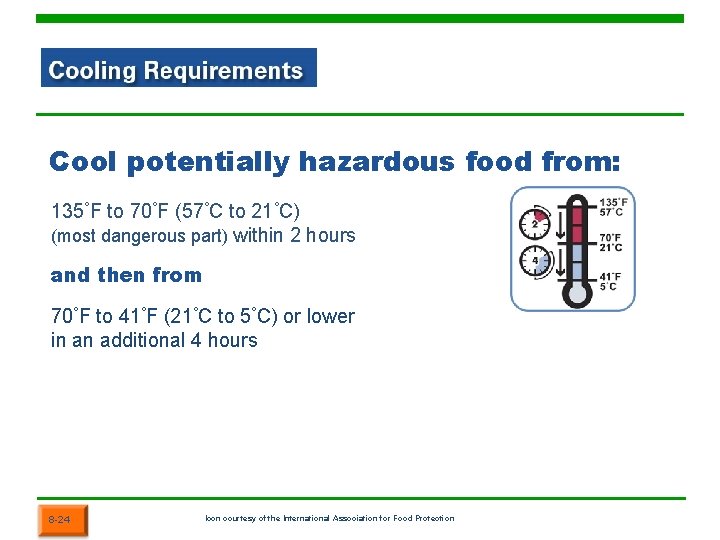
Cool potentially hazardous food from: 135°F to 70°F (57°C to 21°C) (most dangerous part) within 2 hours and then from 70°F to 41°F (21°C to 5°C) or lower in an additional 4 hours 8 -24 Icon courtesy of the International Association for Food Protection
Several factors affect how quickly food will cool, including: Thickness or density of the food The thicker the food, the more slowly it will cool. The container in which the food is stored Stainless steel containers transfer heat from food faster than plastic, Shallow pans transfer heat faster than deep pans. 8 -25
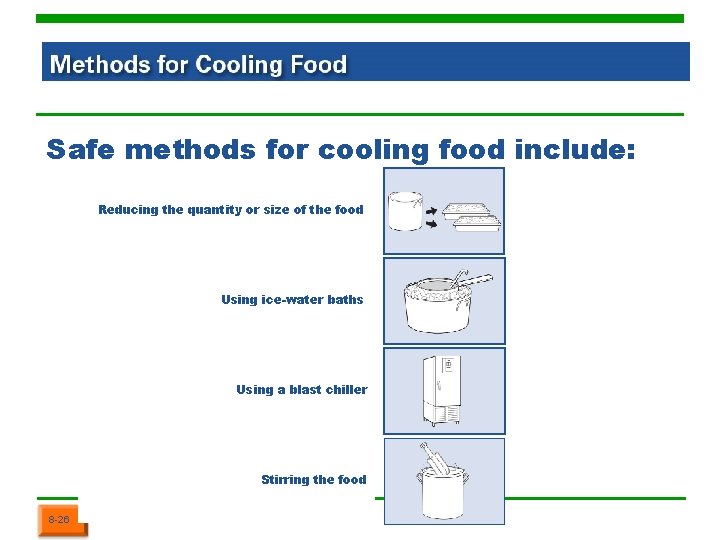
Safe methods for cooling food include: Reducing the quantity or size of the food Using ice-water baths Using a blast chiller Stirring the food 8 -26
Is the soup safe to serve? 1. A stockpot of soup was held for service at 135 F (57 C). 2. The stockpot was placed into an ice-water bath at 8: 00 A. M. 3. At 10: 00 A. M. , the soup was 90 F (32 C). 4. At 11: 00 A. M. , the soup was 70 F (21 C). 5. The soup was poured into shallow pans. 6. The pans were placed in the walk-in on the top shelf. 8 -28
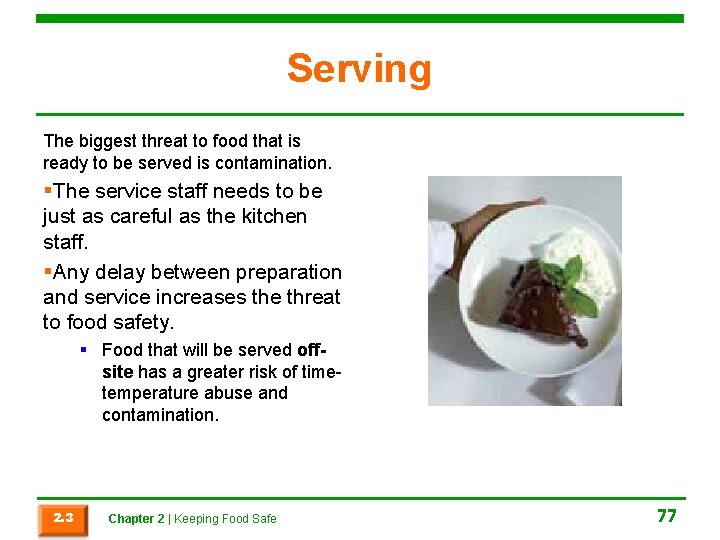
Serving The biggest threat to food that is ready to be served is contamination. §The service staff needs to be just as careful as the kitchen staff. §Any delay between preparation and service increases the threat to food safety. § Food that will be served offsite has a greater risk of timetemperature abuse and contamination. 2. 3 Chapter 2 | Keeping Food Safe 77
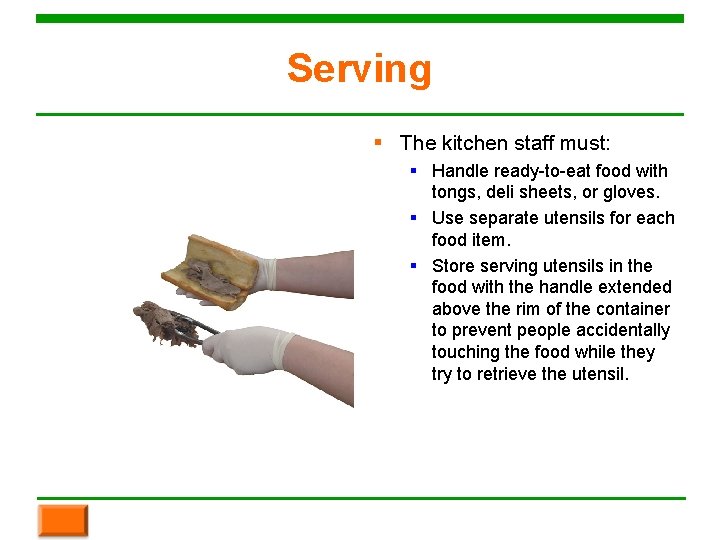
Serving § The kitchen staff must: § Handle ready-to-eat food with tongs, deli sheets, or gloves. § Use separate utensils for each food item. § Store serving utensils in the food with the handle extended above the rim of the container to prevent people accidentally touching the food while they try to retrieve the utensil.
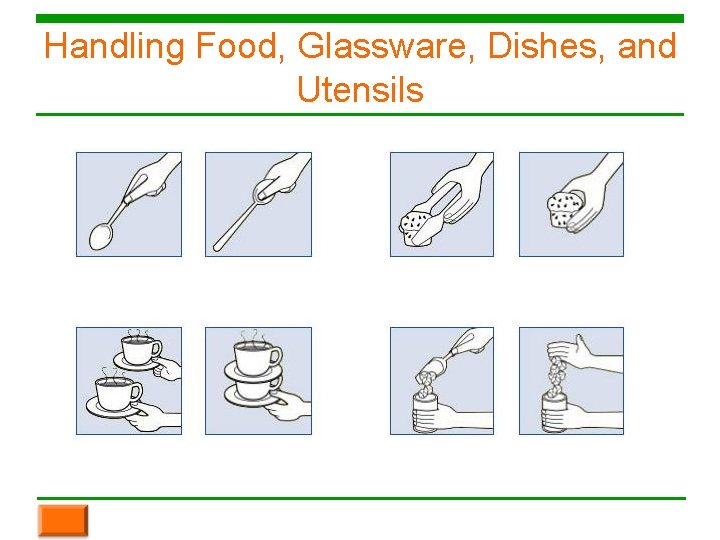
Handling Food, Glassware, Dishes, and Utensils
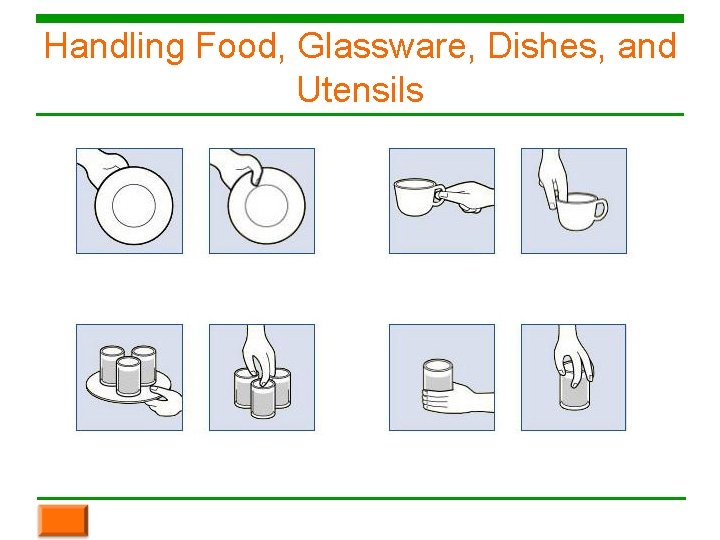
Handling Food, Glassware, Dishes, and Utensils
STOP!
Pro. Start Obj. 2. 0 pt 4 Keeping Food Safe
The HACCP Plan § An example of a food safety management system § Identifies major hazards at specific points within the flow of food through an operation • Figure out where a hazard might happen • Then prevent, eliminate, or reduce it.
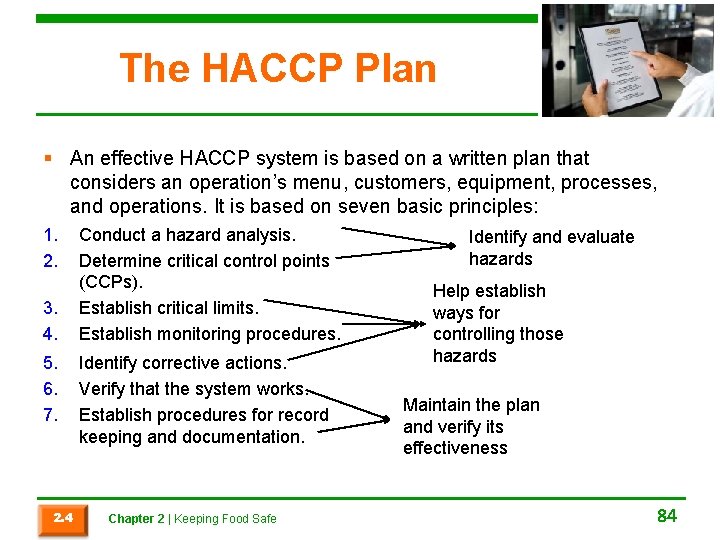
The HACCP Plan § An effective HACCP system is based on a written plan that considers an operation’s menu, customers, equipment, processes, and operations. It is based on seven basic principles: 1. 2. 3. 4. 5. 6. 7. 2. 4 Conduct a hazard analysis. Determine critical control points (CCPs). Establish critical limits. Establish monitoring procedures. Identify corrective actions. Verify that the system works. Establish procedures for record keeping and documentation. Chapter 2 | Keeping Food Safe Identify and evaluate hazards Help establish ways for controlling those hazards Maintain the plan and verify its effectiveness 84
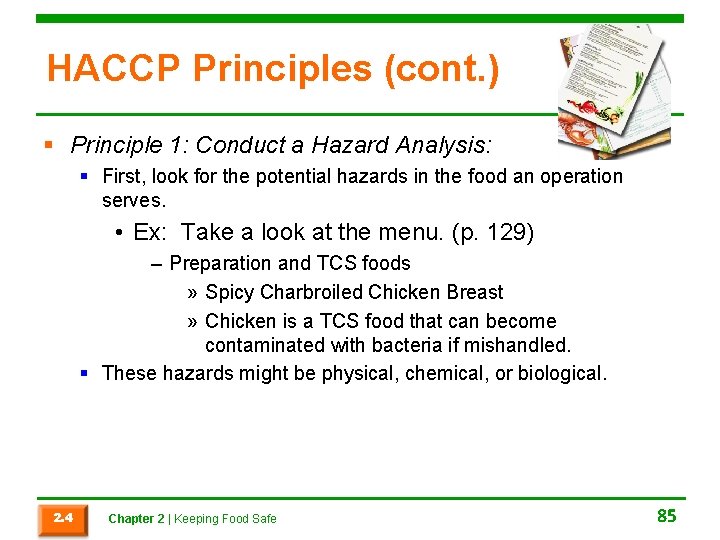
HACCP Principles (cont. ) § Principle 1: Conduct a Hazard Analysis: § First, look for the potential hazards in the food an operation serves. • Ex: Take a look at the menu. (p. 129) – Preparation and TCS foods » Spicy Charbroiled Chicken Breast » Chicken is a TCS food that can become contaminated with bacteria if mishandled. § These hazards might be physical, chemical, or biological. 2. 4 Chapter 2 | Keeping Food Safe 85
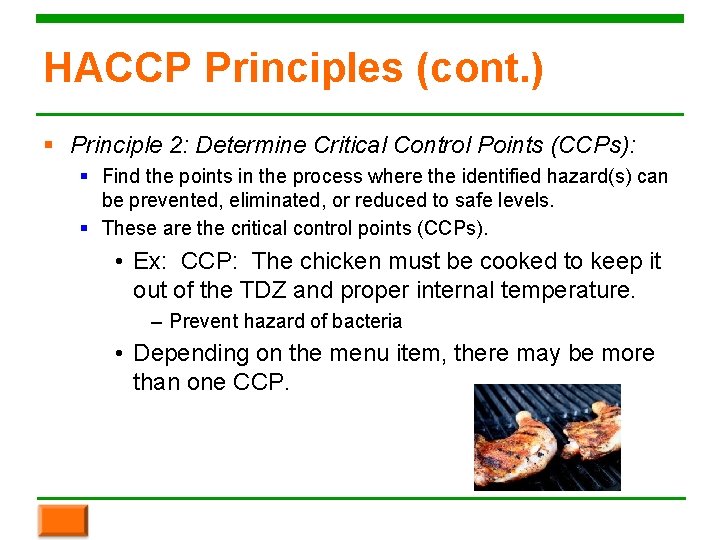
HACCP Principles (cont. ) § Principle 2: Determine Critical Control Points (CCPs): § Find the points in the process where the identified hazard(s) can be prevented, eliminated, or reduced to safe levels. § These are the critical control points (CCPs). • Ex: CCP: The chicken must be cooked to keep it out of the TDZ and proper internal temperature. – Prevent hazard of bacteria • Depending on the menu item, there may be more than one CCP.
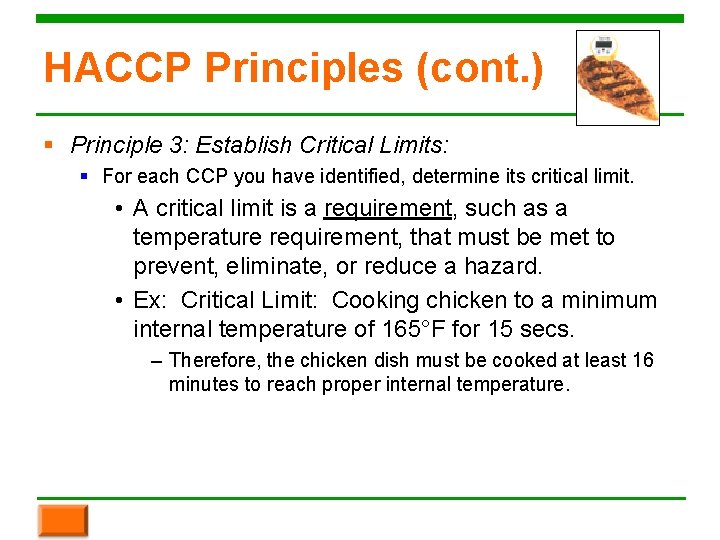
HACCP Principles (cont. ) § Principle 3: Establish Critical Limits: § For each CCP you have identified, determine its critical limit. • A critical limit is a requirement, such as a temperature requirement, that must be met to prevent, eliminate, or reduce a hazard. • Ex: Critical Limit: Cooking chicken to a minimum internal temperature of 165°F for 15 secs. – Therefore, the chicken dish must be cooked at least 16 minutes to reach proper internal temperature.
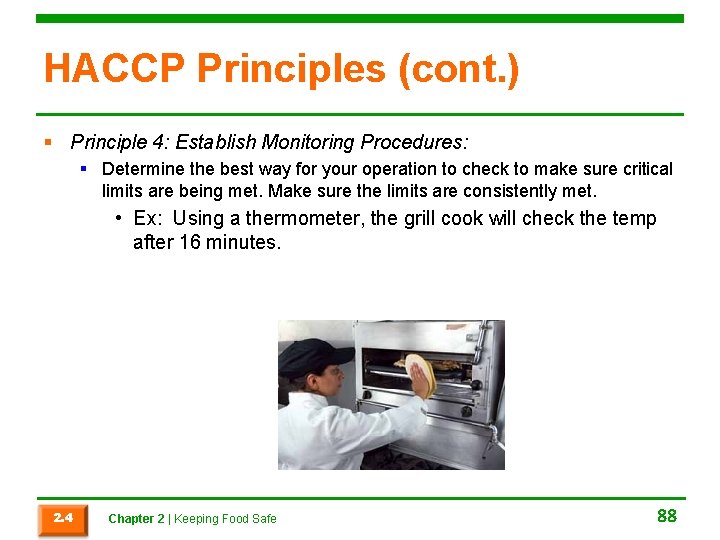
HACCP Principles (cont. ) § Principle 4: Establish Monitoring Procedures: § Determine the best way for your operation to check to make sure critical limits are being met. Make sure the limits are consistently met. • Ex: Using a thermometer, the grill cook will check the temp after 16 minutes. 2. 4 Chapter 2 | Keeping Food Safe 88
HACCP Principles (cont. ) § Principle 5: Identify Corrective Actions: § If a critical limit hasn’t been met, you must take a corrective action • A step to fix the problem. § Corrective actions should be determined in advance so everyone knows what to do when critical limits aren’t met. • Ex: If temperature of chicken is not 165°F for 15 secs, the grill cook will continue to cook the food until it reaches that temperature. • This is noted in the temperature log.
HACCP Principles (cont. ) § Principle 6: Verify that the System Works: § Determine if the plan is working as intended. § Evaluate it on a regular basis. • Temperature log helps the manager to see if there is a pattern. • Determined that chicken wasn’t reaching the temp desired later in the week. – Larger pieces are delivered on Thursdays. • Solution: Manager works with supplier. Weight checks during receiving.
HACCP Principles (cont. ) § Principle 7: Establish Procedures for Record Keeping and Documentation: § Maintain the HACCP plan and keep all documentation created when developing it. • Keep documentation of… – Monitoring activities – Taking corrective action – Validating equipment » Inspections » Repairs – Working with suppliers » Invoices » Purchase specifications
- Slides: 91