
PRM Awareness Training Welcome to Amsterdam Airport Schiphol


- Slides: 30
PRM Awareness Training Welcome to Amsterdam Airport Schiphol
Why is this training offered? • European rules and regulations stipulate that everyone working at a European airport is obliged to follow a training course on awareness and equal treatment of PRMs. • Among other things, this obligation applies to employees who come into contact with passengers and who provide direct assistance to PRMs. • While this training is offered by Schiphol, each organisation can decide for itself how to set up the training. 2
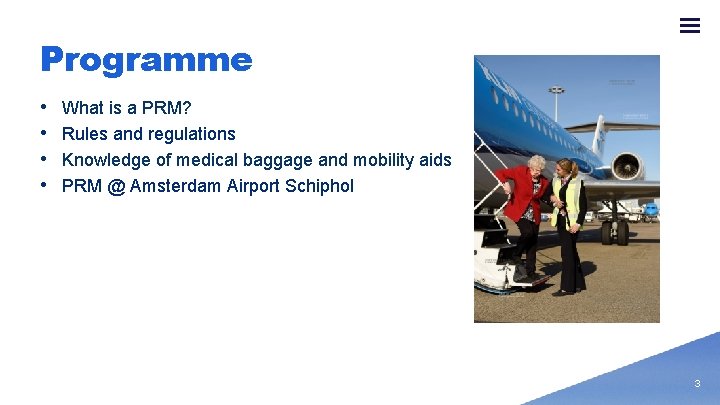
Programme • • What is a PRM? Rules and regulations Knowledge of medical baggage and mobility aids PRM @ Amsterdam Airport Schiphol 3
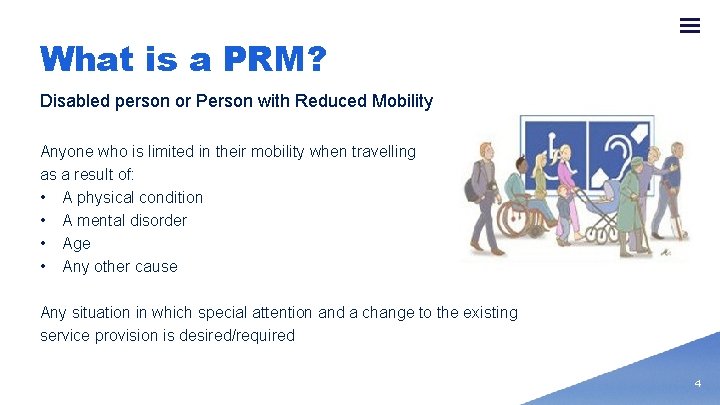
What is a PRM? Disabled person or Person with Reduced Mobility Anyone who is limited in their mobility when travelling as a result of: • A physical condition • A mental disorder • Age • Any other cause Any situation in which special attention and a change to the existing service provision is desired/required 4
What is a PRM? (continued) The 'Interpretative Guidelines' also include: • Obese people • Pregnant women • People travelling alone with young children 5
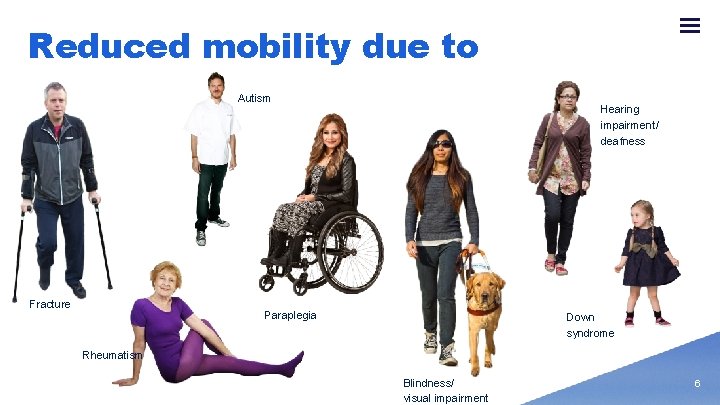
Reduced mobility due to Autism Fracture Hearing impairment/ deafness Paraplegia Down syndrome Rheumatism Blindness/ visual impairment 6
Causes of physical disability • Paraplegia: interruption of the neural pathways in the spinal cord, • • resulting in symptoms of paralysis Hemiplegia: often the result of a stroke Aphasia: language disorder caused by brain damage Physical illnesses: like MS, Parkinson's and ALS Mental disorders: like autism, dementia and Down syndrome 7
Rising number of PRMs due to • • Ageing Baby boomers* More people travelling as a result of low-cost carriers Increase in mental disorders such as dementia Airports becoming larger and more complex, especially for older people Free assistance (which is becoming increasingly well known) Passenger rights enshrined in law Globally, one in seven people (= 1 billion) have some type of disability * The generation born after WW 2 8
European rules and regulations There are three legal frameworks: 1. European Regulation No 1107/2006 2. Interpretative Guidelines 3. ECAC Document 30, Part 1, Section 5 • • • An anti-discrimination principle applies The airport is responsible for providing a solution to the inconvenience that it creates The law safeguards that PRMs get the assistance they need for free Equal rights also means equal obligations Verification of compliance by the Aviation Authority 9
Type of assistance by IATA code • -- WCHR • -- WCHS • -- WCHC • Blind • Deaf • DPNA Wheel Chair Ramp/can use stairs but not walk for longer distances Wheel Chair Stair/cannot use stairs Wheel Chair Completely/fully depends on assistance to enter and exit the aircraft Passenger with vision loss/blindness Passenger with hearing loss/deafness Disabled Person Needing Assistance/passenger with developmental or intellectual disability (dementia, Down syndrome) Described in ECAC Document 30 10
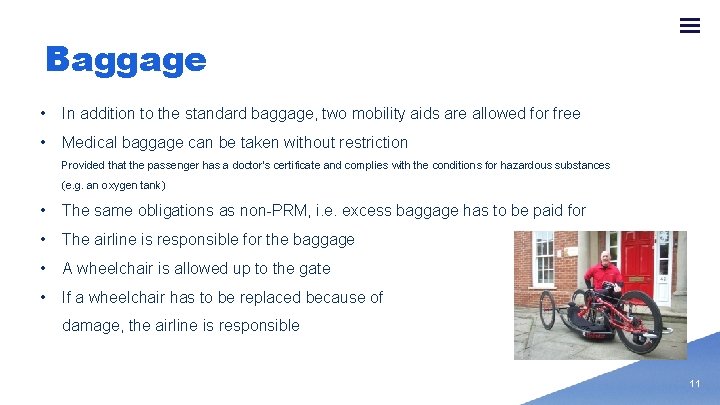
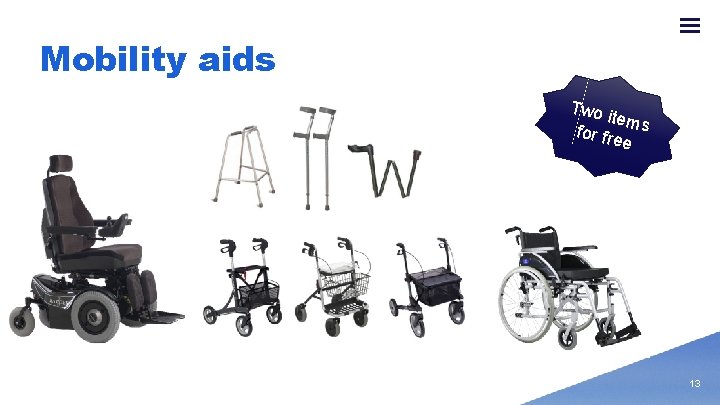
Baggage • In addition to the standard baggage, two mobility aids are allowed for free • Medical baggage can be taken without restriction Provided that the passenger has a doctor's certificate and complies with the conditions for hazardous substances (e. g. an oxygen tank) • The same obligations as non-PRM, i. e. excess baggage has to be paid for • The airline is responsible for the baggage • A wheelchair is allowed up to the gate • If a wheelchair has to be replaced because of damage, the airline is responsible 11
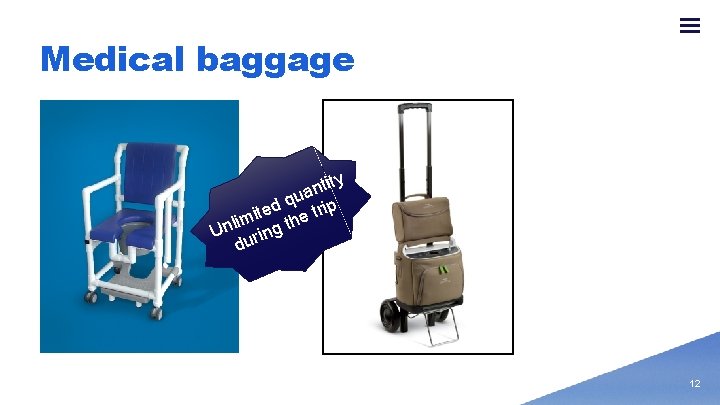
Medical baggage Type text here ity t n ua q ted e trip i m i h Unl ring t du 12
Mobility aids Two items for fre e 13
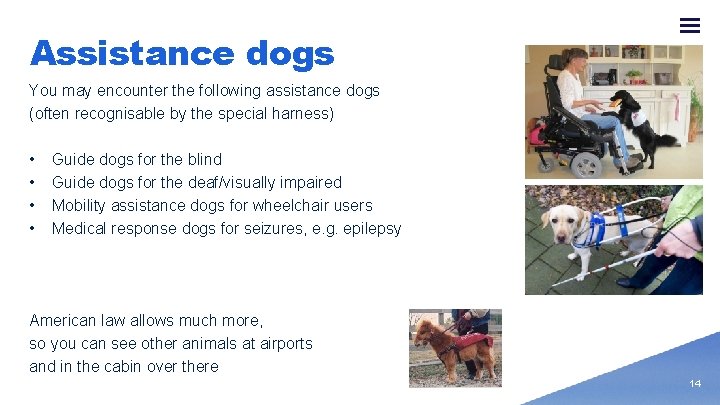
Assistance dogs You may encounter the following assistance dogs (often recognisable by the special harness) • • Guide dogs for the blind Guide dogs for the deaf/visually impaired Mobility assistance dogs for wheelchair users Medical response dogs for seizures, e. g. epilepsy American law allows much more, so you can see other animals at airports and in the cabin over there 14
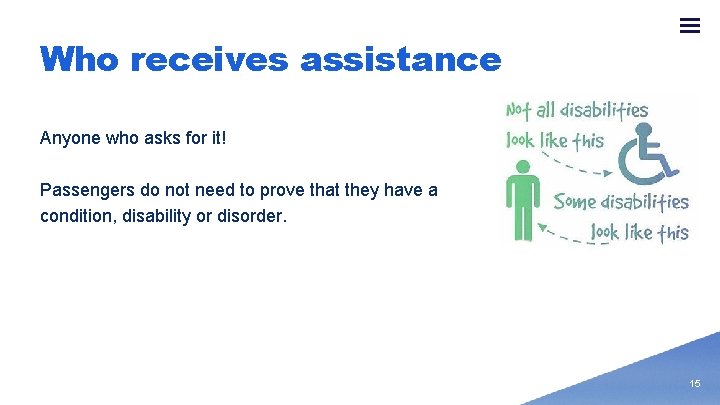
Who receives assistance Anyone who asks for it! Passengers do not need to prove that they have a condition, disability or disorder. 15
When not to provide assistance Based on: • Safety requirements --> assistance must not endanger the service provider • Aircraft dimensions --> PRM cannot be transported safely by airline Responsibility: • Offering a reasonable alternative • Attendant • Safety requirements • Refusal to share information 16
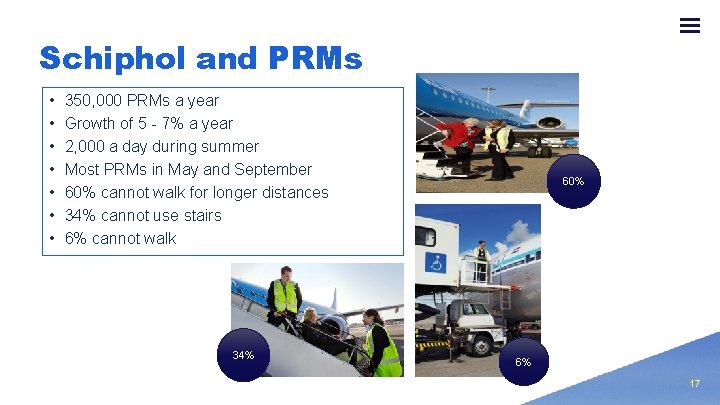
Schiphol and PRMs • • 350, 000 PRMs a year Growth of 5 - 7% a year 2, 000 a day during summer Most PRMs in May and September 60% cannot walk for longer distances 34% cannot use stairs 6% cannot walk 34% 60% 6% 17
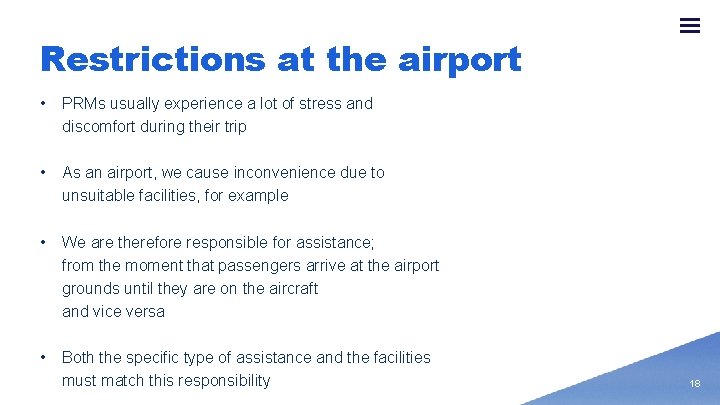
Restrictions at the airport • PRMs usually experience a lot of stress and discomfort during their trip • As an airport, we cause inconvenience due to unsuitable facilities, for example • We are therefore responsible for assistance; from the moment that passengers arrive at the airport grounds until they are on the aircraft and vice versa • Both the specific type of assistance and the facilities must match this responsibility 18
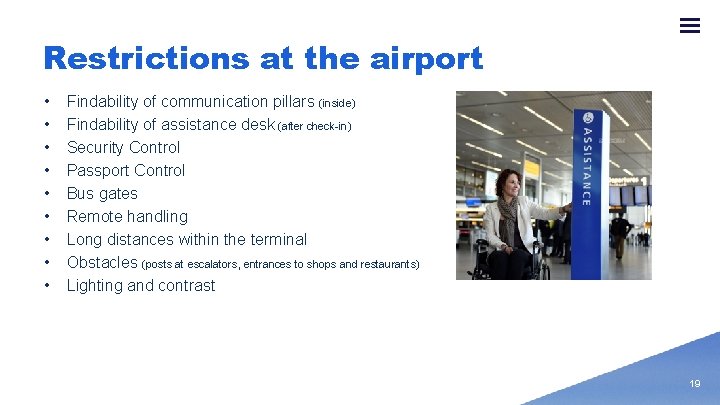
Restrictions at the airport • • • Findability of communication pillars (inside) Findability of assistance desk (after check-in) Security Control Passport Control Bus gates Remote handling Long distances within the terminal Obstacles (posts at escalators, entrances to shops and restaurants) Lighting and contrast 19
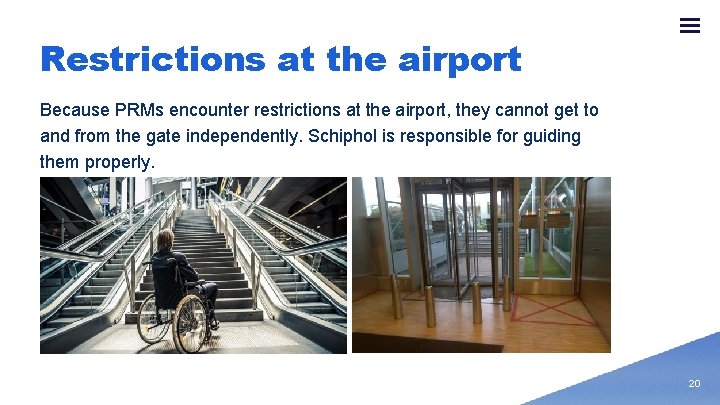
Restrictions at the airport Because PRMs encounter restrictions at the airport, they cannot get to and from the gate independently. Schiphol is responsible for guiding them properly. 20
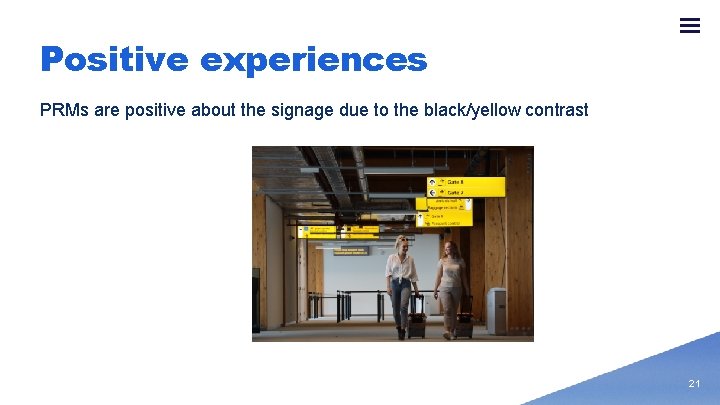
Positive experiences PRMs are positive about the signage due to the black/yellow contrast 21
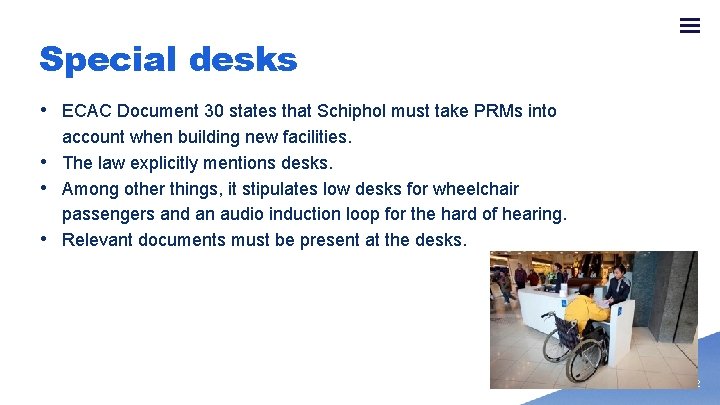
Special desks • ECAC Document 30 states that Schiphol must take PRMs into account when building new facilities. • The law explicitly mentions desks. • Among other things, it stipulates low desks for wheelchair passengers and an audio induction loop for the hard of hearing. • Relevant documents must be present at the desks. 22
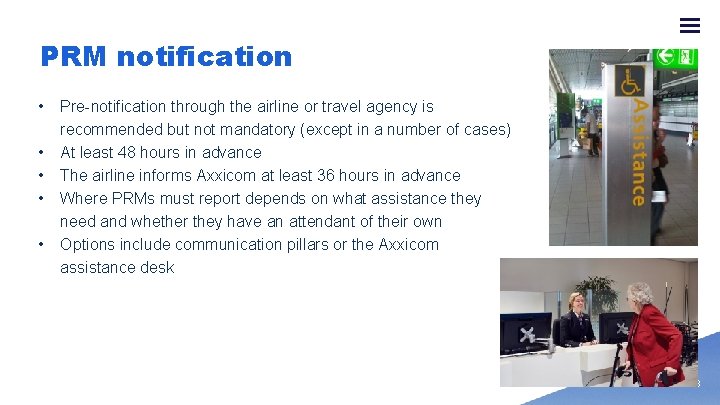
PRM notification • Pre-notification through the airline or travel agency is • • recommended but not mandatory (except in a number of cases) At least 48 hours in advance The airline informs Axxicom at least 36 hours in advance Where PRMs must report depends on what assistance they need and whether they have an attendant of their own Options include communication pillars or the Axxicom assistance desk 23
How to deal with a PRM? • • • Show respect, not pity Speak directly to the PRM rather than the attendant Ask the PRM how best to help them Make and maintain eye contact Do not use either jargon or infantile language Take the limitations of the PRM into account Be aware that not all disabilities are visible 24
Communication The blind and visually impaired: • Use words to describe. Do not point and do not use terms such as 'there' or 'behind’. Indicate when you wish to touch someone and ask permission in advance. • Do not pet an assistance dog when it is wearing its harness; it is on the job. The deaf and hard of hearing: • Look at the person, speak clearly and use a normal tone of voice; if necessary, use pen and paper to explain something; maintain eye contact. 25
Communication Mental disorder: • Make sure that you are understood; repeat if necessary Wheelchair users: • Talk at eye level; do not bend your knees but lean backwards; do not lean on the wheelchair People with a speech impediment: • Do not interrupt the person; do not finish their sentences Do not talk about a PRM with a colleague 26
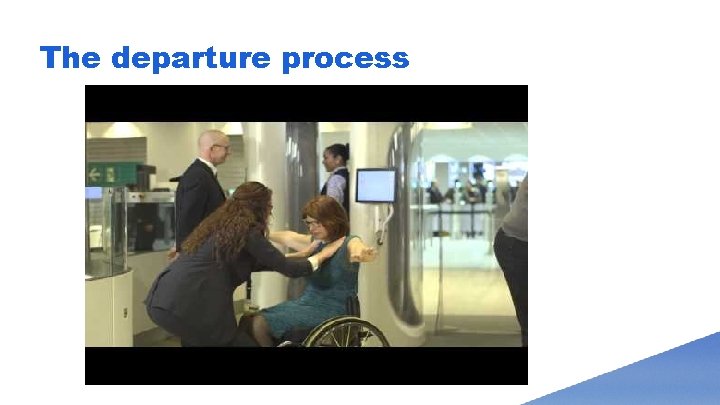
The departure process
What obstacles may a PRM encounter at your sales location? Be aware that disabled people experience everything differently and that things that are normal to you may not be standard for them.
<Add your own information here>