
Private Sector Expectations In the PPP project structure
- Slides: 14
Private Sector Expectations In the PPP project structure
To make project attractive to the private sector (1) o o o PPP project must be in line with strategic public sector goals Unquestionable necessity of the project Political approval by cross-parties Analysis of alternative schemes and PPP scenarios shows better value for money than traditional methods Qualified approach to potential partners
To make project attractive to the private sector (2) o o Good information to all parties (public and private) that may be concerned Equal conditions of access to project information to all prospective bidders Strong Institutions with appropriate resources Mitigation and flexibility in managing macrorisks
Problems with the PPP process o o o o Lack of legislation and laws governing PPP process and protecting both partners Lack of knowledge and approval of the process by the civil service Inappropriate project selection Poorly prepared project Private partner’s interests and risk mitigation are not taken under consideration Lack of effective public marketing of the PPP projects Absence of alternative analysis Inappropriate risk sharing
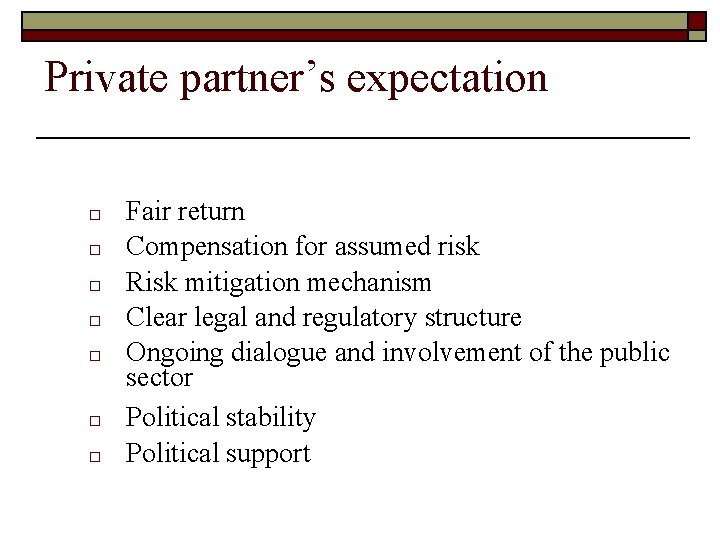
Private partner’s expectation o o o o Fair return Compensation for assumed risk Risk mitigation mechanism Clear legal and regulatory structure Ongoing dialogue and involvement of the public sector Political stability Political support
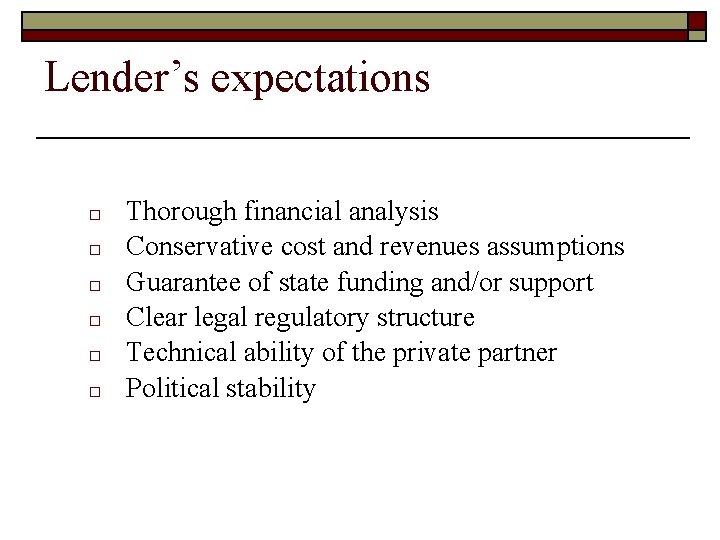
Lender’s expectations o o o Thorough financial analysis Conservative cost and revenues assumptions Guarantee of state funding and/or support Clear legal regulatory structure Technical ability of the private partner Political stability
Risks implication in PPP projects
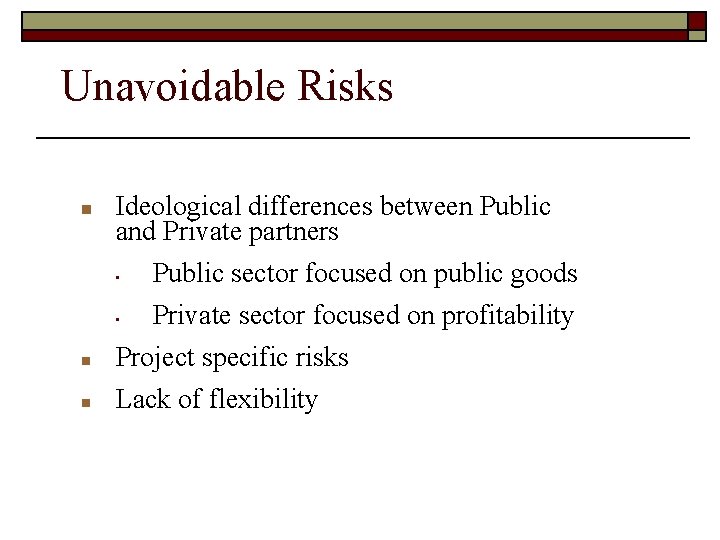
Unavoidable Risks n Ideological differences between Public and Private partners • • n n Public sector focused on public goods Private sector focused on profitability Project specific risks Lack of flexibility
Avoidable Risks n n n n Unfair competition during the bidding process Unclear partner selection procedure Inadequate Risks and Liabilities transfer Sustainability of profits Loss of control by the public sector Public resistance Develop simple and common communication “language” between partners
Selected mechanisms of Risk Mitigation
Revenue guarantee Failure to achieve the minimum revenue level triggers compensation from the public sector. Often the lower limit is set with an upper limit to mitigate risk for the public sector (i. e. ; the private sector does not get to have downside protection along with unlimited upside potential)
Modification of the contract’s economic balance The goal is to re-establish economic balance of the concession when IRR is below a minimum IRR stipulated in the contract. Compensation can include changes in toll or charge levels, adjusting contract’s lengths, public subsidies.
Contract duration This matches contract duration to the predefined revenue target. If full revenue is realized earlier than planned, the concession will end earlier. When revenue is lower than planned – the concession will end later. This evens out the risk profile of the project. Both the concessionaire and public bear the risk of higher or lower than projected revenues. This also reduces the risk of hard-toforecast revenue streams in certain sectors.
Thank you Wojtek Ksiazkiewicz SEE Business Advisory Council (BAC) Email: wojtek. ksiazkiewicz@snclavalin. com