
Private Approximation of Search Problems Amos Beimel Paz
Private Approximation of Search Problems Amos Beimel Paz Carmi Kobbi Nissim Enav Weinreb Ben Gurion University Research partially Supported by the Frankel Center for Computer Science.
Vertex Cover Input: undirected graph G=<E, V>. ¡ A set is a vertex cover of G, if: ¡ l ¡ , or Vertex Cover size: l ¡ For every Return the size of a smallest vertex cover of G. Vertex Cover (Search): l Return a minimum vertex cover of G. .
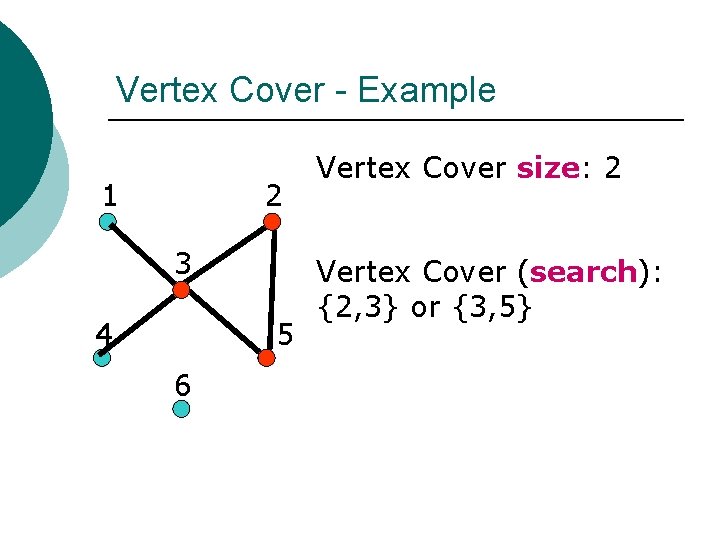
Vertex Cover - Example 1 2 3 4 5 6 Vertex Cover size: 2 Vertex Cover (search): {2, 3} or {3, 5}
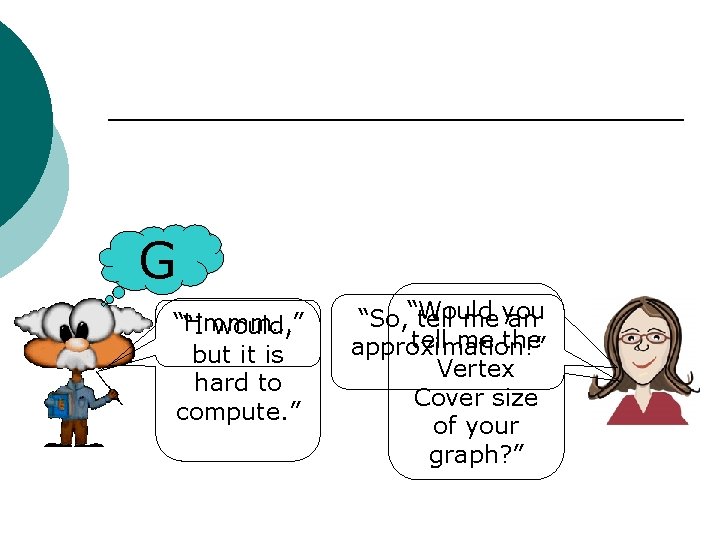
G “Hmmm…” “I would, but it is hard to compute. ” “So, “Would tell me you an tell me the approximation!” Vertex Cover size of your graph? ”

Maximal Matching Approximation Find maximal matching. ¡ Its vertices form a cover. ¡ 2 -approximation: solution size is at most 2 times the optimal solution. ¡ 1 2 3 4 5 6
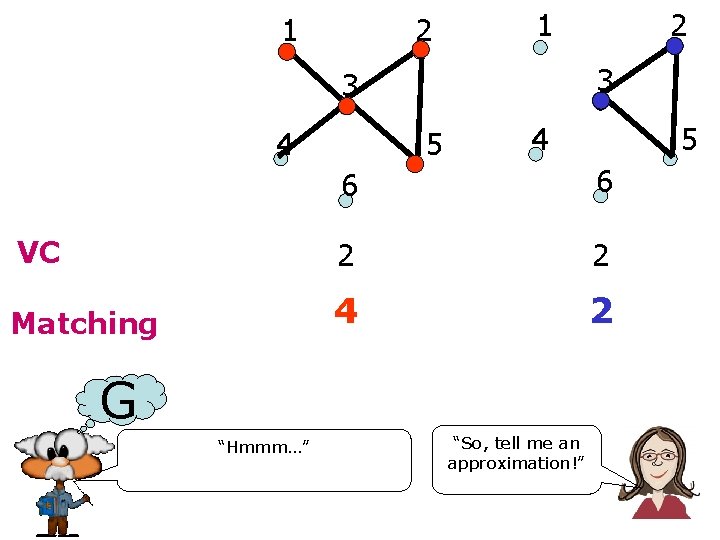
1 2 1 3 3 4 2 5 4 5 6 6 VC 2 2 Matching 4 2 G “Hmmm…” “So, tell me an approximation!”
Talk Overview Definitions and Previous Work ¡ Impossibility Result for Vertex Cover ¡ Algorithms that Leak (Little) Information ¡ l ¡ Positive Result for MAX-3 SAT Conclusions and Open Problems
![Previous Work Private approximation of Vertex Cover size. [HKKN STOC 01] ¡ m. VC(G](http://slidetodoc.com/presentation_image_h2/6363fe664c5d8efb83ccd0aa5e556482/image-8.jpg "Previous Work Private approximation of Vertex Cover size. [HKKN STOC 01] ¡ m. VC(G")
Previous Work Private approximation of Vertex Cover size. [HKKN STOC 01] ¡ m. VC(G 1)=m. VC(G 2) A(G 1)=A(G 2) ¡ Results: ¡ l l If NP BPP there is no polynomial private n 1 -ε-approximation algorithm for Vertex Cover size. There is a 4 -approximation algorithm for Vertex Cover size that leaks 1 bit of information.
![Previous Work (cont. ) ¡ Private Multiparty Computation of Approximations [FIMNSW ICALP 01] l](http://slidetodoc.com/presentation_image_h2/6363fe664c5d8efb83ccd0aa5e556482/image-9.jpg "Previous Work (cont. ) ¡ Private Multiparty Computation of Approximations [FIMNSW ICALP 01] l")
Previous Work (cont. ) ¡ Private Multiparty Computation of Approximations [FIMNSW ICALP 01] l l Private Approximation of Hamming distance in communication ~. (Improved to polylog by [IW STOC 05]) Private approximation algorithm for the Permanent.
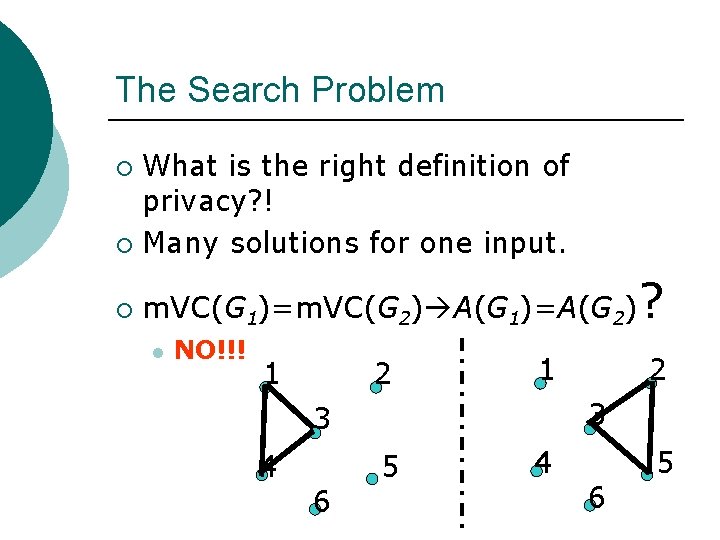
The Search Problem What is the right definition of privacy? ! ¡ Many solutions for one input. ¡ ¡ m. VC(G 1)=m. VC(G 2) A(G 1)=A(G 2) l NO!!! 1 2 1 6 2 3 3 4 ? 5 4 6 5
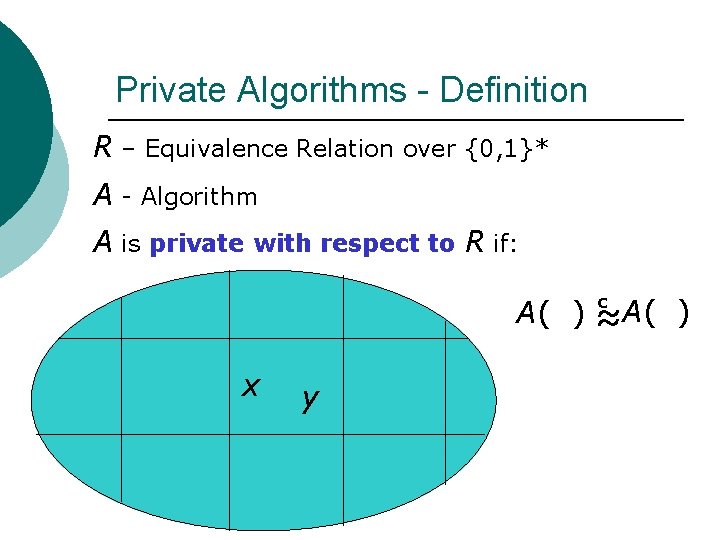
Private Algorithms - Definition R – Equivalence Relation over {0, 1}* A - Algorithm A is private with respect to R if: c A( ) ≈ x y
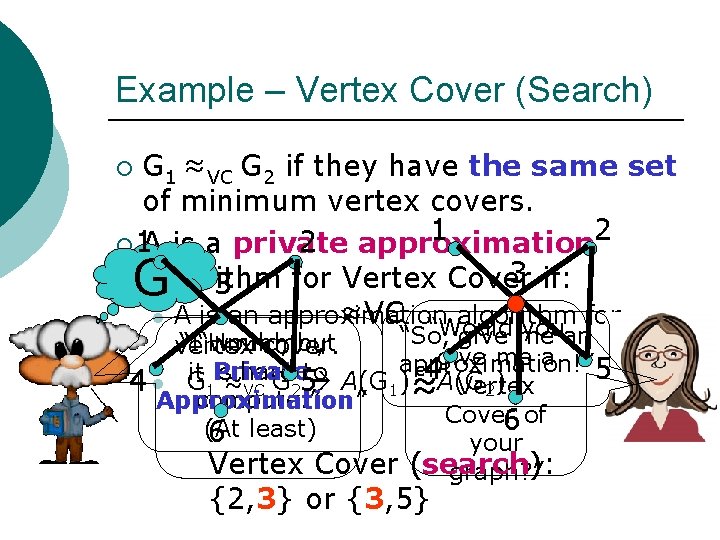
Example – Vertex Cover (Search) G 1 ≈VC G 2 if they have the same set of minimum vertex covers. 1 2 2 approximation ¡ 1 A is a private 3 if: algorithm for Vertex Cover 3 ≈VC “Would l A is an approximation algorithm you for ¡ G “So, give me an “I“Hmmm…, would, but vertex cover. give me a approximation!” c 4 5 it is hard to Private ) 4 l G 1 ≈VC G 25 A(G 1)≈A(G Vertex 2 compute. ” Approximation” Cover 6 of (At 6 least) your Vertex Cover (search): graph? ” {2, 3} or {3, 5}
Relation to previous work A new framework where all previous results fit in. ¡ Search problem – HUGE number of equivalence classes. ¡ Previous works relied on having small number of equivalence classes. ¡
Talk Overview Definitions and Previous Work ¡ Impossibility Result for Vertex Cover ¡ Private Algorithms that Leak (Little) Information ¡ l ¡ Positive Result for MAX-3 SAT Conclusions and Open Problems
Vertex Cover (Search) - Reminder G 1 ≈VC G 2 if they have the same set of minimum vertex covers. ¡ A is a private approximation algorithm for Vertex Cover if: ¡ l l l A is an approximation algorithm for vertex cover. c G 1 ≈VC G 2 A(G 1) ≈A(G 2) If A is deterministic: G 1 ≈VC G 2 A(G 1) = A(G 2)
Vertex Cover - Impossibility Result Theorem 1 If P ≠NP there is no deterministic polynomial time n 1 -ε-approximation algorithm that is private with respect to ≈VC. Proof Idea: Given a private n 1 -ε-approximation algorithm A, we exactly solve Vertex Cover.
Definitions for the Proof Let be a graph. ¡ A vertex is critical for if every minimum vertex cover of contains. ¡ A vertex is relevant for if there exists a minimum vertex cover of that contains. ¡ Every vertex is non-critical or relevant (or both).
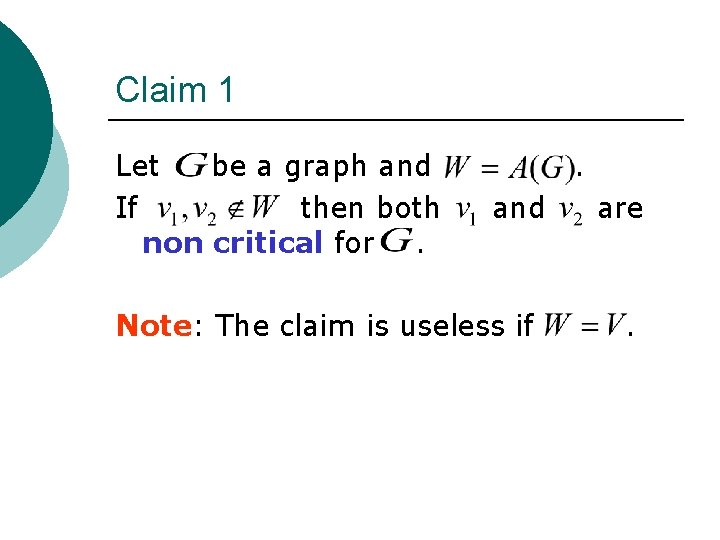
Claim 1 Let be a graph and If then both non critical for. . and Note: The claim is useless if are .
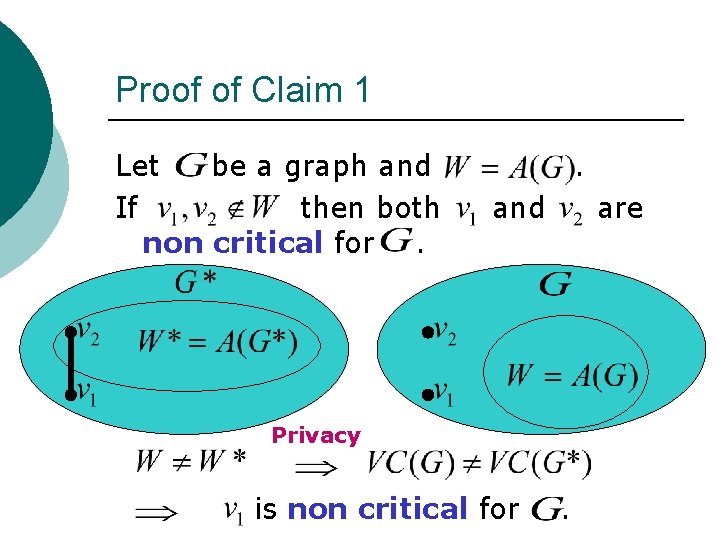
Proof of Claim 1 Let be a graph and If then both non critical for. . and are Privacy is non critical for .
Relevant / Non-Critical Algorithm ¡ Input l l ¡ Output - one of the following: l l ¡ Graph G Vertex v. v is Relevant for G. v is Non-Critical for G. Enables a greedy algorithm for Vertex Cover.
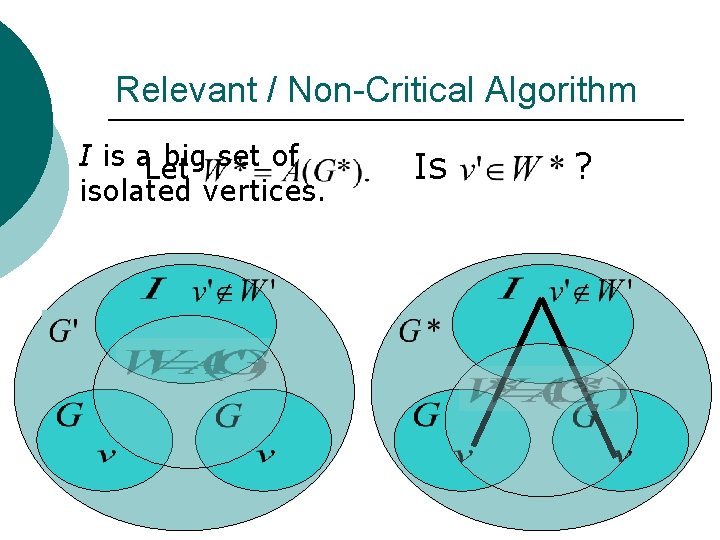
Relevant / Non-Critical Algorithm I is a. Let big set of isolated vertices. Is ?
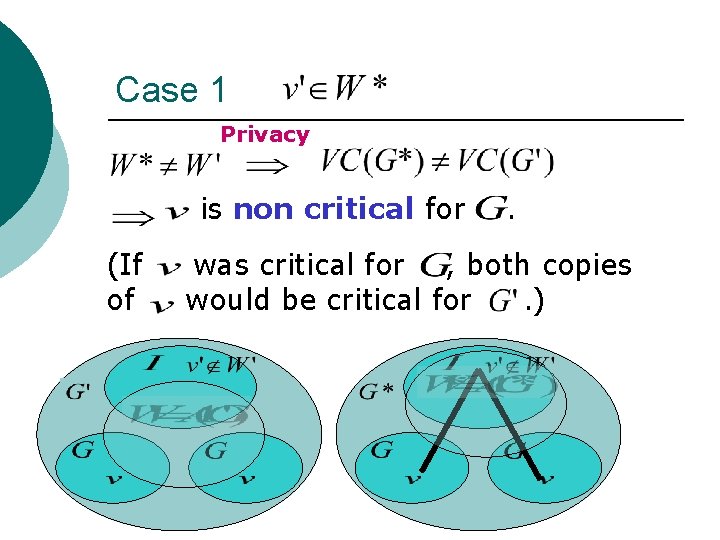
Case 1 Privacy is non critical for (If of . was critical for , both copies would be critical for. )
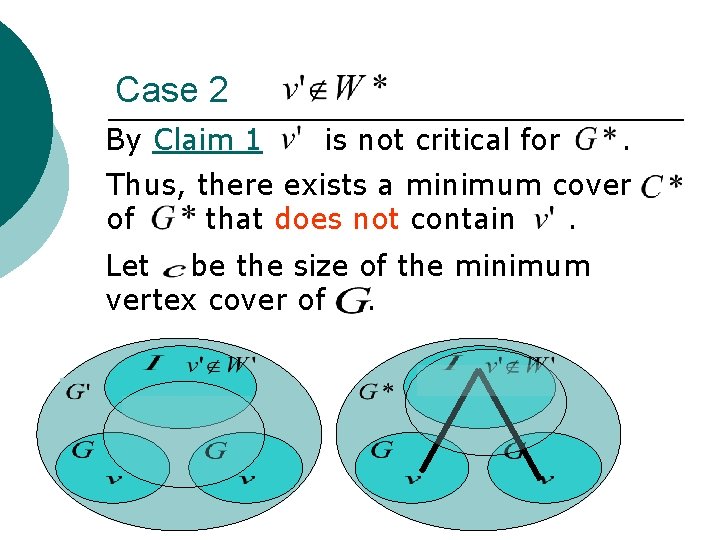
Case 2 By Claim 1 is not critical for . Thus, there exists a minimum cover of that does not contain. Let be the size of the minimum vertex cover of.
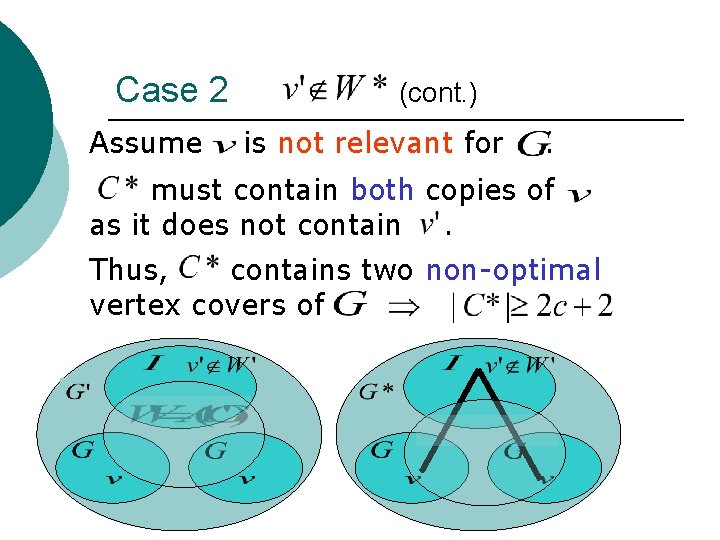
Case 2 Assume (cont. ) is not relevant for . must contain both copies of as it does not contain. Thus, contains two non-optimal vertex covers of
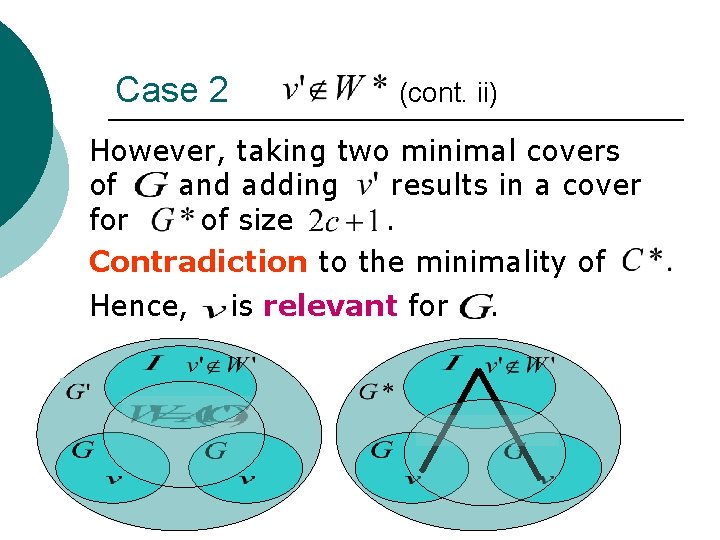
Case 2 (cont. ii) However, taking two minimal covers of and adding results in a cover for of size. Contradiction to the minimality of Hence, is relevant for .
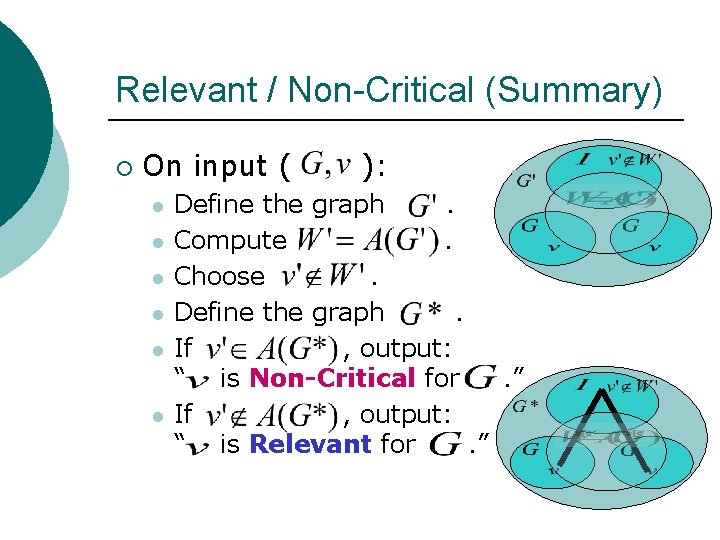
Relevant / Non-Critical (Summary) ¡ On input ( l l l ): Define the graph. Compute. Choose. Define the graph. If , output: “ is Non-Critical for. ” If , output: “ is Relevant for. ”
Greedy Vertex Cover Choose an arbitrary vertex. ¡ Execute the Relevant/Non-Critical algorithm on. ¡ If is Relevant, take and delete all edges adjacent to. ¡ If is Non-Critical, take and delete all edges adjacent to. ¡ Continue recursively. ¡
Vertex Cover - Impossibility Result Theorem 1 NP BPP randomized If P ≠NP there is no deterministic polynomial time n 1 -ε-approximation algorithm that is private with respect to ≈VC.
Talk Overview Definitions and Previous Work ¡ Impossibility Result for Vertex Cover ¡ Algorithms that Leak (Little) Information ¡ l ¡ Positive Result for MAX-3 SAT Conclusions and Open Problems
MAX-3 SAT Given a 3 CNF formula find an assignment that satisfies a maximum fraction of its clauses. ¡ Best approximation ratio: 7/8. ¡ if and have the same set of maximum satisfying assignments. ¡ Again, no private approximation! ¡
Almost-Private Algorithms A( ) c ≈A( ) x y z w A( ) ? A( )
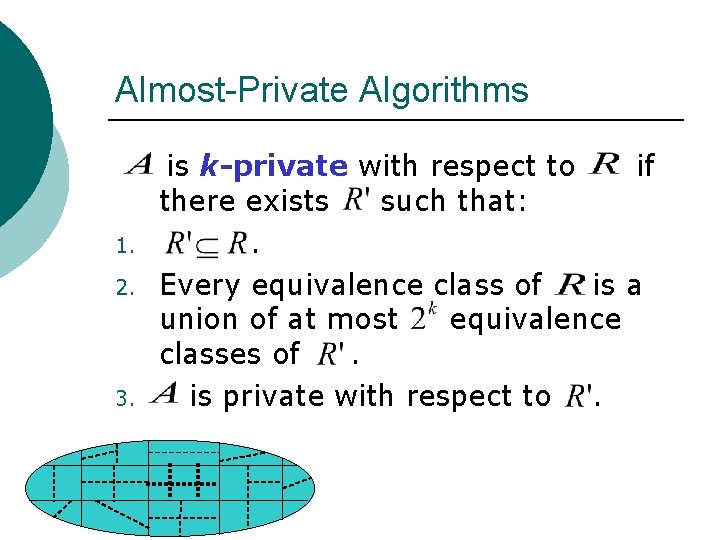
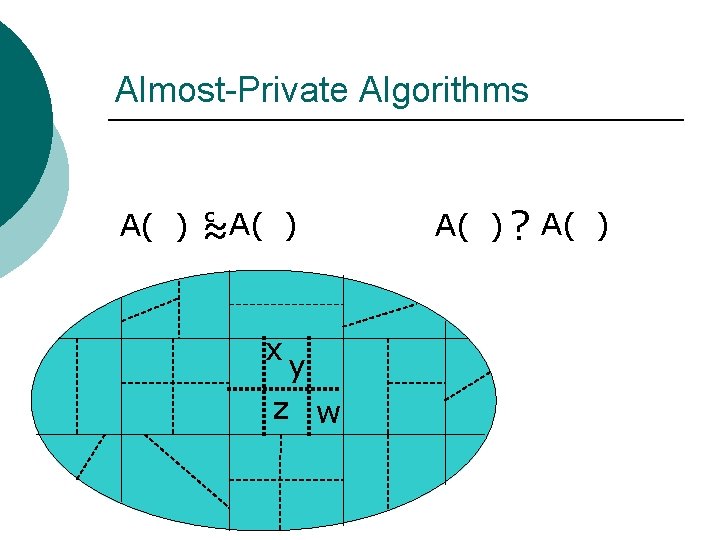
Almost-Private Algorithms 1. 2. 3. is k-private with respect to if there exists such that: . Every equivalence class of is a union of at most equivalence classes of. is private with respect to.
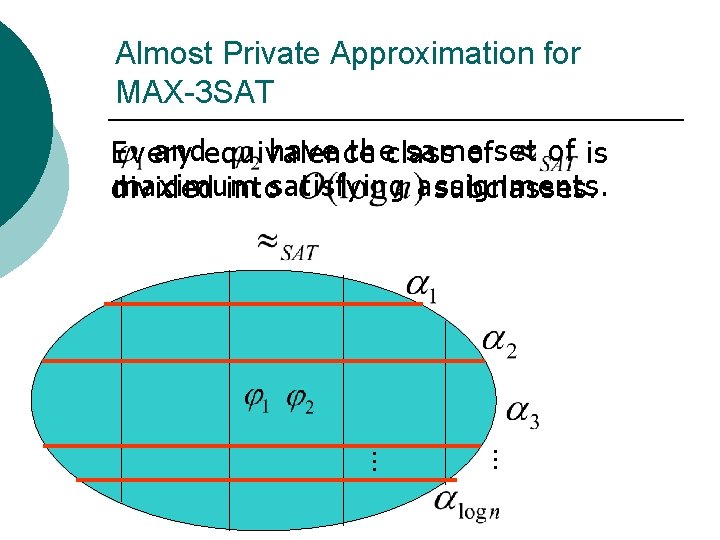
Almost Private Approximation for MAX-3 SAT andequivalence have theclass same Every ofset of is maximum divided intosatisfying assignments. subclasses. … …
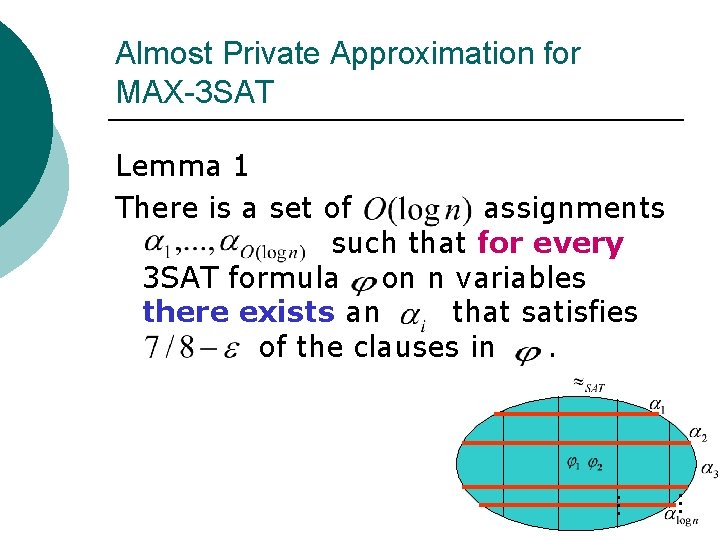
Almost Private Approximation for MAX-3 SAT Lemma 1 There is a set of assignments such that for every 3 SAT formula on n variables there exists an that satisfies of the clauses in. … …
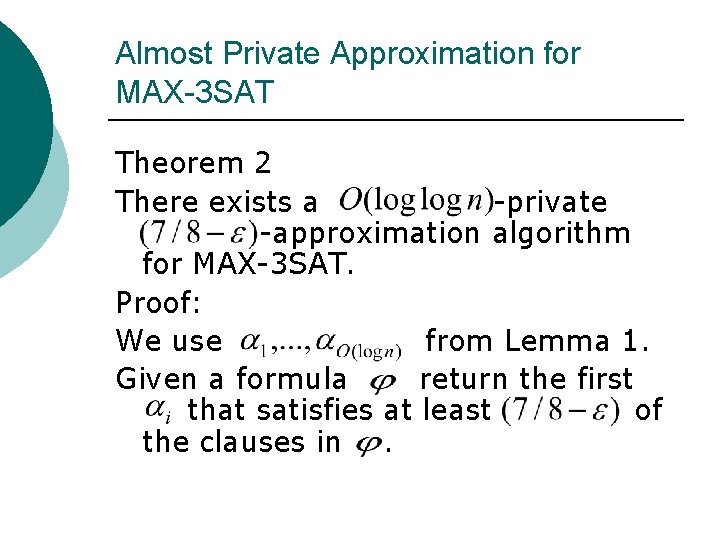
Almost Private Approximation for MAX-3 SAT Theorem 2 There exists a -private -approximation algorithm for MAX-3 SAT. Proof: We use from Lemma 1. Given a formula return the first that satisfies at least of the clauses in.
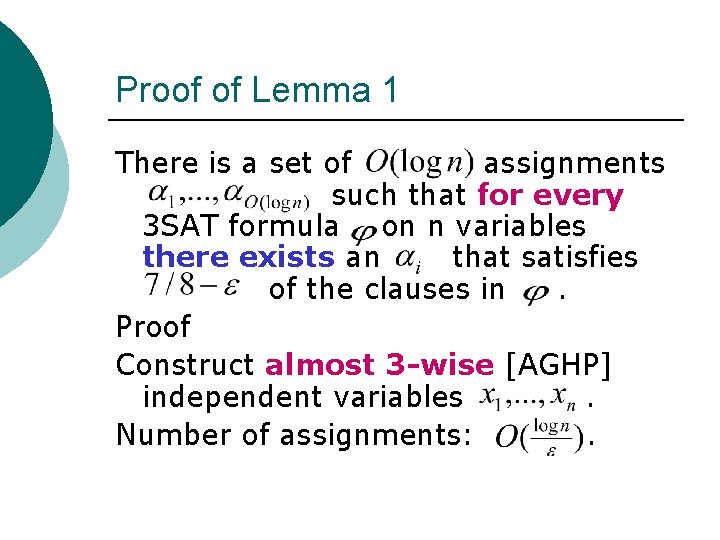
Proof of Lemma 1 There is a set of assignments such that for every 3 SAT formula on n variables there exists an that satisfies of the clauses in. Proof Construct almost 3 -wise [AGHP] independent variables. Number of assignments: .
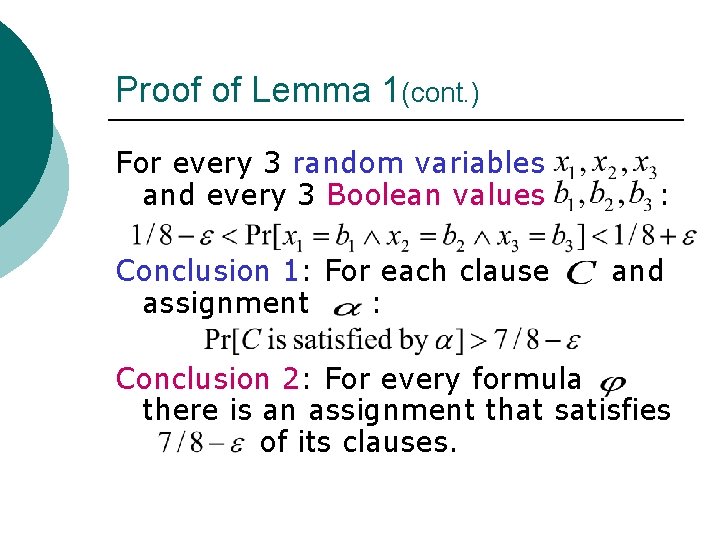
Proof of Lemma 1(cont. ) For every 3 random variables and every 3 Boolean values Conclusion 1: For each clause assignment : : and Conclusion 2: For every formula there is an assignment that satisfies of its clauses.
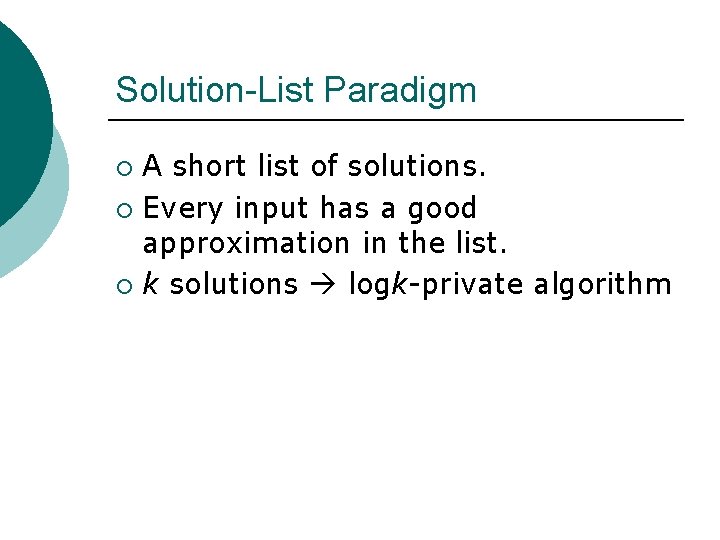
Solution-List Paradigm A short list of solutions. ¡ Every input has a good approximation in the list. ¡ k solutions logk-private algorithm ¡
Talk Overview Definitions and Previous Work ¡ Impossibility Result for Vertex Cover ¡ Algorithms that Leak (Little) Information ¡ l ¡ Positive Result for MAX-3 SAT Conclusions and Open Problems
Further Results ¡ Solution list algorithm for Vertex Cover: l l l ¡ -private (exponential list size) -approximation ratio. Optimal with respect to solution-list algorithms. Impossibility result for (any) 1 -private -approximation algorithm for Vertex Cover.
Further Results (cont. ) Impossibility result for a private -approximation algorithm for MAX-3 SAT. ¡ Impossibility result for a solutionlist algorithm for MAX-3 SAT that is: ¡ l l ¡ -private -approximation ratio. Problems in P. Positive and negative results.
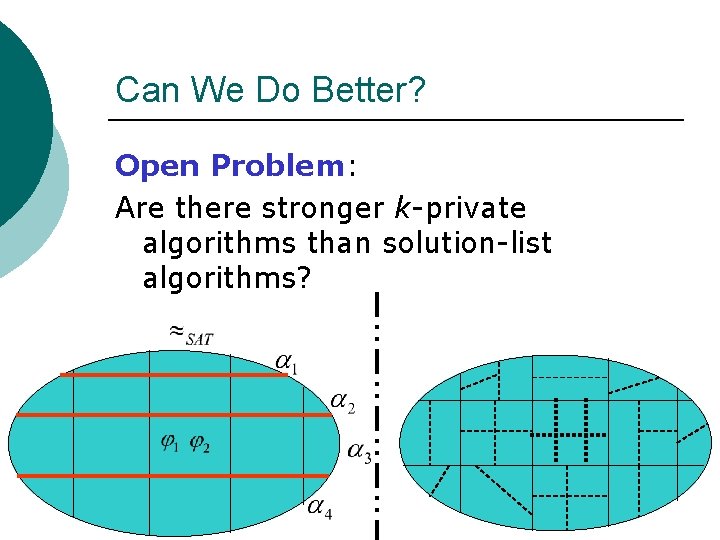
Can We Do Better? Open Problem: Are there stronger k-private algorithms than solution-list algorithms?
Can We Do Better? Open Problem: Are there stronger k-private algorithms than solution-list algorithms? Positive: design non-solution-list private approximation algorithms. Negative: improve impossibility result for any almost-private algorithm.

- Slides: 44