
Privacy Gaps in Mediated Library Services Micah Altman
Privacy Gaps in Mediated Library Services Micah Altman <micah_altman@alumni. brown. edu> Director of Research Center for Research in Equitable and Open Scholarship Prepared for NERCOMP 2019 March 2019 Providence , RI MIT Libraries 1
Abstract In this work in progress, we summarize privacy principles based on ALA, IFLA, and NISO policies. We then organizing and comparing high level privacy protections required by ALA checklist, NISO, and GDPR. This framework of principles and controls is then used to score the privacy policies and practices of major vendors of research library content. We evaluate each element of the vendors privacy policy, and use instrumented browsers to identify the types of tracking mechanisms used by different vendors. We use this set of privacy scores to support analyses of change over time, and of potential gaps between patron expectation and major practices. The major findings are as follows: ● ● ● ● There is misalignment between stated library values and privacy practices Increasingly patrons accessing content purchased and branded by an institution, may not be protected by institutional privacy policies Vendor policies that permit compreshensive data collection, broad use, detailed tracking are common A range of active tracking mechanisms are employed that make individuals reidentifiable even when they are nominally anonymous. Surprisingly even open-access collections are intensively tracked Some vendors do better than others -- e. g portals (EBSCO, Proquest) do better than publishers Many of these privacy risks can be mitigated through awareness, analysis of vendor tracking mechanisms with common tools, and the use of model licensing language
Attribution Statement Co-Conspirators: ● Katie Zimmerman, MIT ● Kit Haines, MIT ● Margaret Purdy, Foaly & Hoag Thanks: ● Harvard University Privacy Tools Project Sponsors: ▶ Supported in part by the Sloan Foundation
Disclaimer These opinions are my own, they are not the opinions of my employers, collaborators, or project funders. Secondary disclaimer: “It’s tough to make predictions, especially about the future!” - Attributed to Woody Allen, Yogi Berra, Niels Bohr, Vint Cerf, Winston Churchill, Confucius, Disreali [sic], Freeman Dyson, Cecil B. Demille, Albert Einstein, Enrico Fermi, Edgar R. Fiedler, Bob Fourer, Sam Goldwyn, Allan Lamport, Groucho Marx, Dan Quayle, George Bernard Shaw, Casey Stengel, Will Rogers, M. Taub, Mark Twain, Kerr L. White, etc.
Related Work ● Altman, M. , Wood, A. , O’Brien, D. R. , Vadhan, S. , & Gasser, U. (2015). Towards a modern approach to privacy-aware government data releases. Berkeley Technology Law Journal , 30(3), 1967 -2072. https: //doi. org/10. 15779/Z 38 FG 17 ● Altman, M. , Wood, A. , O’Brien, D. R. , , & Gasser, U. , (2018) Practical approaches to big data privacy over time, International Data Privacy Law , Volume 8, Issue 1, , Pages 29– 51, https: //doi. org/10. 1093/idpl/ipx 027 ● Wood, A. , Altman, M. , Bembenek, A. , Bun, T. , Gaboardi, M. , Honaker, J. , Nissim, K. . O’Brien D. , Steinke, T. & Vadhan, S. . (2018) Differential Privacy: A Primer for a Non-Technical Audience, 21 Vand. J. Ent. & Tech. 209 http: //www. jetlaw. org/journal-archives/volume-21 -issue-1/
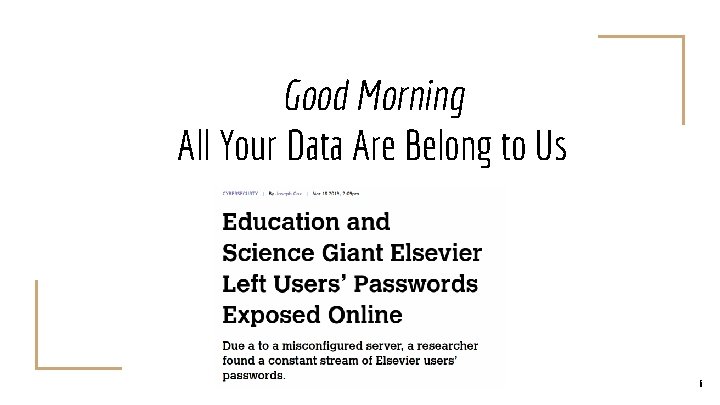
Good Morning All Your Data Are Belong to Us 6
Background - Libraries and Privacy 7
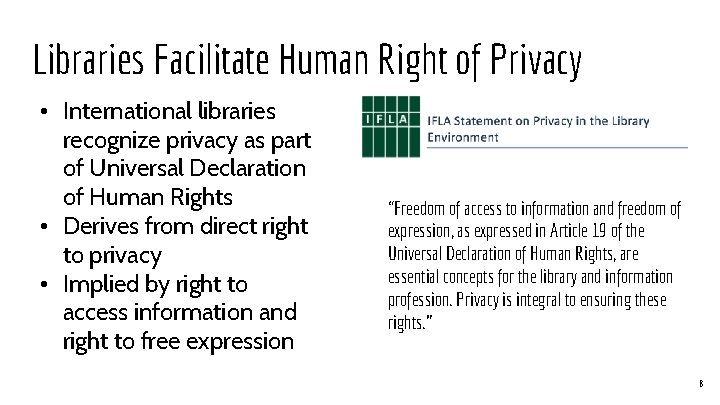
Libraries Facilitate Human Right of Privacy • International libraries recognize privacy as part of Universal Declaration of Human Rights • Derives from direct right to privacy • Implied by right to access information and right to free expression “Freedom of access to information and freedom of expression, as expressed in Article 19 of the Universal Declaration of Human Rights, are essential concepts for the library and information profession. Privacy is integral to ensuring these rights. ” 8
Respect for Privacy is a Core Value of Librarianship • American libraries recognized right to library privacy since 1939 • Privacy and confidentiality identified in list of 10 library core values • Based on a professional value of supporting free inquiry “The Library Bill of Rights affirms the ethical imperative to provide unrestricted access to information and to guard against impediments to open inquiry. Article IV states: “Libraries should cooperate with all persons and groups concerned with resisting abridgement of free expression and free access to ideas. ” When users recognize or fear that their privacy or confidentiality is compromised, true freedom of inquiry no longer exists. ” 9
Legal Requirements for Library Vary by Jurisdiction ▶ ▶ International Law ▶ Libraries increasingly serve content to a global audience ▶ Many countries law’s, such as GDPR apply to users’ interactions with libraries US Federal Law ▶ ▶ ▶ No general protection for library use or patrons, but some protections for certain categories of users (e. g. children under 13) who are library patrons Patriot Act may require disclosure of information collected in libraries State laws ▶ State laws vary from specific protection, to implicit inclusion in open records requests 10
State Laws -- Focus on Circulation Records ▶ Protected from FOI/gov. public records: ▶ Not public: DE, IN (not releasable), MA, MN (private), RI, WY (not open for inspection), TX (Private) CA, CO, IA, MD, ND, OR, VT, VA, WA, HI (AG Opinion) , KY (AG opinion), Confidential – except for court order: AK, AZ, DC, FL, LA, ME, MI, MS (except minors), MO, MT, NB, NH (other statutory exceptions), NJ, NM (except minors), NY (specific records), NC, PA, SC, SD (except minors), TN (except for seeking reimbursement), UT (except minors) WV ( except minors), WU ▶ Confidential: AL, AR, CT, GA, IL, KS, NE, OK (shall not disclose) ▶ See: R. E. Smith 2013 for an Overview 11 Privacy & Libraries
Related Contractual Obligations ▶ Industry Standard for Credit Card Information ▶ PCI-DSS ▶ ▶ Imposes information-security controls, where libraries directly accept credit card payments Content-Vendor Contracts ▶ May impose duties on vendors to protect personal information ▶ May impose duties on libraries to protect “proprietary”information -- eg. usage, service, and cost 12 Privacy & Libraries
Library Usage Has Changed -- Implications for Privacy ▶ From circulation of physical content held by library, → to mediating access to electronic content hosted by vendors ▶ From patron access & reference from within library spaces → to patron working from anywhere ▶ From library hosting of software & business records → cloud-based OPAC systems ▶ Discovery of library-mediated content often occurs outside library 13
Consolidation of Scholarly Communications ▶ ▶ 14 In the last 30 years, scholarly publishing has consolidated to an unprecedented degree Handful of publishers are responsible for vast majority of journal article production Most content accessed through a small number of portals: Elsevier, Wiley, Springer, Pro. Quest, Ebsco, . . . Most in-house content managed by a small number of vendor systems
Vulnerabilities in Mediated Services - Tracking 15
Research Questions ▶ What is privacy protected in library mediated services? ▶ Are there systematic gaps between library values and practice? ▶ ▶ ▶ Are protections different between library-hosted and vendor -hosted content? What privacy practices are necessary address gaps? How do changes in privacy/security landscape create strategic risks/opportunities for research libraries? 16
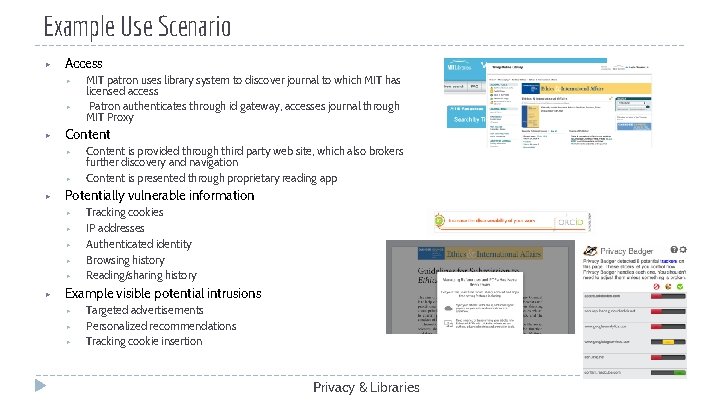
Example Use Scenario ▶ Access ▶ ▶ ▶ Content is provided through third party web site, which also brokers further discovery and navigation Content is presented through proprietary reading app Potentially vulnerable information ▶ ▶ ▶ MIT patron uses library system to discover journal to which MIT has licensed access Patron authenticates through id gateway, accesses journal through MIT Proxy Tracking cookies IP addresses Authenticated identity Browsing history Reading/sharing history Example visible potential intrusions ▶ ▶ ▶ Targeted advertisements Personalized recommendations Tracking cookie insertion Privacy & Libraries
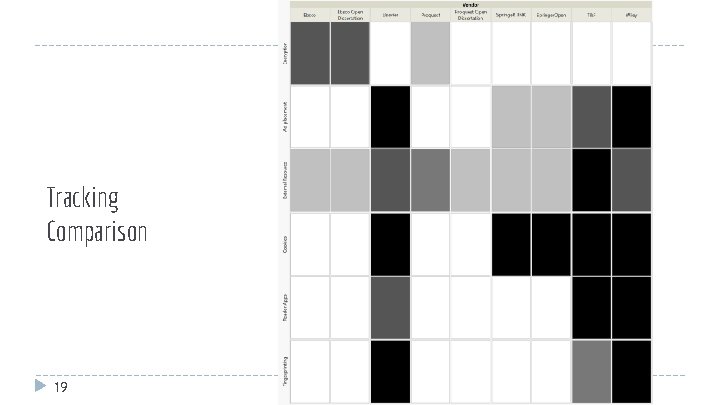
Evaluating Vendor Tracking Practices Tracking Mechanisms Category Exemplar Mechanisms Encryption HTTPS everywhere, valid certificates Ad placement Internal Ads, Third-Party Ads External Resource Fonts, Javascript Packages, Google Analytics Cookies Persistent Cookies, Third Party Cookies, Known ad Networks, Super. Cookies Reader Apps Page and highlight analytics Active Fingerprinting Canvas Fingerprinting, Web. GL fingerprinting 18 Tools ● Visual inspection ● Privacy badger ● Chrome dev tools ● Brave browser
Tracking Comparison 19
Vulnerabilities in Mediated Services - Legal Protections 20
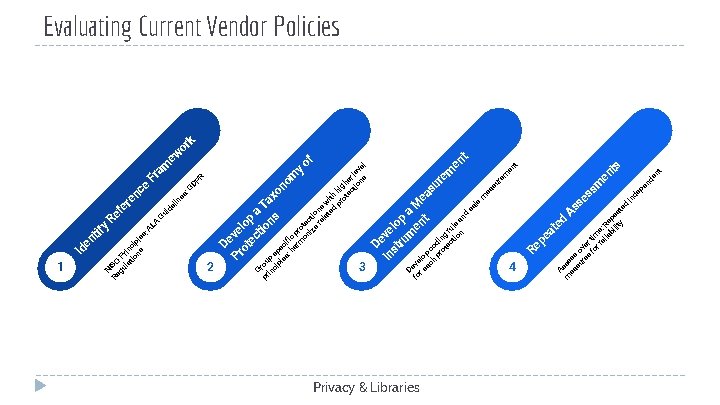
1 s; in e id el Gu 3 Privacy & Libraries 4 a le sa en t m re ea su m or k ew en t m ur e te A d m sse As ea ss su o se re ve s rt ss fo im m rr e el ; R en ia e bi pe ts lit a y te d in de pe nd en t pe Re nd o pr din ot g ec ru tio le n a De In ve st lo ru p De m a. M fo ve en r e lo t eas ac p c le De Pr ve ot lop ec G tio a T pr rou in p ns ax ci sp o p e 2 h R Fr am GD P ce no s; cifi ha c m rm pro y on te of iz ctio e re ns la w te it d hh pr ig ot h ec er tio le ns vel ; A re n fe Re LA tif y Re ISO gu P la rin tio ci ns ple s N en Id Evaluating Current Vendor Policies
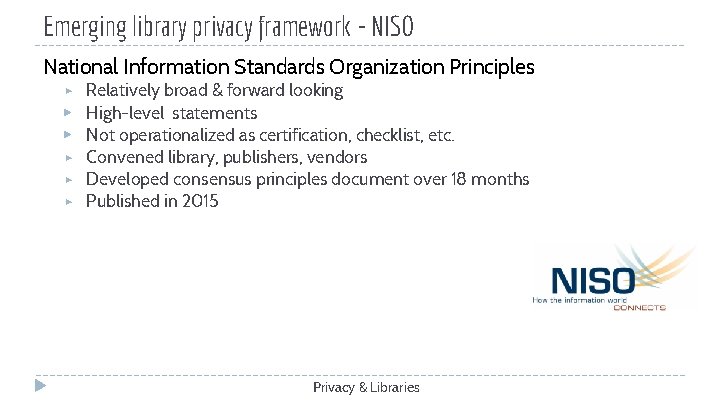
Emerging library privacy framework - NISO National Information Standards Organization Principles Relatively broad & forward looking ▶ High-level statements ▶ Not operationalized as certification, checklist, etc. ▶ Convened library, publishers, vendors ▶ Developed consensus principles document over 18 months ▶ Published in 2015 ▶ Privacy & Libraries
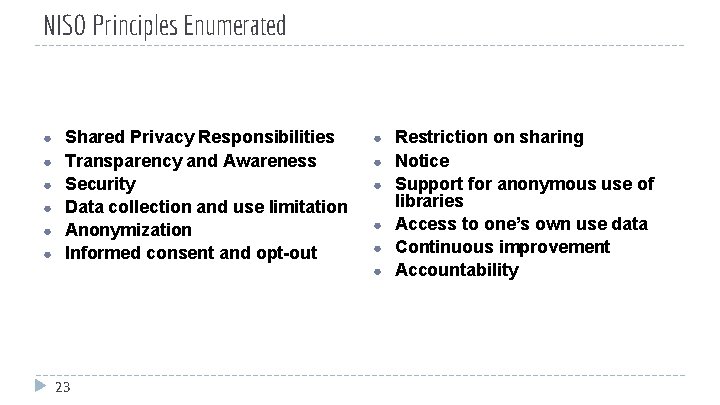
NISO Principles Enumerated ● Shared Privacy Responsibilities ● Restriction on sharing ● Transparency and Awareness ● Notice ● Security ● Support for anonymous use of ● Data collection and use limitation ● Anonymization ● Informed consent and opt-out 23 libraries ● Access to one’s own use data ● Continuous improvement ● Accountability
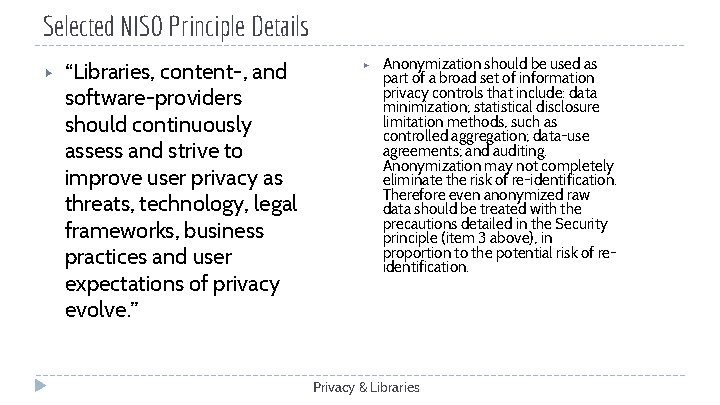
Selected NISO Principle Details ▶ “Libraries, content-, and software-providers should continuously assess and strive to improve user privacy as threats, technology, legal frameworks, business practices and user expectations of privacy evolve. ” ▶ Anonymization should be used as part of a broad set of information privacy controls that include: data minimization; statistical disclosure limitation methods, such as controlled aggregation; data-use agreements; and auditing. Anonymization may not completely eliminate the risk of re-identification. Therefore even anonymized raw data should be treated with the precautions detailed in the Security principle (item 3 above), in proportion to the potential risk of reidentification. Privacy & Libraries
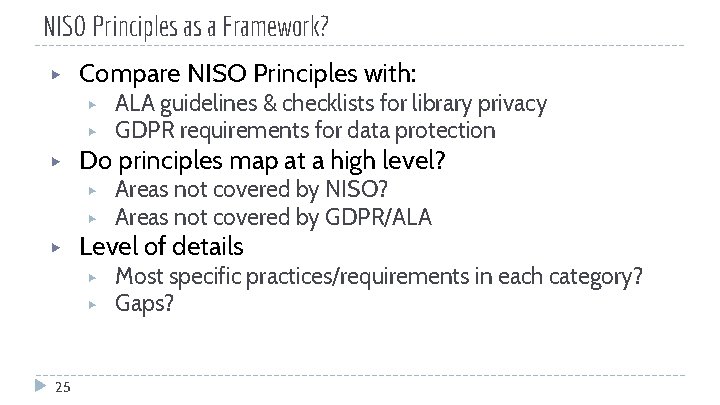
NISO Principles as a Framework? ▶ Compare NISO Principles with: ▶ ▶ ▶ Do principles map at a high level? ▶ ▶ ▶ Areas not covered by NISO? Areas not covered by GDPR/ALA Level of details ▶ ▶ 25 ALA guidelines & checklists for library privacy GDPR requirements for data protection Most specific practices/requirements in each category? Gaps?
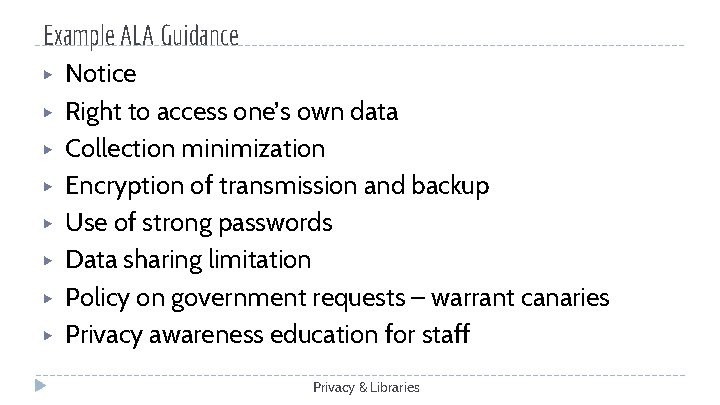
Example ALA Guidance ▶ ▶ ▶ ▶ Notice Right to access one’s own data Collection minimization Encryption of transmission and backup Use of strong passwords Data sharing limitation Policy on government requests – warrant canaries Privacy awareness education for staff Privacy & Libraries
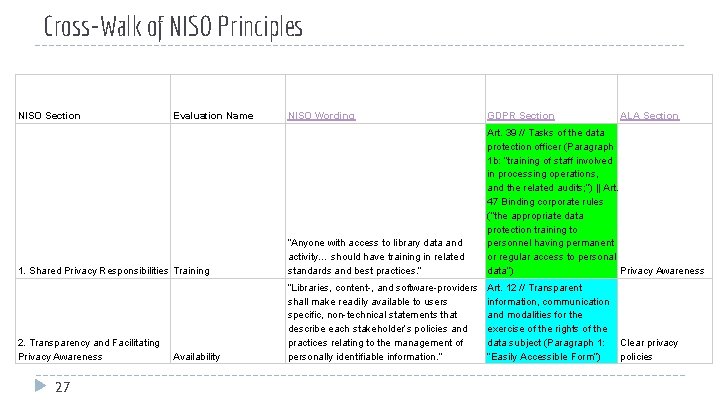
Cross-Walk of NISO Principles NISO Section NISO Wording GDPR Section 1. Shared Privacy Responsibilities Training “Anyone with access to library data and activity… should have training in related standards and best practices. ” Art. 39 // Tasks of the data protection officer (Paragraph 1 b: “training of staff involved in processing operations, and the related audits; ”) || Art. 47 Binding corporate rules (“the appropriate data protection training to personnel having permanent or regular access to personal data”) Privacy Awareness 2. Transparency and Facilitating Privacy Awareness “Libraries, content-, and software-providers shall make readily available to users specific, non-technical statements that describe each stakeholder’s policies and practices relating to the management of personally identifiable information. ” Art. 12 // Transparent information, communication and modalities for the exercise of the rights of the data subject (Paragraph 1: “Easily Accessible Form”) 27 Evaluation Name Availability ALA Section Clear privacy policies
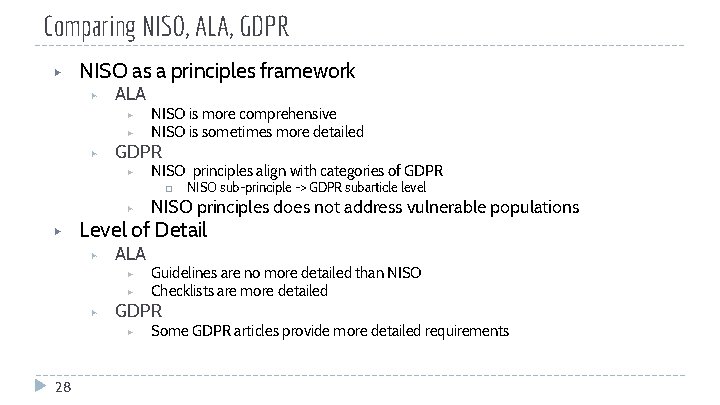
Comparing NISO, ALA, GDPR ▶ NISO as a principles framework ▶ ALA ▶ NISO is more comprehensive NISO is sometimes more detailed ▶ NISO principles align with categories of GDPR ▶ ▶ GDPR � ▶ ▶ NISO principles does not address vulnerable populations Level of Detail ▶ ALA ▶ Guidelines are no more detailed than NISO Checklists are more detailed ▶ Some GDPR articles provide more detailed requirements ▶ ▶ 28 NISO sub-principle -> GDPR subarticle level GDPR
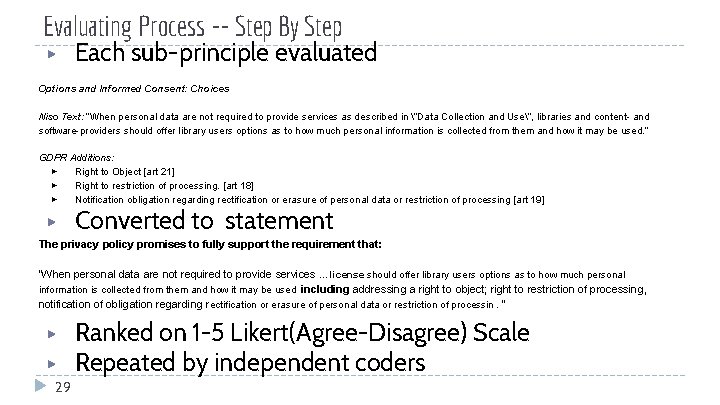
Evaluating Process -- Step By Step ▶ Each sub-principle evaluated Options and Informed Consent: Choices Niso Text: “When personal data are not required to provide services as described in ”Data Collection and Use”, libraries and content- and software-providers should offer library users options as to how much personal information is collected from them and how it may be used. ” GDPR Additions: ▶ Right to Object [art 21] ▶ Right to restriction of processing. [art 18] ▶ Notification obligation regarding rectification or erasure of personal data or restriction of processing [art 19] ▶ Converted to statement The privacy policy promises to fully support the requirement that: “When personal data are not required to provide services. . . license should offer library users options as to how much personal information is collected from them and how it may be used including addressing a right to object; right to restriction of processing, notification of obligation regarding rectification or erasure of personal data or restriction of processin. “ ▶ ▶ 29 Ranked on 1 -5 Likert(Agree-Disagree) Scale Repeated by independent coders
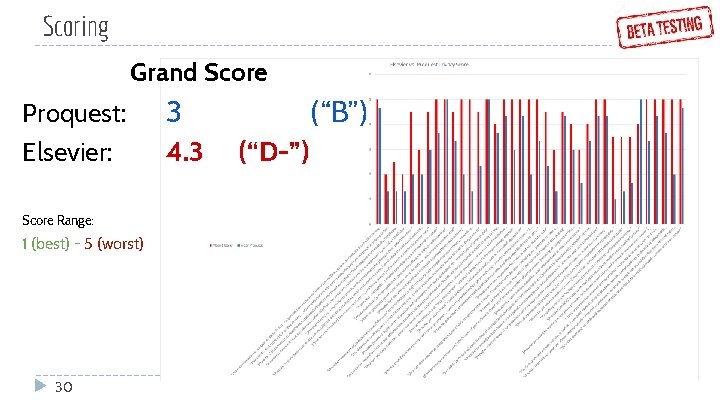
Scoring Grand Score Proquest: Elsevier: Score Range: 1 (best) - 5 (worst) 30 3 4. 3 (“D-”) (“B”)
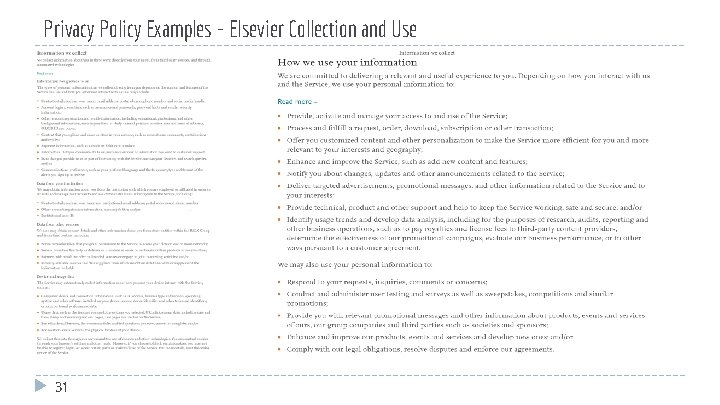
Privacy Policy Examples - Elsevier Collection and Use 31
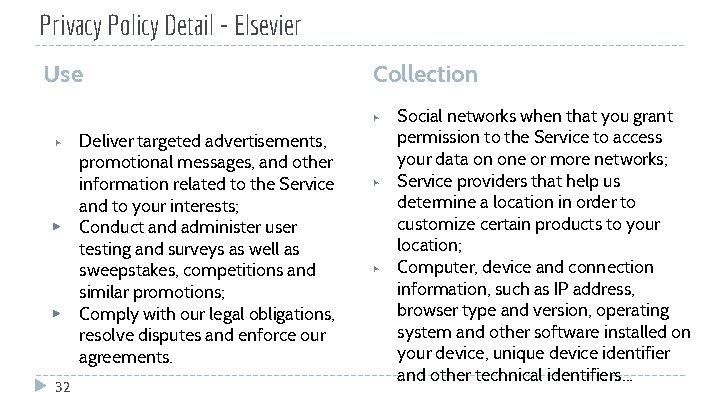
Privacy Policy Detail - Elsevier Use Collection ▶ ▶ 32 Deliver targeted advertisements, promotional messages, and other information related to the Service and to your interests; Conduct and administer user testing and surveys as well as sweepstakes, competitions and similar promotions; Comply with our legal obligations, resolve disputes and enforce our agreements. ▶ ▶ Social networks when that you grant permission to the Service to access your data on one or more networks; Service providers that help us determine a location in order to customize certain products to your location; Computer, device and connection information, such as IP address, browser type and version, operating system and other software installed on your device, unique device identifier and other technical identifiers. . .
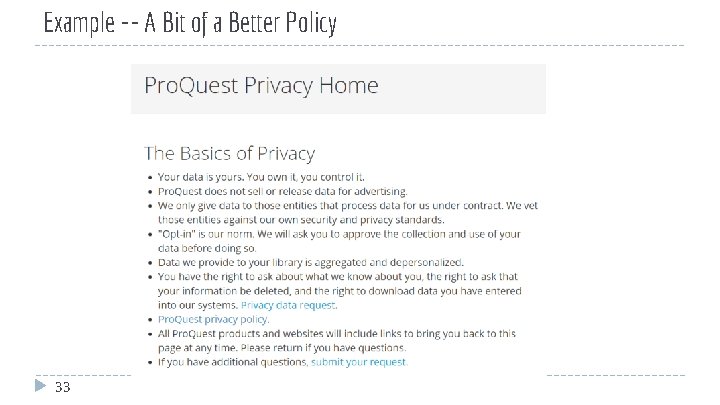
Example -- A Bit of a Better Policy 33
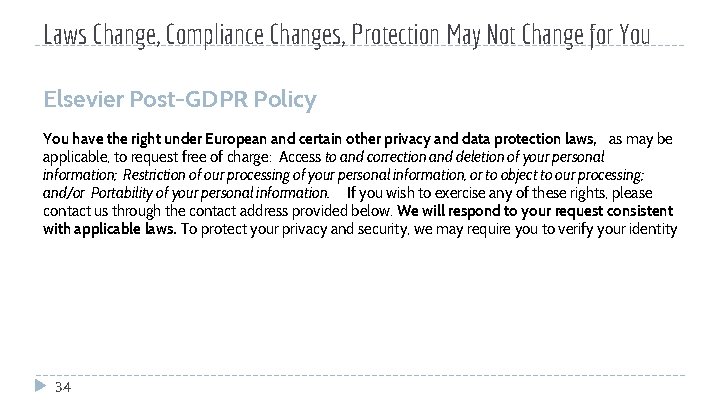
Laws Change, Compliance Changes, Protection May Not Change for You Elsevier Post-GDPR Policy You have the right under European and certain other privacy and data protection laws, as may be applicable, to request free of charge: Access to and correction and deletion of your personal information; Restriction of our processing of your personal information, or to object to our processing; and/or Portability of your personal information. If you wish to exercise any of these rights, please contact us through the contact address provided below. We will respond to your request consistent with applicable laws. To protect your privacy and security, we may require you to verify your identity 34
Discussion & Recommendations 35
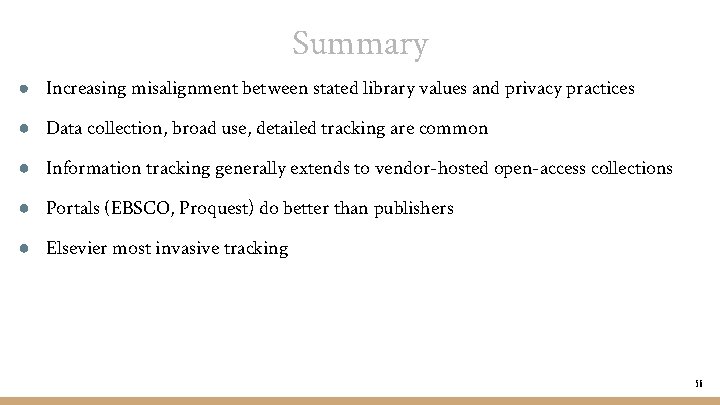
Summary ● Increasing misalignment between stated library values and privacy practices ● Data collection, broad use, detailed tracking are common ● Information tracking generally extends to vendor-hosted open-access collections ● Portals (EBSCO, Proquest) do better than publishers ● Elsevier most invasive tracking 36
The Perfect Solution? 38
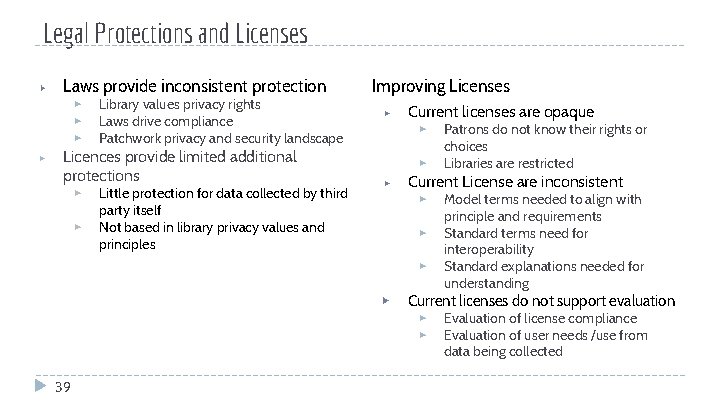
Legal Protections and Licenses ▶ Laws provide inconsistent protection ▶ ▶ Library values privacy rights Laws drive compliance Patchwork privacy and security landscape Licences provide limited additional protections ▶ ▶ Little protection for data collected by third party itself Not based in library privacy values and principles Improving Licenses ▶ Current licenses are opaque ▶ ▶ ▶ Current License are inconsistent ▶ ▶ Model terms needed to align with principle and requirements Standard terms need for interoperability Standard explanations needed for understanding Current licenses do not support evaluation ▶ ▶ 39 Patrons do not know their rights or choices Libraries are restricted Evaluation of license compliance Evaluation of user needs /use from data being collected
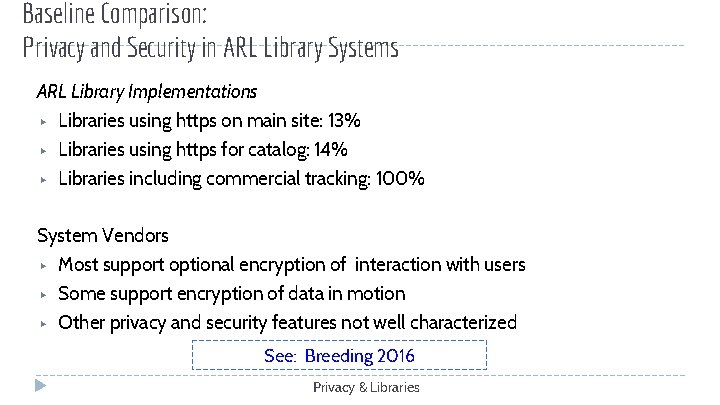
Baseline Comparison: Privacy and Security in ARL Library Systems ARL Library Implementations ▶ Libraries using https on main site: 13% ▶ Libraries using https for catalog: 14% ▶ Libraries including commercial tracking: 100% System Vendors ▶ Most support optional encryption of interaction with users ▶ Some support encryption of data in motion ▶ Other privacy and security features not well characterized See: Breeding 2016 Privacy & Libraries
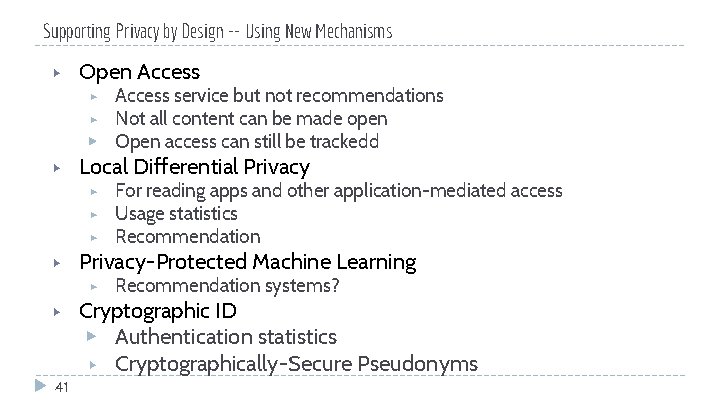
Supporting Privacy by Design -- Using New Mechanisms ▶ Open Access service but not recommendations ▶ Not all content can be made open ▶ Open access can still be trackedd ▶ ▶ Local Differential Privacy ▶ For reading apps and other application-mediated access Usage statistics Recommendation ▶ Recommendation systems? ▶ ▶ 41 Privacy-Protected Machine Learning Cryptographic ID ▶ Authentication statistics ▶ Cryptographically-Secure Pseudonyms
Awareness, Consent & Control ▶ Does university have a contract with vendor ▶ ▶ That protects user data? Is known to patron? Is viewable to patron? ▶ Is presented to patron? Does university policy protect data where. . . ▶ contractor is collector/controller? ▶ ▶ User has accepted separate TOS, etc? Does user agree to vendor policy 42
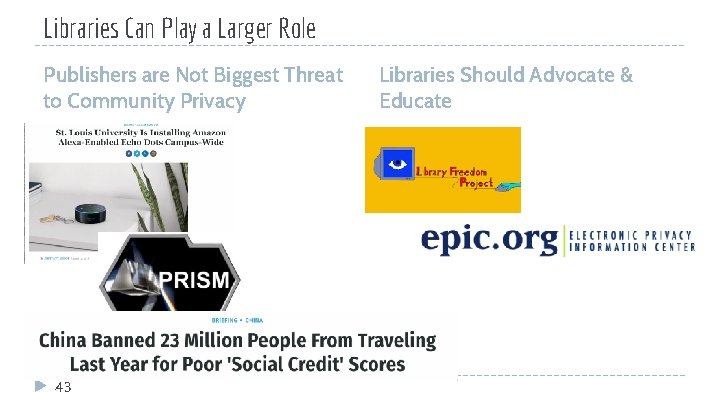
Libraries Can Play a Larger Role Publishers are Not Biggest Threat to Community Privacy 43 Libraries Should Advocate & Educate
Discussion ● Patrons accessing content purchased and branded by an institution, may not be protected by institutional privacy policy ● Support needs to be designed in to enable more patron protection ● ● ○ improved accessibility of services by for human and machine clients ○ explicit support for anonymity, privacy preserving recommendations, etc. Need for standardized model community license ○ Aligned with library principles ○ Transparent, and verifiable ○ Consistent and understandable Need for libraries to promote information privacy, agency, and citizenship 44
Resources ● ● ● Smith, R. E. 2013 (supplemented 2015), Compilation of State and Federal Privacy Laws, Privacy Journal. American Library association Compilation of State Library Laws http: //www. ala. org/advocacy/privacyconfidentiality/privacy/stateprivacy ALA Privacy Resources: http: //www. ala. org/advocacy/privacy/toolkit LITA Patron Privacy Checklists http: //www. ala. org/news/member-news/2017/02/lita-offers-patron-privacy-checklists-support-librarybill-rights NISO, 2015; NISO Consensus Principles on User’s Digital Privacy in Library, Publisher, and Software. Provider Systems. http: //www. niso. org/apps/group_public/download. php/16064/NISO%20 Privacy%20 Principles. pdf , Marshall, 2016 Privacy and Security for Library Systems , Library Technology Reports 52(4) 45
Questions? Observations? Arguments? * Now (10 minutes) or Later micah_altman@alumni. brown. edu micahaltman. com *£ 1 for a five minute argument, but only £ 8 for a course of ten.
- Slides: 45