
Privacy Data Protection Class I ECHR Ratione Personae

- Slides: 53
Privacy & Data Protection: Class I – ECHR (Ratione Personae) Bart van der Sloot Tilburg Institute for Law, Technology and Society www. bartvandersloot. com/
Overview • (1) Basics privacy and data protection • (2) Basics of this course • (3) History of the ECHR: Inter-State and Individual applications • (4) Dominant approach and interpretation of the ECt. HR • (5) Exceptions in the recent jurisprudence of the ECt. HR
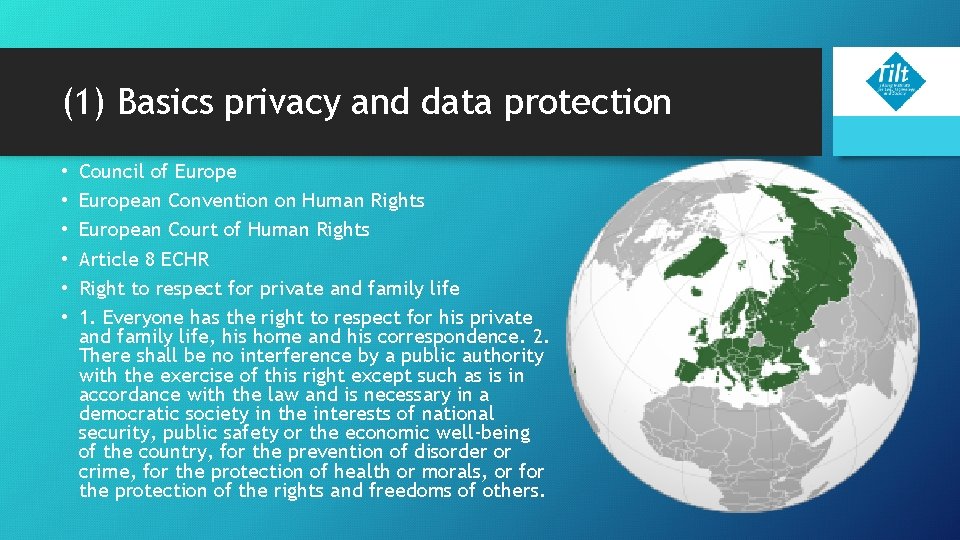
(1) Basics privacy and data protection • • • Council of European Convention on Human Rights European Court of Human Rights Article 8 ECHR Right to respect for private and family life 1. Everyone has the right to respect for his private and family life, his home and his correspondence. 2. There shall be no interference by a public authority with the exercise of this right except such as is in accordance with the law and is necessary in a democratic society in the interests of national security, public safety or the economic well-being of the country, for the prevention of disorder or crime, for the protection of health or morals, or for the protection of the rights and freedoms of others.
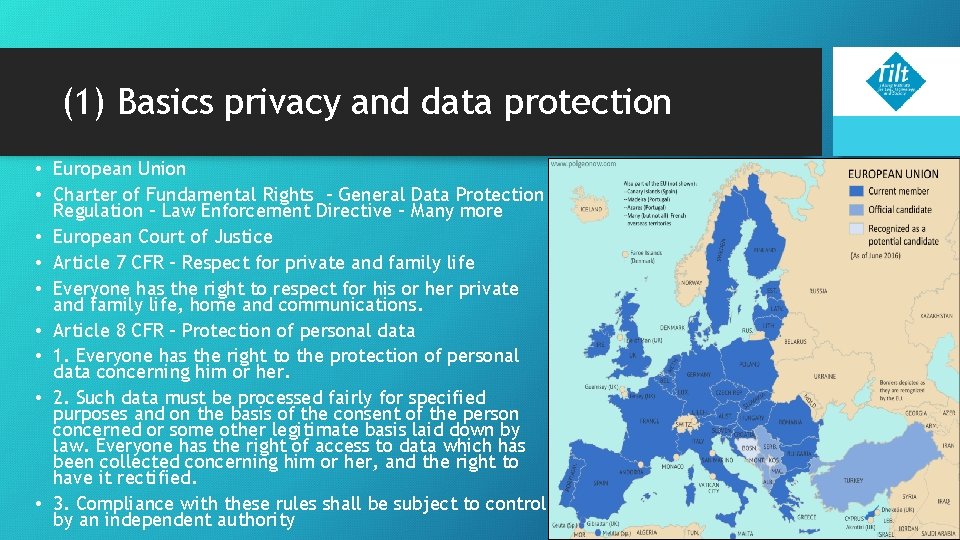
(1) Basics privacy and data protection • European Union • Charter of Fundamental Rights - General Data Protection Regulation – Law Enforcement Directive – Many more • European Court of Justice • Article 7 CFR - Respect for private and family life • Everyone has the right to respect for his or her private and family life, home and communications. • Article 8 CFR - Protection of personal data • 1. Everyone has the right to the protection of personal data concerning him or her. • 2. Such data must be processed fairly for specified purposes and on the basis of the consent of the person concerned or some other legitimate basis laid down by law. Everyone has the right of access to data which has been collected concerning him or her, and the right to have it rectified. • 3. Compliance with these rules shall be subject to control by an independent authority
(1) Basics privacy and data protection • Countries have privacy (and data protection) in their constitution • Countries have to respect EU and Co. E regulation; ECJ and ECt. HR highest official courts • No official hierarchy between ECJ-ECt. HR / EU-Co. E • Difference between privacy and data protection: • • Disputed Material scope Vertical – horizontal Human right – market regulation
(2) Basics of this course Bart van der Sloot Class I ECHR Ratione Personae Class II ECHR Radtione Materiae Class III ECHR Prescribed by law Class IV ECHR Democratic society - 27 August 2019 28 August 2019 3 September 2019 4 September 2019 - 14. 45 -16. 30 - SZ 031 CZ 121
(2) Basics of this course • Class I: • van der Sloot, ‘Where is the harm in a privacy violation? Calculating the damages afforded in privacy cases by the European Court of Human Rights’, JIPITEC, 2017 -4. • Article 8, 33 & 34 ECHR • The admissibility guideline, page 7 -17, p. 45 -48 (http: //www. echr. coe. int/Documents/Admissibility_guide_ENG. pdf (Links to an external site. ) • Protocol 1, 8, 9, 10, 11, 14 bis, 15 and 16 (https: //www. coe. int/en/web/conventions/search-ontreaties/-/conventions/treaty/results/subject/3 (Links to an external site. ) • Class II: • van der Sloot, ‘Privacy as personality right: why the ECt. HR’s focus on ulterior interests might prove indispensable in the age of Big Data’, Utrecht Journal of International and European Law, 2015 -80, p. 25 -50. • The admissibility guideline, page 56 -59 (http: //www. echr. coe. int/Documents/Admissibility_guide_ENG. pdf (Links to an external site. )) • And quickly go through (just to get an impression): The Guide on Article 8 of the European Convention on Human Rights (https: //www. echr. coe. int/Documents/Guide_Art_8_ENG. pdf (Links to an external site. ))
(2) Basics of this course • Class III • van der Sloot, ‘Is the Human Rights Framework Still Fit for the Big Data Era? A Discussion of the ECt. HR’s Case Law on Privacy Violations Arising from Surveillance Activities’, IN: S. Gutwirth, R. Leenes & P. De Hert (eds. ), ‘Data Protection on the Move’, Springer, Dordrecht, 2016, pp 411 -436. • And quickly go through (just to get an impression): The Guide on mass surveillance (http: //www. echr. coe. int/Documents/FS_Mass_surveillance_ENG. pdf (Links to an external site. ) • And quickly go through (just to get an impression): The traveaux preparatoire Article 8 ECHR: http: //www. echr. coe. int/Library. Docs/Travaux/ECHRTravaux-ART 8 -DH(56)12 -EN 1674980. pdf • Class IV • van der Sloot, ‘The Practical and Theoretical Problems with ‘balancing’: Delfi, Coty and the redundancy of the human rights framework’, Maastricht Journal of European and Comparative Law, 2016, 3. • And quickly go through (just to get an impression): The Guide on data protection under the European Convention on Human Rights: (http: //www. echr. coe. int/Documents/FS_Data_ENG. pdf (Links to an external site. )) • And quickly go through (just to get an impression): The original European Convention on Human Rights (http: //www. echr. coe. int/Documents/Collection_Convention_1950_ENG. pdf (Links to an external site. ))
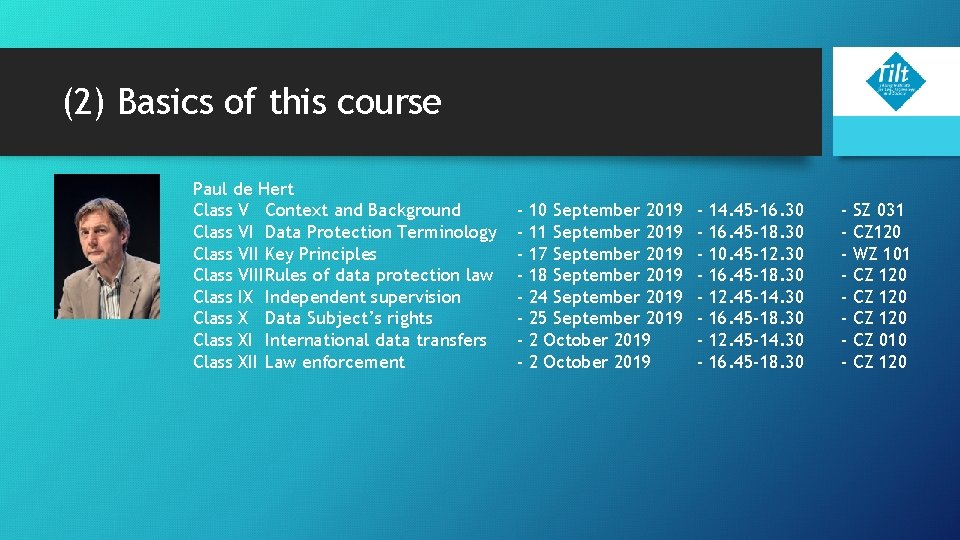
(2) Basics of this course Paul de Hert Class V Context and Background Class VI Data Protection Terminology Class VII Key Principles Class VIIIRules of data protection law Class IX Independent supervision Class X Data Subject’s rights Class XI International data transfers Class XII Law enforcement - 10 September 2019 11 September 2019 17 September 2019 18 September 2019 24 September 2019 25 September 2019 2 October 2019 - 14. 45 -16. 30 16. 45 -18. 30 10. 45 -12. 30 16. 45 -18. 30 12. 45 -14. 30 16. 45 -18. 30 - SZ 031 CZ 120 WZ 101 CZ 120 CZ 010 CZ 120
(2) Basics of this course • The Handbook is now available in English on our website: https: //www. echr. coe. int/Documents/Handbook_data_protection_02 ENG. pdf • Course 5: chapter 1: CONTEXT AND BACKGROUND OF EUROPEAN DATA PROTECTION LAW. • Course 6: chapter 2: DATA PROTECTION TERMINOLOGY • Course 7 chapter 3: Key principles of European data protection law • Course 8 chapter 4: Rules of European data protection law • Course 9 chapter 5: Independent supervision • Course 10 chapter 6: Data subjects’ rights and their enforcement • Course 11 chapter 7: INTERNATIONAL DATA TRANSFERS AND FLOWS OF PERSONAL DATA • Course 12 chapter 8: Data protection in the context of police and criminal justice
(2) Basics of this course Grade and Exam Blog = 20% Grade can be 0, 1, 2 Written exam = 80% Individual feedback from Bart van der Sloot upon appointment 1 Question Bart van der Sloot 3 Questions Paul de Hert For both a resit is possible, independent of each other. There is a reader, which you can bring with you to the exam. Blog assignment: write a case note in groups of 3 or 4 students on the case: BIG BROTHER WATCH AND OTHERS v. THE UNITED KINGDOM (application nos. 58170/13, 62322/14 and 24960/15) 13/09/2018 Exam Training - 24 September 2019 - - 14. 45 -16. 30 - CZ 009 – Mara Paun
(2) Basics of this course • As part of this course, you will need a legislation bundle (i. e. a collection of all relevant legislation, excluding preambles). This is the only material you are allowed to bring to the exam, as long as it complies with the conditions prescribed on the first page (most importantly, do not write in it, highlighting is accepted). • There are 80 bundles/readers available at the LTMS secretariat (M 734). You can pick them up between 13: 00 -14: 00 on: • - Tuesday, 27 August • - Wednesday, 28 August • - Thursday, 29 August • The price for one reader is 5 euro. Please have the exact amount prepared in cash. • The readers are distributed on a first come, first served basis, but do not worry, more readers will be made available if needed.
(2) Basics of this course • • • If you have questions: First, think and read the information on Canvas Second, ask a fellow student for help Third, go to the teacher after class Only if steps 1, 2 and 3 fail, mail someone. Think what type of question it is: • If it concerns questions about registration for Master, registration for this course, access to Canvas or related questions, please go to: https: //www. tilburguniversity. edu/nl/medewerkers/j-p-waterson • If it concerns content of the course > please go to teacher after class > if not possible mail Bart van der Sloot or Paul de Hert • If you are unsure about what type of question you have, or have another question, please mail Mara Paun
(3) History of the ECHR: Inter-State and Individual applications
(3) History of the ECHR: Inter-State and Individual applications • Earlier Human Rights documents • Magna Carta 1215 • Bill of Rights 1689 • United States Bill of Rights 1789 • The Declaration of the Rights of Man and of the Citizen 1789
(3) History of the ECHR: Inter-State and Individual applications • Modern Human Rights Documents • Universal Declaration of Human Rights (UDHR) 1948 • International Covenant on Civil and Political Rights 1966 • • • European Convention on Human Rights 1950 American Convention on Human Rights 1969 African Charter on Human and Peoples' Rights 1981 EU Charter of Fundamental Rights 2000 Association of Southeast Asian Nations (ASEAN) Human Rights Declaration 2012
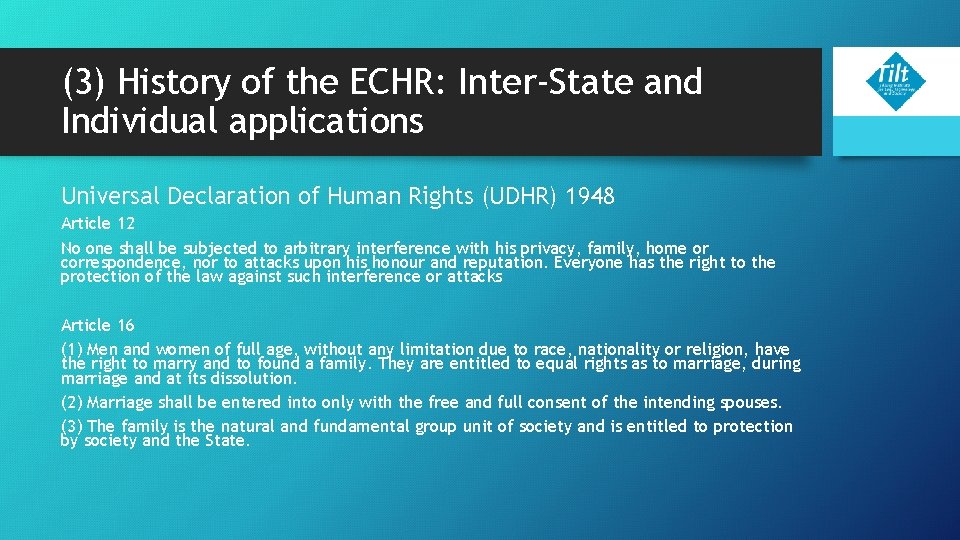
(3) History of the ECHR: Inter-State and Individual applications Universal Declaration of Human Rights (UDHR) 1948 Article 12 No one shall be subjected to arbitrary interference with his privacy, family, home or correspondence, nor to attacks upon his honour and reputation. Everyone has the right to the protection of the law against such interference or attacks Article 16 (1) Men and women of full age, without any limitation due to race, nationality or religion, have the right to marry and to found a family. They are entitled to equal rights as to marriage, during marriage and at its dissolution. (2) Marriage shall be entered into only with the free and full consent of the intending spouses. (3) The family is the natural and fundamental group unit of society and is entitled to protection by society and the State.
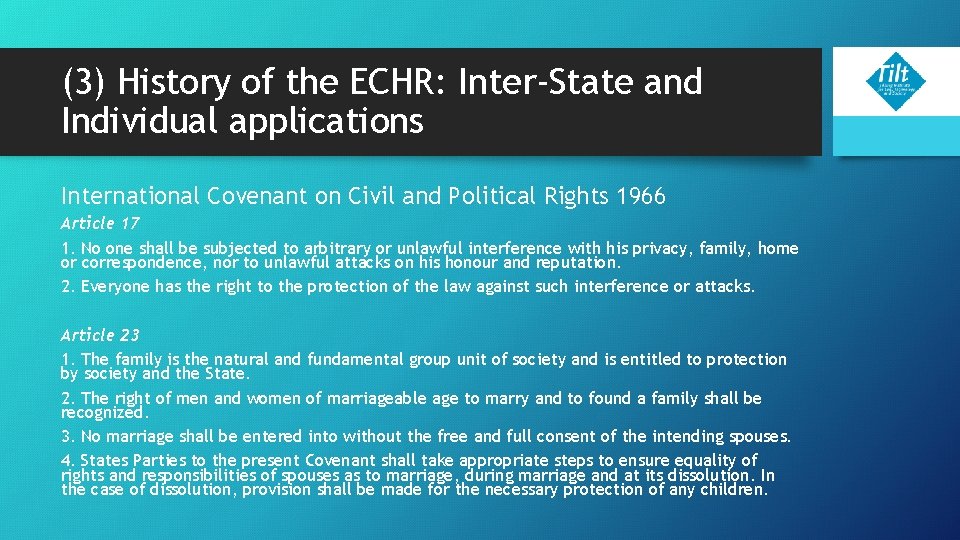
(3) History of the ECHR: Inter-State and Individual applications International Covenant on Civil and Political Rights 1966 Article 17 1. No one shall be subjected to arbitrary or unlawful interference with his privacy, family, home or correspondence, nor to unlawful attacks on his honour and reputation. 2. Everyone has the right to the protection of the law against such interference or attacks. Article 23 1. The family is the natural and fundamental group unit of society and is entitled to protection by society and the State. 2. The right of men and women of marriageable age to marry and to found a family shall be recognized. 3. No marriage shall be entered into without the free and full consent of the intending spouses. 4. States Parties to the present Covenant shall take appropriate steps to ensure equality of rights and responsibilities of spouses as to marriage, during marriage and at its dissolution. In the case of dissolution, provision shall be made for the necessary protection of any children.
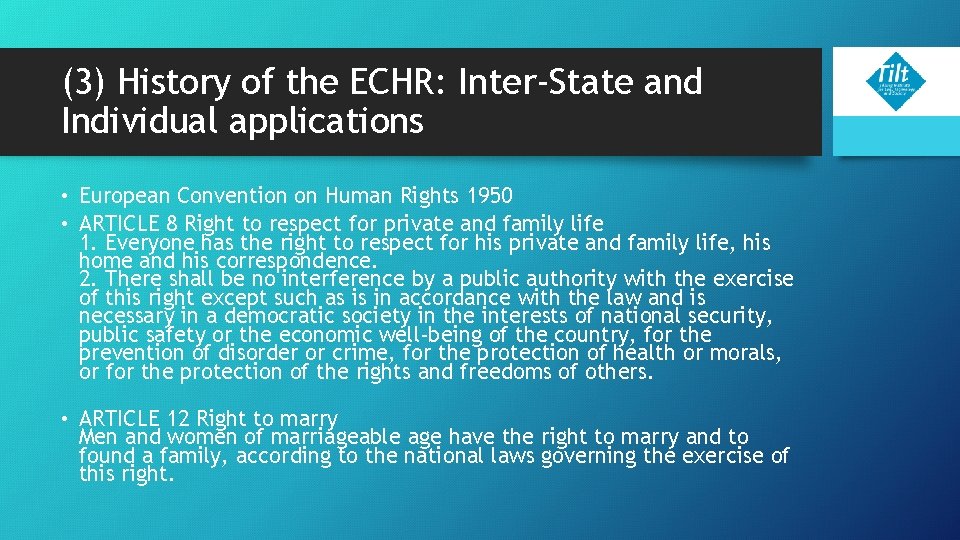
(3) History of the ECHR: Inter-State and Individual applications • European Convention on Human Rights 1950 • ARTICLE 8 Right to respect for private and family life 1. Everyone has the right to respect for his private and family life, his home and his correspondence. 2. There shall be no interference by a public authority with the exercise of this right except such as is in accordance with the law and is necessary in a democratic society in the interests of national security, public safety or the economic well-being of the country, for the prevention of disorder or crime, for the protection of health or morals, or for the protection of the rights and freedoms of others. • ARTICLE 12 Right to marry Men and women of marriageable age have the right to marry and to found a family, according to the national laws governing the exercise of this right.
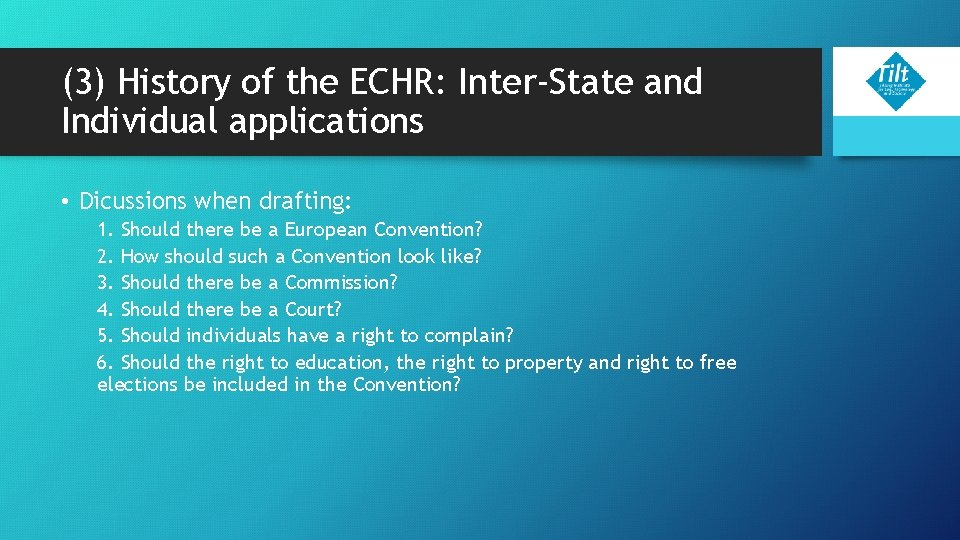
(3) History of the ECHR: Inter-State and Individual applications • Dicussions when drafting: 1. Should there be a European Convention? 2. How should such a Convention look like? 3. Should there be a Commission? 4. Should there be a Court? 5. Should individuals have a right to complain? 6. Should the right to education, the right to property and right to free elections be included in the Convention?
(3) History of the ECHR: Inter-State and Individual applications • 1. Should there be a European Convention? • Yes, Europe should have its own list of rights and have a more precise and effective mechanism of enforcement • No, we already have a Universal Declaration of Human Rights and we should not have a document that could conflict with it • Compromise • Yes, there is a Convention, but signing was optional
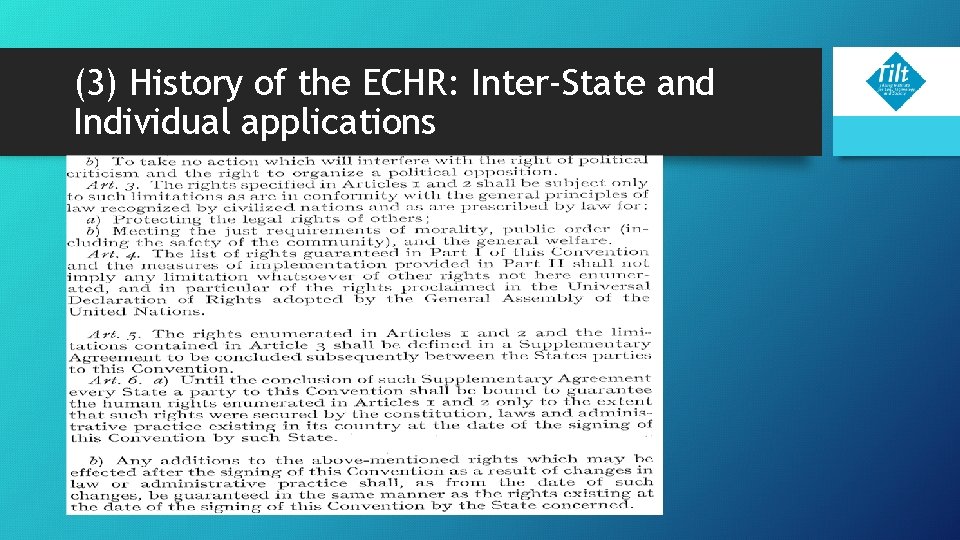
(3) History of the ECHR: Inter-State and Individual applications • 2. How should such a Convention look like? • Ennumeration (Alternative A) • Precise definition (Alternative B) • Compromise • Precise definition was taken as basis, but the rights ennumerated in Alternative A and the other provisions were merged
(3) History of the ECHR: Inter-State and Individual applications
(3) History of the ECHR: Inter-State and Individual applications
(3) History of the ECHR: Inter-State and Individual applications • 3. Should there be a Commission? • Yes, the Commission could investigate the facts of the matter, its judgement would have a reputational effect and the Commission could try and it could stimulate a settlement • No, there is no need for a supervisory mechanism within the Council of Europe, both because countries had mechanisms in place and because there was the International Court of Justice in The Hague • Compromise • Yes, there is a Commission, but its authority was dependent on ratification by each individual Member State
(3) History of the ECHR: Inter-State and Individual applications • 4. Should there be a Court? • Yes, a Court could impose sanctions and penalties, meaning that there would be an effective enforcement-mechanism for the ECHR • No, this would limmit the national authority + if there was a truly totalitarian regime, it would not be stopped by a European Court + the judgements by the Commission would be sufficient • Compromise • Again, the Court’s authority was optional
(3) History of the ECHR: Inter-State and Individual applications • 5. Should individuals have a right to complain? • Yes, otherwise the ECHR would not be effective as a human rights guarantee • No, fear of higher numbers of complaints + fear of abuse of right + fear of many small, individual matters put forward • Compromise: • Both inter-state & indivdiual complain right, but individuals only allowed to pettition to the Commission
(3) History of the ECHR: Inter-State and Individual applications
(3) History of the ECHR: Inter-State and Individual applications • 6. Should the right to education, the right to property and right to free elections be included in the Convention? • Yes, because important (influence on education can be abused by totalitarian states and individual property was challenged by communist regimes) • No, because socio-economic rights and not civil-political rights • Compromise • Included in the First Optional Protocol to the Convention
(3) History of the ECHR: Inter-State and Individual applications • First Protocol • ARTICLE 1 Protection of property Every natural or legal person is entitled to the peaceful enjoyment of his possessions. No one shall be deprived of his possessions except in the public interest and subject to the conditions provided for by law and by the general principles of international law. The preceding provisions shall not, however, in any way impair the right of a State to enforce such laws as it deems necessary to control the use of property in accordance with the general interest or to secure the payment of taxes or other contributions or penalties. • ARTICLE 2 Right to education No person shall be denied the right to education. In the exercise of any functions which it assumes in relation to education and to teaching, the State shall respect the right of parents to ensure such education and teaching in conformity with their own religious and philosophical convictions. • ARTICLE 3 Right to free elections The High Contracting Parties undertake to hold free elections at reasonable intervals by secret ballot, under conditions which will ensure the free expression of the opinion of the people in the choice of the legislature.
(4) Dominant approach and interpretation of the ECt. HR • Protocol No. 9 to the Convention for the Protection of Human Rights and Fundamental Freedoms Rome, 6. XI. 1990 • Article 44 of the Convention shall read as follows: • "Only the High Contracting Parties, the Commission, and persons, non-governmental organisations or groups of individuals having submitted a petition under Article 25 shall have the right to bring a case before the Court. " • Article 45 of the Convention shall read as follows: • "The jurisdiction of the Court shall extend to all cases concerning the interpretation and application of the present Convention which are referred to it in accordance with Article 48. "
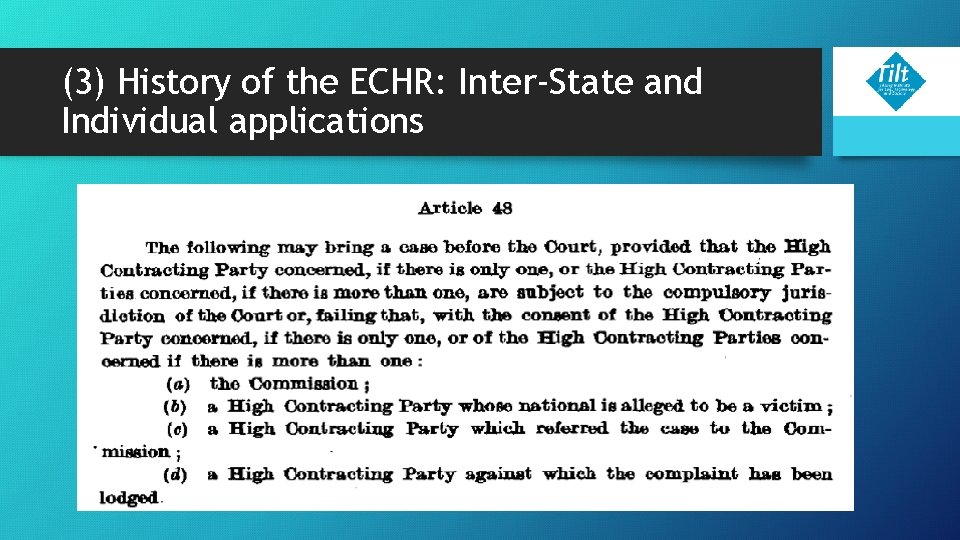
(4) Dominant approach and interpretation of the ECt. HR • Article 48 of the Convention shall read as follows: • "1 The following may refer a case to the Court, provided that the High Contracting Party concerned, if there is only one, or the High Contracting Parties concerned, if there is more than one, are subject to the compulsory jurisdiction of the Court or, failing that, with the consent of the High Contracting Party concerned, if there is only one, or of the High Contracting Parties concerned if there is more than one: • a the Commission; • ba High Contracting Party whose national is alleged to be a victim; • ca High Contracting Party which referred the case to the Commission; • da High Contracting Party against which the complaint has been lodged; • e the person, non-governmental organisation or group of individuals having lodged the complaint with the Commission. • 2 If a case is referred to the Court only in accordance with paragraph 1. e, it shall first be submitted to a panel composed of three members of the Court. There shall sit as an ex officio member of the panel the judge elected in respect of the High Contracting Party against which the complaint has been lodged, or, if there is none, a person of its choice who shall sit in the capacity of judge. If the complaint has been lodged against more than one High Contracting Party, the size of the panel shall be increased accordingly. • If the case does not raise a serious question affecting the interpretation or application of the Convention and does not for any other reason warrant consideration by the Court, the panel may, by a unanimous vote, decide that it shall not be considered by the Court. In that event, the Committee of Ministers shall decide, in accordance with the provisions of Article 32, whethere has been a violation of the Convention. "
(4) Dominant approach and interpretation of the ECt. HR • Protocol No. 11 to the Convention for the Protection of Human Rights and Fundamental Freedoms, restructuring the control machinery established thereby Strasbourg, 11. V. 1994 • Article 26 – Plenary Court • The plenary Court shall: • aelect its President and one or two Vice-Presidents for a period of three years; they may be re-elected; • bset up Chambers, constituted for a fixed period of time; • celect the Presidents of the Chambers of the Court; they may be reelected; • dadopt the rules of the Court; and • eelect the Registrar and one or more Deputy Registrars.
(4) Dominant approach and interpretation of the ECt. HR • Article 27 – Committees, Chambers and Grand Chamber • 1 To consider cases brought before it, the Court shall sit in committees of three judges, in Chambers of seven judges and in a Grand Chamber of seventeen judges. The Court’s Chambers shall set up committees for a fixed period of time. • 2 There shall sit as an ex officio member of the Chamber and the Grand Chamber the judge elected in respect of the State Party concerned or, if there is none or if he is unable to sit, a person of its choice who shall sit in the capacity of judge. • 3 The Grand Chamber shall also include the President of the Court, the Vice-Presidents, the Presidents of the Chambers and other judges chosen in accordance with the rules of the Court. When a case is referred to the Grand Chamber under Article 43, no judge from the Chamber which rendered the judgment shall sit in the Grand Chamber, with the exception of the President of the Chamber and the judge who sat in respect of the State Party concerned.
(4) Dominant approach and interpretation of the ECt. HR • Protocol No. 14 to the Convention for the Protection of Human Rights and Fundamental Freedoms, amending the control system of the Convention Strasbourg, 13. V. 2004 • Article 26 – Single-judge formation, committees, Chambers and Grand Chamber • 1 To consider cases brought before it, the Court shall sit in a single-judge formation, in committees of three judges, in Chambers of seven judges and in a Grand Chamber of seventeen judges. The Court’s Chambers shall set up committees for a fixed period of time. • 2 At the request of the plenary Court, the Committee of Ministers may, by a unanimous decision and for a fixed period, reduce to five the number of judges of the Chambers. • 3 When sitting as a single judge, a judge shall not examine any application against the High Contracting Party in respect of which that judge has been elected. • 4 There shall sit as an ex officio member of the Chamber and the Grand Chamber the judge elected in respect of the High Contracting Party concerned. If there is none or if that judge is unable to sit, a person chosen by the President of the Court from a list submitted in advance by that Party shall sit in the capacity of judge. • 5 The Grand Chamber shall also include the President of the Court, the Vice-Presidents, the Presidents of the Chambers and other judges chosen in accordance with the rules of the Court. When a case is referred to the Grand Chamber under Article 43, no judge from the Chamber which rendered the judgment shall sit in the Grand Chamber, with the exception of the President of the Chamber and the judge who sat in respect of the High Contracting Party concerned. ”
(4) Dominant approach and interpretation of the ECt. HR • Protocol No. 15 amending the Convention for the Protection of Human Rights and Fundamental Freedoms Strasbourg, 24. VI. 2013 • In Article 35, paragraph 1 of the Convention, the words “within a period of six months” shall be replaced by the words “within a period of four months”.
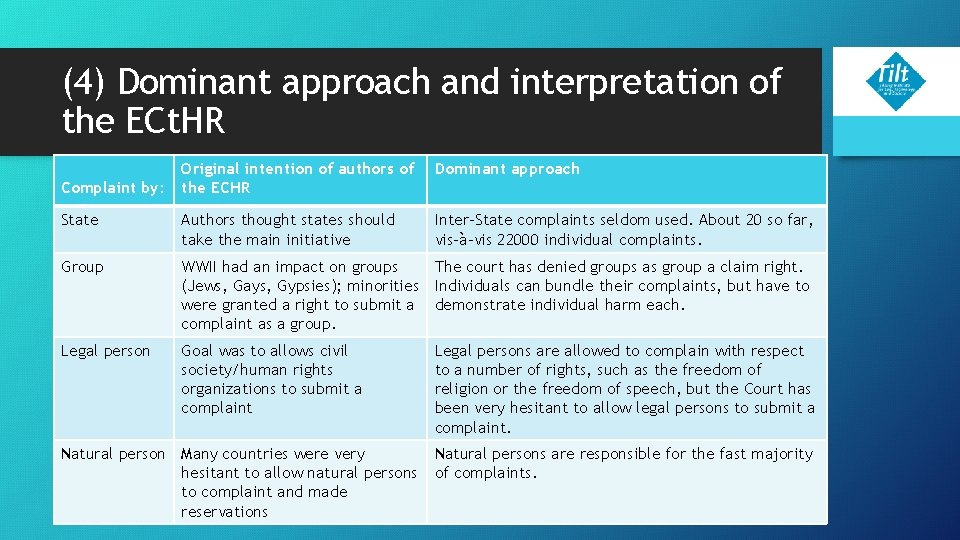
(4) Dominant approach and interpretation of the ECt. HR Original intention of authors of the ECHR Dominant approach State Authors thought states should take the main initiative Inter-State complaints seldom used. About 20 so far, vis-à-vis 22000 individual complaints. Group WWII had an impact on groups The court has denied groups as group a claim right. (Jews, Gays, Gypsies); minorities Individuals can bundle their complaints, but have to were granted a right to submit a demonstrate individual harm each. complaint as a group. Legal person Goal was to allows civil society/human rights organizations to submit a complaint Complaint by: Natural person Many countries were very hesitant to allow natural persons to complaint and made reservations Legal persons are allowed to complain with respect to a number of rights, such as the freedom of religion or the freedom of speech, but the Court has been very hesitant to allow legal persons to submit a complaint. Natural persons are responsible for the fast majority of complaints.
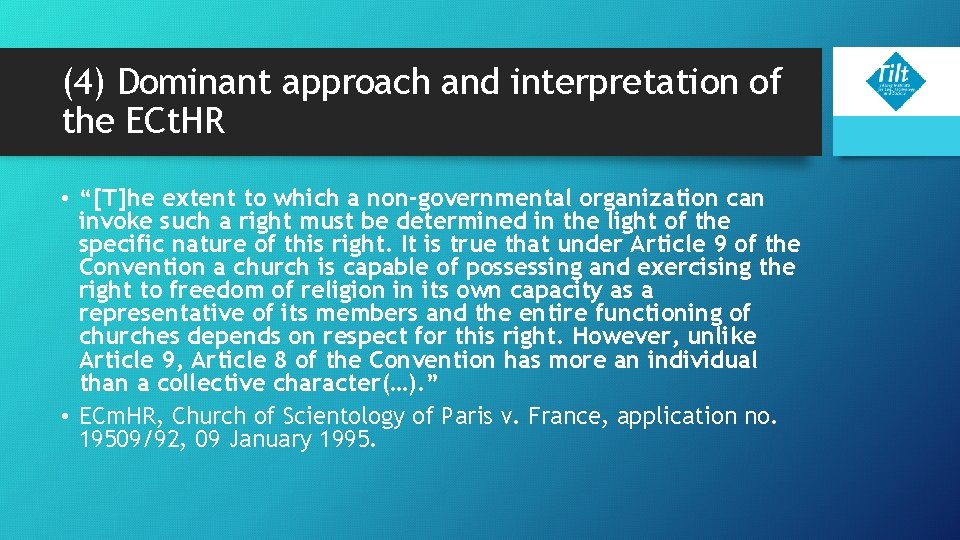
(4) Dominant approach and interpretation of the ECt. HR • “[T]he extent to which a non-governmental organization can invoke such a right must be determined in the light of the specific nature of this right. It is true that under Article 9 of the Convention a church is capable of possessing and exercising the right to freedom of religion in its own capacity as a representative of its members and the entire functioning of churches depends on respect for this right. However, unlike Article 9, Article 8 of the Convention has more an individual than a collective character(…). ” • ECm. HR, Church of Scientology of Paris v. France, application no. 19509/92, 09 January 1995.
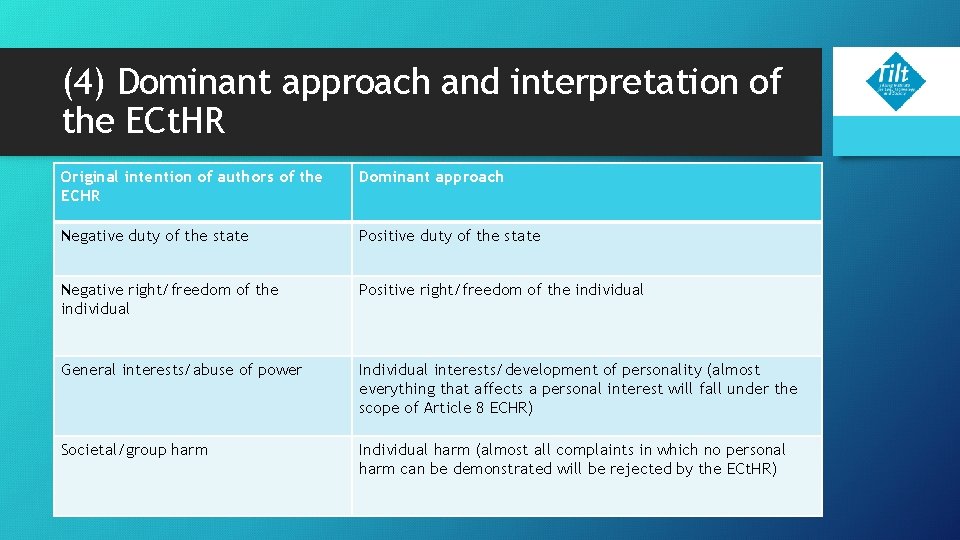
(4) Dominant approach and interpretation of the ECt. HR Original intention of authors of the ECHR Dominant approach Negative duty of the state Positive duty of the state Negative right/freedom of the individual Positive right/freedom of the individual General interests/abuse of power Individual interests/development of personality (almost everything that affects a personal interest will fall under the scope of Article 8 ECHR) Societal/group harm Individual harm (almost all complaints in which no personal harm can be demonstrated will be rejected by the ECt. HR)
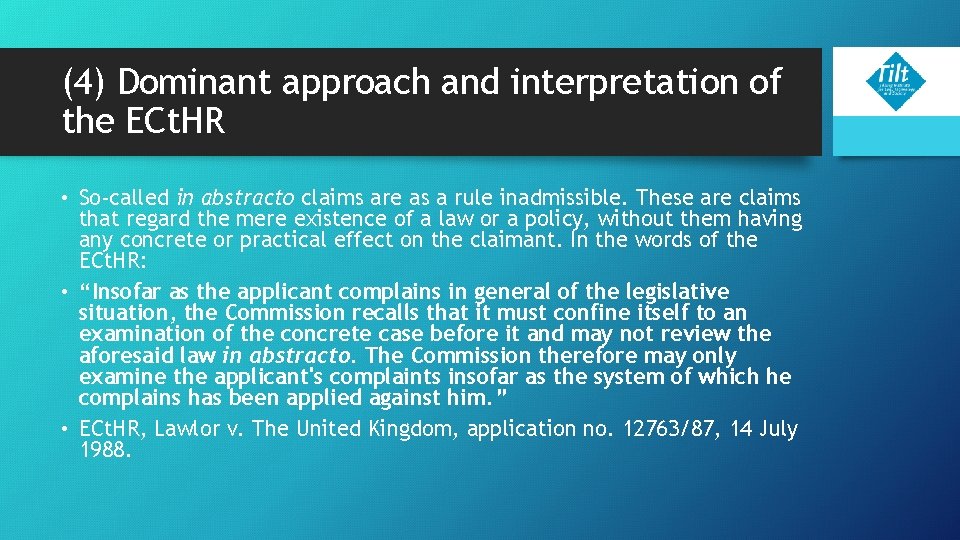
(4) Dominant approach and interpretation of the ECt. HR • So-called in abstracto claims are as a rule inadmissible. These are claims that regard the mere existence of a law or a policy, without them having any concrete or practical effect on the claimant. In the words of the ECt. HR: • “Insofar as the applicant complains in general of the legislative situation, the Commission recalls that it must confine itself to an examination of the concrete case before it and may not review the aforesaid law in abstracto. The Commission therefore may only examine the applicant's complaints insofar as the system of which he complains has been applied against him. ” • ECt. HR, Lawlor v. The United Kingdom, application no. 12763/87, 14 July 1988.
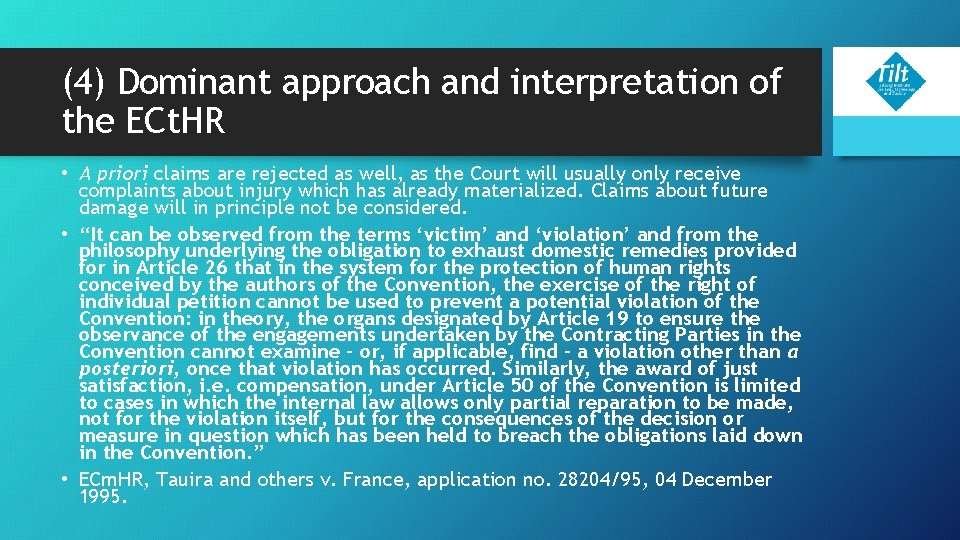
(4) Dominant approach and interpretation of the ECt. HR • A priori claims are rejected as well, as the Court will usually only receive complaints about injury which has already materialized. Claims about future damage will in principle not be considered. • “It can be observed from the terms ‘victim’ and ‘violation’ and from the philosophy underlying the obligation to exhaust domestic remedies provided for in Article 26 that in the system for the protection of human rights conceived by the authors of the Convention, the exercise of the right of individual petition cannot be used to prevent a potential violation of the Convention: in theory, the organs designated by Article 19 to ensure the observance of the engagements undertaken by the Contracting Parties in the Convention cannot examine - or, if applicable, find – a violation other than a posteriori, once that violation has occurred. Similarly, the award of just satisfaction, i. e. compensation, under Article 50 of the Convention is limited to cases in which the internal law allows only partial reparation to be made, not for the violation itself, but for the consequences of the decision or measure in question which has been held to breach the obligations laid down in the Convention. ” • ECm. HR, Tauira and others v. France, application no. 28204/95, 04 December 1995.
(4) Dominant approach and interpretation of the ECt. HR • Hypothetical claims regard damage which might have materialized, but about which the claimant is unsure. The Court usually rejects such claims because it is unwilling to provide a ruling on the basis of presumed facts. The applicant must be able to substantiate her claim with concrete facts, not with beliefs and suppositions.
(4) Dominant approach and interpretation of the ECt. HR • The ECt. HR will in principle also not receive an actio popularis, a case brought up by a claimant or a group of claimants, not to protect their own interests, but that of others or society as a whole. A well-known example of the actio popularis is the so-called class action: • “The Court reiterates in that connection that the Convention does not allow an actio popularis but requires as a condition for exercise of the right of individual petition that an applicant must be able to claim on arguable grounds that he himself has been a direct or indirect victim of a violation of the Convention resulting from an act or omission which can be attributed to a Contracting State. ” • ECt. HR, Asselbourg and 78 others and Greenpeace Association. Luxembourg v. Luxembourg, application no. 29121/95, 29 June 1999.
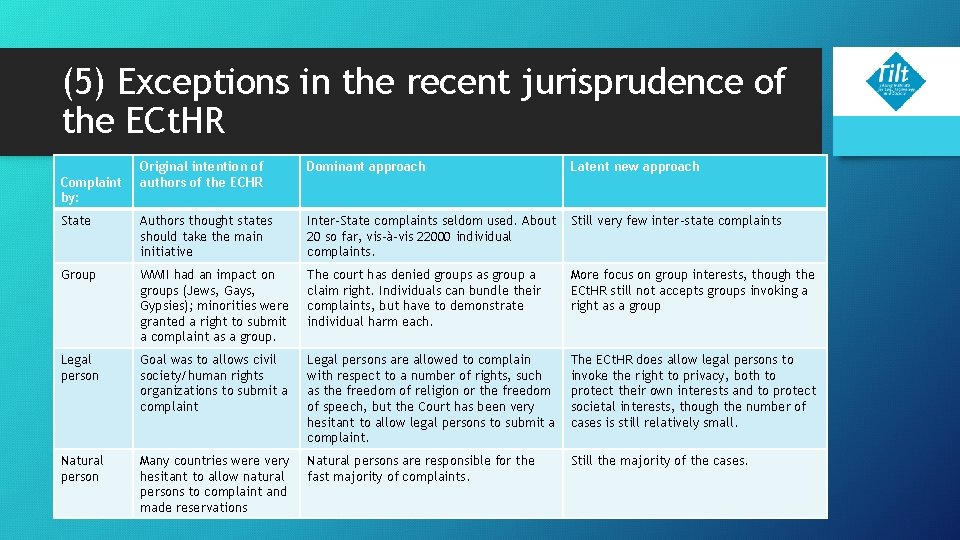
(5) Exceptions in the recent jurisprudence of the ECt. HR Original intention of authors of the ECHR Dominant approach Latent new approach State Authors thought states should take the main initiative Inter-State complaints seldom used. About 20 so far, vis-à-vis 22000 individual complaints. Still very few inter-state complaints Group WWII had an impact on groups (Jews, Gays, Gypsies); minorities were granted a right to submit a complaint as a group. The court has denied groups as group a claim right. Individuals can bundle their complaints, but have to demonstrate individual harm each. More focus on group interests, though the ECt. HR still not accepts groups invoking a right as a group Legal person Goal was to allows civil society/human rights organizations to submit a complaint Legal persons are allowed to complain with respect to a number of rights, such as the freedom of religion or the freedom of speech, but the Court has been very hesitant to allow legal persons to submit a complaint. The ECt. HR does allow legal persons to invoke the right to privacy, both to protect their own interests and to protect societal interests, though the number of cases is still relatively small. Natural person Many countries were very hesitant to allow natural persons to complaint and made reservations Natural persons are responsible for the fast majority of complaints. Still the majority of the cases. Complaint by:
(5) Exceptions in the recent jurisprudence of the ECt. HR • “In Chappell v. the United Kingdom, the Court considered that a search conducted at a private individual's home which was also the registered office of a company run by him had amounted to interference with his right to respect for his home within the meaning of Article 8 of the Convention. The Court reiterates that the Convention is a living instrument which must be interpreted in the light of present day conditions. [] Building on its dynamic interpretation of the Convention, the Court considers that the time has come to hold that in certain circumstances the rights guaranteed by Article 8 of the Convention may be construed as including the right to respect for a company's registered office, branches or other business premises. ” • ECt. HR, Stes Colas Est and others v. France, appl. no. 37971/97, 16 April 2002, § 40 -41.
(5) Exceptions in the recent jurisprudence of the ECt. HR • In exceptional cases, especially those that revolve around mass surveillance activities, the ECt. HR is willing to loosen its focus on individual harm. • ECt. HR, Roman Zakharov v. Russia, application no. 47143/06, 04 December 2015. ECt. HR, Szabó and Vissy v. Hungary, application no. 37138/14, 12 January 2016.
(5) Exceptions in the recent jurisprudence of the ECt. HR • “[T]he Court accepts that an applicant can claim to be the victim of a violation occasioned by the mere existence of secret surveillance measures, or legislation permitting secret surveillance measures, if the following conditions are satisfied. • Firstly, the Court will take into account the scope of the legislation permitting secret surveillance measures by examining whether the applicant can possibly be affected by it, either because he or she belongs to a group of persons targeted by the contested legislation or because the legislation directly affects all users of communication services by instituting a system where any person can have his or her communications intercepted. • Secondly, the Court will take into account the availability of remedies at the national level and will adjust the degree of scrutiny depending on the effectiveness of such remedies. As the Court underlined in Kennedy, where the domestic system does not afford an effective remedy to the person who suspects that he or she was subjected to secret surveillance, widespread suspicion and concern among the general public that secret surveillance powers are being abused cannot be said to be unjustified.
(5) Exceptions in the recent jurisprudence of the ECt. HR • In such circumstances the menace of surveillance can be claimed in itself to restrict free communication through the postal and telecommunication services, thereby constituting for all users or potential users a direct interference with the right guaranteed by Article 8. There is therefore a greater need for scrutiny by the Court and an exception to the rule, which denies individuals the right to challenge a law in abstracto, is justified. • In such cases the individual does not need to demonstrate the existence of any risk that secret surveillance measures were applied to her. By contrast, if the national system provides for effective remedies, a widespread suspicion of abuse is more difficult to justify. In such cases, the individual may claim to be a victim of a violation occasioned by the mere existence of secret measures or of legislation permitting secret measures only if he is able to show that, due to his personal situation, he is potentially at risk of being subjected to such measures. ”
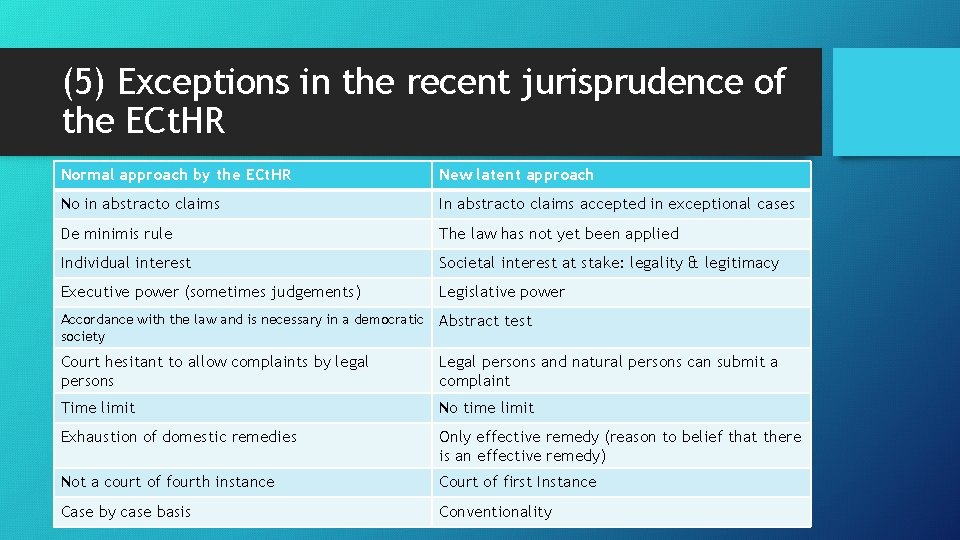
(5) Exceptions in the recent jurisprudence of the ECt. HR Normal approach by the ECt. HR New latent approach No in abstracto claims In abstracto claims accepted in exceptional cases De minimis rule The law has not yet been applied Individual interest Societal interest at stake: legality & legitimacy Executive power (sometimes judgements) Legislative power Accordance with the law and is necessary in a democratic society Abstract test Court hesitant to allow complaints by legal persons Legal persons and natural persons can submit a complaint Time limit No time limit Exhaustion of domestic remedies Only effective remedy (reason to belief that there is an effective remedy) Not a court of fourth instance Court of first Instance Case by case basis Conventionality
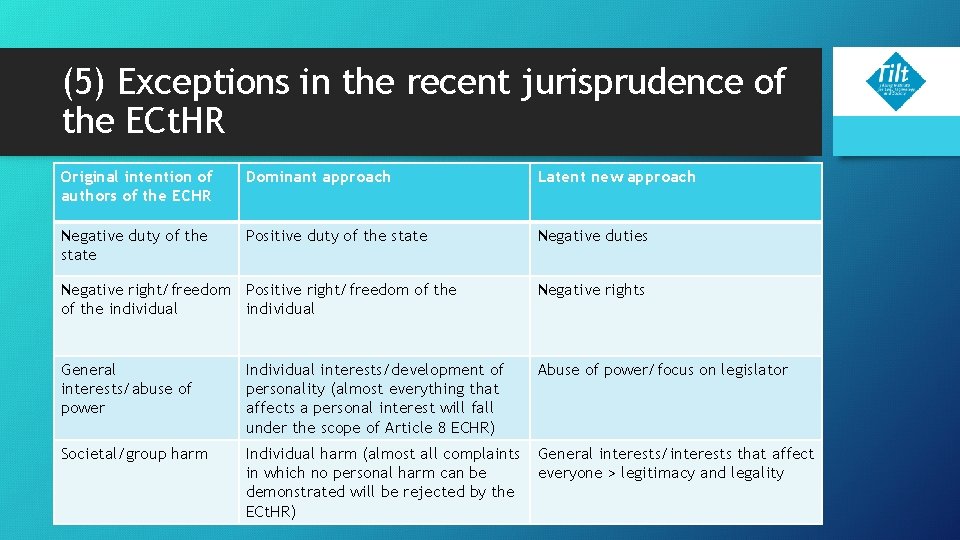
(5) Exceptions in the recent jurisprudence of the ECt. HR Original intention of authors of the ECHR Dominant approach Latent new approach Negative duty of the state Positive duty of the state Negative duties Negative right/freedom Positive right/freedom of the individual Negative rights General interests/abuse of power Individual interests/development of personality (almost everything that affects a personal interest will fall under the scope of Article 8 ECHR) Abuse of power/focus on legislator Societal/group harm Individual harm (almost all complaints in which no personal harm can be demonstrated will be rejected by the ECt. HR) General interests/interests that affect everyone > legitimacy and legality
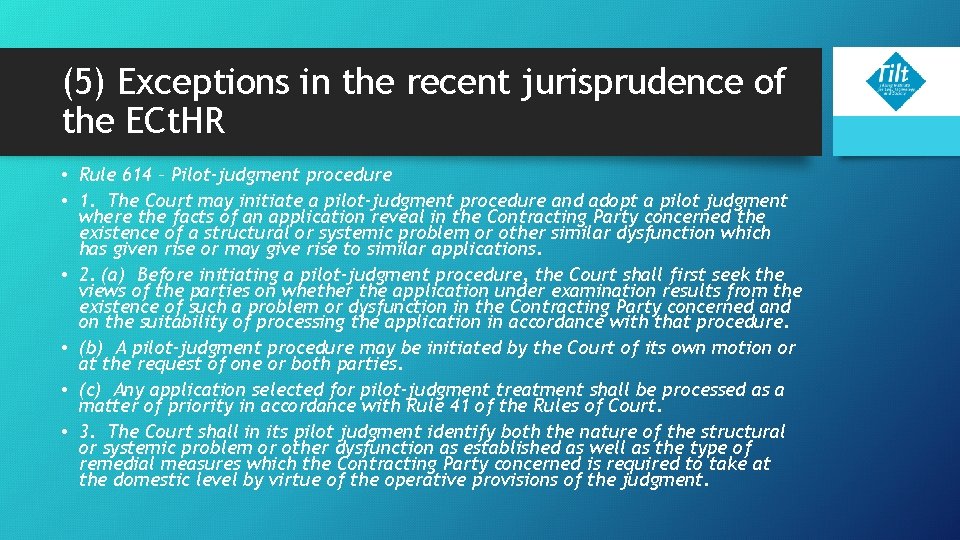
(5) Exceptions in the recent jurisprudence of the ECt. HR • Rule 614 – Pilot-judgment procedure • 1. The Court may initiate a pilot-judgment procedure and adopt a pilot judgment where the facts of an application reveal in the Contracting Party concerned the existence of a structural or systemic problem or other similar dysfunction which has given rise or may give rise to similar applications. • 2. (a) Before initiating a pilot-judgment procedure, the Court shall first seek the views of the parties on whether the application under examination results from the existence of such a problem or dysfunction in the Contracting Party concerned and on the suitability of processing the application in accordance with that procedure. • (b) A pilot-judgment procedure may be initiated by the Court of its own motion or at the request of one or both parties. • (c) Any application selected for pilot-judgment treatment shall be processed as a matter of priority in accordance with Rule 41 of the Rules of Court. • 3. The Court shall in its pilot judgment identify both the nature of the structural or systemic problem or other dysfunction as established as well as the type of remedial measures which the Contracting Party concerned is required to take at the domestic level by virtue of the operative provisions of the judgment.
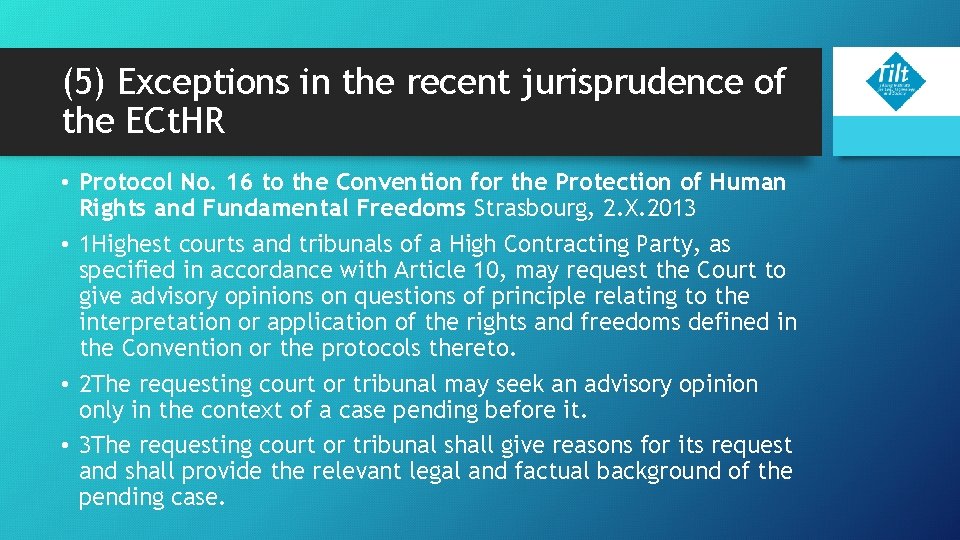
(5) Exceptions in the recent jurisprudence of the ECt. HR • Protocol No. 16 to the Convention for the Protection of Human Rights and Fundamental Freedoms Strasbourg, 2. X. 2013 • 1 Highest courts and tribunals of a High Contracting Party, as specified in accordance with Article 10, may request the Court to give advisory opinions on questions of principle relating to the interpretation or application of the rights and freedoms defined in the Convention or the protocols thereto. • 2 The requesting court or tribunal may seek an advisory opinion only in the context of a case pending before it. • 3 The requesting court or tribunal shall give reasons for its request and shall provide the relevant legal and factual background of the pending case.
Questions?