
Privacy and Cyberspace II Cole Goodyear Lindsay Grant
Privacy and Cyberspace II Cole Goodyear Lindsay Grant Samir Habbal Steven Hatch Katie Hayes Eric Hemingway Adam Hensley
Topics of Privacy and Cyberspace • • • Government Google Subpoena Data Mining and Privacy PETs Privacy Legislation Public Webcams Computers in your Cars
Government Google Subpoena
United States Department of Justice • In 2006 - Requsted records for millions of searches Strenghten argument for online pornography laws o Broad data on search habits § Not personal information o Concern with where the Government will go next o Microsoft, MSN, Yahoo, AOL, and Google Subpoenaed o • Another case o Used Patriot Act to Request library users internet use
User Information Privacy • • Concern over what personal information the Government will ask for next The real purpose was to uphold the Child Online Protection Act (COPA) Material harmful to minors prevented from accessing o Restricts protected free speech o Courts have blocked the law from taking effect o
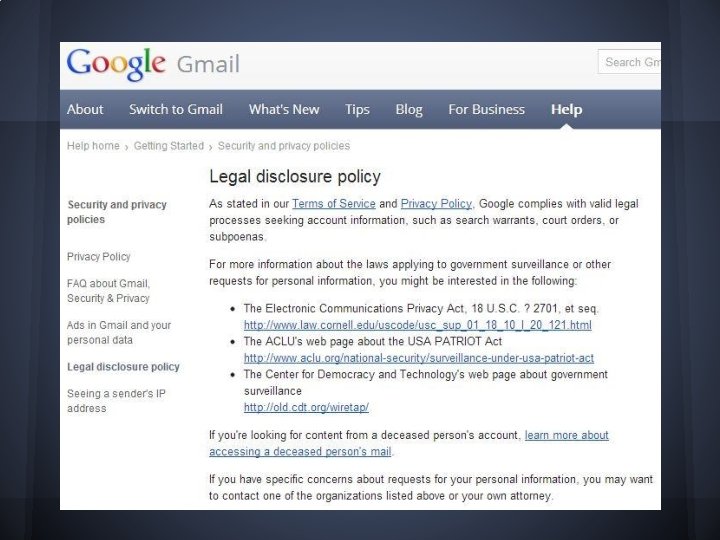
• MSN, Yahoo, AOL Complied with subpoena o Did not violate the privacy of users o • Google Privacy of users o Protection of trade secrets o Goverment's attitude is that it is entitled to this information without justification o • Electronic Fronteir Foundation o Civil Liberties Group "All the search engines have created a honey pot of information about people and what they search for. It's a window into their personalities - what they want, what they dream about. This information gets stored, and that becomes very tempting. " - Kurt Opsah, Staff Attorney for EFF
What Do They Know About You? • At a basic level Record web sites users visit and search terms o Cookies help keep track of a customers habits o Google's cookie lasts until 2036 o • Email services o Retain Personal Information users are required to enter
Be Anonymous • Services that protect your privacy o Tor and Anonymizer § hides a user's IP address from search engines by routing search requests through a maze of servers § Tor is free • § Sponsored by the Electronic Frontier Foundation Anonymizer • Pricier option Can result in slower web browsing o Incognito Mode §
Summing it up • Concerns that Justice Dept. Request is for a large body of data § Rather than specific individual o Privacy advocates worry personal data is part of the search o • EFF Has urged search engines to limit the amount of information they gather o Have listened, but there is a lot of resistance o

PETs What are they?
Privacy Enhanced Technologies Main Goal Give the user the ability to govern who gets their personal data and to what extent • 4 Categories 1. Encryption Tools 2. Policy Tools 3. Filtering Tools 4. Anonymity Tools
Encryption Tools Examples Secure Socket Layer (SSL) Transport Layer Security (TLS) Pretty Good Privacy (PGP) • • • How it works The communicating computers both have the a key used to encrypt and decrypt the data One computer encrypts the data using the key Sends the encrypted data to the other computer The other computer decrypts the data using the key • •
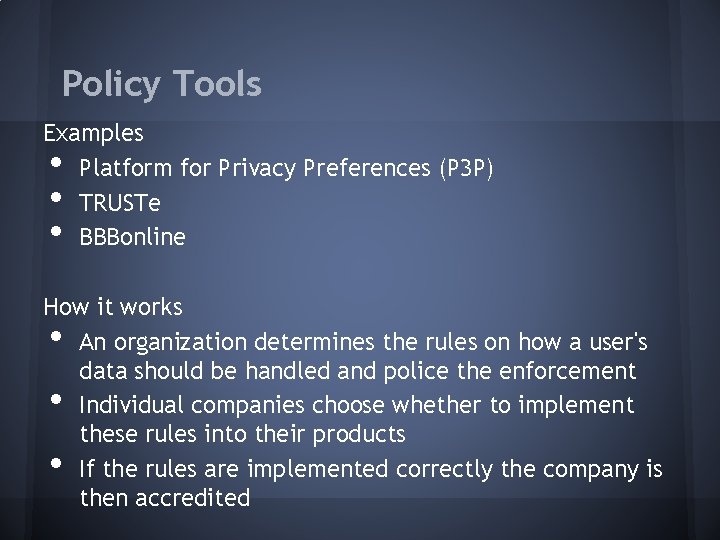
Policy Tools Examples Platform for Privacy Preferences (P 3 P) TRUSTe BBBonline • • • How it works An organization determines the rules on how a user's data should be handled and police the enforcement Individual companies choose whether to implement these rules into their products If the rules are implemented correctly the company is then accredited • • •
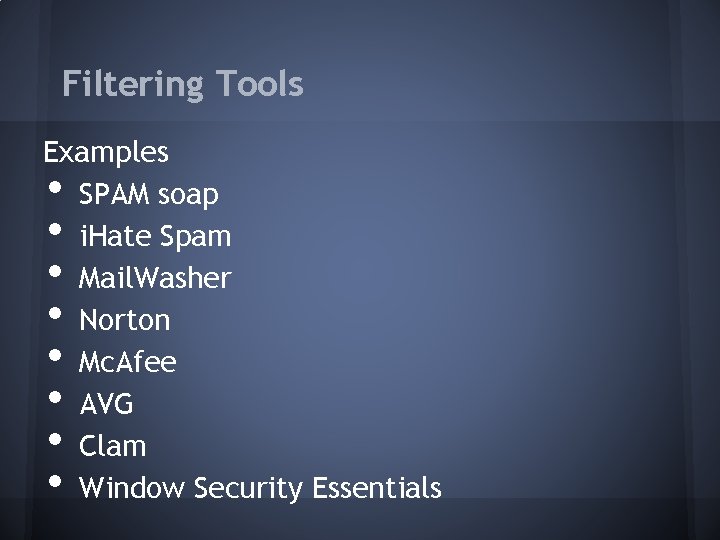
Filtering Tools Examples SPAM soap i. Hate Spam Mail. Washer Norton Mc. Afee AVG Clam Window Security Essentials • •
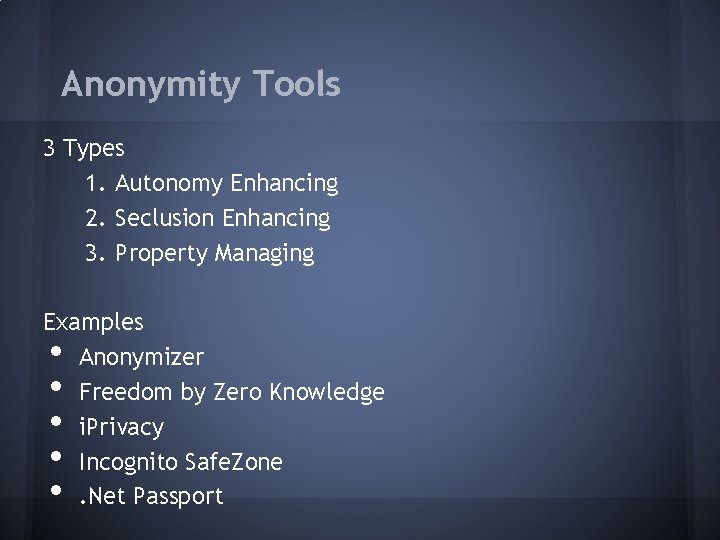
Anonymity Tools 3 Types 1. Autonomy Enhancing 2. Seclusion Enhancing 3. Property Managing Examples Anonymizer Freedom by Zero Knowledge i. Privacy Incognito Safe. Zone. Net Passport • • •
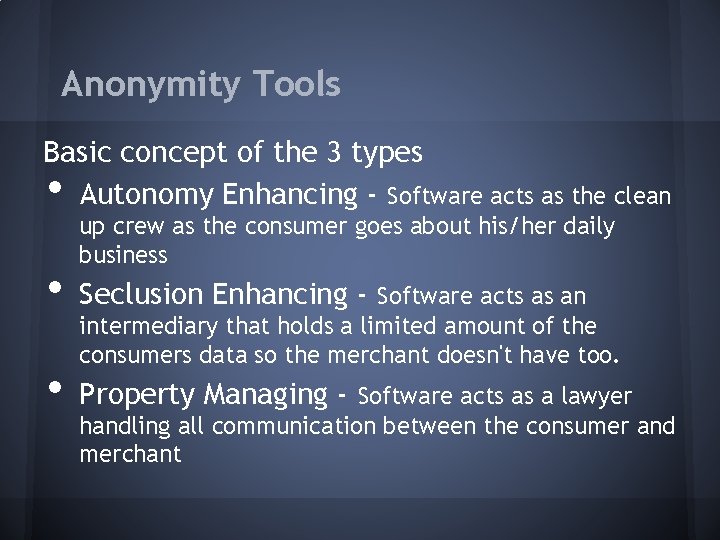
Anonymity Tools Basic concept of the 3 types Autonomy Enhancing - Software acts as the clean • • • up crew as the consumer goes about his/her daily business Seclusion Enhancing - Software acts as an intermediary that holds a limited amount of the consumers data so the merchant doesn't have too. Property Managing - Software acts as a lawyer handling all communication between the consumer and merchant

Privacy Legislation Lindsay Grant
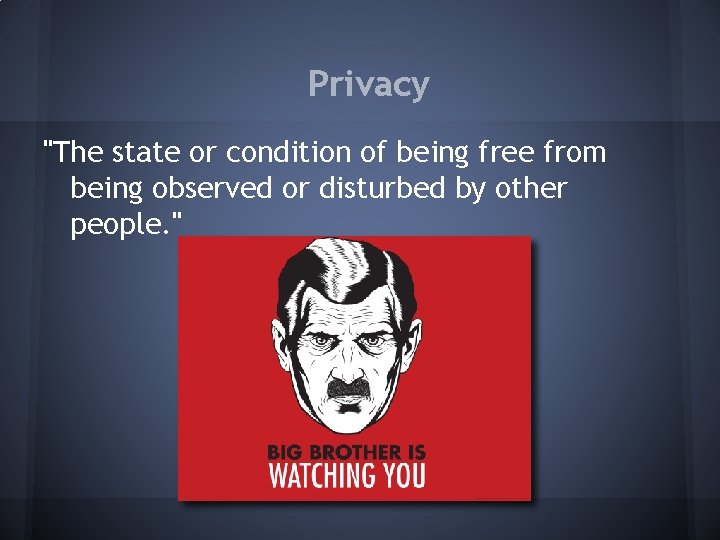
Privacy "The state or condition of being free from being observed or disturbed by other people. "
Opinions on Technological Privacy • "Privacy is dead - get over it. " -Steve Rambam o • Private investigator specializing in Internet privacy cases "Privacy protects us from abuses by those in power, even if we're doing nothing wrong at the time of surveillance. " -Bruce Schnier o Internet security expert, author of The Value of Privacy
Electronic Privacy Breaches • • • Sony CD Spyware '05 The Craigslist Experiment '06 AOL Search Leak '06 Google Street View '07 Hotmail Hot Mess '09 Webcamgate '10 Facebook Apps '10 Health. Net Patient Data '11 i. Phone Tacking '11 Play. Station Network Hacked '11
Privacy Act of 1974 • • Outline: a. To restrict disclosure of personally identifiable records maintained by agencies b. To grant individuals increased rights of access to agency records maintained on them c. To grant individuals the right to seek amendment of agency records maintained on themselves upon a showing that the records are not accurate, relevant, timely, or complete d. To establish a code of "fair information practices" which requires agencies to comply with statutory norms for collection, maintenance, and dissemination of records Amended by the Computer Matching and Privacy act of 1988
Electronic Communications Privacy Act • What constitutes as electronic communications? o Any transfer of signs, signals, writing, images, sounds, data, or intelligence of any nature transmitted in whole or in part by a wire, radio, electromagnetic, photoelectronic or photoopical system that affects interstate or foreign commerce, but does not include: § § Any wire or oral communication Any communication made through a tone-only paging device Any communication from a tracking device Electronic funds transfer information stored by a financial institution in a communications system used for the electronic storage and transfer of funds
ECPA Cont • Title I protects o Wire communication in transit o Oral communication in transit o Electronic communication in transit • Title II protects o Communication held in electronic storage • Title III protects against o Prohibits use of pen register and/or tap or trace devices to record dialing, routing, addressing, and signalling information without a court order
Criticism of Twentieth Century Privacy Acts • New York Times ran an article in 2011, "1986 Privacy Law is Outrun by the Web" o "Last year, for example, the Justice Department argued in court that cellphone users had given up the expectation of privacy about their location by voluntarily giving that information to carries. In April, it argued in a federal court in Colorado that it ought to have access to some e-mails without a search warrant. And federal law enforcement officials, citing technology advances, plan to ask for new regulations that would smooth their ability to perform legal wiretaps of various Internet communications. " o Article found here.
State Laws • • Privacy Policies for Websites § California, Connecticut, Nebraska, Pennsylvania Monitoring Employee Emails/Internet Access § Connecticut, Delaware, Texas, Colorado Privacy of Personal Information held by ISP § Minnesota, Nevada, California, Utah Privacy: Online Activity § California • • Using public libraries' online resources Protects against online book sellers releasing private information
For more information. . . Visit epic. org (EPIC = Electronic Privacy Information Center) • Information on privacy and o Cloud Computing o Facebook o Legislation o Search Engines o Google Street View o Student privacy o Etc.

Public Webcams Katie Hayes
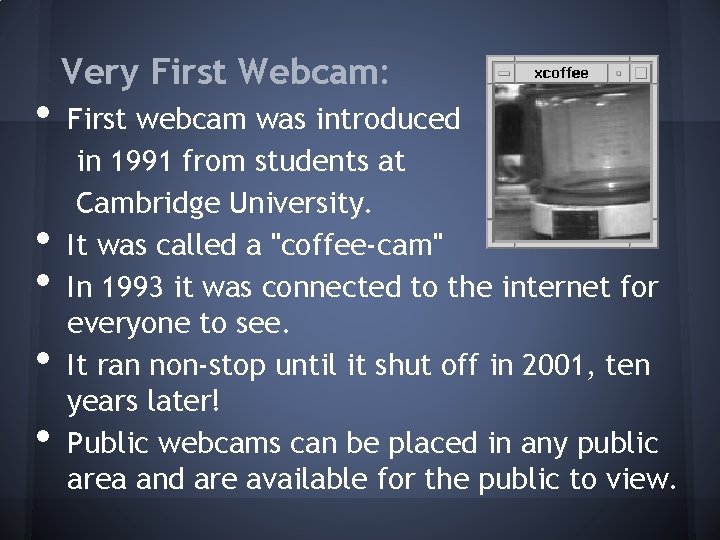
• • • Very First Webcam: First webcam was introduced in 1991 from students at Cambridge University. It was called a "coffee-cam" In 1993 it was connected to the internet for everyone to see. It ran non-stop until it shut off in 2001, ten years later! Public webcams can be placed in any public area and are available for the public to view.
Privacy and Security Issues: • • Programs can be written by computer hackers that allow control of the webcam. Webcams placed on streets by areas where people have a daily route can be used by predators to stalk them. The government thinks terrorists may be monitoring webcams. Webcams at government locations may allow people to see security measures, guard shift changes, and traffic patterns (vehicle and pedestrian).
Privacy issues: • • • People don't think it's right to have their pictures taken and kept without their knowledge. However, webcams are usually placed too far away for people to be identified. In Delaware there was a dispute between a guy who put up a camera overlooking a ferry terminal. The ferry company asked to have it taken down or they would start a lawsuit.
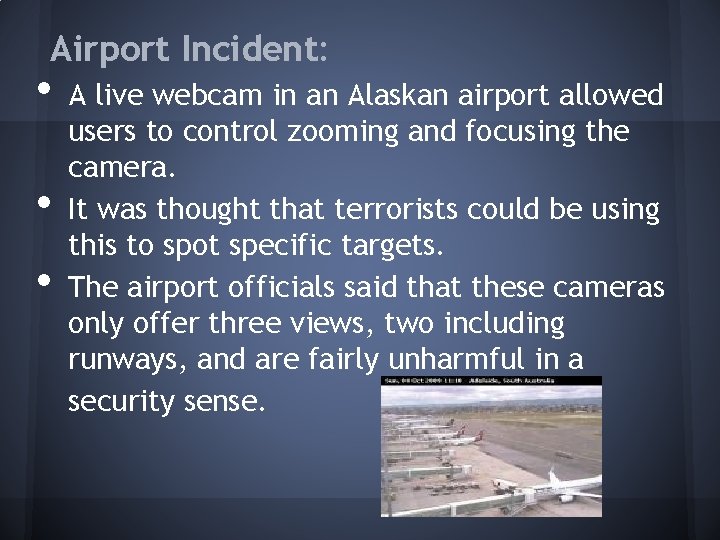
Airport Incident: • • • A live webcam in an Alaskan airport allowed users to control zooming and focusing the camera. It was thought that terrorists could be using this to spot specific targets. The airport officials said that these cameras only offer three views, two including runways, and are fairly unharmful in a security sense.
Interesting Uses of Public Webcams • • One study was done at a DMV that used the webcams to observe people's naturalistic behaviours. Public webcams are put in environments to ensure the safety of humans and to monitor the animal population. Scientists use webcams to see the effect of climate on plants. Paolo Cirio takes images from public webcams and where he sees people standing in a certain spot he creates lifesized prints and puts them on the wall.
Computers In Cars Cole Goodyear and Samir Habbal
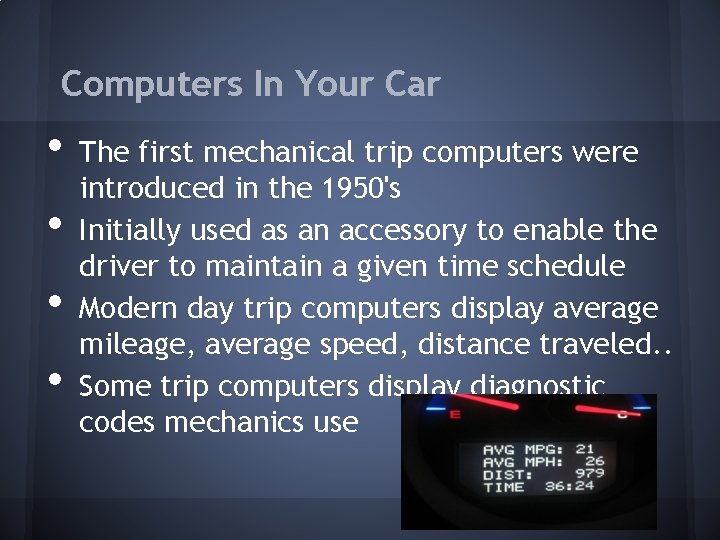
Computers In Your Car • • The first mechanical trip computers were introduced in the 1950's Initially used as an accessory to enable the driver to maintain a given time schedule Modern day trip computers display average mileage, average speed, distance traveled. . Some trip computers display diagnostic codes mechanics use
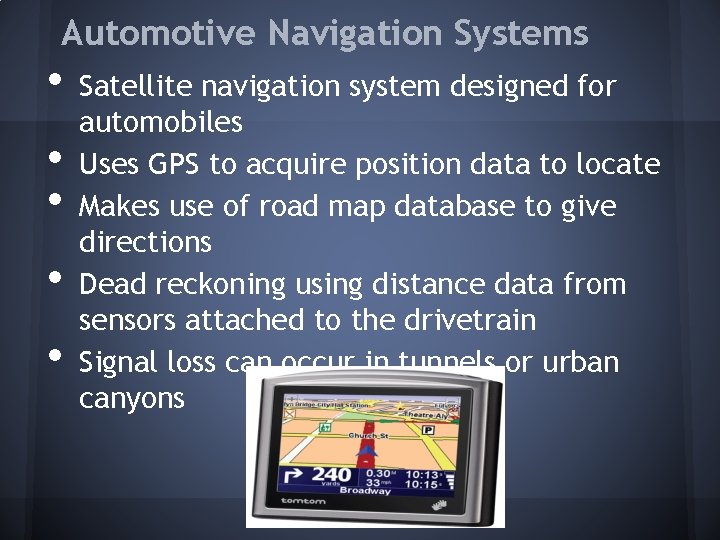
Automotive Navigation Systems • • • Satellite navigation system designed for automobiles Uses GPS to acquire position data to locate Makes use of road map database to give directions Dead reckoning using distance data from sensors attached to the drivetrain Signal loss can occur in tunnels or urban canyons
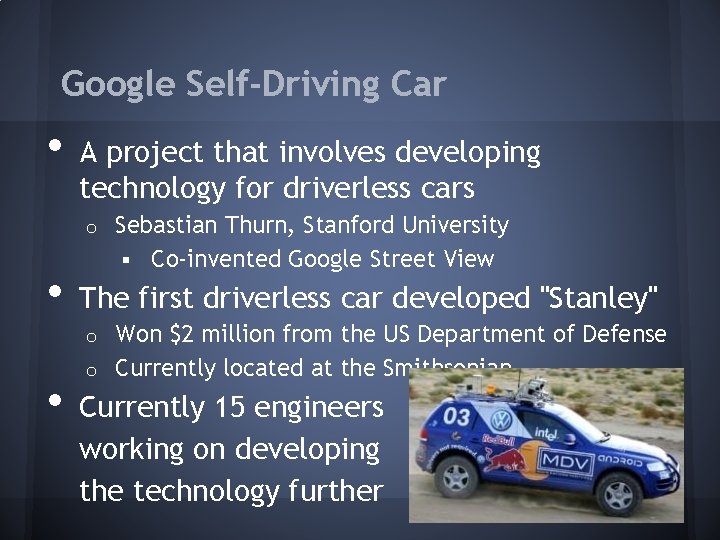
Google Self-Driving Car • A project that involves developing technology for driverless cars o • Sebastian Thurn, Stanford University § Co-invented Google Street View The first driverless car developed "Stanley" Won $2 million from the US Department of Defense o Currently located at the Smithsonian o • Currently 15 engineers working on developing the technology further
Google Self-Driving Car • The system combines information gathered by Street View with artificial intelligence o • • Input from video cameras, a LIDAR sensor on top of the vehicle, radar sensors on the front and back, and a position sensor on the rear wheels help orientate the vehicle There is a test fleet of about a dozen vehicles traversing roads in California and Nevada The fleet has driven in excess of 300 k miles and not logged a single accident
Google Self-Driving Car • The cars are allowed to drive anywhere in CA or NV so long as there is a driver in the front seat that can take over in case of system failure o • • The "drivers" have unblemished records and are yet to have to step in to take control of a vehicle They have successfully traversed Lombard Street in San Francisco The only documented accident was when one of the vehicles got rear-ended at a red light
Google Self Driving Car • • • There are no immediate plans for the cars to become commercially available although that is the plan for the future Forbes says that by 2040 we won't need drivers licenses and we'll be much safer on the roads Google's innovations are going to pave the road for safer streets in the future
Computer in your car, Where are they? • • Computers are located everywhere in your car. For example, your radio is controlled by a computer, your dashboard etc. . . They are in charge of monitoring engine emissions and adjusting engine to keep the emissions as low as possible. Computers are necessary and important to your car All car manufactured today contain at least 1 computer.
How do they work? • • • Computers receives information from sensors Using those sensor, they then can control things like the fuel injector. Computers senses if something had gone wrong and then they inform the driver by putting a light on the dashboard.
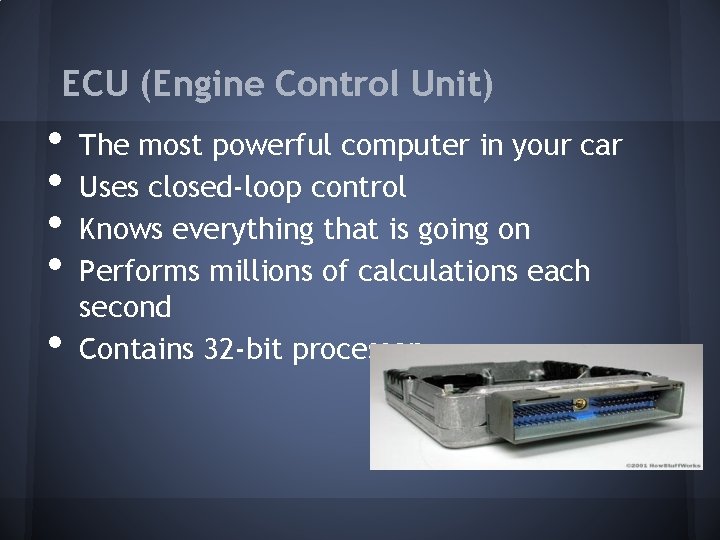
ECU (Engine Control Unit) • • • The most powerful computer in your car Uses closed-loop control Knows everything that is going on Performs millions of calculations each second Contains 32 -bit processor
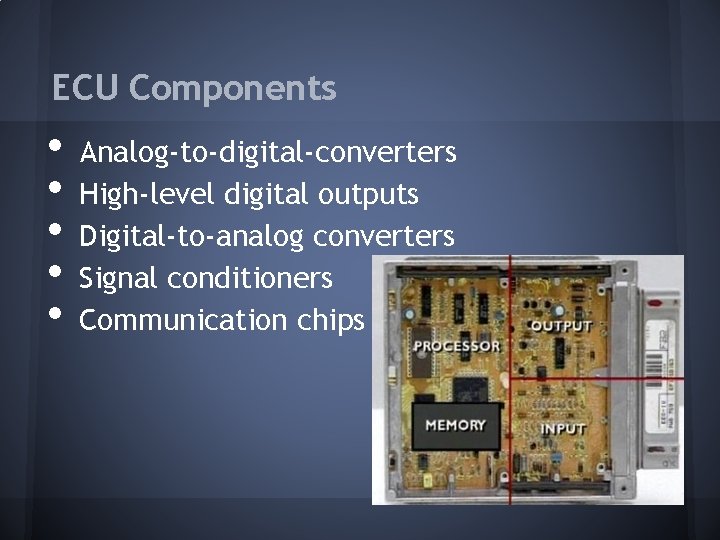
ECU Components • • • Analog-to-digital-converters High-level digital outputs Digital-to-analog converters Signal conditioners Communication chips

Questions?
References Government Google Subpoena • • • http: //www. npr. org/templates/story. php? story. Id=5165854 http: //www. nytimes. com/2006/01/20/technology/20 google. html? _r=4&pagewanted=all http: //support. google. com/mail/bin/answer. py? hl=en&answer=7995 PETs • • • Bobby Vellanki, “Privacy Enhancing Technologies (PET), ” CS 457, Computer Science Dept. , Yale University, Oct. 2003. http: //www. cs. cmu. edu/afs/cs/Web/People/yangwan 1/papers/2008 -Handbook-Liab. Sec-Author. Copy. pdf http: //www. cbpweb. nl/downloads_technologie/pisa_handboek. pdf Privacy Legislation • • http: //www. networkworld. com/news/2012/012612 -privacy-scandals-255357. html? page=3 http: //www. it. ojp. gov/default. aspx? area=privacy&page=1279 http: //en. wikipedia. org/wiki/Electronic_Communications_Privacy_Act http: //en. wikipedia. org/wiki/Internet_privacy Public webcmas: • • http: //thelongestlistofthelongeststuffatthelongestdomainnameatlonglast. com/first 91. html http: //www. ehow. com/about_4613323_webcams. html http: //video. planetgreen. discovery. com/work-connect/scientists-webcams-climate-change. html http: //dataprivacylab. org/courses/dp 1/fair/project 16/paper. pdf http: //www. aviationpros. com/news/10437355/fbi-terrorists-monitoring-public-webcams http: //www. theatlantic. com/technology/archive/2012/09/turning-street-view-into-street-art/263019/ http: //www. nytimes. com/2001/05/03/technology/webcam-s-scenic-view-raises-a-privacyissue. html? pagewanted=all&src=pm
References continued Computers in your Car • • http: //auto. howstuffworks. com/under-the-hood/trends-innovations/question 113. htm http: //auto. howstuffworks. com/under-the-hood/trends-innovations/car-computer 1. htm
- Slides: 47