
Priplast Polyester Oligomers Dimerized Fatty Acid Technology for
- Slides: 18
Priplast Polyester Oligomers Dimerized Fatty Acid Technology for Use in Epoxy Toughening
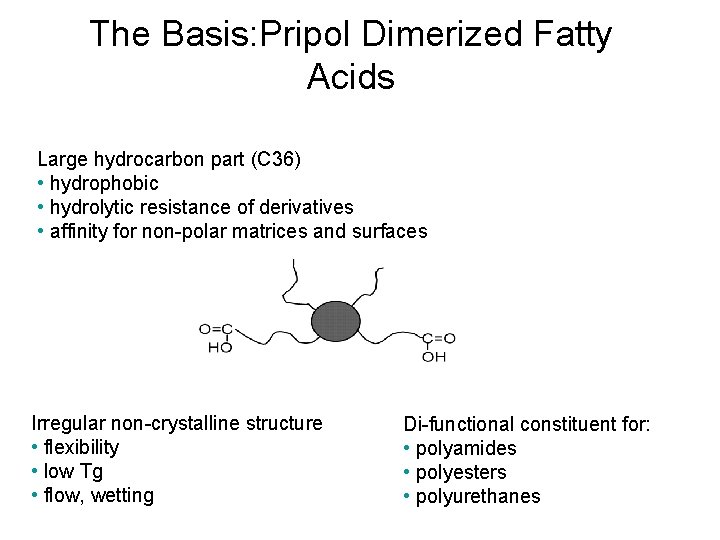
The Basis: Pripol Dimerized Fatty Acids Large hydrocarbon part (C 36) • hydrophobic • hydrolytic resistance of derivatives • affinity for non-polar matrices and surfaces Irregular non-crystalline structure • flexibility • low Tg • flow, wetting Di-functional constituent for: • polyamides • polyesters • polyurethanes
Use in Epoxy resins • Dimer technology traditionally used in epoxy resins – In polyamide curatives – In modifed epoxies • Why? – Brings flexibility (vibration / stress absorption) – Enhances hydrophobicity, weatherability and compatibility with organic matrices (tar, hydrocarbon resins)
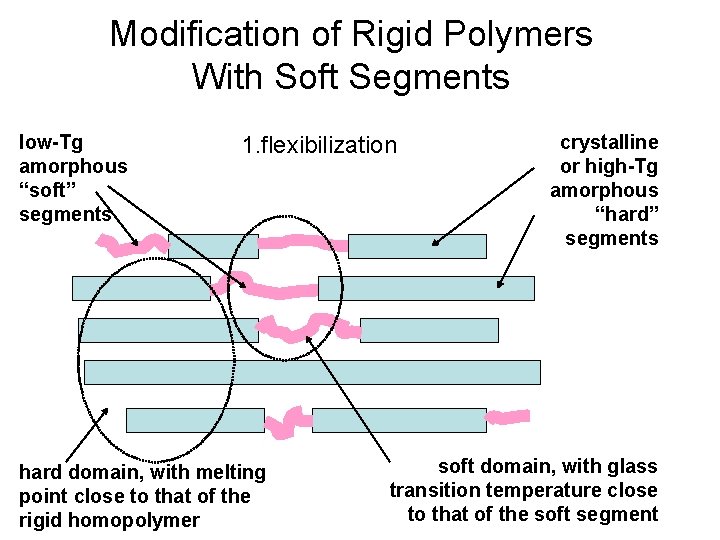
Modification of Rigid Polymers With Soft Segments low-Tg amorphous “soft” segments 1. flexibilization hard domain, with melting point close to that of the rigid homopolymer crystalline or high-Tg amorphous “hard” segments soft domain, with glass transition temperature close to that of the soft segment
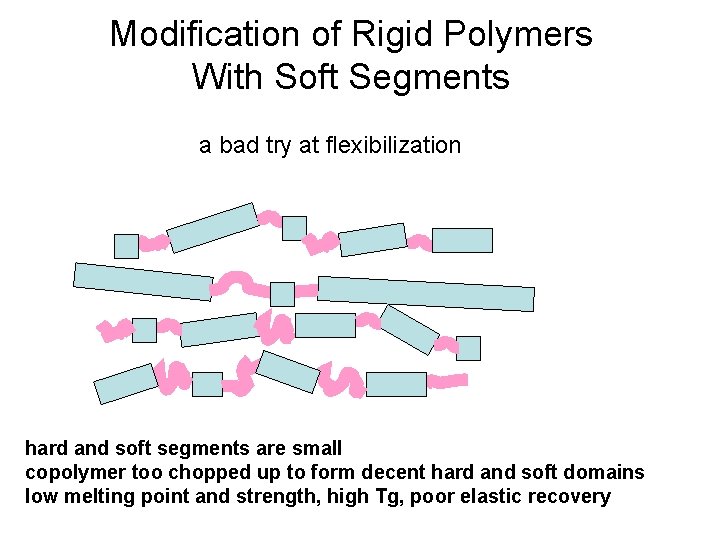
Modification of Rigid Polymers With Soft Segments a bad try at flexibilization hard and soft segments are small copolymer too chopped up to form decent hard and soft domains low melting point and strength, high Tg, poor elastic recovery
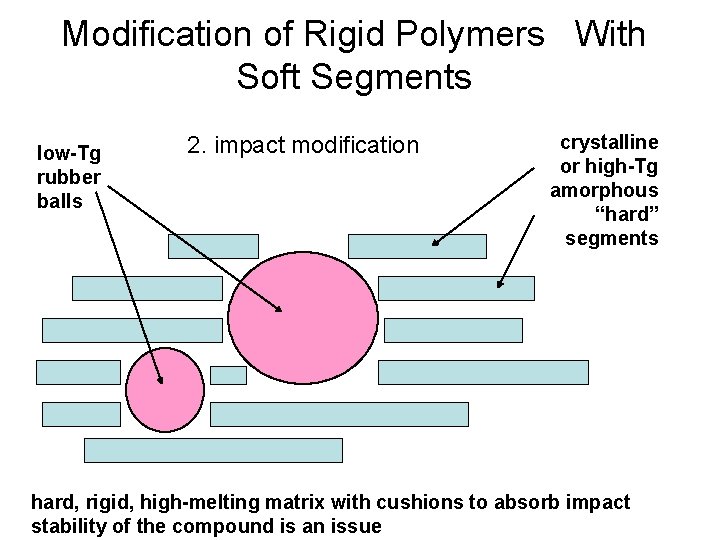
Modification of Rigid Polymers With Soft Segments low-Tg rubber balls 2. impact modification crystalline or high-Tg amorphous “hard” segments hard, rigid, high-melting matrix with cushions to absorb impact stability of the compound is an issue
Dimer technology for epoxy modification the low glass transition temperature of dimer acid makes it suitable for flexibilization and impact modification the low polarity and Tg of dimer acid is a good strating point for phase separation dimer acid itself is rather small as a soft segment (MW 580) so optimal properties cannot be reached
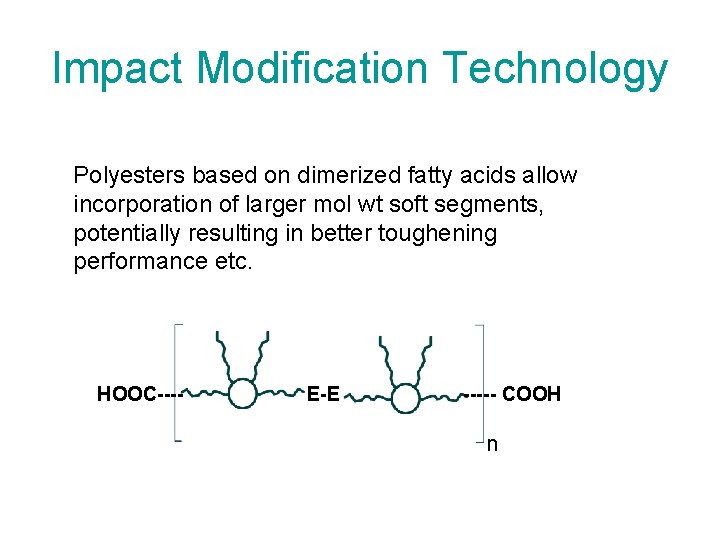
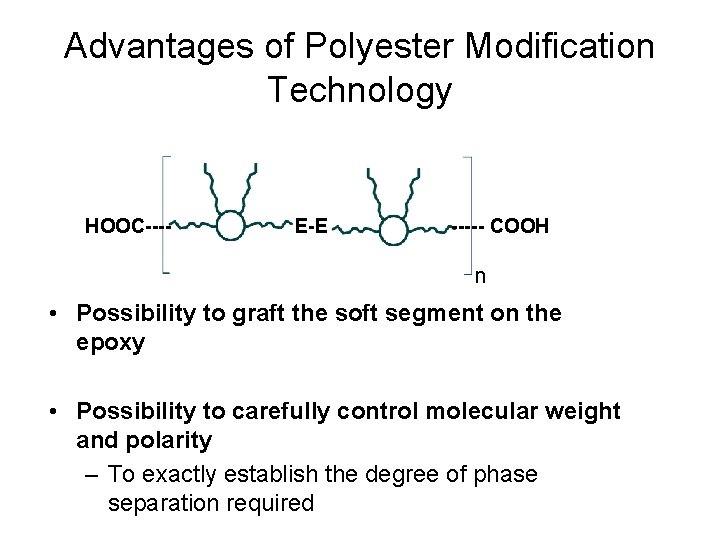
Impact Modification Technology Polyesters based on dimerized fatty acids allow incorporation of larger mol wt soft segments, potentially resulting in better toughening performance etc. HOOC---- E-E ----- COOH n
Advantages of Polyester Modification Technology HOOC---- E-E ----- COOH n • Possibility to graft the soft segment on the epoxy • Possibility to carefully control molecular weight and polarity – To exactly establish the degree of phase separation required
Additional Advantages • Soft domains based on dimerized fatty acid are extremely hydrophobic, which reduces moisture diffusion through the matrix • Polyesters based on dimerized fatty acids do not contain volatile toxic or smelly monomers • Polyesters based on dimerized fatty acids are not susceptible to thermal or oxidative degradation • Polyesters based on dimerized fatty acids have very low glass transition temperatures
Existing Grafted Impact Modifiers • CTBN-rubber (‘liquid rubber’) – a low-MW copolymer of acrylonitrile and butadiene – contains unreacted double bonds – High viscosity (60000 – 500000 m. Pa. s at 27 ºC)
Test Epoxy Formulation Heat curable formulation • 72% ‘Pre-react’ – dimer polyester + low mol wt BPA epoxy (‘ 828’ type) • 15% high mol wt BPA epoxy (‘ 1001’ type) • 4% Phenolic Novolac • Catalyst – Imidazole – Cured at 175 C
Effect of Polyester Polarity Several acid-terminated polyesters of PRIPOL 1009, low-MW dioic acid and glycol prepared Constant molecular weight Ratio of PRIPOL 1009 to low-MW dioic acid varied HUGE impact on reaction
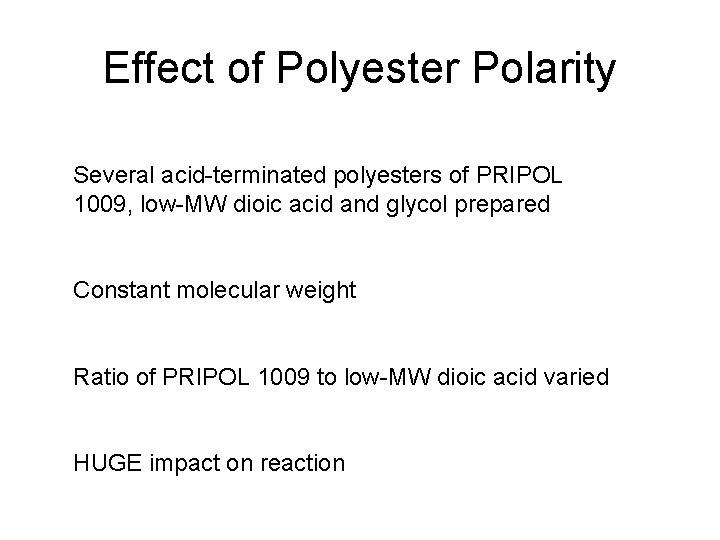
Modification with pure Pripol 1009 / glycol ester (no short-chain dioic acid) no grafting reaction components are too incompatible polymer is brittle AND sticky
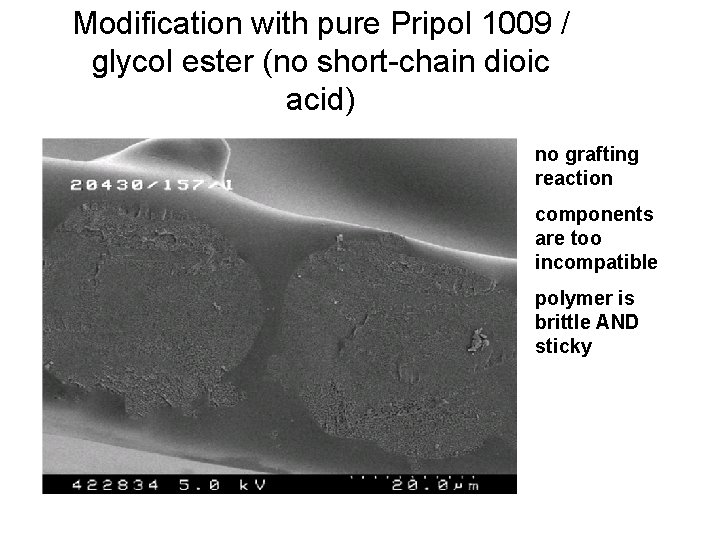
Modification with ester of Pripol 1009 and short dioic acid (75/25) some grafting reaction components are still incompatible polymer is brittle AND sticky
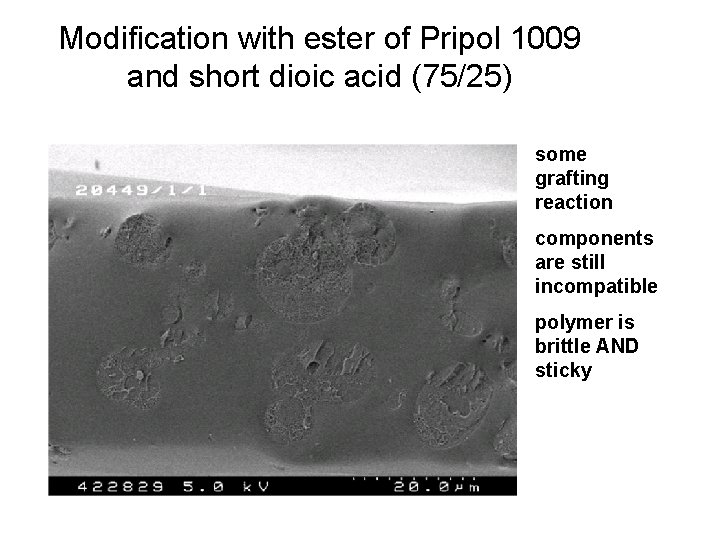
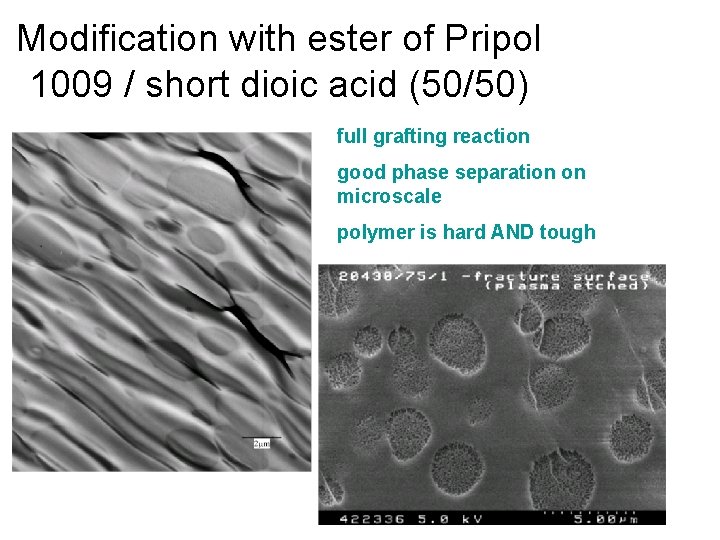
Modification with ester of Pripol 1009 / short dioic acid (50/50) full grafting reaction good phase separation on microscale polymer is hard AND tough
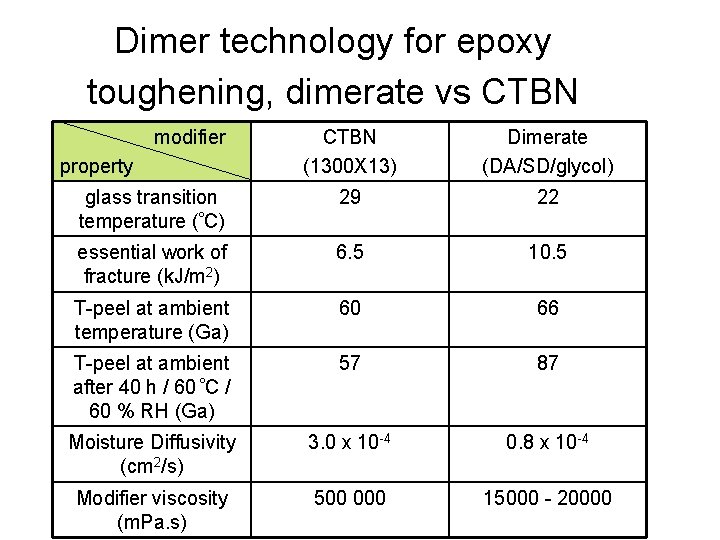
Dimer technology for epoxy toughening, dimerate vs CTBN modifier CTBN (1300 X 13) Dimerate (DA/SD/glycol) glass transition temperature (ºC) 29 22 essential work of fracture (k. J/m 2) 6. 5 10. 5 T-peel at ambient temperature (Ga) 60 66 T-peel at ambient after 40 h / 60 ºC / 60 % RH (Ga) 57 87 Moisture Diffusivity (cm 2/s) 3. 0 x 10 -4 0. 8 x 10 -4 Modifier viscosity (m. Pa. s) 500 000 15000 - 20000 property
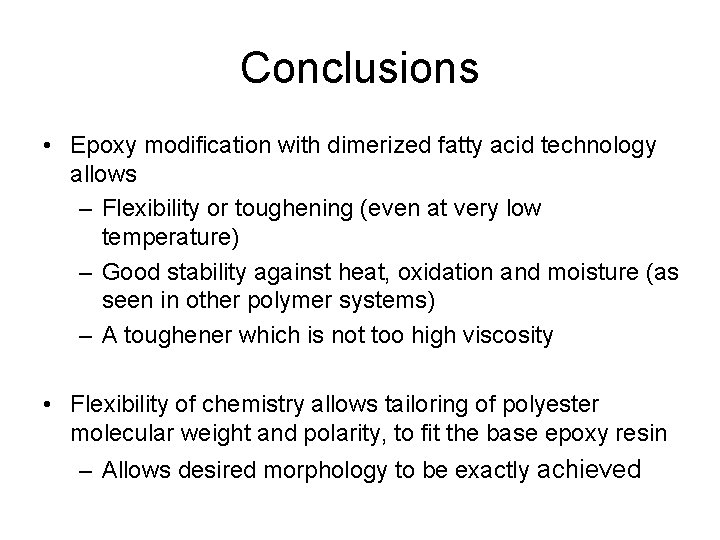
Conclusions • Epoxy modification with dimerized fatty acid technology allows – Flexibility or toughening (even at very low temperature) – Good stability against heat, oxidation and moisture (as seen in other polymer systems) – A toughener which is not too high viscosity • Flexibility of chemistry allows tailoring of polyester molecular weight and polarity, to fit the base epoxy resin – Allows desired morphology to be exactly achieved