
Priority setting in healthcare Hareth AlJanabi MPH University

Priority setting in healthcare Hareth Al-Janabi MPH, University of Birmingham, June 2010
Overview o Rationing in healthcare o Economic approach to setting priorities o Equity & fair innings Priority setting in healthcare
Rationing in healthcare Priority setting in healthcare
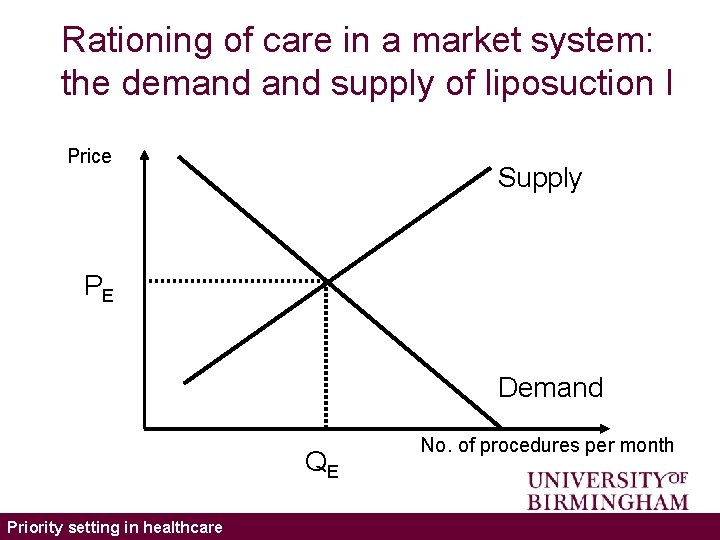
Rationing of care in a market system: the demand supply of liposuction I Price Supply PE Demand QE Priority setting in healthcare No. of procedures per month
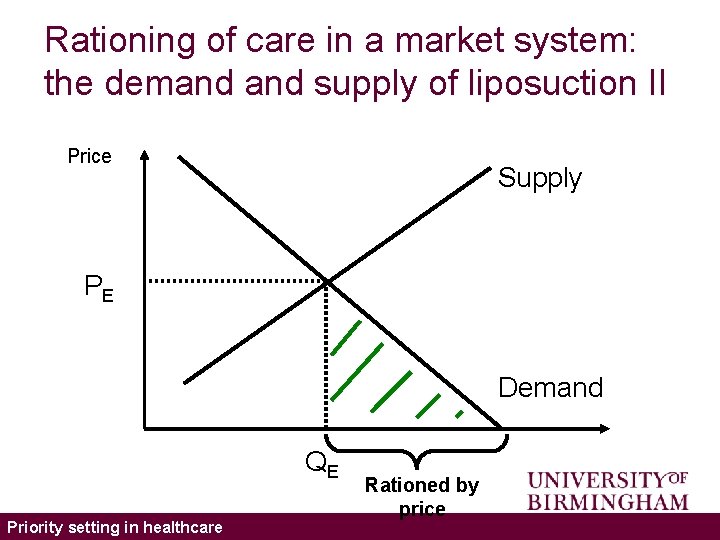
Rationing of care in a market system: the demand supply of liposuction II Price Supply PE Demand QE Priority setting in healthcare Rationed by price
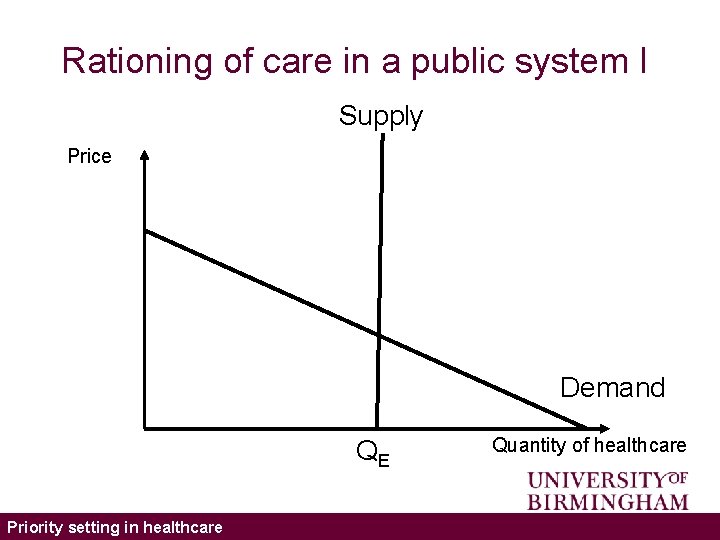
Rationing of care in a public system I Supply Price Demand QE Priority setting in healthcare Quantity of healthcare
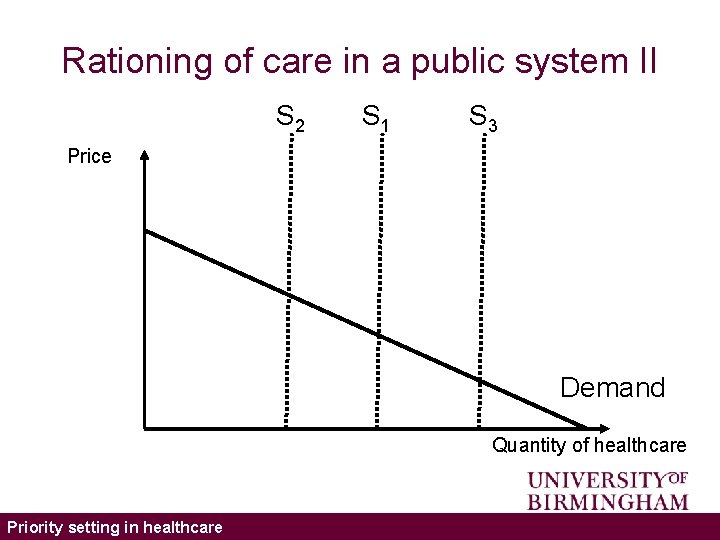
Rationing of care in a public system II S 2 S 1 S 3 Price Demand Quantity of healthcare Priority setting in healthcare
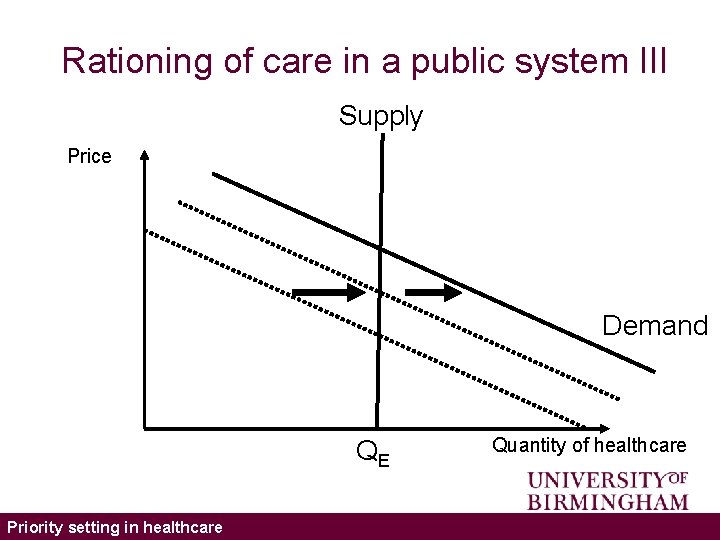
Rationing of care in a public system III Supply Price Demand QE Priority setting in healthcare Quantity of healthcare
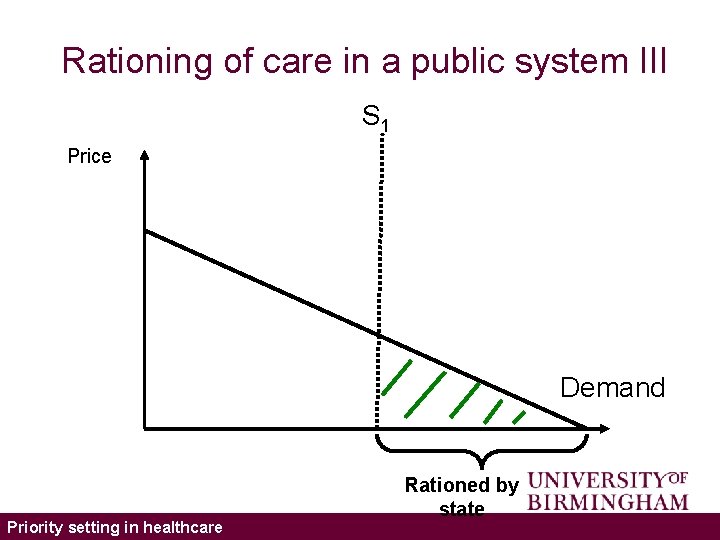
Rationing of care in a public system III S 1 Price Demand Priority setting in healthcare Rationed by state
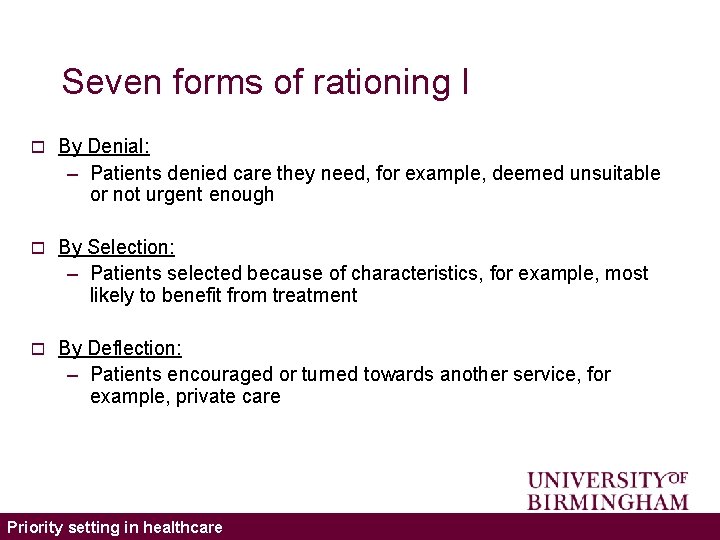
Seven forms of rationing I o By Denial: – Patients denied care they need, for example, deemed unsuitable or not urgent enough o By Selection: – Patients selected because of characteristics, for example, most likely to benefit from treatment o By Deflection: – Patients encouraged or turned towards another service, for example, private care Priority setting in healthcare
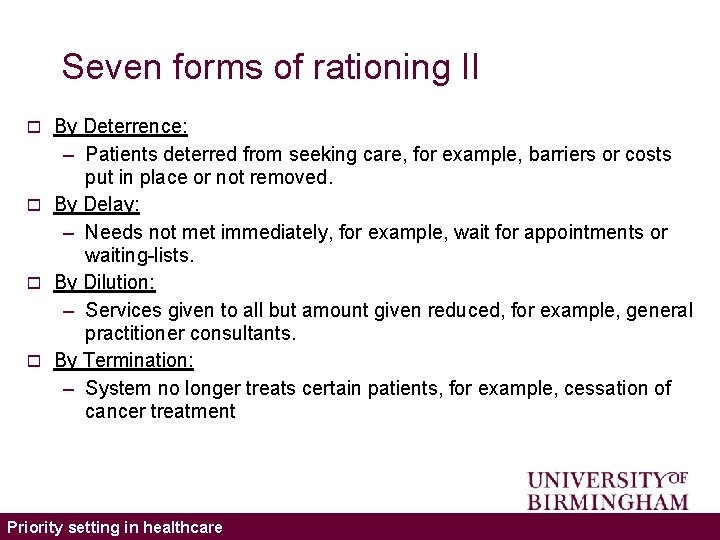
Seven forms of rationing II By Deterrence: – Patients deterred from seeking care, for example, barriers or costs put in place or not removed. o By Delay: – Needs not met immediately, for example, wait for appointments or waiting-lists. o By Dilution: – Services given to all but amount given reduced, for example, general practitioner consultants. o By Termination: – System no longer treats certain patients, for example, cessation of cancer treatment o Priority setting in healthcare
Economic approaches to priority setting Priority setting in healthcare
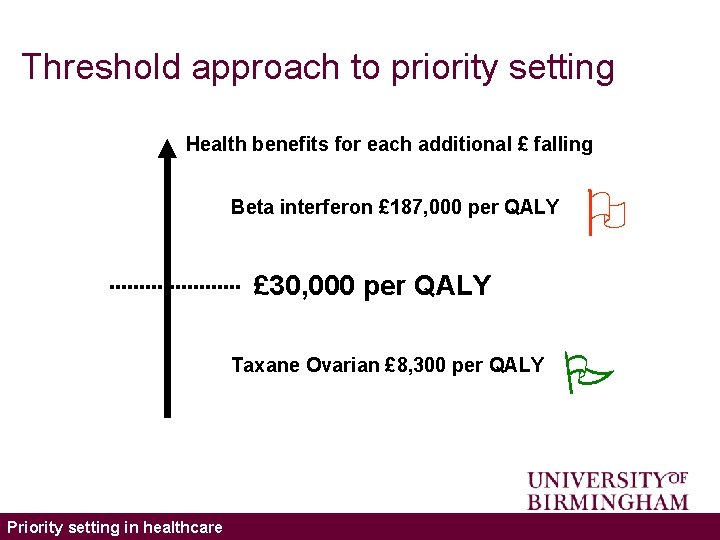
Threshold approach to priority setting Health benefits for each additional £ falling Beta interferon £ 187, 000 per QALY £ 30, 000 per QALY Taxane Ovarian £ 8, 300 per QALY Priority setting in healthcare
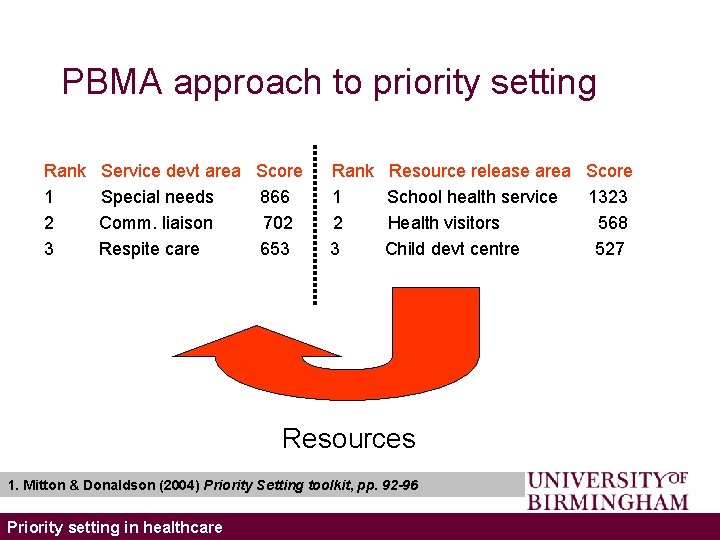
PBMA approach to priority setting Rank 1 2 3 Service devt area Score Special needs 866 Comm. liaison 702 Respite care 653 Rank 1 2 3 Resource release area Score School health service 1323 Health visitors 568 Child devt centre 527 Resources 1. Mitton & Donaldson (2004) Priority Setting toolkit, pp. 92 -96 Priority setting in healthcare
Health economics o Health economists use an economic framework in order to make recommendations about how health care should be rationed efficiently. o The promotion of efficiency (as defined by most health economists) leads to the production of more health. Priority setting in healthcare
Utilitarianism I o The QALY approach adopts a utilitarian framework: – that is, it attempts to maximise the benefits to society from health care spending. o The approach makes the (naïve) assumption that the appropriate benefit is ‘health gain’: – that is, the intervention that maximises health gain per £ spent is the preferred option. Priority setting in healthcare
Utilitarianism II o The QALY approach requires that limited health care resources should be allocated to those individuals that will produce the greatest QALY gain, regardless of: – age – sex – ethnicity – class – income – anything else, except ability to benefit from health care. Priority setting in healthcare
Utilitarianism III The QALY methodology could, therefore, said to be fair as it treats all patients the same. A QALY is a QALY, regardless of who receives it. Priority setting in healthcare
Implications of QALY maximisation – insensitivity to distribution of benefits • An intervention that improves the life of one person by 1 QALY is valued the same as an intervention that improves the life of 100 individuals by 0. 01 QALYs. (The distribution of the benefit) Priority setting in healthcare
Implications of QALY maximisation – insensitivity to culpability • An intervention that improves the quality of life in a smoking-related disease by 0. 1 is valued the same as an intervention that improves the quality of life of a congenital disease by 0. 1 Priority setting in healthcare
Implications of QALY maximisation – insensitivity to severity • An intervention that improves the quality of life of one severely ill patient from 0. 1 to 0. 2 for exactly 4 years is valued the same as an intervention that improves the quality of life of a generally healthy patient from 0. 8 to 0. 9 for 4 years. Priority setting in healthcare
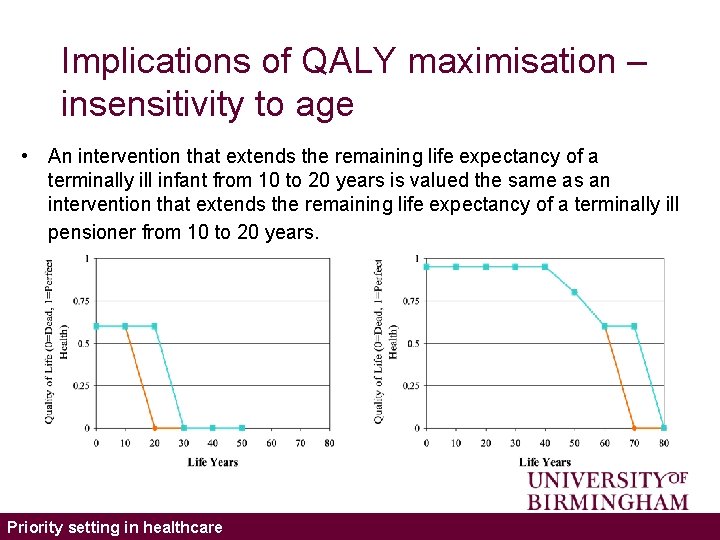
Implications of QALY maximisation – insensitivity to age • An intervention that extends the remaining life expectancy of a terminally ill infant from 10 to 20 years is valued the same as an intervention that extends the remaining life expectancy of a terminally ill pensioner from 10 to 20 years. Priority setting in healthcare
Equity and the ‘fair innings’ argument Priority setting in healthcare
Personal Characteristics o Should we ration, in part, on the basis of personal characteristics? o If yes, what are the relevant personal characteristics? – Desert: what we have and have not done in our lives – Life-cycle: age is important (young preferred to old) – Hard-life: two main types: o Rawls maxi-min: the focus should be on the worst-off o Double jeopardy argument: do not give more hardship to those who have already experienced it. Priority setting in healthcare
QUESTIONS Should we ration, in part, on the basis of personal characteristics? If yes, what are the relevant personal characteristics? Priority setting in healthcare
‘Fair Innings’ argument o It is always a misfortune to die when one wants to goes on living, but it is a tragedy and misfortune to die when young. o Everyone is entitled to some ‘normal’ span of health (e. g. ‘three score years and ten’). 2. Williams (1997) Health Econ. Priority setting in healthcare
Characteristics of the argument o Outcome-based. o Concerns whole life-time experience. o Reflects an aversion to inequality. o Quantifiable. Priority setting in healthcare
Specific requirements o How is health to be measured? o How is health inequality to be measured? Priority setting in healthcare
‘Fair innings’ applied to life expectancy o UK (male) survival rates: – social classes I / II (professional and managerial): 72 years – social classes IV / V (manual workers): 67 years. o Reducing inequality of life expectancy: – would require changes in health/public policy – weighting additional life years gained (from health/public policies) according to social class of recipient. Priority setting in healthcare
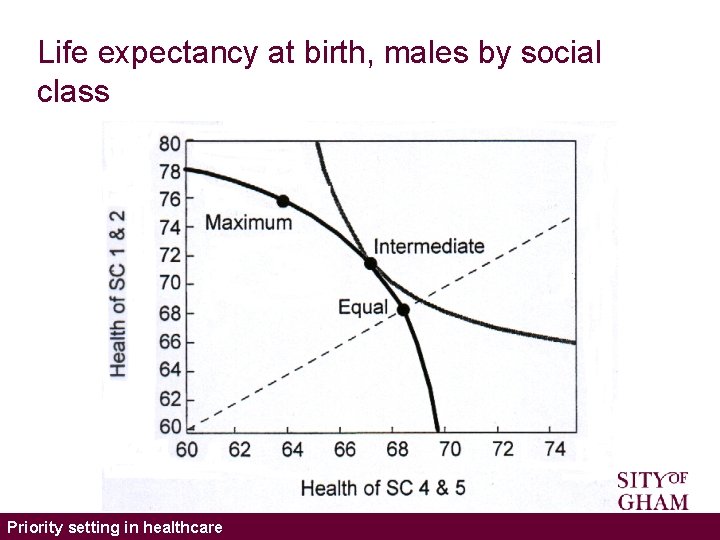
Life expectancy at birth, males by social class Priority setting in healthcare
Key questions o Is the ‘fair innings’ argument a good basis for making equity adjustments in health care? o Fair innings of what? o Are you willing to have the overall level of health of the community reduced in order to reduce inequalities in the distribution of health? Priority setting in healthcare
Fair Innings o Average Life Expectancy at Birth – Combined: 74 years – Males: 71 years – Females: 77 years o Quality Adjusted Life Expectancy at Birth in UK – Combined: 60 QALYs – Males: 57 QALYs – Females: 62 QALYs Priority setting in healthcare
Conclusions o The role of the health economist is to use a normative framework to make rational policy recommendations about how health care should be rationed. o Many other factors should be taken into account (it’s not all about efficiency!) Priority setting in healthcare
References 1. Mitton C, Donaldson C. Priority setting toolkit: a guide to the use of economics in healthcare decision making. London: BMJ Books; 2004. 2. Williams A. Intergenerational Equity: An Exploration of the 'Fair Innings' Argument. Health Economics 1997; 6: 117 -32. Priority setting in healthcare
Reading o Coast J, Donovan J, Frankel S, editors. Priority setting: the health care debate. Chichester, UK: John Wiley & Sons Ltd; 1996. o Dolan P, Shaw R, Tsuchiya A, Williams A. QALY maximisation and people's preferences: a methodological review of the literature. Health Economics, 2005; 14(2): 197 -208 o Morris S, Devlin N, Parkin D. Economic analysis in health care. Chichester, UK: John Wiley & Sons, Ltd; 2007. o Tsuchiya A. QALYs and ageism: philosophical theories and age weighting Health Economics 2000; 9(1): 57 -68 o Williams A. Economics, QALYs and Medical Ethics – A Health Economist’s Perspective. Health Care Analysis 1995; 3: 221 -34. Priority setting in healthcare
- Slides: 35