
Priority queues Priority queue ADT Binary heap Heap
Priority queues Priority queue ADT Binary heap Heap insertion, removal March 16, 2020 Cinda Heeren / Andy Roth / Geoffrey Tien 1

Priority queues? • Suppose Geoff has made a to-do list (with priority values): 6 – MT 2 regrades 2 – Vacuum home 8 – Renew car insurance 1 – Sleep 9 – Extinguish computer on fire 2 – Eat 8 – Lecture prep 1 – Bathe • We are interested in quickly finding the task with the highest priority March 16, 2020 Cinda Heeren / Andy Roth / Geoffrey Tien 2
Priority queue ADT • A collection organised so as to allow fast access to and removal of the largest (or smallest) element – Prioritisation is a weaker condition than ordering – Order of insertion is irrelevant – Element with the highest priority (whatever that means) is the first element to be removed • Not really a queue: not FIFO! March 16, 2020 Cinda Heeren / Andy Roth / Geoffrey Tien 3
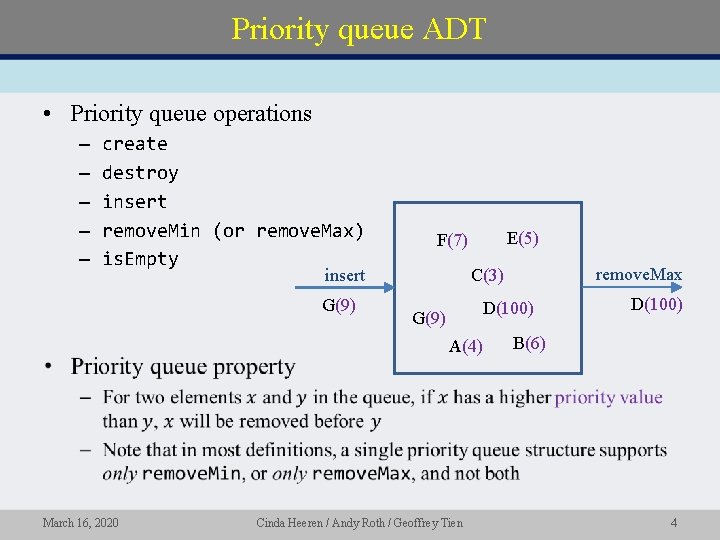
Priority queue ADT • Priority queue operations – – – create destroy insert remove. Min (or remove. Max) is. Empty insert G(9) E(5) F(7) D(100) G(9) A(4) March 16, 2020 remove. Max C(3) Cinda Heeren / Andy Roth / Geoffrey Tien D(100) B(6) 4
Priority queue properties • A priority queue is an ADT that maintains a multiset of items – vs set: a multiset allows duplicate entries • Two or more distinct items in a priority queue may have the same priority • If all items have the same priority, will it behave FIFO like a queue? – not necessarily! Due to implementation details March 16, 2020 Cinda Heeren / Andy Roth / Geoffrey Tien 5
Priority queue applications • Hold jobs for a printer in order of size • Manage limited resources such as bandwidth on a transmission line from a network router • Sort numbers • Anything greedy: an algorithm that makes the "locally best choice" at each step March 16, 2020 Cinda Heeren / Andy Roth / Geoffrey Tien 6
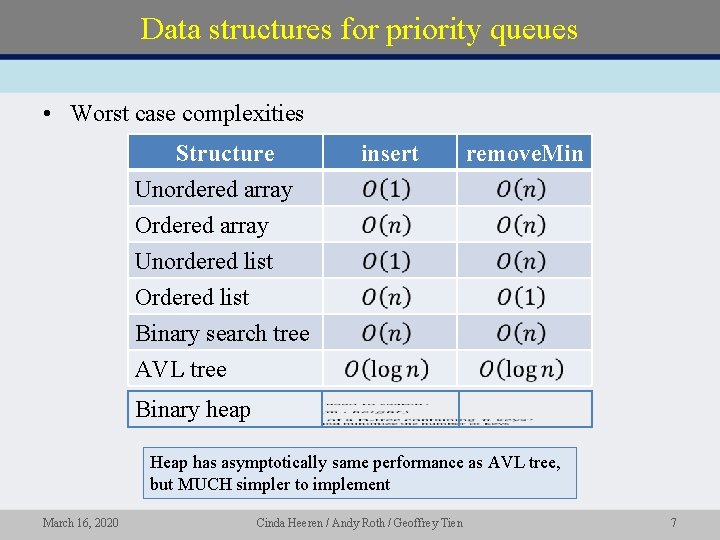
Data structures for priority queues • Worst case complexities Structure Unordered array Ordered array Unordered list insert remove. Min Ordered list Binary search tree AVL tree Binary heap Heap has asymptotically same performance as AVL tree, but MUCH simpler to implement March 16, 2020 Cinda Heeren / Andy Roth / Geoffrey Tien 7

Binary heap A complete, partially-ordered binary tree • A heap is binary tree with two properties • Heaps are complete – All levels, except the bottom, must be completely filled in – The leaves on the bottom level are as far to the left as possible • Heaps are partially ordered – For a max heap – the value of a node is at least as large as its children’s values – For a min heap – the value of a node is no greater than its children’s values March 16, 2020 Cinda Heeren / Andy Roth / Geoffrey Tien 8
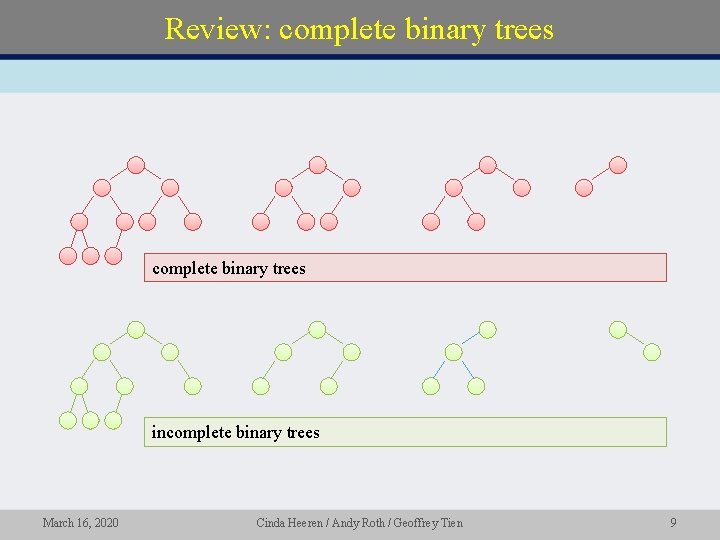
Review: complete binary trees incomplete binary trees March 16, 2020 Cinda Heeren / Andy Roth / Geoffrey Tien 9
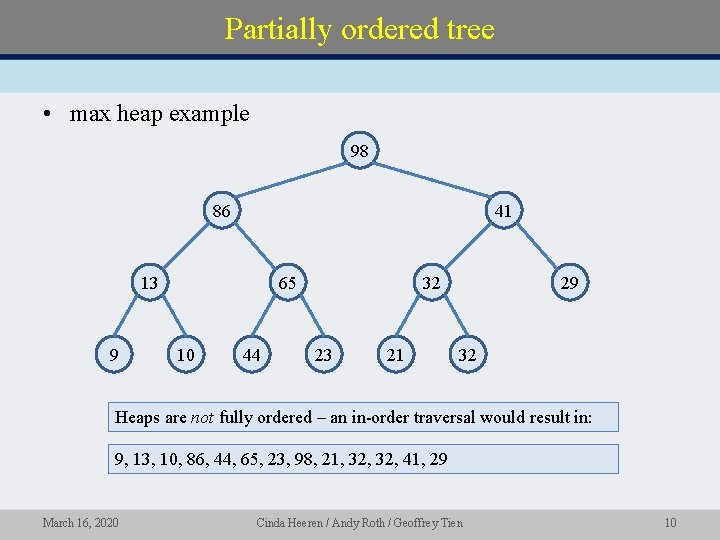
Partially ordered tree • max heap example 98 86 41 13 9 65 10 44 32 23 21 29 32 Heaps are not fully ordered – an in-order traversal would result in: 9, 13, 10, 86, 44, 65, 23, 98, 21, 32, 41, 29 March 16, 2020 Cinda Heeren / Andy Roth / Geoffrey Tien 10
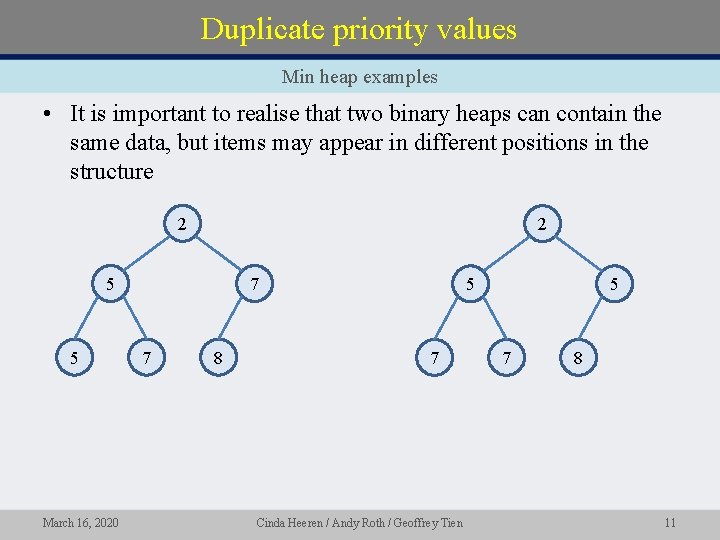
Duplicate priority values Min heap examples • It is important to realise that two binary heaps can contain the same data, but items may appear in different positions in the structure 2 2 5 5 March 16, 2020 7 7 8 5 7 Cinda Heeren / Andy Roth / Geoffrey Tien 5 7 8 11
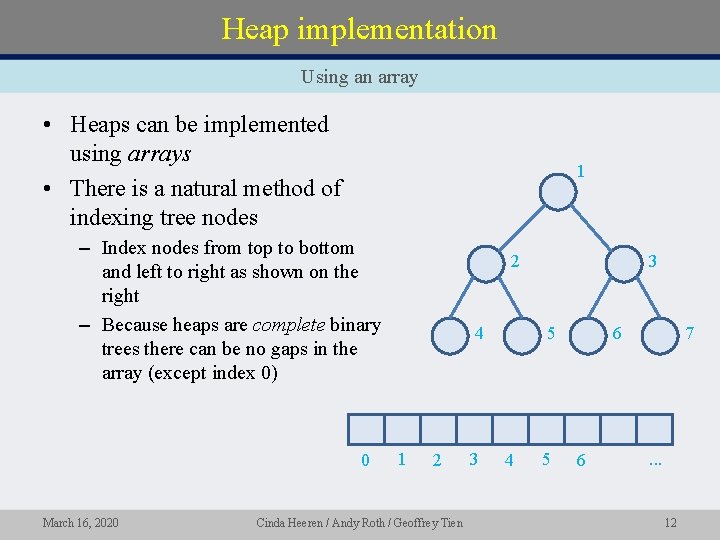
Heap implementation Using an array • Heaps can be implemented using arrays • There is a natural method of indexing tree nodes 1 – Index nodes from top to bottom and left to right as shown on the right – Because heaps are complete binary trees there can be no gaps in the array (except index 0) 0 March 16, 2020 2 4 1 2 Cinda Heeren / Andy Roth / Geoffrey Tien 3 3 5 4 5 6 6 7 . . . 12
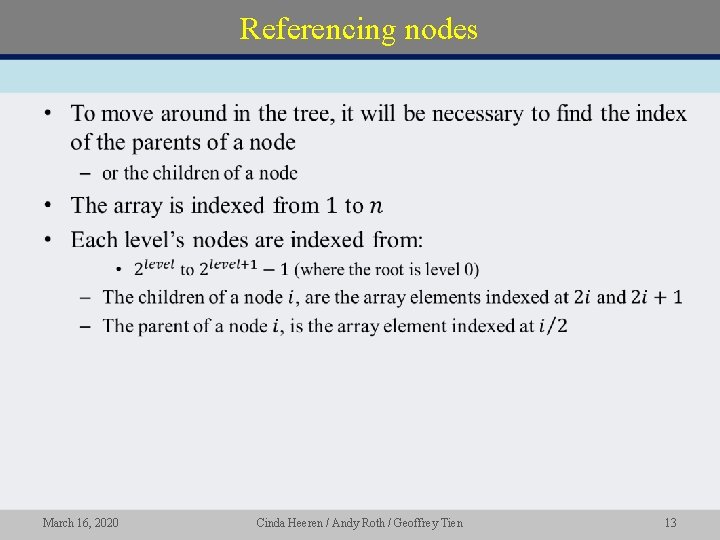
Referencing nodes • March 16, 2020 Cinda Heeren / Andy Roth / Geoffrey Tien 13
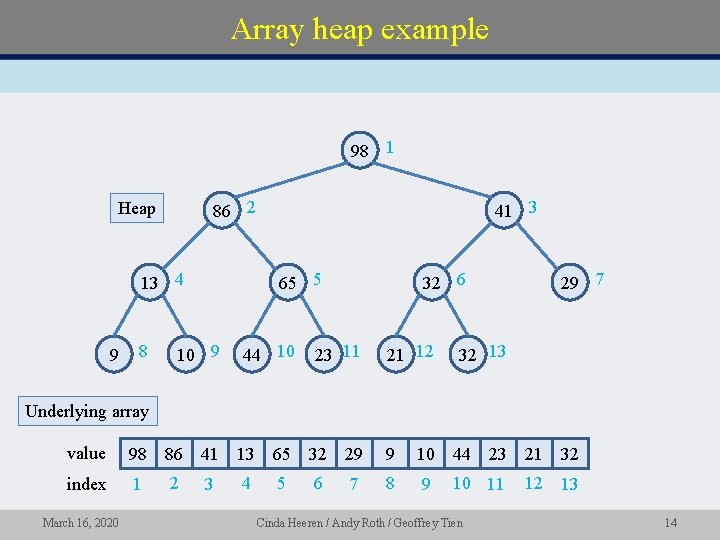
Array heap example 98 1 86 2 Heap 13 4 9 8 41 3 65 5 10 9 44 10 32 6 23 11 21 12 29 7 32 13 Underlying array value 98 86 41 13 65 32 29 9 10 44 index 1 2 3 4 5 6 7 8 9 10 11 March 16, 2020 Cinda Heeren / Andy Roth / Geoffrey Tien 23 21 32 12 13 14
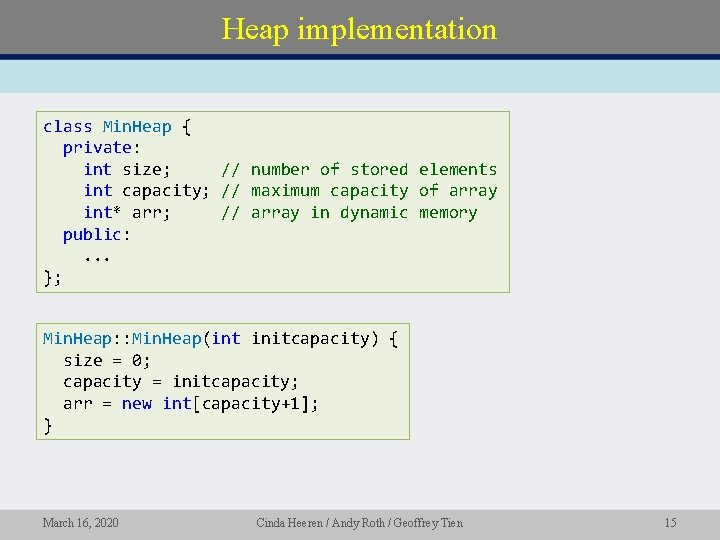
Heap implementation class Min. Heap { private: int size; // number of stored elements int capacity; // maximum capacity of array int* arr; // array in dynamic memory public: . . . }; Min. Heap: : Min. Heap(int initcapacity) { size = 0; capacity = initcapacity; arr = new int[capacity+1]; } March 16, 2020 Cinda Heeren / Andy Roth / Geoffrey Tien 15
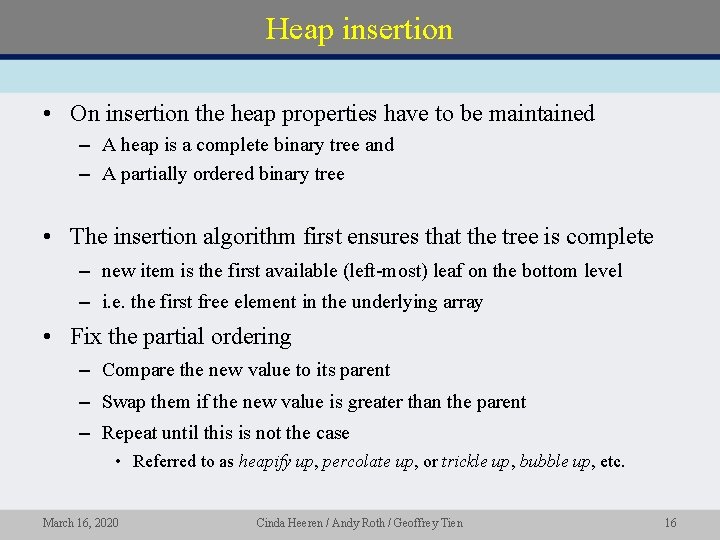
Heap insertion • On insertion the heap properties have to be maintained – A heap is a complete binary tree and – A partially ordered binary tree • The insertion algorithm first ensures that the tree is complete – new item is the first available (left-most) leaf on the bottom level – i. e. the first free element in the underlying array • Fix the partial ordering – Compare the new value to its parent – Swap them if the new value is greater than the parent – Repeat until this is not the case • Referred to as heapify up, percolate up, or trickle up, bubble up, etc. March 16, 2020 Cinda Heeren / Andy Roth / Geoffrey Tien 16
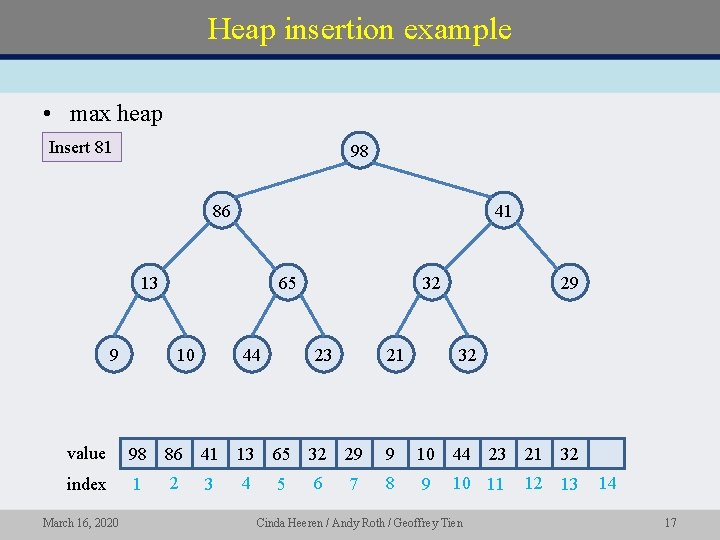
Heap insertion example • max heap Insert 81 98 86 41 13 9 65 10 44 32 23 21 29 32 value 98 86 41 13 65 32 29 9 10 44 index 1 2 3 4 5 6 7 8 9 10 11 March 16, 2020 Cinda Heeren / Andy Roth / Geoffrey Tien 23 21 32 12 13 14 17
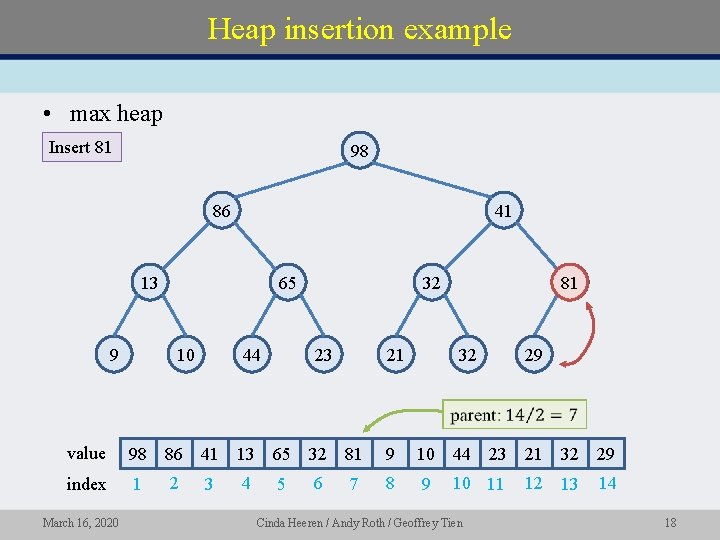
Heap insertion example • max heap Insert 81 98 86 41 13 9 65 10 44 32 23 21 81 29 32 81 29 value 98 86 41 13 65 32 29 81 9 10 44 index 1 2 3 4 5 6 7 8 9 10 11 March 16, 2020 Cinda Heeren / Andy Roth / Geoffrey Tien 23 21 32 81 29 12 13 14 18

Heap insertion example • max heap Insert 81 81 is less than 98 so finished 98 86 41 81 13 9 65 10 44 32 23 21 81 41 32 29 value 98 86 41 81 13 65 32 81 41 9 10 44 index 1 2 3 4 5 6 7 8 9 10 11 March 16, 2020 Cinda Heeren / Andy Roth / Geoffrey Tien 23 21 32 29 12 13 14 19
Heap insertion complexity • March 16, 2020 Cinda Heeren / Andy Roth / Geoffrey Tien 20
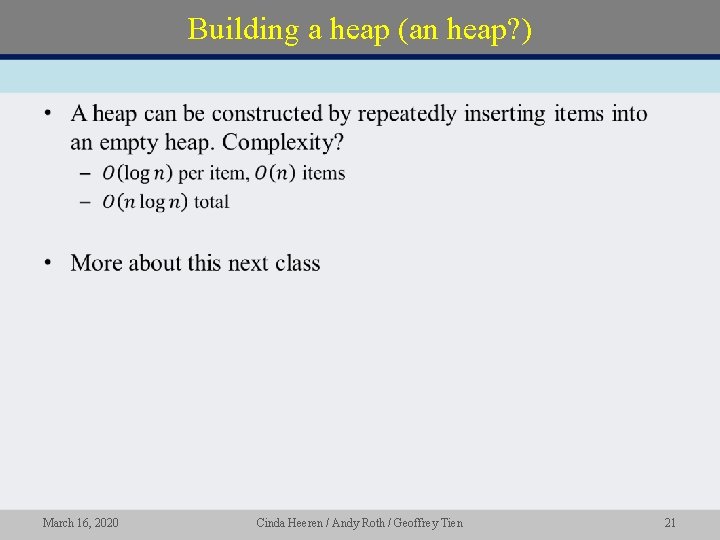
Building a heap (an heap? ) • March 16, 2020 Cinda Heeren / Andy Roth / Geoffrey Tien 21
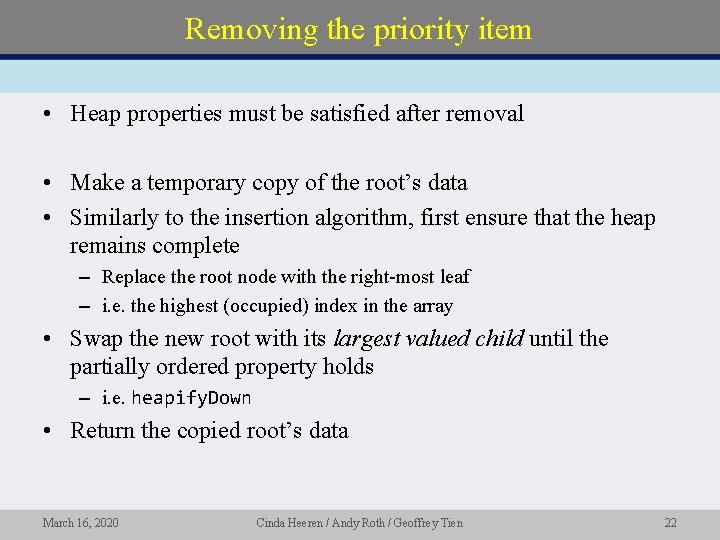
Removing the priority item • Heap properties must be satisfied after removal • Make a temporary copy of the root’s data • Similarly to the insertion algorithm, first ensure that the heap remains complete – Replace the root node with the right-most leaf – i. e. the highest (occupied) index in the array • Swap the new root with its largest valued child until the partially ordered property holds – i. e. heapify. Down • Return the copied root’s data March 16, 2020 Cinda Heeren / Andy Roth / Geoffrey Tien 22

Heap removal example 98 remove. Max 86 41 13 9 65 10 44 32 23 21 29 17 value 98 86 41 13 65 32 29 9 10 44 index 1 2 3 4 5 6 7 8 9 10 11 March 16, 2020 Cinda Heeren / Andy Roth / Geoffrey Tien 23 21 17 12 13 23
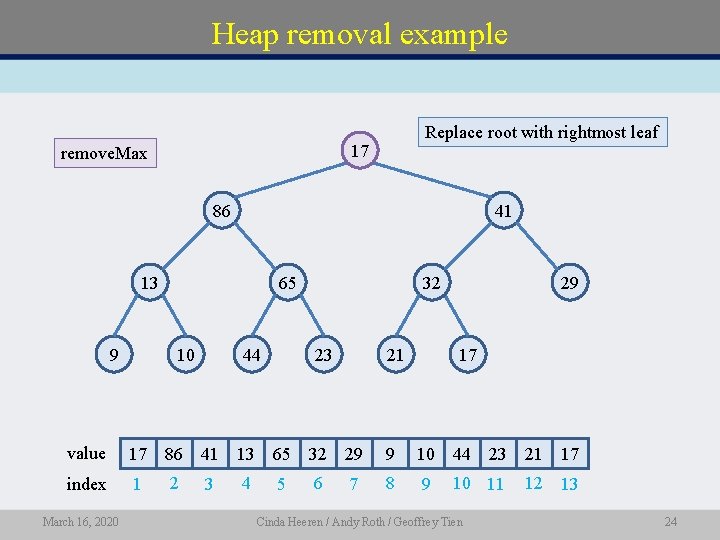
Heap removal example Replace root with rightmost leaf 98 17 remove. Max 86 41 13 9 65 10 44 32 23 21 29 17 value 98 17 86 41 13 65 32 29 9 10 44 index 1 2 3 4 5 6 7 8 9 10 11 March 16, 2020 Cinda Heeren / Andy Roth / Geoffrey Tien 23 21 17 12 13 24
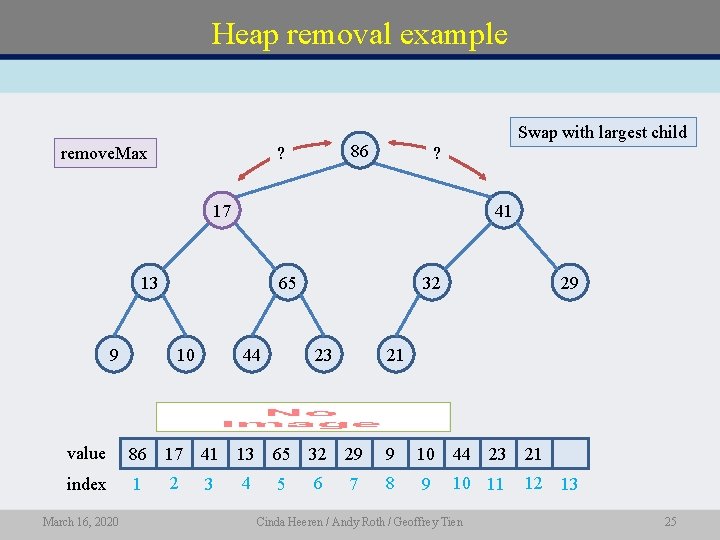
Heap removal example remove. Max Swap with largest child 17 86 ? ? 86 17 41 13 9 65 10 44 32 23 29 21 value 17 86 86 17 41 13 65 32 29 9 10 44 index 1 2 3 4 5 6 7 8 9 10 11 March 16, 2020 Cinda Heeren / Andy Roth / Geoffrey Tien 23 21 12 13 25
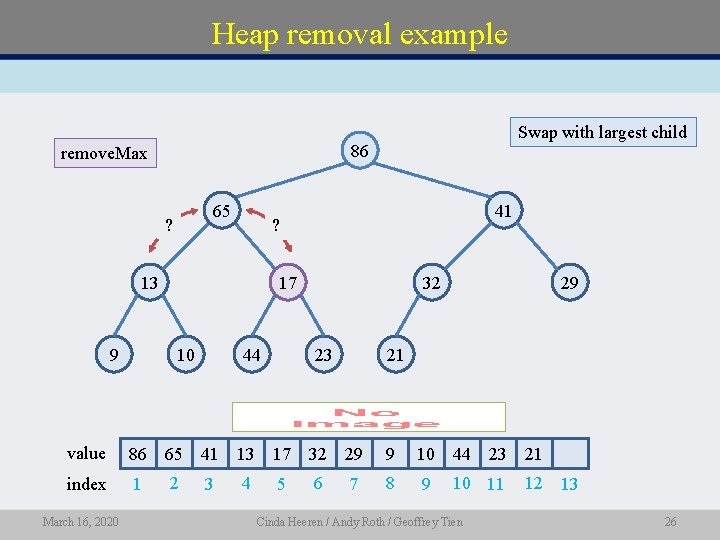
Heap removal example 86 remove. Max 17 65 ? 41 ? 13 9 Swap with largest child 65 17 10 44 32 23 29 21 value 86 17 65 41 13 65 17 32 29 9 10 44 index 1 2 3 4 5 6 7 8 9 10 11 March 16, 2020 Cinda Heeren / Andy Roth / Geoffrey Tien 23 21 12 13 26
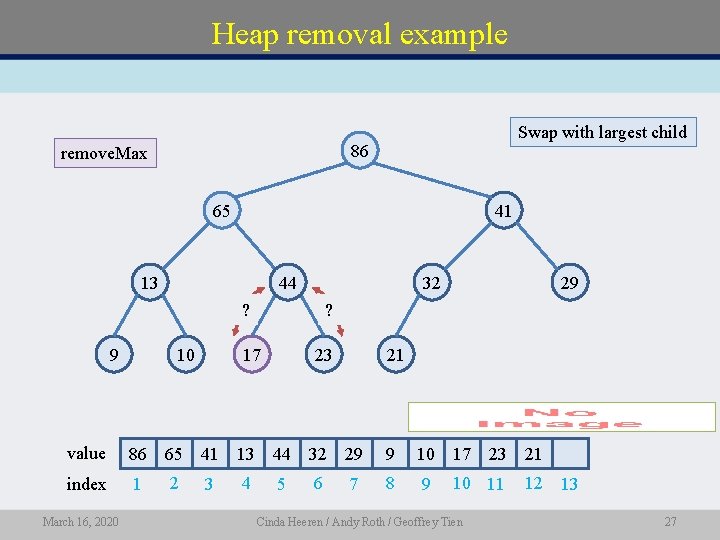
Heap removal example Swap with largest child 86 remove. Max 65 41 13 17 44 32 ? 9 10 29 ? 44 17 23 21 value 86 65 41 13 17 44 32 29 9 10 44 17 index 1 2 3 4 5 6 7 8 9 10 11 March 16, 2020 Cinda Heeren / Andy Roth / Geoffrey Tien 23 21 12 13 27
Complexity of remove. Min / remove. Max • March 16, 2020 Cinda Heeren / Andy Roth / Geoffrey Tien 28
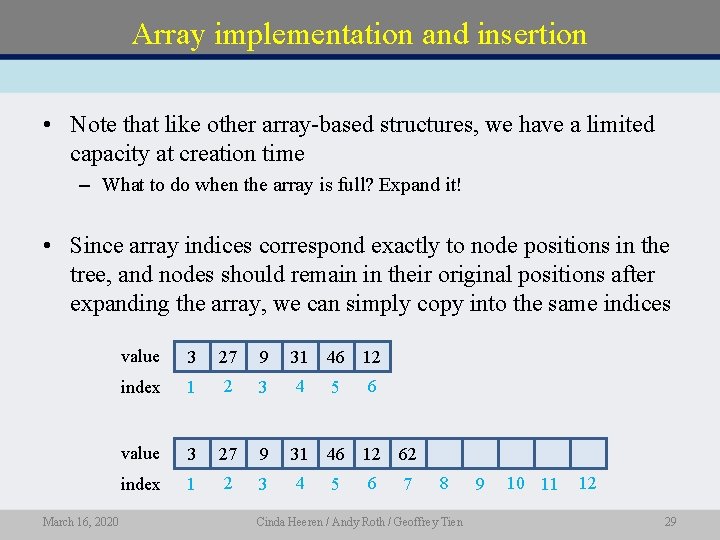
Array implementation and insertion • Note that like other array-based structures, we have a limited capacity at creation time – What to do when the array is full? Expand it! • Since array indices correspond exactly to node positions in the tree, and nodes should remain in their original positions after expanding the array, we can simply copy into the same indices March 16, 2020 value 3 27 9 31 46 12 index 1 2 3 4 5 6 value 3 27 9 31 46 12 62 index 1 2 3 4 5 6 7 8 Cinda Heeren / Andy Roth / Geoffrey Tien 9 10 11 12 29
Exercise • Insert the following sequence of items into an initially empty max heap: 34, 76, 11, 32, 73, 9, 50, 65, 41, 27, 3, 88 • Draw the underlying array after all insertions have completed • Insert the same sequence of items into an initially empty min heap and draw the array after all insertions have been completed. • Implement recursive and iterative implementations: – void Min. Heap: : heapify. Up(int index); March 16, 2020 Cinda Heeren / Andy Roth / Geoffrey Tien 30
Readings for this lesson • Carrano & Henry – Chapter 13. 3 (ADT priority queue) – Chapter 17. 1 – 17. 3 (Heap) • Next class: – Carrano & Henry, Chapter 17. 4 (Heapsort) March 16, 2020 Cinda Heeren / Andy Roth / Geoffrey Tien 31
- Slides: 31