
Priority Queue ADT Revised based on textbook authors
Priority Queue ADT Revised based on textbook author’s notes.
Priority Queues Some applications require the use of a queue in which items are assigned a priority. 2 higher priority items are dequeued first. items with equal priority still follow FIFO.
Some Applications • Operating systems such as Linux use priority queues to manage their jobs (try e. g. , the top command) • Simulations use priority queues to manage events to be simulated • All other FIFO queues, e. g. , online shopping queues are special cases of priority queue, that is, time is the priority
The Priority Queue ADT A priority queue is a queue in which each item is assigned a priority and items with a higher priority are removed before those with lower priority. 4 Integer values are used for the priorities. Smaller integers have a higher priority.
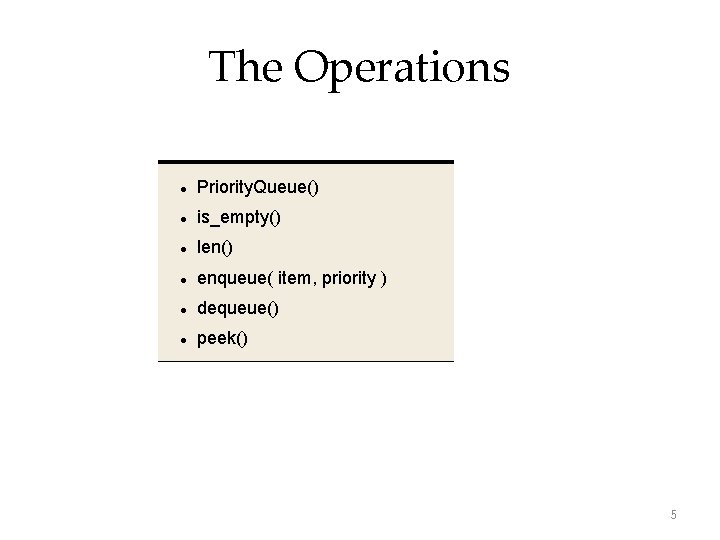
The Operations Priority. Queue() is_empty() len() enqueue( item, priority ) dequeue() peek() 5

Priority Queue Example Consider the following code segment: Q = Priority. Queue( 6 ) Q. enqueue( “purple”, 5 ) Q. enqueue( “black”, 1 ) Q. enqueue( “orange”, 3 ) Q. enqueue( “white”, 0 ) Q. enqueue( “green”, 1 ) Q. enqueue( “yellow”, 5 ) 6
Priority Queue Implementation How should the ADT be implemented. We must consider: 7 A priority must be associated with each item in the queue. The next item dequeued is the item with the highest priority. If multiple items have the same priority, those must be dequeued in a FIFO order.
Priority Queue Implementation • There can be many different implementations, we’ll consider three here – Textbook approach – Linked list – Bounded array with linked lists
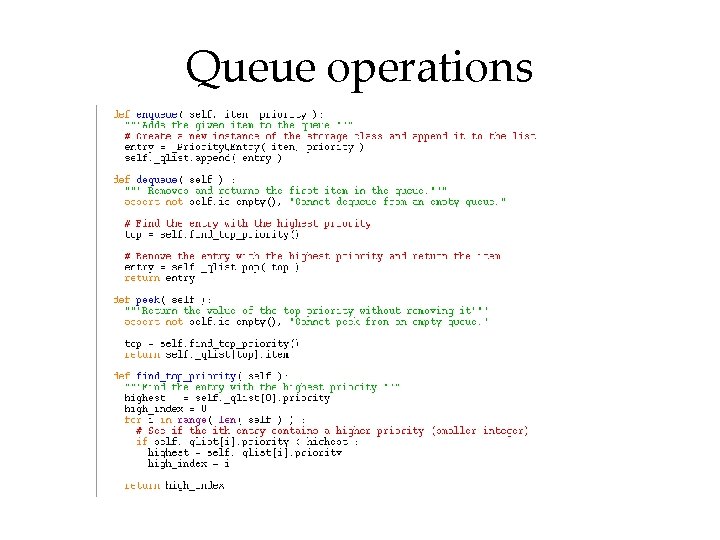
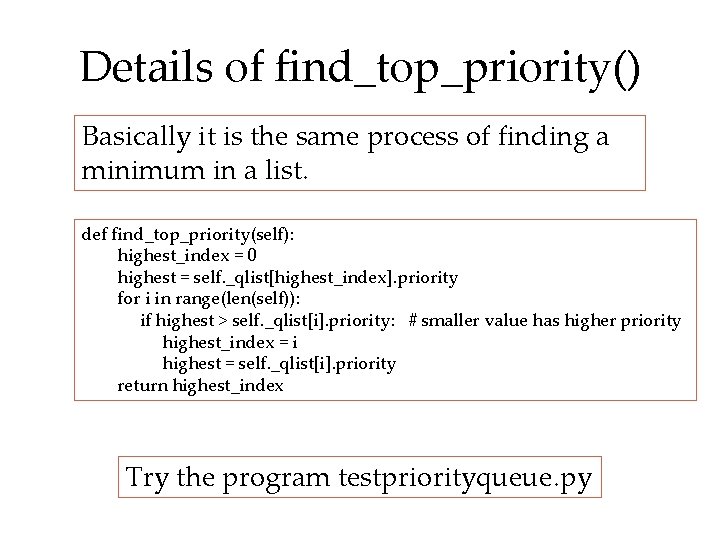
1. Textbook approach 9 The priority queue is implemented as a Python list The enqueue operation puts the item at the end of the queue (as in our FIFO queue) The dequeue operation takes the item with the highest priority off the queue (note: the item could be anywhere in the queue!)
Queue operations
Details of find_top_priority() Basically it is the same process of finding a minimum in a list. def find_top_priority(self): highest_index = 0 highest = self. _qlist[highest_index]. priority for i in range(len(self)): if highest > self. _qlist[i]. priority: # smaller value has higher priority highest_index = i highest = self. _qlist[i]. priority return highest_index Try the program testpriorityqueue. py
Complexity of operations What is the complexity for dequeue? O(n) What is the complexity for enqueue? O(1)
2. Bounded Priority Queue 13 A bounded priority queue has a fixe set of priorities We use an array to represent the set of priorities, each array element maintains a queue of the items with the same priority
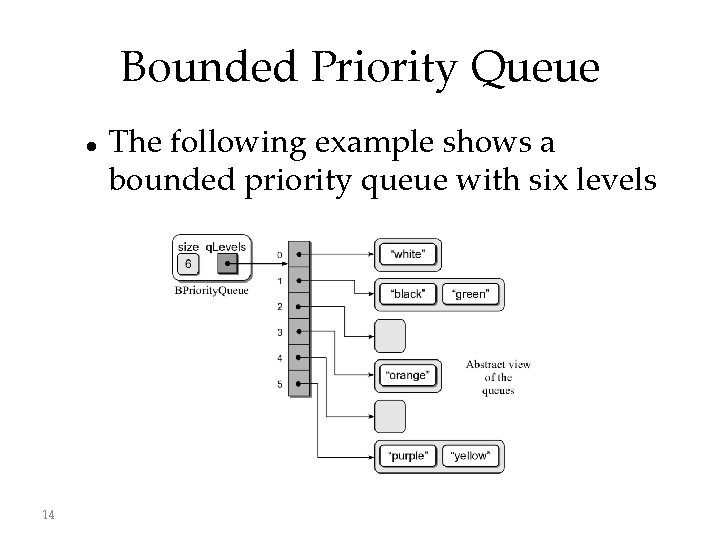
Bounded Priority Queue 14 The following example shows a bounded priority queue with six levels
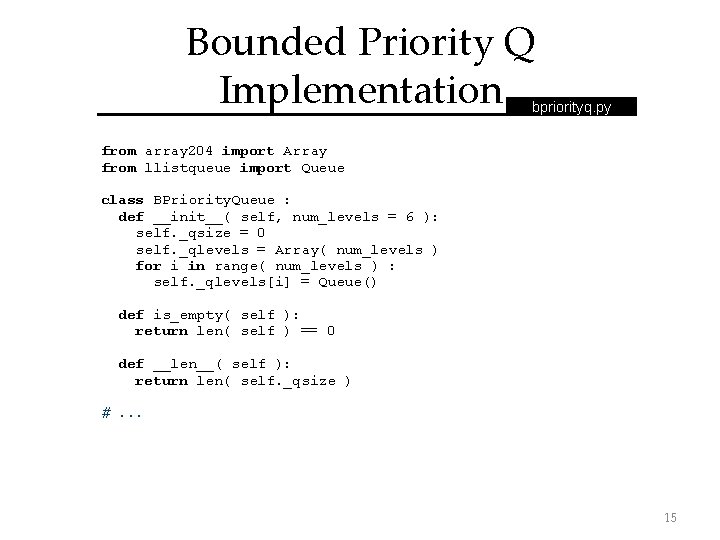
Bounded Priority Q Implementation bpriorityq. py from array 204 import Array from llistqueue import Queue class BPriority. Queue : def __init__( self, num_levels = 6 ): self. _qsize = 0 self. _qlevels = Array( num_levels ) for i in range( num_levels ) : self. _qlevels[i] = Queue() def is_empty( self ): return len( self ) == 0 def __len__( self ): return len( self. _qsize ) #. . . 15
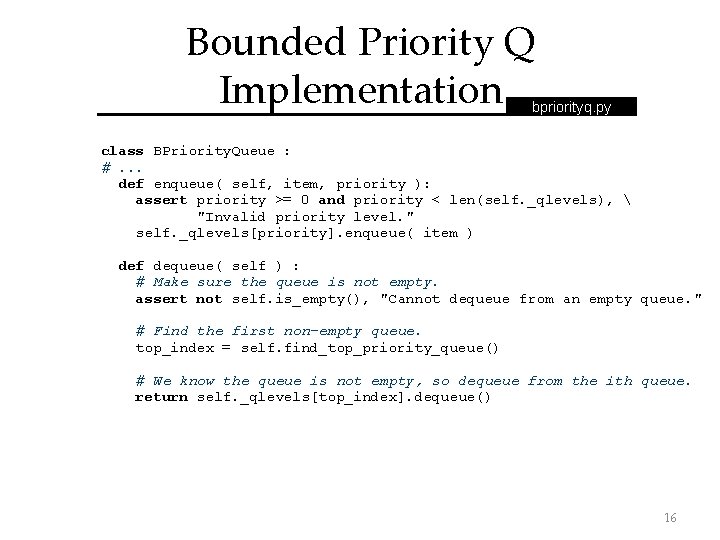
Bounded Priority Q Implementation bpriorityq. py class BPriority. Queue : #. . . def enqueue( self, item, priority ): assert priority >= 0 and priority < len(self. _qlevels), "Invalid priority level. " self. _qlevels[priority]. enqueue( item ) def dequeue( self ) : # Make sure the queue is not empty. assert not self. is_empty(), "Cannot dequeue from an empty queue. " # Find the first non-empty queue. top_index = self. find_top_priority_queue() # We know the queue is not empty, so dequeue from the ith queue. return self. _qlevels[top_index]. dequeue() 16
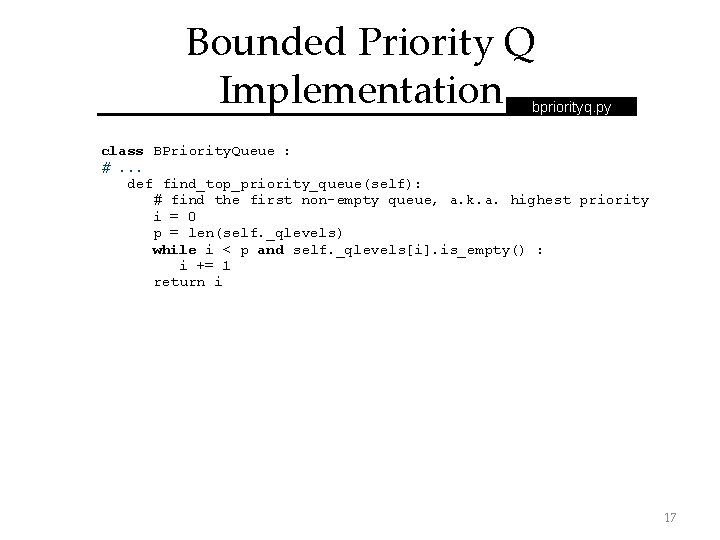
Bounded Priority Q Implementation bpriorityq. py class BPriority. Queue : #. . . def find_top_priority_queue(self): # find the first non-empty queue, a. k. a. highest priority i = 0 p = len(self. _qlevels) while i < p and self. _qlevels[i]. is_empty() : i += 1 return i 17
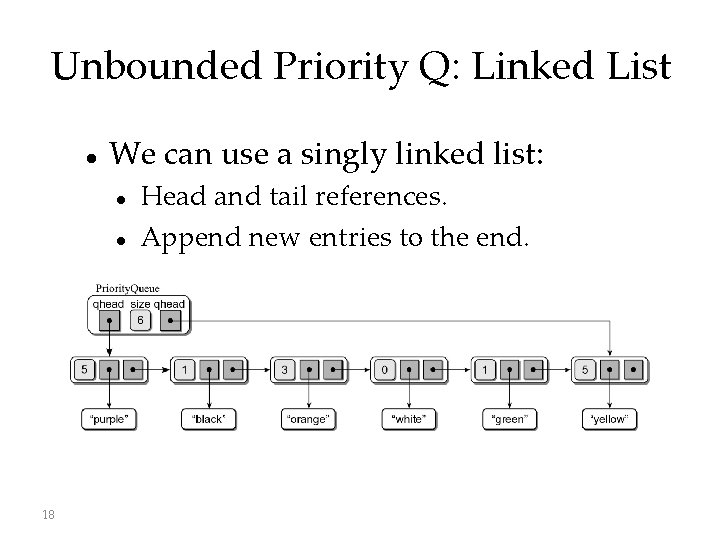
Unbounded Priority Q: Linked List We can use a singly linked list: 18 Head and tail references. Append new entries to the end.
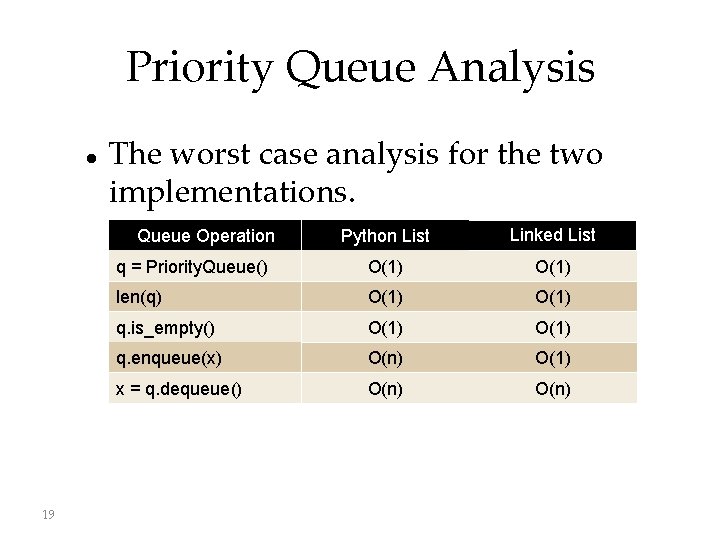
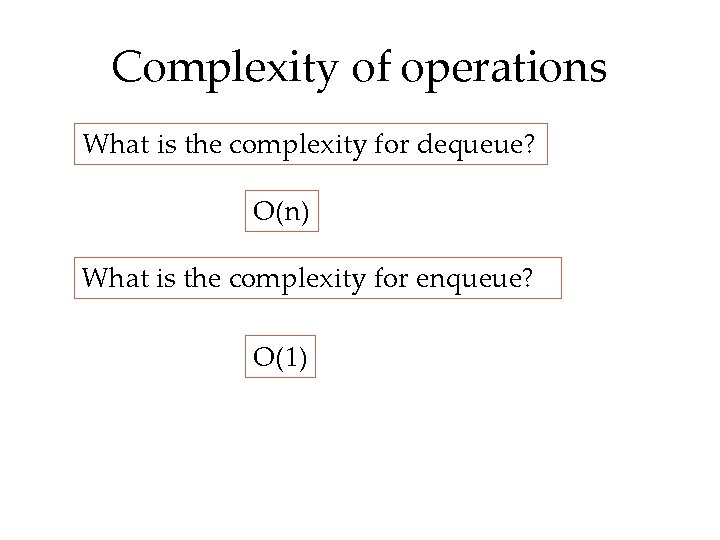
Priority Queue Analysis The worst case analysis for the two implementations. Python List Linked List q = Priority. Queue() O(1) len(q) O(1) q. is_empty() O(1) q. enqueue(x) O(n) O(1) x = q. dequeue() O(n) Queue Operation 19
Implement enqueue() • Your task is to implement the enqueue() method for a linked list based queue in which other necessary methods have been implemented
- Slides: 20