
Priority Access System Architecture for IEEE 802 16


![Traffic Priority Changes • 802. 16 e Traffic Priority format Type Length [145/146]. 6](https://slidetodoc.com/presentation_image_h2/4ac41f2d8ed27b98900797419dff89a1/image-13.jpg "Traffic Priority Changes • 802. 16 e Traffic Priority format Type Length [145/146]. 6")
- Slides: 27
Priority Access System Architecture for IEEE 802. 16 m IEEE 802. 16 Presentation Submission Template (Rev. 9) Document Number: IEEE S 802. 16 m-07/253 r 3 Date Submitted: 2008 -01 -16 Source An Nguyen Arnaud Tonnerre An. P. Nguyen@dhs. gov arnaud. tonnerre@fr. thalesgroup. com DHS/NCS THALES COMMUNICATIONS USA Colombes, France Djamal-Eddine Meddour djamal. meddour@orange-ft. com FRANCE TELECOM Lannion, France Sheng Sun shengs@nortel. com Nortel Ottwa, Ontario, Canada Richard Li richard 929@itri. org. tw ITRI Hsinchu, Taiwan Carlos de Segovia carlos. desegovia@orange-ftgroup. com FRANCE TELECOM Cesson Sévigné, France Bong Ho Kim bhkim@posdata-usa. com Posdata San Jose, CA, USA Venue: Levi, Finland Base Contribution: C 802. 16 m-07/253 r 3 Purpose: Request consideration of concept for System Architecture contained herein for the 802. 16 m SDD Notice: This document does not represent the agreed views of the IEEE 802. 16 Working Group or any of its subgroups. It represents only the views of the participants listed in the “Source(s)” field above. It is offered as a basis for discussion. It is not binding on the contributor(s), who reserve(s) the right to add, amend or withdraw material contained herein. Release: The contributor grants a free, irrevocable license to the IEEE to incorporate material contained in this contribution, and any modifications thereof, in the creation of an IEEE Standards publication; to copyright in the IEEE’s name any IEEE Standards publication even though it may include portions of this contribution; and at the IEEE’s sole discretion to permit others to reproduce in whole or in part the resulting IEEE Standards publication. The contributor also acknowledges and accepts that this contribution may be made public by IEEE 802. 16. Patent Policy: The contributor is familiar with the IEEE-SA Patent Policy and Procedures: <http: //standards. ieee. org/guides/bylaws/sect 6 -7. html#6> and <http: //standards. ieee. org/guides/opman/sect 6. html#6. 3>. Further information is located at <http: //standards. ieee. org/board/pat-material. html> and <http: //standards. ieee. org/board/pat >.
Priority Access System Architecture for IEEE 802. 16 m An Nguyen, DHS/NCS Arnaud Tonnerre, THALES COMMUNICATIONS Djamal-Eddine Meddour, FRANCE TELECOM Sheng Sun, Nortel Carlos de Segovia, FRANCE TELECOM Richard Li, ITRI Bong Ho Kim, Posdata
Outline • Objective • 802. 16 m system architecture to support prioritized radio access • Government priority access requirements
Objective
Objective • IEEE 802. 16 m has requirements on priority for the government and public safety – Section 5. 8 of IEEE 802. 16 m-07/002 r 4 • “IEEE 802. 16 m shall be able to support public safety first responders, military and emergency services such as call-prioritization, preemption, push-to-talk” • Propose Prioritized Radio Access system architecture to be considered by 802. 16 m – Add Prioritized Radio Access capability into 802. 16 m to support call-prioritization. – Services based on 802. 16 m Prioritized Radio Access capability can meet government public safety and emergency services requirements • Priority access is one of the important requirements for Emergency Telecommunications Service (ETS)* *“Overview of Standards in Support of Emergency Telecommunication Service ( ETS), ” ATIS-pp-0100009, November 2006. **”Recommendations and Requirements for Networks based on Wi. MAX Forum Certified Products, ” Release 1. 5, Jan. 2007
802. 16 m Prioritized Radio Access System Architecture
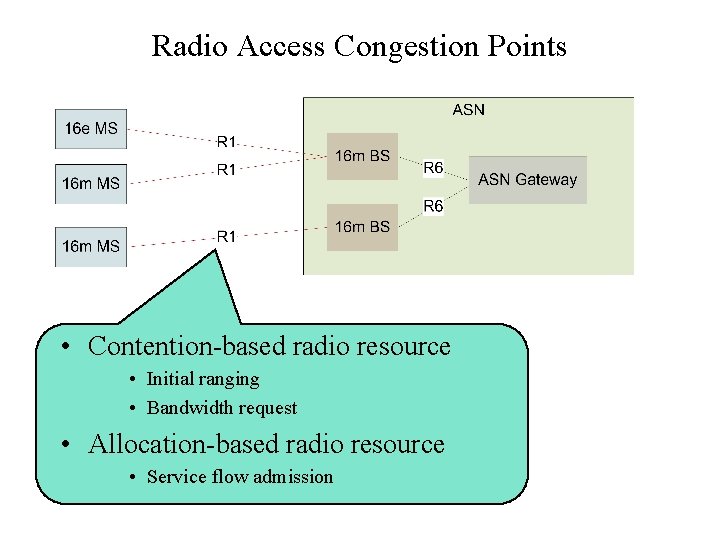
Radio Access Congestion Points • Contention-based radio resource • Initial ranging • Bandwidth request • Allocation-based radio resource • Service flow admission
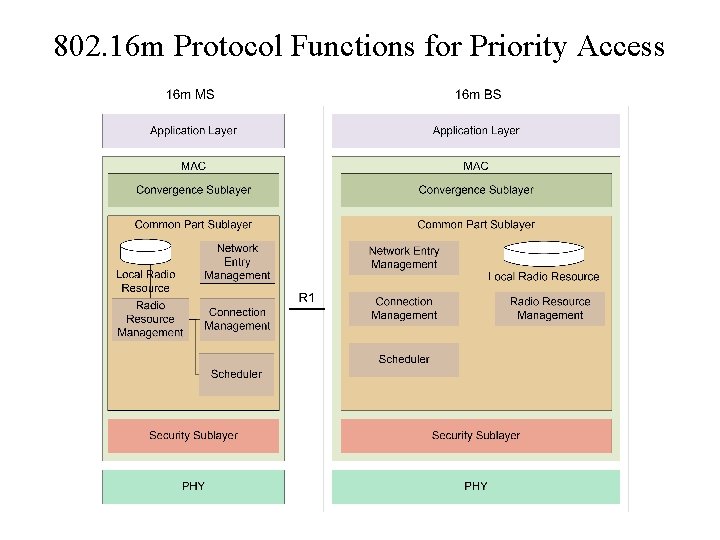
802. 16 m Protocol Functions for Priority Access
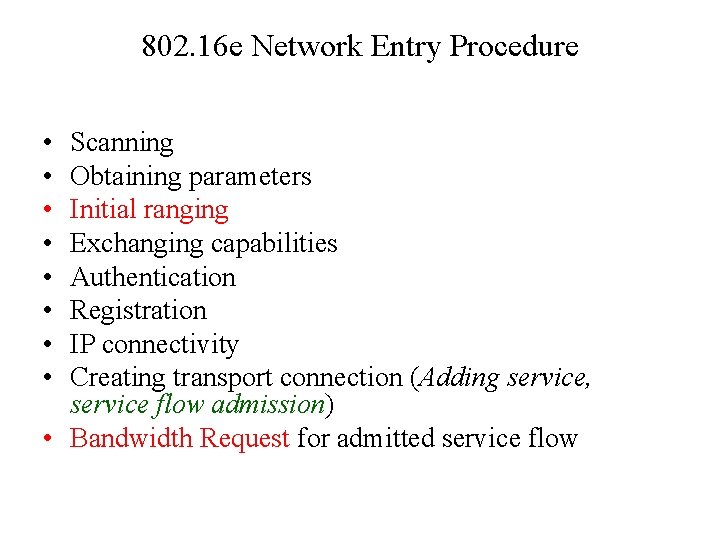
802. 16 e Network Entry Procedure • • Scanning Obtaining parameters Initial ranging Exchanging capabilities Authentication Registration IP connectivity Creating transport connection (Adding service, service flow admission) • Bandwidth Request for admitted service flow
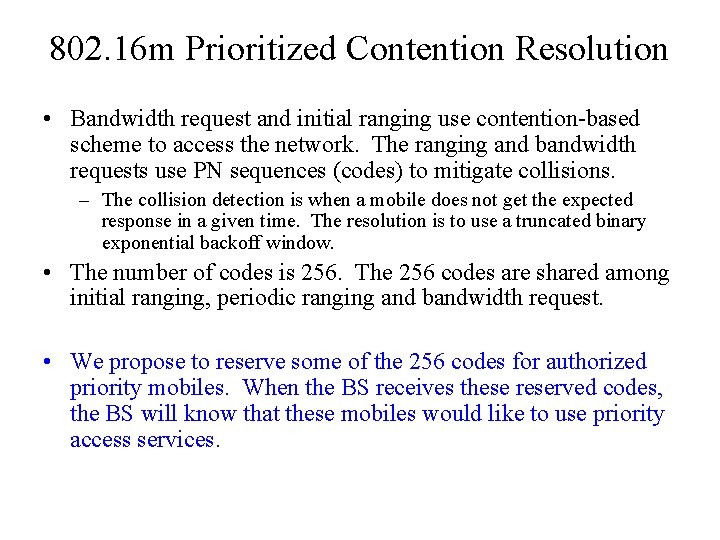
802. 16 m Prioritized Contention Resolution • Bandwidth request and initial ranging use contention-based scheme to access the network. The ranging and bandwidth requests use PN sequences (codes) to mitigate collisions. – The collision detection is when a mobile does not get the expected response in a given time. The resolution is to use a truncated binary exponential backoff window. • The number of codes is 256. The 256 codes are shared among initial ranging, periodic ranging and bandwidth request. • We propose to reserve some of the 256 codes for authorized priority mobiles. When the BS receives these reserved codes, the BS will know that these mobiles would like to use priority access services.
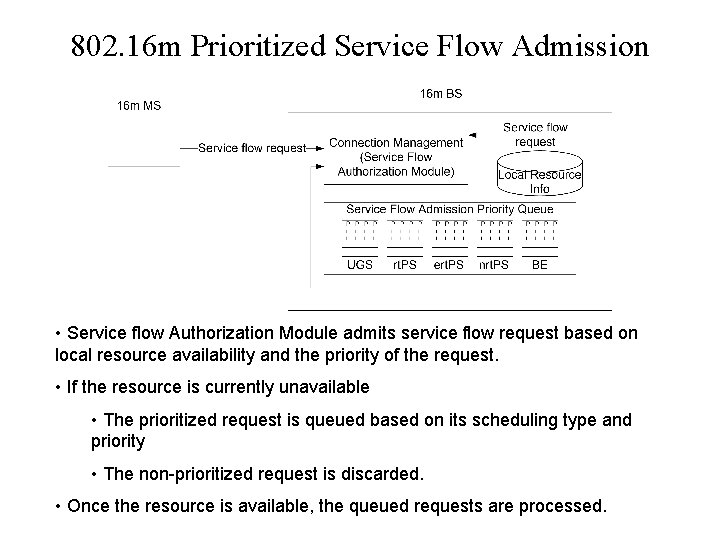
802. 16 m Prioritized Service Flow Admission • Service flow Authorization Module admits service flow request based on local resource availability and the priority of the request. • If the resource is currently unavailable • The prioritized request is queued based on its scheduling type and priority • The non-prioritized request is discarded. • Once the resource is available, the queued requests are processed.
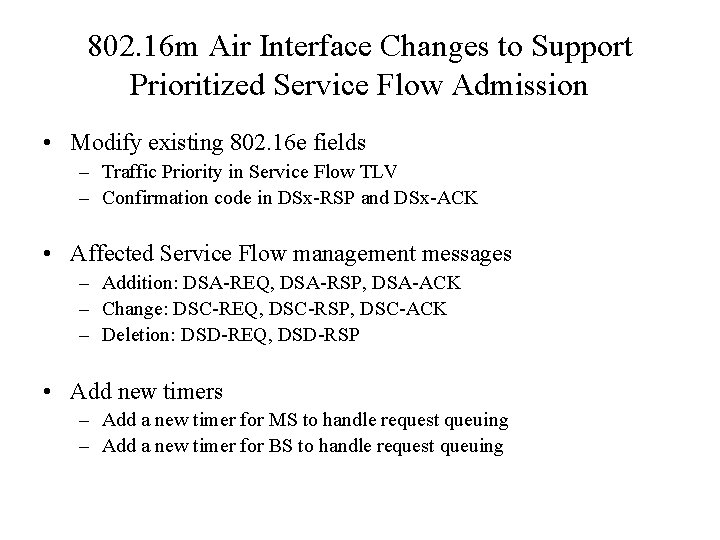
802. 16 m Air Interface Changes to Support Prioritized Service Flow Admission • Modify existing 802. 16 e fields – Traffic Priority in Service Flow TLV – Confirmation code in DSx-RSP and DSx-ACK • Affected Service Flow management messages – Addition: DSA-REQ, DSA-RSP, DSA-ACK – Change: DSC-REQ, DSC-RSP, DSC-ACK – Deletion: DSD-REQ, DSD-RSP • Add new timers – Add a new timer for MS to handle request queuing – Add a new timer for BS to handle request queuing
Traffic Priority Changes • 802. 16 e Traffic Priority format Type Length [145/146]. 6 1 scope 0 to 7 – higher numbers indicate higher priority Default 0 DSx-REQ DSx-RSP DSx-ACK REG-RSP • Proposed 802. 16 m Traffic Priority format Type Length [145/146]. 6 1 scope bit 7 – service flow admission bit 1 prioritized; 0 non-prioritized bit 6 – pre-emption bit if bit 7 == 1 0 precedence; 1 pre-emption Bit 5 -3 – reserved Bit 2 -0 – 0 to 7, higher numbers indicate higher priority, default 0 DSx-REQ DSx-RSP DSx-ACK REG-RSP
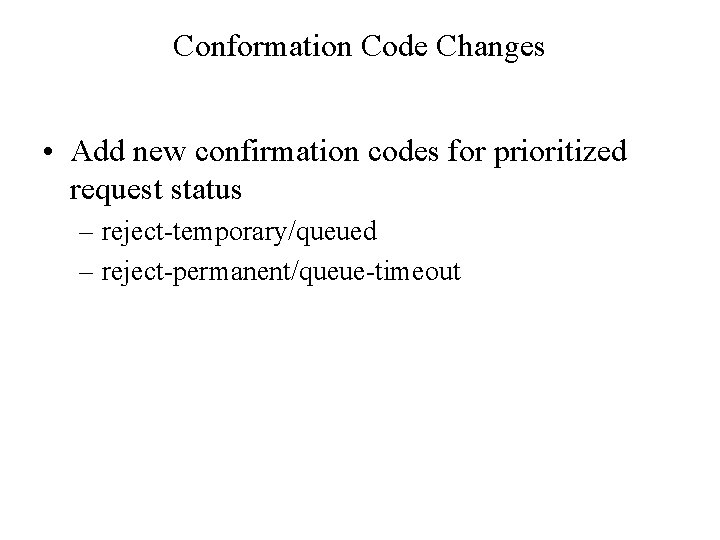
Conformation Code Changes • Add new confirmation codes for prioritized request status – reject-temporary/queued – reject-permanent/queue-timeout
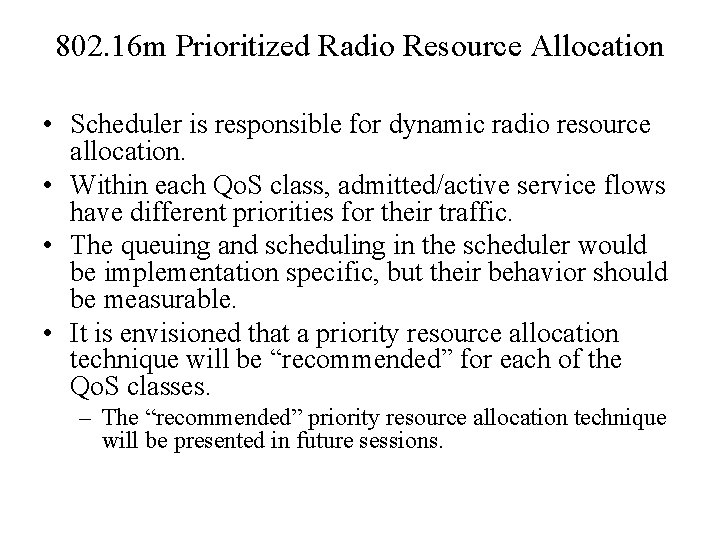
802. 16 m Prioritized Radio Resource Allocation • Scheduler is responsible for dynamic radio resource allocation. • Within each Qo. S class, admitted/active service flows have different priorities for their traffic. • The queuing and scheduling in the scheduler would be implementation specific, but their behavior should be measurable. • It is envisioned that a priority resource allocation technique will be “recommended” for each of the Qo. S classes. – The “recommended” priority resource allocation technique will be presented in future sessions.
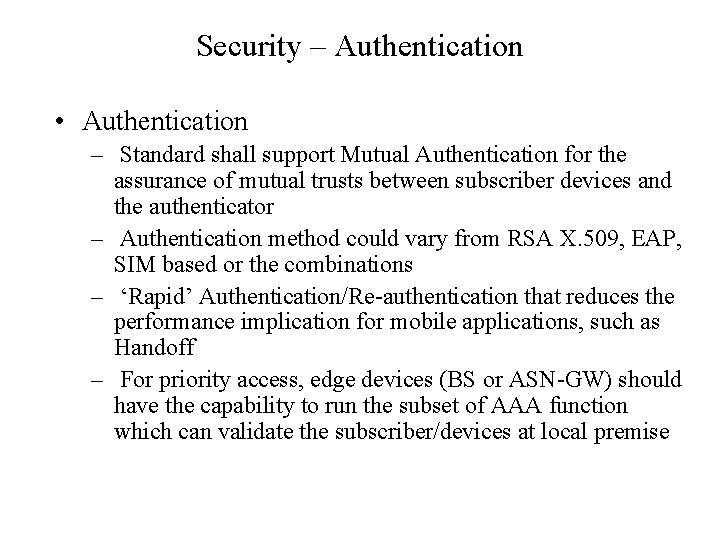
Security – Authentication • Authentication – Standard shall support Mutual Authentication for the assurance of mutual trusts between subscriber devices and the authenticator – Authentication method could vary from RSA X. 509, EAP, SIM based or the combinations – ‘Rapid’ Authentication/Re-authentication that reduces the performance implication for mobile applications, such as Handoff – For priority access, edge devices (BS or ASN-GW) should have the capability to run the subset of AAA function which can validate the subscriber/devices at local premise
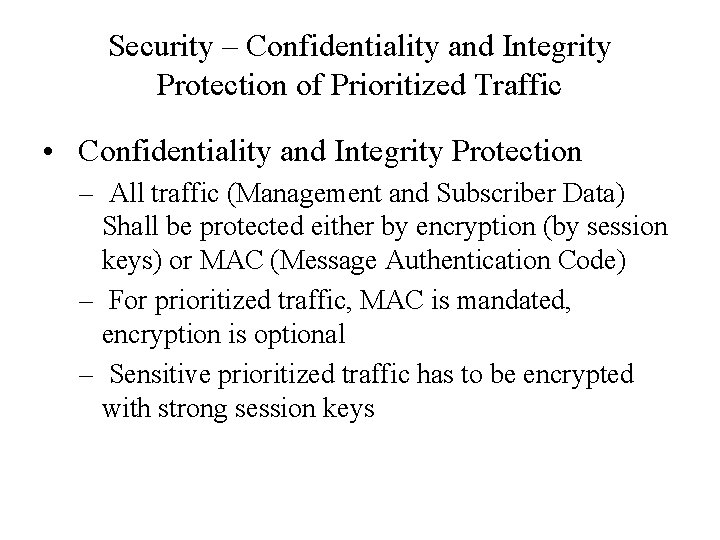
Security – Confidentiality and Integrity Protection of Prioritized Traffic • Confidentiality and Integrity Protection – All traffic (Management and Subscriber Data) Shall be protected either by encryption (by session keys) or MAC (Message Authentication Code) – For prioritized traffic, MAC is mandated, encryption is optional – Sensitive prioritized traffic has to be encrypted with strong session keys
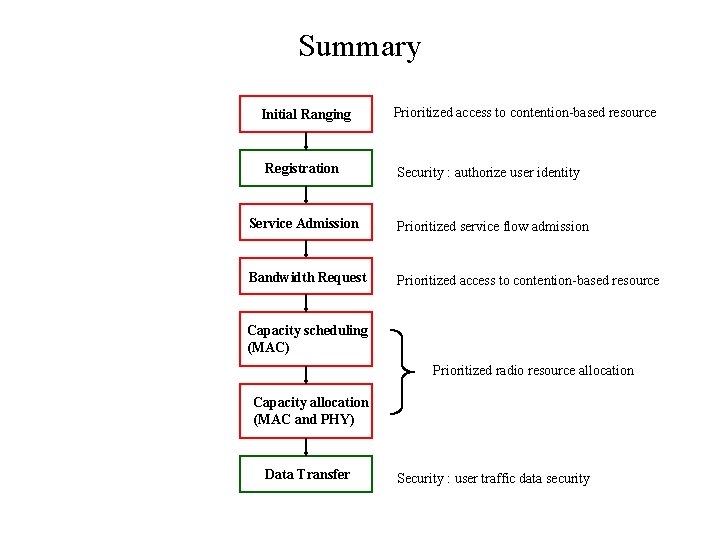
Summary Initial Ranging Registration Prioritized access to contention-based resource Security : authorize user identity Service Admission Prioritized service flow admission Bandwidth Request Prioritized access to contention-based resource Capacity scheduling (MAC) Prioritized radio resource allocation Capacity allocation (MAC and PHY) Data Transfer Security : user traffic data security
Government Priority Access Requirements
Background on DHS Priority Access* • Priority access service is intended to facilitate emergency response and recovery operations in response to natural and man-made disasters and events, such as floods, earthquakes, hurricanes, and terrorist attacks. Priority access service is also intended to support both national and international emergency communications. Priority access service is based upon, and complies with, the FCC Second Report and Order (R&O) 00242 (Wireless Telecommunications (WT) Docket No. 96 -86). Priority access service is intended to allow qualified and authorized National Security and Emergency Preparedness (NS/EP) users to obtain priority access to radio traffic channels and core network resources during situations when Commercial Mobile Radio Service (CMRS) provider network congestion is blocking call attempts *Wireless Priority Service (WPS) Industry Requirements For UMTS – Phase 1 – Redirection to GSM, ” DHS/NCS IR Document, Version 0. 3, April 2005
Background on Emergency Telecommunications Service (ETS) • “Emergency Telecommunications Service: A telecommunications service offering available on public communications networks that facilitates the work of authorized emergency personnel in times of disaster, national emergency, or for executive/governmental communications relating to National Security / Emergency Preparedness (NS/EP). ”* **“Overview of Standards in Support of Emergency Telecommunication Service ( ETS), ” ATIS-pp-0100009, November 2006
ETS Standardization Activities Around the Globe • • ITU (International Telecommunication Union) IETF (Internet Engineering Task Force) ETSI (European Telecommunications Standards Institute) ATIS (Alliance for Telecommunications Industry Solution) TIA (Telecommunications Industry Association) 3 GPP (3 rd Generation Partnership Project) 3 GPP 2 (3 rd Generation Partnership Project 2)
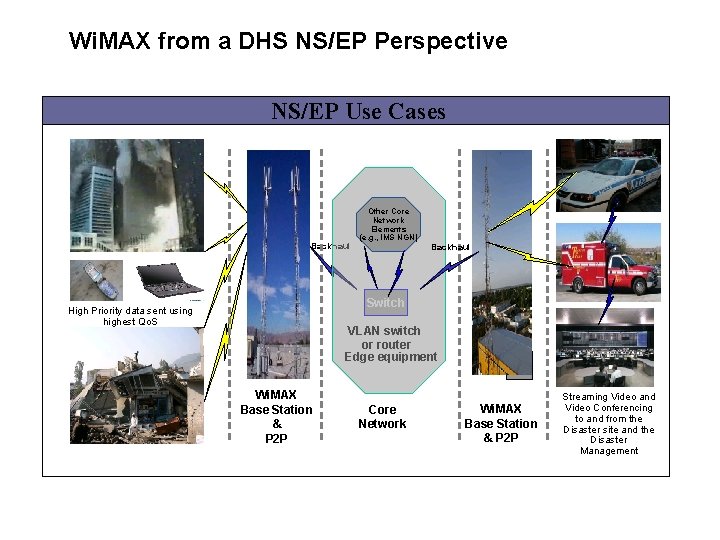
Wi. MAX from a DHS NS/EP Perspective NS/EP Use Cases Backhaul Other Core Network Elements (e. g. , IMS NGN) Backhaul Switch High Priority data sent using highest Qo. S VLAN switch or router Edge equipment Wi. MAX Base Station & P 2 P Core Network BS Wi. MAX Base Station & P 2 P Streaming Video and Video Conferencing to and from the Disaster site and the Disaster Management
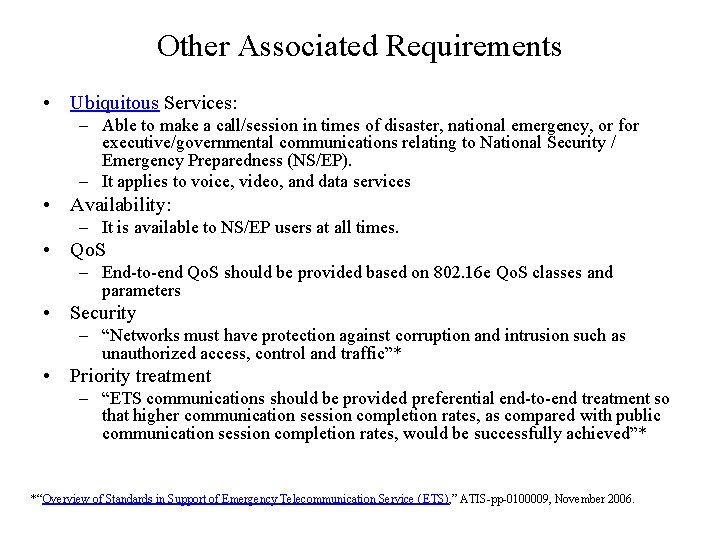
Other Associated Requirements • Ubiquitous Services: – Able to make a call/session in times of disaster, national emergency, or for executive/governmental communications relating to National Security / Emergency Preparedness (NS/EP). – It applies to voice, video, and data services • Availability: – It is available to NS/EP users at all times. • Qo. S – End-to-end Qo. S should be provided based on 802. 16 e Qo. S classes and parameters • Security – “Networks must have protection against corruption and intrusion such as unauthorized access, control and traffic”* • Priority treatment – “ETS communications should be provided preferential end-to-end treatment so that higher communication session completion rates, as compared with public communication session completion rates, would be successfully achieved”* *“Overview of Standards in Support of Emergency Telecommunication Service ( ETS), ” ATIS-pp-0100009, November 2006.
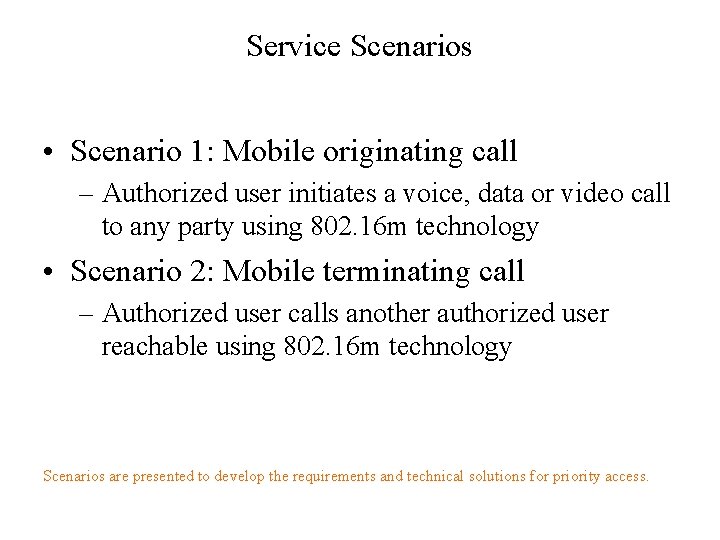
Service Scenarios • Scenario 1: Mobile originating call – Authorized user initiates a voice, data or video call to any party using 802. 16 m technology • Scenario 2: Mobile terminating call – Authorized user calls another authorized user reachable using 802. 16 m technology Scenarios are presented to develop the requirements and technical solutions for priority access.
Conclusion • We have provided a system architecture that supports these services and requirements • We would like this concept to be considered by 802. 16 m • We have presented requirements on priority access from ETS view point
References • • • • • “Overview of Standards in Support of Emergency Telecommunication Service (ETS), ” ATIS-pp-0100009, November 2006. Quality of Service Attributes for Diameter, ” draft-ietf-dime-qos-attributes-02. txt “Quality of Service Parameters for Usage with the AAA Framework, ” draft-ietf-dime-qos-parameters-01. txt “RSVP Extensions for Emergency Services, ” draft-ietf-tsvwg-emergency-rsvp-03. txt “Qo. S NSLP QSPEC Template, ” draft-ietf-nsis-qspec-18. txt Report ITU-R. [PPDR]: “Radiocommunication objectives and requirements for public protection and disaster relief (PPDR)” Recommendation H. 460. 4 – Call priority designation for H. 323 calls Draft recommendation H. SETS – security for ETS (H. 235) E. 106 – Description of an international emergency preference scheme (IEPS) Draft Recommendation U. roec – network requirements and capabilities to support ETS RFC 3523: “Internet Emergency Preparedness (IEPREP) Telephony Topology Terminology” TETRA: “Mobile narrowband wideband communications for public safety applications” TR 41. 4 TSB 146: “Telecommunications – IP Telephony Infrastructure – IP Telephony Support for Emergency Calling Service) 3 GPP TS 22. 153, “Technical Specification Group Services and System Aspects; Multimedia priority service”, Release 8. 3 GPP S. R 0017 -0, “Multimedia Priority Service (MMPS) for MMD-based Networks – Stage 1 Requirements” IEEE Standard 802. 16 -2004, IEEE Standard for Local and Metropolitan Area Networks - Part 16: Air Interface for Fixed Wireless Access Systems. IEEE Standard 802. 16 e-2005, Amendment to IEEE Standard for Local and Metropolitan Area Networks Part 16: Air Interface for Fixed Broadband Wireless Access Systems- Physical and Medium Access Control Layers for Combined Fixed and Mobile Operation in Licensed Bands