
PRIORITIES FOR PUBLIC HEALTH GENOMICS 2012 2017 A
PRIORITIES FOR PUBLIC HEALTH GENOMICS 2012 -2017 A Public Health Stakeholder Consultation
Co-Authors • Toby Citrin, JD – tcitrin@umich. edu – Center for Public Health and Community Genomics • Stephen M. Modell, MD, MS – mod@umich. edu – Center for Public Health and Community Genomics • James O’Leary, BS – Genetic Alliance
Presenter Disclosures The following personal financial relationships with commercial interests relevant to this presentation existed during the past 12 months: No Relationships to Disclose
Our Assignment from CDC/OPHG April-December 2012 • Center for Public Health & Community Genomics – Consult stakeholders from public health community (academe, practice and community) on the future of public health genomics in the next five years – Collect, categorize, analyze input – Report findings at a wrap-up conference and in a written report • Genetic Alliance – Convene and organize the wrap-up conference
Planning Committee • Academe – – Karen Edwards Sharon Kardia Barbara Burns Mc. Grath Sara Shostak • Practice – – Sylvia Au Suzanne Cupal Deb Duquette Karen Greendale
Planning Committee (Cont’d) • Community – Winona Hollins-Hauge – Imogene Wiggs • Ex Officio – Ella Greene-Moton (community liaison) – Dean Hosgood (APHA Genomics Forum)
Center Staff • • Toby Citrin Judy Daltuva Nora Isack Megan Knaus Sally Meyer Stephen Modell Tevah Platt

RFI Responses • 62 responses • Site for review of responses: http: //www. regulations. gov/#!docket. Detail; dct=F R+PR+N+O+SR+PS; rpp=10; po=0; D=CDC 2011 -0008 • Spreadsheet and summaries in background materials of written report
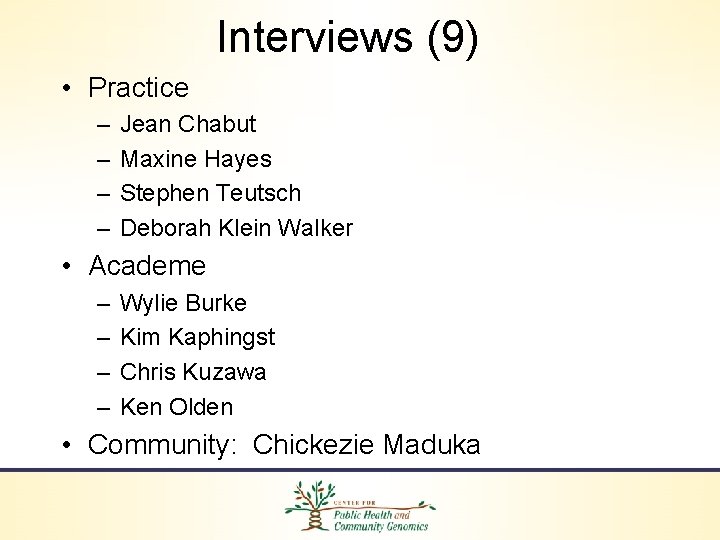
Interviews (9) • Practice – – Jean Chabut Maxine Hayes Stephen Teutsch Deborah Klein Walker • Academe – – Wylie Burke Kim Kaphingst Chris Kuzawa Ken Olden • Community: Chickezie Maduka
Informal Discussions (3) • National Community Committee – Special Interest Group on Genomics • Public Health Practice • Genetic Alliance Annual Meeting – “breakfast discussion”
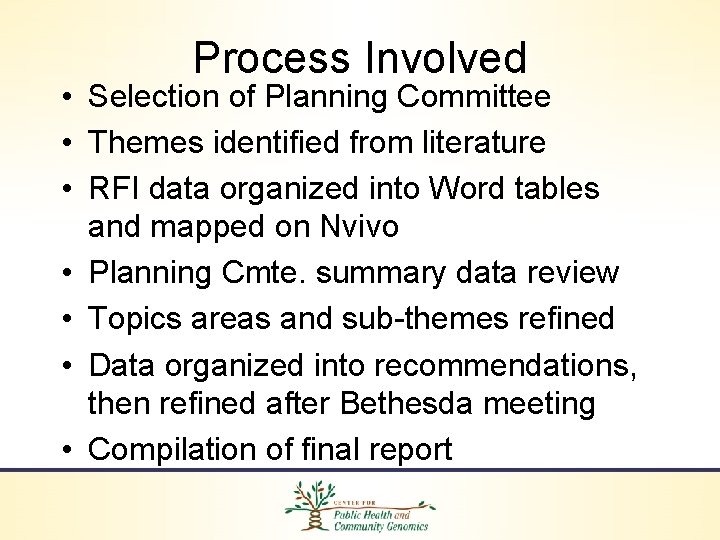
Process Involved • Selection of Planning Committee • Themes identified from literature • RFI data organized into Word tables and mapped on Nvivo • Planning Cmte. summary data review • Topics areas and sub-themes refined • Data organized into recommendations, then refined after Bethesda meeting • Compilation of final report
Literature Review • Workshops – Conferences – Reports Program Reviews & Strategic Plans • Articles on the Future of Public Health Genomics • Articles on Stakeholder Consultation
Other Studies; Reports • • • Healthy People 2020 CDC/OPHG 10 th Year Report (2008) HRSA Strategic Plan NHGRI Strategic Plan IOM Roundtable on Translating Genomic-based Research for Health GAPPNet Public Health Genomics Conference (2010) SACGHS Education & Training Report (2011) NHGRI Genomic Literacy Conference (11/2011)
Procedural Strengths • Preliminary work already done by CDC Office of Public Health Genomics • Combination of federal RFI and University expertise allowed for quick turn-around • Knowledgeable Planning Committee advised on both general (e. g. , frameworks) and specific (e. g. , structuring of meetings) items • Umbrella community and genetics advocacy organizations aided in recruitment and information gathering
Procedural Weaknesses • Federal restriction to 9 key informant interviews • Scope of the project limited the number of assessment avenues. Wiki had to be deferred. • Short time window influenced information collation techniques used.
The Context Past, Promise and Potential • Progress in specific interventions, e. g. : – Newborn Screening – BRCA and Lynch Syndrome testing – Sudden cardiac death • We’re a “half-way technology” needing translation, evidence and guidelines • Near unanimous agreement by “insiders” on broader promise of public health genomics • Lack of understanding or appreciation by “outsiders” of potential value of genomics to all of public health
What We Learned
Education
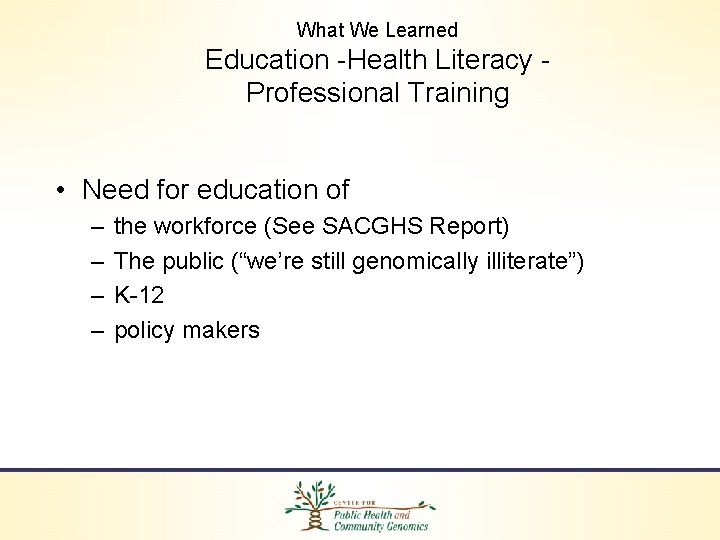
What We Learned Education -Health Literacy Professional Training • Need for education of – – the workforce (See SACGHS Report) The public (“we’re still genomically illiterate”) K-12 policy makers
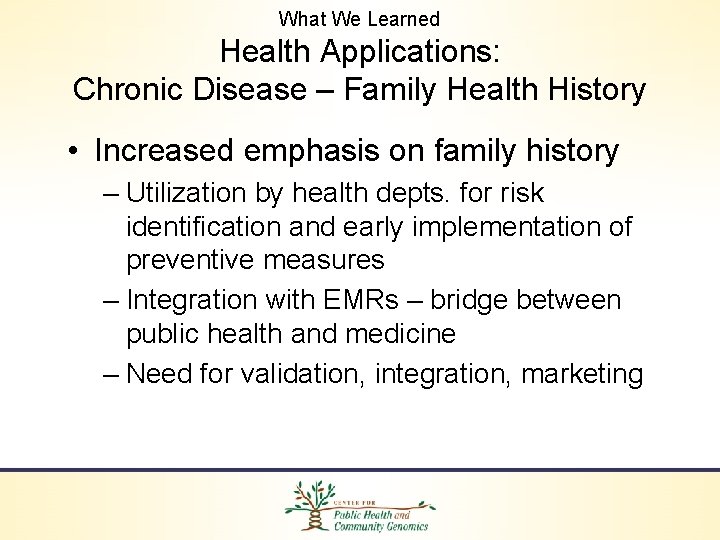
What We Learned Health Applications: Chronic Disease – Family Health History • Increased emphasis on family history – Utilization by health depts. for risk identification and early implementation of preventive measures – Integration with EMRs – bridge between public health and medicine – Need for validation, integration, marketing
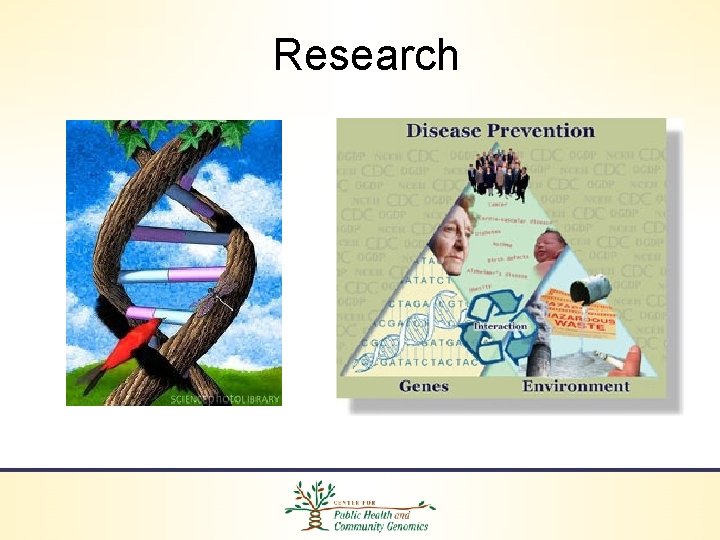
Research
What We Learned Research: Translational – Impact on Health Outcomes • Research base for decisions on screening • Cost-effectiveness of genetic technologies (e. g. , family history) • “Research [providing] evidence that the segmentation of populations by genomic characteristics would…achieve greater effectiveness and efficiency across a range of public health interventions, especially in the fields of obesity, diabetes, stroke, cancer and heart disease, and in neurodegenerative disorders. ” – Ron Zimmern
What We Learned Research: Translational – Impact on Health Outcomes (Continued) • “…public health genomics demands that we understand—and address—how unequally distributed exposures, resources, and other factors outside the body enter into molecular processes to shape health and illness within and across populations. ” – Sara Shostak
What We Learned Research – Infrastructure and Focus • Integration of data sets/registries/tissue banks for research • Database cataloguing genetics, physical and social environment, determinants of health • Research focus toward public health goals and methods • Role of CDC/OPHG – warehousing, guidance; “ushering” through the translation process
What We Learned Assurance – Evidence Base • Systems providing information on validity and utility of genetic tests – e. g. , EGAPP but not as slow – OPHG role as trusted source of evidence • “Leverage electronic healthcare infrastructure to achieve several goals: outcomes research, quality improvement, decision support. ” – RFI Response
Policy Development
What We Learned Policy Development • • • Population level genetic screening Utilization of family health history FDA oversight of genetic tests Advisory panel on multiplex screening Regulation of direct-to-consumer testing
Funding
What We Learned Funding • Support for state-level utilization of genomics professionals • Support for integration of genomics throughout public health practice • Funding of gene x environment research bridging between medicine and public health • Funding CBPR utilizing genomic approaches • Funding to assure equal access to genetic testing
Collaborations - Partnerships
What We Learned Crosscutting: Collaborations - Partnerships • Personalized medicine advisory board within OPHG • NIH, AHRQ, CDC, CMS collaboration on evidence-based approaches • State level: Chronic disease, labs, MCH and NBS collaboration
What We Learned Crosscutting: Collaborations – Partnerships (Cont’d) • Schools of Public Health with State Health Departments • Public-Private (e. g. , with DTC companies) • Transdisciplinary research teams (genetics, social, behavioral) • Enhanced stakeholder engagement, coordination and leadership
Role of CDC/OPHG in Furthering Collaborations and Partnerships • Convener, e. g. , – with PRCs; chronic disease programs – Fostering interdisciplinary research • Advocate – Liaison with APHA Genomics Forum • Need for Advisory Group of stakeholders
Frameworks for Organization • Core Functions (IOM “Future” 1988) • From Genes to Public Health (Khoury, AJPH, 1996) • Core Functions & Essential Services – Public Health in America – 1994 – ASTHO - 2001) • Ecological View (IOM “Future” 2002) – Strengthen all sectors of public health
Health Disparities Community Engagement
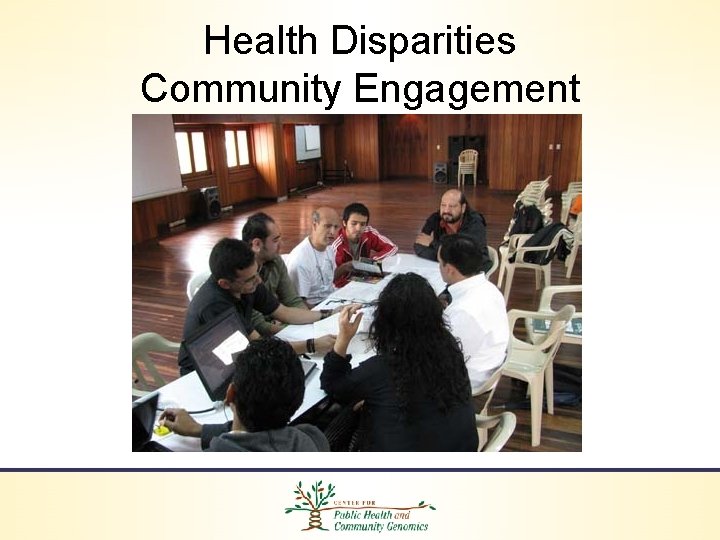
What We Learned Health Disparities Community Engagement • Gene x Environment – Epigenetic Research focused on health disparities • Community-Based Participatory Research incorporating genomics (e. g. by PRC’s) • “continue to seek out [the grassroots voice of the community], embracing the idea that community lies at the heart of public health…. ” – Ella Greene-Moton
Priorities Conference • September 14, 2011 • Over 70 leaders in public health genomics – Academe, public health, health care, community
Priorities Conference Overarching Objectives • Improve public education about genetics through community engagement • Continue working on issues related to evidence development • Take a bottom-up approach to technology development
Priorities Conference Overarching Objectives • Embed genetics into all aspects of healthcare • Expand public health screening programs that utilize genetic information – Relates to cascade screening recommendations in earlier presentation by Scott Bowen, et al
Summary 1. PH Genomics has already achieved an impressive track record in addressing less common diseases and has demonstrated its significant potential to advance all areas of public health 2. Currently available genetic tools still need to be embraced by public health (e. g. , those described by Scott Bowen, et al, earlier in this session) 3. Realizing the future potential of PH genomics will require – – Leadership and a common vision Collaboration among currently separate groups Infrastructure and education Advocacy to secure resources and policies
Written Report – email: • tcitrin@umich. edu
- Slides: 43