
Principlism Phil 318 Theory of Applied and professional
- Slides: 20
Principlism Phil 318 Theory of Applied and professional Ethics
The Georgetown Mantra • Beauchamp and Childress Principles of Bioethics • 4 key principles • autonomy • beneficence • non-maleficence • Justice
Autonomy • Respect a person’s right to make their own decisions • Teach people to be able to make their own choices • Support people in their individual choices • Do not force or coerce people to do things • ‘Informed Consent’ is an important outcome of this principle
Beneficence (to do good) • Our actions must aim to ‘benefit’ people – health, welfare, comfort, well-being, improve a person’s potential, improve quality of life • ‘Benefit’ should be defined by the person themselves. It’s not what we think that is important. • Act on behalf of ‘vulnerable’ people to protect their rights • Prevent harm • Create a safe and supportive environment • Help people in crises
Non – maleficence (to do no harm) • do not to inflict harm on people • do not cause pain or suffering • do not incapacitate • do not cause offence • do not deprive people • do not kill
Justice • Treating people fairly • Not favouring some individuals/groups over others • Acting in a non–discriminatory / nonprejudicial way • Respect for peoples rights • Respect for the law
Justice Distributive Justice – sharing the scarce resources in society in a fair and just manner (e. g. health services, professional time) • How should we share out healthcare resources? • How should doctors share their time with patients? Deciding how to do this raises some difficult questions Patients should get…. . • an equal share ? • just enough to meet their needs ? • what they deserve ? • what they can pay for ?
Also offer 4 ethical rules • Veracity – truth telling, informed consent, respect for autonomy • Privacy – a persons right to remain private, to not disclose information • Confidentiality – only sharing private information on a ‘need to know basis’ • Fidelity – loyalty, maintaining the duty to care for all no matter who they are or what they may have done
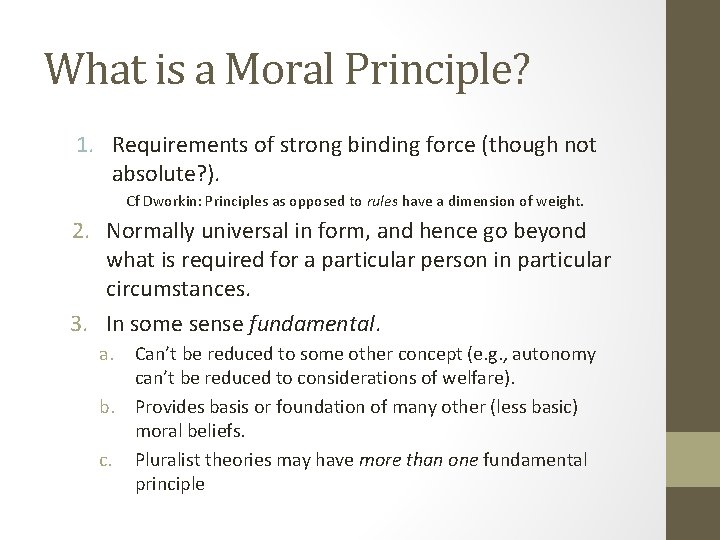
What is a Moral Principle? 1. Requirements of strong binding force (though not absolute? ). Cf Dworkin: Principles as opposed to rules have a dimension of weight. 2. Normally universal in form, and hence go beyond what is required for a particular person in particular circumstances. 3. In some sense fundamental. a. b. c. Can’t be reduced to some other concept (e. g. , autonomy can’t be reduced to considerations of welfare). Provides basis or foundation of many other (less basic) moral beliefs. Pluralist theories may have more than one fundamental principle
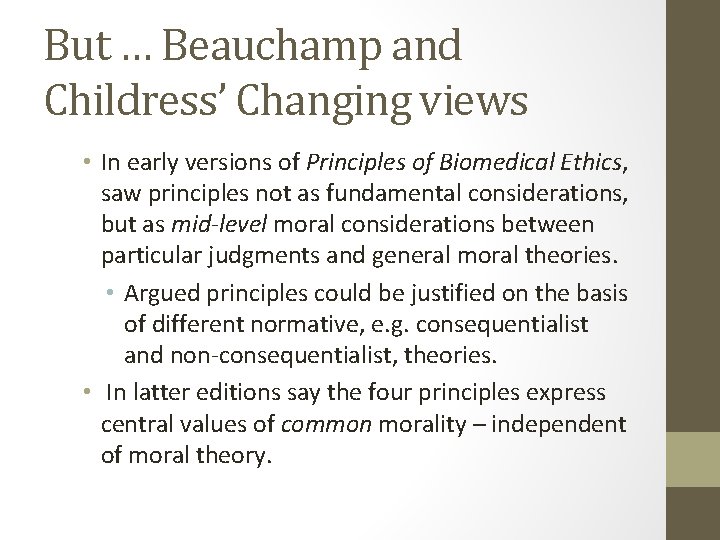
But … Beauchamp and Childress’ Changing views • In early versions of Principles of Biomedical Ethics, saw principles not as fundamental considerations, but as mid-level moral considerations between particular judgments and general moral theories. • Argued principles could be justified on the basis of different normative, e. g. consequentialist and non-consequentialist, theories. • In latter editions say the four principles express central values of common morality – independent of moral theory.
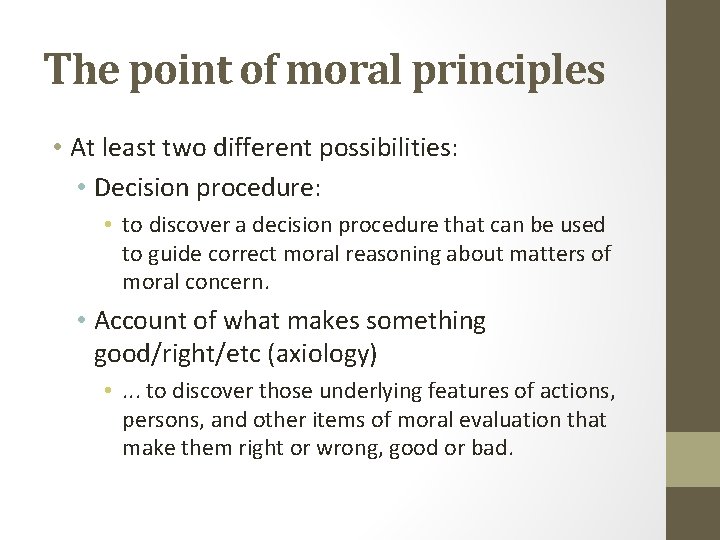
The point of moral principles • At least two different possibilities: • Decision procedure: • to discover a decision procedure that can be used to guide correct moral reasoning about matters of moral concern. • Account of what makes something good/right/etc (axiology) • . . . to discover those underlying features of actions, persons, and other items of moral evaluation that make them right or wrong, good or bad.
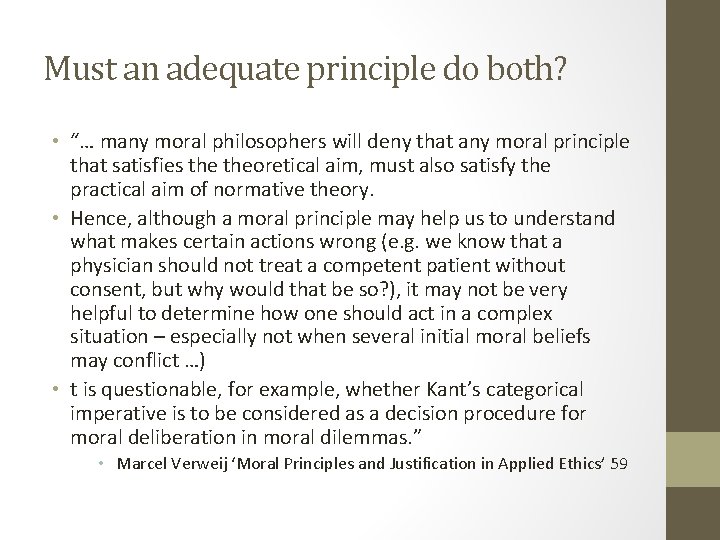
Must an adequate principle do both? • “… many moral philosophers will deny that any moral principle that satisfies theoretical aim, must also satisfy the practical aim of normative theory. • Hence, although a moral principle may help us to understand what makes certain actions wrong (e. g. we know that a physician should not treat a competent patient without consent, but why would that be so? ), it may not be very helpful to determine how one should act in a complex situation – especially not when several initial moral beliefs may conflict …) • t is questionable, for example, whether Kant’s categorical imperative is to be considered as a decision procedure for moral deliberation in moral dilemmas. ” • Marcel Verweij ‘Moral Principles and Justification in Applied Ethics’ 59
A weaker role? • [Appealing to a moral principle should never be the final step and conclusion of ethical deliberation. It might be a sensible way to start and guide further analysis and reflection, raising questions like “Why would autonomy be important in this case? ”; “What would respect for autonomy imply in a case like this? ”; “Would a patient’s choice to participate in the trial be constrained in some sense? ”; but also: “Can it be right to offer this patient such a choice in the first place? ” • Some of these questions may be most clarified with theoretical reflection on the concept and value of autonomy.
And unidirectional? • Practical ethical reflection does not only consist in bridging the gap between general moral principles and particular judgments, it may also contribute to further understanding of a principle and even to critique and adjustment of such a principle.
Criticisms 1. Principles are too abstract to provide for practical guidance in moral problem situations. 2. (If there is more than one principle – ie. if pluralism is true) principles will often conflict, and provide little guidance for how to deal with such conflicts
Reject principles altogether? • Particulalism: • Jonathan Dancy: no general criteria for right and wrong action. Any attempt to formulate general moral principle will be haunted by the problem that each generalisation must admit many exceptions. More importantly, they will hold that moral truth is essential particular, and not to be found on a general or universal level.
Coherentism v Foundationalism • Foundationalism: 1. There are some fundamental moral propositions which can be justified without appeal to any other moral propositions, and 2. all other moral propositions derive their justification (at least partly) from one or more of the fundamental propositions. • Problem for Applied Ethics? • How do know what the principles are? • How do we apply them?
Coherentism: • Seek coherence among a broad range of moral and non-moral convictions: psychological facts, theories about personhood and rationality, but also considered moral judgments and moral principles. Formulate provisional principles that summarise a large range of well-considered moral judgments; and subsequently critically reflect on these principles in the light of (moral and non-moral) background theories and further moral judgments, and other sources. • Practical l moral judgments and general moral principles are justified to the extent that there is mutual support and coherence among the broadest set of moral and non-moral beliefs.
Strength of Coherentism? • “…openness to moral progress and change. In a coherentist model, no element (including moral principles) can be immune to critique and adjustment, and therefore ethical reflection can always be reason for re- thinking the content and implications of even fundamental moral principles. Technological developments, scientific progress, changing practices, and natural and human disasters nowadays create numerous unforeseen moral problems – problems that necessitate us to rethink and ad- just even basic moral beliefs. ”
Problem? • Is coherence enough? • The principled Nazi.