
Principles Underlying the Constitution fedpap The Federalist Papers
- Slides: 22
Principles Underlying the Constitution
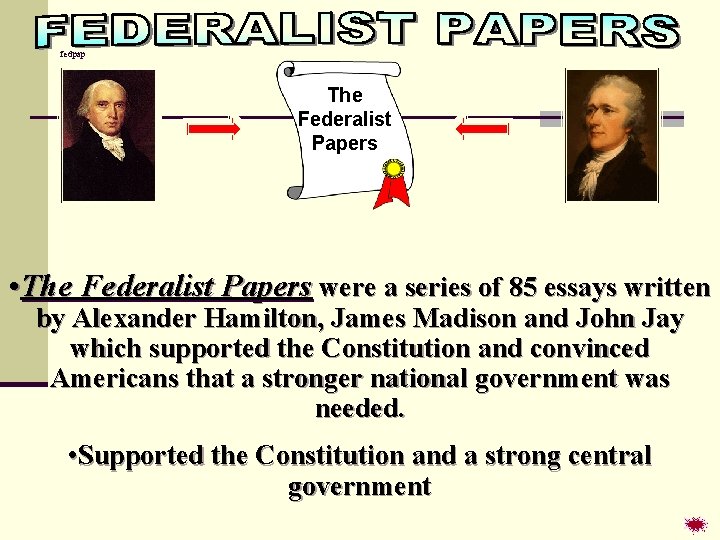
fedpap The Federalist Papers • The Federalist Papers were a series of 85 essays written by Alexander Hamilton, James Madison and John Jay which supported the Constitution and convinced Americans that a stronger national government was needed. • Supported the Constitution and a strong central government
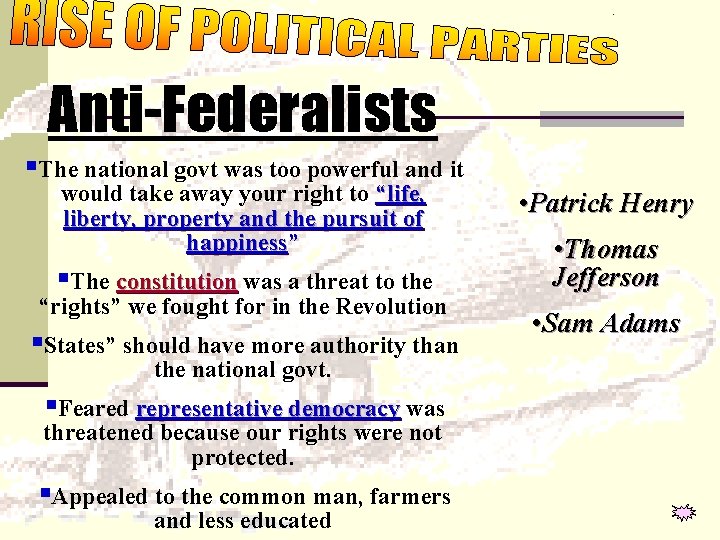
Art. 5, 6, 7 Anti-Federalists §The national govt was too powerful and it would take away your right to “life, liberty, property and the pursuit of happiness” happiness §The constitution was a threat to the “rights” we fought for in the Revolution §States” should have more authority than the national govt. §Feared representative democracy was threatened because our rights were not protected. §Appealed to the common man, farmers and less educated • Patrick Henry • Thomas Jefferson • Sam Adams
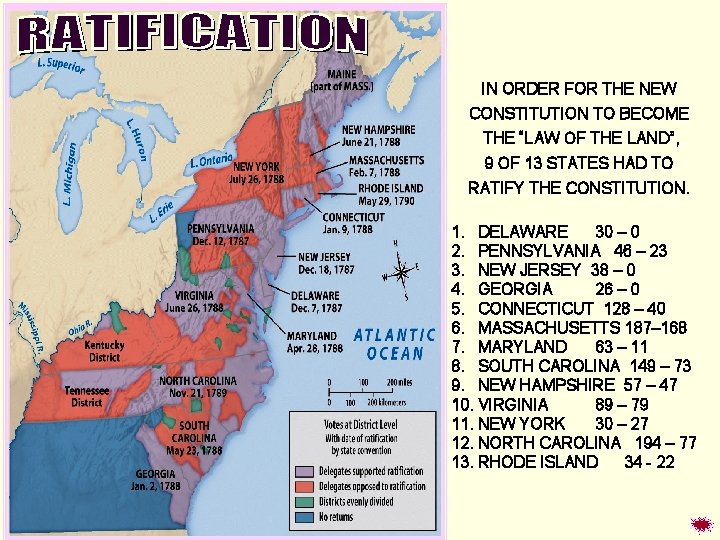
IN ORDER FOR THE NEW CONSTITUTION TO BECOME THE “LAW OF THE LAND”, 9 OF 13 STATES HAD TO RATIFY THE CONSTITUTION. 1. DELAWARE 30 – 0 2. PENNSYLVANIA 46 – 23 3. NEW JERSEY 38 – 0 4. GEORGIA 26 – 0 5. CONNECTICUT 128 – 40 6. MASSACHUSETTS 187– 168 7. MARYLAND 63 – 11 8. SOUTH CAROLINA 149 – 73 9. NEW HAMPSHIRE 57 – 47 10. VIRGINIA 89 – 79 11. NEW YORK 30 – 27 12. NORTH CAROLINA 194 – 77 13. RHODE ISLAND 34 - 22
Foundations of Constitutional Government n We the people of the United States, in order to form a more perfect union, establish justice, insure domestic tranquility, provide for the common defense, promote the general welfare, and secure the blessings of liberty to ourselves and our posterity, do ordain and establish this Constitution for the United States of America.
Foundations of Constitutional Government n. The preamble of a constitution sets forth the goals and purposes to be served by the government.
Foundations of Constitutional Government n The Preamble to the Constitution of the United States of America expresses the reasons the constitution was written.
Foundations of Constitutional Government n Purposes of U. S. government n To form a union n To establish justice n To ensure domestic peace n To provide defense • The Preamble to the Constitution of the United States of America begins, “We the people, ” which establishes that the power of government comes from the people.
Foundations of Constitutional Government n What are the purposes identified in the Preamble to the Constitution of the United States of America?
5 Principles – of the Constitution n The Framers embraced five principles as the backbone of the Constitution: popular sovereignty n rule of law n separation of powers n checks and balances n federalism n
Popular Sovereignty n Article IV guarantees a republic, in which supreme power belongs to the people (popular sovereignty). n The people express their will through elected representatives. n Provisions, such as those about the right to vote, ensure popular sovereignty.
Rule of Law n Government is limited by the rule of law. This means that the law applies to everyone, even those who govern.
Separation of Powers n To keep any one person or group from becoming too powerful, the Framers divided government into three branches with different functions. n This split of authority among the legislative, executive, and judicial branches is called the separation of powers.
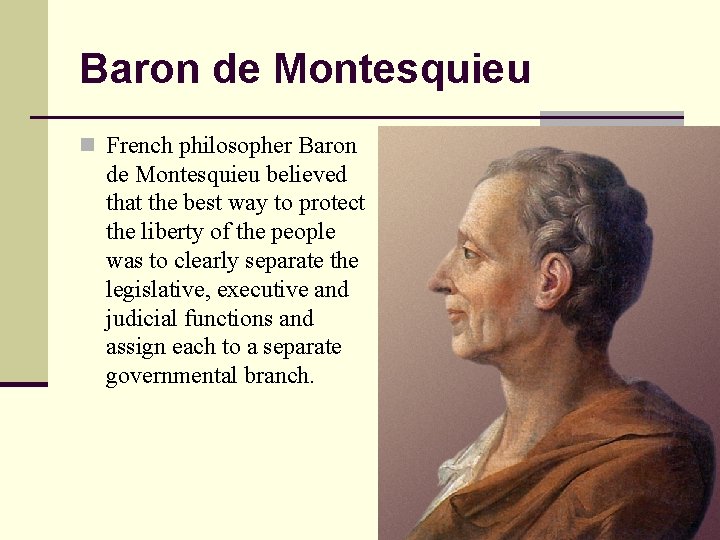
Baron de Montesquieu n French philosopher Baron de Montesquieu believed that the best way to protect the liberty of the people was to clearly separate the legislative, executive and judicial functions and assign each to a separate governmental branch.
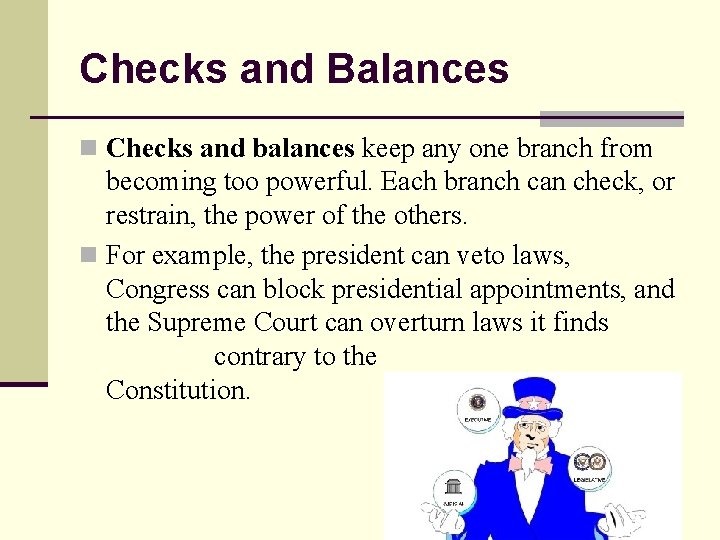
Checks and Balances n Checks and balances keep any one branch from becoming too powerful. Each branch can check, or restrain, the power of the others. n For example, the president can veto laws, Congress can block presidential appointments, and the Supreme Court can overturn laws it finds contrary to the Constitution.
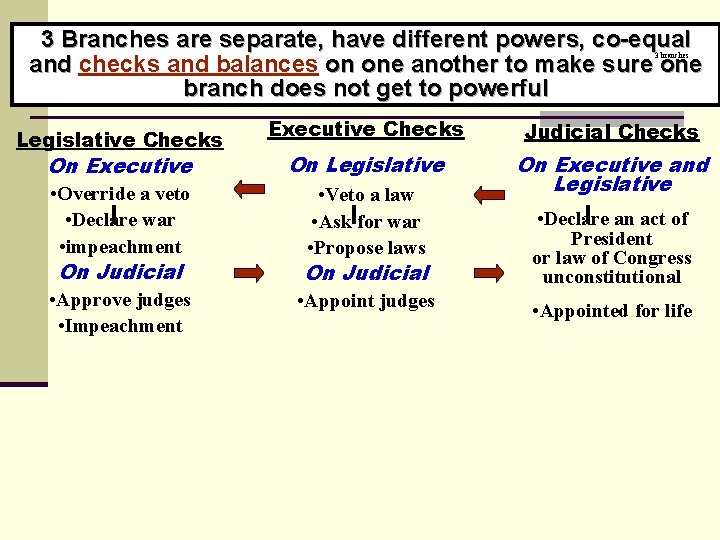
3 Branches are separate, have different powers, co-equal and checks and balances on one another to make sure one branch does not get to powerful 3 branches Legislative Checks On Executive • Override a veto • Declare war • impeachment On Judicial • Approve judges • Impeachment Executive Checks Judicial Checks On Legislative • Veto a law • Ask for war • Propose laws On Judicial • Appoint judges On Executive and Legislative • Declare an act of President or law of Congress unconstitutional • Appointed for life
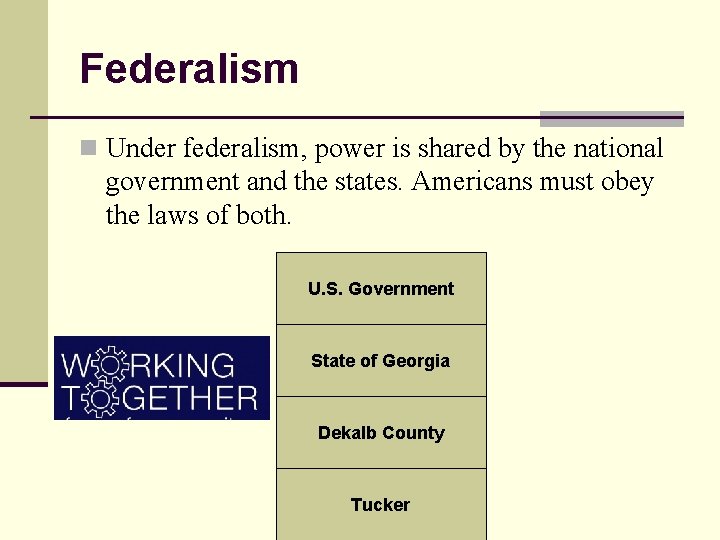
Federalism n Under federalism, power is shared by the national government and the states. Americans must obey the laws of both. U. S. Government State of Georgia Dekalb County Tucker
Class Quiz
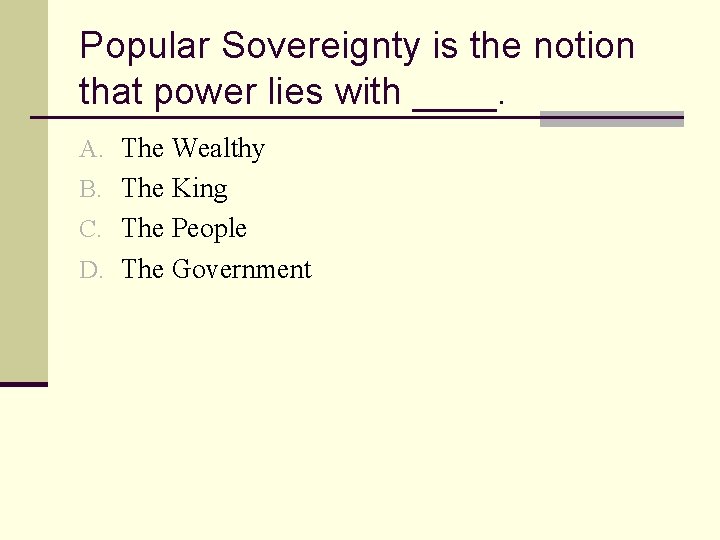
Popular Sovereignty is the notion that power lies with ____. A. The Wealthy B. The King C. The People D. The Government
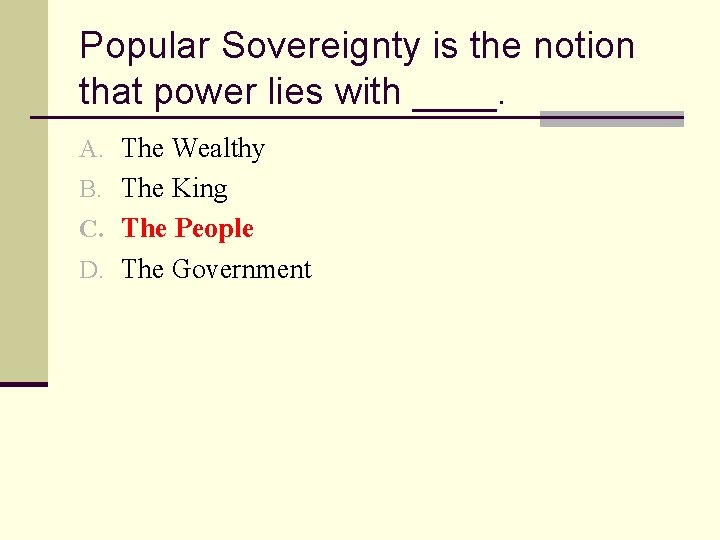
Popular Sovereignty is the notion that power lies with ____. A. The Wealthy B. The King C. The People D. The Government
Which principle of government makes the governed and those who govern equally accountable to the law? A. Popular Sovereignty B. The Rule of Law C. Separation of Powers D. Checks and Balances
Which principle of government makes the governed and those who govern equally accountable to the law? A. Popular Sovereignty B. The Rule of Law C. Separation of Powers D. Checks and Balances