
Principles Purpose of IDEA 2004 The Importance of
- Slides: 15
Principles & Purpose of IDEA 2004 The Importance of IDEA in Special Education Presented By: Liz Cannon July 10, 2014
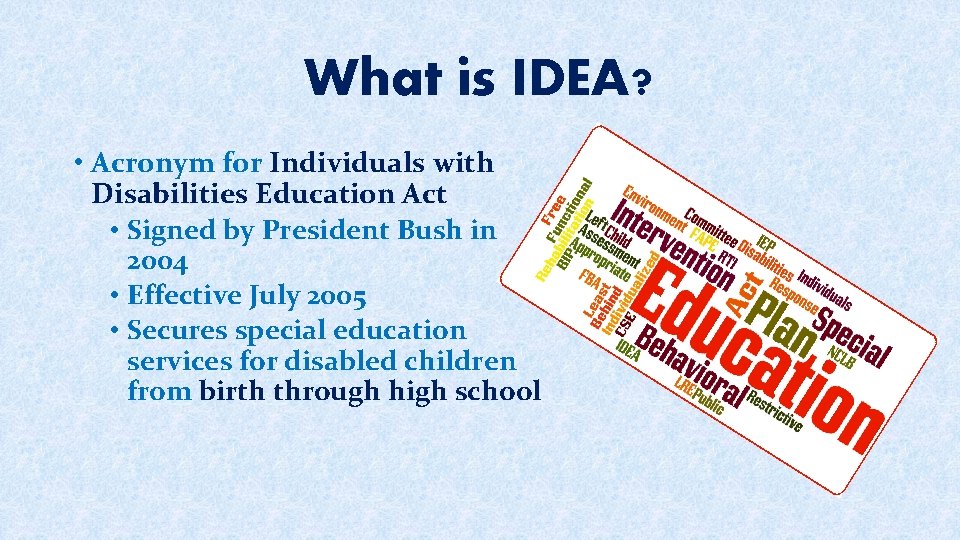
What is IDEA? • Acronym for Individuals with Disabilities Education Act • Signed by President Bush in 2004 • Effective July 2005 • Secures special education services for disabled children from birth through high school
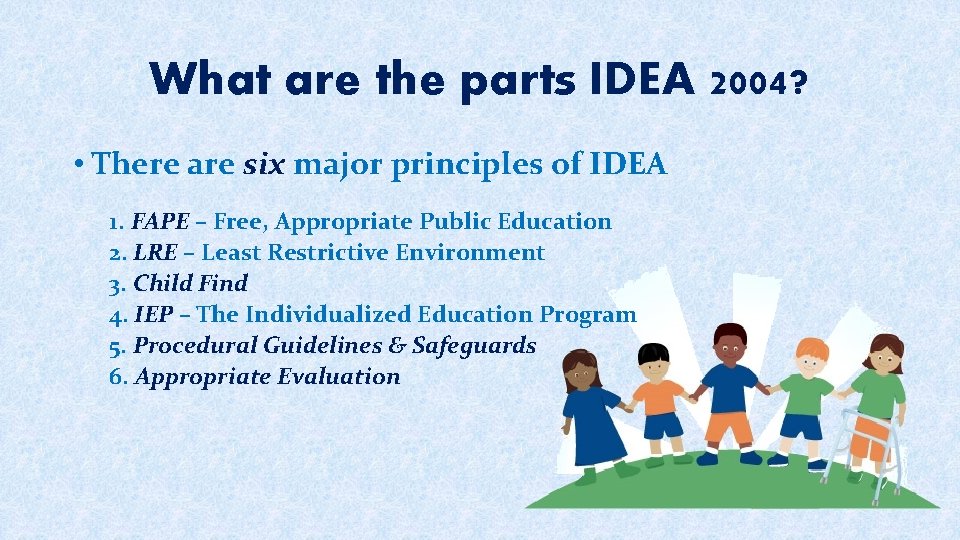
What are the parts IDEA 2004? • There are six major principles of IDEA 1. FAPE – Free, Appropriate Public Education 2. LRE – Least Restrictive Environment 3. Child Find 4. IEP – The Individualized Education Program 5. Procedural Guidelines & Safeguards 6. Appropriate Evaluation
What is Free, Appropriate Education (FAP)? • Under IDEA, every child with a disability is entitled to free, appropriate education • The school district is responsible to create a “level playing field” so students with disabilities are not put at a disadvantage • Teachers must remember that an appropriate education is required by law
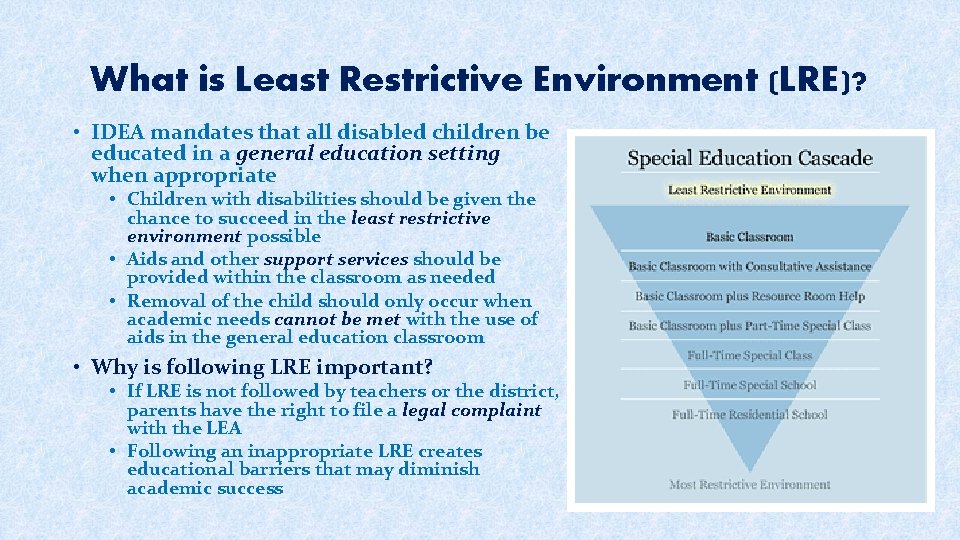
What is Least Restrictive Environment (LRE)? • IDEA mandates that all disabled children be educated in a general education setting when appropriate • Children with disabilities should be given the chance to succeed in the least restrictive environment possible • Aids and other support services should be provided within the classroom as needed • Removal of the child should only occur when academic needs cannot be met with the use of aids in the general education classroom • Why is following LRE important? • If LRE is not followed by teachers or the district, parents have the right to file a legal complaint with the LEA • Following an inappropriate LRE creates educational barriers that may diminish academic success
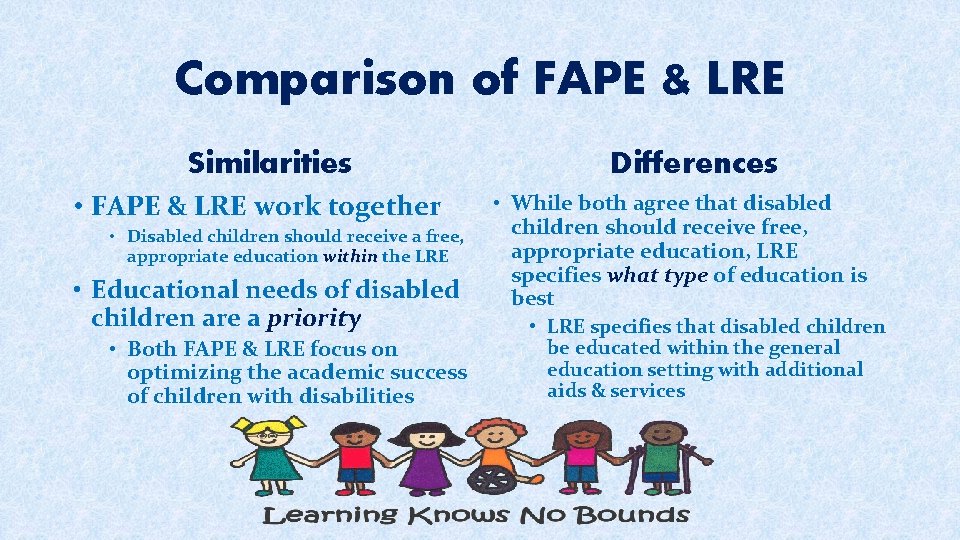
Comparison of FAPE & LRE Similarities • FAPE & LRE work together • Disabled children should receive a free, appropriate education within the LRE • Educational needs of disabled children are a priority • Both FAPE & LRE focus on optimizing the academic success of children with disabilities Differences • While both agree that disabled children should receive free, appropriate education, LRE specifies what type of education is best • LRE specifies that disabled children be educated within the general education setting with additional aids & services
What is Child Find? • IDEA requires that all children with disabilities be identified and evaluated to determine their need for special education services • Responsibility of the school district • Applies to ALL children homeless, private school children, etc.
What is the IEP? • Acronym for Individualized Education Program • IDEA states that all children with a disability must have an IEP • The IEP is a part of the child’s special education program • Includes goals, areas of improvement, necessary services etc. of the student • Based on the student’s unique, individual needs
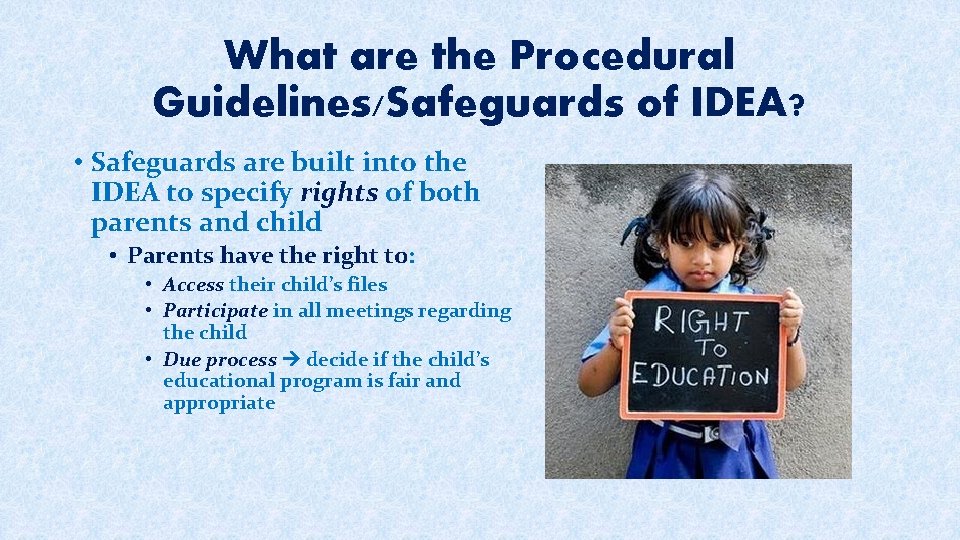
What are the Procedural Guidelines/Safeguards of IDEA? • Safeguards are built into the IDEA to specify rights of both parents and child • Parents have the right to: • Access their child’s files • Participate in all meetings regarding the child • Due process decide if the child’s educational program is fair and appropriate
What is Appropriate Evaluation? • According to IDEA, parents can request a child evaluation to determine if their child has a disability and access his educational needs • IDEA states that assessments must: • Use multiple procedures/assessment tools • Determine what is written in the IEP • Not discriminate based on race or culture
How Does IDEA Affect Special Education in Schools? • Amendments to the IDEA state that schools are required to utilize & participate in: 1. Equitable Participation 2. Permission to Evaluate 3. Effective Instruction/Progress Monitoring 4. Implementation of Short- Term Goals
Equitable Participation & Permission to Evaluate What is Equitable Participation? What is Permission to Evaluate? • Under IDEA, children voluntary enrolled in private schools have a right to be evaluated to receive special education services through Child Find • Before evaluating a child, parental consent must be obtained • IUs where the private school is located are responsible for: • Completing the evaluation • Corresponding with the state as to how many private-school children qualify for services • Meeting with private school reps. To decide on appropriate services • If parent denies evaluation, LEA may obtain permission through due process • Evaluations must be completed within 60 days of receiving permission
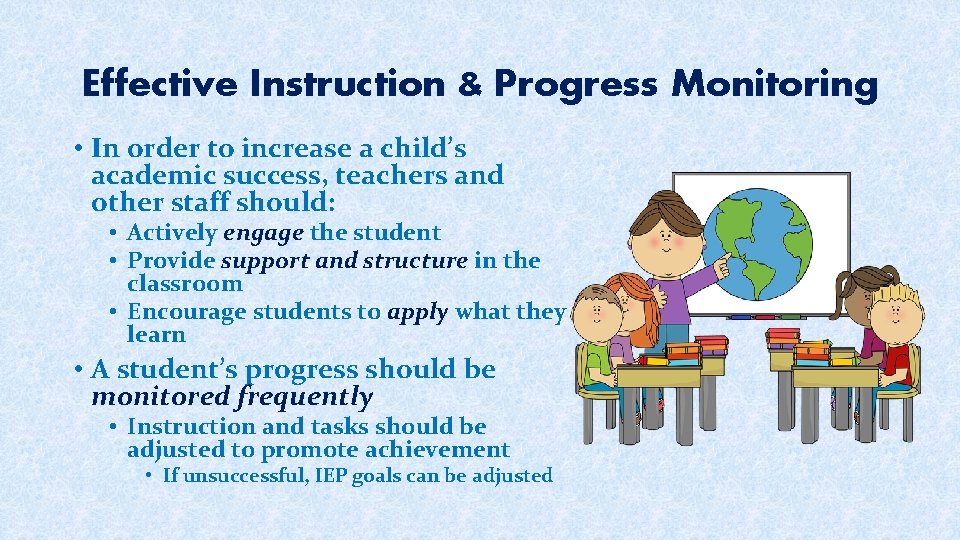
Effective Instruction & Progress Monitoring • In order to increase a child’s academic success, teachers and other staff should: • Actively engage the student • Provide support and structure in the classroom • Encourage students to apply what they learn • A student’s progress should be monitored frequently • Instruction and tasks should be adjusted to promote achievement • If unsuccessful, IEP goals can be adjusted
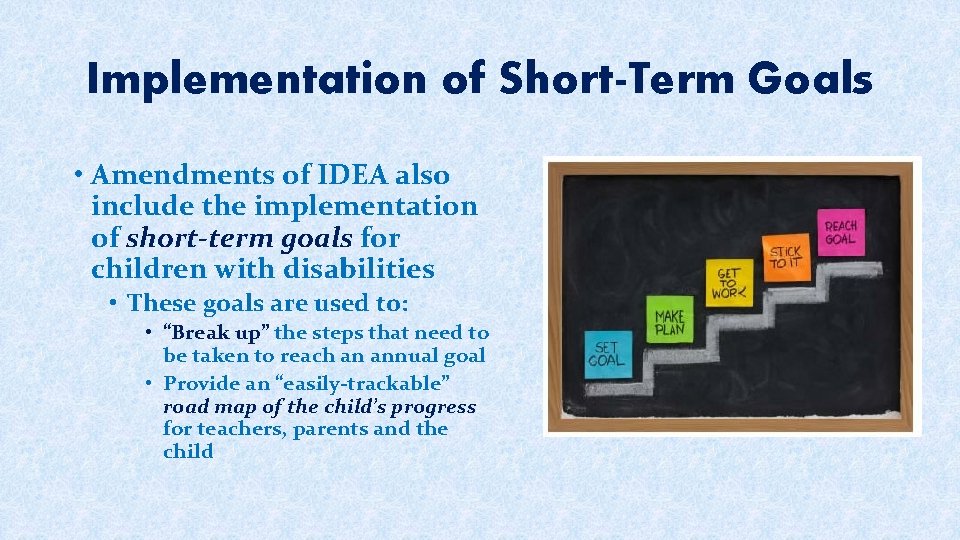
Implementation of Short-Term Goals • Amendments of IDEA also include the implementation of short-term goals for children with disabilities • These goals are used to: • “Break up” the steps that need to be taken to reach an annual goal • Provide an “easily-trackable” road map of the child’s progress for teachers, parents and the child
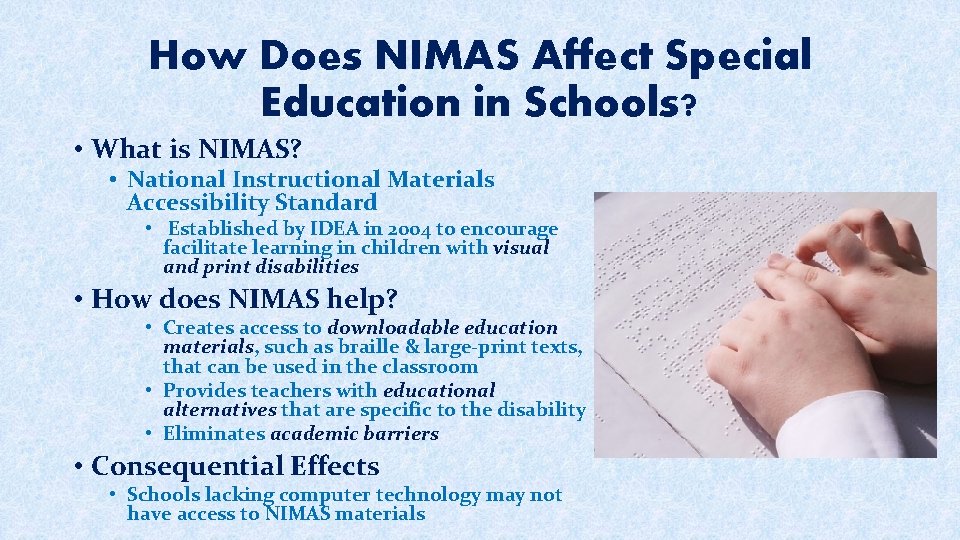
How Does NIMAS Affect Special Education in Schools? • What is NIMAS? • National Instructional Materials Accessibility Standard • Established by IDEA in 2004 to encourage facilitate learning in children with visual and print disabilities • How does NIMAS help? • Creates access to downloadable education materials, such as braille & large-print texts, that can be used in the classroom • Provides teachers with educational alternatives that are specific to the disability • Eliminates academic barriers • Consequential Effects • Schools lacking computer technology may not have access to NIMAS materials