
Principles Practice of Light Microscopy 2 Image T

- Slides: 56
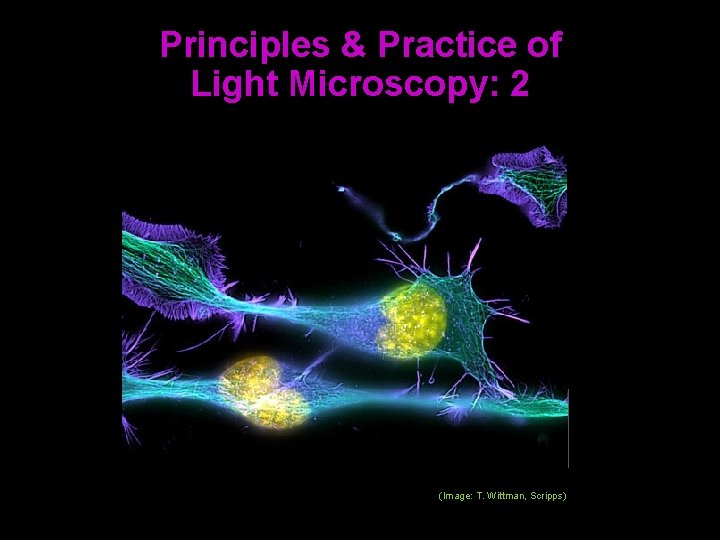
Principles & Practice of Light Microscopy: 2 (Image: T. Wittman, Scripps)
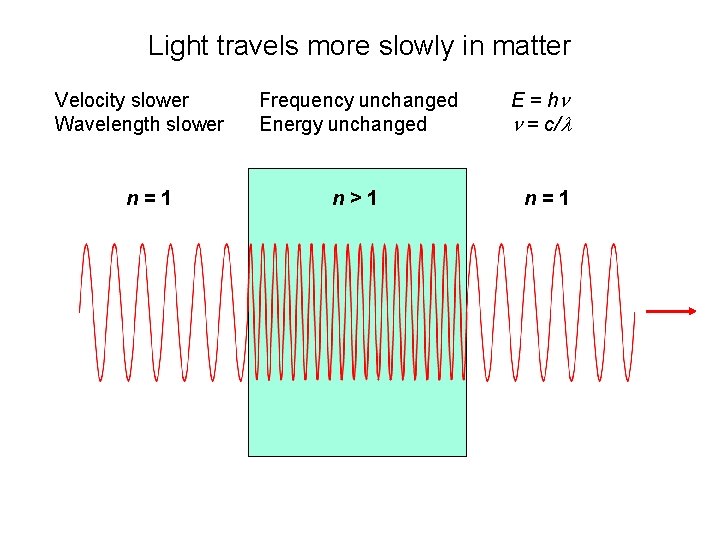
Light travels more slowly in matter Velocity slower Wavelength slower n=1 Frequency unchanged Energy unchanged E = hn n = c/l n>1 n=1
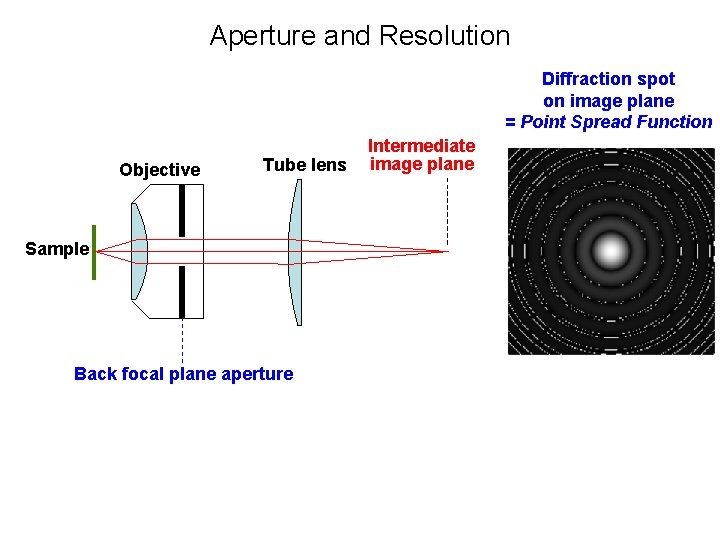
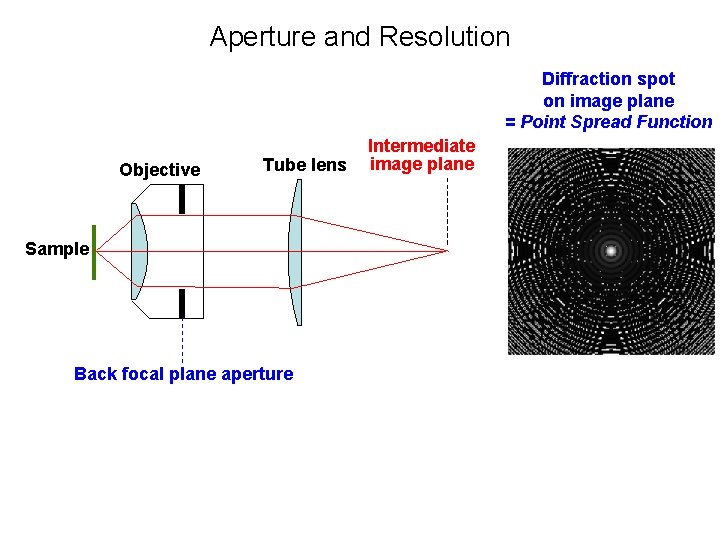
Aperture and Resolution Diffraction spot on image plane = Point Spread Function Objective Tube lens Sample Back focal plane aperture Intermediate image plane
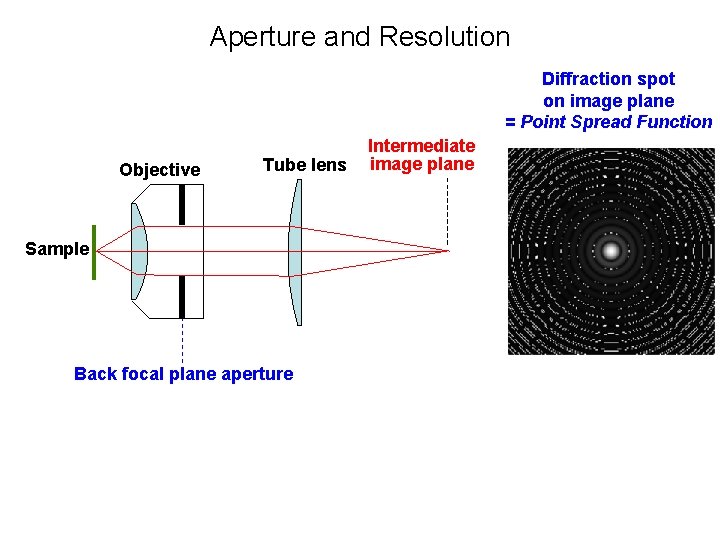
Aperture and Resolution Diffraction spot on image plane = Point Spread Function Objective Tube lens Sample Back focal plane aperture Intermediate image plane
Aperture and Resolution Diffraction spot on image plane = Point Spread Function Objective Tube lens Sample Back focal plane aperture Intermediate image plane
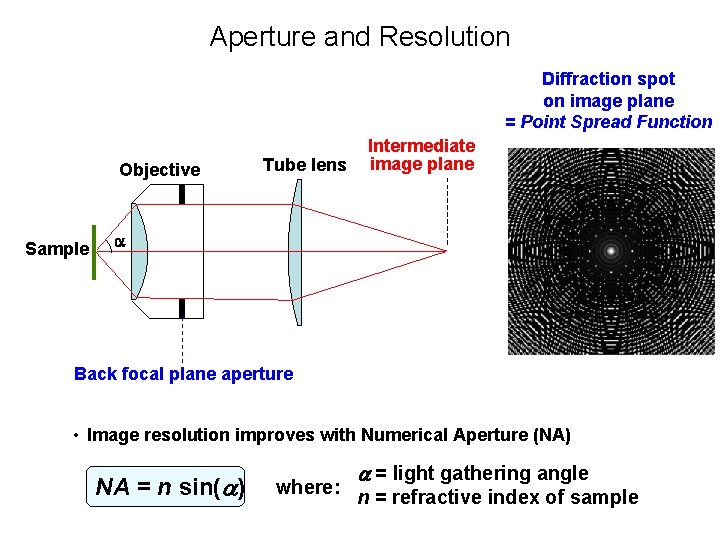
Aperture and Resolution Diffraction spot on image plane = Point Spread Function Objective Sample Tube lens Intermediate image plane Back focal plane aperture • Image resolution improves with Numerical Aperture (NA) NA = n sin( ) where: = light gathering angle n = refractive index of sample
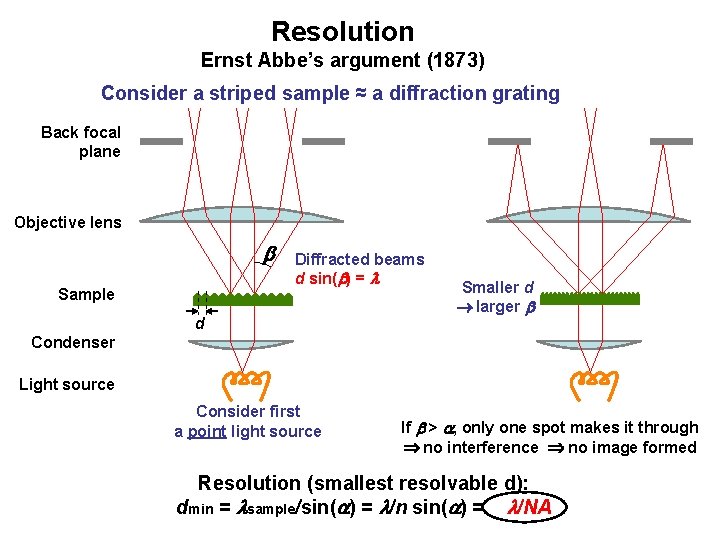
Resolution Ernst Abbe’s argument (1873) Consider a striped sample ≈ a diffraction grating Back focal plane Objective lens b Sample Diffracted beams d sin(b) = d Smaller d larger b Condenser Light source Consider first a point light source If b > , only one spot makes it through no interference no image formed Resolution (smallest resolvable d): dmin = sample/sin( ) = /n sin( ) = /NA
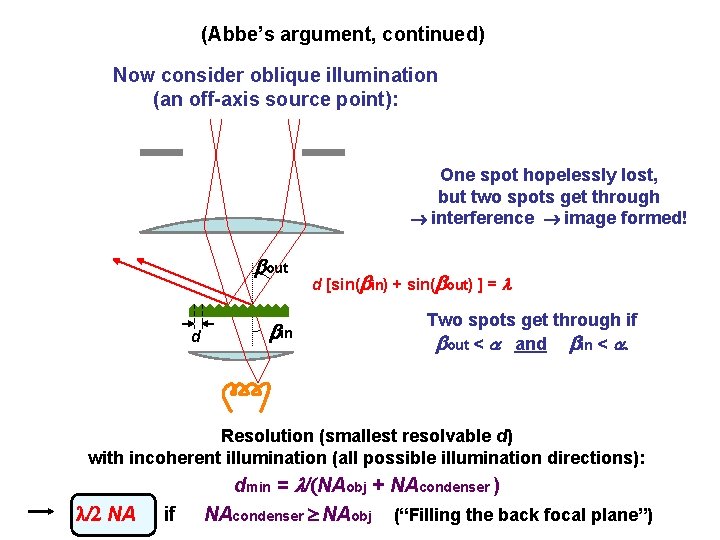
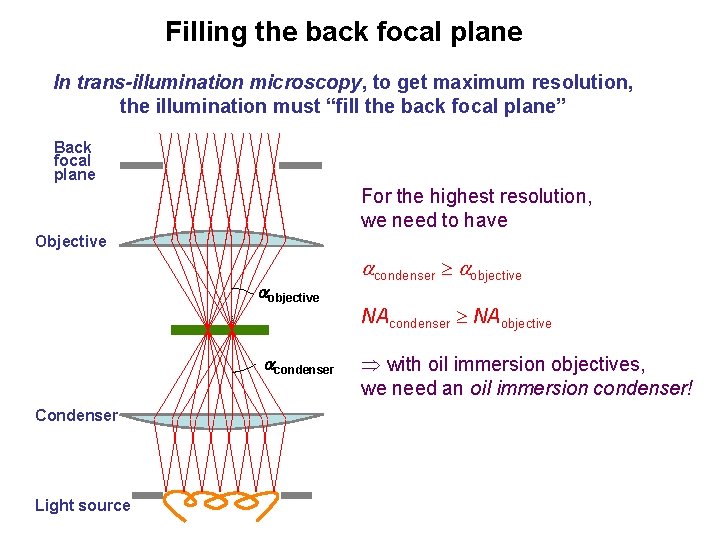
(Abbe’s argument, continued) Now consider oblique illumination (an off-axis source point): One spot hopelessly lost, but two spots get through interference image formed! bout d bin d [sin(bin) + sin(bout) ] = Two spots get through if bout < and bin < . Resolution (smallest resolvable d) with incoherent illumination (all possible illumination directions): l/2 NA if dmin = /(NAobj + NAcondenser ) NAcondenser NAobj (“Filling the back focal plane”)
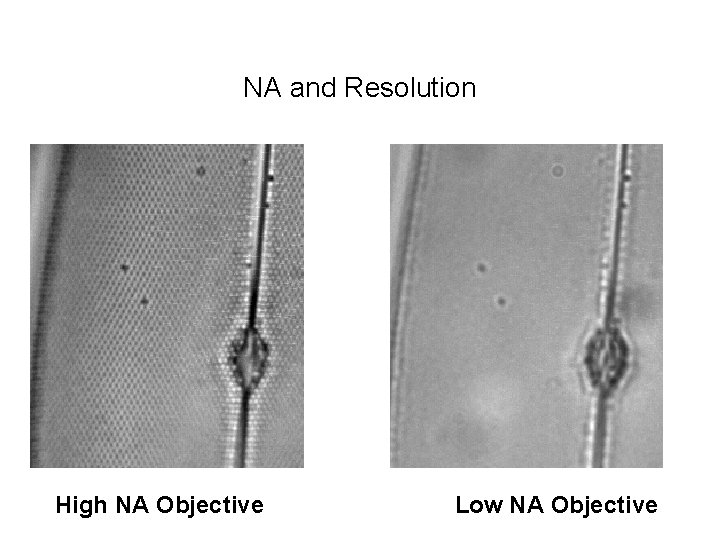
NA and Resolution High NA Objective Low NA Objective
Filling the back focal plane In trans-illumination microscopy, to get maximum resolution, the illumination must “fill the back focal plane” Back focal plane For the highest resolution, we need to have Objective objective condenser Condenser Light source condenser objective NAcondenser NAobjective Þ with oil immersion objectives, we need an oil immersion condenser!
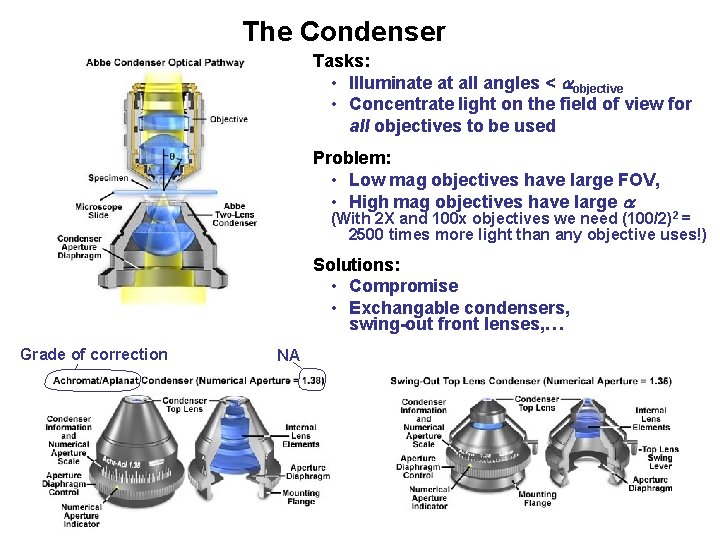
The Condenser Tasks: • Illuminate at all angles < objective • Concentrate light on the field of view for all objectives to be used Problem: • Low mag objectives have large FOV, • High mag objectives have large (With 2 X and 100 x objectives we need (100/2)2 = 2500 times more light than any objective uses!) Solutions: • Compromise • Exchangable condensers, swing-out front lenses, … Grade of correction NA
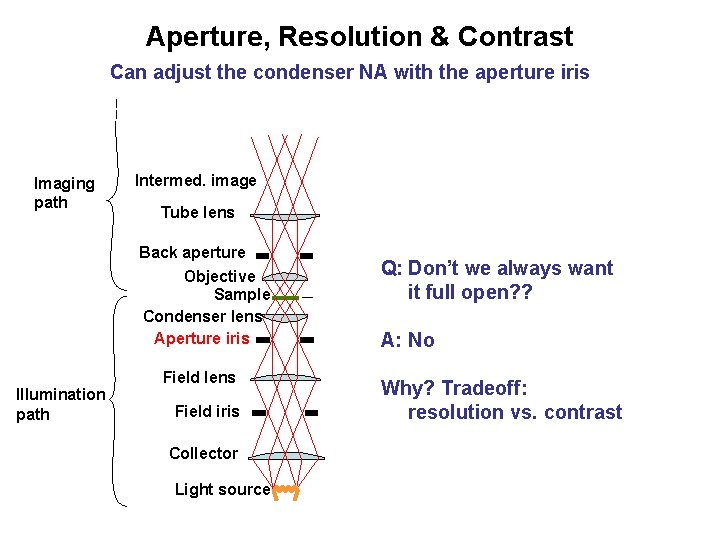
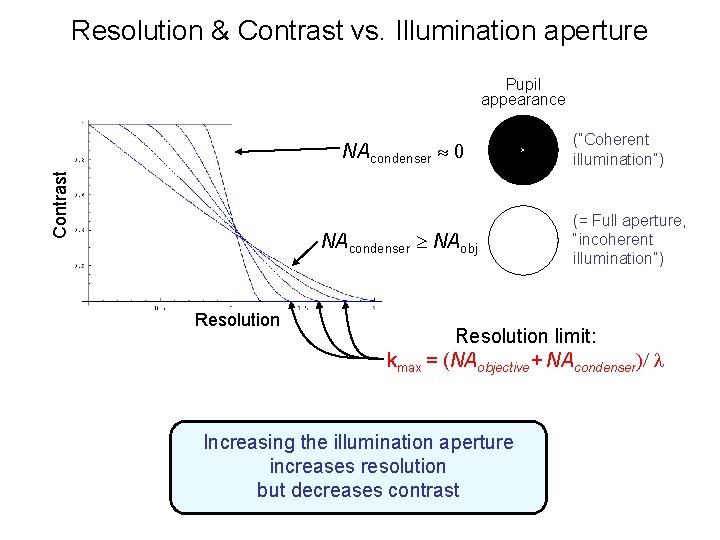
Aperture, Resolution & Contrast Can adjust the condenser NA with the aperture iris Imaging path Intermed. image Tube lens Back aperture Objective Sample Condenser lens Aperture iris Illumination path Field lens Field iris Collector Light source Q: Don’t we always want it full open? ? A: No Why? Tradeoff: resolution vs. contrast
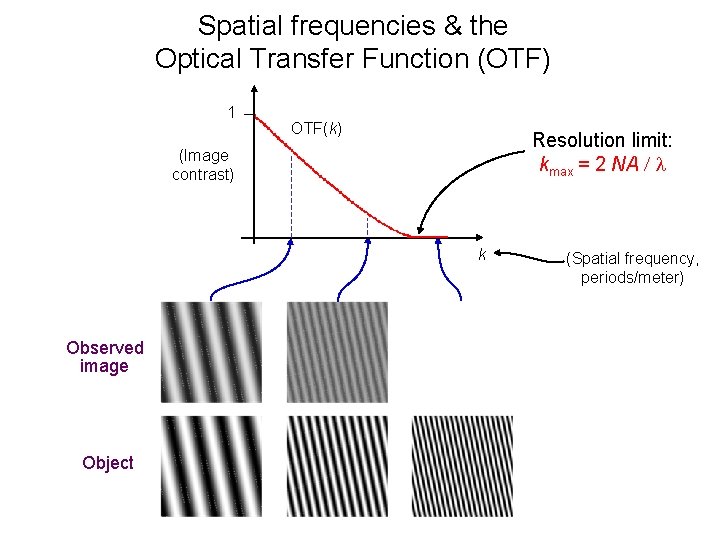
Spatial frequencies & the Optical Transfer Function (OTF) 1 OTF(k) Resolution limit: kmax = 2 NA / l (Image contrast) k Observed image Object (Spatial frequency, periods/meter)
Resolution & Contrast vs. Illumination aperture Pupil appearance Contrast NAcondenser 0 NAcondenser NAobj Resolution (“Coherent illumination”) (= Full aperture, “incoherent illumination”) Resolution limit: kmax = (NAobjective+ NAcondenser)/ l Increasing the illumination aperture increases resolution but decreases contrast
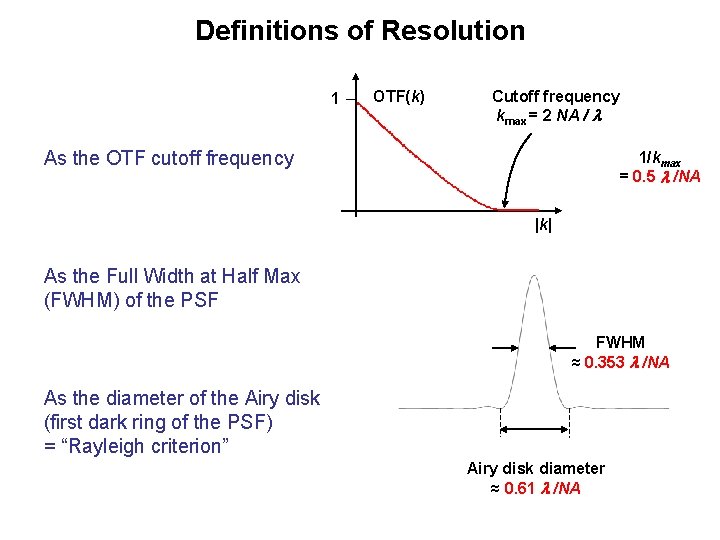
Definitions of Resolution 1 OTF(k) Cutoff frequency kmax = 2 NA / As the OTF cutoff frequency 1/kmax = 0. 5 /NA |k| As the Full Width at Half Max (FWHM) of the PSF FWHM ≈ 0. 353 /NA As the diameter of the Airy disk (first dark ring of the PSF) = “Rayleigh criterion” Airy disk diameter ≈ 0. 61 /NA
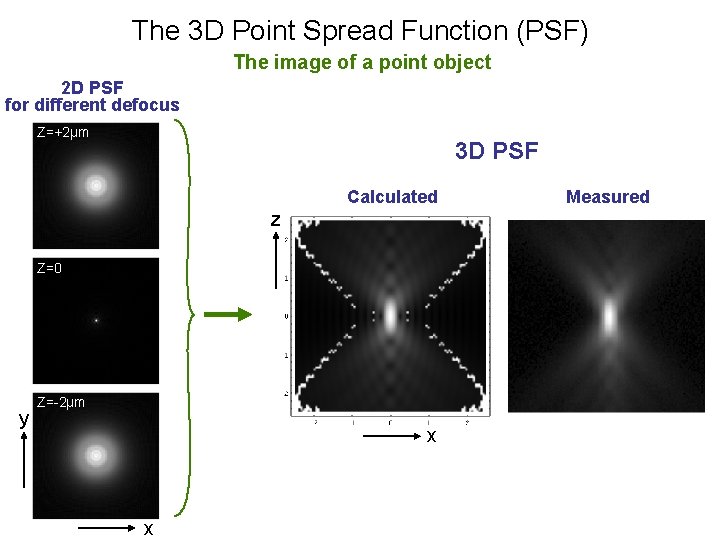
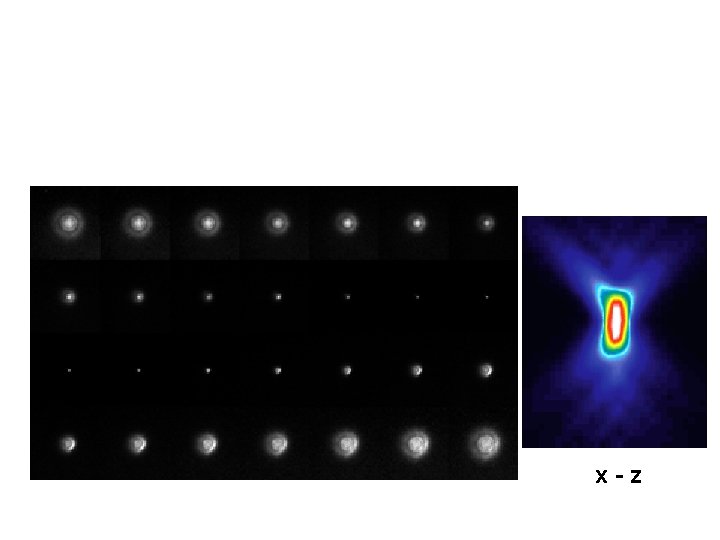
The 3 D Point Spread Function (PSF) The image of a point object 2 D PSF for different defocus Z=+2µm 3 D PSF Calculated z Z=0 y Z=-2µm x x Measured
x-z
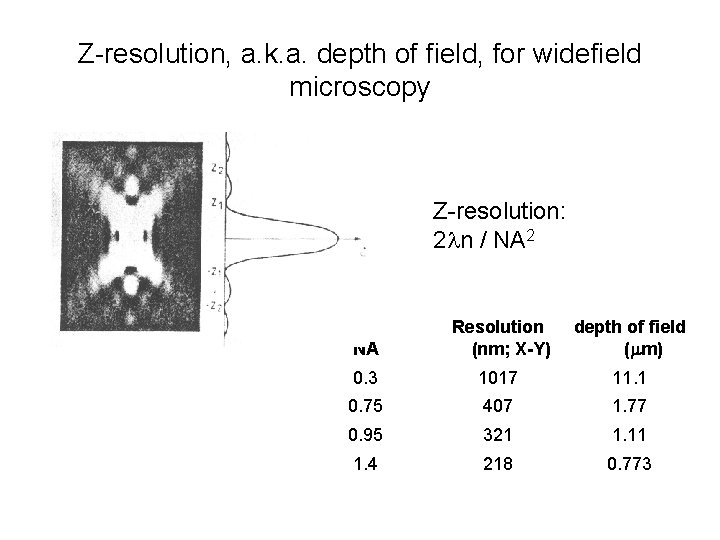
Z-resolution, a. k. a. depth of field, for widefield microscopy Z-resolution: 2 ln / NA 2 NA Resolution (nm; X-Y) depth of field (mm) 0. 3 1017 11. 1 0. 75 407 1. 77 0. 95 321 1. 11 1. 4 218 0. 773
Summary: Numerical Aperture and Resolution • Numerical aperture, not magnification, sets the smallest details you can resolve in an image • Increasing NA also increases the amount of light collected by the lens, thereby increasing the brightness of the image – this scales as NA 2
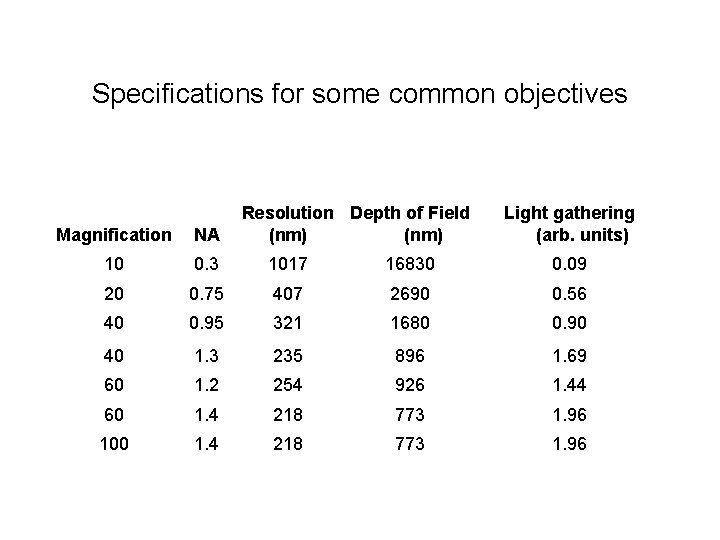
Specifications for some common objectives Resolution Depth of Field (nm) Light gathering (arb. units) Magnification NA 10 0. 3 1017 16830 0. 09 20 0. 75 407 2690 0. 56 40 0. 95 321 1680 0. 90 40 1. 3 235 896 1. 69 60 1. 2 254 926 1. 44 60 1. 4 218 773 1. 96 100 1. 4 218 773 1. 96
Aberrations They are the enemy
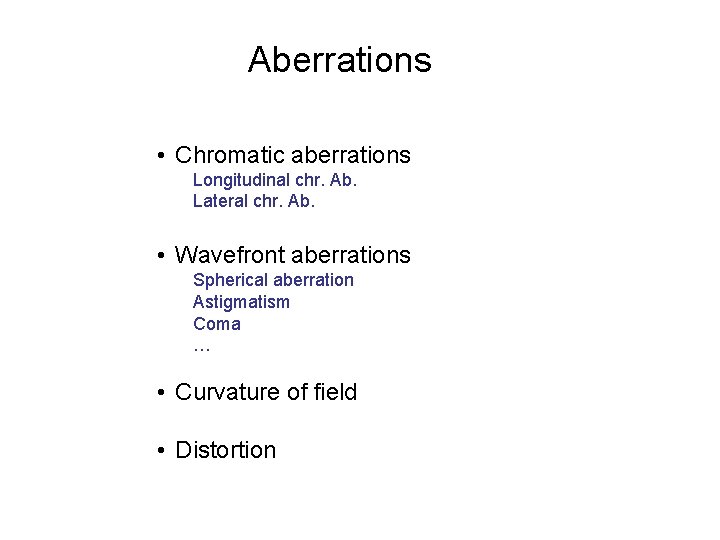
Aberrations • Chromatic aberrations Longitudinal chr. Ab. Lateral chr. Ab. • Wavefront aberrations Spherical aberration Astigmatism Coma … • Curvature of field • Distortion
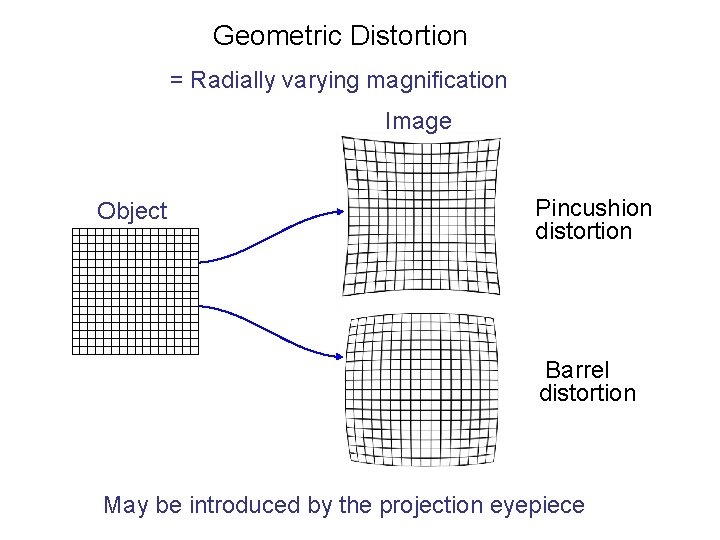
Geometric Distortion = Radially varying magnification Image Object Pincushion distortion Barrel distortion May be introduced by the projection eyepiece
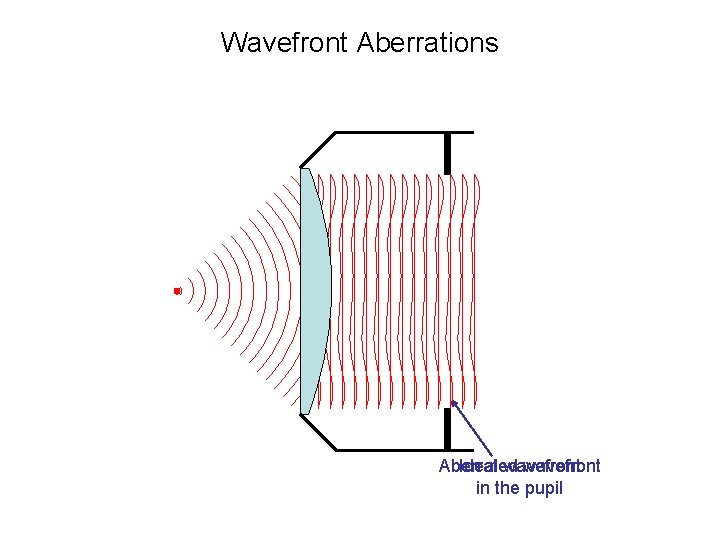
Wavefront Aberrations Aberrated Ideal wavefront in the pupil
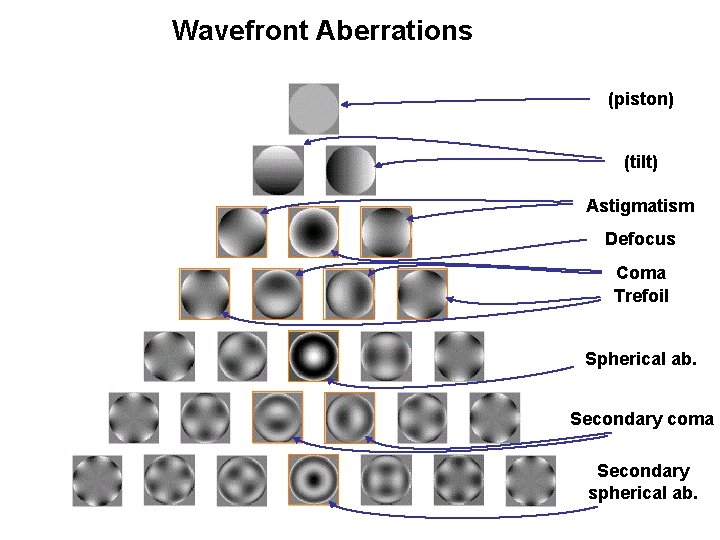
Wavefront Aberrations (piston) (tilt) Astigmatism Defocus Coma Trefoil Spherical ab. Secondary coma Secondary spherical ab.
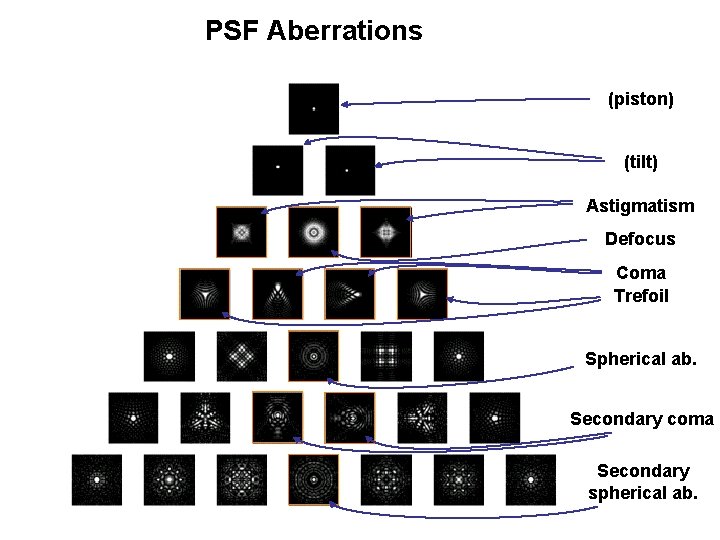
PSF Aberrations (piston) (tilt) Astigmatism Defocus Coma Trefoil Spherical ab. Secondary coma Secondary spherical ab.
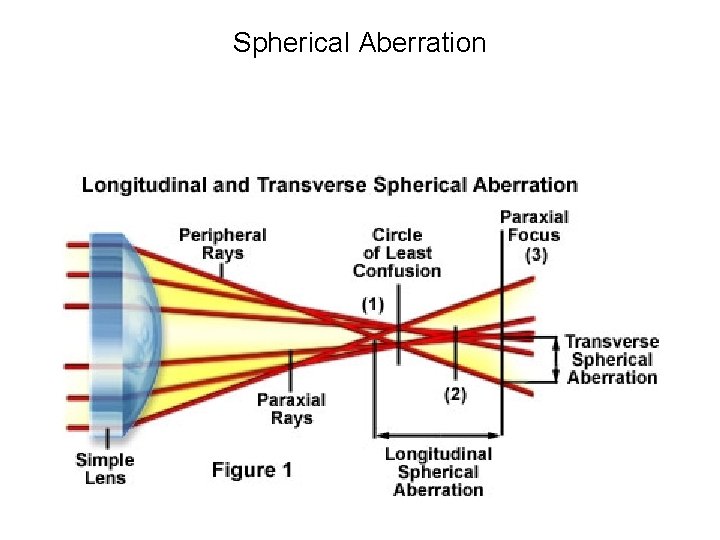
Spherical Aberration
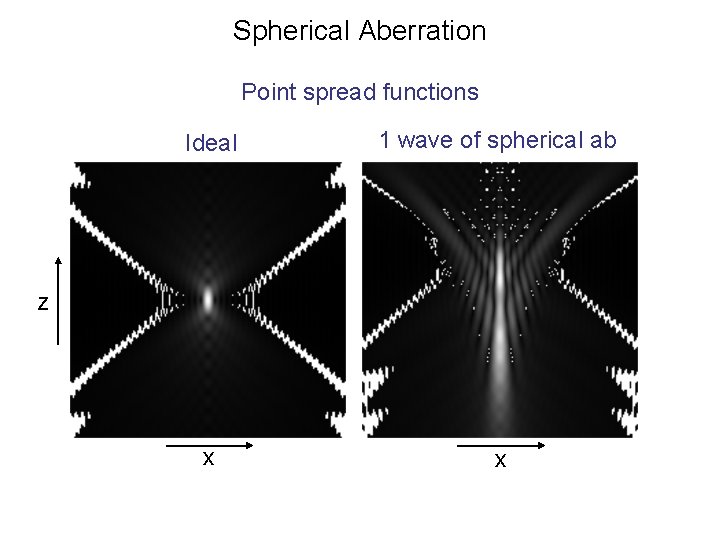
Spherical Aberration Point spread functions Ideal 1 wave of spherical ab x x z
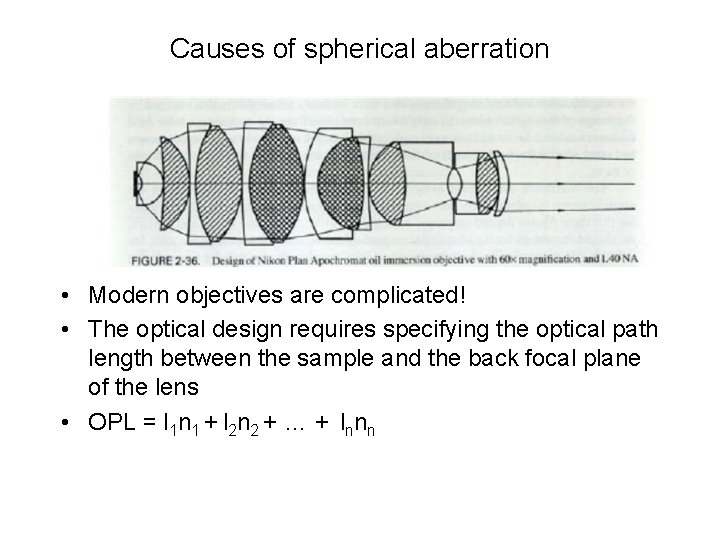
Causes of spherical aberration • Modern objectives are complicated! • The optical design requires specifying the optical path length between the sample and the back focal plane of the lens • OPL = l 1 n 1 + l 2 n 2 + … + lnnn
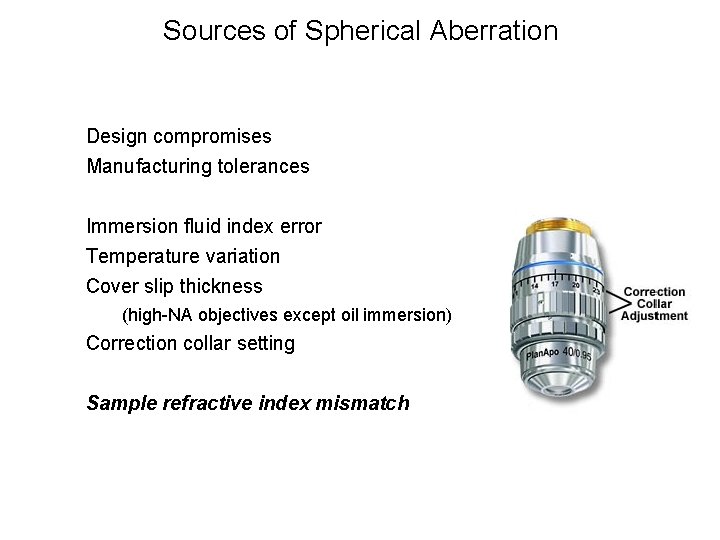
Sources of Spherical Aberration Design compromises Manufacturing tolerances Immersion fluid index error Temperature variation Cover slip thickness (high-NA objectives except oil immersion) Correction collar setting Sample refractive index mismatch
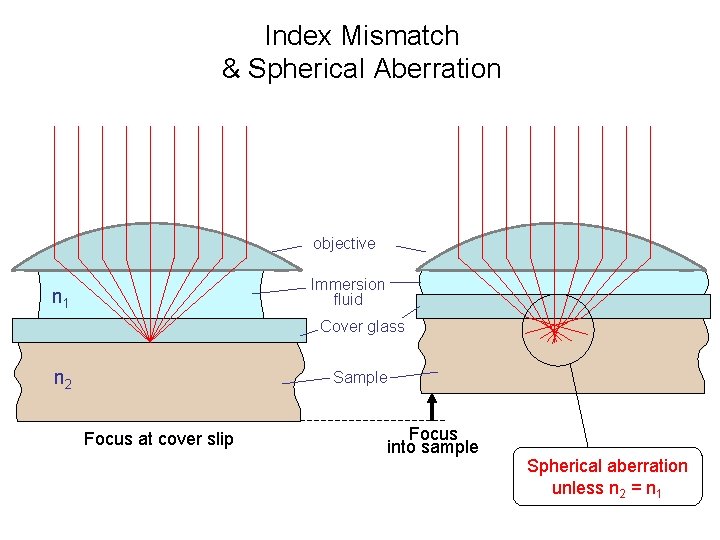
Index Mismatch & Spherical Aberration objective Immersion fluid n 1 Cover glass n 2 Sample Focus at cover slip Focus into sample Spherical aberration unless n 2 = n 1
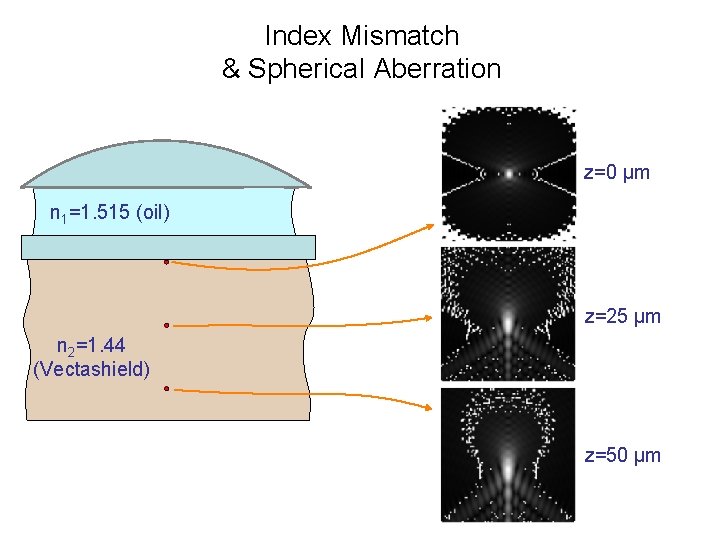
Index Mismatch & Spherical Aberration z=0 µm n 1=1. 515 (oil) z=25 µm n 2=1. 44 (Vectashield) z=50 µm
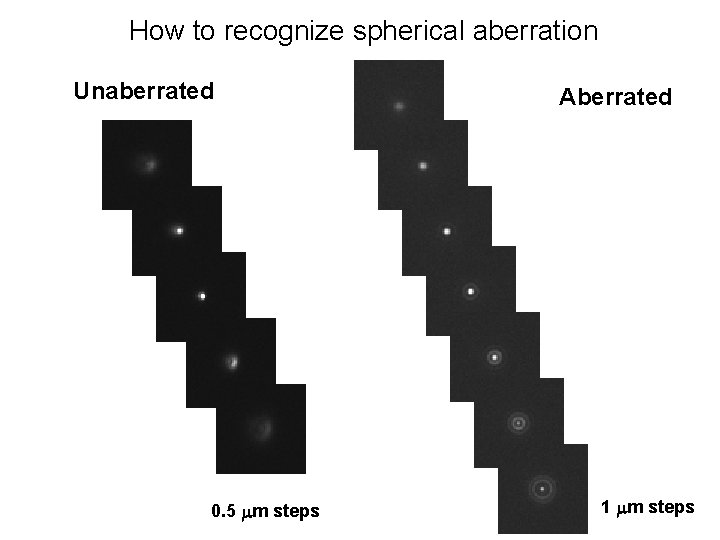
How to recognize spherical aberration Unaberrated 0. 5 mm steps Aberrated 1 mm steps
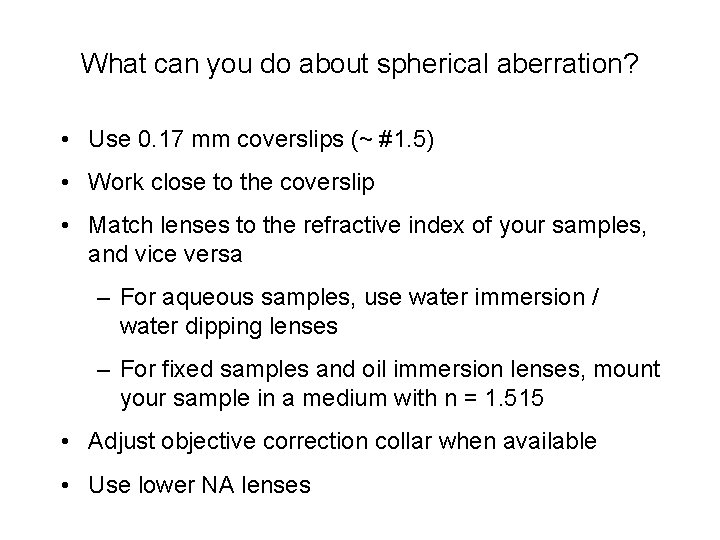
What can you do about spherical aberration? • Use 0. 17 mm coverslips (~ #1. 5) • Work close to the coverslip • Match lenses to the refractive index of your samples, and vice versa – For aqueous samples, use water immersion / water dipping lenses – For fixed samples and oil immersion lenses, mount your sample in a medium with n = 1. 515 • Adjust objective correction collar when available • Use lower NA lenses
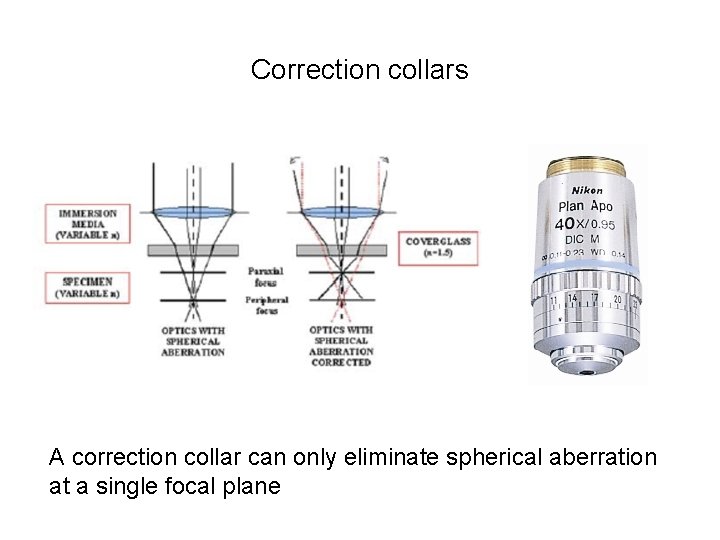
Correction collars A correction collar can only eliminate spherical aberration at a single focal plane
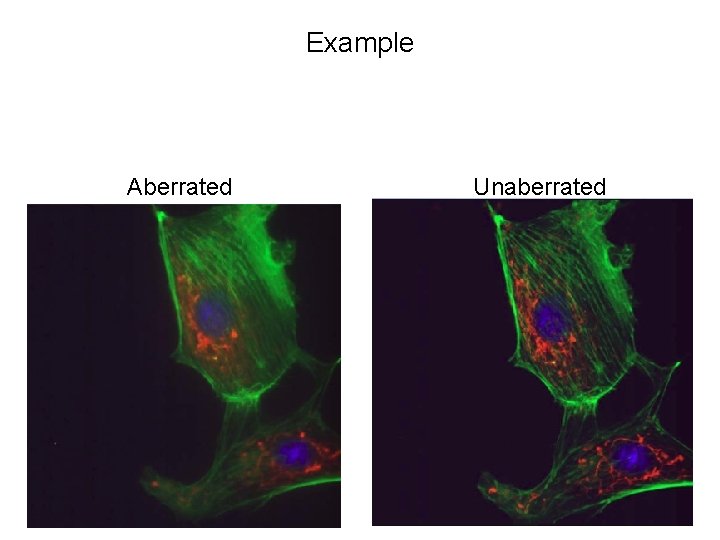
Example Aberrated Unaberrated
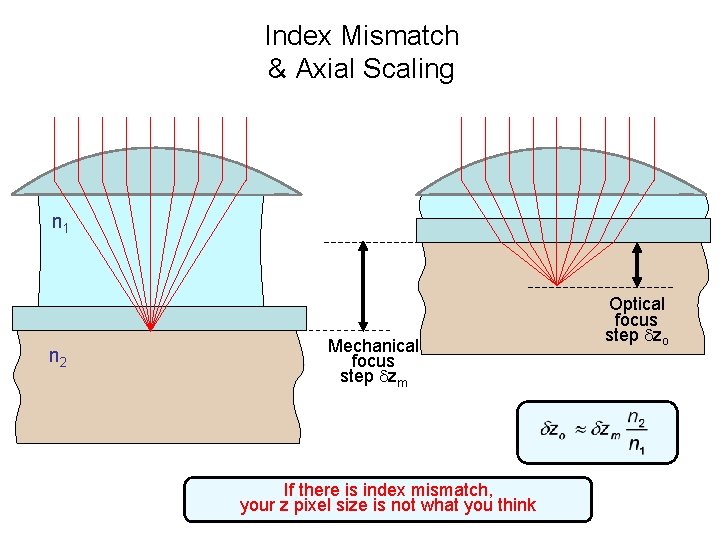
Index Mismatch & Axial Scaling n 1 n 2 Mechanical focus step zm If there is index mismatch, your z pixel size is not what you think Optical focus step zo
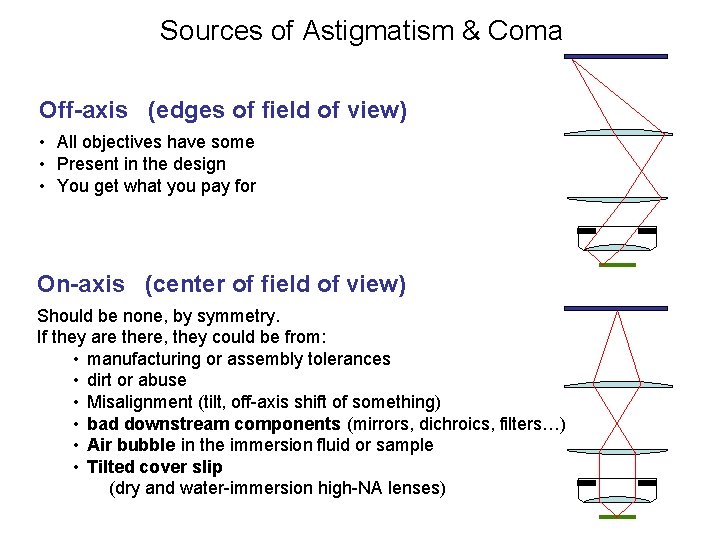
Sources of Astigmatism & Coma Off-axis (edges of field of view) • All objectives have some • Present in the design • You get what you pay for On-axis (center of field of view) Should be none, by symmetry. If they are there, they could be from: • manufacturing or assembly tolerances • dirt or abuse • Misalignment (tilt, off-axis shift of something) • bad downstream components (mirrors, dichroics, filters…) • Air bubble in the immersion fluid or sample • Tilted cover slip (dry and water-immersion high-NA lenses)
More about Spatial frequencies & the Optical Transfer Function (OTF)
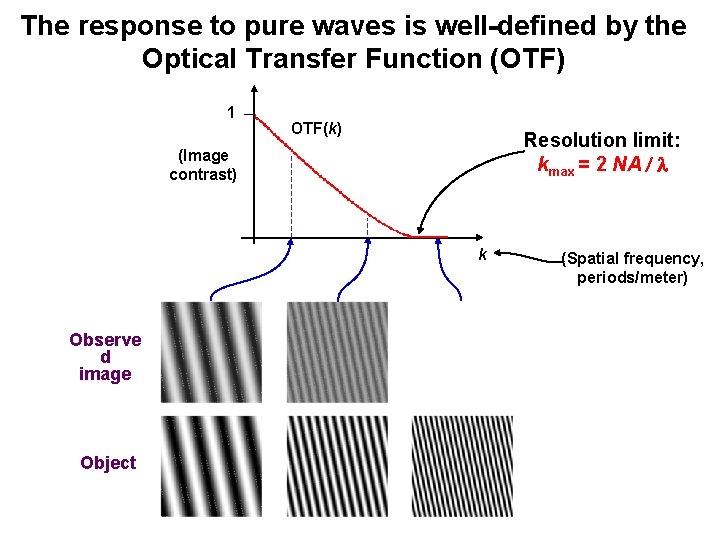
The response to pure waves is well-defined by the Optical Transfer Function (OTF) 1 OTF(k) Resolution limit: kmax = 2 NA / l (Image contrast) k Observe d image Object (Spatial frequency, periods/meter)
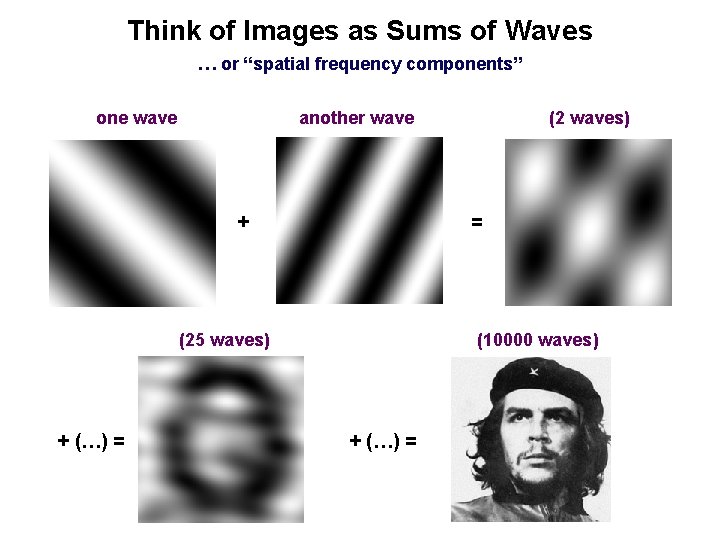
Think of Images as Sums of Waves … or “spatial frequency components” one wave another wave + = (25 waves) + (…) = (2 waves) (10000 waves) + (…) =
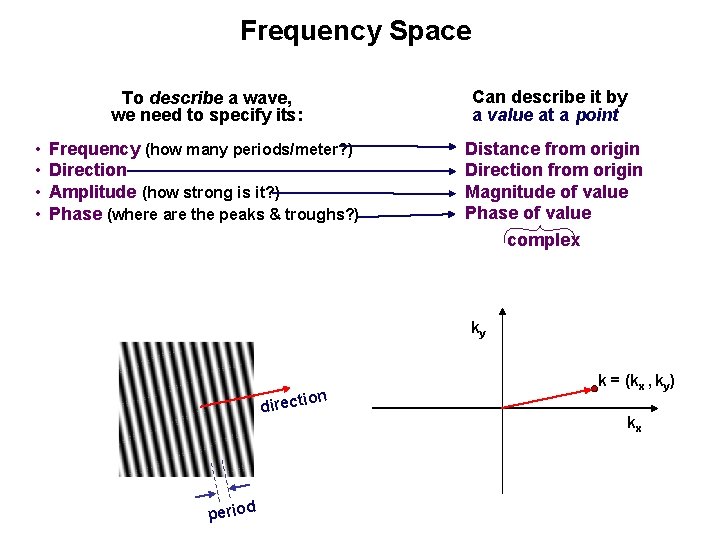
Frequency Space • • To describe a wave, we need to specify its: Can describe it by a value at a point Frequency (how many periods/meter? ) Direction Amplitude (how strong is it? ) Phase (where are the peaks & troughs? ) Distance from origin Direction from origin Magnitude of value Phase of value complex ky direct period ion k = (kx , ky) kx
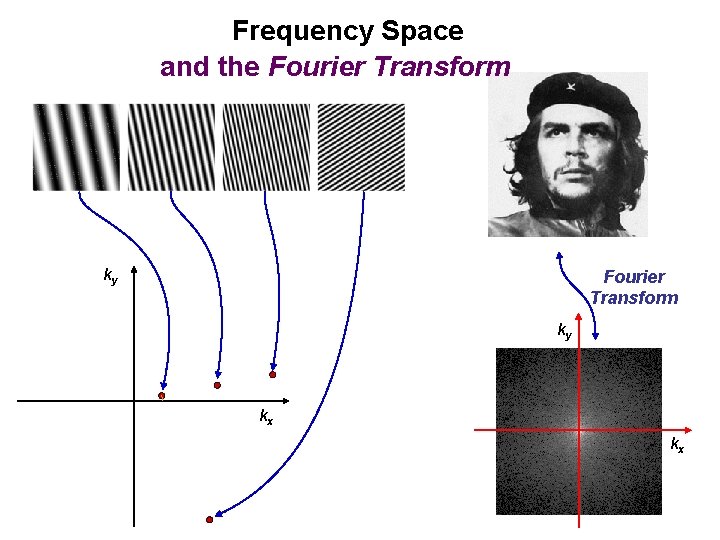
Frequency Space and the Fourier Transform ky kx kx
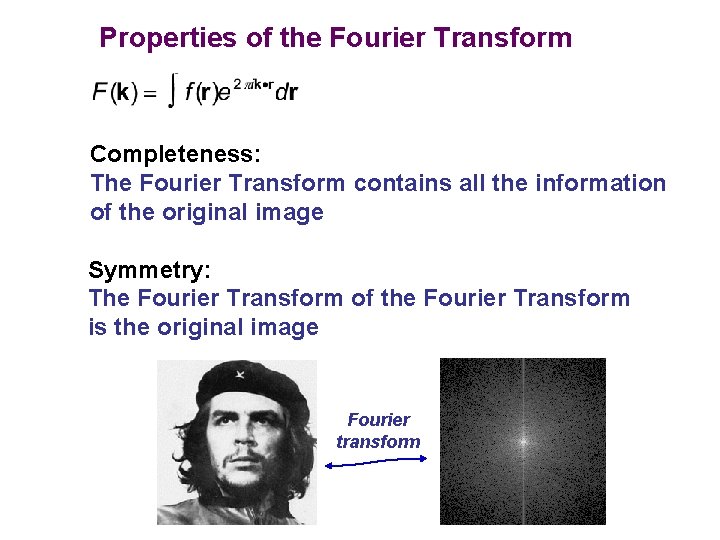
Properties of the Fourier Transform Completeness: The Fourier Transform contains all the information of the original image Symmetry: The Fourier Transform of the Fourier Transform is the original image Fourier transform
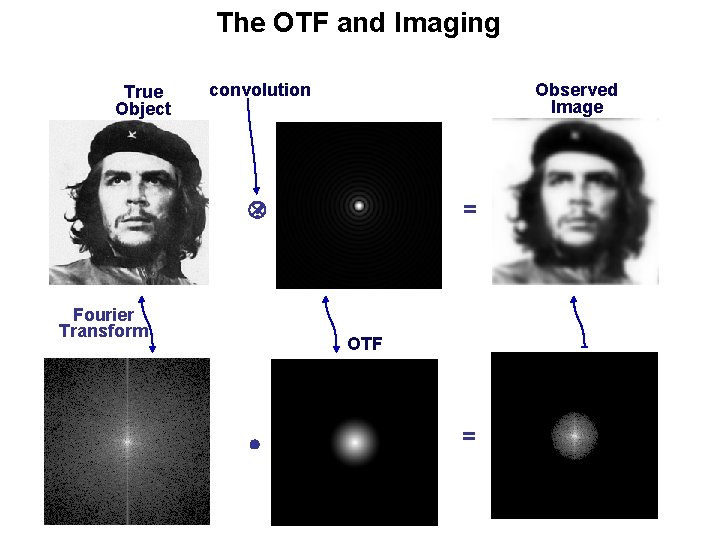
The OTF and Imaging True Object Observed Image convolution ? Fourier Transform ? = OTF =
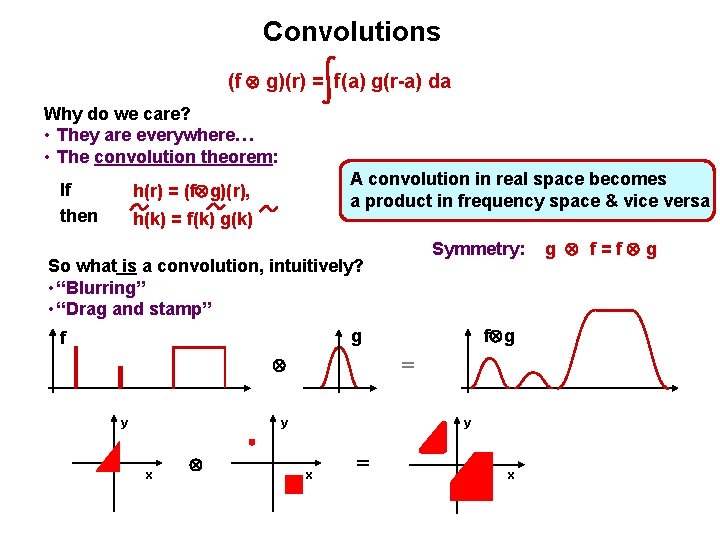
Convolutions (f g)(r) = f(a) g(r-a) da Why do we care? • They are everywhere… • The convolution theorem: If then A convolution in real space becomes a product in frequency space & vice versa h(r) = (f g)(r), h(k) = f(k) g(k) Symmetry: So what is a convolution, intuitively? • “Blurring” • “Drag and stamp” g f = y y x f g y x = x g f=f g
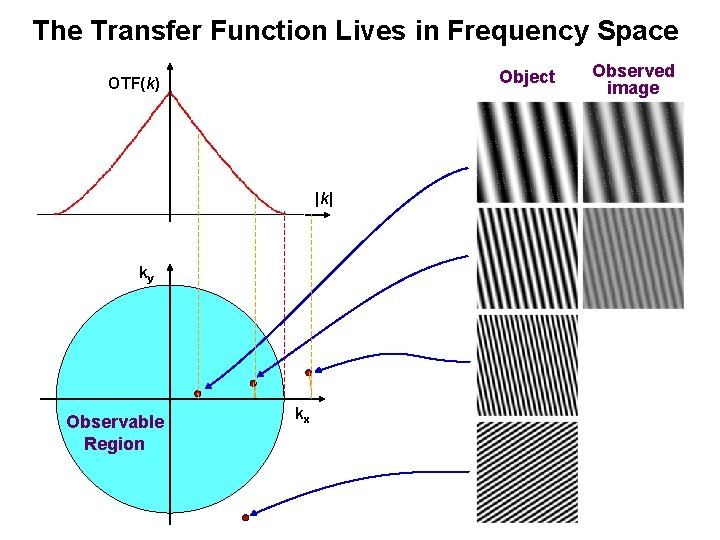
The Transfer Function Lives in Frequency Space Object OTF(k) |k| ky Observable Region kx Observed image
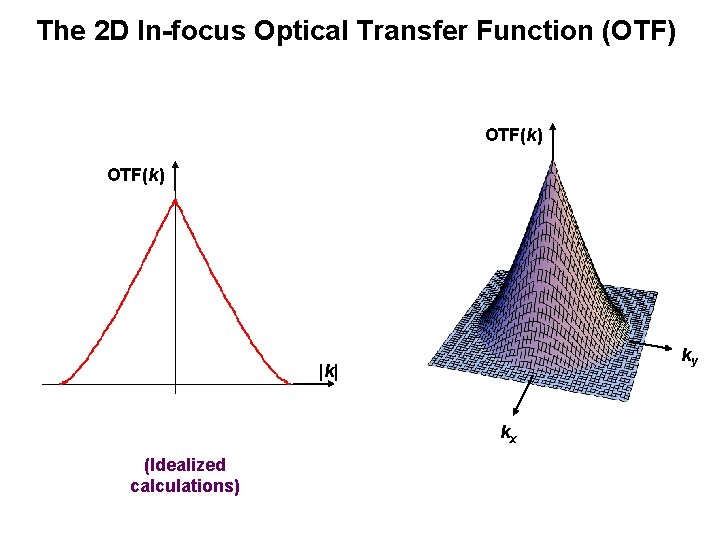
The 2 D In-focus Optical Transfer Function (OTF) OTF(k) ky |k| kx (Idealized calculations)
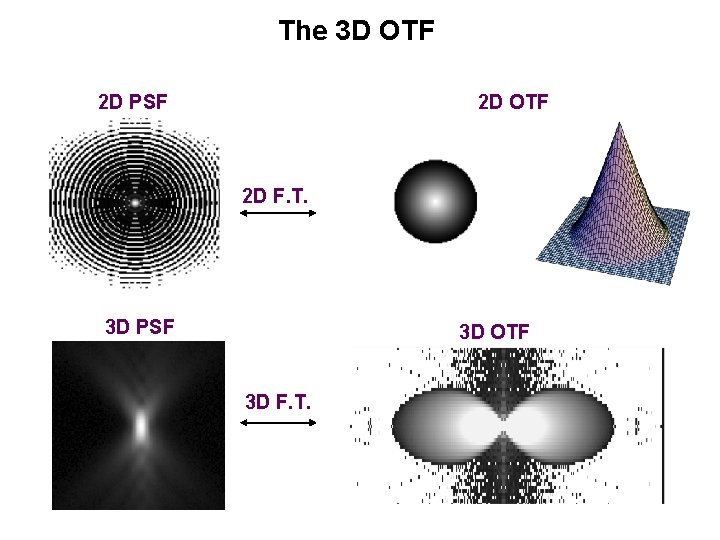
The 3 D OTF 2 D PSF 2 D OTF 2 D F. T. 3 D PSF 3 D OTF 3 D F. T. ? ?
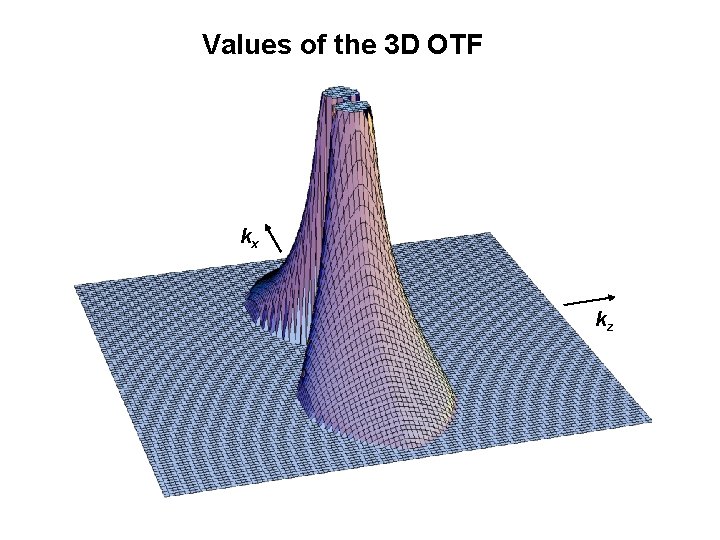
Values of the 3 D OTF kx kz
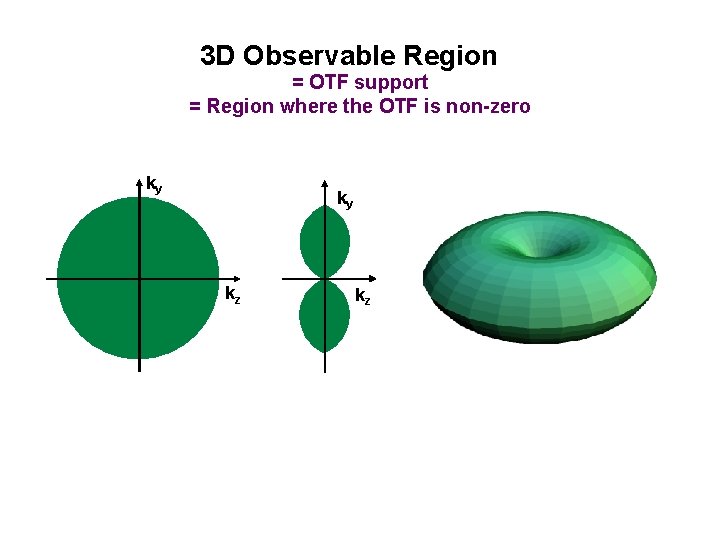
3 D Observable Region = OTF support = Region where the OTF is non-zero ky ky kz kz
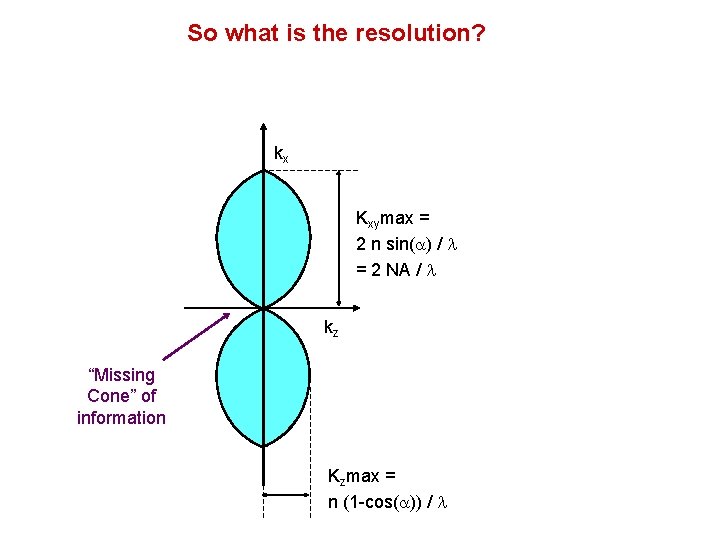
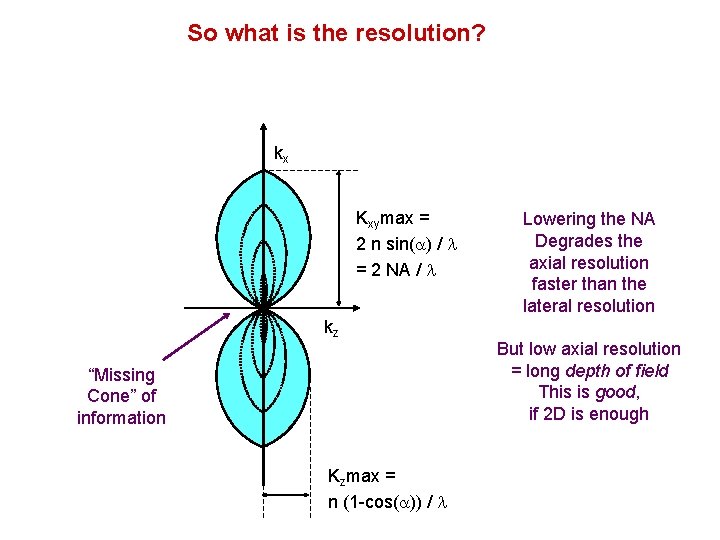
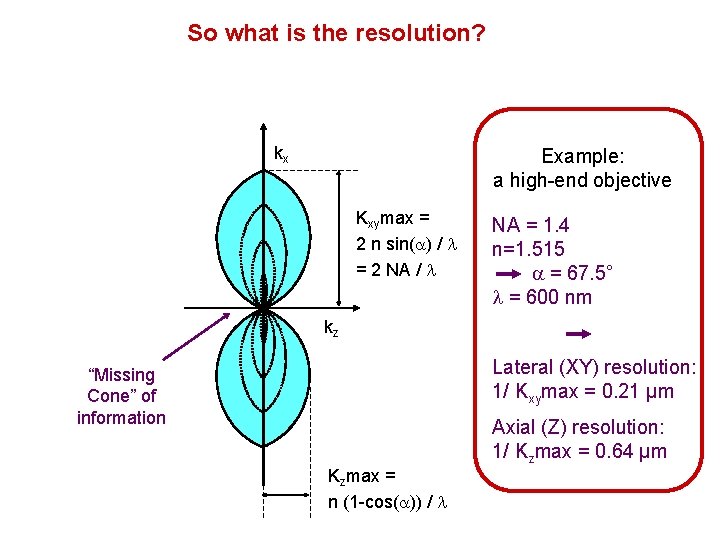
So what is the resolution? kx Kxymax = 2 n sin(a) / l = 2 NA / l kz “Missing Cone” of information Kzmax = n (1 -cos(a)) / l
So what is the resolution? kx Kxymax = 2 n sin(a) / l = 2 NA / l kz “Missing Cone” of information Kzmax = n (1 -cos(a)) / l Lowering the NA Degrades the axial resolution faster than the lateral resolution But low axial resolution = long depth of field This is good, if 2 D is enough
So what is the resolution? kx Example: a high-end objective Kxymax = 2 n sin(a) / l = 2 NA / l NA = 1. 4 n=1. 515 a = 67. 5° l = 600 nm kz Lateral (XY) resolution: 1/ Kxymax = 0. 21 µm “Missing Cone” of information Axial (Z) resolution: 1/ Kzmax = 0. 64 µm Kzmax = n (1 -cos(a)) / l
Nomenclature • Optical Transfer Function, OTF Complex value with amplitude and phase • Contrast Transfer Function, CTF • Modulation Transfer Function, MTF Same thing without the phase information
Resources Slides available at: http: //nic. ucsf. edu/edu. html http: //www. microscopyu. com http: //micro. magnet. fsu. edu Douglas B. Murphy “Fundamentals of Light Microscopy and Electronic Imaging” James Pawley, Ed. “Handbook of Biological Confocal Microscopy, 3 rd ed. ” Acknowledgements Steve Ross, Mats Gustafsson