
Principles of tympanoplasty By Dr Supreet Singh Nayyar
Principles of tympanoplasty By : Dr. Supreet Singh Nayyar, AFMC For more presentations , visit www. nayyar. ENT. com Tuesday, July 17, 2012 1
Layout � History & evolution of middle ear surgery � Definition of tympanoplasty � The transformer mechanism in health and disease � Functional considerations of tympanoplasty � Classification � Principles of tympanoplasty surgery � Basics of ossiculoplasty � Reporting protocols � Pediatric tympanoplasty � Recent advances www. nayyar. ENT. com Tuesday, July 17, 2012 2
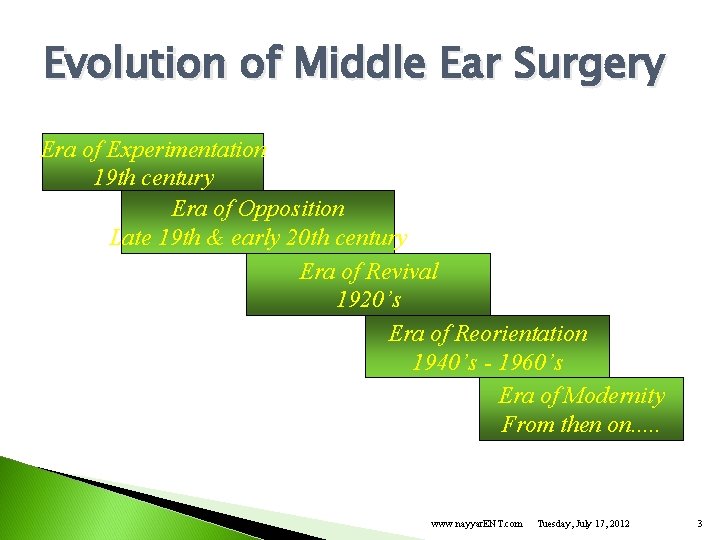
Evolution of Middle Ear Surgery Era of Experimentation 19 th century Era of Opposition Late 19 th & early 20 th century Era of Revival 1920’s Era of Reorientation 1940’s - 1960’s Era of Modernity From then on. . . www. nayyar. ENT. com Tuesday, July 17, 2012 3

Acoustic transformer mechanism Ossicular coupling Hydraulic lever Ossicular lever Catenary lever Acoustic coupling www. nayyar. ENT. com Tuesday, July 17, 2012 4

Transformer in Diseased State Effect on Ossicular coupling Ossicular Discontinuity Ossicular Fixity Effect on Acoustic coupling Loss of Round Window shielding Effect of Stapes, Cochlear & RW Impedance Middle ear aeration / fluid www. nayyar. ENT. com Tuesday, July 17, 2012 5

Definition of Tympanoplasty “ Procedure to eradicate disease in the middle ear & to reconstruct the hearing mechanism with/without TM (tympanic membrane) grafting ”* * 1965 - American Academy of Ophthalmology & Otolaryngology Subcommittee on Conservation of Hearing www. nayyar. ENT. com Tuesday, July 17, 2012 6
Goals of Surgery To establish intact tympanic membrane Eradication of middle ear disease & create an air containing middle ear space Restore hearing by building a secure connection between the tympanic membrane & cochlea www. nayyar. ENT. com Tuesday, July 17, 2012 7
Techniques Minimalistic techniques ◦ Cauterization & fat plug ◦ Cauterization with trichloroacetic acid ◦ Sealed tympanostomy tubes Formal Tympanoplasty www. nayyar. ENT. com Tuesday, July 17, 2012 8
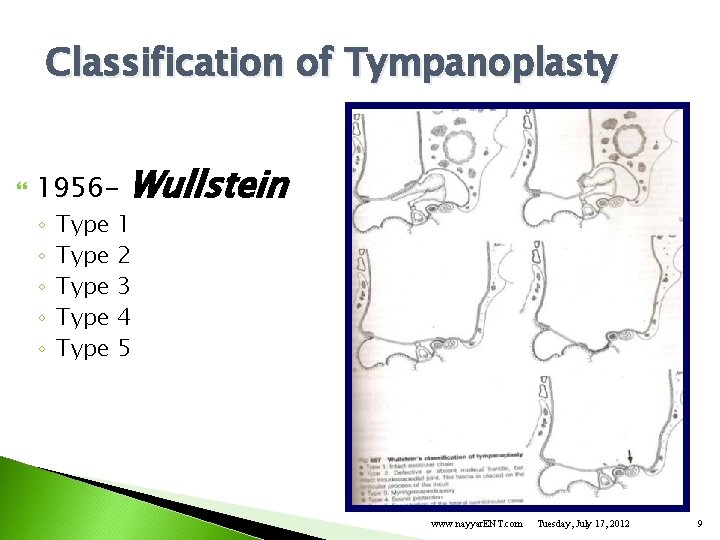
Classification of Tympanoplasty 1956◦ ◦ ◦ Type Type Wullstein 1 2 3 4 5 www. nayyar. ENT. com Tuesday, July 17, 2012 9

Classification of Tympanoplasty Mirko Tos ◦ 1 - Intact chain ◦ 2 – Short columella ◦ 3 – Long columella ◦ 4 - Sound protection ◦ 5 A - Fenestration of LSCC ◦ 5 B - Platinectomy www. nayyar. ENT. com Tuesday, July 17, 2012 10
Indications � Conductive hearing loss due to TM perforation or ossicular dysfunction � Chronic or recurrent otitis media � Progressive hearing loss due to chronic middle ear pathology � Perforation or hearing loss persistent for more than three months due to trauma, infection or surgery � Inability to bathe or participate in water sport activities (Arun Gadre, Christopher Muller, University of Texas Branch, Texas) www. nayyar. ENT. com Tuesday, July 17, 2012 11
Contraindications Absolute Relative (Glasscock 1976 / Shambaug) Uncontrolled cholesteatoma Malignant tumors Unusual infections Intracranial complications Eustachian tube dysfunction / OME in other ear Dead ear Only hearing ear Elderly patient Very young children Repeated failures Uncooperative patients www. nayyar. ENT. com Tuesday, July 17, 2012 12
Preoperative Evaluation Extent & location of perforation Ossicular status Counseling ◦ ◦ Nature of disease Treatment options Outcomes of surgical options Post op morbidity – restriction of water activities, hearing deterioration www. nayyar. ENT. com Tuesday, July 17, 2012 13

Approach Transcanal Endaural Postaural ◦ Posterior moderate sized perforations ◦ Favorable EAC anatomy ◦ Visualisation of annulus & ant sulcus is difficult ◦ Limited atticotomy ◦ All perforation sizes ◦ Better angle of visualisation ◦ Second look ossiculoplasty www. nayyar. ENT. com Tuesday, July 17, 2012 14
Graft Placement Lateral / Overlay Medial / Underlay Over-Underlay www. nayyar. ENT. com Tuesday, July 17, 2012 15
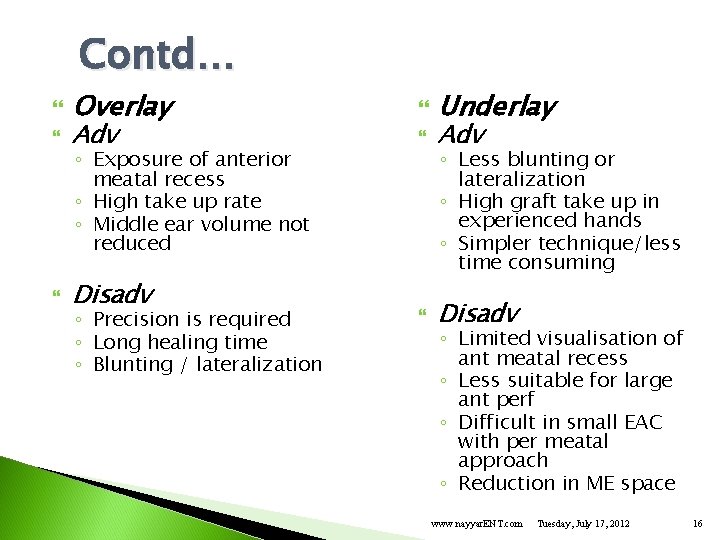
Contd… Overlay Adv Disadv ◦ Exposure of anterior meatal recess ◦ High take up rate ◦ Middle ear volume not reduced ◦ Precision is required ◦ Long healing time ◦ Blunting / lateralization Underlay Adv Disadv ◦ Less blunting or lateralization ◦ High graft take up in experienced hands ◦ Simpler technique/less time consuming ◦ Limited visualisation of ant meatal recess ◦ Less suitable for large ant perf ◦ Difficult in small EAC with per meatal approach ◦ Reduction in ME space www. nayyar. ENT. com Tuesday, July 17, 2012 16
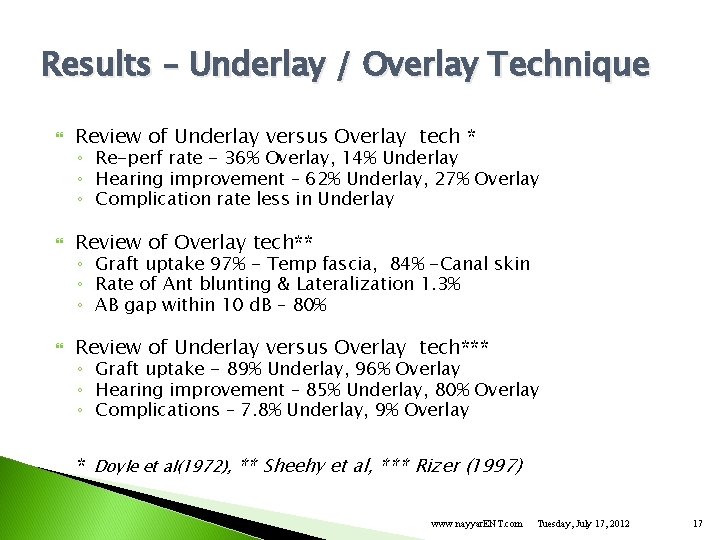
Results – Underlay / Overlay Technique Review of Underlay versus Overlay tech * Review of Overlay tech** Review of Underlay versus Overlay tech*** ◦ Re-perf rate - 36% Overlay, 14% Underlay ◦ Hearing improvement – 62% Underlay, 27% Overlay ◦ Complication rate less in Underlay ◦ Graft uptake 97% - Temp fascia, 84% -Canal skin ◦ Rate of Ant blunting & Lateralization 1. 3% ◦ AB gap within 10 d. B – 80% ◦ Graft uptake - 89% Underlay, 96% Overlay ◦ Hearing improvement – 85% Underlay, 80% Overlay ◦ Complications – 7. 8% Underlay, 9% Overlay * Doyle et al(1972), ** Sheehy et al, *** Rizer (1997) www. nayyar. ENT. com Tuesday, July 17, 2012 17
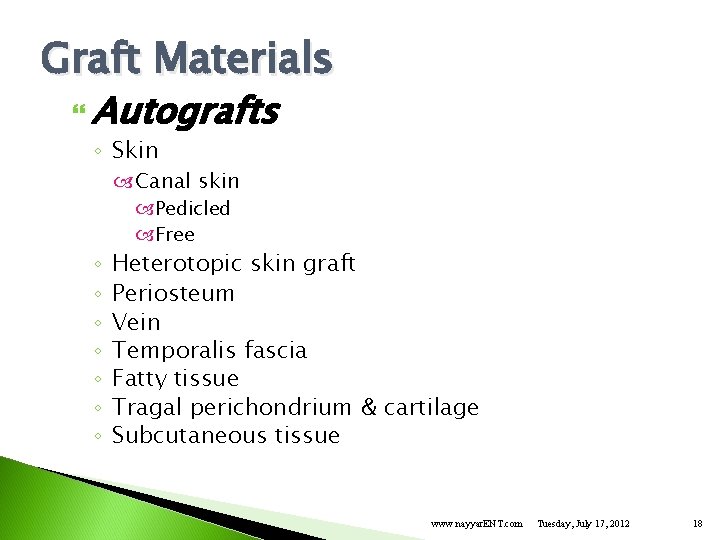
Graft Materials Autografts ◦ Skin Canal skin ◦ ◦ ◦ ◦ Pedicled Free Heterotopic skin graft Periosteum Vein Temporalis fascia Fatty tissue Tragal perichondrium & cartilage Subcutaneous tissue www. nayyar. ENT. com Tuesday, July 17, 2012 18
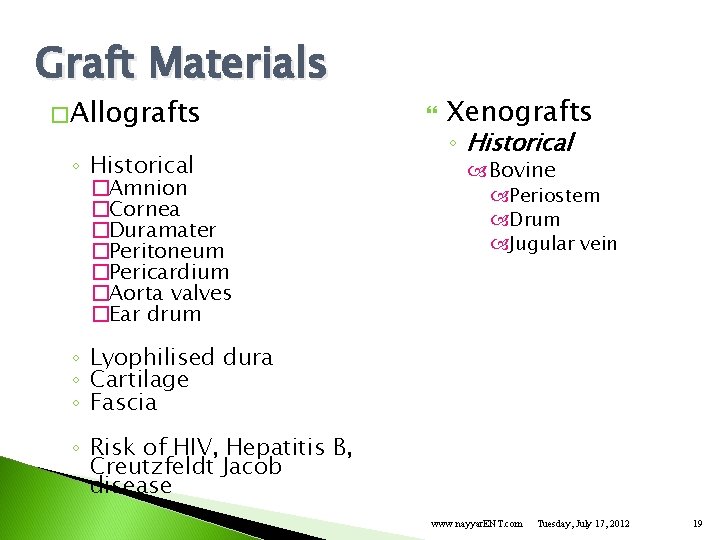
Graft Materials � Allografts ◦ Historical �Amnion �Cornea �Duramater �Peritoneum �Pericardium �Aorta valves �Ear drum Xenografts ◦ Historical Bovine Periostem Drum Jugular vein ◦ Lyophilised dura ◦ Cartilage ◦ Fascia ◦ Risk of HIV, Hepatitis B, Creutzfeldt Jacob disease www. nayyar. ENT. com Tuesday, July 17, 2012 19
Reasons for Graft failure ◦ Technical/surgeon errors ◦ Infectious complications ◦ Poor tubal function ◦ Patient factors www. nayyar. ENT. com Tuesday, July 17, 2012 20
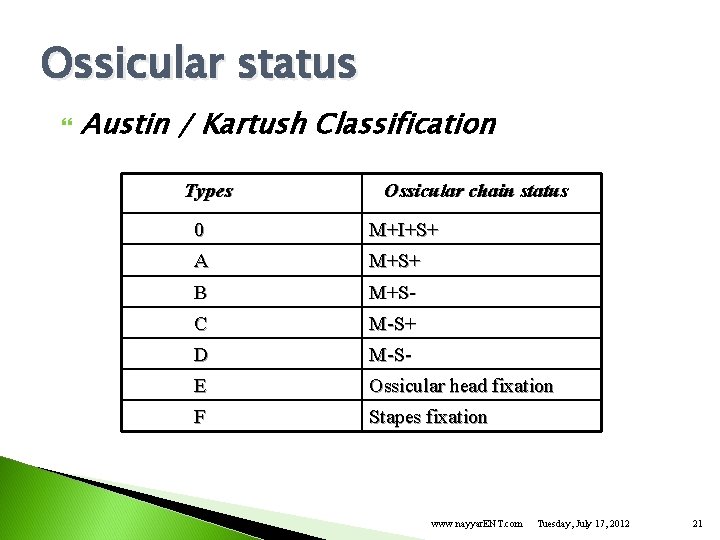
Ossicular status Austin / Kartush Classification Types Ossicular chain status 0 M+I+S+ A M+S+ B M+S- C M-S+ D M-S- E Ossicular head fixation F Stapes fixation www. nayyar. ENT. com Tuesday, July 17, 2012 21
Materials used in Ossiculoplasty Autografts Bone � Adv ◦ ◦ Immediate availability Biocompatibility Low cost Low extrusion rate Cartilage Conchal /Tragal Cartilage � Disadv ◦ Disease recurrence ◦ Fixation to adjacent structures ◦ Skill & time to shape www. nayyar. ENT. com Tuesday, July 17, 2012 22
Homografts Irradiated Ossicles En Bloc TM with attached Ossicles Risk of disease transmission www. nayyar. ENT. com Tuesday, July 17, 2012 23
Allografts Biocompatible ◦ 1960’s – Polyethylene tubing, Teflon, Proplast ◦ 1970’s – HDPS (Plastipore), Thermal fused HDPS (Polycel) ◦ Silastic, Stainless steel, Titanium Bioinert ◦ Al 2 O 3 Ceramic (Germany & Japan in 1970’s) Bioactive ◦ Bioactive glass – Bioglass, Ceravital (1970’s) ◦ Ca. PO 4 Ceramic - Hydroxyapatite www. nayyar. ENT. com Tuesday, July 17, 2012 24

Configurations of Allografts Total Ossicular Replacement Prosthesis (TORP) Partial Ossicular Replacement Prosthesis (PORP) Prosthesis for ossicular discontinuity restricted to IS joint Combined forms - Hydroxyapatite platform with Plastipore shaft www. nayyar. ENT. com Tuesday, July 17, 2012 25
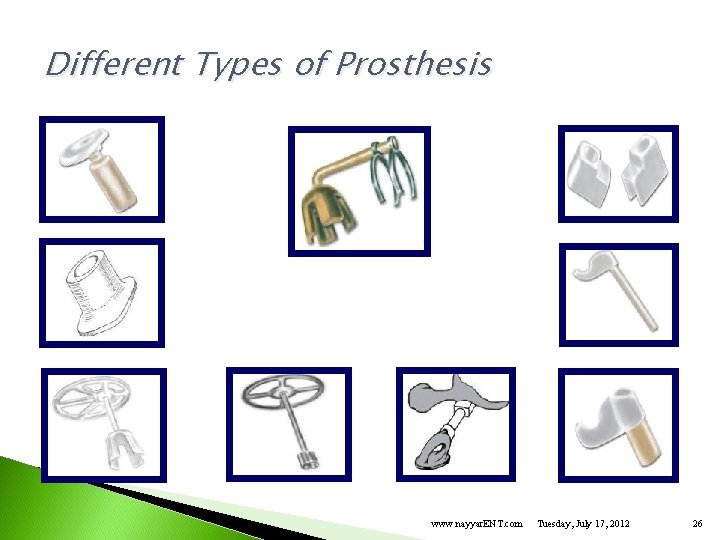
Different Types of Prosthesis www. nayyar. ENT. com Tuesday, July 17, 2012 26

Ossiculoplasty � Choice of prosthesis / placement ◦ Ossicular status ◦ Med – lat distance / vertical position ◦ Retracted umbo – severing of tensor tympani tendon www. nayyar. ENT. com Tuesday, July 17, 2012 27
Surgical Techniques in case of ossicular fixation Tympanosclerosis ◦ Disease restricted to attic ◦ Disease restricted to stapes ◦ Combined attic & stapedial disease Acquired bony fixation ◦ Removal of fixation with intact chain ◦ Removal of incus/malleus head with interposition of allograft/autograft www. nayyar. ENT. com Tuesday, July 17, 2012 28
Surgical Techniques for ossicular discontinuity Ossicular status ◦ Lenticular process missing ◦ Tip of Incus missing ◦ Long process of Incus missing Stapes superstructure +/ Malleus handle +/- www. nayyar. ENT. com Tuesday, July 17, 2012 29
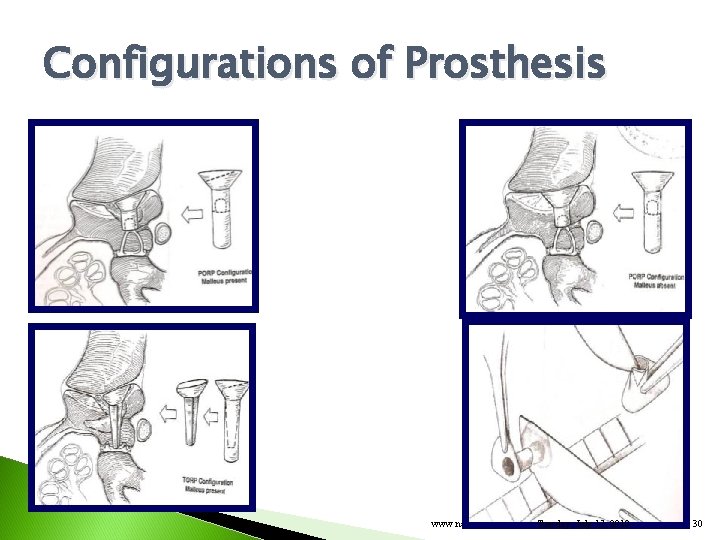
Configurations of Prosthesis www. nayyar. ENT. com Tuesday, July 17, 2012 30
Factors affecting outcomes of ossiculoplasty Intrinsic factors ◦ ◦ Status of ossicular chain – mobility Severity of disease Eustachian tube function Adequate control of allergy www. nayyar. ENT. com Tuesday, July 17, 2012 31
Contd… Extrinsic Factors ◦ Surgical technique ◦ Design of prosthesis ◦ Composition of prosthesis www. nayyar. ENT. com Tuesday, July 17, 2012 32
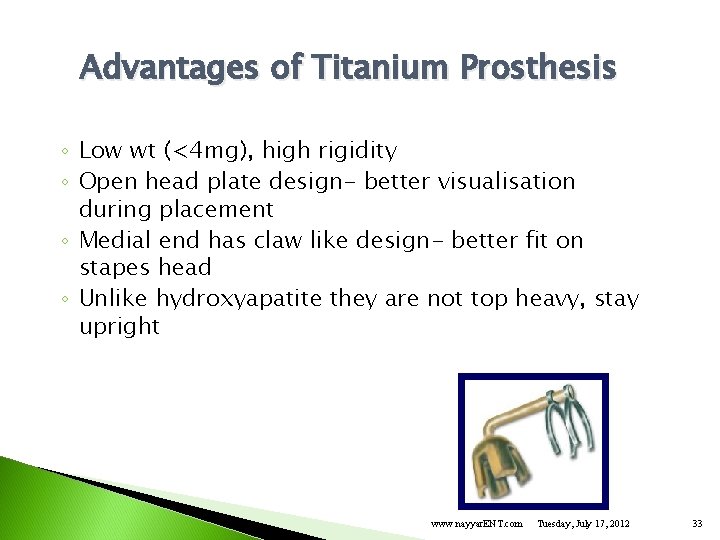
Advantages of Titanium Prosthesis ◦ Low wt (<4 mg), high rigidity ◦ Open head plate design- better visualisation during placement ◦ Medial end has claw like design- better fit on stapes head ◦ Unlike hydroxyapatite they are not top heavy, stay upright www. nayyar. ENT. com Tuesday, July 17, 2012 33
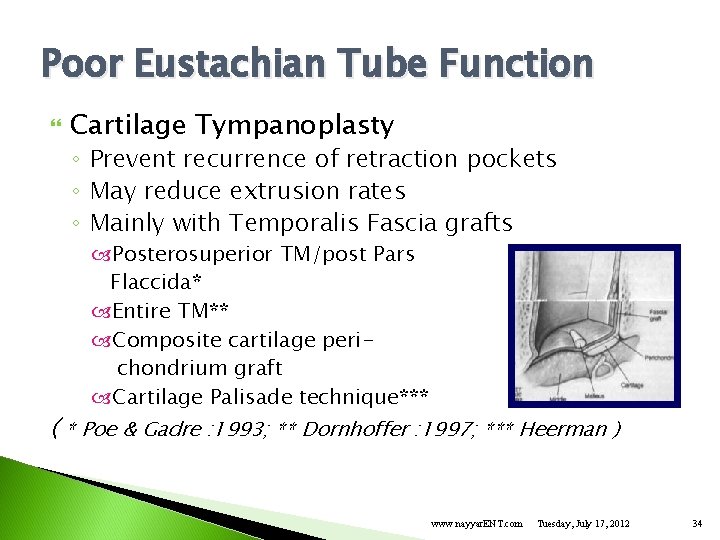
Poor Eustachian Tube Function Cartilage Tympanoplasty ◦ Prevent recurrence of retraction pockets ◦ May reduce extrusion rates ◦ Mainly with Temporalis Fascia grafts Posterosuperior TM/post Pars Flaccida* Entire TM** Composite cartilage perichondrium graft Cartilage Palisade technique*** ( * Poe & Gadre : 1993; ** Dornhoffer : 1997; *** Heerman ) www. nayyar. ENT. com Tuesday, July 17, 2012 34

Poor ET Function (contd…) Tympanostomy ◦ Rarely at the time of TM grafting ◦ Maybe during follow up if effusion or retraction develops www. nayyar. ENT. com Tuesday, July 17, 2012 35

Middle Ear Stents Teflon / Silicone pieces Silastic sheet Biodegradable materials ◦ Gelfoam ◦ Gelfilm www. nayyar. ENT. com Tuesday, July 17, 2012 36
Reporting protocols “ Fiction & fact need untangling, otherwise, surgeons are little better than gossips ” : Gordon Smyth
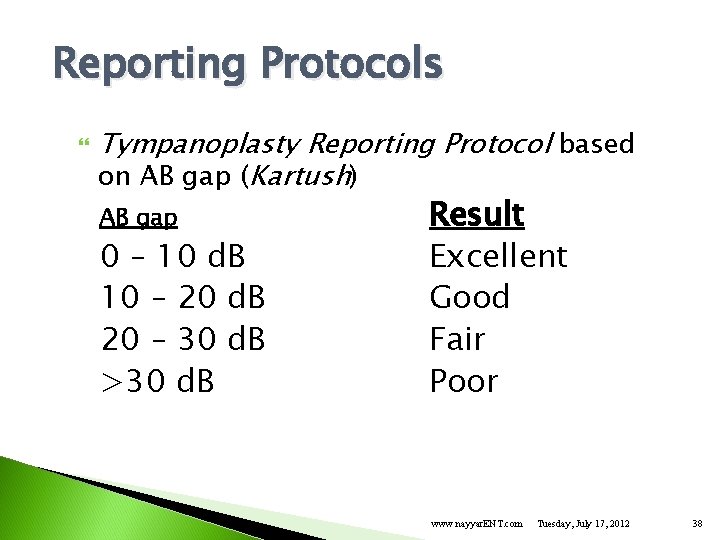
Reporting Protocols Tympanoplasty Reporting Protocol based on AB gap (Kartush) AB gap 0 – 10 d. B 10 – 20 d. B 20 – 30 d. B >30 d. B Result Excellent Good Fair Poor www. nayyar. ENT. com Tuesday, July 17, 2012 38
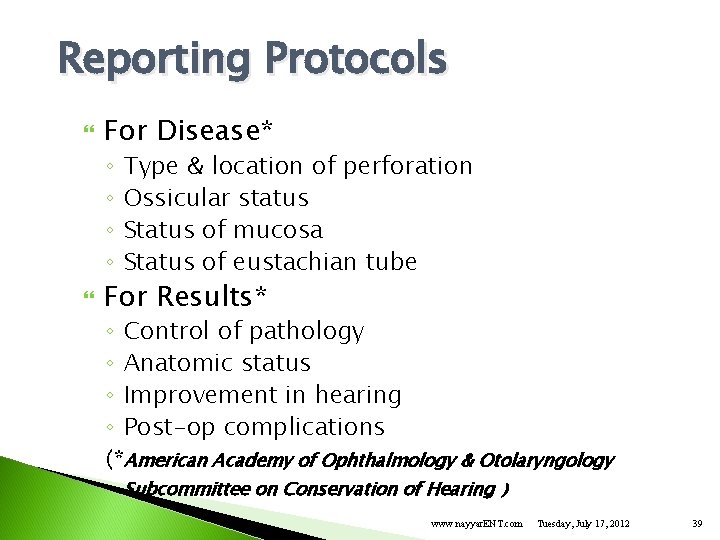
Reporting Protocols For Disease* ◦ ◦ Type & location of perforation Ossicular status Status of mucosa Status of eustachian tube For Results* Control of pathology Anatomic status Improvement in hearing Post-op complications (*American Academy of Ophthalmology & Otolaryngology ◦ ◦ Subcommittee on Conservation of Hearing ) www. nayyar. ENT. com Tuesday, July 17, 2012 39

www. nayyar. ENT. com Tuesday, July 17, 2012 40

Middle ear risk index ◦ MERI 0 Normal ◦ MERI 1 -3 Mild disease ◦ MERI 4 -6 Moderate disease ◦ MERI 7 -12 Severe disease www. nayyar. ENT. com Tuesday, July 17, 2012 41
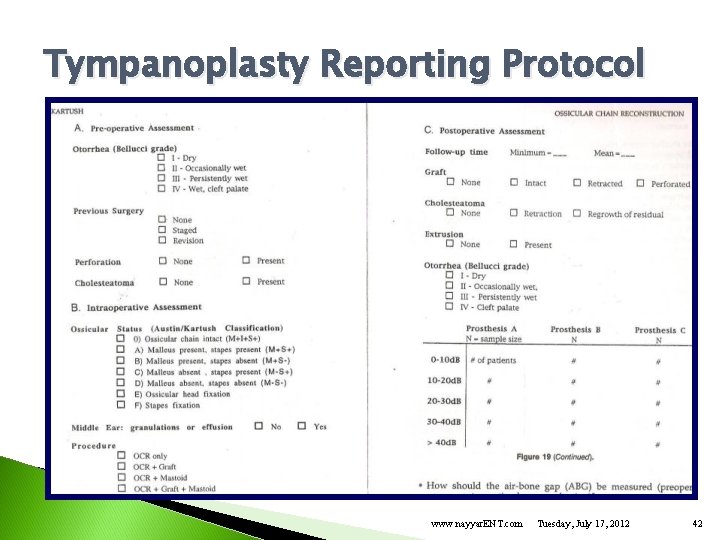
Tympanoplasty Reporting Protocol www. nayyar. ENT. com Tuesday, July 17, 2012 42
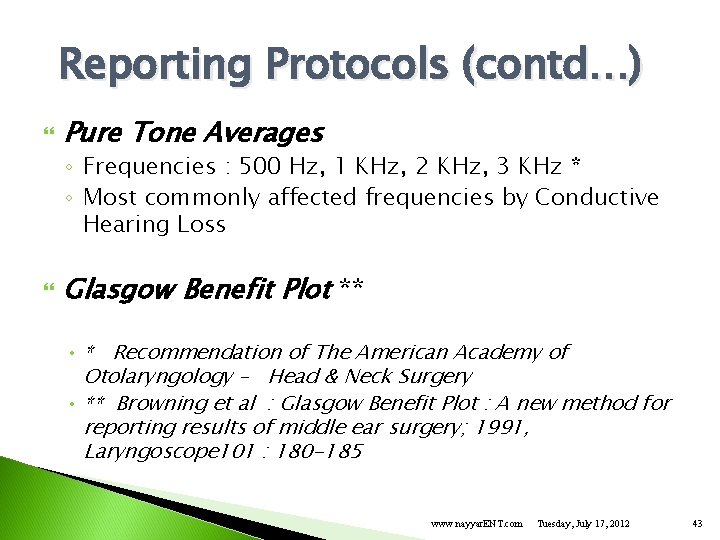
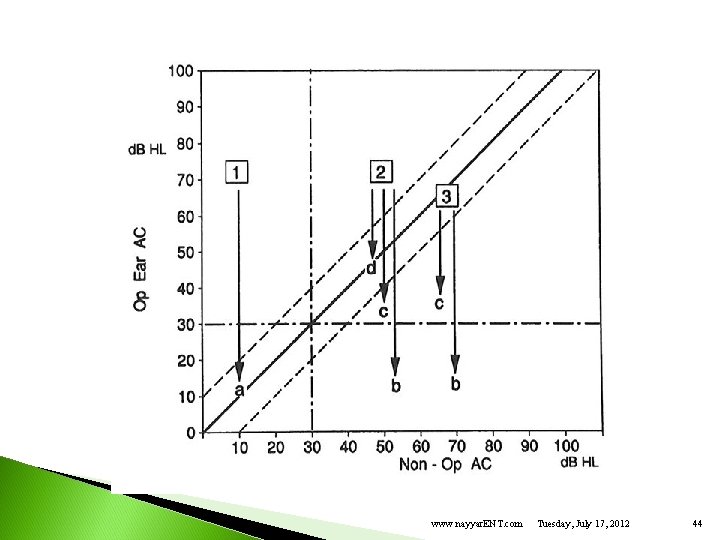
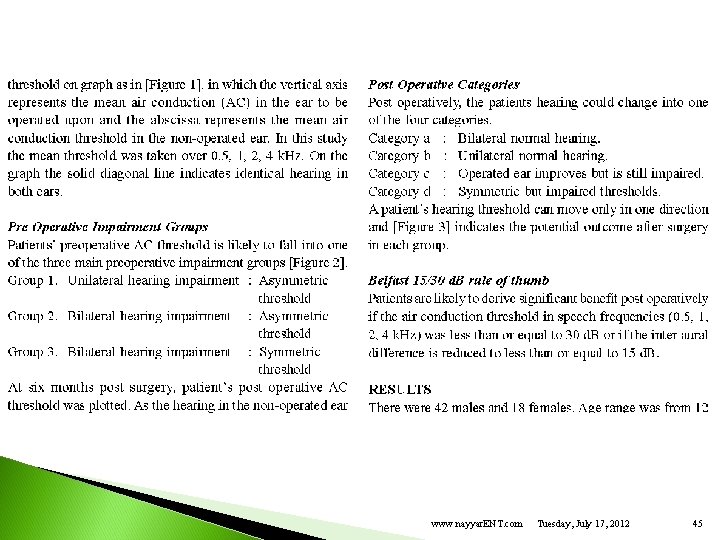
Reporting Protocols (contd…) Pure Tone Averages ◦ Frequencies : 500 Hz, 1 KHz, 2 KHz, 3 KHz * ◦ Most commonly affected frequencies by Conductive Hearing Loss Glasgow Benefit Plot ** • * Recommendation of The American Academy of Otolaryngology – Head & Neck Surgery • ** Browning et al : Glasgow Benefit Plot : A new method for reporting results of middle ear surgery; 1991, Laryngoscope 101 : 180 -185 www. nayyar. ENT. com Tuesday, July 17, 2012 43
www. nayyar. ENT. com Tuesday, July 17, 2012 44
www. nayyar. ENT. com Tuesday, July 17, 2012 45
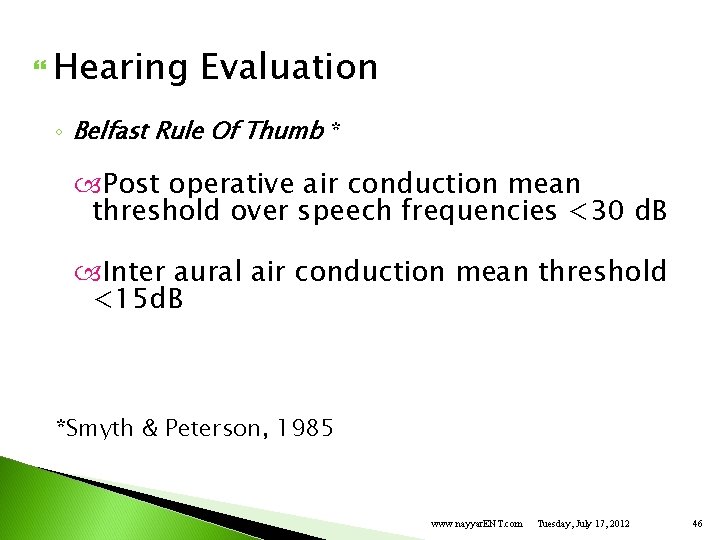
Hearing Evaluation ◦ Belfast Rule Of Thumb * Post operative air conduction mean threshold over speech frequencies <30 d. B Inter aural air conduction mean threshold <15 d. B *Smyth & Peterson, 1985 www. nayyar. ENT. com Tuesday, July 17, 2012 46

Paediatric Tympanoplasty Controversy - Mgt of pts with TM perforation(+/-otorrhea) Factors affecting decision of surgery ◦ Poor tubal function( perforation acts as natural grommet) ◦ Frequent episodes of URTI ◦ Negative middle ear pressure in contralateral ear www. nayyar. ENT. com Tuesday, July 17, 2012 47
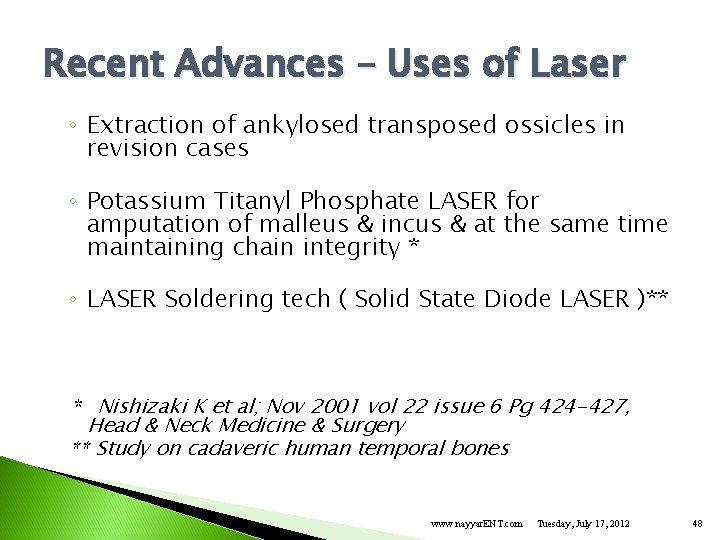
Recent Advances – Uses of Laser ◦ Extraction of ankylosed transposed ossicles in revision cases ◦ Potassium Titanyl Phosphate LASER for amputation of malleus & incus & at the same time maintaining chain integrity * ◦ LASER Soldering tech ( Solid State Diode LASER )** * Nishizaki K et al; Nov 2001 vol 22 issue 6 Pg 424 -427, Head & Neck Medicine & Surgery ** Study on cadaveric human temporal bones www. nayyar. ENT. com Tuesday, July 17, 2012 48
Conclusion Rich history Antibiotics & binocular microscope major role brought turnaround Better & better results with tympanoplasty Newer materials for ossiculoplasty Scope of further research e. g. in area of cartilage & pediatric tympanoplasty www. nayyar. ENT. com Tuesday, July 17, 2012 49
References Text book of Otolaryngology – Head & Neck Surgery : Charles W Cummings, 4 th ed , vol 4, 3058 – 74 Manual of Middle Ear Surgery : Mirko Tos, vol 1 The Otolaryngologic Clinics of North America : Aug 1994; Ossiculoplasty, vol 27, No 4 Surgery of the Ear : Glasscock – Shambough, 5 th ed Scott Brown otolaryngology 7 th edition Internet Journal articles www. nayyar. ENT. com Tuesday, July 17, 2012 50

www. nayyar. ENT. com Tuesday, July 17, 2012 51
- Slides: 51