
Principles of Toxicology The Study of Poisons Elizabeth
Principles of Toxicology: The Study of Poisons Elizabeth Casarez Department of Pharmacology and Toxicology University of Arizona
The study of the adverse effects of a toxicant on living organisms • Adverse effects – any change from an organism’s normal state – dependent upon the concentration of active compound at the target site for a sufficient time. • Toxicant (Poison) – any agent capable of producing a deleterious response in a biological system • Living organism – a sac of water with target sites, storage depots and enzymes
What is a Poison? All substances are poisons; there is none that is not a poison. The right dose differentiates a poison and a remedy. Paracelsus (1493 -1541)
Dose The amount of chemical entering the body This is usually given as mg of chemical/kg of body weight = mg/kg The dose is dependent upon * The environmental concentration * The properties of the toxicant * The frequency of exposure * The length of exposure * The exposure pathway
What is a Response? The degree and spectra of responses depend upon the dose and the organism--describe exposure conditions with description of dose • Change from normal state – could be on the molecular, cellular, organ, or organism level--the symptoms • • Local vs. Systemic Reversible vs. Irreversible Immediate vs. Delayed Graded vs. Quantal – degrees of the same damage vs. all or none
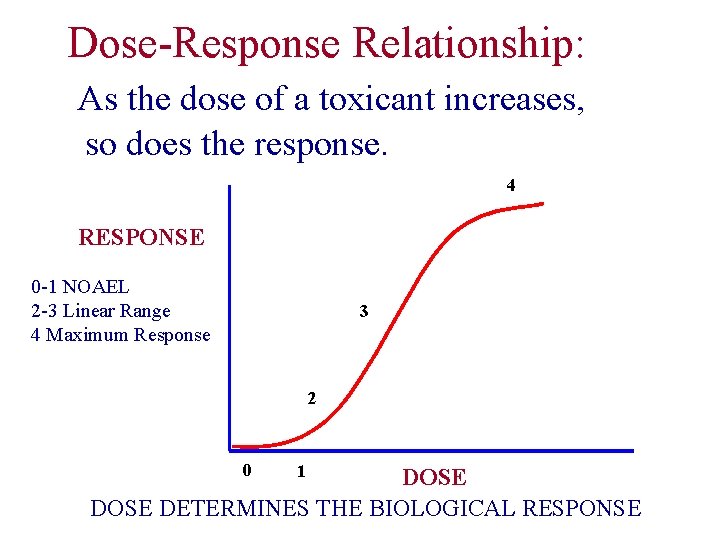
Dose-Response Relationship: As the dose of a toxicant increases, so does the response. 4 RESPONSE 0 -1 NOAEL 2 -3 Linear Range 4 Maximum Response 3 2 0 1 DOSE DETERMINES THE BIOLOGICAL RESPONSE
LD 50 • Quantal responses can be treated as gradient when data from a population is used. • The cumulative proportion of the population responding to a certain dose is plotted per dose--10 -30 fold variation w/in a population • If Mortality is the response, the dose that is lethal to 50% of the population LD 50 can be generated from the curve • Different toxicants can be compared--lowest dose is most potent
LD 50 Comparison
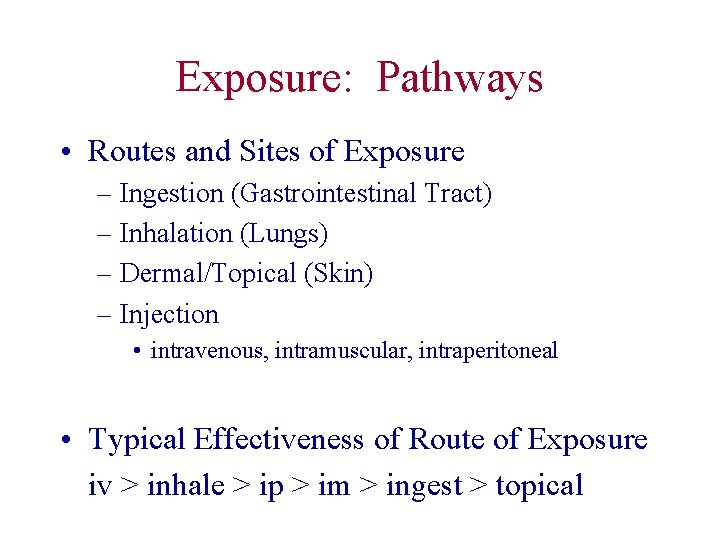
Exposure: Pathways • Routes and Sites of Exposure – Ingestion (Gastrointestinal Tract) – Inhalation (Lungs) – Dermal/Topical (Skin) – Injection • intravenous, intramuscular, intraperitoneal • Typical Effectiveness of Route of Exposure iv > inhale > ip > im > ingest > topical
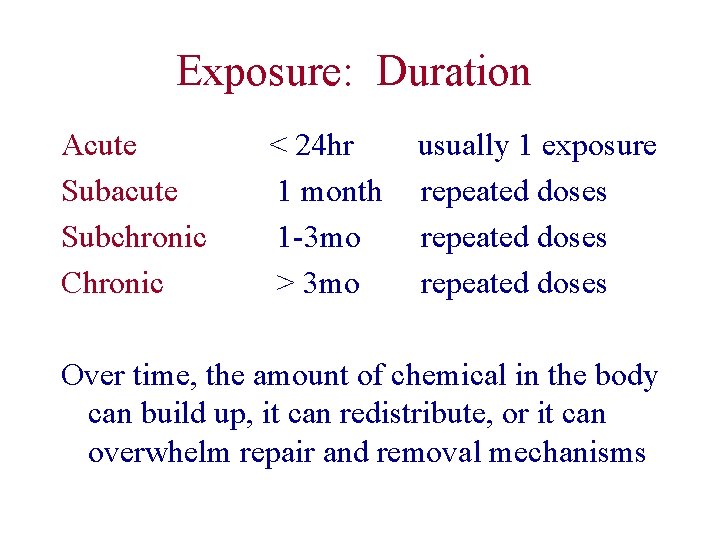
Exposure: Duration Acute Subacute Subchronic Chronic < 24 hr 1 month 1 -3 mo > 3 mo usually 1 exposure repeated doses Over time, the amount of chemical in the body can build up, it can redistribute, or it can overwhelm repair and removal mechanisms
ADME: Absorption, Distribution, Metabolism, and Excretion • Once a living organism has been exposed to a toxicant, the compound must get into the body and to its target site in an active form in order to cause an adverse effect. • The body has defenses: – Membrane barriers • passive and facilitated diffusion, active transport – Biotransformation enzymes, antioxidants – Elimination mechanisms
Absorption: ability of a chemical to enter the blood (blood is in equilibrium with tissues) • Inhalation--readily absorb gases into the blood stream via the alveoli. (Large alveolar surface, high blood flow, and proximity of blood to alveolar air) • Ingestion--absorption through GI tract stomach (acids), small intestine (long contact time, large surface area--villi; bases and transporters for others) – 1 st Pass Effect (liver can modify) • Dermal--absorption through epidermis (stratum corneum), then dermis; site and condition of skin
Distribution: the process in which a chemical agent translocates throughout the body • Blood carries the agent to and from its site of action, storage depots, organs of transformation, and organs of elimination • Rate of distribution (rapid) dependent upon – blood flow – characteristics of toxicant (affinity for the tissue, and the partition coefficient) • Distribution may change over time
Distribution: Storage and Binding • Storage in Adipose tissue--Very lipophylic compounds (DDT) will store in fat. Rapid mobilization of the fat (starvation) can rapidly increase blood concentration • Storage in Bone--Chemicals analogous to Calcium--Fluoride, Lead, Strontium • Binding to Plasma proteins--can displace endogenous compounds. Only free is available for adverse effects or excretion
Target Organs: adverse effect is dependent upon the concentration of active compound at the target site for enough time • Not all organs are affected equally – greater susceptibility of the target organ – higher concentration of active compound • • • Liver--high blood flow, oxidative reactions Kidney--high blood flow, concentrates chemicals Lung--high blood flow, site of exposure Neurons--oxygen dependent, irreversible damage Myocardium--oxygen dependent Bone marrow, intestinal mucosa--rapid divide
Target Sites: Mechanisms of Action • Adverse effects can occur at the level of the molecule, cell, organ, or organism • Molecularly, chemical can interact with Proteins Lipids DNA • Cellularly, chemical can – interfere with receptor-ligand binding – interfere with membrane function – interfere with cellular energy production – bind to biomolecules – perturb homeostasis (Ca)
Excretion: Toxicants are eliminated from the body by several routes • Urinary excretion – water soluble products are filtered out of the blood by the kidney and excreted into the urine • Exhalation – Volatile compounds are exhaled by breathing • Biliary Excretion via Fecal Excretion – Compounds can be extracted by the liver and excreted into the bile. The bile drains into the small intestine and is eliminated in the feces. • Milk Sweat Saliva
Metabolism: adverse effect depends on the concentration of active compound at the target site over time • The process by which the administered chemical (parent compounds) are modified by the organism by enzymatic reactions. • 1 o objective--make chemical agents more water soluble and easier to excrete – decrease lipid solubility --> decrease amount at target – increase ionization -> increase excretion rate --> decrease toxicity • Bioactivation--Biotransformation can result in the formation of reactive metabolites
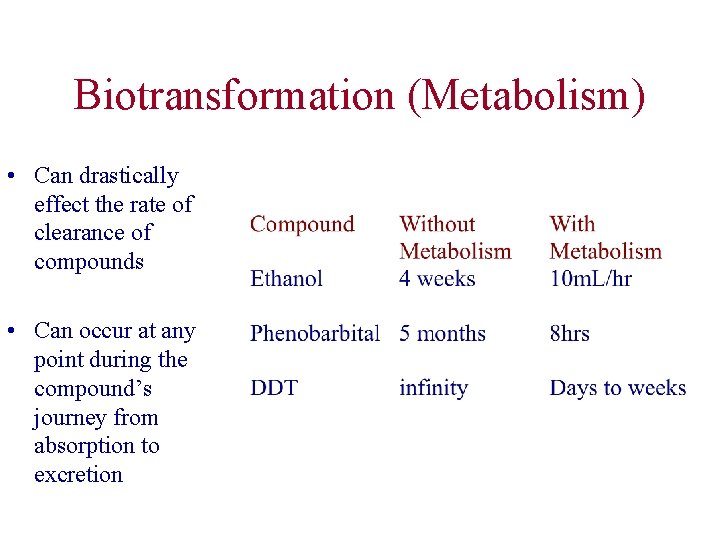
Biotransformation (Metabolism) • Can drastically effect the rate of clearance of compounds • Can occur at any point during the compound’s journey from absorption to excretion
Biotransformation • Key organs in biotransformation – LIVER (high) – Lung, Kidney, Intestine (medium) – Others (low) • Biotransformation Pathways * Phase I--make the toxicant more water soluble * Phase II--Links with a soluble endogenous agent (conjugation)
Individual Susceptibility --there can be 10 -30 fold difference in response to a toxicant in a population • Genetics-species, strain variation, interindividual variations (yet still can extrapolate between mammals--similar biological mechanisms) • Gender (gasoline nephrotox in male mice only) • Age--young (old too) – underdeveloped excretory mechanisms – underdeveloped biotransformation enzymes – underdeveloped blood-brain barrier
Individual Susceptibility • Age--old – changes in excretion and metabolism rates, body fat • Nutritional status • Health conditions • Previous or Concurrent Exposures – additive – synergistic --antagonistic
Toxicology • • Exposure + Hazard = Risk All substances can be a poison Dose determines the response Pathway, Duration of Frequency of Exposure and Chemical determine Dose Absorption, Distribution, Metabolism & Excretion The extent of the effect is dependent upon the concentration of the active compound at its site of action over time Bioactivation: compounds to reactive metabolites Individual variation of the organism will affect ADME
- Slides: 23