
Principles of the Constitution Major Principles of Government

- Slides: 18
Principles of the Constitution
Major Principles of Government u Principles are basic beliefs by which people live their lives. u The U. S. Constitution is filled with details about how our government should be structured u The basic principles are on the following slides. Take notes, they are the foundation on which government is built
The Constitution rests on seven basic principles: u Popular Sovereignty u Limited Government u Rule of Law u Separation of Powers u Checks and Balances u Federalism u Representative Democracy
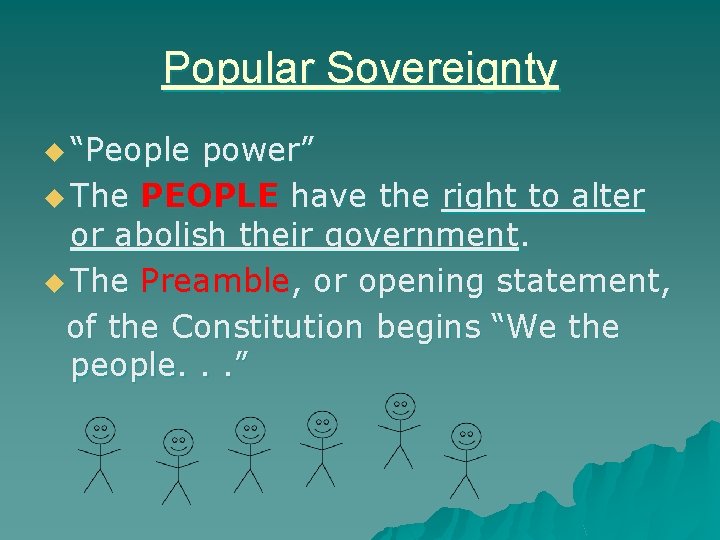
Popular Sovereignty u “People power” u The PEOPLE have the right to alter or abolish their government. u The Preamble, or opening statement, of the Constitution begins “We the people. . . ”
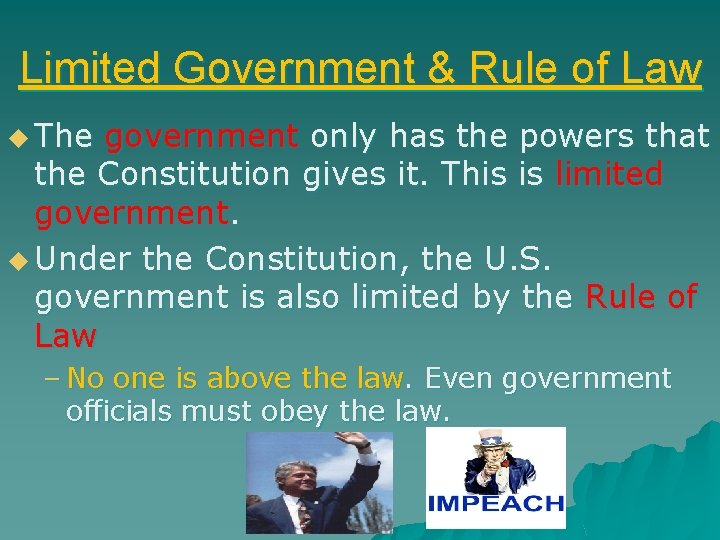
Limited Government & Rule of Law u The government only has the powers that the Constitution gives it. This is limited government. u Under the Constitution, the U. S. government is also limited by the Rule of Law – No one is above the law. Even government officials must obey the law.
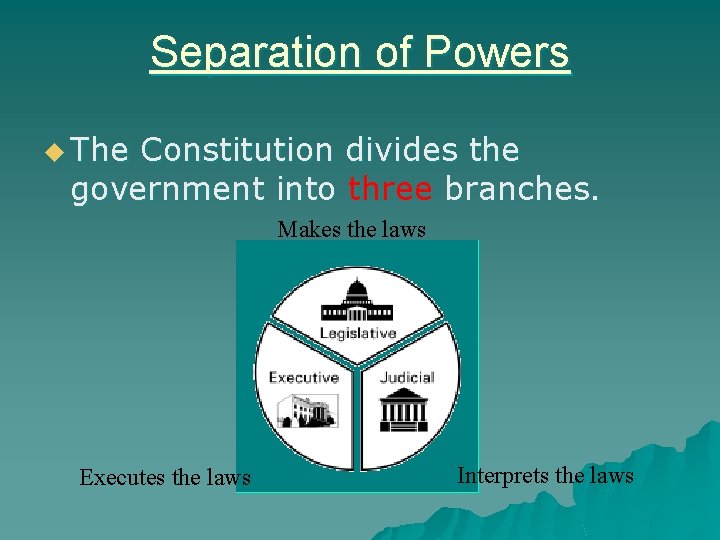
Separation of Powers u The Constitution divides the government into three branches. Makes the laws Executes the laws Interprets the laws
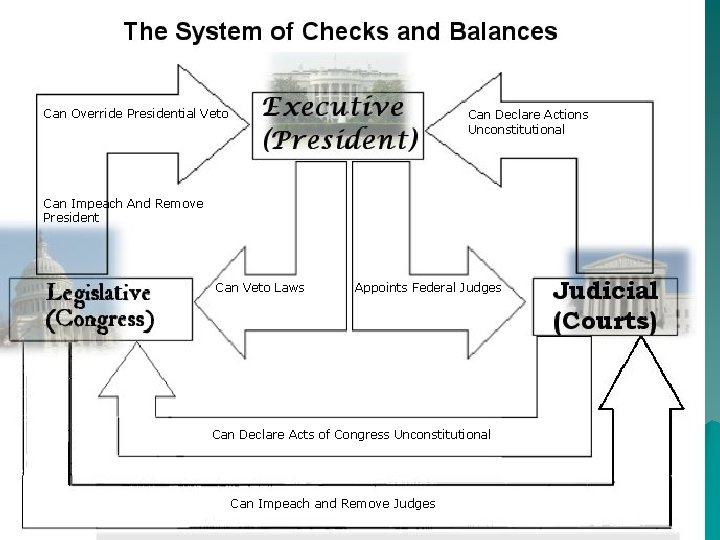
Checks and Balances u Each branch of government has the power to check, or limit, the actions of the other two. u This guards against the abuse of power.
Can Override Presidential Veto Can Declare Actions Unconstitutional Can Impeach And Remove President Can Veto Laws Appoints Federal Judges Can Declare Acts of Congress Unconstitutional Can Impeach and Remove Judges
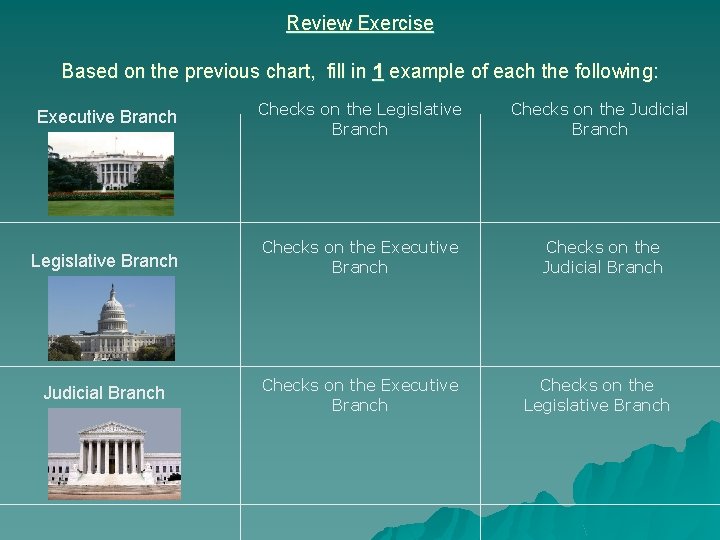
Review Exercise Based on the previous chart, fill in 1 example of each the following: Executive Branch Checks on the Legislative Branch Checks on the Judicial Branch Legislative Branch Checks on the Executive Branch Checks on the Judicial Branch Checks on the Executive Branch Checks on the Legislative Branch
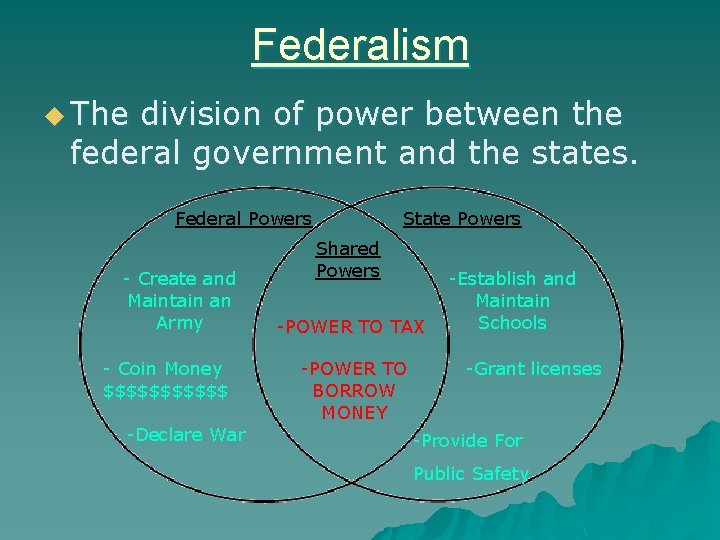
Federalism u The division of power between the federal government and the states. Federal Powers - Create and Maintain an Army - Coin Money $$$$$$ -Declare War State Powers Shared Powers -POWER TO TAX -POWER TO BORROW MONEY -Establish and Maintain Schools -Grant licenses -Provide For Public Safety
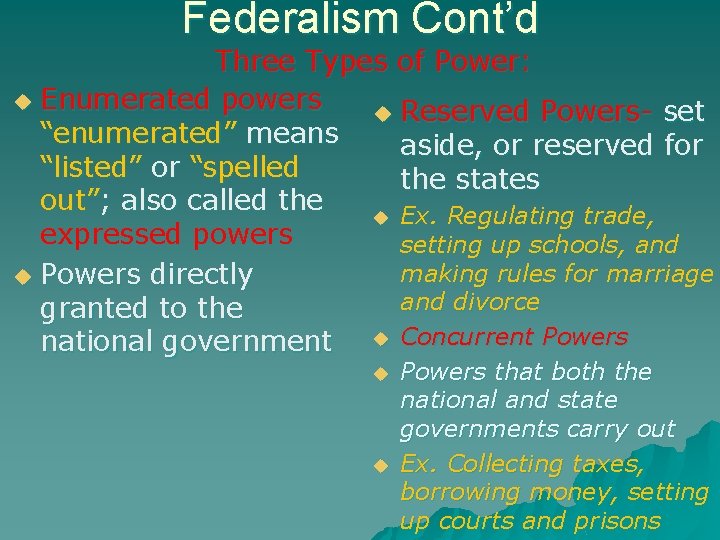
Federalism Cont’d Three Types of Power: u Enumerated powers u Reserved Powers- set “enumerated” means aside, or reserved for “listed” or “spelled the states out”; also called the u Ex. Regulating trade, expressed powers setting up schools, and making rules for marriage u Powers directly and divorce granted to the national government u Concurrent Powers u u Powers that both the national and state governments carry out Ex. Collecting taxes, borrowing money, setting up courts and prisons
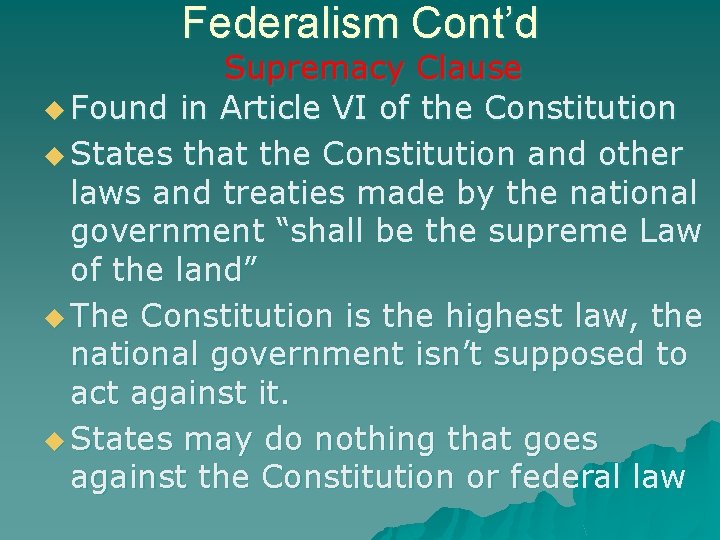
Federalism Cont’d Supremacy Clause u Found in Article VI of the Constitution u States that the Constitution and other laws and treaties made by the national government “shall be the supreme Law of the land” u The Constitution is the highest law, the national government isn’t supposed to act against it. u States may do nothing that goes against the Constitution or federal law
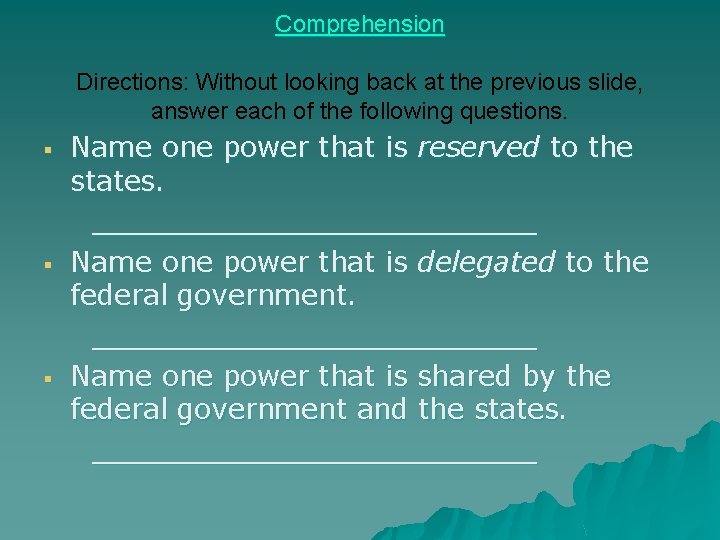
Comprehension Directions: Without looking back at the previous slide, answer each of the following questions. § § § Name one power that is reserved to the states. _____________ Name one power that is delegated to the federal government. _____________ Name one power that is shared by the federal government and the states. _____________
Representative Democracy u Also known as Republicanism u We elect representatives to carry out our will.
Individual Rights u The Bill of Rights in the Constitution protects individual rights, such as freedom of speech, freedom of religion, and the right to trial by jury. Example: The Fourth Amendment to the Constitution protects citizens from illegal searches and seizures by the government. DO YOU KNOW: What do the police need to have in order to search your house? ____________________
Assignment u Complete a graphic organizer to identify the principles of the Constitution. u Using your text pgs. 143 -144 complete the Chapter 5 Assessment Questions 1 -8 u If necessary, for extra help see the bottom of page 144 for Chapter 5 lessons to review u Wrap Up- Answer the following: Think about it, which of the principles of the Constitution do you think is the most important? Write a paragraph explaining your choice…
u Using your text pgs. 143 -144 complete the Chapter 5 Assessment Questions 1 -8 u Please write out the question and answer (“ 1. Question …… B) Answer)
u Wrap Up- Answer the following: Think about it, which of the principles of the Constitution do you think is the most important? Write a paragraph explaining your choice…