
PRINCIPLES OF TAXONOMY Interesting tool need to understand
- Slides: 20
PRINCIPLES OF TAXONOMY Interesting tool, need to understand concept and meaning of : ☻ Taxonomy ☻ Systematics ☻ International code of nomenclature 1/21/2022
TAXONOMY (Greek, taxis= arranged; nomos= law) ☻ Making and maintaining collection ☻ Differentiating species ☻ Identification (Keys) and diagnosis of species and genera ☻ Naming and describing species and genera 1/21/2022
WHAT IS A KEY ? ☻ A tool to identify of an unknown organism where large numbers of taxa are difficult to distinguish just by using the naked eye and memory ☻ An Expert in the relevant field puts together the information and builds the key ☻ The builder of a key must choose features that best distinguish between taxa. Each feature has a number of states e. g. pink, yellow, blue etc. ☻ Clearly defining these states is crucial to the efficient working of a key 1/21/2022
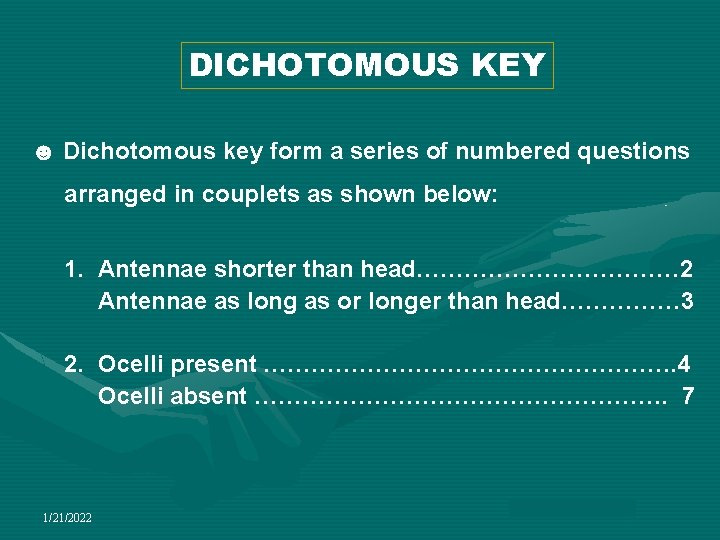
DICHOTOMOUS KEY ☻ Dichotomous key form a series of numbered questions arranged in couplets as shown below: 1. Antennae shorter than head……………… 2 Antennae as long as or longer than head…………… 3 2. Ocelli present ………………………. 4 Ocelli absent ………………………. 7 1/21/2022
SYSTEMATICS (Greek, systema = a whole made of several parts) ☻ Develops the classification of organisms ☻ Species comparison and grouping into higher categories ☻ Organisms are arranged in definite, hierarchical order ☻ The order of the system is based on hypothesis of common descend (“Study of the kinds and diversity of organisms and the relationships between them”) 1/21/2022
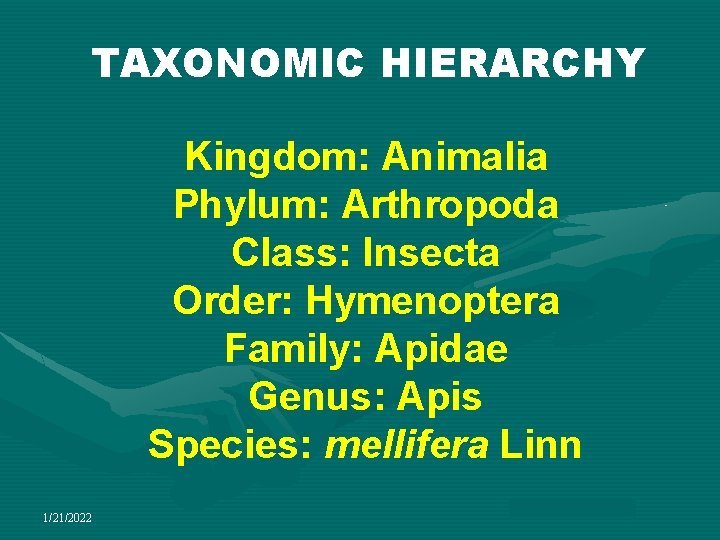
TAXONOMIC HIERARCHY Kingdom: Animalia Phylum: Arthropoda Class: Insecta Order: Hymenoptera Family: Apidae Genus: Apis Species: mellifera Linn 1/21/2022
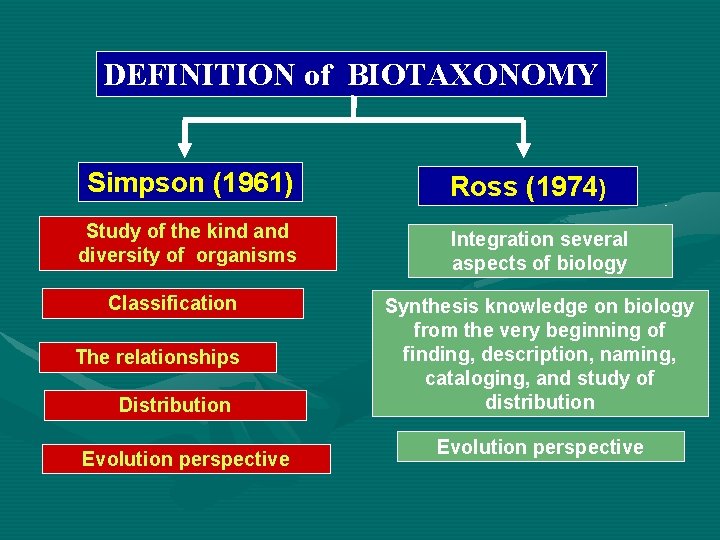
DEFINITION of BIOTAXONOMY Simpson (1961) Study of the kind and diversity of organisms Classification The relationships Distribution Evolution perspective Ross (1974) Integration several aspects of biology Synthesis knowledge on biology from the very beginning of finding, description, naming, cataloging, and study of distribution Evolution perspective
CLASSIFICATION ☻ Arrangement of organisms into taxonomic groups ☻ Natural classifications are objective Monophyletic vs Polyphyletic ☻ Artificial classifications are subjective (The characters are not considered in relation to their Phylogeny) 1/21/2022
Monophyletic (Greek, monos =one; phyle= tribe; ic= consisting of) ☻All members of which are derived from a common ancestor and not excluding from an historical group any descendants of the ancestor of that groups Polyphyletic (Greek, polys = many; phylon =race; ic = of the nature of ) ☻ A Natural or genetically cohesive lineage of Taxa whose most recent common ancestor has given rise to excluded Taxa of which at least one of the sister group is only partly included in the group 1/21/2022
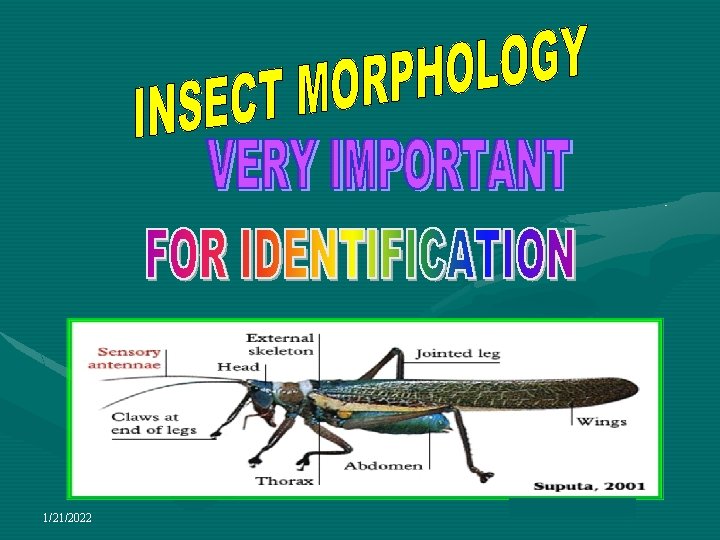
1/21/2022
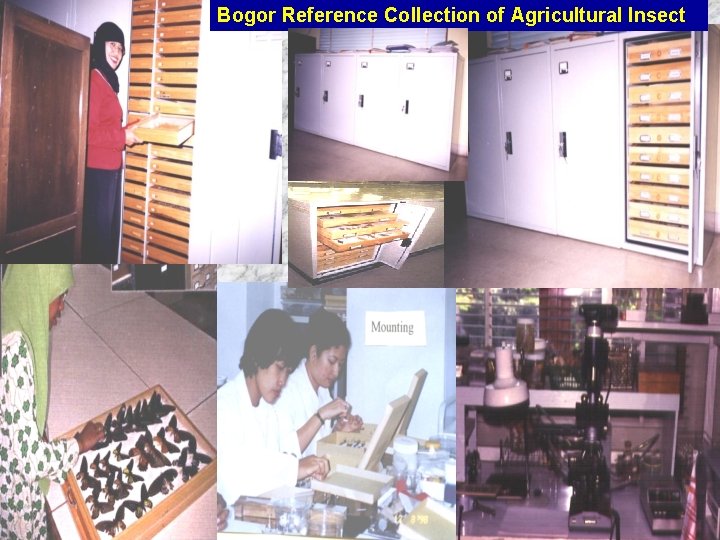
Bogor Reference Collection of Agricultural Insect
NOMENCLATURE & TYPES ☻ Formation and use of scientific names ☻ The Linnaean using a combination two words of binomial scientific name of insects Common name: Honey Bee Scientific Name: Apis mellifera Linn ☻ International Code of Zoological Nomenclature (ICZN), rules that must be obeyed ☻ Registering all new names, making all new names unique across Kingdom, and providing authoritative guidance on the formation of new names 1/21/2022
NOMENCLATURE & TYPES Guiding principles of the ICZN: ☻ Availability ☻ Validity ☻ Priority: first published name is the correct one to use ☻ Typification: Data in the label, put in collection somewhere, Type specimen 1/21/2022
TYPE AND VOUCHER MATERIAL ☻ Holotypes, Syntypes, Lectotypes, and Neotypes are the bearers of the scientific names of all animal taxa. ☻ International standards of reference provide objectivity in zoological nomenclature ☻ Types specimen or specimens should be deposited in a reputable scientific institution ☻ It is good practice to deposit voucher specimens of any organisms studied and published research papers on an institutional collection, even if they are not new species 1/21/2022
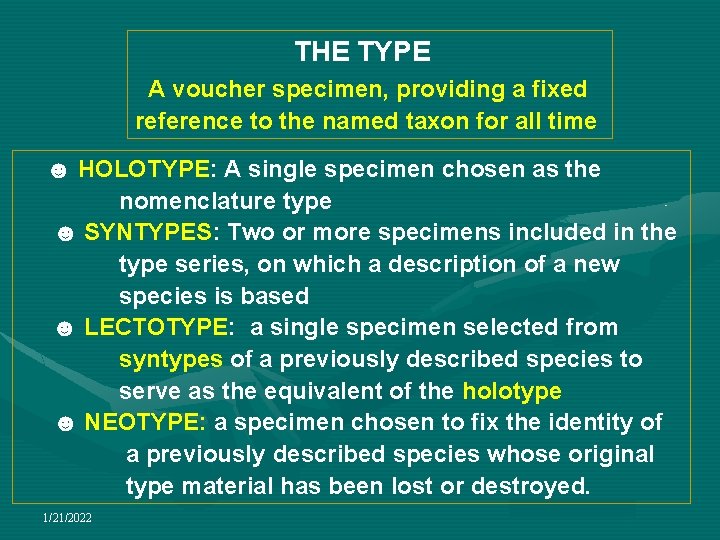
THE TYPE A voucher specimen, providing a fixed reference to the named taxon for all time ☻ HOLOTYPE: A single specimen chosen as the nomenclature type ☻ SYNTYPES: Two or more specimens included in the type series, on which a description of a new species is based ☻ LECTOTYPE: a single specimen selected from syntypes of a previously described species to serve as the equivalent of the holotype ☻ NEOTYPE: a specimen chosen to fix the identity of a previously described species whose original type material has been lost or destroyed. 1/21/2022
DATA TYPES ☻ Morphology; Behaviour, Ecology, Distribution, and Life cycle ☻ Embryology ☻ Physiology ☻ Paleontology ☻ Genetics ☻ Biochemistry ☻ Molecular data- DNA, protein sequencing ☻ Host- Parasite relationships 1/21/2022
SPECIATION AND VARIATION ☻ Cryptic species: species very difficult to separate ☻ Subspecies ☻ Sibling species ☻ Geographic variation : size, available of food, pattern ☻ Morphs: social insect. Termites, ants ☻ Sexual dimorphism: wasps ☻ Races 1/21/2022
PHYLOGENY ☻ Phylogenetic systematic is a method of systematic coherently formulated by Hennig ( 1950; 1966 ). ☻ Cladistic methods, are used to reconstruct the evolutionary history of organisms ☻ Cladistic is important for systematists when they construct classification ☻ Phylogenetic tree: a common ancestors are identified 1/21/2022
REFERENCES ☻Winston, J. E. 1999. Describing Species: Practical Taxonomic Procedure for Biologiests. Columbia University Press. New York. 518 pp ☻ Quicke, D. L. J. 1993. Principles and Techniques of Contemporary Taxonomy. Blackie Academic & Prefessional. London, New York, Tokyo, Melbourne. Madras. 311 pp ☻Insect 2000. (http: //www. sp 2000. org) 1/21/2022
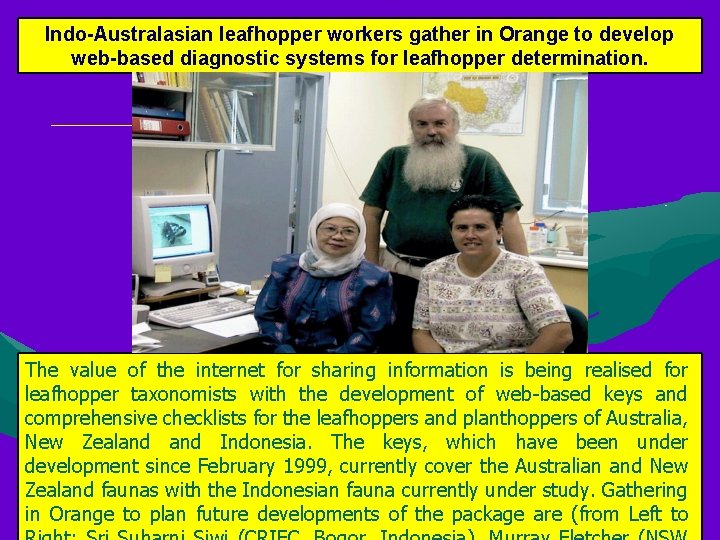
Indo-Australasian leafhopper workers gather in Orange to develop web-based diagnostic systems for leafhopper determination. The value of the internet for sharing information is being realised for leafhopper taxonomists with the development of web-based keys and comprehensive checklists for the leafhoppers and planthoppers of Australia, New Zealand Indonesia. The keys, which have been under development since February 1999, currently cover the Australian and New Zealand faunas with the Indonesian fauna currently under study. Gathering in Orange to plan future developments of the package are (from Left to