
Principles of taxation Essential vocabulary Principles of taxation
Principles of taxation
Essential vocabulary � Principles of taxation – načela oporezivanja � The application of tax provisions – primjena poreznih propisa � Right to declaration – pravo na očitovanje � Non-disclosure obligation – obveza čuvanja porezne tajne � Obligation to act in good faith – obveza postupanja u dobroj vjeri � Economic approach – gospodarstveni pristup � Sham transactions – prividni pravni poslovi
Tax… � Tax � Tax provisions – porezni propisi authority – porezno tijelo law relations – porezno-pravni odnos ordinance – porezni akt guarantor – porezni jamac liability – porezna obveza
The Application of Tax Provisions � During the course of taxation procedures, tax provisions shall be applied which are in force at the moment of emergence of the conditions which form the basis for taxation. � Translate the sentence!

�U postupku oporezivanja primjenjuju se porezni propisi koji su bili na snazi u vrijeme nastanka činjenica na kojima se temelji oporezivanje.
Tax Authority Procedures � Read Art. 6 and answer the following questions: � What is the tax authority obliged to establish during the process of taxation? � What is the tax authority duty-bound to determine? � What do tax authorities have to encourage taxpayers to do? � What is the procedure that a tax authority has to follow if it receives documentation in a foreign language? � What does the tax authority undertake if the certified translation is not submitted?
Translate the following: �A tax authority shall be obliged to determine all facts essential to lawful and legitimate decision-making. In this process, the tax authority shall be duty-bound to determine facts that benefit taxpayers with equal diligence. The tax authority shall ascertain which operations are to be undertaken during procedures and to which extent. � with equal diligence – s jednakom pažnjom

� Porezno tijelo dužno je utvrđivati sve činjenice koje su bitne za donošenje zakonite i pravilne odluke, pri tom je dužno s jednakom pažnjom utvrditi i one činjenice koje idu u prilog poreznog obveznika. Koje će se radnje u postupku poduzimati i u kojem opsegu određuje porezno tijelo.

Translate the following: � Porezno tijelo treba porezne obveznike poticati na podnošenje poreznih prijava.
Find English equivalents for the following: � utvrđivati prava i obveze � utvđivati sve činjenice � utvrditi činjenice koje idu u prilog poreznog obveznika � podnijeti poreznu prijavu � predati ispravu na stranom jeziku i pismu � dostaviti ovjerovljeni prijevod
� utvrđivati prava i obveze – to establish rights and obligations � utvđivati sve činjenice – to determine all facts � utvrditi činjenice koje idu u prilog poreznog obveznika – to determine facts that benefit taxpayers � podnijeti poreznu prijavu – to file tax return � predati ispravu na stranom jeziku i pismu – to submit documentation in a foreign language and script � dostaviti ovjerovljeni prijevod – to submit a certified translation
Right to Declaration � Prior to the issuing of a tax ordinance whereby the rights and obligations of a taxpayer are established, the tax authority must provide the taxpayer with the opportunity to submit a declaration on the facts and circumstances essential to the enactment of this tax ordinance. � Translate the sentence!

� Prije donošenja poreznog akta kojim se utvrđuju prava i obveze poreznog obveznika, porezno tijelo mora poreznom obvezniku omogućiti očitovanje o činjenicama i okolnostima koje su bitne za donošenje poreznog akta.
Fill in the gaps: � The non-disclosure obligation shall be deemed not violated: 1. if the tax guarantor is allowed to view the. . . on the taxpayer essential to his/her relation to the taxpayer, 2. if the members of a partnership are informed of. . essential to taxation of said partnership, 3. if data are released during taxation procedures, hearings concerning tax. . . or proceedings before courts, and 4. if data are released with the written. . . of the persons to whom such data pertains.
� The non-disclosure obligation shall be deemed not violated: 1. if the tax guarantor is allowed to view the data on the taxpayer essential to his/her relation to the taxpayer, 2. if the members of a partnership are informed of facts essential to taxation of said partnership, 3. if data are released during taxation procedures, hearings concerning tax violations or proceedings before courts, and 4. if data are released with the written consent of the persons to whom such data pertains.
Economic approach � (1) Facts relevant to taxation shall be determined on the basis of their economic nature. � (2) If income, revenues, profits or other estimable benefits are derived without legal grounds, the tax authority shall determine the tax liability in accordance with special legislation governing individual types of taxes.
Economic approach � If a protective measure is imposed by means of a legally-binding decision in criminal, minor offense or misdemeanor proceedings which orders the seizure of economic gains derived from illegal activity, the tax ordinance which establishes the tax liability shall be rescinded at the request of the taxpayer. � � � to impose a protective measure – izreći zaštitnu mjeru misdemeanor proceedings – prekršajni postupak Seizure of economic gains – oduzimanje imovinske koristi
Sham transactions � If a sham transaction conceals some other transaction, then the tax liability shall be determined on the basis of the concealed transaction. � Translate & explain the sentence above!

� Ako se prividnim pravnim poslom prikriva neki drugi pravni posao, tada je osnova za utvrđivanje porezne obveze prikriveni pravni posao.

Conditional clauses
� Conditional sentences state the dependence of one circumstance or set of circumstances on another. � They are chiefly introduced by the conjunctions if (positive condition) and unless (negative condition), but also by other compound conjunctions, such as: if only, provided that, as long as, on condition that.
Zero condition � Natural laws and their consequences (one thing follows automatically from another) � If. . . + present If it snows, people wear warm coats.
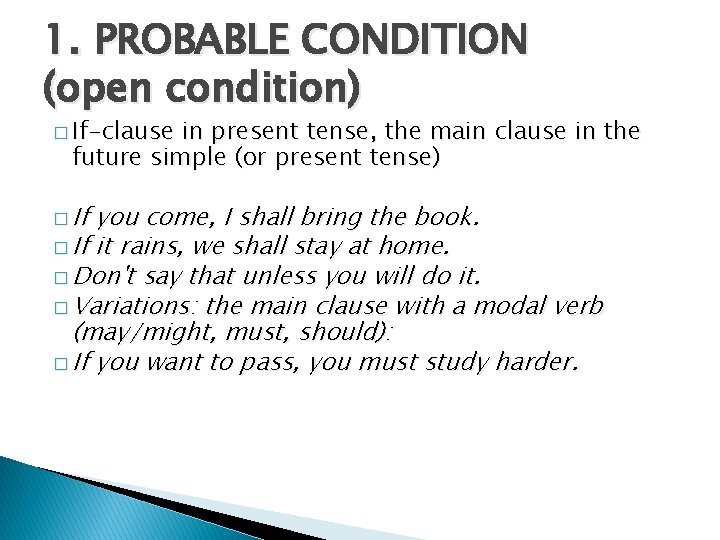
1. PROBABLE CONDITION (open condition) � If-clause in present tense, the main clause in the future simple (or present tense) � If you come, I shall bring the book. � If it rains, we shall stay at home. � Don't say that unless you will do it. � Variations: the main clause with a modal verb (may/might, must, should): � If you want to pass, you must study harder.
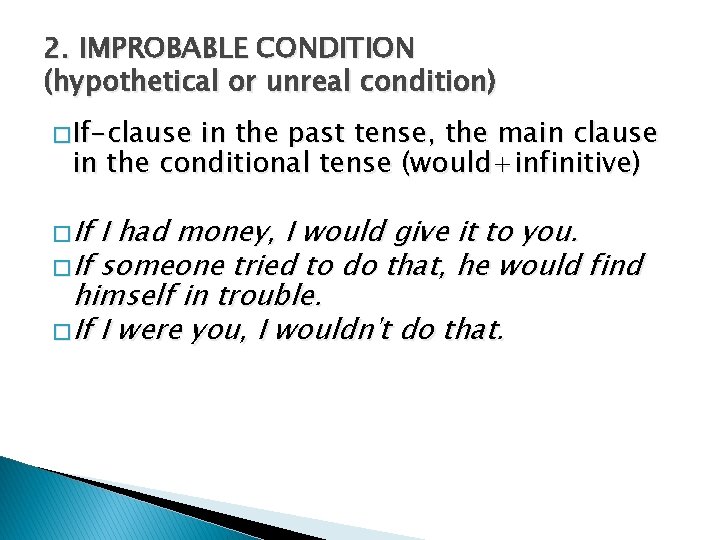
2. IMPROBABLE CONDITION (hypothetical or unreal condition) � If-clause in the past tense, the main clause in the conditional tense (would+infinitive) � If I had money, I would give it to you. � If someone tried to do that, he would find himself in trouble. � If I were you, I wouldn't do that.
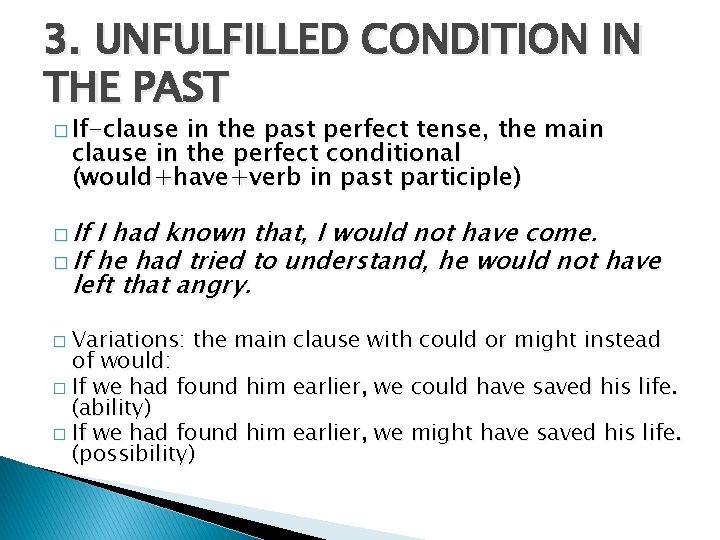
3. UNFULFILLED CONDITION IN THE PAST � If-clause in the past perfect tense, the main clause in the perfect conditional (would+have+verb in past participle) � If I had known that, I would not have come. � If he had tried to understand, he would not have left that angry. � Variations: the main clause with could or might instead of would: � If we had found him earlier, we could have saved his life. (ability) � If we had found him earlier, we might have saved his life. (possibility)

� Had can be placed first and the if ommitted: � Had I known that, I would not have come.
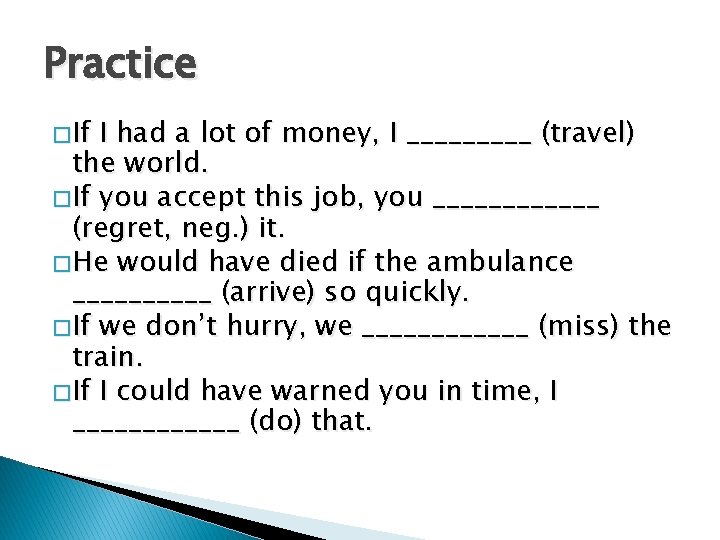
Practice � If I had a lot of money, I _____ (travel) the world. � If you accept this job, you ______ (regret, neg. ) it. � He would have died if the ambulance _____ (arrive) so quickly. � If we don’t hurry, we ______ (miss) the train. � If I could have warned you in time, I ______ (do) that.

� If I had a lot of money, I would travel round the world. � If you accept this job, you will not regret it. � He would have died if the ambulance hadn’t arrived so quickly. � If we don’t hurry, we will miss the train. � If I could have warned you in time, I would have done that.
Translate the following: � Ako sada odeš, nećeš me više nikad vidjeti. � Da sam to znala, ne bih kupila stan. � Ne bih se kladila u to da sam na tvojem mjestu. � Ako me netko bude tražio, reci im da spavam.

� If you leave now, you will never see me again. � If I had known that, I wouldn’t have bought the apartment. � I wouldn’t bet on it if I were you. � Should anyone come looking for me, tell them I am sleeping.
Write the correct form of the verbs in brackets: � If, after all the documents have been served, the defendant ________ (appear, neg. ) at the action on the date named, judgment _________ (will enter) for the plaintiff who will submit his or her case by _________ (outline) shortly the essence of his or her claim to the judge. Judgment _________ (will give) to him or her, usually with costs. If, however, the plaintiff __________(appear, neg. ) at the court and ________ (give) no explanation for his or her absence, the action _______ (will strike out) for want of prosecution. The action _________ (may reinstate) for sufficient cause on the plaintiff's application.
� If, after all the documents have been served, the defendant DOES NOT APPEAR at the action on the date named, judgment WILL BE ENTERED for the plaintiff who will submit his or her case by OUTLINING shortly the essence of his or her claim to the judge. Judgment WILL BE GIVEN to him or her, usually with costs. If, however, the plaintiff DOES NOT APPEAR at the court and GIVES no explanation for his or her absence, the action WILL BE STRUCK OUT for want of prosecution. The action MAY BE REINSTATED for sufficient cause on the plaintiff's application.
Complete the following sentences with the correct form of the verbs in brackets: � � � If income, revenues, profits or other estimable benefits are derived without legal grounds, the tax authority ________ (determine) the tax liability in accordance with special legislation governing individual types of taxes. If a protective measure is imposed by means of a legally binding decision in criminal proceedings that orders the seizure of economic gains derived from illegal activity, the tax ordinance that establishes the tax liability ________ (rescind) at the request of the taxpayer. If a tax is not paid on time, interest _________ (charge). If the tax authority refunds to the taxpayer excess taxes that have been paid, the period for the calculation of the tax ______ (run) from he fifteenth day after the claim for a refund was received. If the tax cannot be collected via the normal procedure, it _________ (can, collect) forcibly from the assets of the defaulting taxpayer.
� � � If income, revenues, profits or other estimable benefits are derived without legal grounds, the tax authority shall determine the tax liability in accordance with special legislation governing individual types of taxes. If a protective measure is imposed by means of a legally binding decision in criminal proceedings that orders the seizure of economic gains derived from illegal activity, the tax ordinance that establishes the tax liability shall be rescinded at the request of the taxpayer. If a tax is not paid on time, interest will be charged. If the tax authority refunds to the taxpayer excess taxes that have been paid, the period for the calculation of the tax will run from he fifteenth day after the claim for a refund was received. If the tax cannot be collected via the normal procedure, it can be collected forcibly from the assets of the defaulting taxpayer.

Thank you for your attention!
- Slides: 35