
PRINCIPLES OF SUSTAINABLE FINANCE Chapter 3 Governance and
PRINCIPLES OF SUSTAINABLE FINANCE Chapter 3: Governance and behaviour Principles of Sustainable Finance © Schoenmaker and Schramade 2019 1 Oxford University Press
Overview of the book Part I: What is sustainability and why does it matter? Part III: Financing sustainability 7. Investing for long-term value creation 1. 8. Equity – investing with an ownership stake 9. Bonds – investing without voting power Sustainability and the transition challenge Part II: Sustainability’s challenges to corporates 10. Banks – new forms of lending 2. Externalities - internalisation 11. Insurance – managing long-term risk 3. Governance and behaviour 4. Coalitions for sustainable finance Part IV: Epilogue 5. Strategy and intangibles – changing business models 12. Transition management and integrated thinking 6. Integrated reporting - metrics and data Principles of Sustainable Finance © Schoenmaker and Schramade 2019 2 Oxford University Press
Learning objectives – chapter 3 � explain behavioural biases against change � understand the changing objective of corporates � explain the role of corporate governance steering companies behaviour � explain how markets reinforce short-termism � understand the design of incentives for long-term thinking Principles of Sustainable Finance © Schoenmaker and Schramade 2019 3 Oxford University Press
Behavioural biases Principles of Sustainable Finance © Schoenmaker and Schramade 2019 Oxford University Press 4
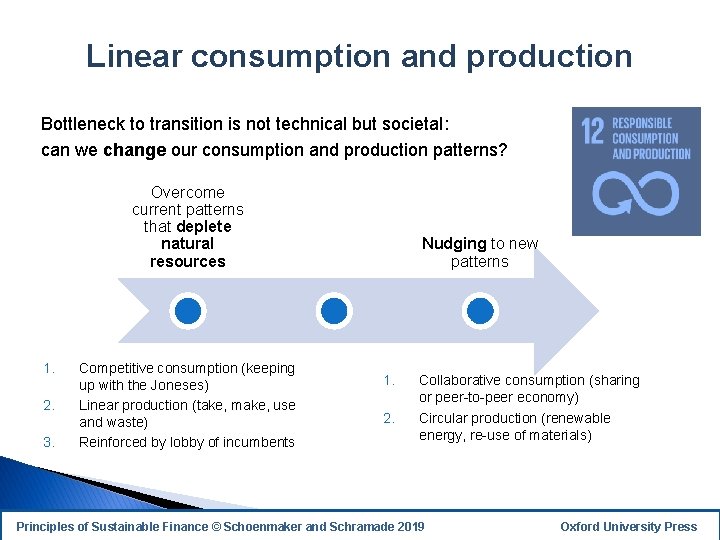
Linear consumption and production Bottleneck to transition is not technical but societal: can we change our consumption and production patterns? Overcome current patterns that deplete natural resources 1. 2. 3. Competitive consumption (keeping up with the Joneses) Linear production (take, make, use and waste) Reinforced by lobby of incumbents Nudging to new patterns 1. 2. Collaborative consumption (sharing or peer-to-peer economy) Circular production (renewable energy, re-use of materials) Principles of Sustainable Finance © Schoenmaker and Schramade 2019 5 Oxford University Press
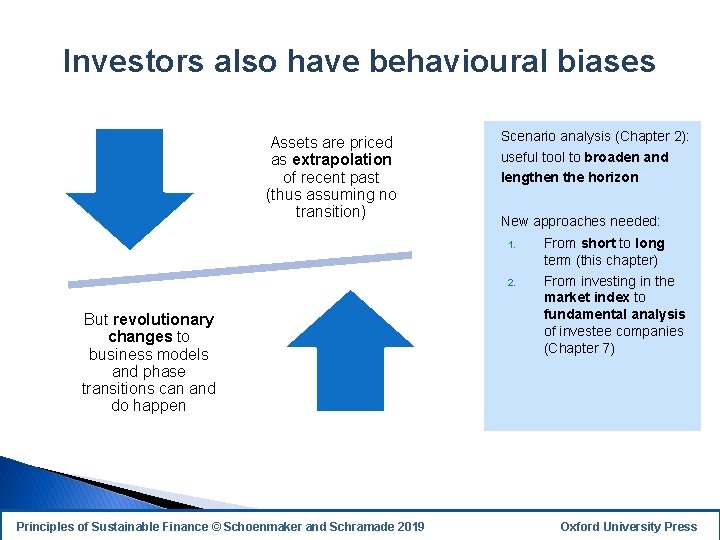
Investors also have behavioural biases Assets are priced as extrapolation of recent past (thus assuming no transition) Scenario analysis (Chapter 2): useful tool to broaden and lengthen the horizon New approaches needed: 1. 2. But revolutionary changes to business models and phase transitions can and do happen Principles of Sustainable Finance © Schoenmaker and Schramade 2019 From short to long term (this chapter) From investing in the market index to fundamental analysis of investee companies (Chapter 7) 6 Oxford University Press
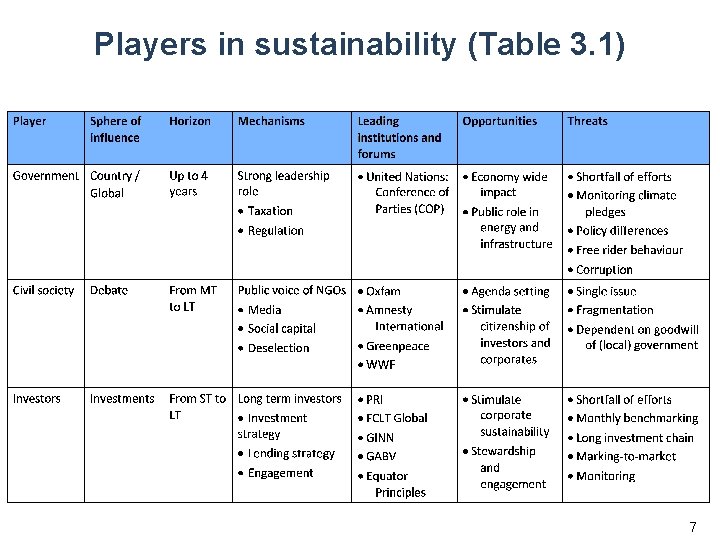
Players in sustainability (Table 3. 1) 7
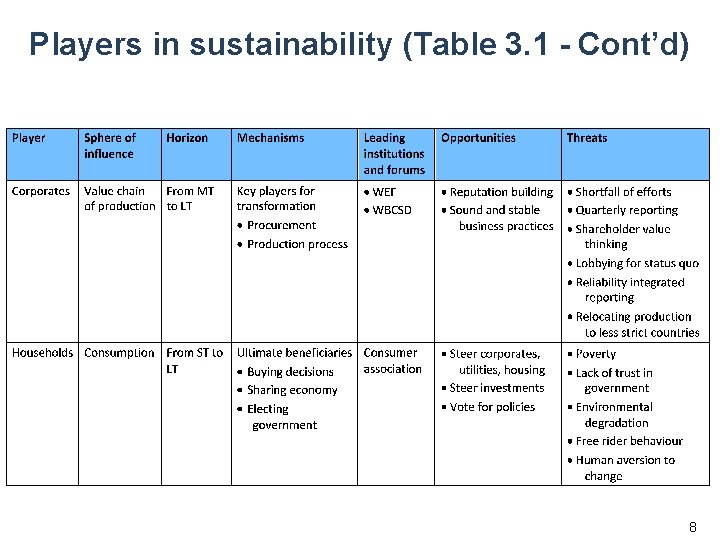
Players in sustainability (Table 3. 1 - Cont’d) 8
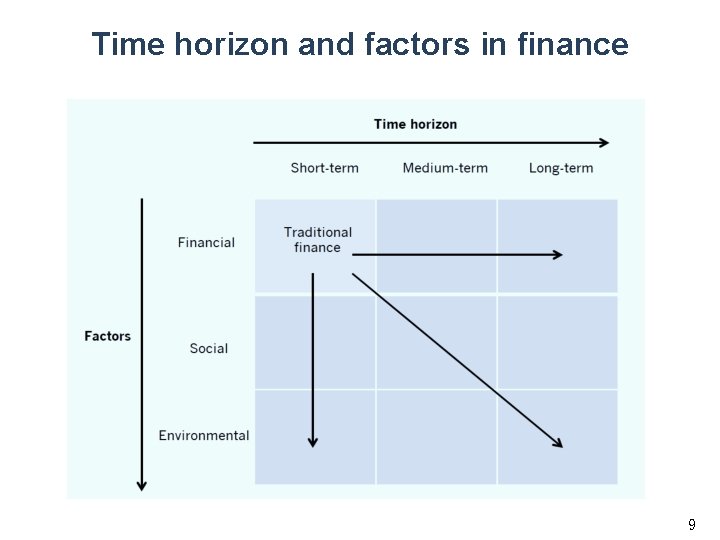
Time horizon and factors in finance 9
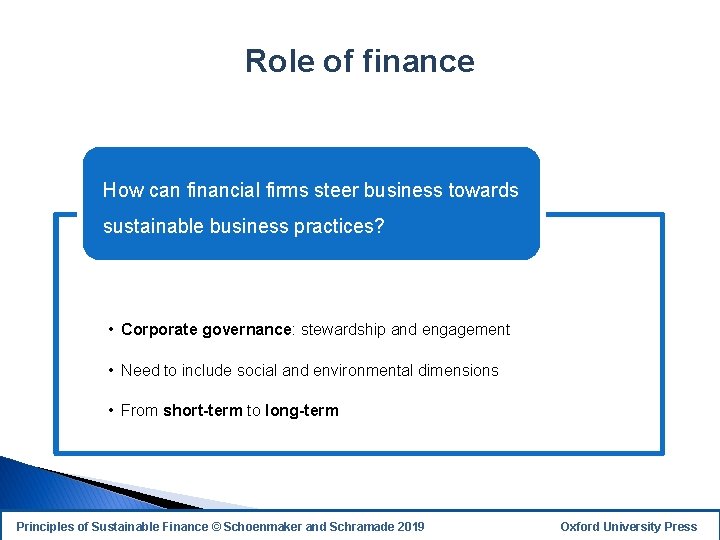
Role of finance How can financial firms steer business towards sustainable business practices? • Corporate governance: stewardship and engagement • Need to include social and environmental dimensions • From short-term to long-term Principles of Sustainable Finance © Schoenmaker and Schramade 2019 10 Oxford University Press
Objective of the corporation Principles of Sustainable Finance © Schoenmaker and Schramade 2019 Oxford University Press 11
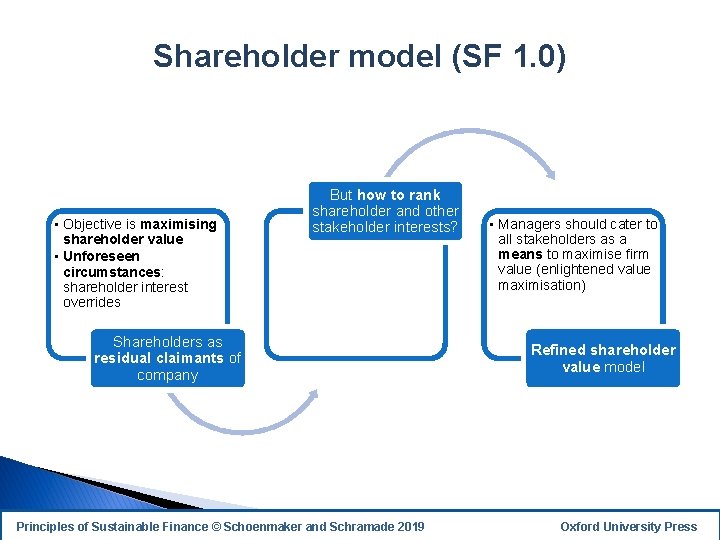
Shareholder model (SF 1. 0) • Objective is maximising shareholder value • Unforeseen circumstances: shareholder interest overrides But how to rank shareholder and other stakeholder interests? Shareholders as residual claimants of company Principles of Sustainable Finance © Schoenmaker and Schramade 2019 • Managers should cater to all stakeholders as a means to maximise firm value (enlightened value maximisation) Refined shareholder value model 12 Oxford University Press
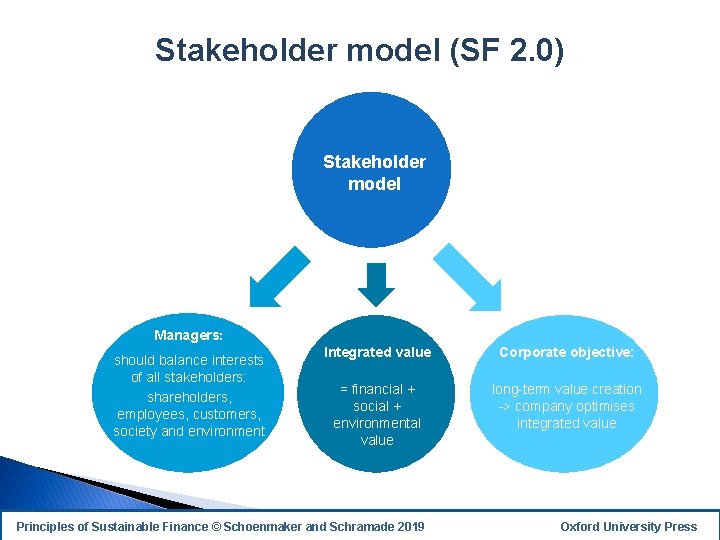
Stakeholder model (SF 2. 0) Stakeholder model Managers: should balance interests of all stakeholders: shareholders, employees, customers, society and environment Integrated value Corporate objective: = financial + social + environmental value long-term value creation -> company optimises integrated value Principles of Sustainable Finance © Schoenmaker and Schramade 2019 13 Oxford University Press
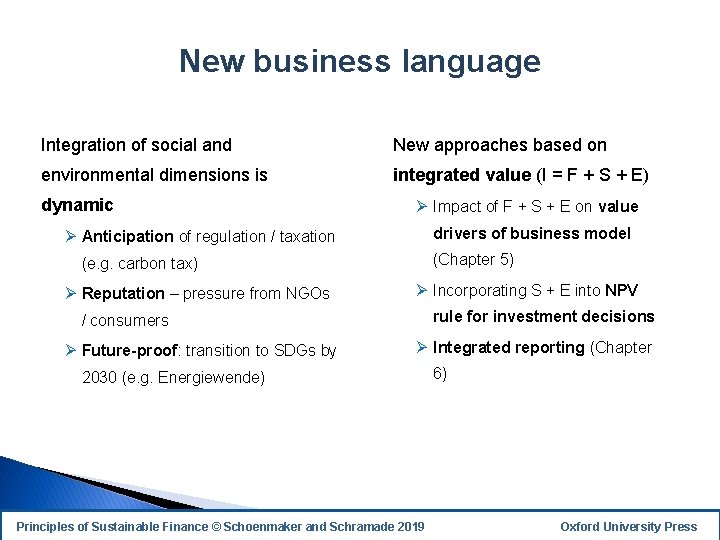
New business language Integration of social and New approaches based on environmental dimensions is integrated value (I = F + S + E) dynamic Ø Impact of F + S + E on value drivers of business model Ø Anticipation of regulation / taxation (Chapter 5) (e. g. carbon tax) Ø Reputation – pressure from NGOs Ø Incorporating S + E into NPV rule for investment decisions / consumers Ø Future-proof: transition to SDGs by Ø Integrated reporting (Chapter 2030 (e. g. Energiewende) Principles of Sustainable Finance © Schoenmaker and Schramade 2019 6) 14 Oxford University Press
Corporate governance Principles of Sustainable Finance © Schoenmaker and Schramade 2019 Oxford University Press 15
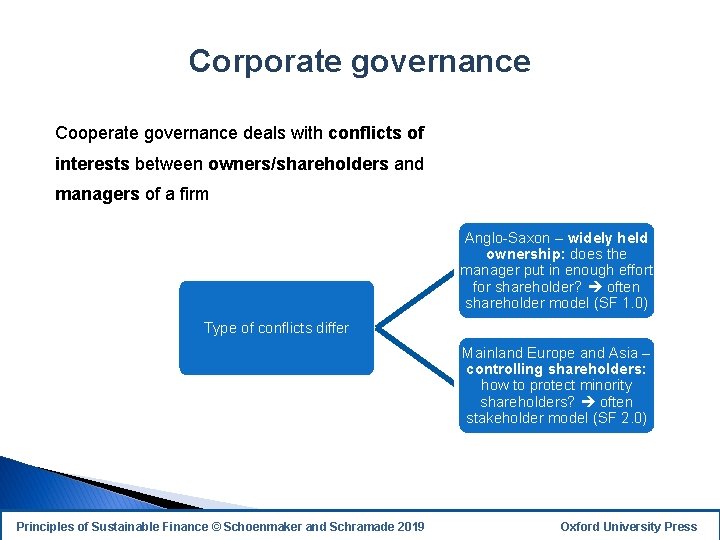
Corporate governance Cooperate governance deals with conflicts of interests between owners/shareholders and managers of a firm Anglo-Saxon – widely held ownership: does the manager put in enough effort for shareholder? often shareholder model (SF 1. 0) Type of conflicts differ Mainland Europe and Asia – controlling shareholders: how to protect minority shareholders? often stakeholder model (SF 2. 0) Principles of Sustainable Finance © Schoenmaker and Schramade 2019 16 Oxford University Press
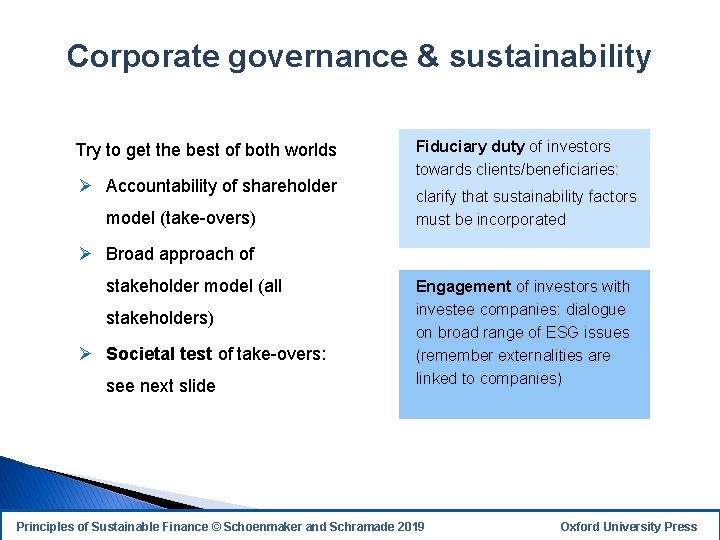
Corporate governance & sustainability Try to get the best of both worlds Ø Accountability of shareholder model (take-overs) Fiduciary duty of investors towards clients/beneficiaries: clarify that sustainability factors must be incorporated Ø Broad approach of stakeholder model (all stakeholders) Ø Societal test of take-overs: see next slide Engagement of investors with investee companies: dialogue on broad range of ESG issues (remember externalities are linked to companies) Principles of Sustainable Finance © Schoenmaker and Schramade 2019 17 Oxford University Press
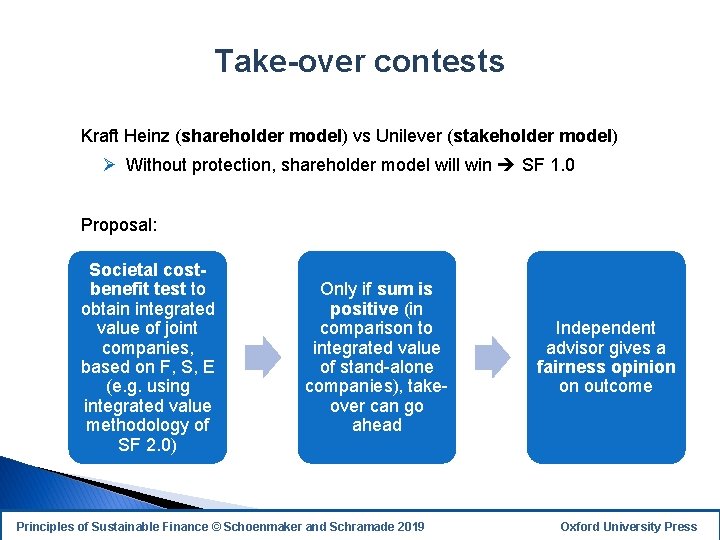
Take-over contests Kraft Heinz (shareholder model) vs Unilever (stakeholder model) Ø Without protection, shareholder model will win SF 1. 0 Proposal: Societal costbenefit test to obtain integrated value of joint companies, based on F, S, E (e. g. using integrated value methodology of SF 2. 0) Only if sum is positive (in comparison to integrated value of stand-alone companies), takeover can go ahead Principles of Sustainable Finance © Schoenmaker and Schramade 2019 Independent advisor gives a fairness opinion on outcome 18 Oxford University Press
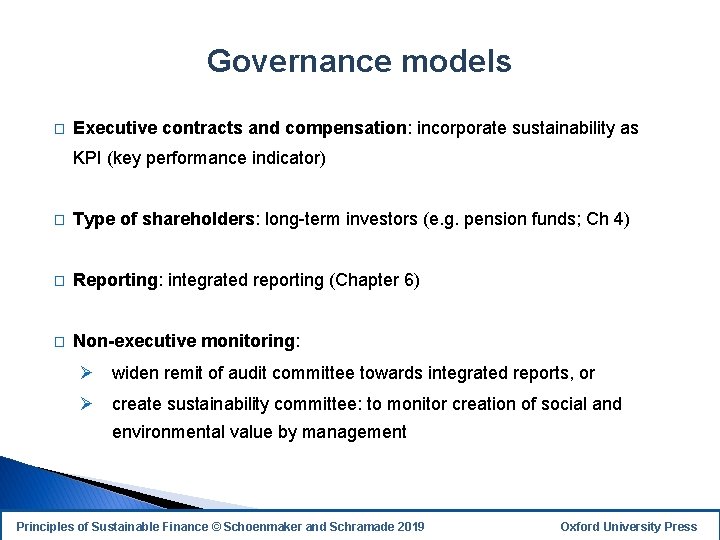
Governance models � Executive contracts and compensation: incorporate sustainability as KPI (key performance indicator) � Type of shareholders: long-term investors (e. g. pension funds; Ch 4) � Reporting: integrated reporting (Chapter 6) � Non-executive monitoring: Ø widen remit of audit committee towards integrated reports, or Ø create sustainability committee: to monitor creation of social and environmental value by management Principles of Sustainable Finance © Schoenmaker and Schramade 2019 19 Oxford University Press
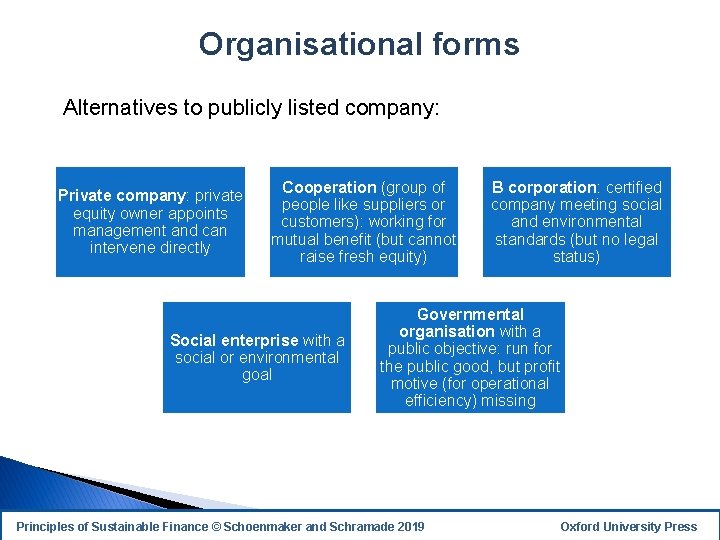
Organisational forms Alternatives to publicly listed company: Private company: private equity owner appoints management and can intervene directly Cooperation (group of people like suppliers or customers): working for mutual benefit (but cannot raise fresh equity) Social enterprise with a social or environmental goal B corporation: certified company meeting social and environmental standards (but no legal status) Governmental organisation with a public objective: run for the public good, but profit motive (for operational efficiency) missing Principles of Sustainable Finance © Schoenmaker and Schramade 2019 20 Oxford University Press
Horizon – from ST to LT thinking Principles of Sustainable Finance © Schoenmaker and Schramade 2019 Oxford University Press 21
Tragedy of the horizon (Carney, 2015) is major obstacle to sustainable finance: Ø Costs of action are now, while benefits remain in the future Ø Impact of social and environmental issues in long term … Ø. . . but managers and investors operate in a short-term framework Principles of Sustainable Finance © Schoenmaker and Schramade 2019 22 Oxford University Press
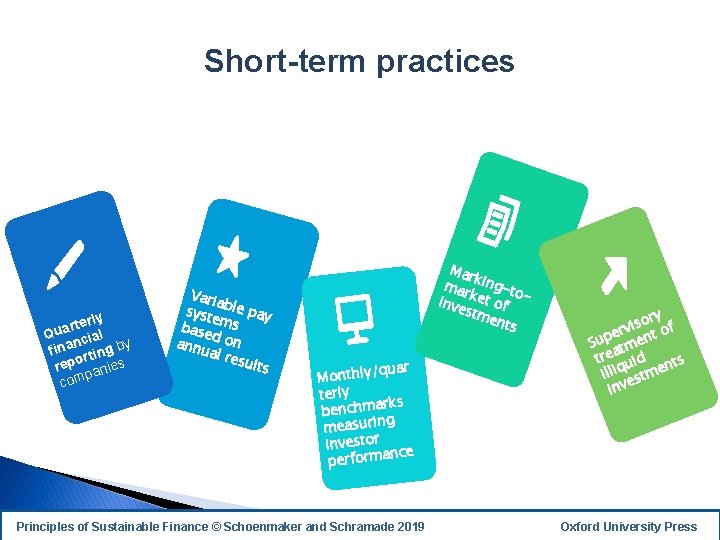
Short-term practices erly t r a Qu cial n y fina rting b repo anies p com Vari a syst ble pay e base ms d annu on al re sults Mar k mar ing-to k inve et of stm ent s quar Monthly/ terly rks benchma g measurin investor nce performa Principles of Sustainable Finance © Schoenmaker and Schramade 2019 ry iso of v r e t Sup tmen a tre uid nts illiq stme e inv 23 Oxford University Press
Market efficiency and carbon risk Efficient markets hypothesis (Fama, 1970) � Stock prices incorporate all relevant information � On average reflect LT fundamental value of firm � Stock price is indicator for asset selection and investor performance (Chapter 7) Principles of Sustainable Finance © Schoenmaker and Schramade 2019 24 Oxford University Press
Market efficiency and carbon risk Adaptive markets hypothesis (Lo, 2017) � Degree of market efficiency depends on evolutionary model of individuals adapting to a changing environment � Prices reflect as much info as number and nature distinct groups of market participants allow � If small number of groups or new risk market less efficient � Can explain why new risks (carbon) are not yet fully priced Principles of Sustainable Finance © Schoenmaker and Schramade 2019 25 Oxford University Press
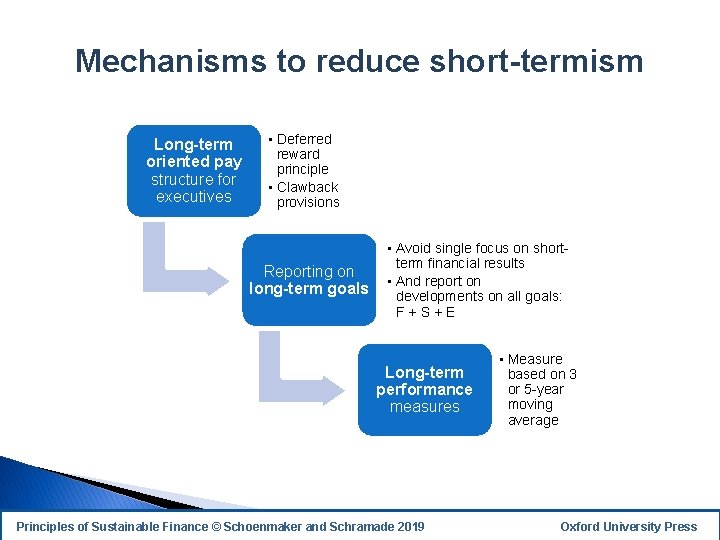
Mechanisms to reduce short-termism Long-term oriented pay structure for executives • Deferred reward principle • Clawback provisions Reporting on long-term goals • Avoid single focus on shortterm financial results • And report on developments on all goals: F+S+E Long-term performance measures Principles of Sustainable Finance © Schoenmaker and Schramade 2019 • Measure based on 3 or 5 -year moving average 26 Oxford University Press
Discussion: barriers What is the most important barrier to sustainable finance? 1. Value: shareholder value versus stakeholder value 2. Horizon: short term versus long term Principles of Sustainable Finance © Schoenmaker and Schramade 2019 27 Oxford University Press
Conclusions � Transition to sustainable economy Ø Requires overcoming behavioural bias business + consumers Ø Key challenge is to move from ST to LT thinking � Corporate governance defines focus of firm Ø From shareholder model financial value (F) Ø To stakeholder model integrated value (I=F+S+E) � Several incentives reviewed Ø New theory: from efficient markets to adaptive markets Ø Longer term reporting and LT executive pay Principles of Sustainable Finance © Schoenmaker and Schramade 2019 28 Oxford University Press
- Slides: 28