
PRINCIPLES OF SUSTAINABLE FINANCE Chapter 2 Externalities internalisation
PRINCIPLES OF SUSTAINABLE FINANCE Chapter 2: Externalities internalisation Principles of Sustainable Finance © Schoenmaker and Schramade 2019 1 Oxford University Press
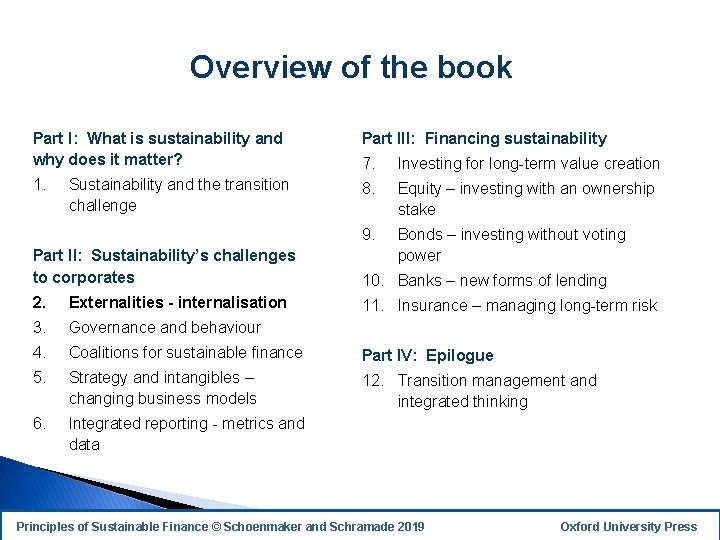
Overview of the book Part I: What is sustainability and why does it matter? Part III: Financing sustainability 7. Investing for long-term value creation 1. 8. Equity – investing with an ownership stake 9. Bonds – investing without voting power Sustainability and the transition challenge Part II: Sustainability’s challenges to corporates 10. Banks – new forms of lending 2. Externalities - internalisation 11. Insurance – managing long-term risk 3. Governance and behaviour 4. Coalitions for sustainable finance Part IV: Epilogue 5. Strategy and intangibles – changing business models 12. Transition management and integrated thinking 6. Integrated reporting - metrics and data Principles of Sustainable Finance © Schoenmaker and Schramade 2019 2 Oxford University Press

Learning objectives – chapter 2 � explain the concepts of externality and internalisation � understand the role of government regulation and taxation � understand the integrated value approach for measuring externalities � explain policy and technology uncertainty � use scenario analysis Principles of Sustainable Finance © Schoenmaker and Schramade 2019 3 Oxford University Press
Why externalities matter Principles of Sustainable Finance © Schoenmaker and Schramade 2019 Oxford University Press 4

Impact of people on nature I=P*A*T I = Impact on natural resources P = Population (number of persons) A = Affluence (consumption person) T = Technology (impact per unit consumption) Principles of Sustainable Finance © Schoenmaker and Schramade 2019 5 Oxford University Press

Natural resources are finite � Non-renewable or abiotic resources Na are finite � Speed of depletion T in years depends on annual demand Da Ø T = N a / Da � Example: T = 70 years for copper (Cu) Ø But depends on new discoveries (Na ) Ø And intensified use (Da ) and re-cycling (Da ) Principles of Sustainable Finance © Schoenmaker and Schramade 2019 6 Oxford University Press
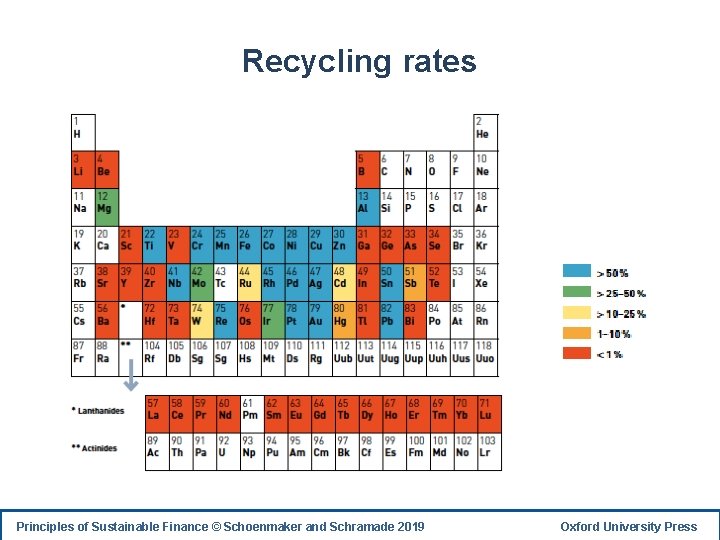
Recycling rates Principles of Sustainable Finance © Schoenmaker and Schramade 2019 7 Oxford University Press
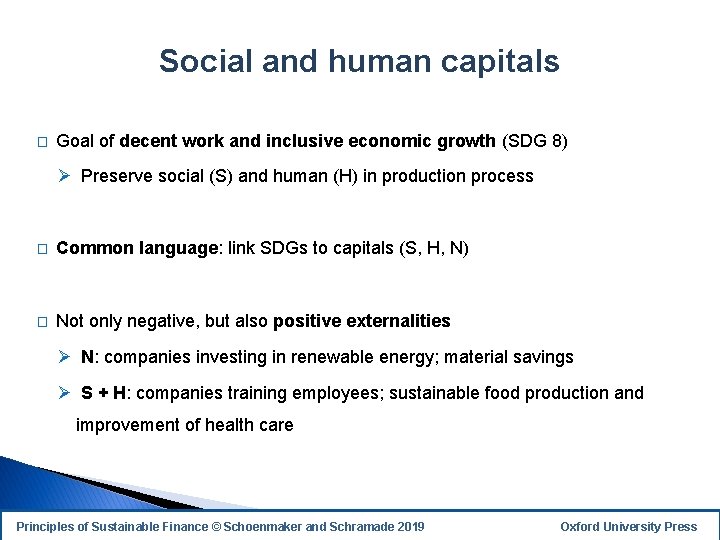
Social and human capitals � Goal of decent work and inclusive economic growth (SDG 8) Ø Preserve social (S) and human (H) in production process � Common language: link SDGs to capitals (S, H, N) � Not only negative, but also positive externalities Ø N: companies investing in renewable energy; material savings Ø S + H: companies training employees; sustainable food production and improvement of health care Principles of Sustainable Finance © Schoenmaker and Schramade 2019 8 Oxford University Press
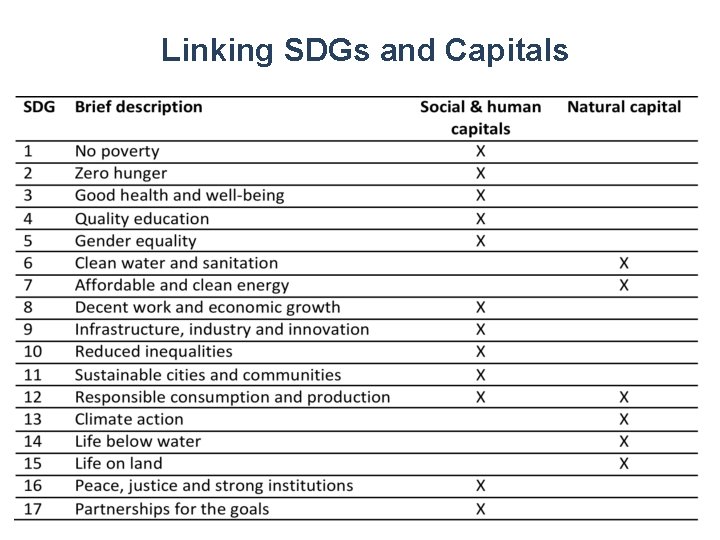
Linking SDGs and Capitals 9

Perspectives on externalities Human rights advocate: ensuring every person’s claim to life’s essentials Economist: a public good which is not priced Ecologist: need to operate within ecological limits F S E Sustainable development: I = F + S + E Principles of Sustainable Finance © Schoenmaker and Schramade 2019 Oxford University Press

Internalising externalities Government: regulation or taxation Problem: externalities not reflected in market prices Consumers: buy sustainable products and services Civil society: NGOs can raise awareness (advocacy) Internalisation Corporates: incorporate costs of externalities in production Principles of Sustainable Finance © Schoenmaker and Schramade 2019 Financials: incorporate ESG factors in investment + lending 11 Oxford University Press
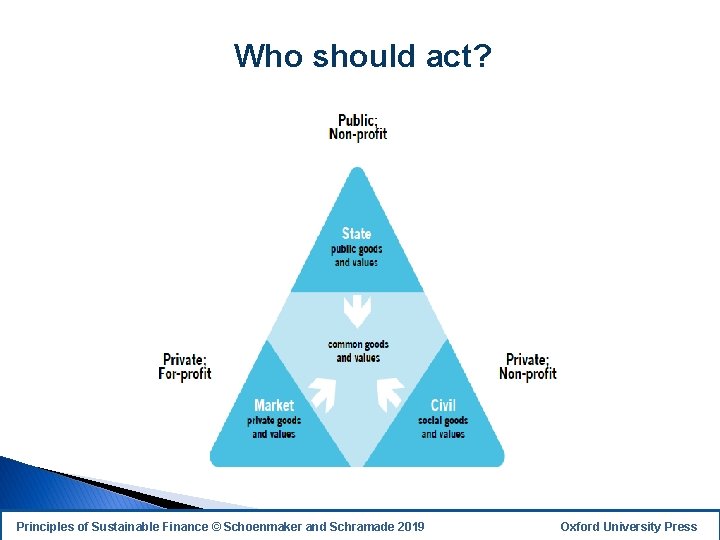
Who should act? Principles of Sustainable Finance © Schoenmaker and Schramade 2019 Oxford University Press
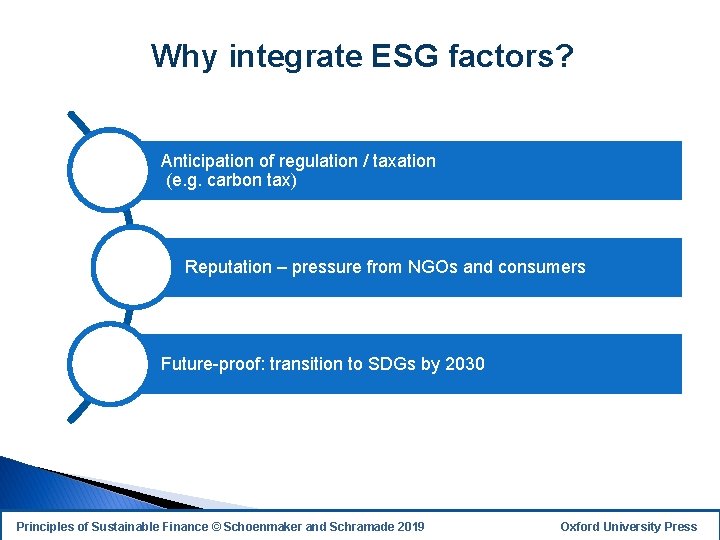
Why integrate ESG factors? Anticipation of regulation / taxation (e. g. carbon tax) Reputation – pressure from NGOs and consumers Future-proof: transition to SDGs by 2030 Principles of Sustainable Finance © Schoenmaker and Schramade 2019 Oxford University Press
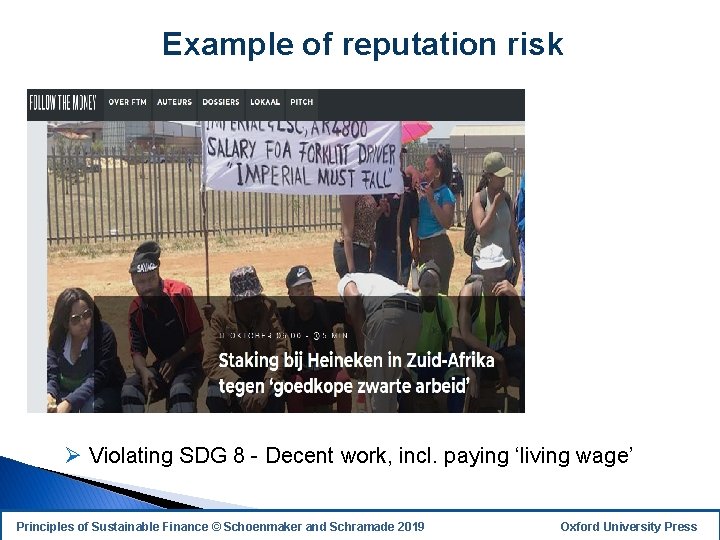
Example of reputation risk Ø Violating SDG 8 - Decent work, incl. paying ‘living wage’ Principles of Sustainable Finance © Schoenmaker and Schramade 2019 14 Oxford University Press

Internalisation of social and environmental impacts Impacts Business Internalisation rate Society Dependencies Principles of Sustainable Finance © Schoenmaker and Schramade 2019 Oxford University Press
Government intervention Principles of Sustainable Finance © Schoenmaker and Schramade 2019 Oxford University Press 16
Government intervention The climate economy guru - Nicolas Stern (2015): • “Why Are We Waiting? The Logic, Urgency, and Promise of Tackling Climate Change” Main recommendations • Energy infrastructure investments lock in energy use for 20 years stop investing in fossil fuel powered utilities and networks • First best: carbon tax of $40 -50 per t. CO 2 e by 2020 and $50 -100 by 2030 Principles of Sustainable Finance © Schoenmaker and Schramade 2019 17 Oxford University Press
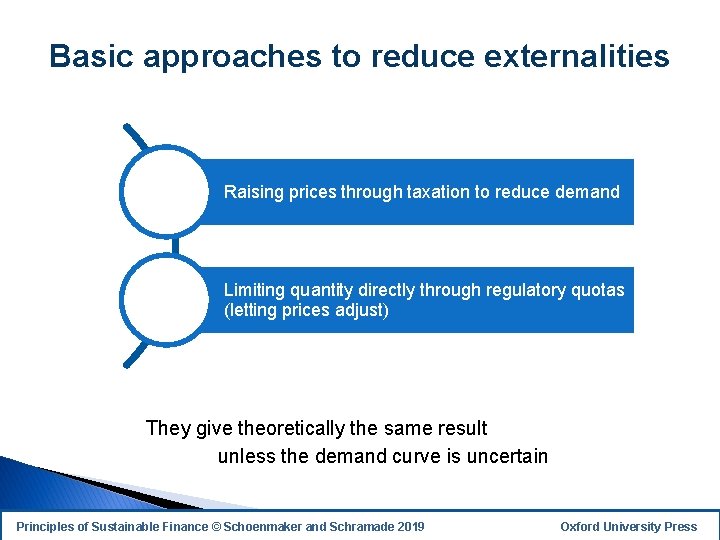
Basic approaches to reduce externalities Raising prices through taxation to reduce demand Limiting quantity directly through regulatory quotas (letting prices adjust) They give theoretically the same result unless the demand curve is uncertain Principles of Sustainable Finance © Schoenmaker and Schramade 2019 18 Oxford University Press

Example regulatory approach Principles of Sustainable Finance © Schoenmaker and Schramade 2019 19 Oxford University Press
Taxing externalities � Carbon tax is efficient way to get public good of low carbon economy Ø Marginal adjustment cost = tax � Alternative is Emissions Trading Systems (ETS) – cap emissions and trade allowances � Also taxes on natural resources to prevent depletion Principles of Sustainable Finance © Schoenmaker and Schramade 2019 20 Oxford University Press
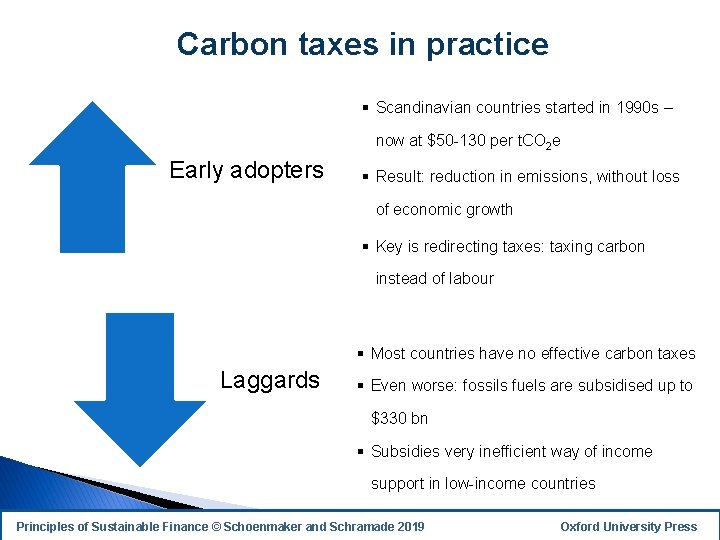
Carbon taxes in practice § Scandinavian countries started in 1990 s – now at $50 -130 per t. CO 2 e Early adopters § Result: reduction in emissions, without loss of economic growth § Key is redirecting taxes: taxing carbon instead of labour § Most countries have no effective carbon taxes Laggards § Even worse: fossils fuels are subsidised up to $330 bn § Subsidies very inefficient way of income support in low-income countries Principles of Sustainable Finance © Schoenmaker and Schramade 2019 21 Oxford University Press
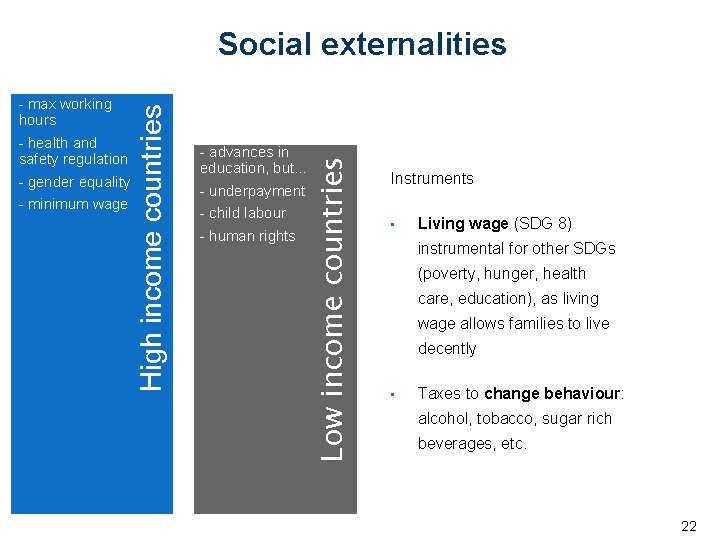
- advances in education, but… - underpayment - child labour - human rights Low income countries - max working hours - health and safety regulation - gender equality - minimum wage High income countries Social externalities Instruments • Living wage (SDG 8) instrumental for other SDGs (poverty, hunger, health care, education), as living wage allows families to live decently • Taxes to change behaviour: alcohol, tobacco, sugar rich beverages, etc. 22
Discussion: who acts first? Who should act first to internalise externalities? • Government should tax and regulate versus all parties should act Principles of Sustainable Finance © Schoenmaker and Schramade 2019 23 Oxford University Press
Measuring and pricing externalities Principles of Sustainable Finance © Schoenmaker and Schramade 2019 Oxford University Press 24

How to deal with externalities? What can business do with remaining externalities? • Measuring and monetisation is possible through technology (IT, data) and science (life cycle analyses, environmental economics) • Pricing is possible by optimising across F, S and E dimension 25

From financial value to integrated value 26
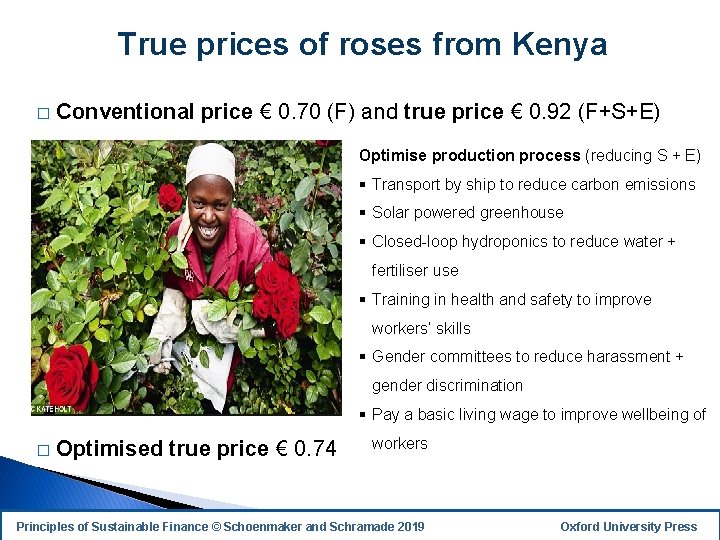
True prices of roses from Kenya � Conventional price € 0. 70 (F) and true price € 0. 92 (F+S+E) Optimise production process (reducing S + E) § Transport by ship to reduce carbon emissions § Solar powered greenhouse § Closed-loop hydroponics to reduce water + fertiliser use § Training in health and safety to improve workers’ skills § Gender committees to reduce harassment + gender discrimination § Pay a basic living wage to improve wellbeing of � Optimised true price € 0. 74 workers Principles of Sustainable Finance © Schoenmaker and Schramade 2019 27 Oxford University Press
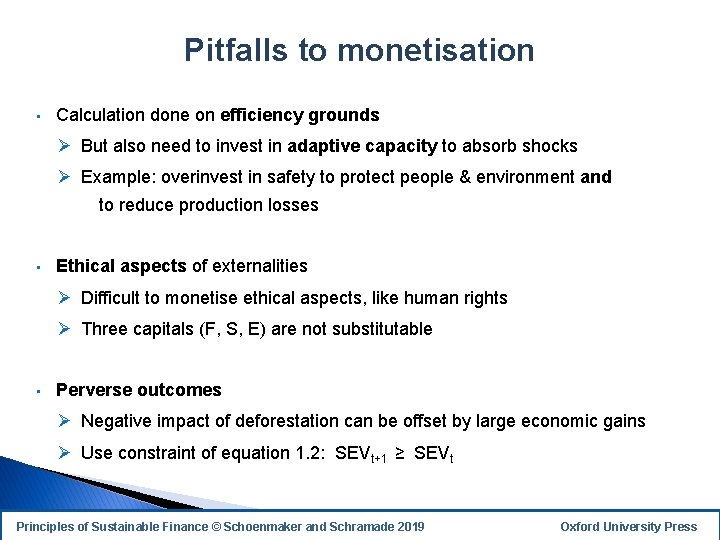
Pitfalls to monetisation • Calculation done on efficiency grounds Ø But also need to invest in adaptive capacity to absorb shocks Ø Example: overinvest in safety to protect people & environment and to reduce production losses • Ethical aspects of externalities Ø Difficult to monetise ethical aspects, like human rights Ø Three capitals (F, S, E) are not substitutable • Perverse outcomes Ø Negative impact of deforestation can be offset by large economic gains Ø Use constraint of equation 1. 2: SEVt+1 ≥ SEVt Principles of Sustainable Finance © Schoenmaker and Schramade 2019 28 Oxford University Press

Scenario analysis Principles of Sustainable Finance © Schoenmaker and Schramade 2019 Oxford University Press 29
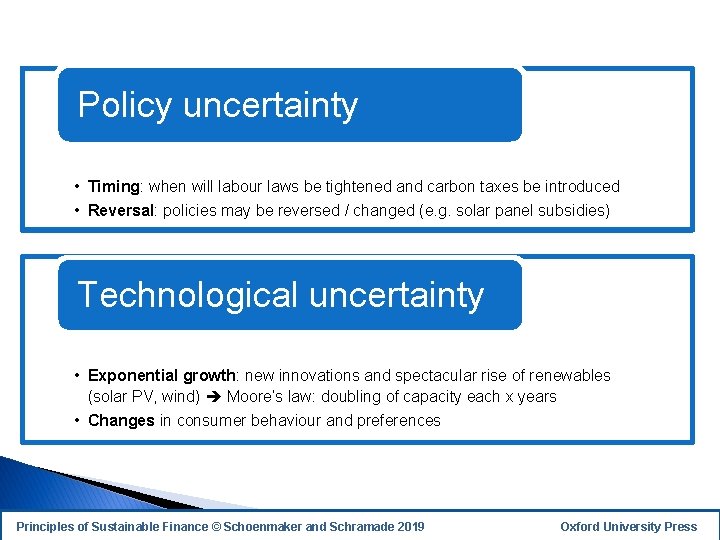
Policy uncertainty • Timing: when will labour laws be tightened and carbon taxes be introduced • Reversal: policies may be reversed / changed (e. g. solar panel subsidies) Technological uncertainty • Exponential growth: new innovations and spectacular rise of renewables (solar PV, wind) Moore’s law: doubling of capacity each x years • Changes in consumer behaviour and preferences Principles of Sustainable Finance © Schoenmaker and Schramade 2019 30 Oxford University Press
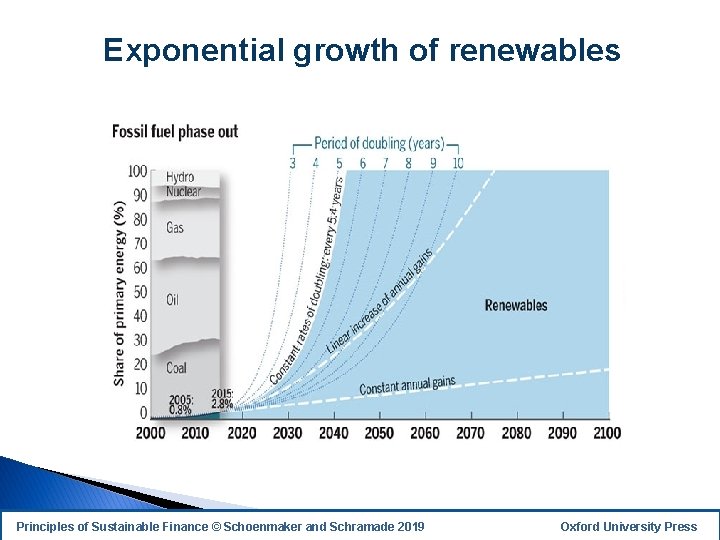
Exponential growth of renewables Principles of Sustainable Finance © Schoenmaker and Schramade 2019 31 Oxford University Press

Stranded assets • Government regulation (e. g. carbon pricing), or • Technological change (e. g. reduced cost of solar PV or wind) Which assets? • Carbon pricing affects all carbon-intensive assets • Intensive agriculture (fertiliser + irrigation) may lead to degraded land (lower soil quality), species loss and human migration • Broadly applicable: car parks in cities can become stranded asset (car share) Principles of Sustainable Finance © Schoenmaker and Schramade 2019 32 Oxford University Press

Environmentalexposures beyond Environmental beyondenergysector Emissions (100 m tonnes of CO 2 equivalent) 14 Electricity & gas supply 12 10 Manufacturing 8 Agriculture, forestry and fishing 6 4 Transportation Real estate Water supply & waste management 2 Mining and quarrying 0 Construction Wholesale and retail trade Finance 0 200 400 600 800 1, 000 1, 200 1, 400 1, 600 Value added of each sector (billions of 2015 euros) Source: Calculations based on Eurostat data. Notes: Real estate emissions include household heating and cooling costs 1, 800 2, 000
Scenario analysis � Scenario analysis to get insight in development of externalities over time � Strategic approach to making scenarios � 1. Determine most important uncertainties for the future 2. Elaborate the scenarios with trends, uncertainties and possible actions 3. Re-present scenarios as appealing stories about (paths to) the future Analyst reports are the fortune tellers of investor community • From DCF analysis of main scenario (often ‘business as usual’) • Towards DCF analysis of 3 or 4 scenarios including disruptions and internalising externalities Principles of Sustainable Finance © Schoenmaker and Schramade 2019 34 Oxford University Press
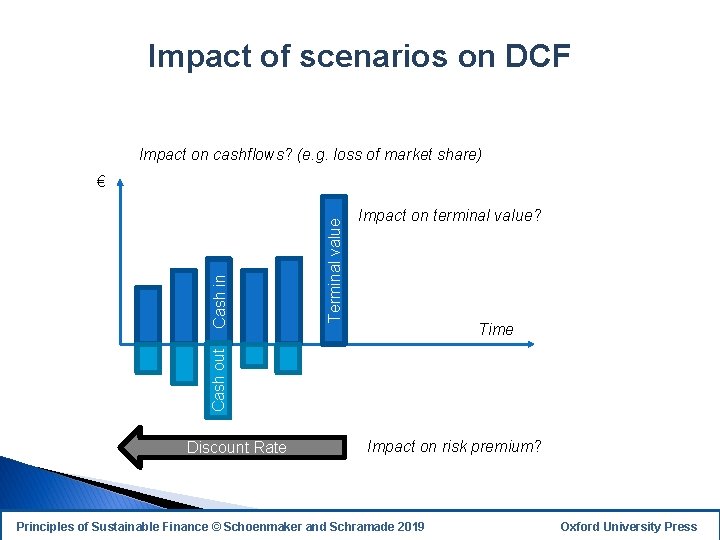
Impact of scenarios on DCF Impact on cashflows? (e. g. loss of market share) Terminal value Impact on terminal value? Time Cash out Cash in € Discount Rate Impact on risk premium? Principles of Sustainable Finance © Schoenmaker and Schramade 2019 35 Oxford University Press

Adverse scenario: disorderly transition • Shift to low-carbon economy requires strong reductions in carbon emissions • An early and gradual shift can facilitate a soft landing in a low carbon economy • The adverse scenario is a hard landing with large emissions cuts implemented over a short horizon • Amplified by lack of technical progress • A later transition may also pose larger physical risks from climate change Principles of Sustainable Finance © Schoenmaker and Schramade 2019 36 Oxford University Press
Stress testing � Central banks and supervisors conduct (climate) stress tests of financial sector using extreme scenarios � � Goal is to 1. Raise awareness of major environmental exposures at financials 2. Monitor major concentrations at financials in supervision Possible instruments • Large exposure rules for high carbon concentrations • Brown capital charge for high carbon assets Principles of Sustainable Finance © Schoenmaker and Schramade 2019 37 Oxford University Press
Conclusions � Social and environmental externalities are relevant, but absent in traditional production function and neo-classical finance � Instruments to internalise externalities Ø Government: taxes and regulation first best, but not always done Ø Business: incorporating S + E in decision making (integrated value) � Scenario analysis is tool to deal with uncertainties Ø Calculate value company under different scenarios Ø Prompt companies to reconsider strategy and take action Principles of Sustainable Finance © Schoenmaker and Schramade 2019 38 Oxford University Press
- Slides: 38