
PRINCIPLES OF SURGERY Introduction Incision Surgical Flaps Tissue

- Slides: 25
PRINCIPLES OF SURGERY Introduction Incision Surgical Flaps Tissue handling and hemostasis Dead space and edema control Decontamination and debridement
INTRODUCTION Smooth surgical procedures depends on following basic principles of surgery Principles of surgery - help to optimize the wound healing environment. and Minimize complications
BASIC NECESSITIES FOR SURGERY 1. Adequate visibility and 2. Assistance Adequate visibility depends on: (1) adequate access, (2) adequate light, and (3) a surgical field free of excess blood and other fluids.
ASEPTIC TECHNIQUE: It includes minimizing wound contamination by pathogenic microbes. PRINCIPLES OF INCISIONS 1. sharp blade 2. firm, continuous stroke should be used when incising. 3 avoid cutting vital structures 3. incision to be placed perpendicular to epithelial surface of incision 4. incisions to be placed on healthy and attached gingiva, and over healthy bone
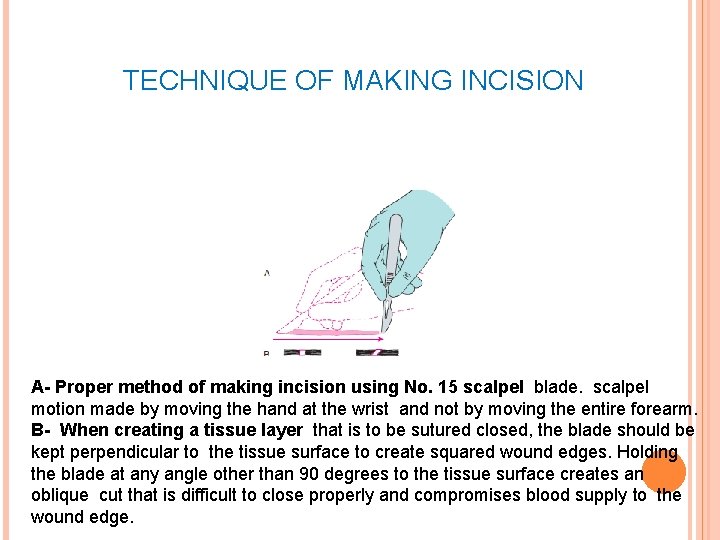
TECHNIQUE OF MAKING INCISION A- Proper method of making incision using No. 15 scalpel blade. scalpel motion made by moving the hand at the wrist and not by moving the entire forearm. B- When creating a tissue layer that is to be sutured closed, the blade should be kept perpendicular to the tissue surface to create squared wound edges. Holding the blade at any angle other than 90 degrees to the tissue surface creates an oblique cut that is difficult to close properly and compromises blood supply to the wound edge.
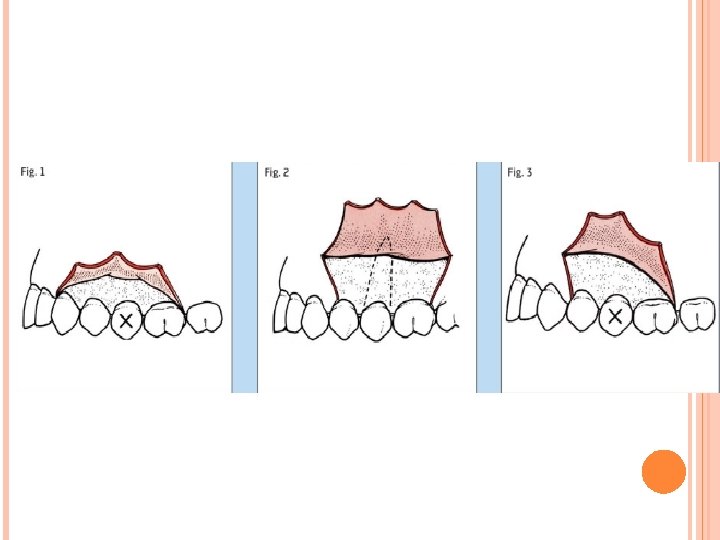
SURGICAL FLAPS Surgical Flaps are made to gain surgical access to an area or to move tissue from one place to another. Basic principles of flap design: Prevention of Necrosis, dehiscence, and tearing of flaps.
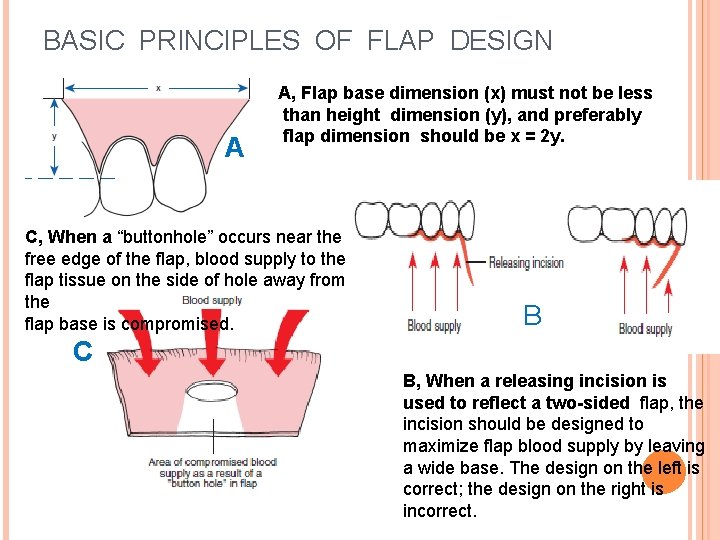
PREVENTION OF FLAP NECROSIS (1) The apex (tip) of a flap should never be wider than the base unless a major artery is present in the base and the sides should preferably, converge moving from the base to the apex of the flap. 2. Length of a flap should be no more than twice the width of the base. (3) Maintain axial blood supply at the base of the flap. (4) The base of flaps should not be excessively twisted, stretched, or grasped with anything that might damage vessels because these could compromise the blood supply , as well as lymphatics.
BASIC PRINCIPLES OF FLAP DESIGN A A, Flap base dimension (x) must not be less than height dimension (y), and preferably flap dimension should be x = 2 y. C, When a “buttonhole” occurs near the free edge of the flap, blood supply to the flap tissue on the side of hole away from the flap base is compromised. B C B, When a releasing incision is used to reflect a two-sided flap, the incision should be designed to maximize flap blood supply by leaving a wide base. The design on the left is correct; the design on the right is incorrect.
Flap margin dehiscence (separation) is prevented by : 1. approximating the edges of the flap over healthy bone 2. By gently handling the edges of the flap, 3. By not placing the flap under tension.
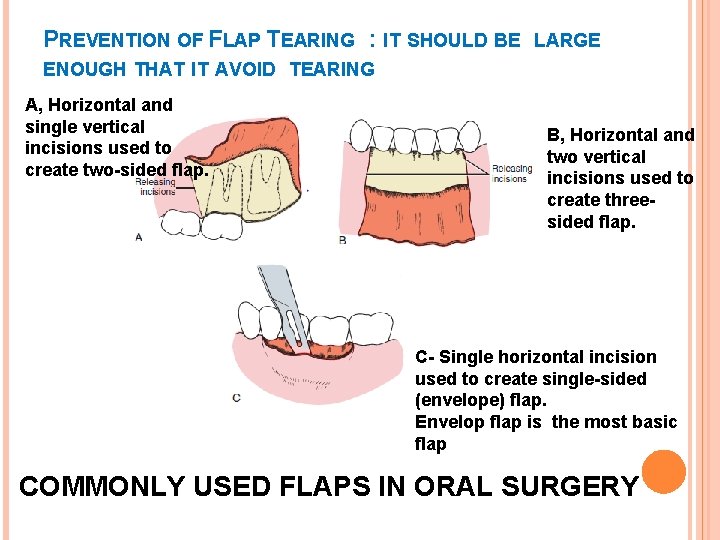
PREVENTION OF FLAP TEARING : IT SHOULD BE LARGE ENOUGH THAT IT AVOID TEARING A, Horizontal and single vertical incisions used to create two-sided flap. B, Horizontal and two vertical incisions used to create threesided flap. C- Single horizontal incision used to create single-sided (envelope) flap. Envelop flap is the most basic flap COMMONLY USED FLAPS IN ORAL SURGERY
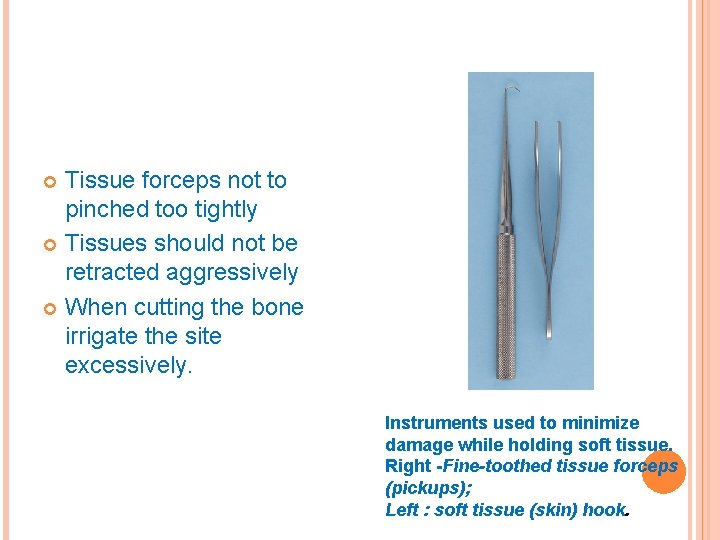
TISSUE HANDLING AND HAEMOSTASIS Excessive pulling or crushing, extremes of temperature, desiccation, or the use of unphysiologic chemicals easily damages tissue. Therefore, tissues should be handled carefully. When tissue forceps are used, they should not be pinched together too tightly but delicately to hold tissue. When possible, toothed forceps or tissue hooks should be used to hold tissue.
Tissue forceps not to pinched too tightly Tissues should not be retracted aggressively When cutting the bone irrigate the site excessively. Instruments used to minimize damage while holding soft tissue. Right -Fine-toothed tissue forceps (pickups); Left : soft tissue (skin) hook.
Soft tissue should also be protected from frictional heat or direct trauma from drilling equipment. Tissue should not be allowed to desiccate; open wounds should be frequently moistened or covered with a damp sponge if the surgeon is not working on them for a while. Only physiologic substances should come in contact with living tissue.
EFFECTS OF UNCONTROLLED BLEEDING Decreased visibility Formation of hematomas. Hematomas cause pressure on wounds, decreasing vascularity; they increase tension on the wound edges; and they provide a nidus for bacterial growth and cause wound infection.
MEANS OF PROMOTING WOUND HEMOSTASIS 1. pressure over bleeding areas. 2. use of heat to cause the ends of cut vessels to fuse (thermal coagulation). 3. Suture ligation. 4. by placing vasoconstrictive substances such as epinephrine in the wound or by applying procoagulants such as commercial thrombin or collagen on the wound. Epinephrine serves as a vasoconstrictor most effectively when placed in the site of desired vasoconstriction at least 7 minutes before surgery begins.
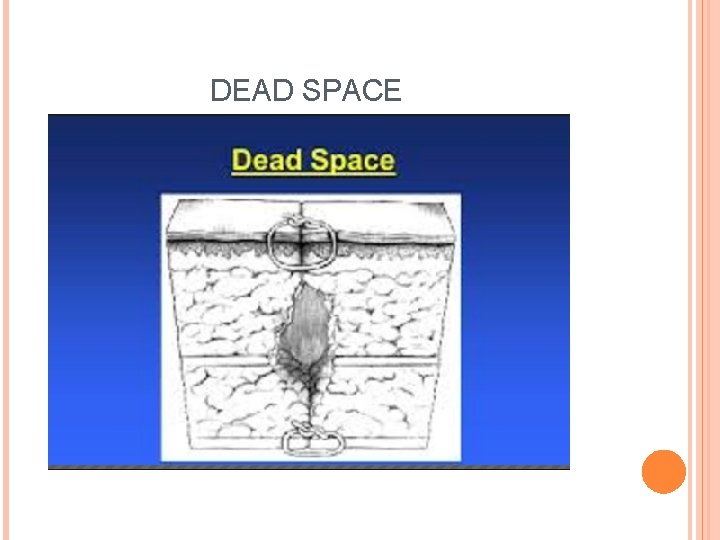
DEAD SPACE
DEAD SPACE MANAGEMENT Dead space: any area that remains devoid of tissue after closure of the wound. It is created by removing tissue in the depths of a wound or by not re approximating all tissue planes during closure. Dead space in a wound usually fills with blood, which creates a hematoma with a high potential for infection.
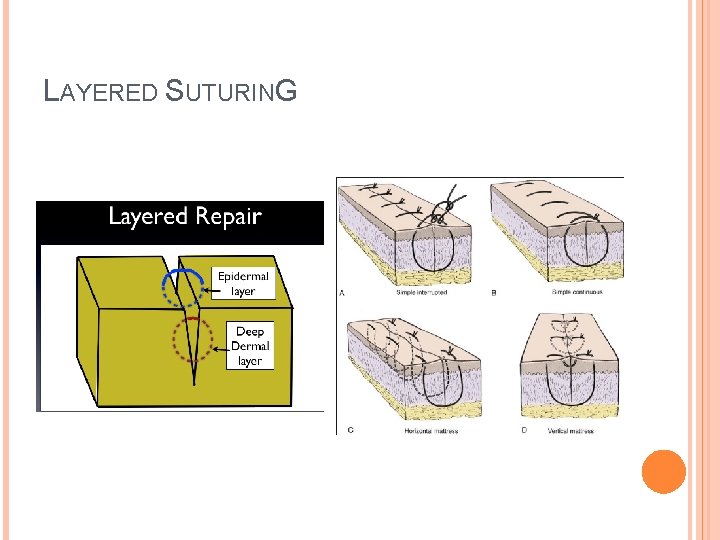
LAYERED SUTURING
Dead space can be eliminated in four ways: 1. By suturing tissue planes together to minimize the postoperative void. (2) To place a pressure dressing over the repaired wound. The dressing compresses tissue planes together until they are bound by fibrin or pressed together by surgical edema (or both). This usually takes about 12 to 18 hours. (3) place packing into the void until bleeding has stopped and then to remove the packing.
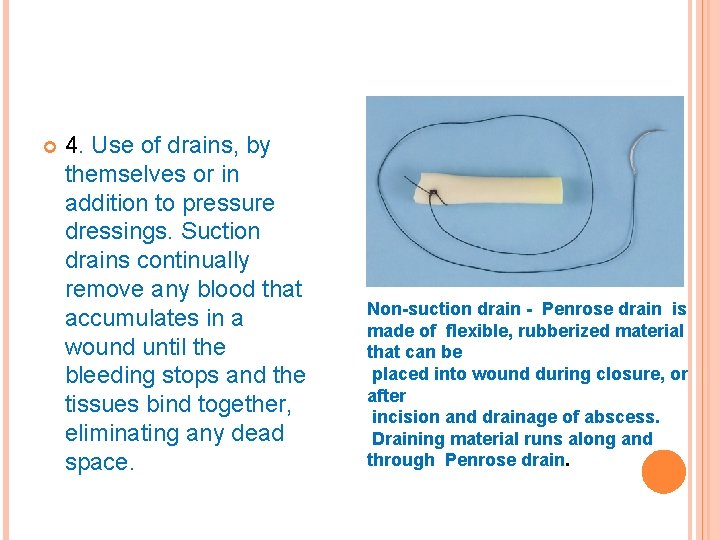
4. Use of drains, by themselves or in addition to pressure dressings. Suction drains continually remove any blood that accumulates in a wound until the bleeding stops and the tissues bind together, eliminating any dead space. Non-suction drain - Penrose drain is made of flexible, rubberized material that can be placed into wound during closure, or after incision and drainage of abscess. Draining material runs along and through Penrose drain.
DECONTAMINATION AND DÉBRIDEMENT Bacteria invariably contaminate all wound. Bacterial count can be reduced by 1. repeatedly irrigating the wound during surgery and closure. Irrigation, particularly when delivered under pressure, dislodges bacteria and other foreign materials and rinses them out of the wound. An irrigant may be a solutions containing antibiotics or sterile saline or sterile water. Wound débridement : is the careful removal of necrotic and severely ischemic tissue and foreign material from injured tissue that would impede wound healing.
OEDEMA CONTROL Edema occurs after surgery as a result of tissue injury. Edema is an accumulation of fluid in the interstitial space because of transudation from damaged vessels and lymphatic obstruction by fibrin. Causes of post surgical oedema : 1. Amount of tissue injury : More tissue injury, More edema 2. Type of Connective tissue : the looser the connective tissue in the injured region, the more is the edema. Example : attached gingiva has little loose connective tissue, so it exhibits little tendency toward edema. The lips and floor of the mouth contain large amounts of loose connective tissue and so they swell significantly.
Measures to control post surgical oedema: Cold therapy : ice applied to a freshly wounded area decreases vascularity and thereby diminishes transudation and edema. Patient positioning in the early postoperative period : Having the patient to keep the head elevated above the rest of the body as much as possible during the first few postoperative days. Short-term, high-dose systemic corticosteroids: Steroids have good ability to lessen inflammation and transudation (and thus edema), can be administered to the patient. However, corticosteroids are useful for edema control only if administration is done before tissue is damaged.
THANK YOU FOR MORE DETAILS CONSULT YOUR TEXT BOOK -