
Principles of Signalized Intersections CTC340 Components of a
- Slides: 28
Principles of Signalized Intersections CTC-340
Components of a Traffic Signal – Cycle • One complete rotation through all the indications provided. Every legal maneuver receives green time. Time from start of green on a signal head to start of green on the same signal head – Cycle Length • Time it takes to complete one cycle – Interval • Period of time when no signal indication changes
Components of a Traffic Signal – Interval • Change Interval – Yellow indication on a given movement. yi • Clearance Interval – All movements have a red signal (all red) – ari • Green Interval – Permitted movements have a green indicator – Gi • Red Interval – Movements not permitted have a red indicator – Ri – Phase • Green + Change and Clearance intervals for a set of movements
Types of Signal Operation • Pretimed – Cycle length is a constant. All Intervals are also constant. Usually have 3 Pretimed cylces on a controller – AM, PM, Off Peak – Semi-Actuated – Detector loops on side streets call green signal. Side street gets green after major street has had minimum green time. Light stays on side street as long as needed to a max time.
Types of Signal Operation • Full Actuated Operation – Two major streets intersect. Detectors on all approaches. Green is distributed based on calls. • Computer Controlled – system operations computer determines cycle length and phasing based on real time traffic info
Left Turns • Permitted – LT when through movement has green. Must Yield to oncoming traffic • Protected – LT has a green arrow. Opposing traffic is stopped • Compound LT – permitted and protected LT.
Discharge Headways • F 17. 1 – 1 st headway is time from green to vehicle front wheels cross stop line – 2 nd headway = from 1 st vehicle’s front wheels crossing stop line to second vehicles front wheels crossing stop line – Etc – Only headways through the last vehicle in queue at start of green are considered to be operating under saturated conditions
Saturation Flow & Flow Rate • Average headways will tend towards a constant value – Usually by 4 th or 5 th vehicle – Called saturation headway – h – Saturation flow rates assumes that signal is always green • s = 3600/h • Multiplied by # of lanes to determine the sat flow rate for a lane group
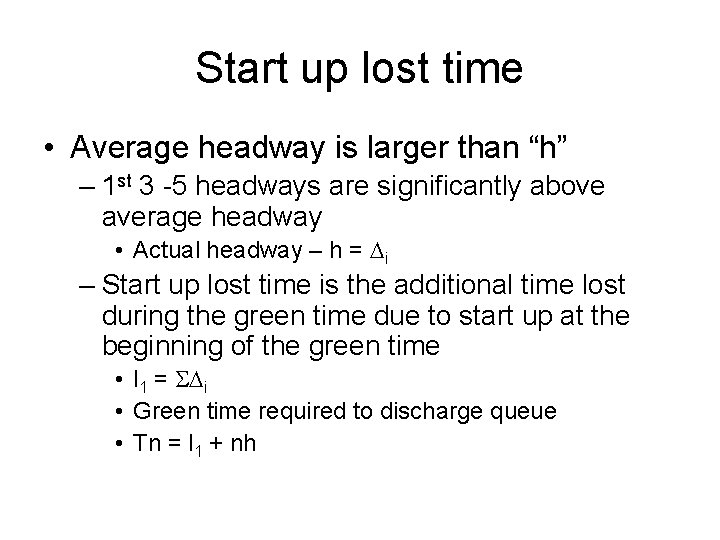
Start up lost time • Average headway is larger than “h” – 1 st 3 -5 headways are significantly above average headway • Actual headway – h = Di – Start up lost time is the additional time lost during the green time due to start up at the beginning of the green time • l 1 = SDi • Green time required to discharge queue • Tn = l 1 + nh
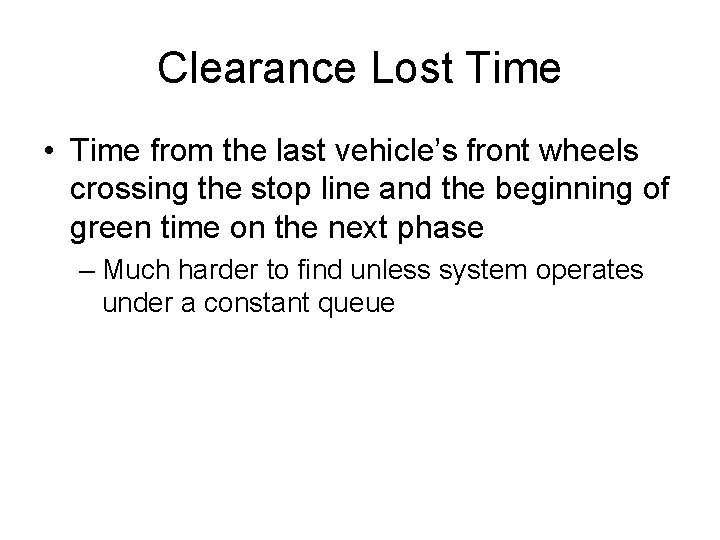
Clearance Lost Time • Time from the last vehicle’s front wheels crossing the stop line and the beginning of green time on the next phase – Much harder to find unless system operates under a constant queue
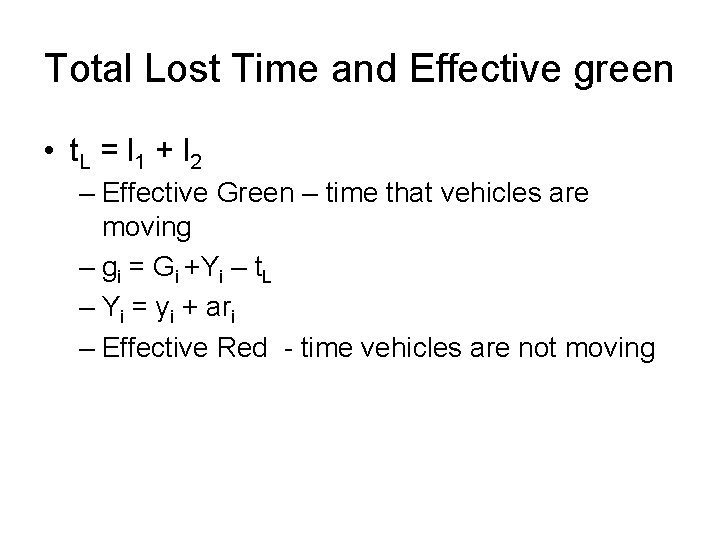
Total Lost Time and Effective green • t. L = l 1 + l 2 – Effective Green – time that vehicles are moving – gi = Gi +Yi – t. L – Yi = yi + ari – Effective Red - time vehicles are not moving
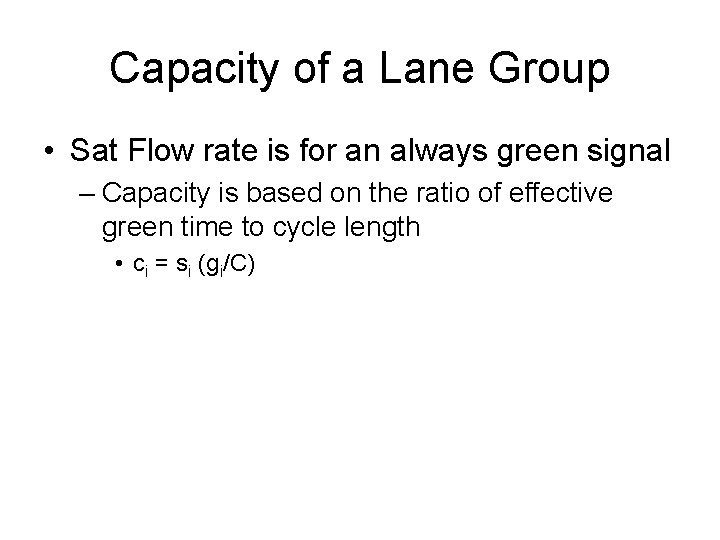
Capacity of a Lane Group • Sat Flow rate is for an always green signal – Capacity is based on the ratio of effective green time to cycle length • ci = si (gi/C)
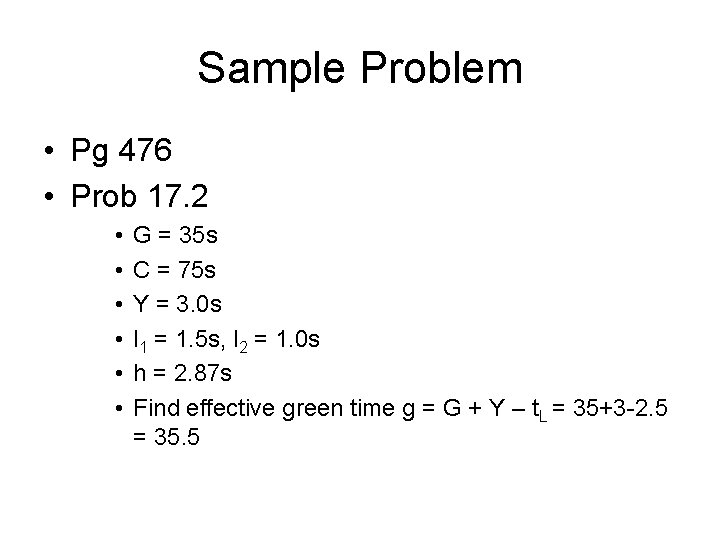
Sample Problem • Pg 476 • Prob 17. 2 • • • G = 35 s C = 75 s Y = 3. 0 s l 1 = 1. 5 s, l 2 = 1. 0 s h = 2. 87 s Find effective green time g = G + Y – t. L = 35+3 -2. 5 = 35. 5
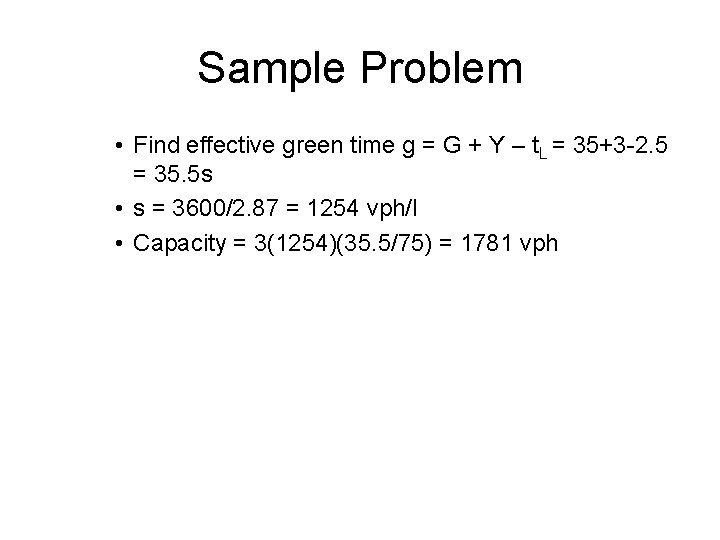
Sample Problem • Find effective green time g = G + Y – t. L = 35+3 -2. 5 = 35. 5 s • s = 3600/2. 87 = 1254 vph/l • Capacity = 3(1254)(35. 5/75) = 1781 vph
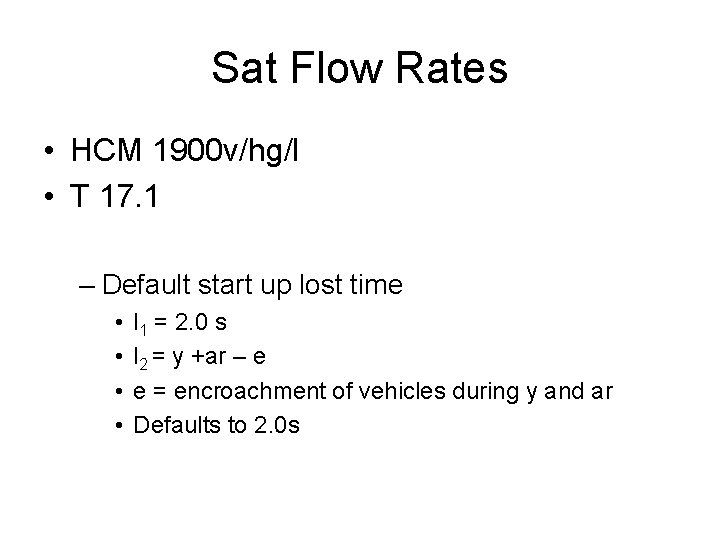
Sat Flow Rates • HCM 1900 v/hg/l • T 17. 1 – Default start up lost time • • l 1 = 2. 0 s l 2 = y +ar – e e = encroachment of vehicles during y and ar Defaults to 2. 0 s
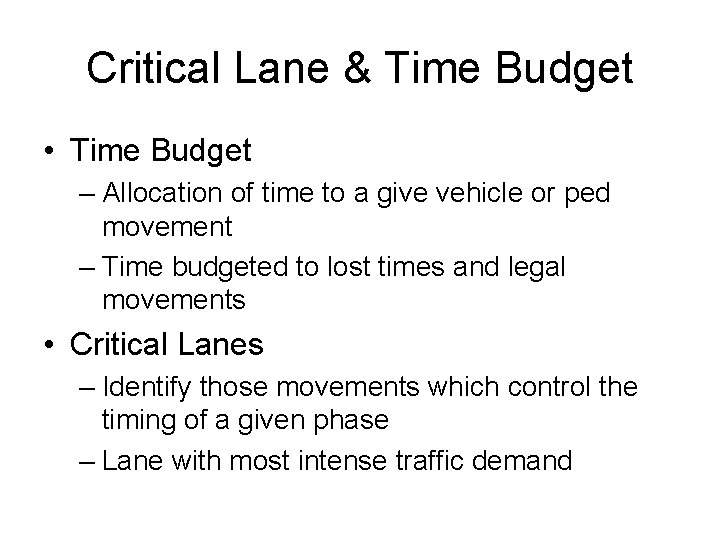
Critical Lane & Time Budget • Time Budget – Allocation of time to a give vehicle or ped movement – Time budgeted to lost times and legal movements • Critical Lanes – Identify those movements which control the timing of a given phase – Lane with most intense traffic demand
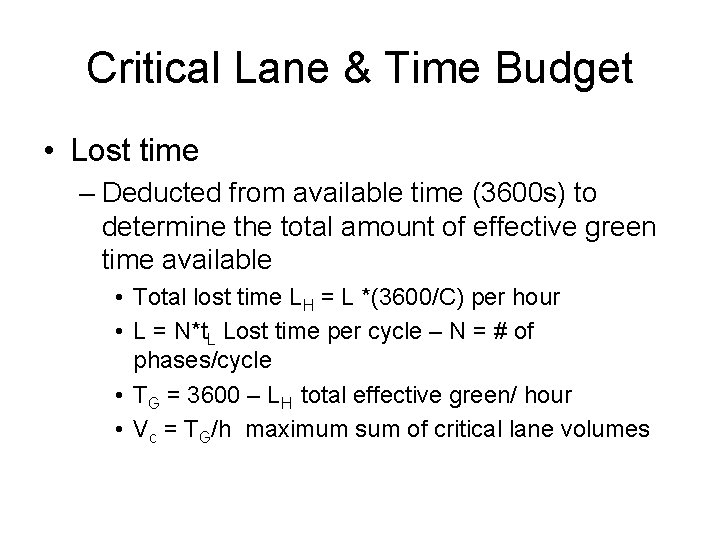
Critical Lane & Time Budget • Lost time – Deducted from available time (3600 s) to determine the total amount of effective green time available • Total lost time LH = L *(3600/C) per hour • L = N*t. L Lost time per cycle – N = # of phases/cycle • TG = 3600 – LH total effective green/ hour • Vc = TG/h maximum sum of critical lane volumes
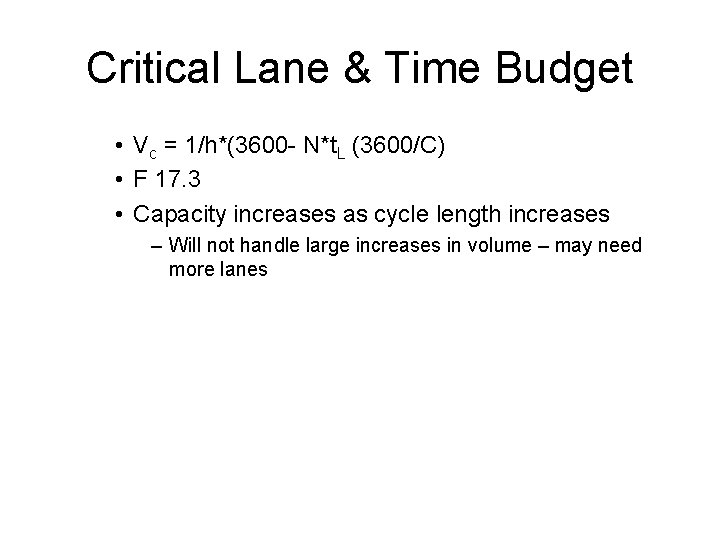
Critical Lane & Time Budget • Vc = 1/h*(3600 - N*t. L (3600/C) • F 17. 3 • Capacity increases as cycle length increases – Will not handle large increases in volume – may need more lanes
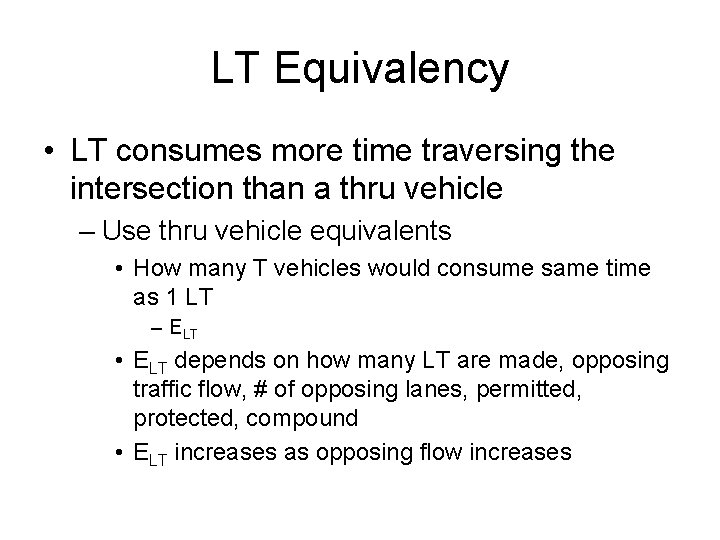
LT Equivalency • LT consumes more time traversing the intersection than a thru vehicle – Use thru vehicle equivalents • How many T vehicles would consume same time as 1 LT – ELT • ELT depends on how many LT are made, opposing traffic flow, # of opposing lanes, permitted, protected, compound • ELT increases as opposing flow increases
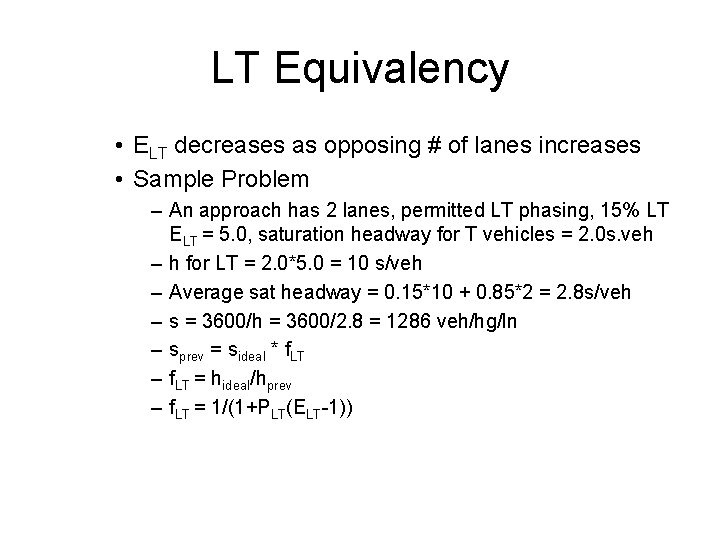
LT Equivalency • ELT decreases as opposing # of lanes increases • Sample Problem – An approach has 2 lanes, permitted LT phasing, 15% LT ELT = 5. 0, saturation headway for T vehicles = 2. 0 s. veh – h for LT = 2. 0*5. 0 = 10 s/veh – Average sat headway = 0. 15*10 + 0. 85*2 = 2. 8 s/veh – s = 3600/h = 3600/2. 8 = 1286 veh/hg/ln – sprev = sideal * f. LT – f. LT = hideal/hprev – f. LT = 1/(1+PLT(ELT-1))
Delay • Types of Delay – Stopped time delay – time a vehicle is stopped in a queue while waiting to pass thru an intersection – averaged for all vehicles – Approach Delay – includes stopped time delay plus time to decel and accel – averaged for all vehicles – Time in queue delay – total time a vehicle joining an intersection queue to tis discharge across the stop bar. – averaged for all vehicles
Delay • Types of Delay – Travel time delay – difference between driver’s expected travel time and actual travel time – rarely used, hard to quantify – Control Delay – delay due to traffic control device – time in queue delay + accel/decel delay – averaged for all vehicles – F 17. 9
Delay • F 17. 10 – Time axis divided into effective G and effective R – Vehicles arriving during effective green travel thru intersection – Vehicles arriving during effective R stop in queue – Vehicles depart from queue at Sat Flow Rate
Delay – Total time any vehicle waits in queue W(i) is given by horizontal time scale – time of arrival – time of departure – Total # of vehicles queued at any time Q(t) vertical scale difference between # that have arrived and # that have departed – Aggregate delay = time between curves • 2 simplifications – 1) uniform arrival rate • 2) queue builds at a point location (stacking) – actual queue grows backwards • F 17. 11
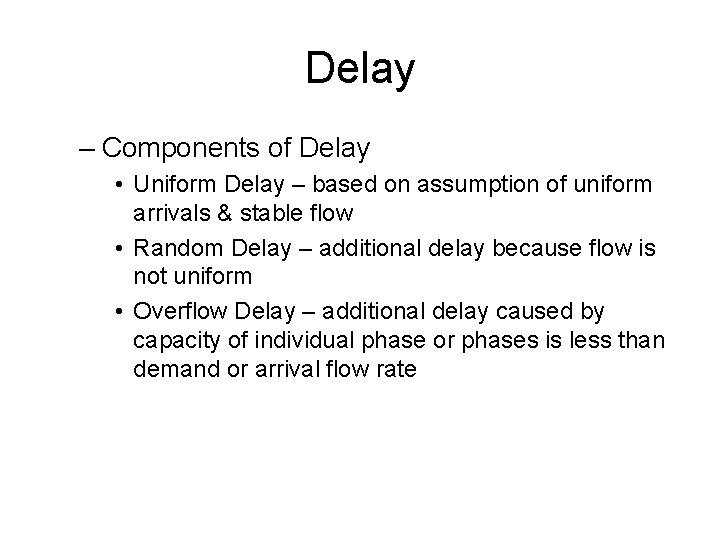
Delay – Components of Delay • Uniform Delay – based on assumption of uniform arrivals & stable flow • Random Delay – additional delay because flow is not uniform • Overflow Delay – additional delay caused by capacity of individual phase or phases is less than demand or arrival flow rate
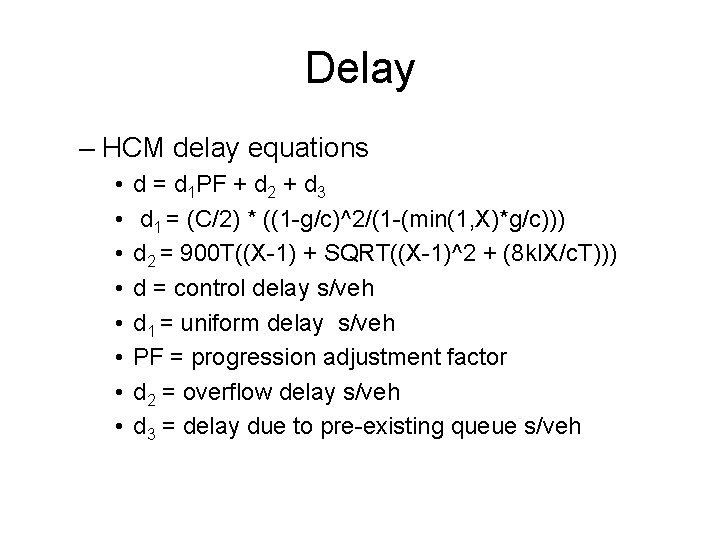
Delay – HCM delay equations • • d = d 1 PF + d 2 + d 3 d 1 = (C/2) * ((1 -g/c)^2/(1 -(min(1, X)*g/c))) d 2 = 900 T((X-1) + SQRT((X-1)^2 + (8 k. IX/c. T))) d = control delay s/veh d 1 = uniform delay s/veh PF = progression adjustment factor d 2 = overflow delay s/veh d 3 = delay due to pre-existing queue s/veh
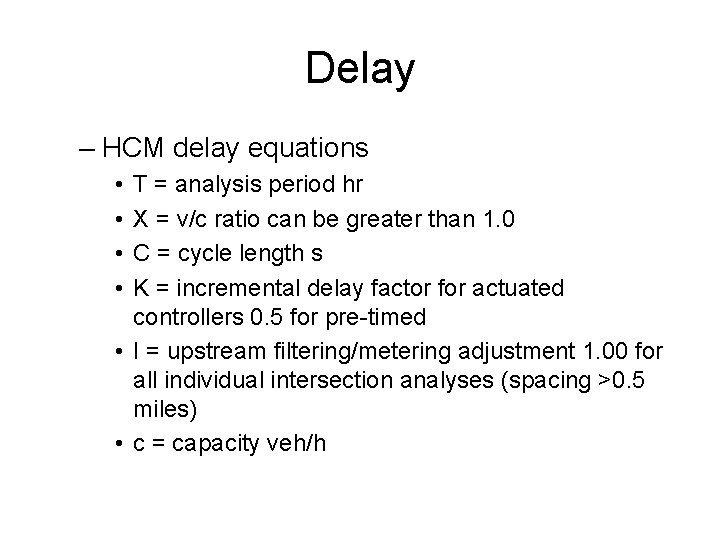
Delay – HCM delay equations • • T = analysis period hr X = v/c ratio can be greater than 1. 0 C = cycle length s K = incremental delay factor for actuated controllers 0. 5 for pre-timed • I = upstream filtering/metering adjustment 1. 00 for all individual intersection analyses (spacing >0. 5 miles) • c = capacity veh/h
Hmwk • Ch 17 # 4, 8, 10, 11