
Principles of Signal theory IVO MARTINS Synchronous and
- Slides: 7
Principles of Signal theory IVO MARTINS
Synchronous and Asynchronous Synchronous is typically a way to describe a series of objects or events that are coordinated in time. In signal theory synchronous transmission is a data transfer method which is a continuous stream of data signals which is accompanied by timing signals which is generated by an electronic clock. This is used to ensure that the transmitter and the receiver are in synchronisation. Asynchronous funnily enough is the opposite of Synchronous. The best way to describe the way Asynchronous transmission works is with a telephone conversation. This is because when you are on the phone, one person says something at a time and they aren’t in synchronisation. This is the same with how Asynchronous transmission works as the data is transmitted in varying timed intervals.
Baud Rate Baud rate is a unit which is the symbol rate for symbols or pulses per second. For example, if you had ‘ 3000 baud’ it would be referring to the fact that you can transfer a maximum of 3000 bits per second.
Bandwidth Noise (Interference) Bandwidth noise is a form of interference to the bandwidth similar to the way that electromagnetic interference (EMI) is also and interference. Bandwidth noise is a form of interference of a signal which is caused by other signals which will degrade the signal. This will then result in interference to the bandwidth. This interference can occur on both digital and analogue signals.
Bandwidth Limitation Bandwidth limitation is as simple as it sounds. It is the limitation that you bandwidth can handle. For example, a lot of internet providers have different bandwidth rate plans. The higher the bandwidth limit the faster the internet will be and also the more expensive it will be. There are some cases where bandwidth limit refers to the speed limit of a network or in other cases it refers to the data limit of that network. Another example is mobile phone data plans, they would be referring to data limit and also speed limit depending on your distance to the cellular towers which provide you with that data.
Data Compression Data compression is where you can store the same amount of data but in fewer bits. By using data compression it can save storage space, speed to transfer file. This can is very useful for companies which store data on servers as they can reduce file size and storage required to store them. That would also save them money for storage hardware and even bandwidth.
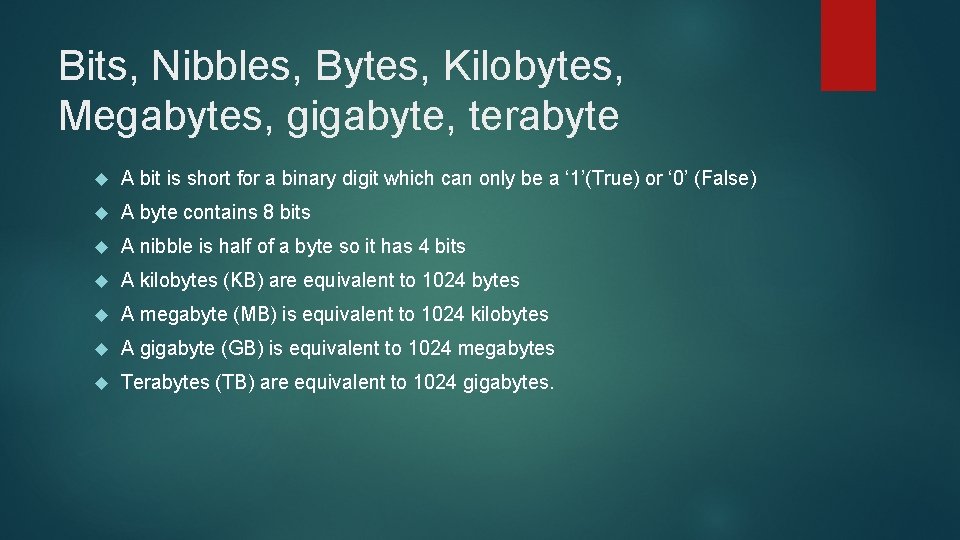
Bits, Nibbles, Bytes, Kilobytes, Megabytes, gigabyte, terabyte A bit is short for a binary digit which can only be a ‘ 1’(True) or ‘ 0’ (False) A byte contains 8 bits A nibble is half of a byte so it has 4 bits A kilobytes (KB) are equivalent to 1024 bytes A megabyte (MB) is equivalent to 1024 kilobytes A gigabyte (GB) is equivalent to 1024 megabytes Terabytes (TB) are equivalent to 1024 gigabytes.